
Stocks vs options: Which works better for your portfolio?
Trading
By Gerald Wong, CFA • 27 Feb 2026
Why trust Beansprout? We’ve been awarded Best Investment Website at the SIAS Investors’ Choice Awards 2025
'%3e%3cpath%20fill-rule='evenodd'%20clip-rule='evenodd'%20d='M17.64%209.20455C17.64%208.56637%2017.5827%207.95273%2017.4764%207.36364H9V10.845H13.8436C13.635%2011.97%2013.0009%2012.9232%2012.0477%2013.5614V15.8195H14.9564C16.6582%2014.2527%2017.64%2011.9455%2017.64%209.20455V9.20455Z'%20fill='%234285F4'/%3e%3cpath%20fill-rule='evenodd'%20clip-rule='evenodd'%20d='M9%2018C11.43%2018%2013.4673%2017.1941%2014.9564%2015.8195L12.0477%2013.5614C11.2418%2014.1014%2010.2109%2014.4205%209%2014.4205C6.65591%2014.4205%204.67182%2012.8373%203.96409%2010.71H0.957275V13.0418C2.43818%2015.9832%205.48182%2018%209%2018V18Z'%20fill='%2334A853'/%3e%3cpath%20fill-rule='evenodd'%20clip-rule='evenodd'%20d='M3.96409%2010.71C3.78409%2010.17%203.68182%209.59318%203.68182%209C3.68182%208.40682%203.78409%207.83%203.96409%207.29V4.95818H0.957273C0.347727%206.17318%200%207.54773%200%209C0%2010.4523%200.347727%2011.8268%200.957273%2013.0418L3.96409%2010.71V10.71Z'%20fill='%23FBBC05'/%3e%3cpath%20fill-rule='evenodd'%20clip-rule='evenodd'%20d='M9%203.57955C10.3214%203.57955%2011.5077%204.03364%2012.4405%204.92545L15.0218%202.34409C13.4632%200.891818%2011.4259%200%209%200C5.48182%200%202.43818%202.01682%200.957275%204.95818L3.96409%207.29C4.67182%205.16273%206.65591%203.57955%209%203.57955V3.57955Z'%20fill='%23EA4335'/%3e%3c/g%3e%3cdefs%3e%3cclipPath%20id='clip0_0_2849'%3e%3crect%20width='18'%20height='18'%20fill='white'/%3e%3c/clipPath%3e%3c/defs%3e%3c/svg%3e)
Make Beansprout your preferred source on Google
Add us on Google to see more of our insights in your search results
Explore the key differences between stocks and options, practical options strategies, and platforms for options trading.
What happened?
For many investors like myself, stocks are the most familiar way to participate in the market and ideally earn passive income.
They are straightforward: buy a share, own a piece of a company, and if it performed well, so did my investment portfolio.
But it only offers one way to express my market view.
In recent years, however, options have gained popularity as an additional tool for investors to express their view on whether the market will rise, fall, or even stay flat.
The trade-off is complexity, because option outcomes depend on time, volatility, liquidity, and strategy structure, not just price direction.
In this article, I’ll share how options can be used to complement an existing stock portfolio, highlighting what we should consider when trading options trading.
What’s the difference between stocks and options?
Stocks enable you to own a part of a company, receive dividends (if any), and potentially benefit from capital gains over time.
With options, on the other hand, you can express market views beyond simply buying or staying out of the market. You can go directional, hedge against downside risks, or structure strategies tailored to different conditions. This gives you more flexibility.
Options also allow you to define your risk and reward upfront. Unlike stocks, where losses can theoretically go all the way to zero, options made it possible to set clearer boundaries and limit potential downside.
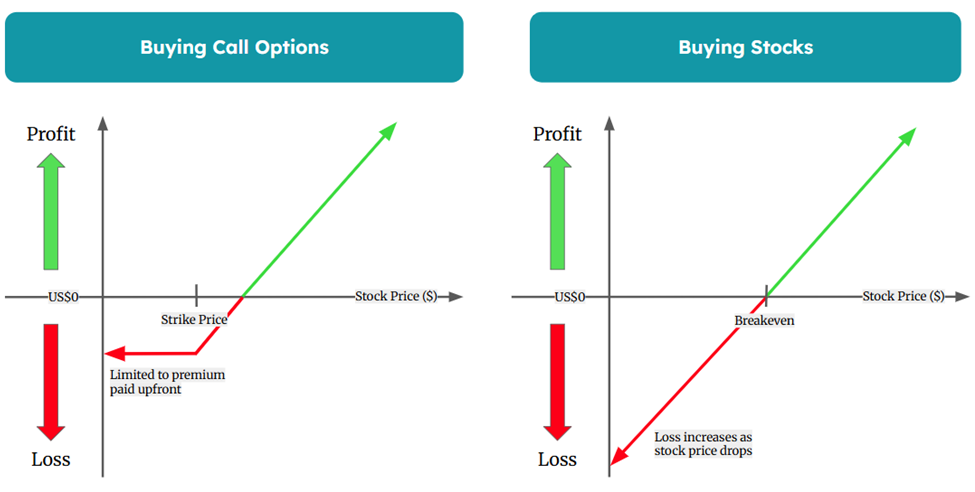
While both stocks and options are tools for investing, the way they work and the opportunities they offer are quite different.
Below, I’ve outlined the key differences between stocks and options:
| Stocks | Options | |
|---|---|---|
| Capital Efficiency | Require a larger upfront capital to build a meaningful position. | Allow you to control larger exposure with a smaller initial investment (leverage) |
| Strategies | Focus on buy-and-hold, dividend investing, dollar-cost averaging, and value investing. Possible to short-sell in some markets. | Income generation (e.g., covered calls, cash-secured puts) and risk management through hedging (e.g., protective puts) |
| Risk Profile | Downside risk is tied to the full value of the stock—you could lose everything if the company goes to zero. | Risk can be predefined, such as being limited to the premium paid when buying calls or puts. |
| Time Horizon | Involves long-term investing and compounding. Can also be used to trade short-to-medium opportunities. | Typically applied to short- to medium-term opportunities, though some strategies can support longer horizons. |
| Complexity | Straightforward, fewer variables to monitor and accessible for most investors. | Requires a deeper understanding of strategies, the Greeks, volatility, and expiry risks. |
Despite the differences, stocks and options share some similar features in that both are traded on regulated exchanges, are highly liquid, and are ultimately tied to the company’s underlying performance and broader market conditions.
When stocks may be the simpler choice
Stocks are often the cleaner tool when your goal is long-term wealth building with minimal complexity.
- Long-term compounding and dividends: Share ownership lets you participate in growth and dividends over time without managing expiries.
- Lower monitoring burden: Stocks do not expire, so you typically avoid rolling positions or managing trades as deadlines approach.
- Easier position sizing: It is usually simpler to scale exposure by buying or selling shares than managing contract sizes, strikes, and expiries.
- Less path dependency: Option outcomes can depend heavily on when a move happens and how volatility changes, not just whether the stock eventually rises or falls.
For many investors, stocks can form the core foundation of a portfolio, with options used selectively when there is a clear purpose.
Practical scenarios where options add value
#1 - Hedging a stock portfolio with protective puts
A protective put involves holding a stock while buying a put option, which gives you the right to sell the stock at a predetermined price. If the stock declines, the put increases in value, helping to reduce potential losses.
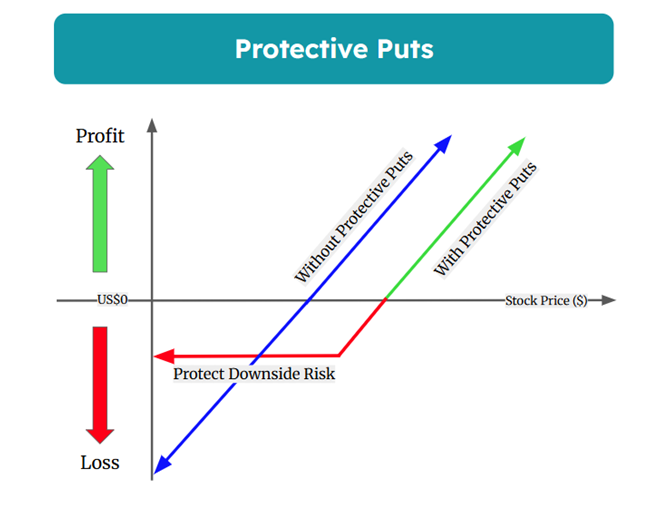
As shown, a protective put strategy limits losses during a market decline but raises the breakeven point due to the put premium cost.
#2 – Generating income with covered calls
This strategy involves owning the stock and selling a call option on it, which is the right to buy the underlying stock.
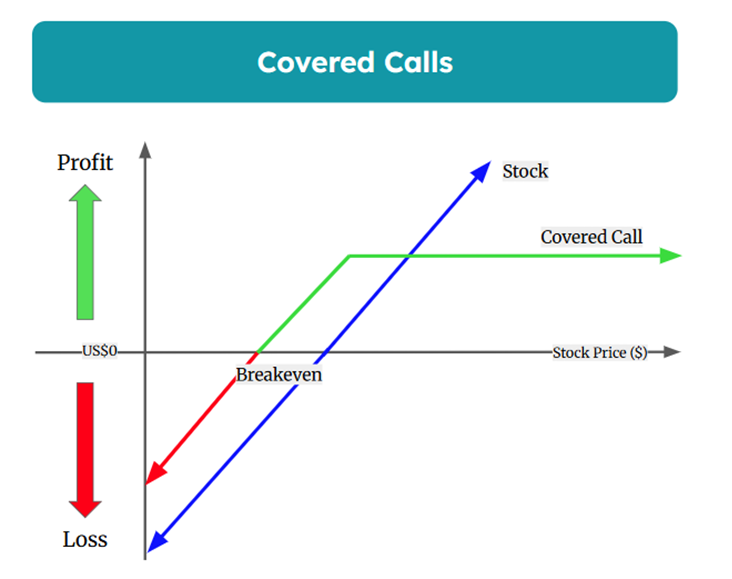
By selling the call, you collect a premium.
If the stock doesn’t rise above the strike price, the option expires worthless, and you keep the premium.
Some investors may use this strategy as a way to potentially generate more consistent premium income from their stock holdings.
#3 – Speculating tactically using long call/put
Options also let you capitalise on accurately identifying the direction of stock movements:
- Buy a call if you think the stock will go up.
- Buy a put if you think the stock will go down.
The best part is that your maximum loss is limited to the premium you paid for the option.
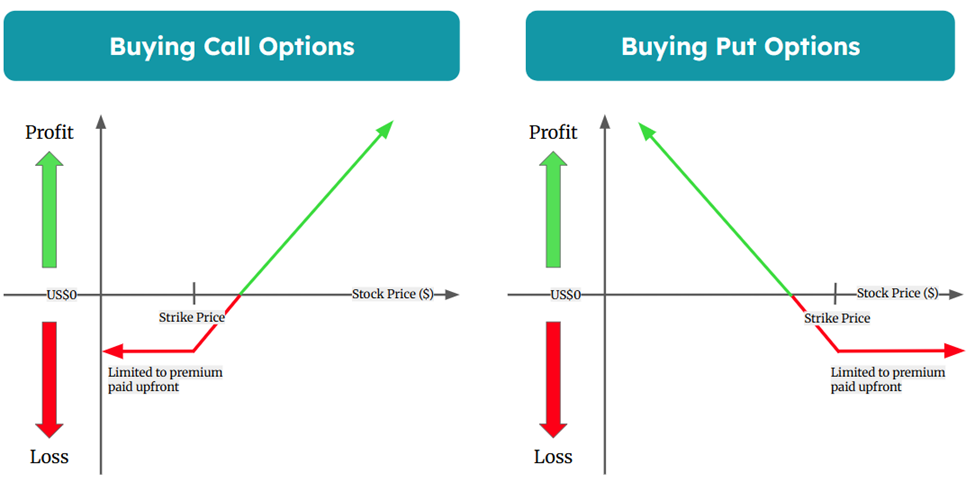
When you buy a call or put option, the most you can lose is the premium paid upfront for the contract.
This makes the risk defined before entering the trade.
#4 – Volatility plays (Strangle/Straddles)
A slightly more advanced strategy is trading based on volatility rather than direction.
A strangle/straddle involves buying a call option and a put option at the same time.
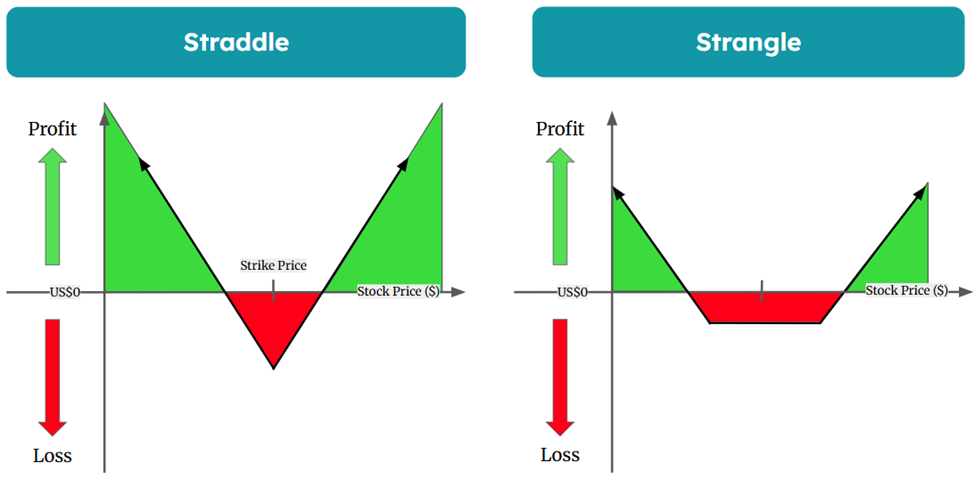
This means the stock price needs to move a lot, either up or down, for the strategy to make a profit.
Such big moves often happen around important events, like company earnings announcements or major economic news that can affect the stock.
Key risks to know before trading options
Options can be useful, but they are not beginner-proof. A few risks matter for most strategies:
- Time decay: Options lose value as expiry approaches, especially for buyers.
- Implied volatility: Option prices can change even if the stock barely moves.
Liquidity and spreads: Wide bid–ask spreads can increase trading costs and hurt execution. - Assignment and margin: Selling options can lead to assignment and may involve margin requirements and margin calls.
- Position sizing: Leverage can amplify mistakes quickly, so sizing and discipline matter.
What would Beansprout do?
Stocks can be a strong foundation for long-term investing because they are simpler to understand, easier to hold through cycles, and less time-sensitive.
If you are looking to buy stocks, you can find out the best stock trading platforms in Singapore here.
On the other hand, options can be a useful addition to an investor’s toolkit, offering flexibility and the ability to manage risk in ways that stocks alone cannot.
But they also come with added complexity and the potential for losses if not used carefully. That’s why it’s important to approach them with the right knowledge, strategy, and platform.
For investors who are considering options, starting small, perhaps even with a demo account, can be a good way to build familiarity before committing real capital.
Many platforms like Webull, Moomoo, Longbridge and Tiger Brokers have made it easier for investors to take their first steps into options, with transparent fees, access to multiple markets, and dedicated educational resources.
If you are looking to trade options, you can discover the best options trading platforms in Singapore here where we compare the features, fees, and tools.
If you’re new to options trading, read our guide for beginners here.
Options can be a complementary strategy to stock investing for investors who want to expand their toolkit.
However, trading options can carry a high level of risk and may not be suitable for all investors.
Follow us on Telegram, Youtube, Facebook and Instagram to get the latest financial insights.
Read also
Gain financial insights in minutes
Subscribe to our free weekly newsletter for more insights to grow your wealth
Most Popular

Comments
0 comments