
kopi-C with Trust Bank’s CEO: The profitable path to becoming a primary bank
Stocks
Powered by

By Raphael Lim • 30 Sep 2026
Why trust Beansprout? We’ve been awarded Best Investment Website at the SIAS Investors’ Choice Awards 2025
'%3e%3cpath%20fill-rule='evenodd'%20clip-rule='evenodd'%20d='M17.64%209.20455C17.64%208.56637%2017.5827%207.95273%2017.4764%207.36364H9V10.845H13.8436C13.635%2011.97%2013.0009%2012.9232%2012.0477%2013.5614V15.8195H14.9564C16.6582%2014.2527%2017.64%2011.9455%2017.64%209.20455V9.20455Z'%20fill='%234285F4'/%3e%3cpath%20fill-rule='evenodd'%20clip-rule='evenodd'%20d='M9%2018C11.43%2018%2013.4673%2017.1941%2014.9564%2015.8195L12.0477%2013.5614C11.2418%2014.1014%2010.2109%2014.4205%209%2014.4205C6.65591%2014.4205%204.67182%2012.8373%203.96409%2010.71H0.957275V13.0418C2.43818%2015.9832%205.48182%2018%209%2018V18Z'%20fill='%2334A853'/%3e%3cpath%20fill-rule='evenodd'%20clip-rule='evenodd'%20d='M3.96409%2010.71C3.78409%2010.17%203.68182%209.59318%203.68182%209C3.68182%208.40682%203.78409%207.83%203.96409%207.29V4.95818H0.957273C0.347727%206.17318%200%207.54773%200%209C0%2010.4523%200.347727%2011.8268%200.957273%2013.0418L3.96409%2010.71V10.71Z'%20fill='%23FBBC05'/%3e%3cpath%20fill-rule='evenodd'%20clip-rule='evenodd'%20d='M9%203.57955C10.3214%203.57955%2011.5077%204.03364%2012.4405%204.92545L15.0218%202.34409C13.4632%200.891818%2011.4259%200%209%200C5.48182%200%202.43818%202.01682%200.957275%204.95818L3.96409%207.29C4.67182%205.16273%206.65591%203.57955%209%203.57955V3.57955Z'%20fill='%23EA4335'/%3e%3c/g%3e%3cdefs%3e%3cclipPath%20id='clip0_0_2849'%3e%3crect%20width='18'%20height='18'%20fill='white'/%3e%3c/clipPath%3e%3c/defs%3e%3c/svg%3e)
Make Beansprout your preferred source on Google
Add us on Google to see more of our insights in your search results
Trust Bank reached profitability about 3.5 years after launching in September 2022. CEO Dwaipayan Sadhu credits three things: tackling customer inertia, a legacy-free tech platform, and a referral engine that brings in 70% of new customers.
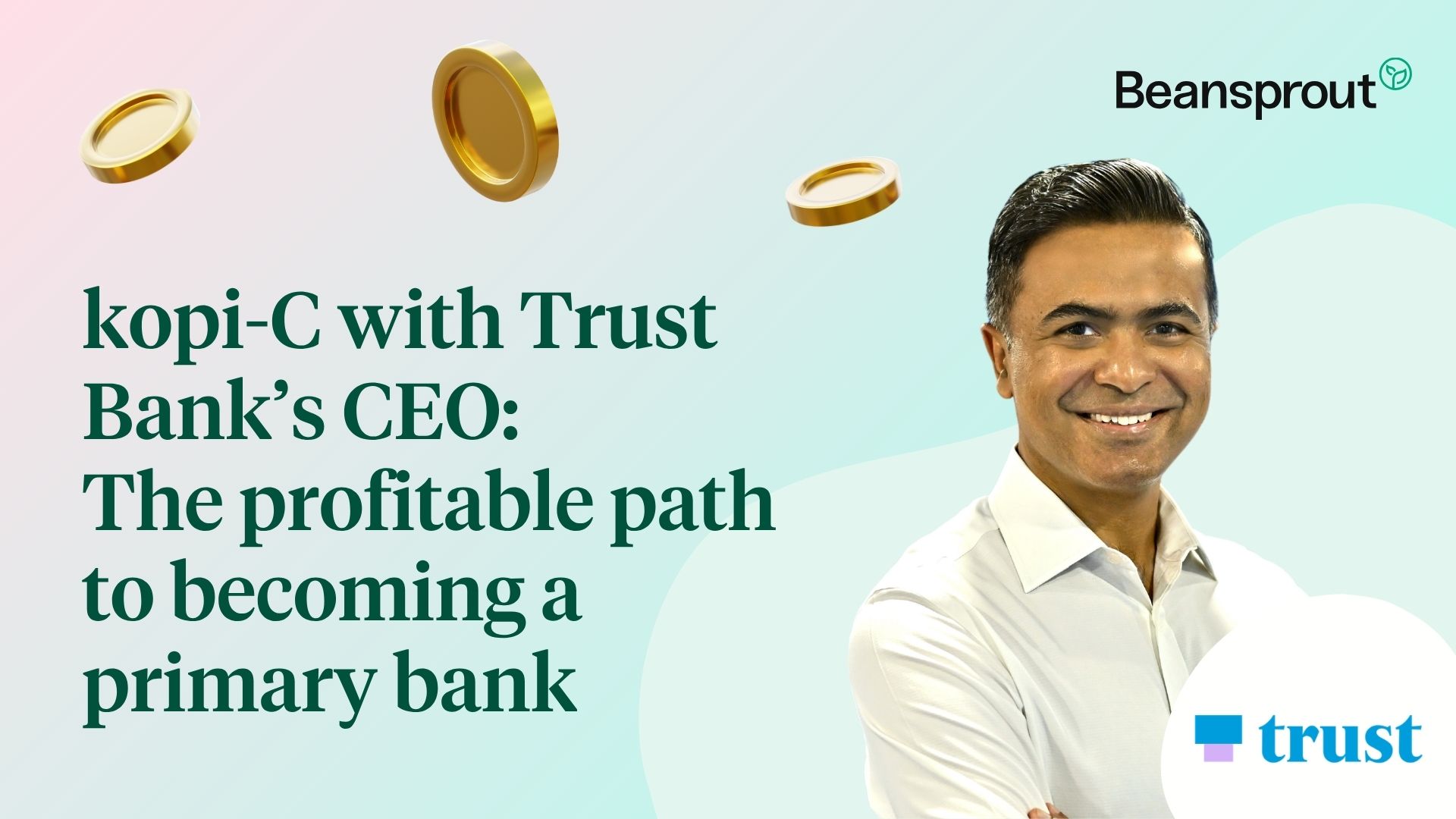
When Trust Bank announced its entry into Singapore’s banking scene four years ago, the key question was clear: how could a new player possibly carve out a profitable niche? Less than four years later, Trust has provided a decisive answer.
"We launched the bank in September 2022. We announced our profitability earlier this year. That's around 3.5 years after we started," shares Dwaipayan Sadhu, CEO of Trust Bank.
"If you look at the global digital banks, this mainly puts us among the top few in terms of the speed of getting to this milestone."
For Dwaipayan, who has led Trust since its founding, this achievement is proof of a robust, repeatable model designed to achieve an ambitious goal.
“We were very clear that we don't want to be a rarely-used, occasional secondary bank,” he says. “We want to be a main bank, a primary bank.”
The Growth Engine: Overcoming Customer Inertia
To become a primary bank, Trust had to overcome the biggest challenge in any established market.
"One of the things that we always compete with, is not necessarily with another bank, but customer inertia," Dwaipayan explains. "Customers are used to a certain way of working, a certain way of banking.”
Trust’s strategy to break this inertia was to embed itself directly into the daily lives of the Singapore community.
Leveraging its foundational partnership with Standard Chartered and FairPrice Group, which respectively hold a 60-40 stake in the bank, Trust focused on immediate relevance. By integrating with the FairPrice ecosystem, Trust addressed a core concern for consumers.
"We know that the everyday consumer in Singapore is worried about cost of living," Dwaipayan notes. "And because we are enabling you to get tangible savings on cost of living, it's almost a no-brainer."
Beyond solving for daily necessities, Trust tackled other common customer pain points.
Recognising the frustration with high credit card foreign exchange fees—a common industry practice—the bank made a zero-markup FX proposition a core part of its initial offering, especially appealing to Singaporeans' love for travel.
Customer onboarding was also another issue tackled head-on, with the bank streamlining processes such that just three minutes are required between the start of the onboarding process to a customer being able to pay with a Trust credit card.
Today, the bank has over a million customers, and its relentless focus on solving real problems has successfully converted customers from occasional users to loyal advocates.
"Our credit cards are now used up to 25 times every month," Dwaipayan remarks. "If you use a card 25 times, clearly it's a daily use card, which is no longer an occasional use card."
The Profitability Model: Building a Sustainable Business
While rapid growth was essential, building a sustainable economic model was the key to long-term success. An important pillar in the profitability push has been a highly scalable tech platform that creates strong operating leverage.
In FY2025, Trust’s total income grew almost 40 per cent to S$135 million, yet its total operating expenses for the year decreased.
“This is a very unusual situation where you have revenue growing at hyper growth, but costs are coming down,” Dwaipayan observes.
This efficiency is driven by relentless automation and the early adoption of AI. The bank’s AI-powered chatbot now handles 50 per cent of all customer queries end-to-end, without human intervention. More impressively, their predictive complaint system has reduced customer service escalations by 40 per cent.
“Because our tech is new and our data is centralised, it gives us the ability to adopt AI at scale, and we are seeing increasing productivity gains,” Dwaipayan notes. “We are digital native, and all our technology has been built over the last three to four years, so we have zero legacy.”
In a fintech world often defined by cash-burning acquisition, Trust also engineered a business that relies on an organic, self-perpetuating referral engine.
"Today, 70 per cent of all our new acquisition comes as referrals from another client," Dwaipayan reveals "Our client acquisition cost is one-seventh that of traditional banks."
This powerful, organic referral loop creates a virtuous cycle, building a loyal customer base without incurring outsized marketing spend.
The proof of this model's success lies in its consistency and the strong financial performance demonstrates the "fundamental strength and sustainability" of their business, says Dwaipayan.
Execution and Vision
Building a bank from scratch is a formidable task. As CEO, Dwaipayan credits a core principle for keeping the company on track: being a disciplined listener to both customers and his team.
"Every day you have multiple things that come to you. Some of it urgent, some of it important, and some of it just noise," he explains. "To make that judgment, you really need to listen, because if you react immediately, you will make a wrong choice."
This philosophy also translates into a culture of rapid, pragmatic iteration, allowing Trust to deepen its roots in Singapore’s competitive but lucrative retail banking ecosystem.
“We estimate there is a revenue pool of S$20 billion in the market, and clearly, the clients in Singapore have very large wallet sizes, and are very willing to try out new innovations,” he says.
Such innovations include launching Singapore’s first “Stockback” credit card in August called the Freedom Card, which gives customers rewards in the form of investment units to reduce obstacles such as time or confidence, and make investing easier for everyone.
The recent announcement that Standard Chartered would transfer a portion of its credit card and personal loan customers to Trust also serves as another powerful "vote of confidence" in the digital bank's growth and stability.
As its product suite expands and its customer relationships deepen, Trust is methodically advancing toward its ultimate goal.
“We had a good start… but the reality is that we are still scratching the surface, there is a lot more that we can do,” Dwaipayan concludes. “Increasingly we will become a main bank, a primary bank for our clients in the coming years.”
About Trust Bank
Trust Bank is a digitally-native bank in Singapore, backed by a unique partnership between Standard Chartered Bank and the FairPrice Group. Launched in September 2022, Trust is dedicated to serving the everyday banking needs of its customers through a suite of products including credit cards, a savings account, and personal loans, all delivered through a seamless mobile-first experience.
About kopi-C: the Company brew
kopi-C is a regular column by SGX Research in collaboration with Beansprout, Singapore’s trusted investment intelligence platform which helps everyday investors build the knowledge and confidence to make decisions that matter. kopi-C features C-level executives of leading companies. These interviews are profiles of senior management aimed at helping investors better understand the individuals who run these corporations.
Read also
Gain financial insights in minutes
Subscribe to our free weekly newsletter for more insights to grow your wealth
Most Popular

Comments
0 comments