
3 worst-performing Singapore blue chips fell over 10% in October. What to watch next
Stocks
By Ng Hui Min • 10 Nov 2026
Why trust Beansprout? We’ve been awarded Best Investment Website at the SIAS Investors’ Choice Awards 2025

Make Beansprout your preferred source on Google
Add us on Google to see more of our insights in your search results
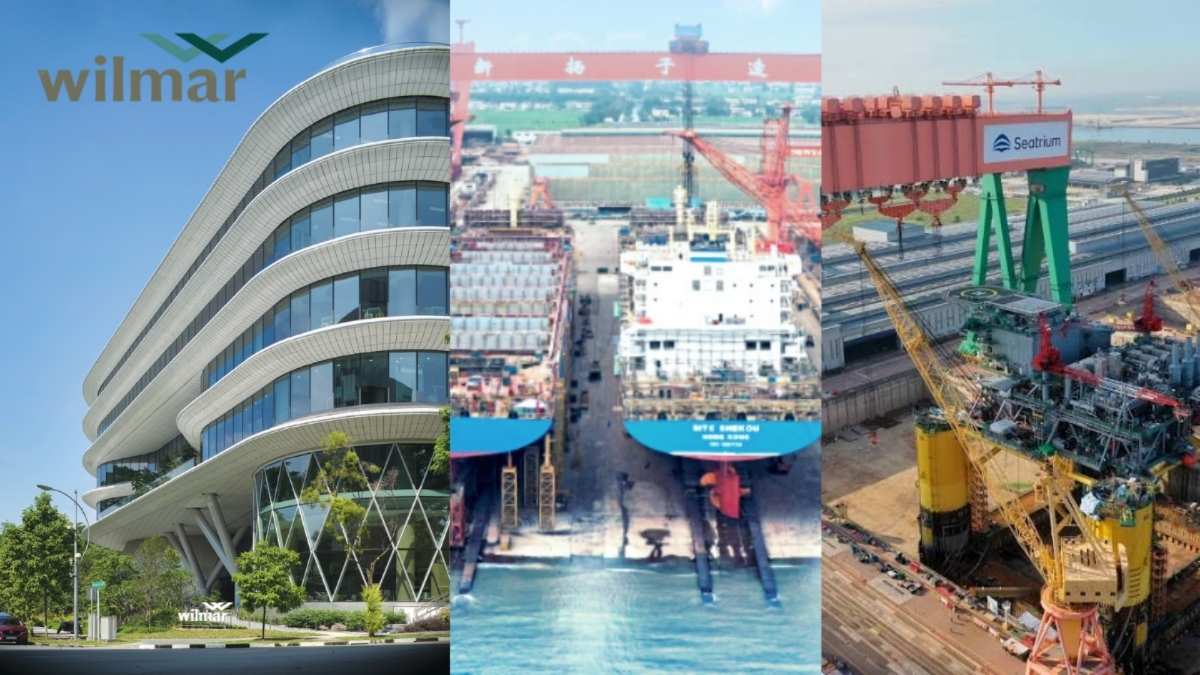
The Straits Times Index (STI) declined 5.1% in October 2026, with Wilmar International, Yangzijiang Shipbuilding and Seatrium recording even sharper falls. We look at what has changed for these three Singapore blue chips, and whether their lower share prices warrant a closer look.
What happened?
Singapore blue chip stocks fell in October.
The Straits Times Index (STI) ended October 2026 5.1% lower, with several index constituents recording double-digit share-price declines.
Wilmar International was the worst performer, falling 16.6%, followed by Yangzijiang Shipbuilding at 11.3% and Seatrium at 10.7%, according to FactSet.
Interestingly, Yangzijiang Shipbuilding was the best-performing Singapore blue chip in September, before reversing course in October.
We also previously looked at Singapore blue chip stocks trading near their 52-week lows, including Seatrium.
With these share-price declines, I wanted to find out whether the three Singapore blue chips are worth revisiting, or whether their fundamentals suggest more caution is warranted.
3 worst-performing Singapore blue chips in October 2026
| Rank | Stock | SGX code | October total return |
| 1 | Wilmar International | F34 | -16.6% |
| 2 | Yangzijiang Shipbuilding | BS6 | -11.3% |
| 3 | Seatrium | 5E2 | -10.7% |
| Source: Factset | |||
#1 – Wilmar International (SGX: F34): Earnings pressure and regulatory uncertainty
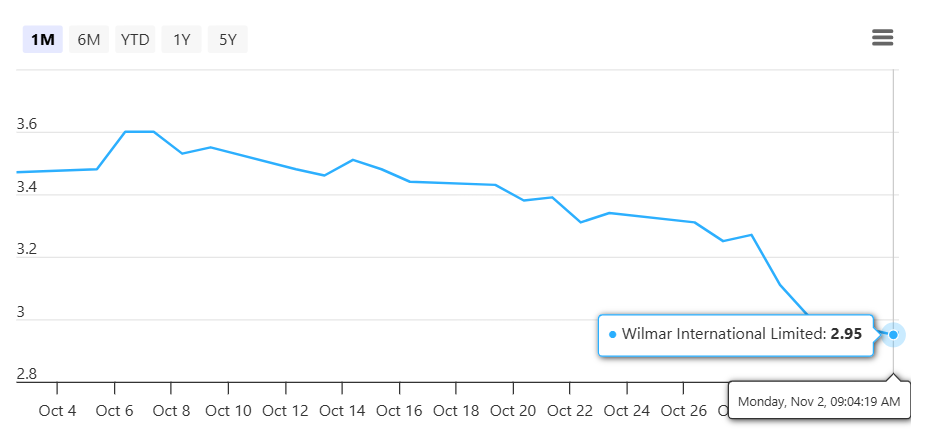
Wilmar International was the worst-performing Singapore blue chip in October, with its share price falling 16.6%.
Wilmar is one of Asia's largest agribusiness groups, with operations spanning oil palm plantations, oilseed crushing, edible oils, food products and sugar.
Its latest third-quarter results provide some context for the weakness in its share price.
Wilmar's 3Q26 core net profit declined despite higher revenue
Wilmar reported revenue of US$21.66 billion for the third quarter of 2026 (3Q26), an increase of 13.6% year on year.
However, core net profit fell 25.2% year on year to US$267.3 million.
The decline reflected higher raw material costs in its food products business and weaker soybean crushing margins.
This suggests that higher sales are not necessarily translating into stronger profitability across Wilmar's businesses.
For investors, the more important question is whether these margin pressures are temporary or could continue into subsequent quarters.
If raw material costs remain elevated and Wilmar is unable to pass them on to customers, its earnings could remain under pressure.
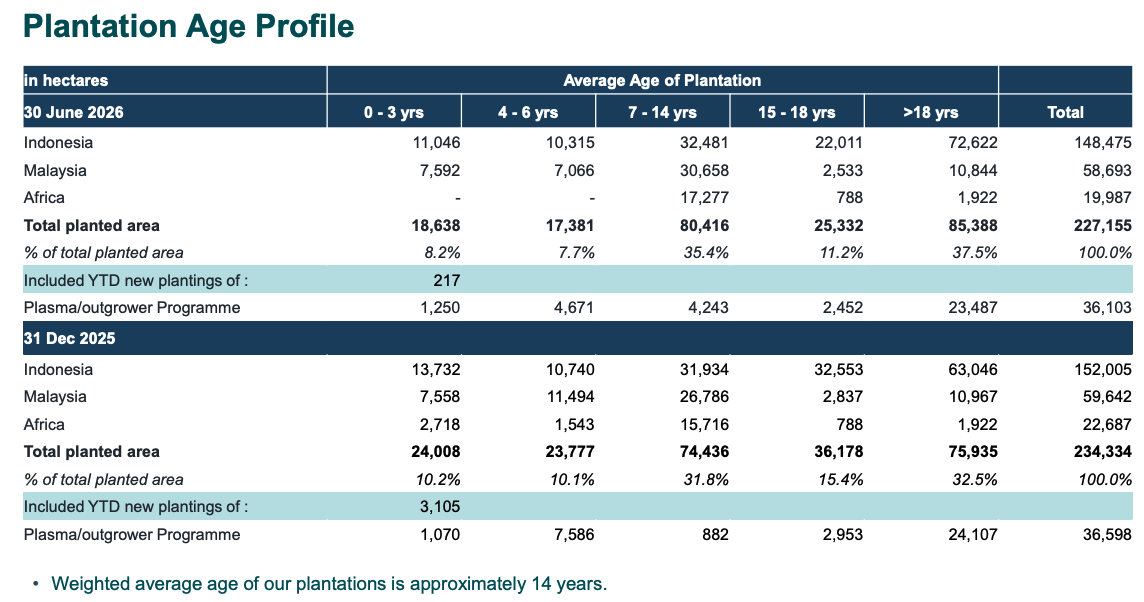
Another development in October was the disclosure of preliminary inquiries by Indonesian police into fires affecting land associated with Wilmar's subsidiaries in West Kalimantan.
The development has added regulatory and reputational uncertainty for the company.
How does Wilmar fare on our Fundamental Checklist?
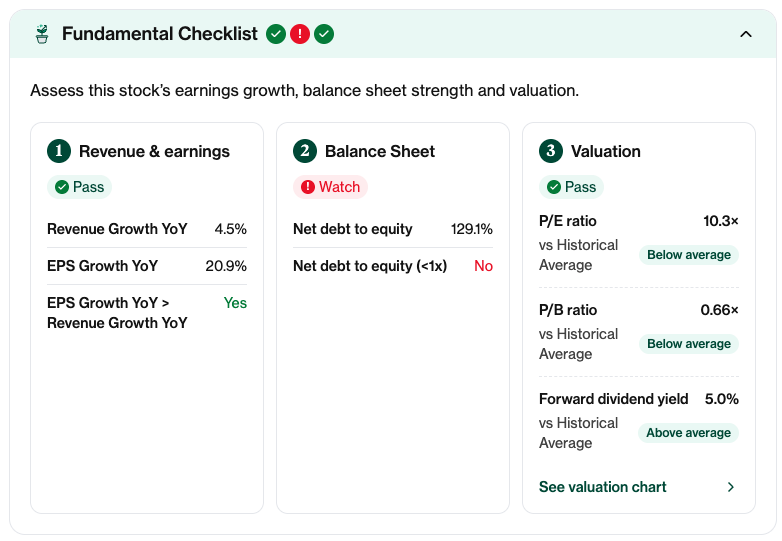
Wilmar passes two of the three fundamental checks.
It passes the revenue and earnings check, with earnings per share (EPS) growth of 20.9% outpacing revenue growth of 4.5%.
Wilmar also passes the valuation check. Its price-to-earnings (P/E) ratio of 10.3 times and price-to-book (P/B) ratio of 0.66 times are below their historical averages, while its forward dividend yield of 5.0% is above its historical average.
However, Wilmar is flagged on balance sheet strength, with a net debt-to-equity ratio of 129.1%, above the screener's 100% threshold.
While Wilmar's valuation appears relatively attractive against its historical averages, its higher leverage and recent earnings pressure warrant caution.
What to watch for Wilmar
Wilmar's share-price decline may warrant a closer look, but the earnings outlook remains an important consideration.
I would focus on whether its food products margins recover, whether soybean crushing profitability improves, and whether cash generation remains healthy.
I would also monitor developments relating to the Indonesian fire inquiries.
Related links:
- Explore Wilmar’s latest share price, share price target, valuation and analysis
- Explore Wilmar's dividend yield and dividend payout history
#2 – Yangzijiang Shipbuilding (SGX: BS6): Can strong earnings momentum continue?
Yangzijiang Shipbuilding was the second-worst-performing Singapore blue chip in October, declining 11.3%.
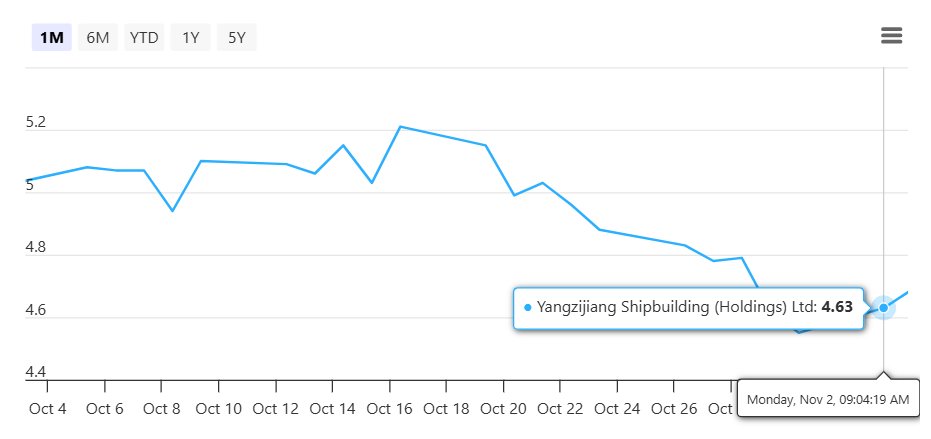
This marks a reversal from September, when Yangzijiang was the best-performing STI constituent with a total return of 6.0%.
The company had also recorded a strong share-price rally in August, supported by robust earnings and a sizeable order book.
The recent decline raises a question about whether expectations for its future earnings have become too optimistic.
Yangzijiang's 1H26 earnings showed strong profitability
Yangzijiang Shipbuilding is one of China's largest privately owned shipbuilders, producing container ships, bulk carriers and other commercial vessels.
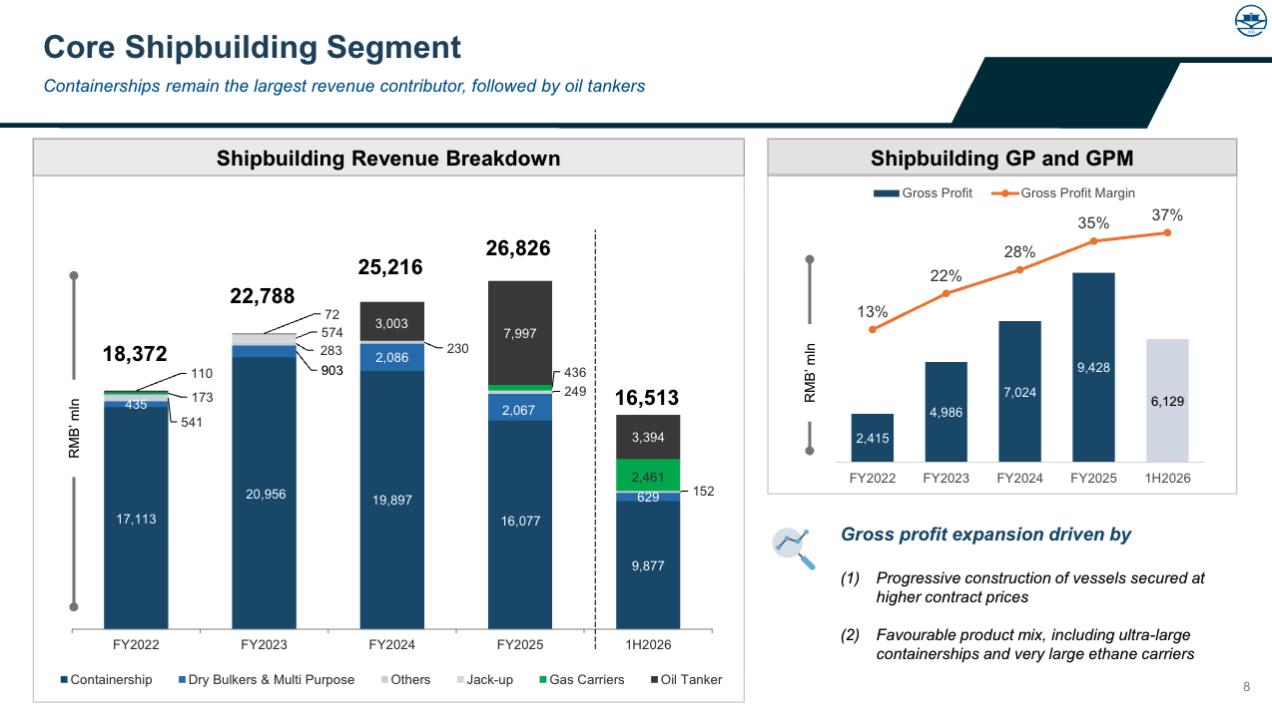
For the first half of 2026 (1H26), its revenue rose 36.2% year on year to 17.5 billion Chinese renminbi (RMB17.5 billion).
Net profit attributable to shareholders increased 28.4% to RMB5.4 billion, supported by higher-priced vessel contracts and a favourable mix of ships.
Its group gross profit margin improved to 36.2%, while its shipbuilding segment gross profit margin reached approximately 37%.
The improvement reflects the progressive construction of vessels secured at higher contract prices, alongside a greater contribution from higher-value vessel types.
Yangzijiang’s shipbuilding gross profit margin rose from approximately 13% in FY2022 to 37% in 1H26, reflecting higher contract prices and a more profitable mix of vessels under construction.
A sizeable order book provides revenue visibility
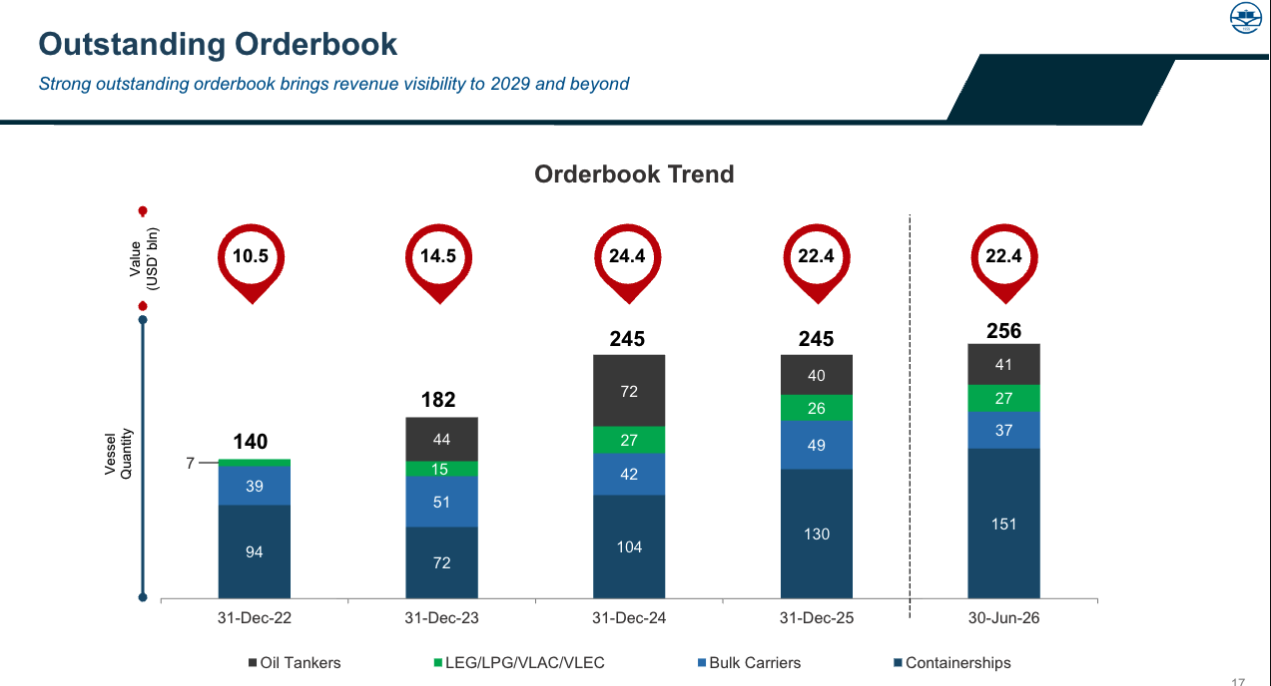
Yangzijiang reported an order book of US$22.4 billion across 256 vessels at the end of June 2026, with deliveries scheduled through 2030.
Containerships accounted for 151 vessels in the order book, making them the largest category.
The order book has grown significantly from US$10.5 billion at the end of 2022, although its value has remained broadly unchanged since the end of 2025.
This provides visibility over future revenue, but does not guarantee that the group can sustain its current profit margins.
Yangzijiang also maintained a net cash position of approximately RMB12.5 billion at the end of June 2026.
This gives the group financial flexibility to support its operations and investment requirements.
How does Yangzijiang fare on our Fundamental Checklist?
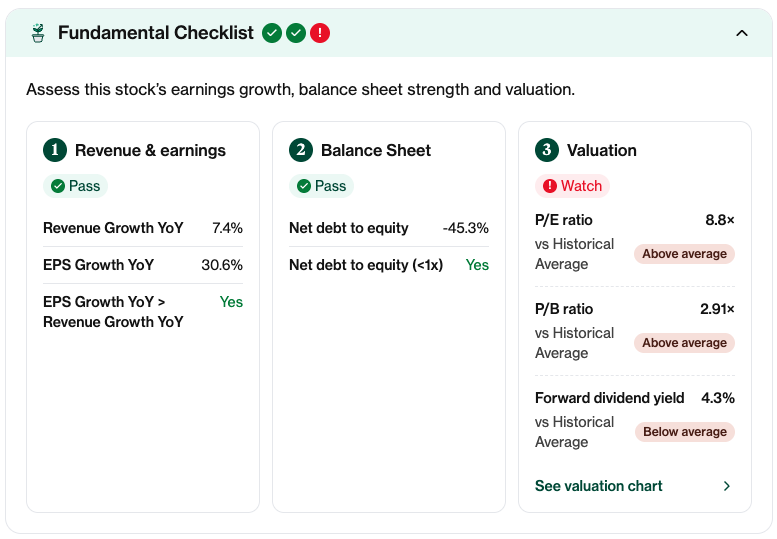
Yangzijiang Shipbuilding passes two of the three checks, supported by its earnings growth and strong balance sheet.
Its EPS growth of 30.6% exceeds revenue growth of 7.4%, allowing it to pass the revenue and earnings check.
It also passes the balance sheet check, with a net debt-to-equity ratio of -45.3%, reflecting its net cash position.
However, the valuation check is flagged.
Yangzijiang's P/E ratio of 8.8 times and P/B ratio of 2.89 times are both above their historical averages, while its forward dividend yield of 4.3% is below its historical average.
This suggests that while Yangzijiang's fundamentals remain strong, its shares may not necessarily be attractively valued relative to their own history.
What to watch for Yangzijiang Shipbuilding
For me, the most important question is whether Yangzijiang can continue securing new orders at attractive margins.
Its large order book and net cash position provide financial strength, but I would also watch the pace of new orders and project execution.
I would compare its current valuation against earnings across a full shipbuilding cycle, rather than relying solely on its recent record profitability.
If earnings remain strong while the valuation becomes more reasonable, the recent correction could make Yangzijiang worth examining more closely.
Related links:
- Explore Yangzijiang Shipbuilding's latest share price, share price target, valuation and analysis.
- Explore Yangzijiang Shipbuilding's dividend yield and dividend payout history
#3 – Seatrium (SGX: 5E2): Improving profitability, but execution risks remain
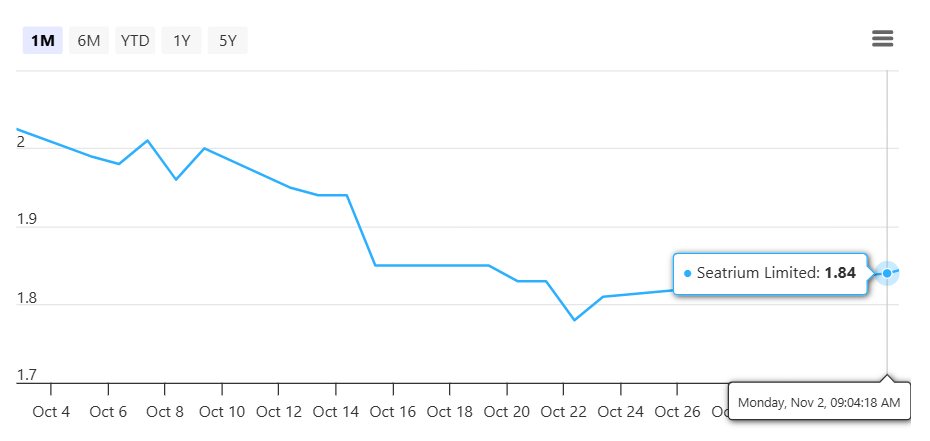
Seatrium was the third-worst-performing Singapore blue chip in October, with its share price declining 10.7%.
The company provides engineering solutions to the offshore, marine and energy industries, including floating production vessels, offshore wind infrastructure and ship repairs.
Despite the share-price weakness, Seatrium's latest reported financial results showed an improvement in profitability.
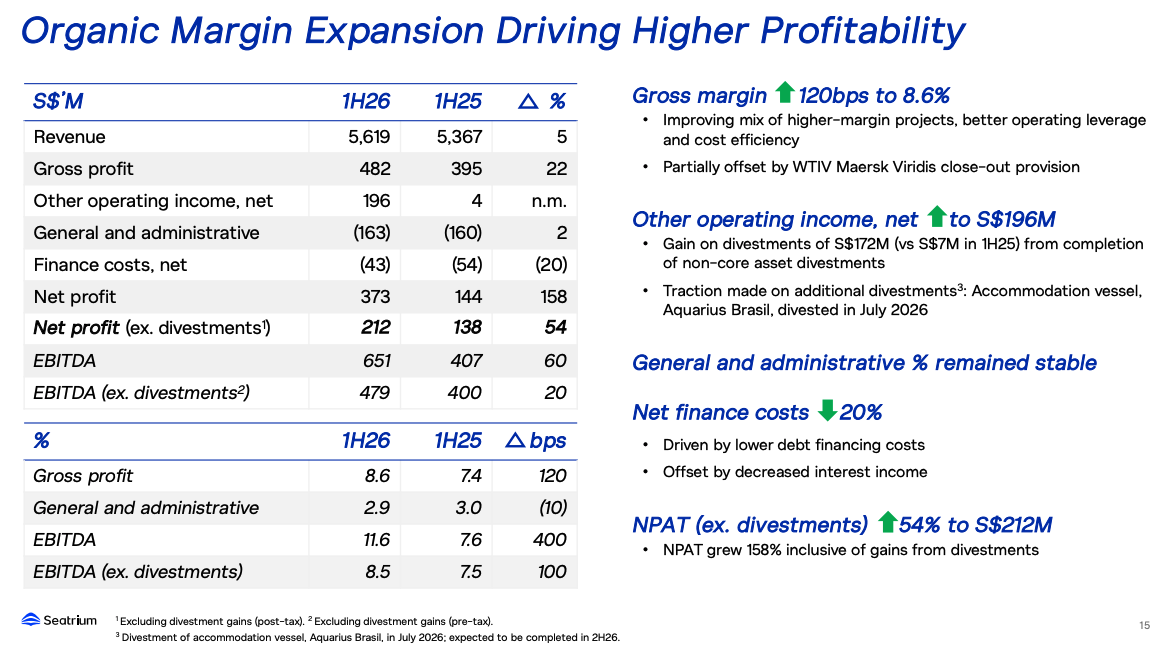
Seatrium's 1H26 underlying earnings improved
For the first half of 2026, Seatrium reported revenue of S$5.6 billion, an increase of 4.7% year on year.
Net profit rose to S$373 million, compared with S$144 million a year earlier.
However, part of this increase came from divestment gains.
Excluding these gains, net profit rose 54% to S$212 million.
This is an important distinction because underlying earnings provide a clearer picture of how its core operations are performing.
Seatrium's gross profit margin also improved to 8.6%, from 7.4% a year earlier.
The improvement was supported by a better project mix, operating leverage and cost efficiencies.
How does Seatrium fare on our Fundamental Checklist?
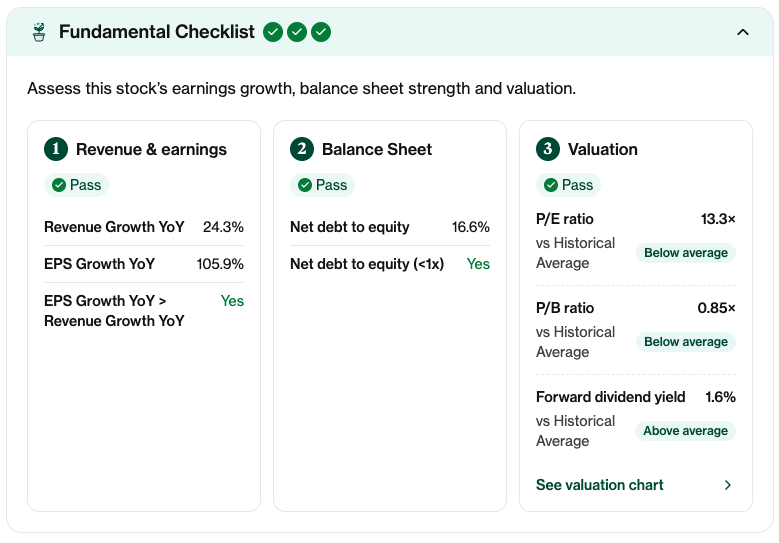
Seatrium is the only company among the three that passes all of our three fundamental checks.
Its EPS growth of 105.9% exceeds revenue growth of 24.3%, meeting the revenue and earnings check.
Seatrium also passes the balance sheet check, with a net debt-to-equity ratio of 16.6%, below the screener's 100% threshold.
On valuation, its P/E ratio of 13.3 times and P/B ratio of 0.85 times are below their historical averages, while its forward dividend yield of 1.6% is above its historical average.
These results suggest that Seatrium's improving fundamentals are accompanied by a valuation that compares favourably with its historical averages.
What to watch for Seatrium
I would focus on whether Seatrium can sustain its improvement in underlying profitability.
Its higher gross margins and earnings growth are encouraging signs, but I would want to see continued progress in project execution and cash flow.
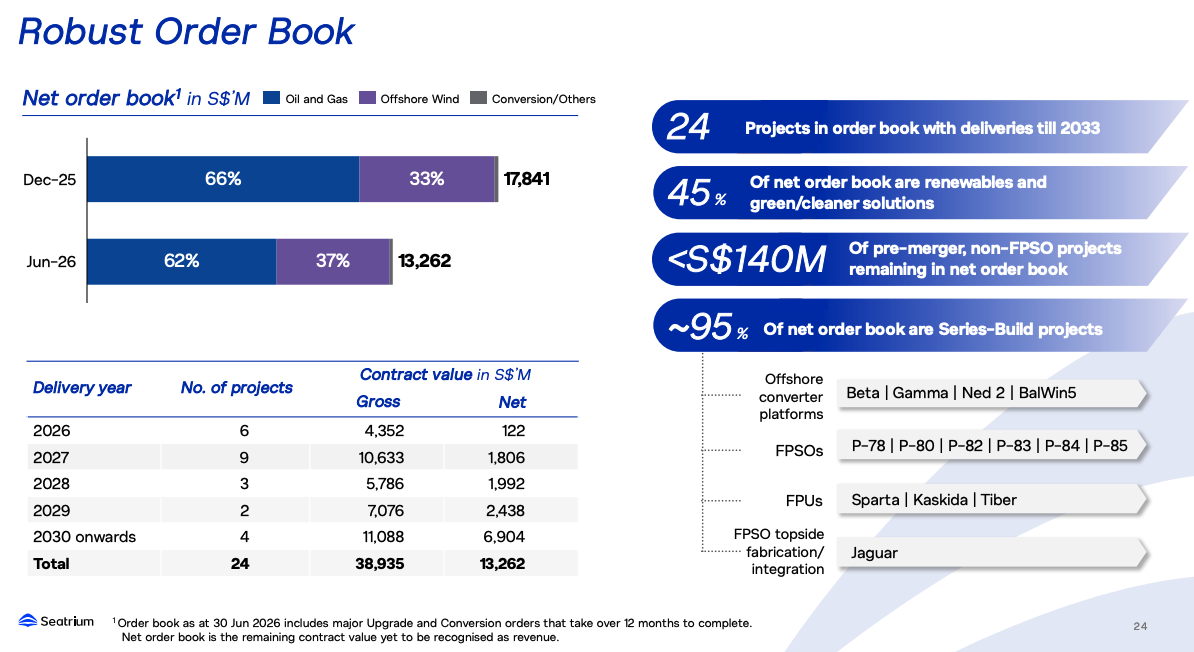
I would also monitor new contract wins and whether they can support future earnings without taking on excessive execution risks.
Related links:
- Explore Seatrium's latest share price, share price target, valuation and analysis.
- Explore Seatrium's latest dividend yield and dividend payout history
What would Beansprout do?
Wilmar International, Yangzijiang Shipbuilding and Seatrium were the three worst-performing Singapore blue chips in October.
However, I would not assume that these stocks have become attractively valued simply because their share prices have fallen.
For my Opportunity Pot, I would focus on three factors: whether earnings are improving, whether the balance sheet can support future growth, and whether the valuation offers sufficient potential returns for the risks involved.
Here is how the three stocks compare across these fundamental checks.
| Stock | Fundamental Checklist result | What stands out | Key risks |
| Wilmar International | 2/3 checks | Diversified agribusiness operations, earnings growth on the screener and attractive valuation relative to historical averages. | High leverage, pressure on profit margins, raw material costs and regulatory uncertainty. |
| Yangzijiang Shipbuilding | 2/3 checks | Strong earnings growth, high ROE, net cash and large order book. | Shipbuilding cycle, pace of new orders, steel costs, currencies and execution. |
| Seatrium | 3/3 checks | Strong underlying earnings growth, improving profit margins, manageable debt and attractive valuation relative to historical averages. | Project execution, cost overruns, cash flow generation and sustainability of earnings recovery. |
Based on our fundamental checklist, Seatrium stands out as the only company passing all three checks, although I would not treat this as a buy signal.
For Seatrium, I would want to see sustained underlying profitability, better cash generation and continued progress in project execution.
For Yangzijiang, I would focus on whether earnings can justify its valuation through the shipbuilding cycle.
For Wilmar, I would want greater clarity on its earnings recovery, leverage and regulatory uncertainties before drawing conclusions about its valuation.
I would therefore use the October declines as a starting point for deeper research, rather than assume that any of these stocks is due for a rebound.
To find out which Singapore blue-chip stocks we would hold in a portfolio, you can also see how we would invest S$100,000 in Singapore stocks today.
If you are looking for greater clarity on the markets and the investment decisions that matter, explore Beansprout Pro for our latest views, portfolio thinking and the reasoning behind each opportunity.
Despite the broad-based decline in Singapore blue chip stocks, we believe Singapore stocks remain worth a closer look in 2026.
For investors who are looking to gain exposure to Singapore, we share 5 ways to invest in blue chips and growth opportunities here.
Which of these blue chips are you watching? Share your thoughts in the comments below or join the discussion in our Telegram community.
Planning to invest in Singapore blue chip stocks? Check out Beansprout's guide to the best stock trading platforms in Singapore with the latest promotions to invest in the Singapore market and see the latest promotions and sign-up rewards available.
Enjoyed this insight? Follow Beansprout on Telegram, Youtube, Facebook and Instagram, and add Beansprout as your preferred source on Google so you never miss an update.
Read also
Gain financial insights in minutes
Subscribe to our free weekly newsletter for more insights to grow your wealth
Most Popular

Comments
0 comments