
5 Singapore blue chip stocks near 52-week lows to assess for opportunities
Stocks
By Ng Hui Min • 26 Oct 2026
Why trust Beansprout? We’ve been awarded Best Investment Website at the SIAS Investors’ Choice Awards 2025

Make Beansprout your preferred source on Google
Add us on Google to see more of our insights in your search results
We look at 5 Singapore blue chip stocks near 52-week lows - Singtel, CapitaLand Investment, Seatrium, City Developments and UOL.
What happened?
Several Singapore blue chip stocks are trading near their 52-week lows.
After the Straits Times Index (STI) pulled back from its record high, I took a closer look at familiar names that have seen sharper declines from their recent peaks.
Using Beansprout's screener for stocks near 52-week lows, Singtel, CapitaLand Investment, Seatrium, City Developments and UOL caught my attention.
For those who have been waiting for lower prices, these declines may warrant another look, although we highlighted in our recent review of DBS, OCBC and UOB that a pullback alone does not make a stock attractively valued.
Our October investment climate assessment also points to a need for greater selectivity, as resilient earnings are being weighed against inflation concerns and elevated bond yields.
With this in mind, we examine these five companies’ latest developments to assess whether their financial performance points to potential investment opportunities worth researching further.
5 Singapore blue chip stocks near their 52-week lows
#1 – Singtel: Regional associates and digital businesses are supporting growth
Singtel is more than a Singapore mobile operator. Alongside its Singapore operations and Optus in Australia, the group has regional telecommunications investments and businesses in IT services, data centres and digital infrastructure.
This gives it several potential sources of earnings growth, although performance across those businesses can differ.
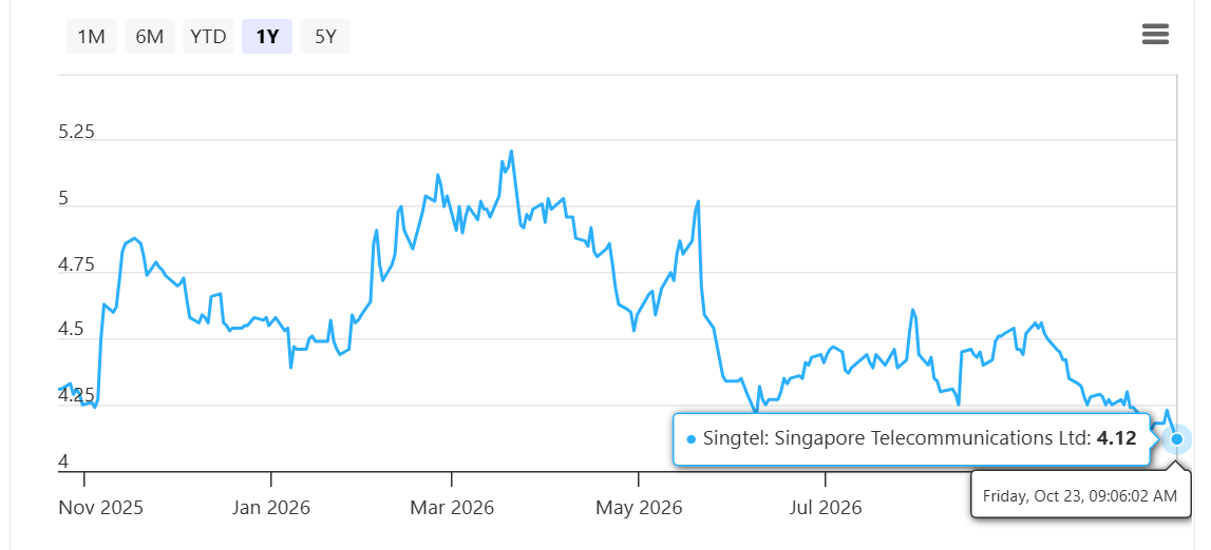
Singtel’s share price has declined 4.4% over the past year to S$4.12, placing it 3.3% above its 52-week low of S$3.99.
For the quarter ended June 2026, or 1Q FY2027, revenue rose about 5% to S$3.56 billion and underlying net profit increased 21% to S$831 million.
Reported net profit fell to S$818 million because the previous year included exceptional gains. For assessing ongoing performance, the increase in underlying earnings is the more useful development.
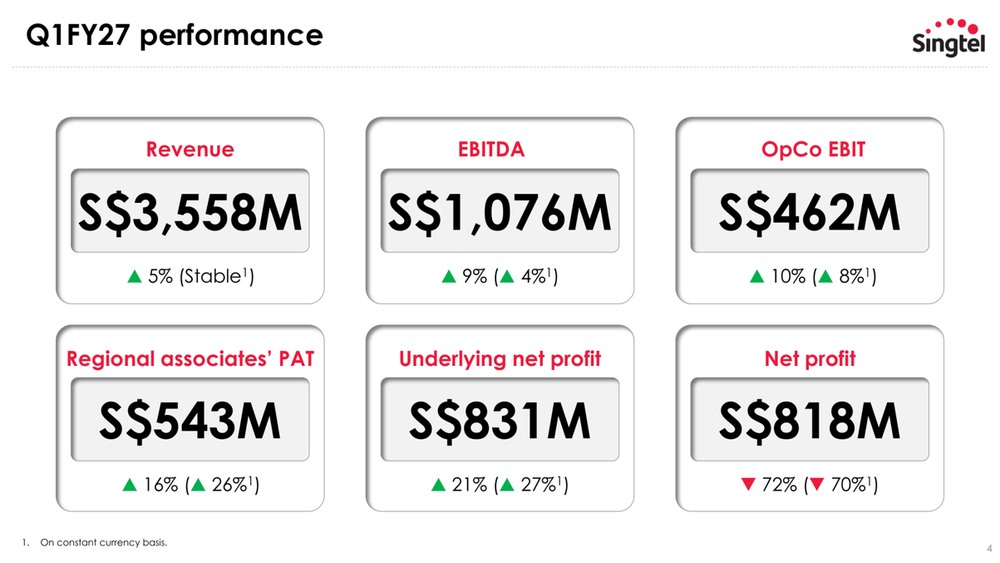
Regional associates’ profit contribution increased 16% to S$543 million.
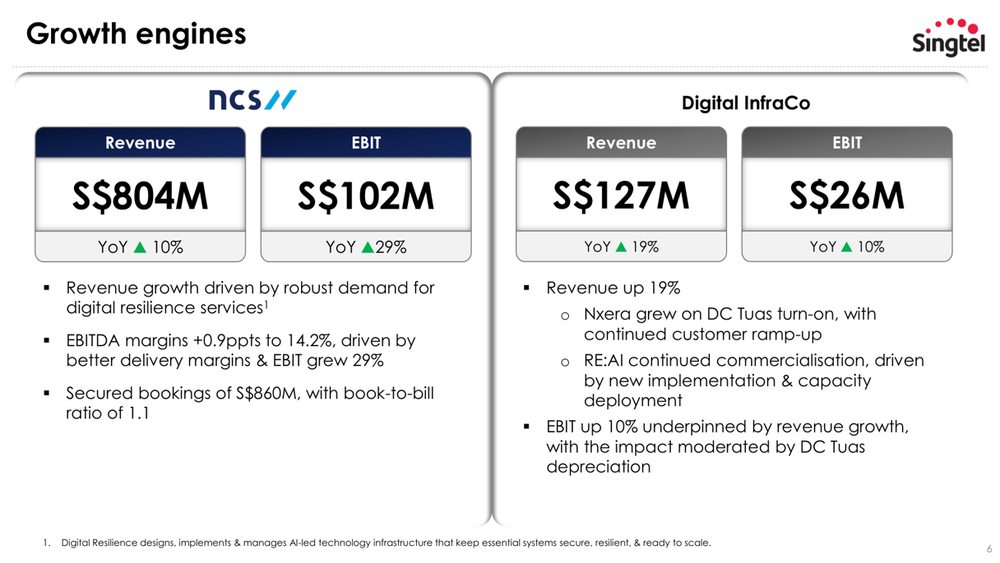
Meanwhile, NCS revenue grew 10%, with earnings before interest and tax, or EBIT, increasing 29%. This suggests that improved margins helped profit grow faster than sales.
Digital InfraCo revenue rose 19%, supported by the ramp-up of Nxera’s DC Tuas and continued commercialisation of RE:AI. EBIT increased 10%, with depreciation from DC Tuas moderating the profit contribution.
Another development to monitor is Singtel’s potential sale of a minority stake in Optus.
On 30 July, Singtel confirmed discussions with interested parties, although no transaction had been announced as of this draft.
These developments offer potential growth beyond the traditional telecommunications business. However, new infrastructure also requires investment, and revenue growth needs to translate into adequate returns after depreciation and other costs.
These developments offer potential growth beyond the traditional telecommunications business. However, new infrastructure also requires investment, and revenue growth needs to translate into adequate returns after depreciation and other costs.
I would watch regional associate earnings, NCS margins and whether digital infrastructure investments deliver the expected profit growth.
Related links:
- Singtel latest share price and analysis
- Singtel dividend history and forecast
- Singtel latest valuation
#2 – CapitaLand Investment: Growing fees and capital recycling could support a recovery
CapitaLand Investment, or CLI, is a global real asset manager with businesses spanning listed REITs, private funds, commercial management and lodging.
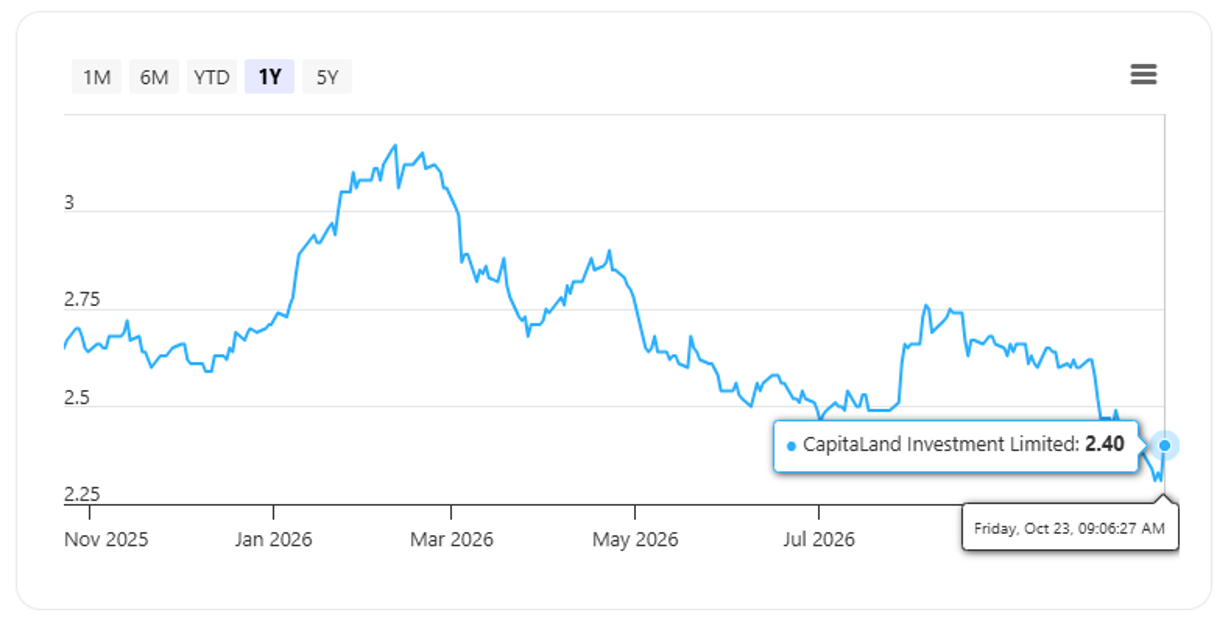
CLI’s share price closed at S$2.40 on 23 October 2026, down 10..1% over the past year, and 4.8% above its 52-week low of S$2.29.
Its investment case centres on a gradual shift towards earning more management fees, rather than relying as heavily on properties held on its own balance sheet.
This matters because a larger fee business could allow CLI to grow without committing as much capital to owning additional assets.
Its first-half 2026 results showed progress.
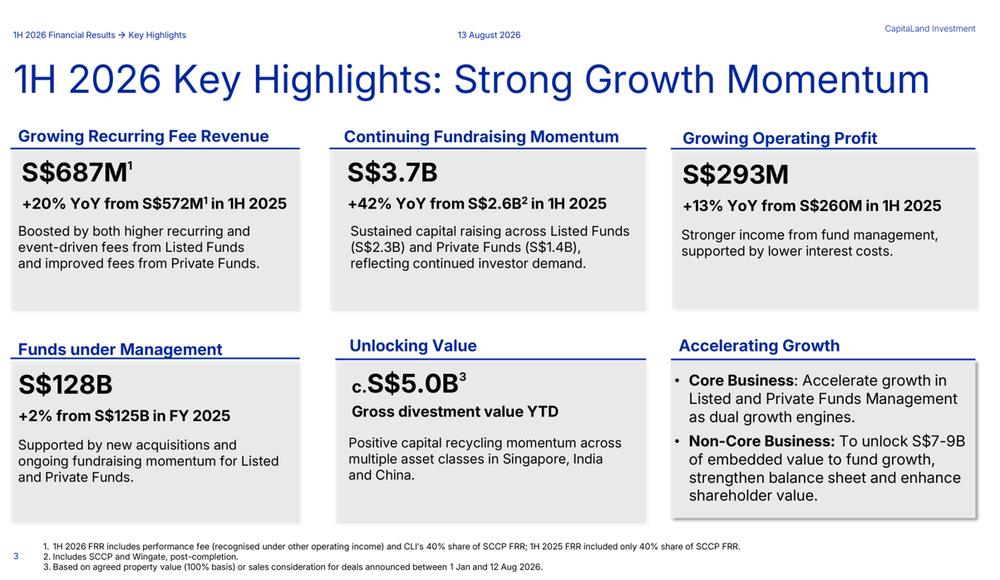
Operating profit after tax and minority interests, or operating PATMI, rose 13% year on year to S$293 million. Fee revenue increased 20% to S$687 million, including performance fees and CLI’s share of SC Capital Partners’ fee revenue.
Funds under management reached S$128 billion, while fundraising of S$3.7 billion was 42% higher than a year earlier.
However, the transition also has trade-offs. Group revenue fell 2% as divestments reduced contributions, while some of the fee growth came from transaction-related activity that may not repeat at the same pace.
Capital recycling is another potential catalyst. Management identified S$7 billion to S$9 billion of embedded value in non-core investments for recycling, with proceeds intended to support growth, strengthen the balance sheet and potentially return excess capital to shareholders.
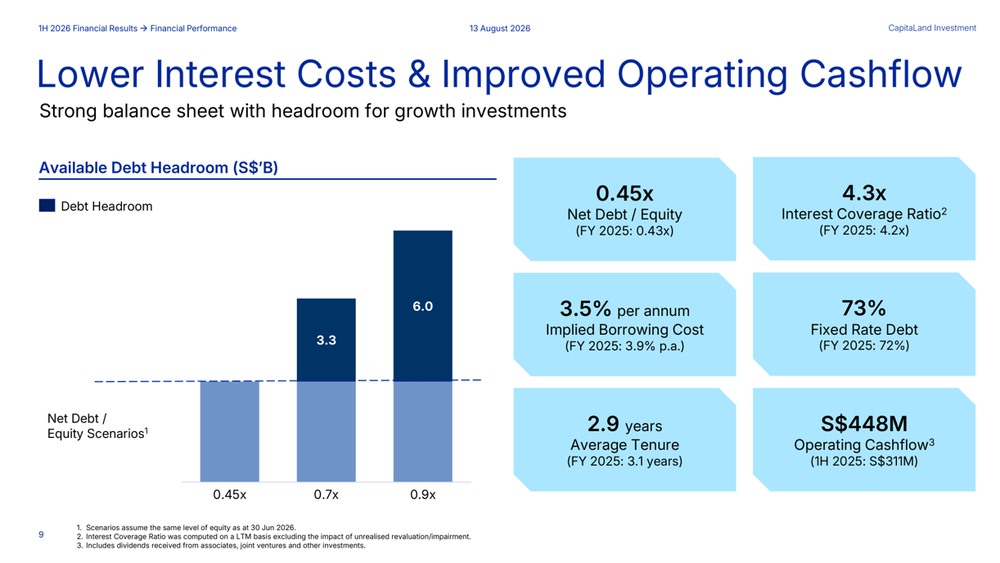
CLI also showed operating cash flow, including dividends received from investments, rising to S$448 million from S$311 million. Company-reported net debt-to-equity was 0.45 times at end-June.
The latest operating results are more encouraging than the historical screening figures, but I would want to see recurring fees translate into sustained improvement in returns on capital.
For me, the key developments to watch are recurring fee growth, the pace of asset sales and how effectively the proceeds are redeployed.
Related links:
- CapitaLand Investment latest share price and analysis
- CapitaLand Investment dividend history and forecast
#3 – Seatrium: Better project margins are strengthening the earnings recovery
Seatrium provides engineering solutions to the offshore, marine and energy industries.
Its work includes floating production vessels, offshore wind infrastructure, ship repairs and upgrades. These are large projects that can provide revenue visibility over several years, but profitability depends on execution and cost control.
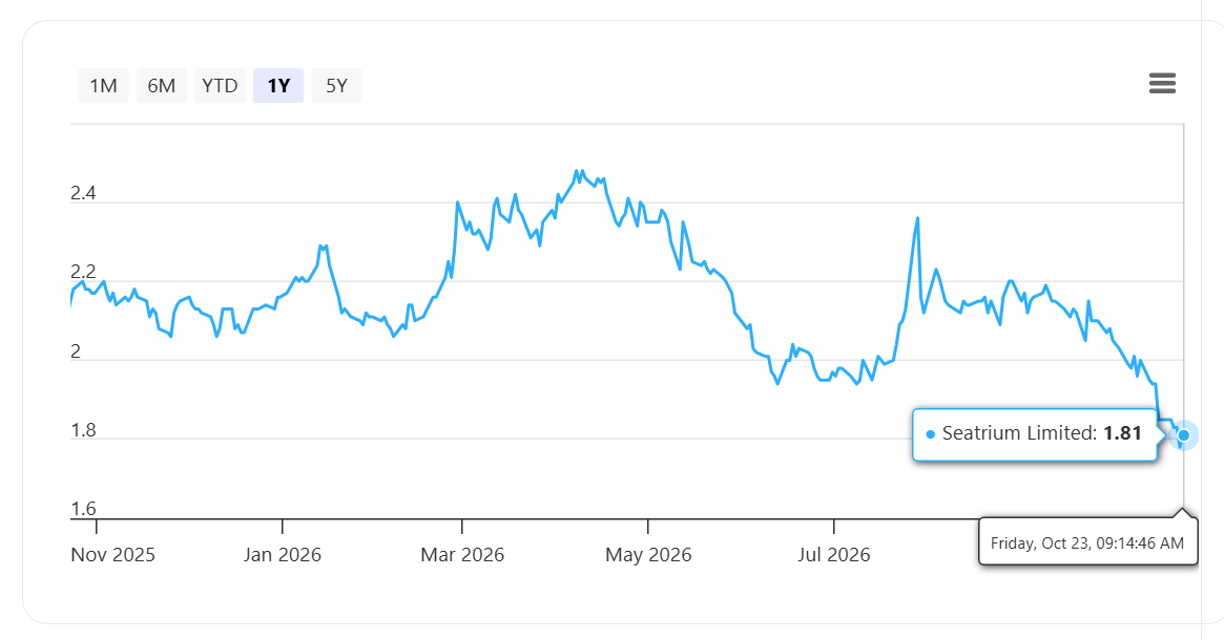
As of 23 October 2026, Seatrium’s share price has fallen 17.0% over the past year to S$1.81, placing it 2.3% above its 52-week low of S$1.77.
The latest results showed stronger profitability.
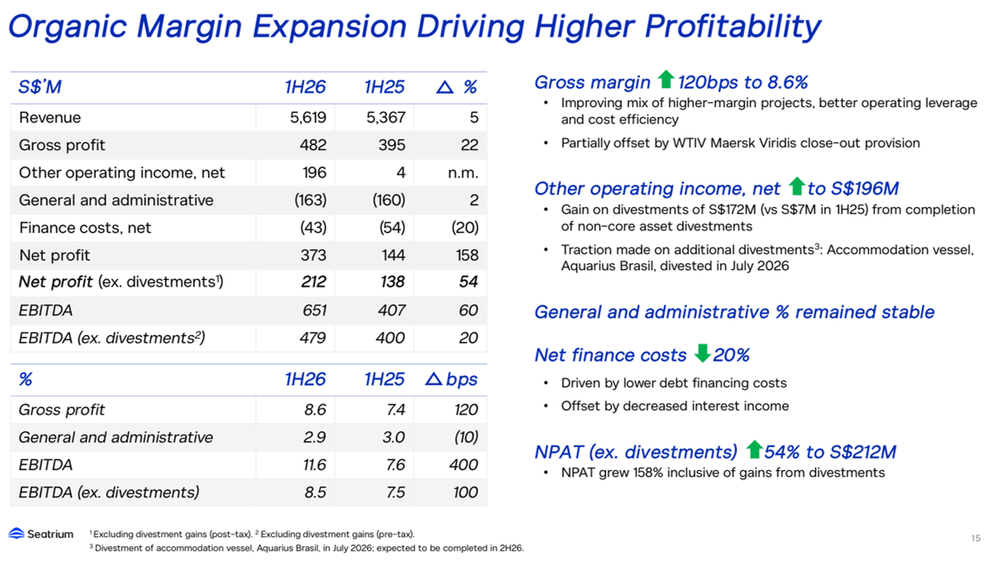
First-half 2026 revenue increased 4.7% to S$5.6 billion, while net profit rose to S$373 million from S$144 million.
Part of that increase came from divestment gains. Excluding those gains, net profit rose 54% to S$212 million.
Gross margin also improved to 8.6% from 7.4%, supported by a better project mix, operating leverage and cost efficiency.
Seatrium’s net order book stood at S$13.3 billion at end-June, covering 24 projects with deliveries extending to 2033.
This provides work visibility, although future growth also depends on securing new orders as existing projects are completed.
There have been recent contract wins to support its order pipeline.
In early October, Seatrium announced two floating storage and regasification unit (FSRU) contracts: its first engineering, procurement, construction, installation and commissioning (EPCIC) FSRU conversion for Excelerate Energy, and its ninth conversion project with Karpowership.
Engineering work for the Excelerate Energy project is expected to begin in the fourth quarter of 2026, with delivery targeted for 2028; financial terms were not disclosed.
Seatrium also renewed its Favoured Customer Contract with Carnival for cruise vessel maintenance and upgrades through 2029.
These contracts provide additional work, but their contribution to profits will depend on pricing and project execution.
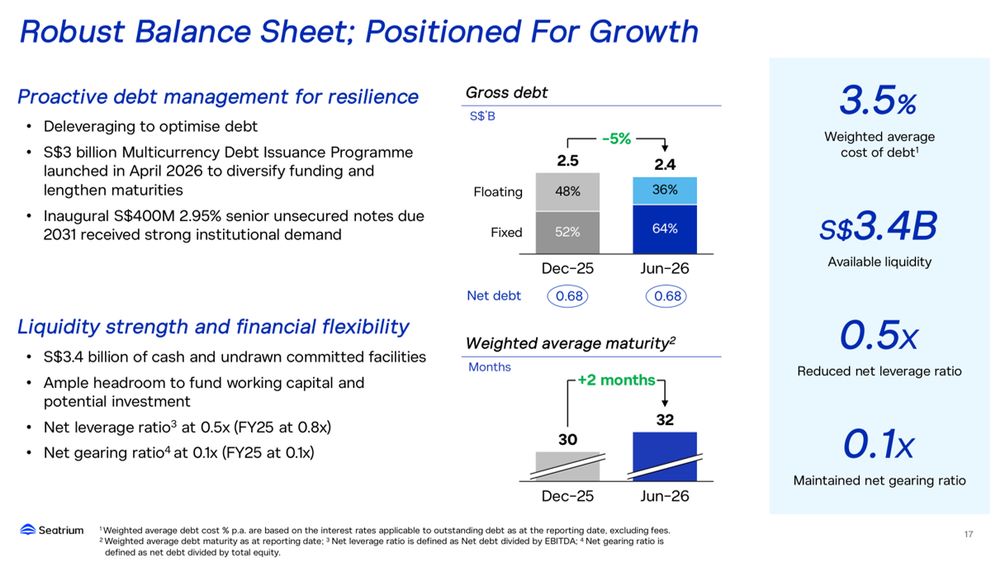
Its balance sheet offers some support. Seatrium reported S$3.4 billion of cash and undrawn committed facilities, net gearing of around 0.1 times and a reduction in gross debt.
For me, this is an earnings recovery story with improving margins, but returns on capital still need to strengthen.
I would focus on whether new projects sustain the better margins and whether reported profits convert into cash. Cost overruns, project delays or slower contract awards could weaken the recovery.
Related links:
#4 – City Developments: Project completions are lifting profits, with leverage to monitor
City Developments, or CDL, is a real estate group with property development, investment property and hotel businesses.
Its earnings depend on a combination of residential sales and completions, rental income, hotel operations and asset disposals.
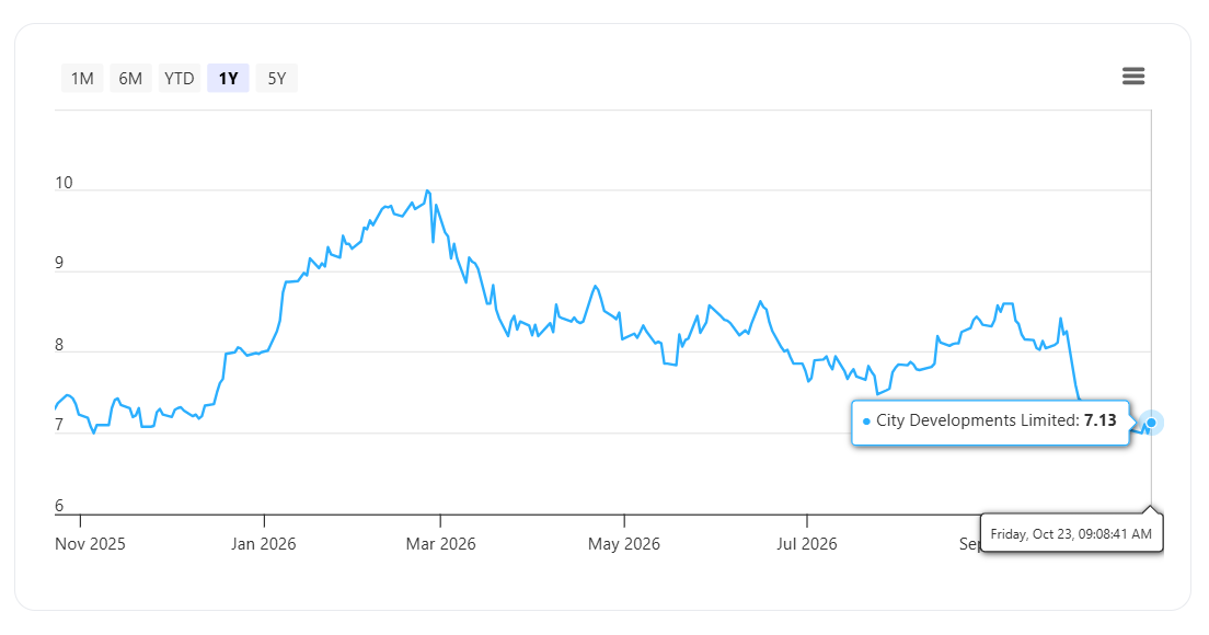
CDL’s share price has declined 3.3% over the past year to S$7.13, placing it 2.9% above its 52-week low of S$6.93.
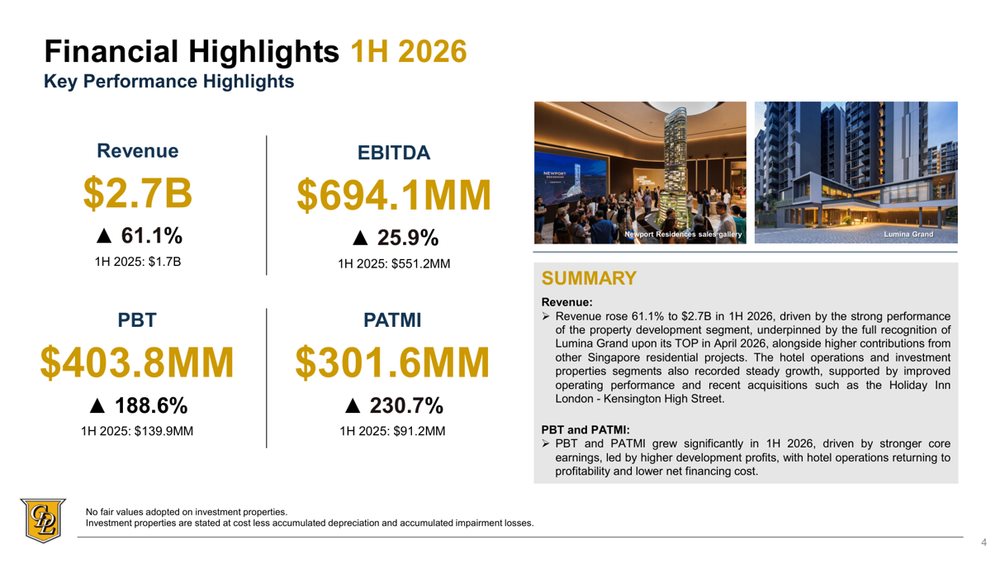
The first half of 2026 showed a significant improvement.
Revenue rose 61% to S$2.72 billion, while net profit increased to S$301.6 million from S$91.2 million.
A major contributor was Lumina Grand, which obtained its Temporary Occupation Permit in April. This allowed the development’s revenue and profit to be recognised in full under the accounting treatment for executive condominiums.
CDL also saw a strong start to sales at Lucerne Grand.
As at 6pm on 4 October, it had sold 350 of the development’s 570 units, or 61.4%, during the launch weekend at an overall average price of S$2,480 per square foot.
The sales could support future cash collections as buyers make progress payments, although the timing of cash receipts will depend on the payment schedule and project progress.
The hotel business also improved, with revenue per available room rising 4.9% and hotel operations returning to a pre-tax profit.
This shows that the earnings recovery was supported by more than one business, although property completion timing can still produce large swings between reporting periods.
The balance sheet remains an important consideration.
CDL has also conducted a strategic review, as it considers options to unlock value and improve capital efficiency.
CDL reported net gearing of 75% after including fair-value adjustments to investment properties, up from 71% at end-2025. On its cost accounting basis, gearing was 122%.
Interest cover fell to 3.1 times from 3.6 times, while cash and undrawn committed facilities totalled S$4.9 billion.
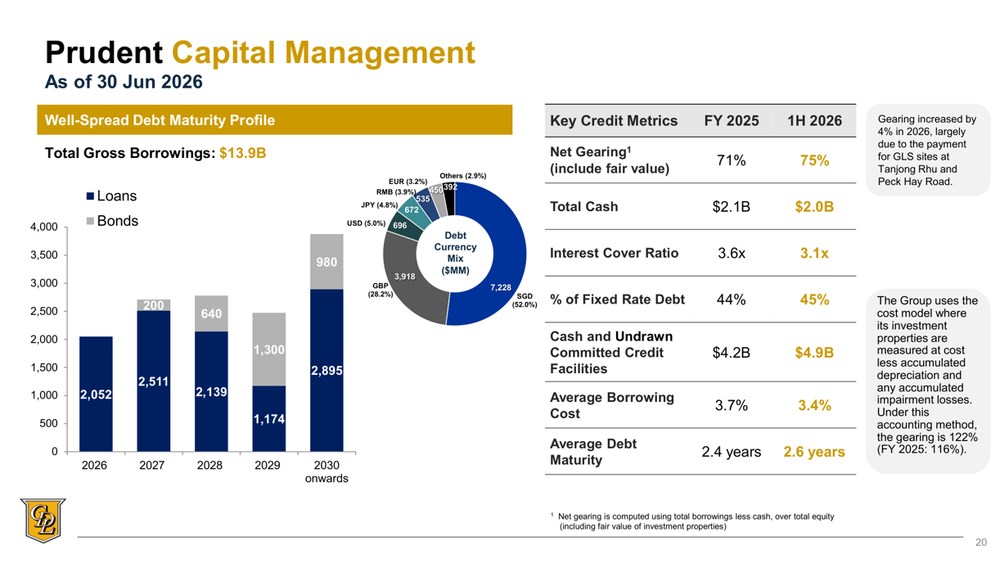
For me, the key question is whether stronger earnings and capital recycling translate into cash and lower debt. A smaller valuation discount would be easier to support if CDL improves returns while reducing financial pressure.
I would therefore watch project completions, cash collection, asset disposals and debt reduction together.
Related links:
#5 – UOL: Property earnings are improving, but capital returns remain modest
UOL is a property and hospitality group with interests in residential development, investment properties, hotels and serviced suites.
Its businesses include Singapore commercial properties and the Pan Pacific, PARKROYAL COLLECTION and PARKROYAL hotel brands.
This gives UOL a mix of development profits, rental income and hospitality earnings, rather than dependence on a single property segment.
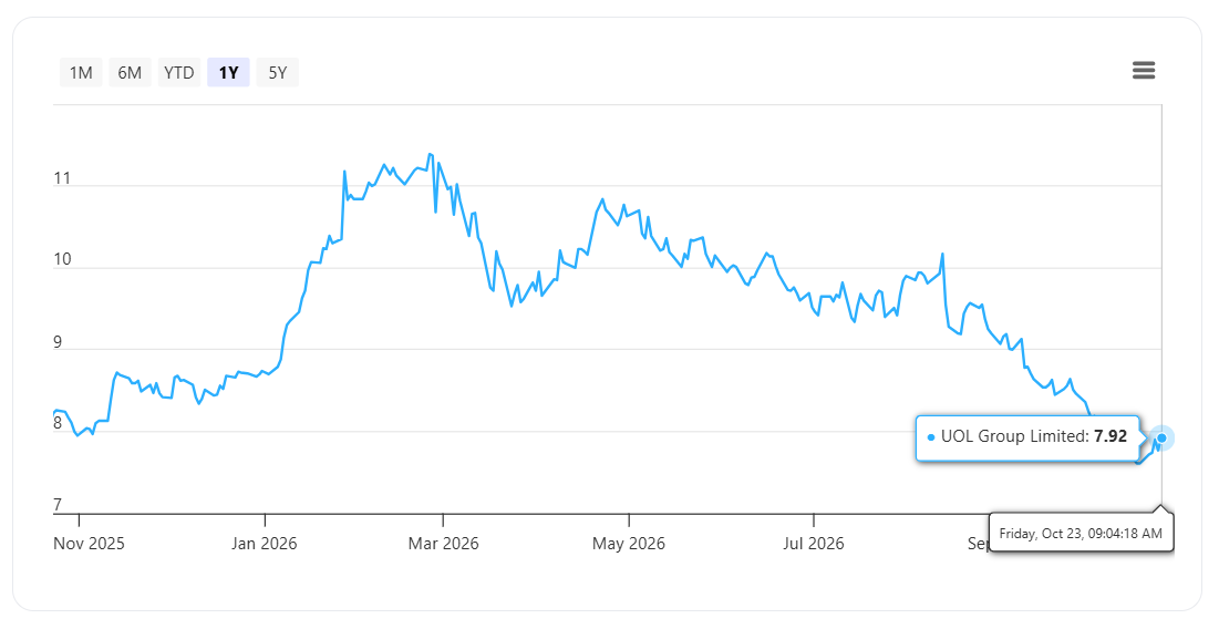
UOL’s share price has fallen 4.1% over the past year to S$7.92, placing it 4.5% above its 52-week low of S$7.58.
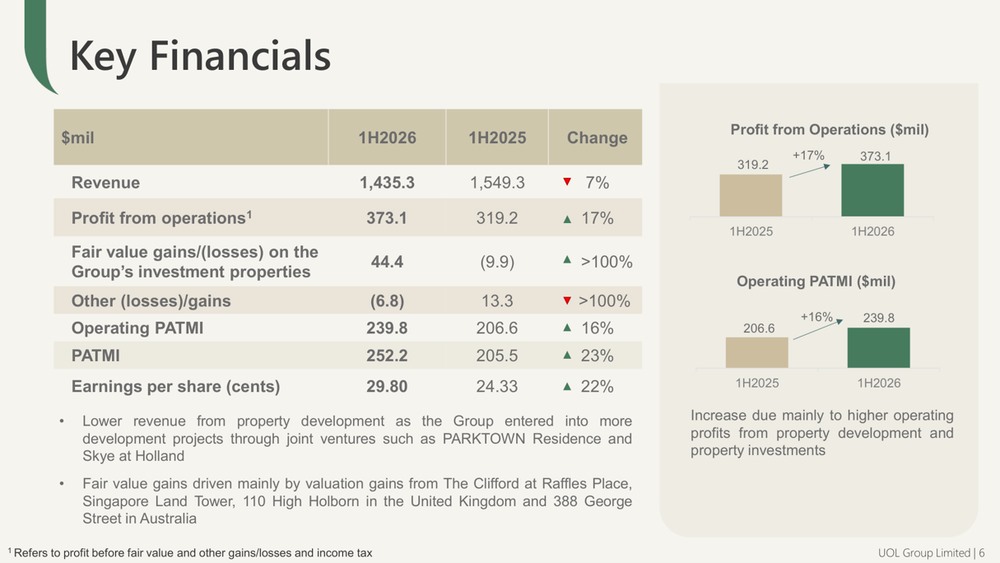
For the first half of 2026, operating PATMI rose 16% to S$239.8 million, while reported net profit increased 23% to S$252.2 million.
Revenue fell 7%, but this does not tell the full earnings story. More development activity took place through joint ventures, where contributions appear in UOL’s share of profits rather than consolidated revenue.
The investment property business also improved. Revenue rose 4% to S$316.7 million, supported by properties including Singapore Land Tower and West Mall following enhancement works.
These developments could help lift recurring earnings alongside contributions from residential projects.
However, expansion has increased borrowing requirements.
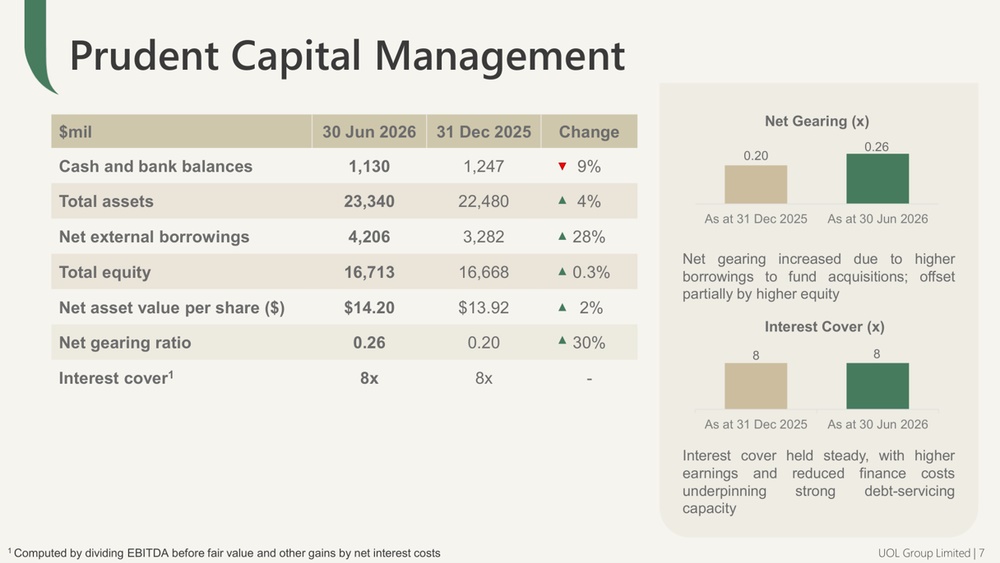
Company-reported net gearing rose to 0.26 times at end-June from 0.20 times at end-2025, while interest cover remained at eight times.
There is also a potential acquisition to watch.
New World Development and Abu Dhabi Investment Authority (ADIA) were reported to be in talks with UOL over a sale of the Hyatt Regency Hong Kong, Tsim Sha Tsui, potentially valuing the hotel at about HK$3 billion. However, no binding agreement has been announced.
For me, the opportunity depends on residential projects and rental growth generating better returns from UOL’s asset base. I would watch those earnings alongside the funding needs of acquisitions and redevelopment projects.
Related links:
What would Beansprout do?
With the pullback in the Singapore stock market, several blue chip stocks have now trading near their 52 week lows.
I would use these share prices trading near 52-week lows as a way to screen for stock ideas, rather than assume that a rebound is due.
But for me, the more important question is whether the fundamentals and valuation together offer an attractive enough potential return for the risks I am taking.
For my Opportunity Pot, I would look for improving earnings, a balance sheet that can support continued investment, and a credible path to better returns on shareholders’ capital.
| Stock | What stands out | Key risks |
| CapitaLand Investment | Growing fee revenue, stronger fundraising and potential capital recycling | Low ROE, sustainability of fee growth and pace of asset disposals |
| Seatrium | Higher underlying profit, improving project margins and a sizeable order book | Low ROE, cost overruns, project delays and pace of new orders |
| Singtel | Growing underlying earnings, stronger regional associate contributions and NCS margin improvement | Exceptional gains affecting reported earnings, infrastructure investment returns and valuation |
| UOL | Higher operating profit, improving rental income and a valuation below book value | Low ROE, property market conditions and increased borrowing requirements |
| City Developments | Stronger development profits, improving hotel performance and potential asset disposals | High gearing, uneven project completion earnings and conversion of profits into cash |
The next step is doing deeper research into whether their business and management, catalysts, valuation and risks.
In our Beansprout Pro research, we have identified which of these Singapore listed companies trading at a 52 week low offers attractive growth prospects, and examined their valuations and key risks.
Our latest Opportunity Pot Model Portfolio update also shows how we size individual positions so that we can participate in the upside while limiting the impact if the investment case does not play out as expected.
With the recent market volatility, you can continue to monitor and screen for Singapore stocks at 52-week lows here.
For investors who are looking to gain exposure to Singapore, we share 5 ways to invest in blue chips and growth opportunities here.
Which of these blue chips are you watching? Share your thoughts in the comments below or join the discussion in our Telegram community.
Planning to invest in Singapore blue chip stocks? Check out Beansprout's guide to the best stock trading platforms in Singapore with the latest promotions to invest in the Singapore market and see the latest promotions and sign-up rewards available.
Enjoyed this insight? Follow Beansprout on Telegram, Youtube, Facebook and Instagram, and add Beansprout as your preferred source on Google so you never miss an update.
Read also
Gain financial insights in minutes
Subscribe to our free weekly newsletter for more insights to grow your wealth
Most Popular

Comments
0 comments