
Asian stocks have rallied. 3 funds offering different ways to gain exposure
Mutual Funds
Powered by

By Gerald Wong, CFA • 25 Sep 2026
Why trust Beansprout? We’ve been awarded Best Investment Website at the SIAS Investors’ Choice Awards 2025
Asian stocks have rallied. Compare three UOBAM funds offering broad Asia, Greater China, and ASEAN dividend exposure, including key risks and fees.

This post was created in partnership with UOB Asset Management. All views and opinions expressed in this article are Beansprout's objective and professional opinions.
What happened?
Asian equities have enjoyed a strong run over the past year.
As at 31 July 2026, the MSCI AC Asia ex Japan Index returned 36.10% over one year in SGD terms1, supported by improving corporate earnings and strong demand for artificial intelligence and semiconductors.
After such a rally, investors may naturally wonder whether it is too late to gain exposure to the region.
However, rising stock prices do not necessarily mean that the investment case for Asia has run its course.
Earnings are still growing in several parts of the region, valuations vary across markets, and the next opportunities may come from countries and sectors different from those that led the initial rally.
In this article, we look at the outlook for Asian equities and compare three UOB Asset Management funds – United Asia Fund, United Greater China Fund, and the UOBAM Ping An FTSE ASEAN Dividend Index ETF – offering different types of exposure.
Is it too late to invest in Asia?
After the strong rally in Asian equities, it is understandable for investors to wonder whether much of the upside has already been captured.
However, there are a few reasons why the opportunity may not necessarily be over.
#1 – Earnings growth could continue to support parts of the region
The rally in Asian equities has been accompanied by improving corporate earnings.
As of 20 June 2026, UOB Asset Management (UOBAM) expected earnings per share for Asia ex-Japan to grow by 52.8% in 2026 and 23.1% in 2027, compared with 22.9% and 15.4% respectively for the US.
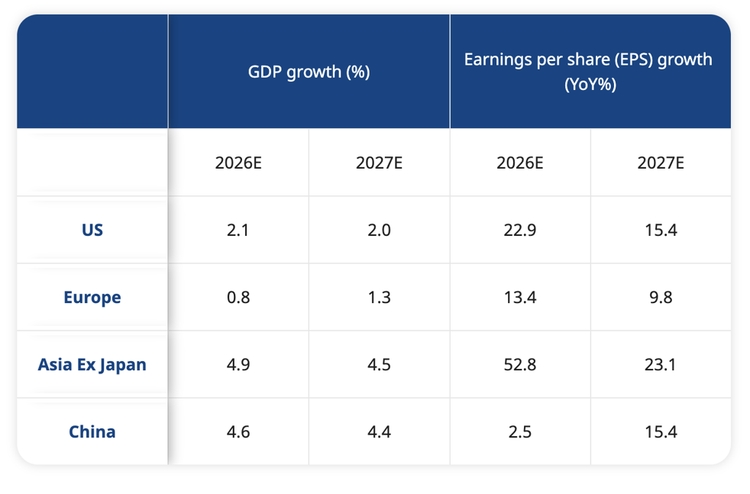
Technology has been an important contributor to this growth.
Taiwan and South Korea sit at the heart of the global semiconductor supply chain and have benefited from continued investment in artificial intelligence infrastructure.
In particular, demand for memory chips used in AI servers has supported companies such as Samsung Electronics and SK Hynix.
UOBAM believes the AI investment cycle remains intact despite the volatility seen in Asian technology stocks in July and August2.
It also points to improving earnings visibility for leading memory producers as contract prices catch up with higher spot prices and more supply is secured through longer-term agreements.
This suggests that the recent rally has not been driven by rising share prices alone.
Stronger earnings have also helped support Asian equities, although whether that earnings growth is sustained will remain an important factor for returns from here.
#2 – Not every Asian market has become expensive
Despite the rally, valuations vary significantly across Asia.
UOBAM notes that the region continues to trade at a valuation discount to the US even as earnings prospects remain strong.
There can also be large differences even within the same investment theme.
For example, UOBAM believes the correction in Korean technology stocks in July has made valuations more attractive.
The KOSPI was trading at 5.6x forward P/E as of 31 August 20263, despite earnings remaining near record levels and continued AI-linked demand.
That does not mean that Asian equities as a whole are cheap. Rather, the relative attractiveness of different markets has become increasingly important after the rally.
#3 – The next opportunities may look different from those that drove the rally
Taiwan and South Korea have benefited significantly from demand for semiconductors, memory chips and AI infrastructure. But the Asia investment universe is much broader.
India, for example, offers exposure to areas such as financial services, digitalisation and domestic consumption, while opportunities in China span areas including AI, semiconductors, advanced manufacturing and industrial technology.
UOBAM also expects the drivers of Asian earnings growth to broaden beyond technology over time.
Even if the outlook for parts of Asia remains constructive, deciding where to invest isn't straightforward.
Different markets are being supported by different drivers, while earnings prospects and valuations can also change over time.
Investors can select individual stocks or country-specific funds, although doing so requires them to assess different markets and companies themselves.
For investors considering Asia, the next question is what type of exposure they are seeking. The three UOBAM funds below illustrate three quite different approaches: broad regional growth, concentrated Greater China exposure and ASEAN dividend exposure.
Three UOBAM funds offering different types of Asia exposure
#1 – United Asia Fund: Broader Asia exposure
The United Asia Fund aims to achieve long-term capital growth by investing mainly in companies across Asia, excluding Japan.
The United Asia Fund is actively managed, which gives the investment team flexibility to adjust its exposure across markets and sectors depending on where it sees opportunities.
As at 31 July 2026, the fund’s largest country exposures were Taiwan, South Korea, India and China.
As the fund is actively managed, these allocations can change as UOBAM's views on earnings, valuations and market conditions evolve.
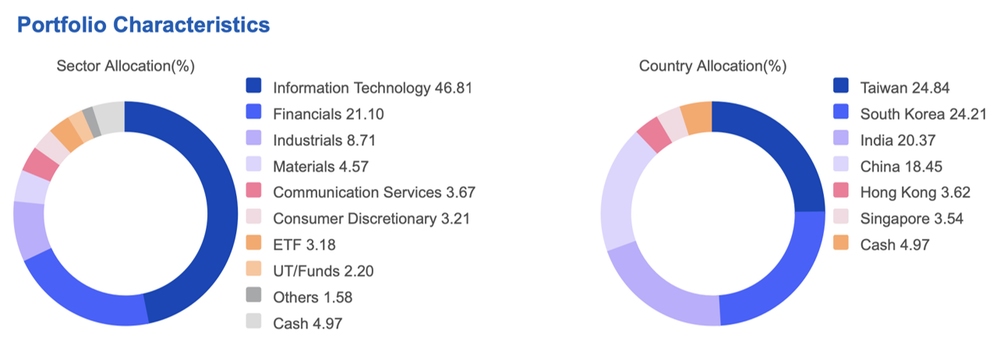
As at 31 July 2026, Information Technology was the fund's largest sector exposure at 46.81%. Its three largest holdings, TSMC (17.06%), Samsung Electronics (10.01%) and SK Hynix (6.62%), gave it significant exposure to the semiconductor and AI infrastructure theme.
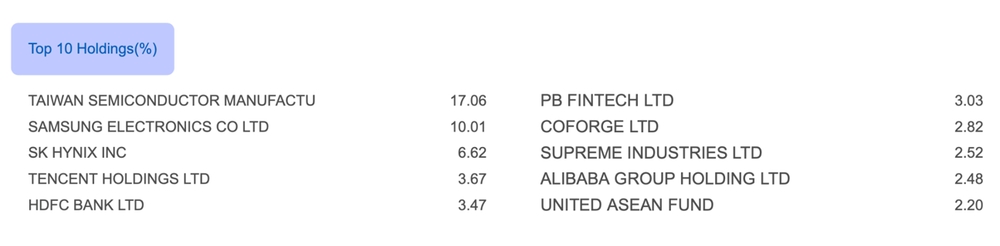
Beyond technology, Financials made up 21.10% of the portfolio, followed by Industrials at 8.71%. Other top holdings include Tencent, HDFC Bank, PB Fintech and Alibaba, providing exposure to themes ranging from Indian financial services to Chinese technology.
Learn more about the United Asia Fund here
#2 – United Greater China Fund: More concentrated Greater China exposure
The United Greater China Fund takes a more concentrated approach, investing primarily in companies with exposure to China, Hong Kong and Taiwan.
The fund aims to achieve long-term capital growth primarily by investing in companies with assets or revenues in or derived from these markets.
This is a narrower investment universe than the United Asia Fund, and the fund is actively managed, benchmarked to the MSCI Golden Dragon.
As at 31 July 2026, Taiwan was the fund's largest market allocation. Information Technology made up 50.28% of the portfolio, followed by Financials at 15.14% and Consumer Discretionary at 9.13%.
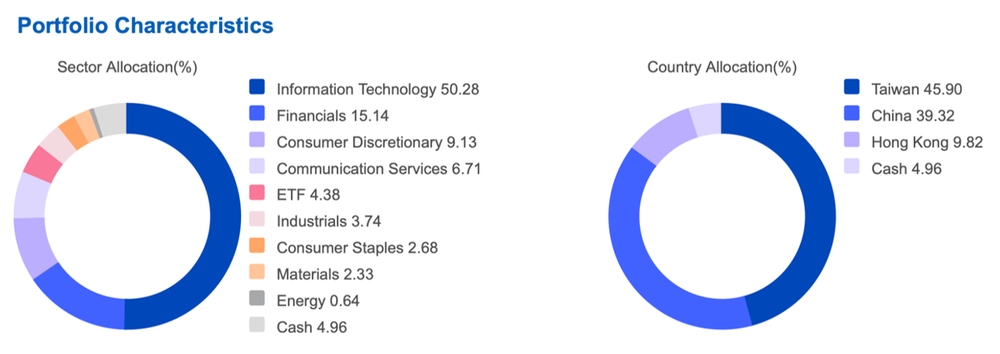
TSMC was the largest holding at 22.20%, while other top holdings included Tencent (4.93%), Alibaba (3.57%) and China CITIC Bank (3.53%).
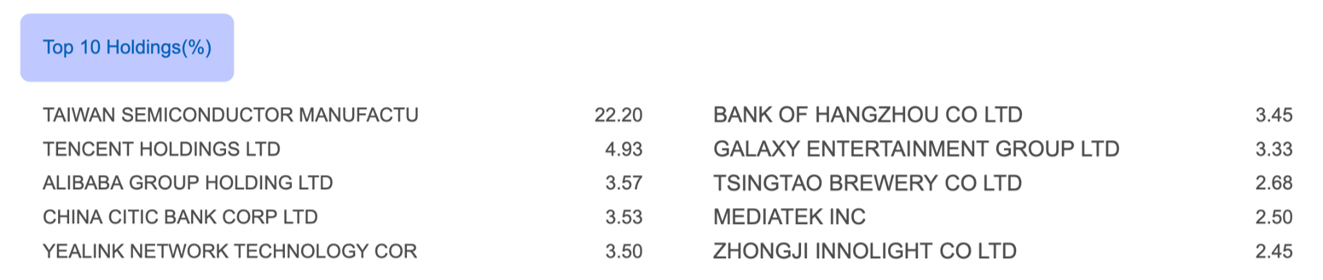
The portfolio currently combined substantial Taiwan technology exposure with investments in Chinese technology, financial and consumer-related businesses.
Learn more about the United Greater China Fund here
#3 – UOBAM Ping An FTSE ASEAN Dividend Index ETF: ASEAN dividend exposure
The UOBAM Ping An FTSE ASEAN Dividend Index ETF takes a different approach, providing dividend-focused exposure across ASEAN markets.
This ETF aims to deliver investment results that, before fees, costs and expenses, closely correspond to the FTSE ASEAN ex REITs Target Dividend Index.
As at 31 July 2026, its portfolio covered five ASEAN markets, led by Singapore and Thailand.
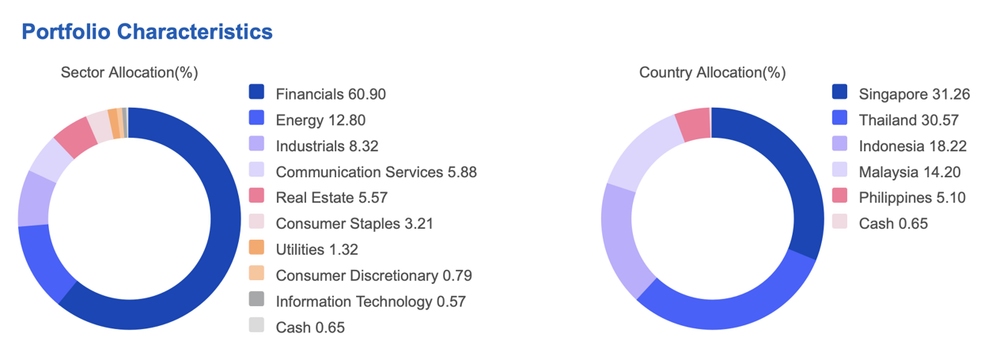
Financials accounted for 60.90% of the portfolio, followed by Energy at 12.80% and Industrials at 8.32%. Information Technology represented just 0.57%.
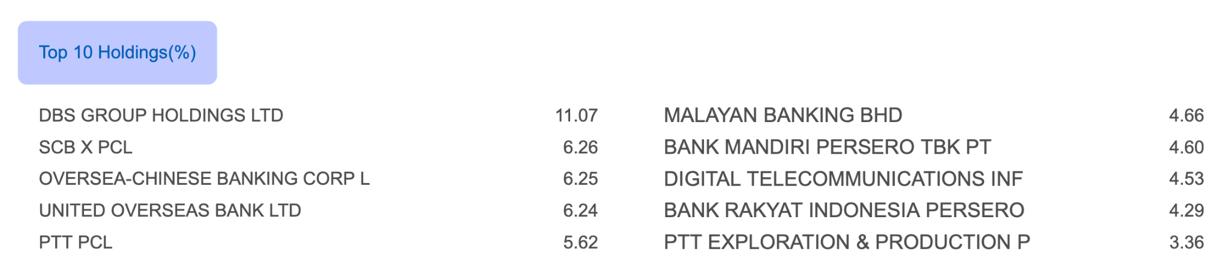
Its largest holdings included DBS (11.07%), SCB X (6.26%), OCBC (6.25%), UOB (6.24%) and PTT (5.62%).
This gives investors a different mix of companies from the technology-heavy United Asia Fund and United Greater China Fund, but also introduces significant Financials concentration.
The SGD Class has an expected semi-annual distribution frequency. Distributions are not guaranteed and may be paid from income, capital gains and/or capital.
Learn more about the UOBAM Ping An FTSE ASEAN Dividend Index ETF here
Summary of three UOBAM funds offering different types of Asia exposure
| Detail | United Asia Fund | United Greater China Fund | UOBAM Ping An FTSE ASEAN Dividend Index ETF |
| Investment focus and approach | Actively managed fund seeking long-term capital growth across Asia, excluding Japan. | Actively managed fund seeking long-term capital growth through companies with assets or revenues in or derived from China, Hong Kong SAR and Taiwan. | Index-tracking ETF providing dividend-focused exposure to five ASEAN markets, excluding REITs. |
| Fund size | S$210.02 million | S$118.45 million | S$84.80 million |
| Annual management fee | 1.25% p.a. for both A SGD Acc and A SGD Dist. | 1.50% p.a. for A SGD Acc. | 0.45% p.a. |
| How to buy and sell | Through fund distributors | Through fund distributors | Through a broker, on SGX |
| Cash/SRS access and minimum investment | Cash or SRS. Minimum S$1,000 | Cash or SRS. Minimum S$1,000 | Cash or SRS. SGX board lot: 1 unit, at the prevailing market price, plus trading charges. |
| Distributions* | Acc: accumulation Dist: expected quarterly | Accumulation class | Expected semi-annually |
| Performance^ (NAV-to-NAV basis) | A SGD Acc class: 6M: 10.87% 1Y: 40.72% 3Y: 15.08% 5Y: 5.44% 10Y: 8.49% | A SGD Acc class: 6M: 6.40% 1Y: 37.55% 3Y: 15.70% 5Y: 6.76% 10Y: 10.40% | SGD class: 6M: 4.76% 1Y: N/A 3Y: N/A 5Y: N/A 10Y: N/A |
| Source: UOB Asset Management. *Distribution frequency is expected, not guaranteed. ^Performance as at 31 July 2026, SGD basis, with dividends and distributions reinvested, if any. Performance figures for 1 month till 1 year show the % change, while performance figures above 1 year show the average annual compounded returns. Since inception performance under 1 year is not annualised. Distributor terms and available share classes may differ. | |||
How do the funds look for opportunities?
The United Asia Fund and the United Greater China Fund are actively managed strategies.
For the United Asia Fund, UOBAM uses its AI-Augmentation@UOBAM framework alongside traditional investment research.
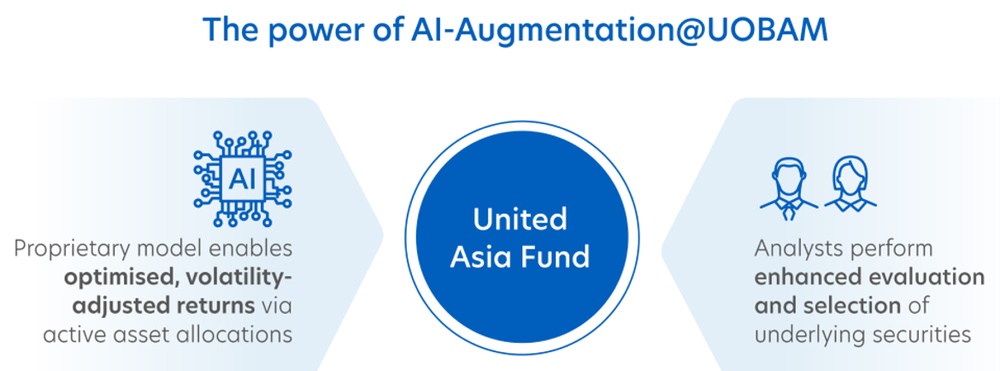
The technology analyses a wider investment universe and factors such as momentum, quality, volatility and liquidity, while investment decisions ultimately remain with the fund management team.
The United Greater China Fund also incorporates UOBAM's AI-Augmentation process, combining analyst research with AI and machine-learning techniques to support stock selection and portfolio allocation.
The UOBAM Ping An FTSE ASEAN Dividend Index ETF works differently because it is an index-tracking ETF.
Its holdings are determined largely by the FTSE ASEAN ex REITs Target Dividend Index methodology.
The index is designed to tilt towards companies with stronger dividend yields while applying rules intended to address issues such as concentration, turnover and "yield traps".
The key distinction is that the UOBAM Ping An FTSE ASEAN Dividend Index ETF follows a defined rules-based dividend strategy, while the United Asia Fund and the United Greater China Fund give their investment teams flexibility to select and adjust investments within their respective markets.
AI supports rather than replaces investment judgement, and neither AI nor active management guarantees outperformance.
What are the risks investors should consider?
#1 – Sector concentration and overlapping holdings
As at 31 July 2026, Information Technology accounted for 46.81% of the United Asia Fund and 50.28% of the United Greater China Fund.
Both held sizeable TSMC positions, making changes in semiconductor demand, AI-related spending and technology valuations relevant to both portfolios.
The UOBAM Ping An FTSE ASEAN Dividend Index ETF had a different concentration: 60.90% in Financials.
Its low technology allocation does not make it a low-risk investment. Investors with existing Singapore bank holdings should also check how much those holdings overlap with the ETF.
#2 – Country and geopolitical risk
Taiwan, South Korea, India and China together accounted for close to 88% of the United Asia Fund as at 31 July 2026. The United Greater China Fund was focused on Taiwan, China and Hong Kong, while Singapore and Thailand together made up 61.83% of the UOBAM Ping An FTSE ASEAN Dividend Index ETF.
Each market comes with its own set of risks, ranging from changes in economic policy and regulation to geopolitical tensions and shifts in global trade.
For example, developments affecting the semiconductor supply chain could have a meaningful impact on Taiwan and South Korea, while the outlook for China remains sensitive to domestic economic conditions and policy developments.
#3 - Currency risk
Although the funds’ base currency is Singapore dollars, it invests in companies across multiple Asian markets.
Changes in exchange rates can therefore affect the value of the fund’s underlying investments when translated back into Singapore dollars.
#4 – Market volatility
Asian equities can also experience significant short-term swings.
Investors should therefore be comfortable with the possibility of periods of sharp volatility, even when the longer-term outlook remains positive.
As with any equity fund, the value of an investment can fall as well as rise, and past performance is not indicative of future performance.
What would Beansprout do?
We would avoid adding Asia exposure simply because markets have already rallied.
Instead, we would look at whether the underlying earnings outlook, valuations and long-term growth drivers still support the investment case.
Our house view remains constructive on selected parts of Asia.
South Korea remains one of our preferred markets, supported by AI-related memory demand, the Value Up programme and relatively undemanding valuations.
We remain positive on Taiwan’s exposure to AI and semiconductor capex, although we would be more selective after its strong re-rating.
India’s longer-term structural growth story also remains intact, while China remains our least preferred market given weak macro conditions and the ongoing property downturn.
Against this backdrop, the United Asia Fund offers investors a broad regional growth exposure, with meaningful allocations to South Korea, Taiwan and India.
However, we would still be mindful of its sizeable technology exposure and allocation to China.
Learn more about the United Asia Fund here
We would be more selective on the United Greater China Fund.
Its large Taiwan technology exposure provides access to the AI theme we remain constructive on, but its China and Hong Kong exposure means investors are also taking exposure to markets where our house view remains more cautious.
Learn more about the United Greater China Fund here
The UOBAM Ping An FTSE ASEAN Dividend Index ETF offers a different proposition.
Its focus on ASEAN dividend stocks and relatively low technology exposure could provide diversification from the AI-heavy regional funds, while its exposure to Singapore also aligns with our positive view on the market.
However, we would be mindful that Financials make up more than half of the ETF.
For Singapore investors who already own DBS, OCBC or UOB, this could result in significant overlap rather than additional diversification.
Learn more about the UOBAM Ping An FTSE ASEAN Dividend Index ETF here.
For investors with significant US exposure, Asia can provide access to different markets and growth drivers. But adding more fund names does not automatically mean adding more diversification.
We would look through to the underlying companies, consider the fees and risks, and choose the exposure that fits our objectives and investment horizon.
1UOB Asset Management, United Asia Fund factsheet, August 2026. Data as at 31 July 2026.
2https://www.uobam.com.sg/uobam/insights/investment-perspective/ai-trade-asia.page
3Factset, as of 31 August 2026
Important Notice and Disclaimers
Distributions will be made in respect of the Distribution Classes of the Fund. Distributions are based on the NAV per unit of the relevant Distribution Class as at the last business day of the calendar month or quarter. The making of distributions is at the absolute discretion of UOB Asset Management Ltd’s (“UOBAM”) and that distributions are not guaranteed. The making of any distribution shall not be taken to imply that further distributions will be made. UOBAM reserves the right to vary the frequency and/or amount of distributions. Distributions from a fund may be made out of income and/or capital gains and (if income and/or capital gains are insufficient) out of capital. Investors should also note that the declaration and/or payment of distributions (whether out of income, capital gains, capital or otherwise) may have the effect of lowering the net asset value (NAV) of the relevant fund. Moreover, distributions out of capital may amount to a reduction of part of your original investment and may result in reduced future returns. Please refer to the Fund's prospectus for more information.
This document is for general information only. It does not constitute an offer or solicitation to deal in units in the Fund (“Units”) or investment advice or recommendation and was prepared without regard to the specific objectives, financial situation or needs of any particular person who may receive it.
The information contained in this document, including any data, projections and underlying assumptions, are based upon certain assumptions, management forecasts and analysis of information available and reflects prevailing conditions and UOBAM views as of the date of the document, all of which are subject to change at any time without notice. In preparing this document, UOBAM has relied upon and assumed, without independent verification, the accuracy and completeness of all information available from public sources or which was otherwise reviewed by UOBAM. While the information provided herein is believed to be reliable, UOBAM makes no representation or warranty whether express or implied, and accepts no responsibility or liability for its completeness or accuracy. Nothing in this document shall, under any circumstances constitute a continuing representation or give rise to any implication that there has not been or there will not be any change affecting the Fund. No representation or promise as to the performance of the Fund or the return on your investment is made. Past performance of the Fund or UOBAM and any past performance or prediction, projection or forecast of the economic trends or securities market are not necessarily indicative of the future or likely performance of the Fund or UOBAM. The value of Units and the income from them, if any, may fall as well as rise, and is likely to have high volatility due to the investment policies and/or portfolio management techniques employed by the Fund. Investments in Units involve risks, including the possible loss of the principal amount invested, and are not obligations of, deposits in, or guaranteed or insured by United Overseas Bank Limited (“UOB”), UOBAM, or any of their subsidiary, associate or affiliate (“UOB Group”) or distributors of the Fund. The Fund may use or invest in financial derivative instruments and you should be aware of the risks associated with investments in financial derivative instruments which are described in the Fund's prospectus. The UOB Group may have interests in the Units and may also perform or seek to perform brokering and other investment or securities-related services for the Fund.
Investors should note that the Fund is not like a conventional unit trust in that an investor cannot redeem his Units directly with UOBAM and can only do so through the participating dealers if his redemption amount satisfies a prescribed minimum that will be comparatively larger than that required for redemptions of units in a conventional unit trust. An investor may therefore only be able to realise the value of his Units by selling the Units on the Singapore Exchange Limited (“SGX”). Investors should also note that any listing and quotation of Units on the SGX does not guarantee a liquid market for the Units.
An investment in unit trusts is subject to investment risks and foreign exchange risks, including the possible loss of all or part of the principal amount invested. Investors should read the Fund's prospectus and product highlights sheet, which are available and may be obtained from UOBAM or any of its appointed agents or distributors, before deciding whether to subscribe for or purchase any Units. You are responsible for your own investment decisions. You may wish to seek advice from a financial adviser before making a commitment to invest in any Units, and in the event that you choose not to do so, you should consider carefully whether the Fund is suitable for you.
This advertisement has not been reviewed by the Monetary Authority of Singapore.
UOB Asset Management Ltd Co. Reg. No. 198600120Z
Read also
Gain financial insights in minutes
Subscribe to our free weekly newsletter for more insights to grow your wealth
Most Popular

Comments
0 comments