
Will rising bond yields hurt stocks? What 5 indicators tell us: Beansprout Investment Climate
Bonds
By Gerald Wong, CFA • 14 Oct 2026
Why trust Beansprout? We’ve been awarded Best Investment Website at the SIAS Investors’ Choice Awards 2025
'%3e%3cpath%20fill-rule='evenodd'%20clip-rule='evenodd'%20d='M17.64%209.20455C17.64%208.56637%2017.5827%207.95273%2017.4764%207.36364H9V10.845H13.8436C13.635%2011.97%2013.0009%2012.9232%2012.0477%2013.5614V15.8195H14.9564C16.6582%2014.2527%2017.64%2011.9455%2017.64%209.20455V9.20455Z'%20fill='%234285F4'/%3e%3cpath%20fill-rule='evenodd'%20clip-rule='evenodd'%20d='M9%2018C11.43%2018%2013.4673%2017.1941%2014.9564%2015.8195L12.0477%2013.5614C11.2418%2014.1014%2010.2109%2014.4205%209%2014.4205C6.65591%2014.4205%204.67182%2012.8373%203.96409%2010.71H0.957275V13.0418C2.43818%2015.9832%205.48182%2018%209%2018V18Z'%20fill='%2334A853'/%3e%3cpath%20fill-rule='evenodd'%20clip-rule='evenodd'%20d='M3.96409%2010.71C3.78409%2010.17%203.68182%209.59318%203.68182%209C3.68182%208.40682%203.78409%207.83%203.96409%207.29V4.95818H0.957273C0.347727%206.17318%200%207.54773%200%209C0%2010.4523%200.347727%2011.8268%200.957273%2013.0418L3.96409%2010.71V10.71Z'%20fill='%23FBBC05'/%3e%3cpath%20fill-rule='evenodd'%20clip-rule='evenodd'%20d='M9%203.57955C10.3214%203.57955%2011.5077%204.03364%2012.4405%204.92545L15.0218%202.34409C13.4632%200.891818%2011.4259%200%209%200C5.48182%200%202.43818%202.01682%200.957275%204.95818L3.96409%207.29C4.67182%205.16273%206.65591%203.57955%209%203.57955V3.57955Z'%20fill='%23EA4335'/%3e%3c/g%3e%3cdefs%3e%3cclipPath%20id='clip0_0_2849'%3e%3crect%20width='18'%20height='18'%20fill='white'/%3e%3c/clipPath%3e%3c/defs%3e%3c/svg%3e)
Make Beansprout your preferred source on Google
Add us on Google to see more of our insights in your search results
Will rising bond yields hurt stocks? We assess five key indicators, including inflation, economic growth and valuations, to understand the investment outlook.
What happened?
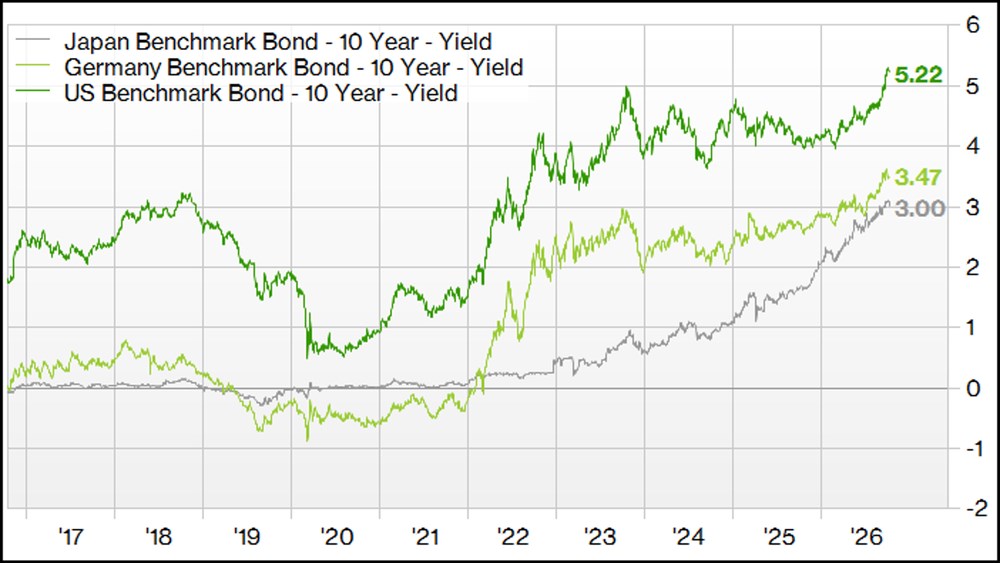
Bond yields have been rising sharply around the world, while stock markets have experienced increased volatility.
The US 10-year Treasury yield has risen significantly this year, alongside higher government bond yields in Japan and Europe.
This has raised an important question for investors: Will higher bond yields lead to further declines in stock markets, and should we be taking a more defensive stance?
As we shared earlier, higher bond yields can put pressure on stocks in several ways. They increase borrowing costs for companies, make bonds more attractive relative to equities, and can weigh on stock valuations.
Recently, we have seen how higher bond yields have impacted sentiment towards Singapore stocks, as the Straits Times Index (STI) pulled back from record highs, while Singapore bank stocks DBS, OCBC and UOB also corrected.
However, rising bond yields do not necessarily mean that stocks will always perform poorly, as the difference often comes down to the underlying economic conditions.
This is why we believe it is important to look beyond bond yields alone when assessing the outlook for investments.
Introducing the Beansprout Investment Climate
At Beansprout, we have developed a framework to assess whether the investment environment is becoming more favourable, or whether market risks are increasing.
We call this the Beansprout Investment Climate, a regular assessment of five key indicators that shape our investment outlook.
These are:
- Inflation
- Economic growth
- Corporate earnings
- Valuations
- AI investments
The first four are fundamental drivers of investment outlook that remain relevant across different market cycles.
While AI investments have been a key driver of economic growth, we have chosen to track them separately because they have become such a significant driver of economic activity and stock market performance.
Over time, we may replace AI investments with another major driver of economic growth and market returns as the investment environment evolves.
Our indicators are primarily focused on the US, given its significant influence on global financial markets and the Singapore economy. As the saying goes, when America sneezes, the rest of the world catches a cold.
A slowdown in the US economy can eventually affect Singapore through weaker global demand, trade and business investment, often with a lag.
Rather than trying to predict every market movement, we monitor these indicators to understand how the investment environment is changing and whether there are reasons to become more cautious.
Importantly, no single indicator tells us everything. For example, rising bond yields may be less concerning when economic growth and corporate earnings remain strong. However, they could pose a greater risk when inflation stays elevated while economic growth slows.
What is the Beansprout Investment Climate telling us now?
Based on our latest assessment in October 2026, inflation is the biggest concern among the five indicators we track.
However, economic growth and corporate earnings remain resilient, while equity valuations have become more reasonable following the recent market correction.
AI investments also remain an important driver of growth, although we are watching this area more closely as investors increasingly question the returns on spending.
Taken together, these indicators suggest that while market risks have increased, there are not sufficient reasons to turn outright defensive yet.
Here is our current assessment.
| Indicator | Our assessment | What we're watching |
| 1. Inflation | Concerning | Whether elevated oil prices lead to persistent inflation and higher interest rates |
| 2. Economic growth | Resilient | Whether economic growth stays resilient despite weakening consumer confidence |
| 3. Corporate earnings | Resilient | Whether companies can maintain earnings growth despite higher costs |
| 4. Valuations | More reasonable | Whether equity valuations remain attractive relative to earnings and bond yields |
| 5. AI investments | Still supportive, but worth watching | Whether AI spending continues to grow and delivers sustainable returns |
Let's take a closer look at each indicator.
#1 - Inflation: Our biggest concern
Of the five indicators, inflation is currently giving us the greatest cause for concern.
One of the main drivers of the recent increase in bond yields has been higher oil prices, amid continued tensions in the Middle East.
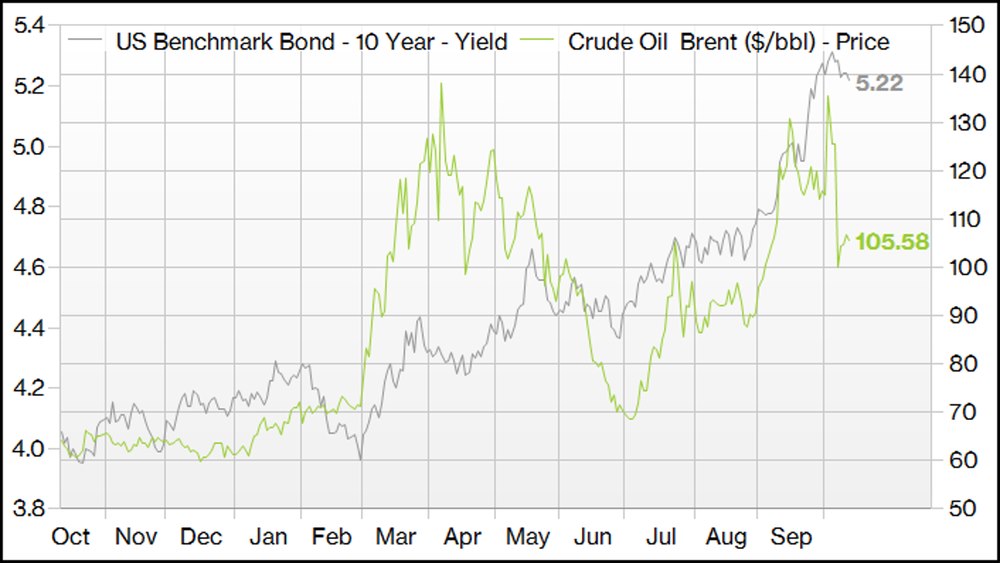
As the chart below shows, Brent crude oil prices have risen sharply over the past year, reaching approximately US$105.60 per barrel as of 13 October 2026.
Over the same period, the US 10-year Treasury yield has climbed from around 4% to 5.22%.
While the two do not always move together, the recent increase in oil prices has contributed to concerns that inflation could remain elevated, keeping bond yields higher for longer.
With the Middle East conflict showing few signs of a quick resolution, oil prices may remain elevated for some time.
Higher energy prices can increase transportation and production costs for businesses. If companies pass these costs on to consumers, inflation could remain elevated for longer.
This matters because central banks may need to maintain high interest rates, or even hike rates further, to contain inflation.
Higher interest rates can then lead to tighter financial conditions, slower economic growth and increased pressure on company earnings.
In other words, the concern is not simply that oil prices are rising. It is whether higher oil prices lead to more persistent inflation and force central banks to keep monetary policy tighter than expected.
For now, we believe inflation remains the clearest risk to the investment outlook.
You can track some of the key indicators for inflation here:
- Oil price
- US Federal Reserve interest rate expectations and projections
- US 10 Year government bond yield
- Singapore 10 Year government bond yield
#2 - Economic growth: Still resilient despite weak consumer sentiment
Despite higher interest rates, the US economy has remained relatively resilient.
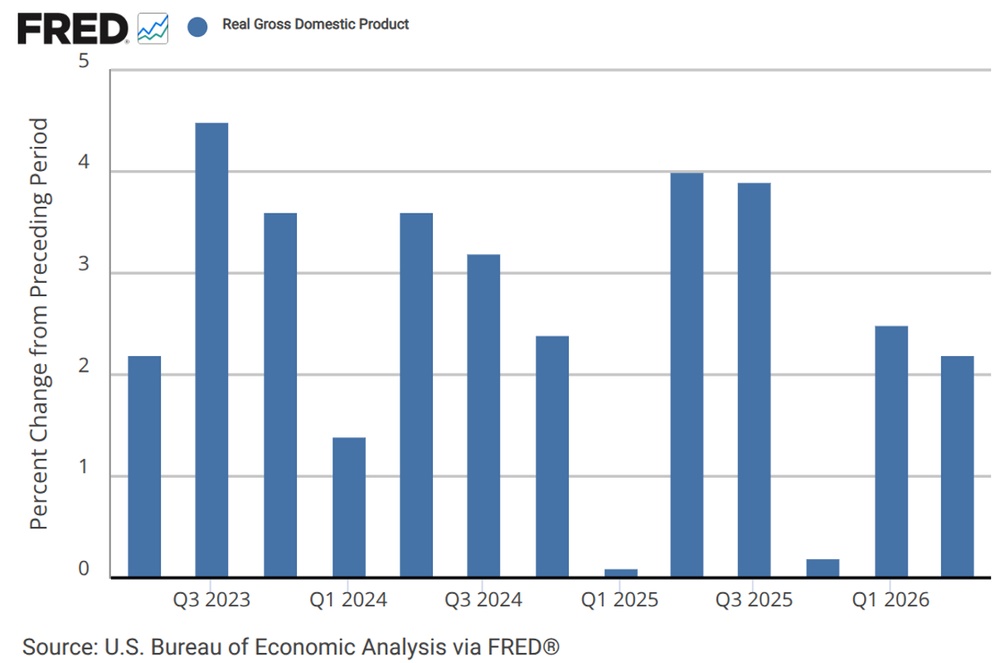
As the chart below shows, US real GDP grew at an annualised rate of 2.2% in the second quarter of 2026, following growth of 2.5% in the first quarter.
While economic growth has moderated, the US economy continues to expand.
According to the US Bureau of Economic Analysis, consumer spending, business investment and exports contributed positively to growth in the second quarter.
However, there is a growing divergence between what the economic data is telling us and how consumers are feeling.
The University of Michigan's Consumer Sentiment Index fell to 46.3 in the preliminary October 2026 survey, compared with 48.1 in September.
As the chart below shows, consumer sentiment is now near some of the lowest levels recorded over the past several decades.
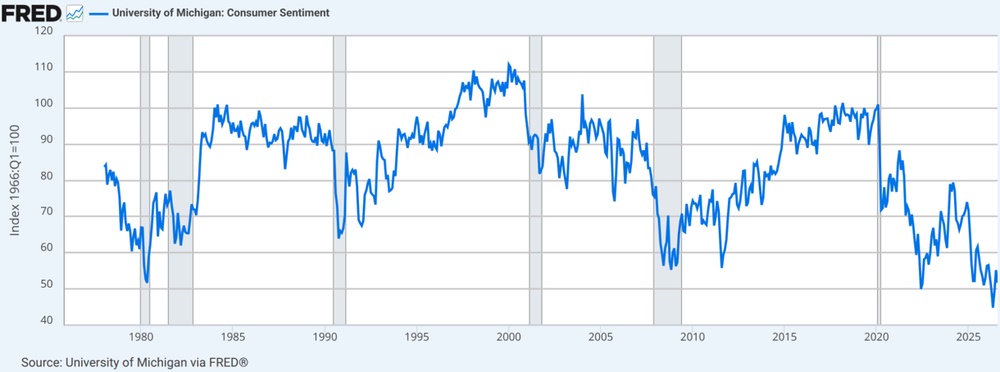
This suggests that many households remain concerned about their financial circumstances, even as overall economic activity continues to expand.
The key question is whether this weakness in consumer sentiment will eventually translate into lower spending.
So far, this has not happened on a scale that would suggest a sharp economic slowdown.
However, if consumers begin cutting back significantly, businesses could see weaker demand, which may eventually affect hiring and investment decisions.
While consumer confidence is weak, we have not yet seen sufficient evidence of a broader deterioration in economic growth.
#3 - Corporate earnings: Can companies continue growing profits?
Corporate earnings are another important indicator of whether stock markets can withstand higher bond yields.
When bond yields rise, companies may face higher borrowing costs, particularly if they have significant debt or refinancing requirements.
At the same time, higher input costs and slower economic growth could put pressure on profit margins.
However, companies that can continue growing their earnings despite these challenges may be better positioned to withstand higher interest rates.
Earnings growth remains resilient
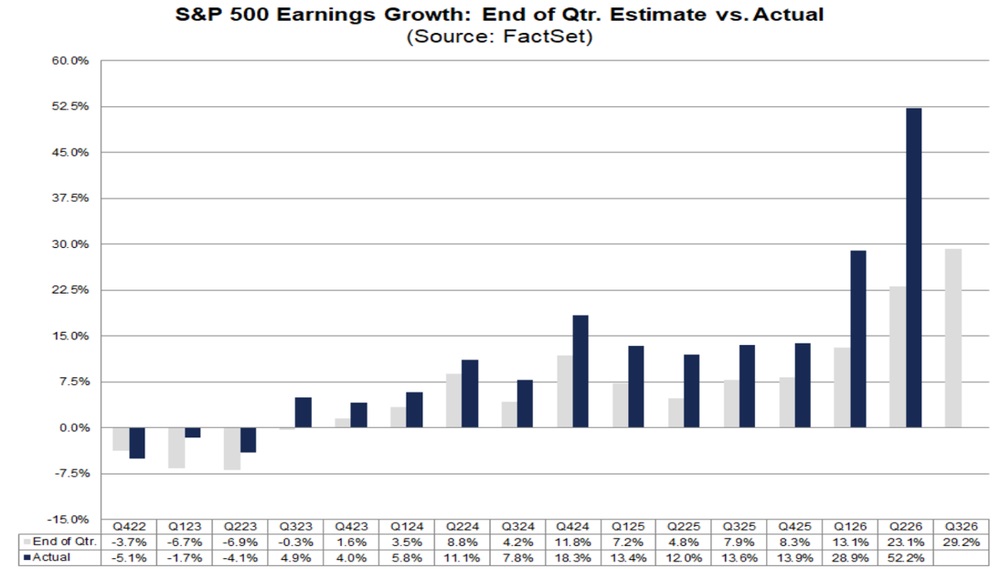
As the first chart below shows, S&P 500 companies have continued to deliver strong earnings growth, with reported earnings generally exceeding analysts' estimates in recent quarters.
According to FactSet, the S&P 500 was expected to report earnings growth of 29% year on year for the third quarter of 2026, based on estimates as of 9 October.
This would mark the third consecutive quarter of earnings growth exceeding 25%.
FactSet also noted that actual earnings growth has exceeded estimates made at the end of the quarter in 37 of the previous 40 quarters.
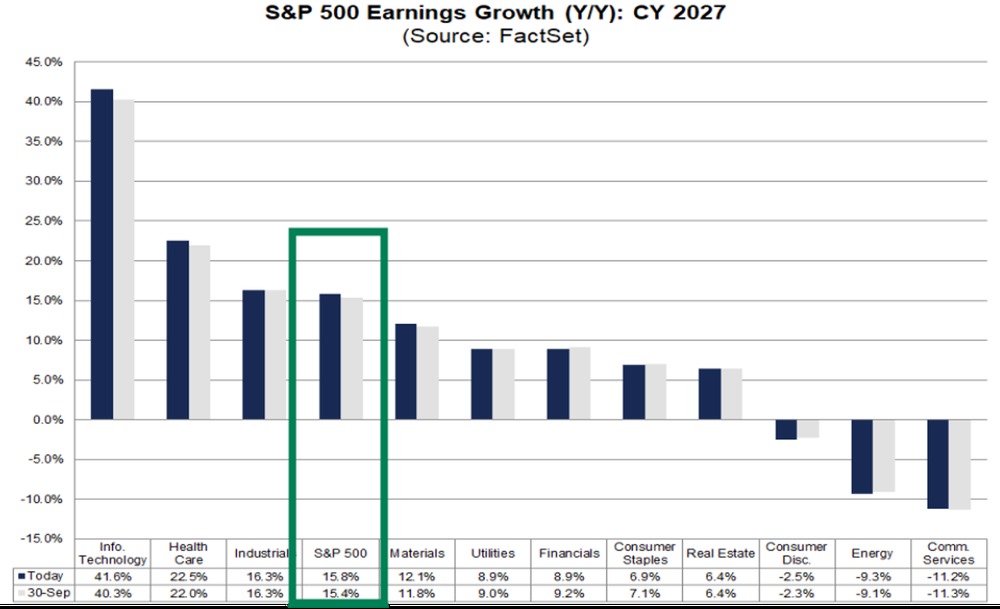
However, analysts expect earnings growth to moderate next year.
As the chart below shows, consensus estimates point to approximately 15.8% earnings growth for the S&P 500 in 2027.
Importantly, the outlook varies significantly across sectors, with technology expected to remain a major contributor to earnings growth.
This suggests that while overall earnings growth remains supportive, investors will need to pay closer attention to which sectors and companies can continue delivering strong profits.
Why earnings matter when bond yields rise
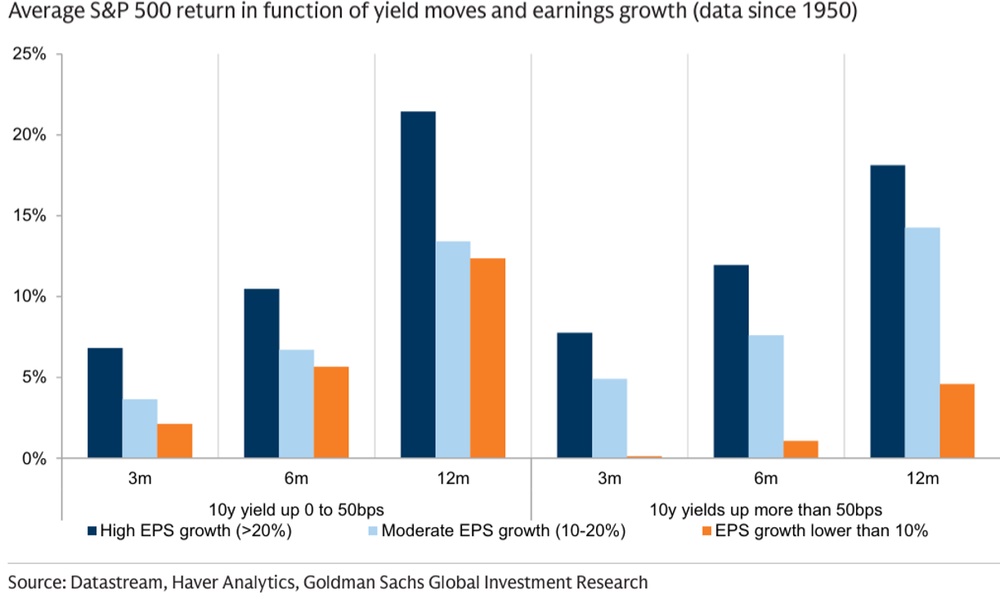
Historical data also suggests that stock market returns have generally been more resilient during periods of stronger earnings growth, even when bond yields were rising.
The chart below compares historical S&P 500 returns across different levels of earnings growth and changes in bond yields.
For example, during periods when the US 10-year Treasury yield rose by more than 0.5 percentage points, the S&P 500 generated average returns of approximately 18% over 12 months when earnings growth exceeded 20%.
In contrast, average returns were closer to 4% to 5% when earnings growth was below 10%.
These are historical averages rather than forecasts, but they illustrate why earnings growth can be an important source of support for stock markets even when bond yields are rising.
This is why we believe the outlook for corporate earnings matters as much as the direction of bond yields.
As companies report their latest quarterly results, we will be paying close attention to whether they can continue delivering earnings growth and maintaining their profit margins.
We will also watch whether analysts begin revising their earnings forecasts lower.
A sustained decline in earnings expectations, combined with elevated bond yields, would be a more concerning development for equities.
For now, corporate earnings remain a source of support for equity markets.
#4 - Valuations: Have stocks become more attractive?
Even when economic growth and corporate earnings remain strong, the price investors pay for an investment matters.
When valuations are elevated, future investment returns may be more limited, particularly if earnings growth disappoints.
Higher bond yields can also put pressure on equity valuations.
This is because investors can earn higher returns from bonds, potentially making them less willing to pay a premium for stocks.
Equity valuations have become more reasonable
The recent market correction has brought some equity valuations back to more reasonable levels.
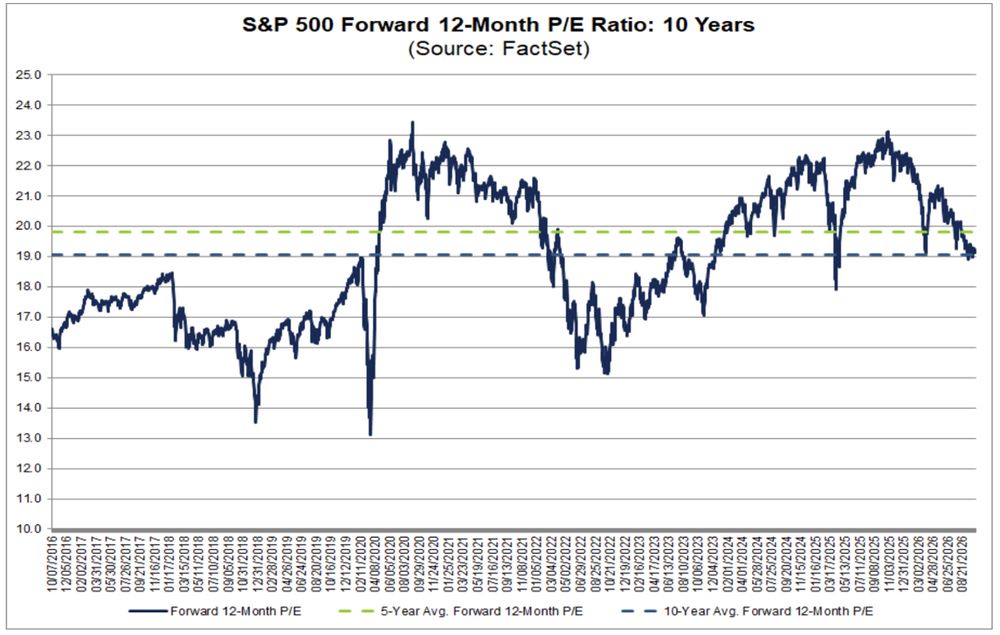
As the chart below shows, the S&P 500 forward price-to-earnings ratio has declined from around 22 to 23 times earlier in the year to approximately 19 times.
This brings valuations closer to their 10-year average.
The decline reflects a combination of the recent market pullback and continued growth in corporate earnings expectations.
Importantly, this does not necessarily mean that all stocks are cheap. Valuations can vary significantly across sectors and individual companies.
It also means that future stock market returns may increasingly depend on earnings growth, rather than investors being willing to pay higher valuation multiples.
Bonds are becoming more attractive relative to equities
At the same time, bond yields have risen significantly.
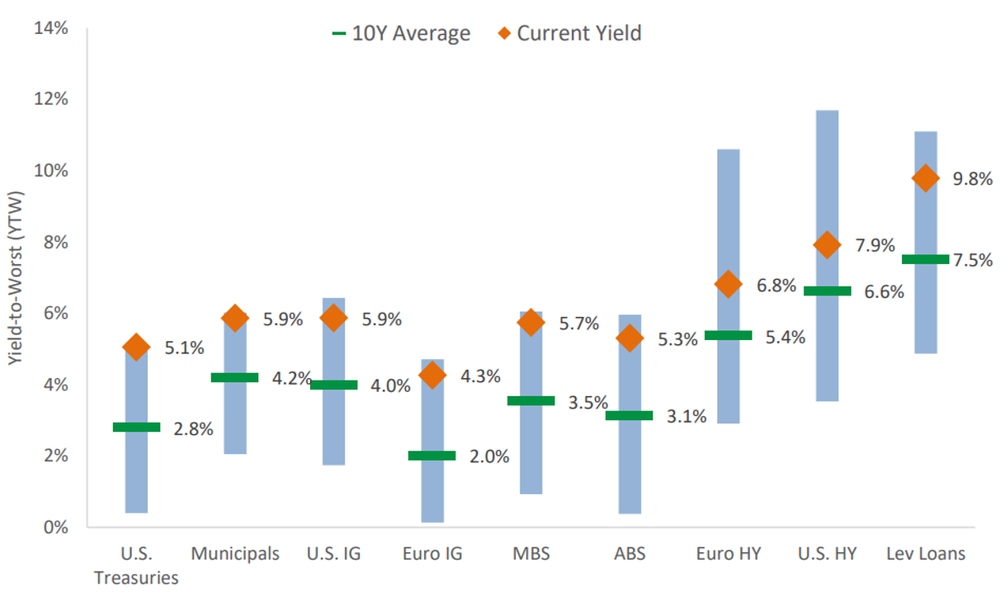
As the chart below shows, yields across several fixed income segments are now above their respective 10-year averages.
For example, the Apollo comparison shows US Treasury yields of approximately 5.1%, compared with a 10-year average of 2.8%.
US investment-grade corporate bond yields are also shown at around 5.9%, compared with a historical average of 4.0%.
This means that investors can now earn higher yields from bonds than they could during much of the past decade.
As a result, equities face greater competition from fixed income investments.
However, higher yields also reflect increased inflation and interest rate risks, and bond prices could decline further if yields continue rising.
For now, we believe equity valuations have become more reasonable, but there remains a need to be selective.
#5 - AI investments: Will spending continue to support growth?
AI investments have become an increasingly important driver of US economic growth, with major technology companies investing heavily in data centres, computing infrastructure and other AI capabilities.
While AI investments would typically be captured under our economic growth indicator, their scale and influence on financial markets mean that we believe they warrant closer attention.
This is why we have included AI investments as a separate indicator in our current Beansprout Investment Climate assessment.
AI capital expenditure is expected to continue growing
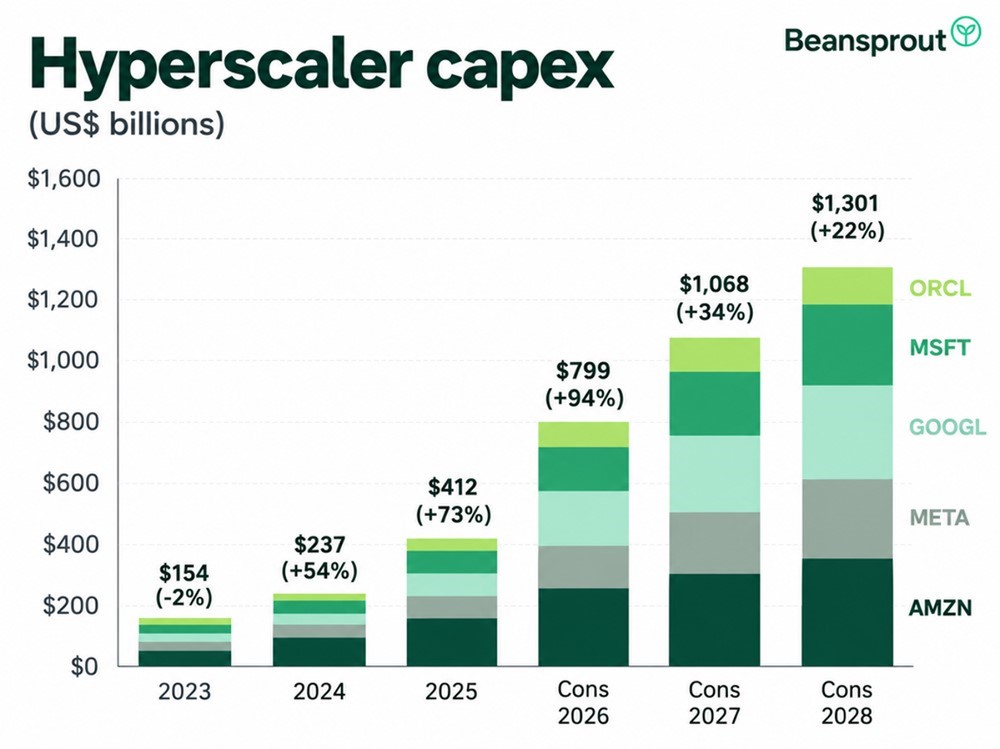
As the chart below shows, capital expenditure by five major hyperscalers, Amazon, Meta, Alphabet, Microsoft and Oracle, has increased significantly in recent years.
According to the FactSet estimates shown in the chart, their combined capital expenditure is projected to rise from approximately US$412 billion in 2025 to US$799 billion in 2026, representing growth of 94%.
Spending is expected to increase further to US$1.07 trillion in 2027 and US$1.30 trillion in 2028.
However, the growth rate is projected to moderate from 94% in 2026 to 34% in 2027 and 22% in 2028.
These figures cover the companies' overall capital expenditure, much of which is associated with AI infrastructure, rather than exclusively AI-related spending.
Can companies generate sufficient returns from AI investments?
The second question is whether companies can generate attractive returns from their AI investments.
The scale of AI spending has raised questions about how quickly these investments can translate into higher revenue, improved productivity and stronger profits.
One important distinction from previous technology investment cycles is that much of the current AI capital expenditure by major technology companies is supported by their own operating cash flows, rather than being funded entirely through borrowing.
This provides some reassurance about the financial sustainability of spending by the larger companies.
However, it does not mean that every company exposed to AI will benefit equally, or that investors will continue to reward AI-related stocks regardless of valuations.
We continue to see AI as an important driver of economic growth, but believe greater selectivity is warranted as investment expectations rise.
Beansprout's take: Putting the five factors together
The sharp rise in bond yields has raised concerns about whether stock markets could experience further declines.
However, our assessment of the five indicators suggests that it may be premature to turn outright defensive.
Inflation is currently our biggest concern, particularly as elevated oil prices could keep interest rates higher for longer.
At the same time, economic growth and corporate earnings remain resilient, while equity valuations have become more reasonable following the recent market correction.
AI investments also continue to support growth, although investors are increasingly focused on whether these investments can deliver attractive returns.
Taken together, only one of the five indicators is currently flashing a clear warning signal.
This suggests that while market risks have increased, the underlying conditions supporting investment returns have not deteriorated sufficiently to warrant an outright defensive stance.
Our overall assessment of the investment climate therefore remains cautiously constructive.
What would make us change our view?
The key question is whether the risks we are monitoring begin to spread beyond inflation.
For example, we would become more cautious if weakening consumer confidence starts to affect spending, AI investment growth slows significantly, or corporate earnings expectations begin to deteriorate.
A combination of weaker economic growth, declining earnings and persistently high bond yields would be particularly concerning for stock markets.
Conversely, if inflationary pressures ease while economic growth and corporate earnings remain resilient, the investment environment could become more supportive.
Rather than trying to predict exactly where stock markets or bond yields will move next, we believe it is more useful to monitor whether these underlying conditions are changing.
Through the Beansprout Investment Climate, we will continue tracking these five indicators and updating our assessment as new developments emerge.
What would Beansprout do?
Amid the changing economic environment, we return to our Four Pots of Wealth framework, which allows us to make investment decisions based on the role each investment plays in our portfolio, rather than reacting to short-term market movements.
For our Liquidity Pot, higher interest rates are creating more opportunities to earn attractive returns on cash. We continue to compare savings accounts, fixed deposits, T-bills and other short-term instruments, while ensuring that we maintain sufficient liquidity for our immediate needs.
For our Growth Pot, which focuses on building wealth through long-term compounding, we believe there is no need to react to every market movement. Rather than trying to predict when markets will bottom, we can continue dollar-cost averaging (DCA) into diversified investments over time.
For our Income Pot, we are starting to warm up to bonds. Higher bond yields have improved their potential risk and reward, creating more interesting opportunities to generate income. However, with the possibility of yields rising further, we believe there is no need to rush into increasing bond exposure aggressively.
For our Opportunity Pot, we remain cautiously constructive on equities but are becoming more selective about where we allocate capital. We favour large-cap companies with strong balance sheets, healthy cash flows and sustainable earnings growth.
Through the Beansprout Investment Climate, we will continue monitoring these five indicators and updating our assessment as market conditions evolve.
Do check back regularly to see what has changed and what it means for the investment outlook.
For Beansprout Pro subscribers, we take this analysis a step further.
Read also
Gain financial insights in minutes
Subscribe to our free weekly newsletter for more insights to grow your wealth
Most Popular

Comments
0 comments