
Bond investing in Singapore: A beginner’s guide to yields, coupons and duration
bonds-101
By Gerald Wong, CFA • 09 Oct 2026
Why trust Beansprout? We’ve been awarded Best Investment Website at the SIAS Investors’ Choice Awards 2025
'%3e%3cpath%20fill-rule='evenodd'%20clip-rule='evenodd'%20d='M17.64%209.20455C17.64%208.56637%2017.5827%207.95273%2017.4764%207.36364H9V10.845H13.8436C13.635%2011.97%2013.0009%2012.9232%2012.0477%2013.5614V15.8195H14.9564C16.6582%2014.2527%2017.64%2011.9455%2017.64%209.20455V9.20455Z'%20fill='%234285F4'/%3e%3cpath%20fill-rule='evenodd'%20clip-rule='evenodd'%20d='M9%2018C11.43%2018%2013.4673%2017.1941%2014.9564%2015.8195L12.0477%2013.5614C11.2418%2014.1014%2010.2109%2014.4205%209%2014.4205C6.65591%2014.4205%204.67182%2012.8373%203.96409%2010.71H0.957275V13.0418C2.43818%2015.9832%205.48182%2018%209%2018V18Z'%20fill='%2334A853'/%3e%3cpath%20fill-rule='evenodd'%20clip-rule='evenodd'%20d='M3.96409%2010.71C3.78409%2010.17%203.68182%209.59318%203.68182%209C3.68182%208.40682%203.78409%207.83%203.96409%207.29V4.95818H0.957273C0.347727%206.17318%200%207.54773%200%209C0%2010.4523%200.347727%2011.8268%200.957273%2013.0418L3.96409%2010.71V10.71Z'%20fill='%23FBBC05'/%3e%3cpath%20fill-rule='evenodd'%20clip-rule='evenodd'%20d='M9%203.57955C10.3214%203.57955%2011.5077%204.03364%2012.4405%204.92545L15.0218%202.34409C13.4632%200.891818%2011.4259%200%209%200C5.48182%200%202.43818%202.01682%200.957275%204.95818L3.96409%207.29C4.67182%205.16273%206.65591%203.57955%209%203.57955V3.57955Z'%20fill='%23EA4335'/%3e%3c/g%3e%3cdefs%3e%3cclipPath%20id='clip0_0_2849'%3e%3crect%20width='18'%20height='18'%20fill='white'/%3e%3c/clipPath%3e%3c/defs%3e%3c/svg%3e)
Make Beansprout your preferred source on Google
Add us on Google to see more of our insights in your search results
Learn how bond investing in Singapore works, including bond yields, coupon rates, yield to maturity, duration, risks and the different ways to invest in bonds.
What happened?
The rising bond yields have been a hot discussion topic in the Beansprout community.
Bonds can be one pillar within the Income Pot of Beansprout’s Four Pots of Wealth framework, and are commonly used by investors looking for income and diversification.
But if you are new to bond investing in Singapore, terms such as coupon, yield, yield to maturity and duration can quickly become confusing.
We raised a question about bonds in the Beansprout community channel and found that over 30% of members were unclear about the mechanisms of bonds.
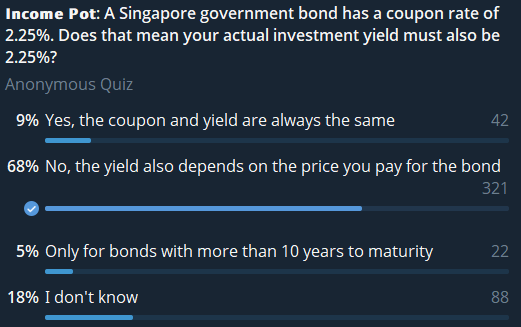
The key thing to understand is that a bond's coupon is not necessarily the return you will earn.
In this article, we will cover how bond investing works and how to understand bond yields, coupon rates, yield to maturity, duration, risks and the different ways to invest in bonds in Singapore.
To make these concepts easier to understand, we will use a real example throughout this guide, the 10 year Singapore Government Securities bond, NZ16100X, which was reopened in August 2026.
At its August 2026 auction:
| Feature | NZ16100X |
| Principal amount | S$1,000 |
| Coupon rate | 2.25% per year |
| Coupon payment | S$11.25 every six months |
| Auction price | About S$997.48 per every S$1,000 principal, before accrued interest |
| Yield to maturity | 2.30% per year |
| Maturity date | 1 August 2036 |
We will use these numbers to understand how bonds actually work.
What is a bond?
A bond is essentially a loan from an investor to a government or company.
When you buy a bond, the issuer agrees to:
- Pay you interest during the life of the bond
- Repay the principal when the bond matures
For example, NZ16100X is a Singapore Government Securities, or SGS, bond.
An investor holding S$1,000 in principal receives S$11.25 every six months, or S$22.50 a year.
When the bond matures on 1 August 2036, the investor is expected to receive the S$1,000 principal back.
This gives us the basic structure of a bond.
However, there are several different terms investors need to understand.
What are the key bond terms?
Here are the main terms you will come across when investing in bonds.
| Term | What it means | NZ16100X example |
| Principal or face value | Amount repaid at maturity | S$1,000 |
| Coupon rate | Interest rate based on face value | 2.25% per year |
| Coupon payment | Interest paid to the bondholder | S$22.50 per year |
| Bond price | What you pay for the bond | About S$997.48 before accrued interest |
| Yield to maturity | Estimated annualised return if held to maturity | 2.30% per year |
| Maturity | When the principal is due to be repaid | 1 August 2036 |
| Duration | Sensitivity of the bond price to changes in interest rates | Longer dated bonds generally have greater sensitivity |
| Credit risk | Risk that the issuer cannot make its payments | Depends on the issuer |
The distinction between coupon, price, and yield is particularly important.
What is a bond coupon?
The coupon is the interest paid by the bond issuer on a regular basis.
NZ16100X has a coupon rate of 2.25% per year.
For every S$1,000 of principal held, an investor receives:
S$1,000 x 2.25% = S$22.50 per year.
The bond pays its coupon every six months, so the investor receives S$11.25 twice a year.
The important point is that the coupon is calculated based on the bond's face value. It does not change just because the market price of the bond changes.
For example, an investor who paid S$950 for S$1,000 of principal would still receive S$22.50 a year.
Meanwhile, an investor who paid S$1,050 would also receive S$22.50 a year.
This is why the coupon rate alone does not tell us the full return from a bond and we need to consider the price paid for it as well.
What is bond yield?
The bond yield tells us the return we are earning if we hold the bond to maturity.
This is where price starts to matter because the price will determine what the yield of the bond is.
NZ16100X has a coupon rate of 2.25%.
But, successful investors at the August 2026 auction paid about S$997.48 for every S$1,000 in principal, before accrued interest.
In other words, they paid slightly less than the S$1,000 they are expected to receive when the bond matures which makes their return slightly higher than the 2.25% coupon rate.
In this case, the yield to maturity at the auction was 2.30% per year.
This illustrates an important relationship:
What is yield to maturity?
Yield to maturity, or YTM, is one of the most useful numbers when comparing bonds.
It estimates the annualised return an investor may earn if the bond is held until maturity, assuming the issuer makes all its payments as promised.
Yield to maturity takes into account:
- The price you pay for the bond,
- The coupon payments you receive,
- The principal you receive at maturity,
- The time remaining until maturity.
Because investors paid slightly less than S$1,000 for S$1,000 of principal, the yield to maturity on NZ16100X was 2.30%, even though its coupon rate was only 2.25%.
They receive the S$22.50 annual coupon and, if they hold the bond until maturity, they are expected to receive the full S$1,000 in principal.
The difference between the purchase price and the amount received at maturity also contributes to the higher yield to maturity.
Because NZ16100X was a reopened bond, successful applicants also paid accrued interest. This affects the settlement amount, but does not change the basic distinction between the bond's coupon rate and its yield to maturity.
Coupon rate vs current yield vs yield to maturity
| Measure | What it tells you |
| Coupon rate | Interest paid as a percentage of the bond's face value |
| Current yield | Coupon income relative to the current market price |
| Yield to maturity | Estimated annualised return if the bond is held until maturity |
For most investors comparing bonds, we would pay more attention to yield to maturity than the coupon rate alone.
A bond with a 5% coupon might have a lower yield to maturity than one with a 3% coupon because the price you pay matters too.
Why do bond prices fall when interest rates rise?
Bond prices and interest rates generally move in opposite directions.
For example, imagine you own NZ16100X, which pays a coupon rate of 2.25%.
Suppose newly issued Singapore Government bonds of similar maturity start offering significantly higher yields.
Investors would naturally prefer the newer bonds if they could earn a higher return for similar risk.
For the existing NZ16100X bond to remain attractive, its market price would have to fall.
That lower price pushes its yield higher to make it comparable with the newly issued Singapore Government bonds of similar maturity.
The reverse can happen when market yields decline.
If newly issued bonds offer lower yields, the existing 2.25% coupon becomes relatively more attractive. Investors may then be willing to pay a higher price for the bond, which would make its yield to maturity lower.
This is why rising market yields generally lead to falling bond prices, while falling market yields generally lead to rising bond prices.
This relationship becomes especially important if you want to sell a bond before it matures.
For example, below is the price movement of the Fidelity Investment Grade Bond Fund (FBNDX), one of the oldest listed bond funds in the US, against the US Federal Reserve Interest rates.
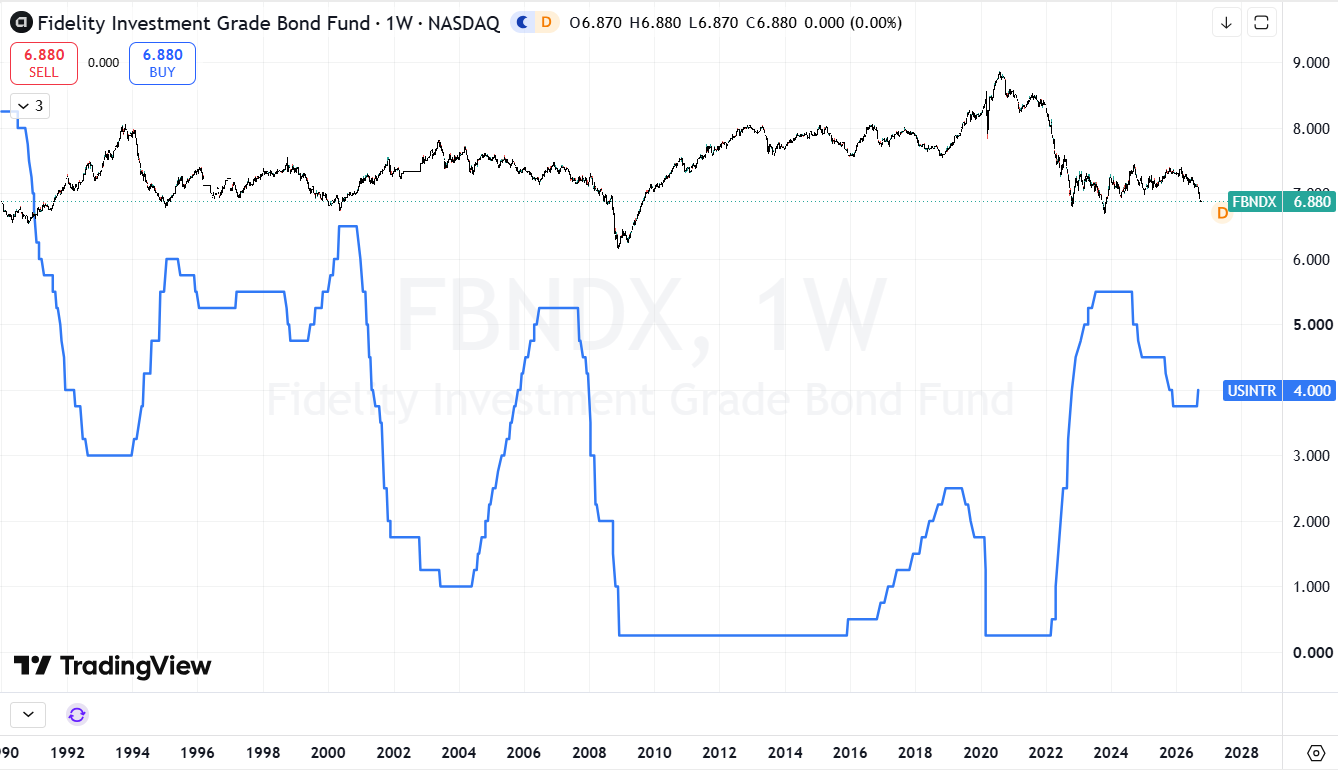
During periods where interest rates are on a downtrend, the unit price of FBNDX tends to rise. On the other hand, when interest rates are rising, the unit price of FBNDX tends to fall.
During periods of exceptional stress like the 2008 financial crisis, however, bond prices and interest rates can fall in tandem, reflecting the higher risk premium demanded by the market for holding bonds.
What is bond duration?
Duration is a measure of how sensitive a bond's price is to changes in interest rates.
As a rough example, the market price of a bond with a duration of five years could fall by approximately 5% if its yield rises by one percentage point, all else being equal.
Likewise, its market price could rise by approximately 5% if its yield falls by one percentage point.
The exact relationship is more complicated, but duration gives investors a useful indication of interest rate risk.
Why does duration matter for the 10 year SGS bond?
NZ16100X has almost 10 years remaining until maturity at the August 2026 auction.
If interest rates rise significantly after an investor buys the bond, its market price could fall.
The investor may therefore suffer a loss if the bond has to be sold before maturity.
However, if the investor holds the bond until maturity and the Singapore Government meets its obligations, changes in the bond's market price along the way would not change the S$1,000 principal due at maturity.
Longer maturity bonds generally have greater interest rate sensitivity than shorter maturity bonds.
This is one reason we would not look at a 10 year SGS bond in the same way as a six month Singapore T-bill.
You can learn more about shorter term government securities in our complete guide to Singapore T-bills.
What determines a bond's yield?
Why might one bond offer a yield of 2% while another offers 5% or 8%?
Several factors matter.
#1 - Interest rates
Bond yields are influenced by prevailing market interest rates.
When interest rates rise, bond yields generally rise as well.
#2 - Credit risk
Investors usually require a higher return for lending to a riskier issuer.
A financially weaker company may therefore need to offer a higher yield than the Singapore Government.
#3 - Maturity and duration
Longer dated bonds are more sensitive to changes in interest rates.
Investors may therefore demand a different yield depending on how long the bond has until maturity.
#4 - Liquidity
Some bonds trade frequently, while others may be harder to buy or sell.
Investors may demand a higher yield for holding less liquid bonds.
#5 - Market conditions
Inflation expectations, economic growth, and investor risk appetite can also affect bond yields.
This is why the yield on an existing bond can change even though interest rates stay the same.
Is a higher bond yield always better?
A higher yield often reflects higher risk.
For example, it may compensate investors for weaker credit quality, longer duration, lower liquidity or foreign currency exposure.
Therefore, a higher bond yield is not always better.
If one bond offers a significantly higher yield than another, we would want to understand why.
Instead of asking only, "Which bond has the highest yield?", a more useful question is:
"What risk am I being paid to take?"
What bond investments are available in Singapore?
Singapore investors have several ways to invest in bonds.
#1 - Singapore Government Securities
SGS bonds are Singapore Government bonds with maturities ranging from a few years to much longer periods.
They typically pay a fixed coupon every six months.
Their market price can rise or fall before maturity, as we saw with NZ16100X.
If you want to see how an actual SGS auction works, you can read our analysis of the August 2026 10 year SGS bond auction.
#2 - Singapore T-bills
Singapore Treasury bills are short term government securities, typically with maturities of six months or one year.
Unlike conventional bonds, they do not make regular coupon payments.
Instead, investors buy them at a discount and receive the face value at maturity.
Read our Singapore T-bill guide to learn how T-bills work and how to apply for them.
#3 - Singapore Savings Bonds
Singapore Savings Bonds, or SSBs, are also backed by the Singapore Government, but they work differently from conventional SGS bonds.
Their interest rates step up over time, and investors can redeem them monthly at their original principal value.
This means investors do not face the same market price risk when redeeming an SSB early.
Read our complete guide to Singapore Savings Bonds to learn more.
#4 - Corporate bonds
Singapore investors can also invest in bonds issued by companies.
Corporate bonds may offer higher yields than government bonds, but investors should also consider the issuer's financial strength and ability to repay its debt.
#5 - Bond ETFs
A bond exchange traded fund, or ETF, allows investors to own a diversified portfolio of bonds through a single investment.
This can reduce the concentration risk of investing in just one issuer.
However, a bond ETF does not have one fixed maturity date where your original investment is automatically repaid.
Its market price can fluctuate based on market conditions and you may not be able to get back your investment.
Read our guide to the best Singapore bond ETFs to see the options available.
For more information about ETFs, please read our Beginner guide to ETF investing.
#6 - Bond funds
Bond funds also invest across a portfolio of bonds.
A fund manager decides which bonds to buy and how much credit and interest rate risk to take.
This may provide diversification and professional management, although investors should also consider fees.
Learn more in our complete guide to bond funds in Singapore.
How can I invest in bonds in Singapore?
The way you invest depends on the type of bond.
Singapore investors may access bonds through government bond auctions, banks and brokerage platforms, SGX-listed bonds, bond ETFs, and unit trusts.
For example, you can invest in T-Bills and SGS bonds through a cash purchase using your CDP account linked to your bank account, using your CPF OA, or your SRS account.
Read our Singapore T-bill guide or our complete guide to Singapore Savings Bonds to learn how to apply for Singapore Government bonds.
Bond ETFs can be bought or sold using a brokerage account or other licensed platforms. You can check out our review of the best online brokerage & trading platform in Singapore to find one that suits your needs.
The minimum investment amount and liquidity can vary significantly depending on the product, so you would need to read the terms and conditions of each product before investing.
What should I look at before buying a bond?
We would focus on five questions.
| What to check | What to ask |
| Yield to maturity | What return am I earning based on the price I am paying? |
| Maturity and duration | When will I get my money back, and how sensitive could the price be to interest rates? |
| Credit quality | How likely is the issuer to make its coupon and principal payments? |
| Currency and liquidity | Am I taking foreign exchange risk, and can I sell the bond easily if needed? |
| Yield versus risk | Is the return attractive enough for the risks I am taking? |
This brings the different bond concepts together.
For NZ16100X, for example, an investor would not look only at its 2.25% coupon.
The 2.30% yield to maturity tells us more about the return available at the auction price, while its longer maturity means investors also need to consider how its market price could move if interest rates change.
Where can bonds fit in your portfolio?
At Beansprout, we think about investments based on the role they play in a portfolio within our Four Pots of Wealth framework.
Bonds would generally sit within our Income Pot, which is designed to generate regular cash flow over the medium to long term.
However, not every bond has the same risk profile.
A six month Singapore T-bill, a 10 year SGS bond, and a US dollar corporate bond may all be fixed income investments, but they can behave very differently.
This is why we look at the yield, maturity, duration, credit quality, currency, and liquidity before deciding what role a bond can play in a portfolio.
Frequently asked questions about bonds
Can I lose money investing in bonds?
Yes. If you sell a bond before maturity, its market price may be lower than what you paid.
You could also lose money if the issuer is unable to meet its obligations.
Foreign currency bonds introduce additional exchange rate risk.
However, if you hold a bond to maturity and the issuer does not default, you would receive all your money back in the currency that you invest in.
What happens when a bond matures?
When a conventional bond matures, the issuer repays the bond's face value, assuming it is able to meet its obligations.
For NZ16100X, an investor holding S$1,000 in principal until 1 August 2036 is expected to receive S$1,000 at maturity.
What happens to bonds when interest rates rise?
Existing bond prices generally fall when market interest rates rise.
The impact tends to be greater for bonds with higher duration.
What happens to bonds when interest rates fall?
Existing bond prices generally rise when market interest rates fall.
Again, bonds with higher duration tend to experience larger price movements.
Is the coupon the same as the bond yield?
No. The coupon tells you the interest paid relative to the bond's face value.
Yield takes into account the price you pay.
NZ16100X is a useful example. Its coupon rate was 2.25%, but its yield to maturity at the August 2026 auction was 2.30%.
Are bonds safer than stocks?
Bonds generally rank ahead of shares in a company's capital structure and may experience less price volatility.
However, bond risk varies significantly.
A Singapore Government bond is generally viewed as safer than stocks, but it should not be treated as having the same risk profile as a high yield corporate bond which tends to have higher risk.
What would Beansprout do?
At Beansprout, we believe long-term wealth is built on clarity, and the Four Pots of Wealth is one way to put that into practice.
Instead of thinking whether a bond is a good investment today, I ask about the role it's meant to play in my portfolio.
Bonds can be an important pillar in my Income Pot to generate regular cash flow over the medium to long term.
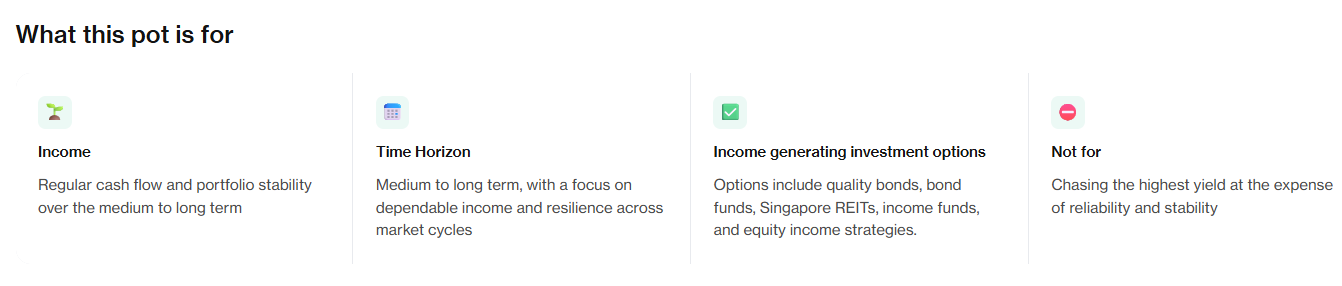
It can also function as a useful diversification tool alongside other income investments like REITs or dividend stocks.
When evaluating bonds, we need to look beyond just the coupon rate, and consider the bond price, yield to maturity, duration, credit risk, and interest rate sensitivity as well.
The August 2026 SGS bond illustrates this clearly.
Its coupon rate was 2.25%, but investors paid slightly below its principal value, resulting in a yield to maturity of 2.30%.
At the same time, with close to 10 years remaining until maturity, investors also need to consider how its market price could move if interest rates change.
This is why we would look at yield to maturity, duration, and credit quality together alongside its yield.
A bond must offer a sufficiently high yield to compensate us for the risks we are taking, but high yield alone is not enough to evaluate a bond.
Want to learn more about building your passive income portfolio? Read our guide to the best ways to earn passive income in Singapore.
If you are interested in using real estate to generate regular income, read our beginner's guide to investing in Singapore REITs.
You can use our Bond ETF Screener, Income Stock Screener, and Income REITs Screener to discover and compare bonds, stocks, and REITs.
To learn more about the other pots in the Four Pots of Wealth framework, explore the Liquidity Pot, Growth Pot, and Opportunity Pot.
If you want a capital guaranteed instrument, you could explore fixed deposits instead. Take a look at the Best Fixed Deposit Rates in Singapore to find the best rates available.
What is the most important criteria in bond investing to you? Share your thoughts in the comments below or join the discussion in our Telegram community.
Planning to invest in Singapore bonds? Check out Beansprout's guide to the best stock trading platforms in Singapore with the latest promotions to invest in the Singapore market and see the latest promotions and sign-up rewards available.
Enjoyed this insight? Follow Beansprout on Telegram, Youtube, Facebook and Instagram, and add Beansprout as your preferred source on Google so you never miss an update.
Read also
Gain financial insights in minutes
Subscribe to our free weekly newsletter for more insights to grow your wealth
Most Popular

Comments
0 comments