
Beginner guide to ETF investing: How to choose your first ETF
ETFs
By Gerald Wong, CFA • 25 Jun 2026
Why trust Beansprout? We’ve been awarded Best Investment Website at the SIAS Investors’ Choice Awards 2025
'%3e%3cpath%20fill-rule='evenodd'%20clip-rule='evenodd'%20d='M17.64%209.20455C17.64%208.56637%2017.5827%207.95273%2017.4764%207.36364H9V10.845H13.8436C13.635%2011.97%2013.0009%2012.9232%2012.0477%2013.5614V15.8195H14.9564C16.6582%2014.2527%2017.64%2011.9455%2017.64%209.20455V9.20455Z'%20fill='%234285F4'/%3e%3cpath%20fill-rule='evenodd'%20clip-rule='evenodd'%20d='M9%2018C11.43%2018%2013.4673%2017.1941%2014.9564%2015.8195L12.0477%2013.5614C11.2418%2014.1014%2010.2109%2014.4205%209%2014.4205C6.65591%2014.4205%204.67182%2012.8373%203.96409%2010.71H0.957275V13.0418C2.43818%2015.9832%205.48182%2018%209%2018V18Z'%20fill='%2334A853'/%3e%3cpath%20fill-rule='evenodd'%20clip-rule='evenodd'%20d='M3.96409%2010.71C3.78409%2010.17%203.68182%209.59318%203.68182%209C3.68182%208.40682%203.78409%207.83%203.96409%207.29V4.95818H0.957273C0.347727%206.17318%200%207.54773%200%209C0%2010.4523%200.347727%2011.8268%200.957273%2013.0418L3.96409%2010.71V10.71Z'%20fill='%23FBBC05'/%3e%3cpath%20fill-rule='evenodd'%20clip-rule='evenodd'%20d='M9%203.57955C10.3214%203.57955%2011.5077%204.03364%2012.4405%204.92545L15.0218%202.34409C13.4632%200.891818%2011.4259%200%209%200C5.48182%200%202.43818%202.01682%200.957275%204.95818L3.96409%207.29C4.67182%205.16273%206.65591%203.57955%209%203.57955V3.57955Z'%20fill='%23EA4335'/%3e%3c/g%3e%3cdefs%3e%3cclipPath%20id='clip0_0_2849'%3e%3crect%20width='18'%20height='18'%20fill='white'/%3e%3c/clipPath%3e%3c/defs%3e%3c/svg%3e)
Make Beansprout your preferred source on Google
Add us on Google to see more of our insights in your search results
Learn what ETFs are, how ETF investing works in Singapore, how to choose an ETF, and the key fees, tax and risks to watch.
What happened?
ETFs are gaining traction as another way to invest.
An exchange-traded fund, or ETF, is a low-maintenance and easy-to-access investment option that allows investors to get started without having to pick individual stocks or constantly monitor the markets.
Instead of buying shares in one company, an ETF allows us to buy a basket of assets through a single trade. This can include Singapore stocks, US stocks, global stocks, REITs, bonds or commodities.
This makes ETFs a simple way to start building a portfolio and gain exposure to global markets.
Many investors also use ETFs as a building block for long-term investing, especially if they want broad market exposure at relatively low cost.
In this article, I will cover what ETFs are, the types of ETFs available, why investors use ETFs, how to choose an ETF that fits our investment objectives, common mistakes to avoid, and a simple checklist before buying our first ETF.
What is an ETF?
An ETF is a fund that owns a basket of assets tracking an underlying index or benchmark and is listed and traded on the stock exchange, just like a stock.
Your money is pooled with money from other investors and invested according to the ETF’s stated investment objective.
Many ETFs aim to track an index.
For example, an ETF that tracks the Straits Times Index (STI) gives investors exposure to the Singapore stock market by holding the companies in the STI.
An ETF that tracks the S&P 500 gives investors exposure to about 500 large US-listed companies.
By buying an ETF, we get exposure to all the individual components in an index in one go without having to make multiple transactions.
Imagine going to a hawker centre with 30 different stalls. Buying a dish from each stall takes time, effort, and multiple separate payments.
Instead of that, buying an ETF is like buying a platter with a bit of everything on one plate with just one transaction.
| ETF Feature | What it means |
| It holds a basket of assets | This may include stocks, bonds, REITs, commodities or other assets |
| It trades on an exchange | We can buy or sell it through a brokerage account during market hours |
| It usually tracks an index | Many ETFs aim to follow the performance of a market index, such as the STI or S&P 500 |
Net asset value (NAV) vs price
The NAV of an ETF is the value of all its underlying assets minus liabilities, usually written as a per share basis.
Meanwhile, since ETFs are traded on the exchange, the market price of the ETF can rise or fall depending on buyers and sellers in the market.
The market price of an ETF is independent of its net asset value although price and value usually move in tandem.
The difference between the market price and the NAV is known as premium or discount.
For example, if an ETF has a NAV of SG$100, it is said to be trading at a premium if the market price is above SG$100 per share, or at a discount if the market price is below SG$100 per share.
In highly liquid ETFs, the premium or discount tends to be insignificant.
Why invest in ETFs?
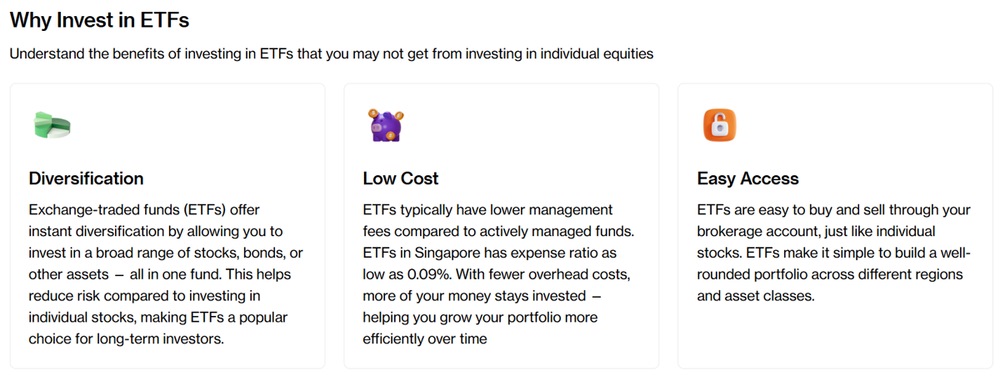
#1 - Diversification
With a single ETF, we can gain exposure to a broad range of assets across many companies, sectors or countries.
For example, a Singapore equity ETF may give us exposure to banks, telecoms, industrial companies and REITs listed in Singapore.
A global equity ETF may give us exposure to companies across many countries.
ETFs are also not limited to stocks. There are REIT ETFs, bond ETFs and commodity ETFs that provide exposure to different asset classes.
This helps reduce the risk and effort associated with investing into individual stocks and makes long term compounding easier.
However, diversification does not remove market risk. If the overall market falls, the ETF may still decline in value.
#2 - Low cost
Many ETFs have lower annual fees than actively managed funds because they are designed to track an index instead of trying to beat it.
This matters because fees reduce our returns over time.
For example, the SPDR S&P 500 ETF Trust listed on SGX under the ticker S27 has an expense ratio of 0.0945% according to its April 2026 factsheet.
However, investors should check the exact fee definition carefully.
Some factsheets show the management fee, while others show the total expense ratio or ongoing charge.
For example, the Amova Singapore STI ETF factsheet shows a management fee of 0.09% p.a. and a trustee fee of up to 0.045% p.a., rather than simply one “expense ratio” figure.
A lower expense ratio means more of our money stays invested instead of paying fees.
Over time, this helps to grow our portfolio more efficiently and can make a difference to long-term compounding.
#3 - Easy access
ETFs provide easy access to a wide range of assets through a brokerage account.
This can help us build a more diversified portfolio across different regions and asset classes.
Since ETFs are traded on the exchange, they are easy to buy or sell with low fees and transparent pricing as well.
#4 - ETFs can support a disciplined investing habit
ETFs are often used with regular investing.
Instead of trying to time the market, some investors invest a fixed amount regularly into their chosen ETFs.
This is also known as dollar-cost averaging.
For beginners, this can make investing feel more manageable because the focus is on consistency rather than short-term market movements.
Types of ETFs
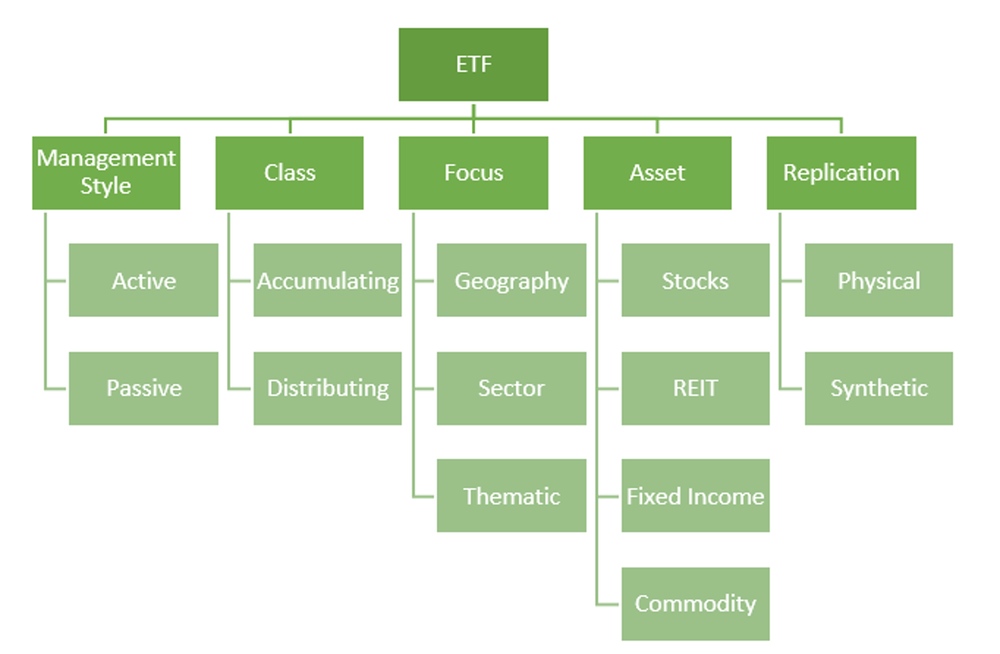
There are several ways to classify ETFs.
First, we can look at how the ETF is managed. This is where passive ETFs and active ETFs come in.
Second, we can look at what the ETF invests in. This may include stocks, REITs, bonds, commodities, sectors or themes.
Third, we can look at how the ETF handles dividends. Some ETFs distribute dividends to investors, while others reinvest them automatically.
Finally, there are also physical and synthetic ETFs, which differ in the way the ETFs replicate their benchmark.
Passive vs Active ETFs
ETFs can be broadly classified into passive ETFs, which are passively managed ETFs, and active ETFs, which are actively managed ETFs.
Passive ETFs mechanically track an underlying index such as the STI or S&P 500. They will only buy or sell their holdings based on whether the stocks were added or removed to the respective index.
Passive ETFs typically have very low fees since they have very low portfolio turnover and are just tracking an index rather than trying to outperform.
Some examples of Passive ETFs listed in the SGX are State Street SPDR S&P 500 ETF Trust (SGX: S27) and Amova Singapore STI ETF (SGX: G3B).
Active ETFs on the other hand are actively managed by a team of fund managers and analysts with the aim to outperform a target benchmark. They will actively buy and sell holdings in the fund based on their investment criteria.
Active ETFs tend to have higher fees to account for the higher activity as well as the research required to run the fund.
Examples of active ETFs listed on SGX include the Lion-Nomura Japan Active ETF, which trades under the SGX code JJJ, and the LionGlobal Short Duration Bond Fund Active ETF, which trades under the SGX code SBO for the SGD counter.
Learn more about active ETFs in our comprehensive guide here.
What can ETFs invest in?
After understanding whether an ETF is passive or active, the next question is what the ETF actually invests in.
Some ETFs provide broad market exposure, while others focus on specific sectors, countries or themes.
For beginners, broad market ETFs are usually easier to understand than narrow sector or thematic ETFs.
A broad market ETF usually tracks a large and diversified index. This may include many companies across different sectors, rather than just one industry or theme.
For example, an STI ETF gives exposure to a basket of Singapore blue-chip stocks across sectors such as banks, telecommunications, transport, property and consumer companies.
An S&P 500 ETF gives exposure to about 500 large US-listed companies across sectors such as technology, healthcare, financials, consumer goods and industrials.
A global equity ETF may go even wider by giving exposure to companies across many countries and regions.
This means that the performance of a broad market ETF is usually less dependent on a single company, sector or theme.
By comparison, a sector or thematic ETF may focus mainly on one area, such as semiconductors, artificial intelligence, clean energy or healthcare.
These ETFs can still be useful, but they may be more volatile because their performance depends more heavily on how that specific sector or theme performs.
For beginners, I would usually start by understanding broad market ETFs first before moving into narrower ETFs. This helps me build a more diversified foundation before taking more targeted views.
| Type of ETF | What it gives exposure to | Common use |
| Singapore equity ETF | Singapore-listed companies | Local stock market exposure |
| US equity ETF | US-listed companies | Exposure to US market growth |
| Global equity ETF | Companies across many countries | Long-term global diversification |
| REIT ETF | Real estate investment trusts | Dividend income exposure |
| Bond ETF | Government or corporate bonds | Income and portfolio stability |
| Gold or commodity ETF | Gold or commodities | Diversification or inflation hedge |
| Sector ETF | Specific sectors such as technology or healthcare | Targeted exposure |
| Thematic ETF | Themes such as AI, semiconductors or clean energy | Higher-conviction exposure |
| Active ETF | Portfolio selected by a fund manager | Active strategy in ETF form |
Accumulating vs distributing ETFs
ETFs are also further classified into accumulating or distributing class ETFs.
Accumulating ETFs will automatically reinvest all dividends received by the fund back into their holdings. This means that we will not receive any dividends paid into our account from holding Accumulating ETFs.
Distributing ETFs instead will distribute the dividends back to us. We can then decide whether to spend the cash, keep it, or reinvest it.
| ETF type | What happens to dividends | What investors may prefer it for |
| Distributing ETF | Dividends are paid out | Investors who want cash income |
| Accumulating ETF | Dividends are reinvested | Investors focused on long-term compounding |
Physical vs synthetic replication
Physical replication means that the ETF actually buys the assets within the tracked index.
For example, an ETF that physically tracks the STI would own all the constituent shares of the index such as DBS, OCBC, Singtel, and so on.
Synthetic replication on the other hand replicates the index by utilizing financial derivatives and engineering to track the underlying index but without owning actual shares.
For example, an ETF that tracks the movements of crude oil is typically synthetic by using financial instruments like swaps to replicate the movements in the commodity rather than owning barrels of oil.
Synthetic ETFs may have lower tracking error and fees than physical ETFs because they just mimic the index and don’t incur trading and rebalancing fees. Since they don’t own the shares of the company, they also don’t have to incur withholding tax on any dividends declared but just roll over the dividends into the NAV of the fund.
However, synthetic ETFs are exposed to counterparty risk as they rely on the counterparty to deliver the returns of the financial instruments used.
How to choose an ETF in Singapore
There are plenty of ETF options available that fit a wide variety of goals in our portfolio.
Most of the information we need to know about an ETF can be found from their ETF factsheet and product highlights sheet.
#1 - Understand what the ETF tracks
Before buying any ETF, we must first understand what the ETF is tracking.
The most popular ETFs track well known indices, such as the Singapore Straits Times Index, the US S&P500 Index, or even the FTSE All-World Index. These ETFs provide access to a wide basket of stocks exposed to the global economy.
There are also ETFs for other goals, such as REIT ETF and Bond ETF for income seekers, gold, precious metals, and commodity ETFs for those who want to hedge on commodities, sector specific ETF for those who want exposure to a particular sector like semiconductors, and thematic ETFs for those who want to invest in trends like AI, space, energy transition, and so on.
#2 - Check the ETF’s fees
Then, we need to find out the Expense Ratio of the ETF.
Expense Ratio is the ongoing fee for owning the ETF, which will cover the funds’ operational costs. Typically, a niche ETF will have a higher Expense Ratio compared to the popular ETFs tracking a famous index.
For the same underlying index, the lower expense ratio the better as more of our money can work into compounding for us.
#3 - Look at currency
The trading currency is also another important consideration. There are ETFs that trade in SGD, USD, GBP, or other currencies. If we earn and spend in SGD, then an ETF trading in another currency will introduce a layer of cost during currency conversion.
#4 - Check the ETF’s domicile
Finally, we need to know the ETF’s domicile. Domicile refers to the country that the ETF operates from, which determines the laws and regulations that it has to follow.
For investors, this is important because it impacts the taxes we pay on the distributions or during estate planning.
For example, US listed ETFs incur withholding tax of 30% on distributions, while Irish domiciled ETFs incur only 15%. Meanwhile, we do not need to pay any withholding tax for Singapore listed ETFs.
US domiciled ETFs also incur up to 40% estate tax on amounts above US$60,000. This will impact estate planning in the scenario where we pass on. However, non-US domiciled ETFs like those in Singapore or Ireland do not incur estate taxes.
| Amova Singapore STI ETF | SPDR S&P 500 ETF Trust | iShares Core MSCI EM IMI UCITS ETF | |
| Trading Code | G3B | S27 | EIMI.L |
| Underlying Index | Straits Times Index (STI) | S&P 500 Index | MSCI Emerging Markets Investable Market Index (USD) (Net) |
| Expense Ratio | 0.25% | 0.09% | 0.18% |
| Dividend Type | Distributing | Distributing | Accumulating |
| Currency | SGD | USD | USD |
| Domicile | Singapore | United States | Ireland |
| Source: Respective ETF Factsheets as of June 2026 | |||
#5 - Decide whether you want income or accumulation
If I want regular cash payouts, I may prefer a distributing ETF.
If I am investing for long-term growth and do not need the cash flow, I may prefer an accumulating ETF.
However, the dividend policy is only one factor.
I would still look at the underlying assets, fees, currency, domicile and risks.
#6 - Look at fund size and liquidity
An ETF with a larger fund size and higher trading volume may be easier to buy and sell.
For Singapore-listed ETFs, it is also useful to check the bid-ask spread.
The bid price is what buyers are willing to pay, while the ask price is what sellers are asking for.
A wider spread can increase trading cost, especially for investors who buy and sell frequently.
#7 - Check whether the ETF can be bought with SRS or CPF
Singapore investors may also want to know whether an ETF can be bought using cash, SRS or CPF.
SRS account holders can invest in SGX-listed ETFs.
For CPF, only approved products can be bought under the CPF Investment Scheme.
CPF members generally need to be at least 18, not be an undischarged bankrupt, have more than S$20,000 in their Ordinary Account or more than S$40,000 in their Special Account, and complete the CPFIS Self-Awareness Questionnaire if they are new investors.
I would always verify eligibility with my broker, SRS operator or CPF Investment Account bank before placing an order.
Learn how to start investing using the CPF Investment Scheme (CPFIS) here.
Learn how to choose the best ETF as a SRS investor here.
Risk factors to consider before investing in ETFs
#1 – Market risk and volatility
Since ETFs track or hold underlying assets, their value can fluctuate based on market conditions.
This means our investments can go up or down depending on market movements.
For example, an ETF tracking the S&P 500 may fall if the US stock market declines.
An ETF tracking Singapore REITs may fall if investor sentiment towards REITs weakens.
#2 – Tracking error
ETF returns may differ slightly from the index they track.
This can happen because of fund fees, trading costs, cash holdings, taxes and the way the ETF replicates the index.
For passive ETFs, I would look at whether the ETF has historically tracked its benchmark closely.
#3 – Foreign currency risk
Some ETFs are traded in foreign currencies such as USD or GBP.
If we invest in these ETFs, we need to consider the impact of exchange rates.
This matters especially if we eventually want to sell the ETF and convert the money back into SGD.
How to buy ETFs in Singapore
ETFs are bought and sold on the stock exchange, just like stocks.
This means that investors can place buy or sell orders through a brokerage account during market hours.
For SGX-listed ETFs, the board lot size is 1 unit. This means investors can buy as little as 1 unit of an ETF, subject to brokerage fees and other trading costs.
This makes SGX-listed ETFs more accessible for investors who want to start with a smaller amount or invest regularly.
However, investors should still consider transaction costs. If the investment amount is very small, brokerage fees and spreads may take up a larger portion of the trade.
Here are the basic steps.
| Step | What to do |
| 1 | Decide what exposure you want, such as Singapore stocks, US stocks, global equities, REITs or bonds |
| 2 | Shortlist ETFs that track the exposure you want |
| 3 | Read the ETF factsheet and product highlights sheet |
| 4 | Check the ticker, exchange, currency, dividend policy, fees and domicile |
| 5 | Open a brokerage account with access to the relevant exchange |
| 6 | Search for the ETF ticker and place an order |
| 7 | Monitor whether the ETF still fits your portfolio over time |
If you are buying SGX-listed ETFs, you will need a brokerage account that allows you to trade Singapore stocks and ETFs.
If you are buying US-listed or London-listed ETFs, you will need a brokerage account that provides access to those markets.
If you have yet to open a brokerage account, find out the best online brokerage and stock trading platforms here.
Simple 5-step checklist before buying your first ETF
Before buying an ETF, I would make sure I can answer these questions:
| Item | Description | Answer |
| 1 | I understand the type of ETF, what the ETF tracks and what it gives exposure to | |
| 2 | I know the management fee, expense ratio, or ongoing charges | |
| 3 | I know the currency it trades in and its domicile | |
| 4 | I know whether the ETF pays dividends or reinvests them | |
| 5 | I know the tax implications |
What would Beansprout do?
ETFs can be a simple way to start investing because they allow me to buy a basket of assets through one product.
It makes it easy to build a well-rounded portfolio through the convenience of our brokerage accounts.
ETFs provide a simple way to start compounding our wealth by getting exposure to the global economy while avoiding concentration risk and reducing the amount of time we need to do in-depth research as compared to individual stocks.
However, ETFs are still subject to market risks and volatility.
Before investing in ETFs, I will first build my liquidity pot and have all my short term needs covered.
After that, I would start investing for the long term to let compounding grow my wealth for me. The earlier I start, the more time my investments will have to compound.
I would take my time to understand the various ETF options available to me, and ensure I can answer the checklist before deciding which ETF to buy.
Once I have decided which ETFs I want to invest in, I would be disciplined and set aside a fixed amount of money every month to invest into these ETFs.
For a more structured way to organise your investments and wealth, you can read our guide to the Four Pots of Wealth, as well as our beginner’s guide to start investing in Singapore.
You can also dive deeper into specific types of ETFs through these guides:
- Guide to STI ETF
- Best S&P 500 ETFs for Singapore investors
- Best Singapore REIT ETFs: How to choose for your portfolio
- Best gold ETF in Singapore
If you are planning to start investing in ETFs and have yet to open a brokerage account, you can compare the best online brokerage accounts in Singapore and check out the latest Beansprout brokerage promotions.
Have you decided on which ETF you want to invest in? Share the idea with us in the comments below or in our Telegram group!
Follow Beansprout on Telegram, Youtube, Facebook and Instagram, and add Beansprout as your preferred source on Google so you never miss an update.
Read also
Gain financial insights in minutes
Subscribe to our free weekly newsletter for more insights to grow your wealth
Most Popular

Comments
0 comments