
Rising bond yields: What it means for Singapore blue chip stocks, REITs and your investments
Stocks
By Gerald Wong, CFA • 11 Sep 2026
Why trust Beansprout? We’ve been awarded Best Investment Website at the SIAS Investors’ Choice Awards 2025
'%3e%3cpath%20fill-rule='evenodd'%20clip-rule='evenodd'%20d='M17.64%209.20455C17.64%208.56637%2017.5827%207.95273%2017.4764%207.36364H9V10.845H13.8436C13.635%2011.97%2013.0009%2012.9232%2012.0477%2013.5614V15.8195H14.9564C16.6582%2014.2527%2017.64%2011.9455%2017.64%209.20455V9.20455Z'%20fill='%234285F4'/%3e%3cpath%20fill-rule='evenodd'%20clip-rule='evenodd'%20d='M9%2018C11.43%2018%2013.4673%2017.1941%2014.9564%2015.8195L12.0477%2013.5614C11.2418%2014.1014%2010.2109%2014.4205%209%2014.4205C6.65591%2014.4205%204.67182%2012.8373%203.96409%2010.71H0.957275V13.0418C2.43818%2015.9832%205.48182%2018%209%2018V18Z'%20fill='%2334A853'/%3e%3cpath%20fill-rule='evenodd'%20clip-rule='evenodd'%20d='M3.96409%2010.71C3.78409%2010.17%203.68182%209.59318%203.68182%209C3.68182%208.40682%203.78409%207.83%203.96409%207.29V4.95818H0.957273C0.347727%206.17318%200%207.54773%200%209C0%2010.4523%200.347727%2011.8268%200.957273%2013.0418L3.96409%2010.71V10.71Z'%20fill='%23FBBC05'/%3e%3cpath%20fill-rule='evenodd'%20clip-rule='evenodd'%20d='M9%203.57955C10.3214%203.57955%2011.5077%204.03364%2012.4405%204.92545L15.0218%202.34409C13.4632%200.891818%2011.4259%200%209%200C5.48182%200%202.43818%202.01682%200.957275%204.95818L3.96409%207.29C4.67182%205.16273%206.65591%203.57955%209%203.57955V3.57955Z'%20fill='%23EA4335'/%3e%3c/g%3e%3cdefs%3e%3cclipPath%20id='clip0_0_2849'%3e%3crect%20width='18'%20height='18'%20fill='white'/%3e%3c/clipPath%3e%3c/defs%3e%3c/svg%3e)
Make Beansprout your preferred source on Google
Add us on Google to see more of our insights in your search results
The US 10-year Treasury yield rose to about 5.0% on 10 September 2026. Here’s what rising yields could mean for Singapore stocks, S-REITs, banks, bonds and cash in your investment portfolio.
What happened?
US government bond yields are climbing again.
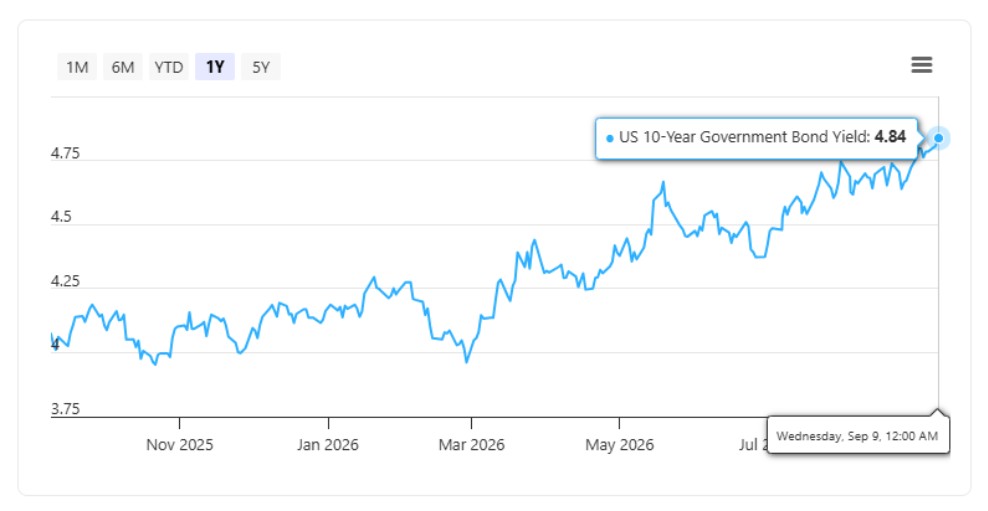
The US 10-year Treasury yield reached close to 5.0% on 10 September 2026, its highest level since November 2023.
Longer-term yields have also remained elevated. In August, the US 30-year Treasury yield briefly reached its highest level in almost two decades
In Singapore, we have also seen the 6-month T-bill reach 1.7%, its highest level this year.
I seen a growing number of questions from the Beansprout community about what higher bond yields could mean for the investments they already own.
With bond yields moving higher again, I take a broader look at what a rising US Treasury yield could mean for a Singapore portfolio, from stocks and S-REITs to banks, bonds and cash.
Why are bond yields moving higher?
Several forces are pushing yields higher at the same time.
#1 - Stronger economic data is keeping interest rate expectations elevated
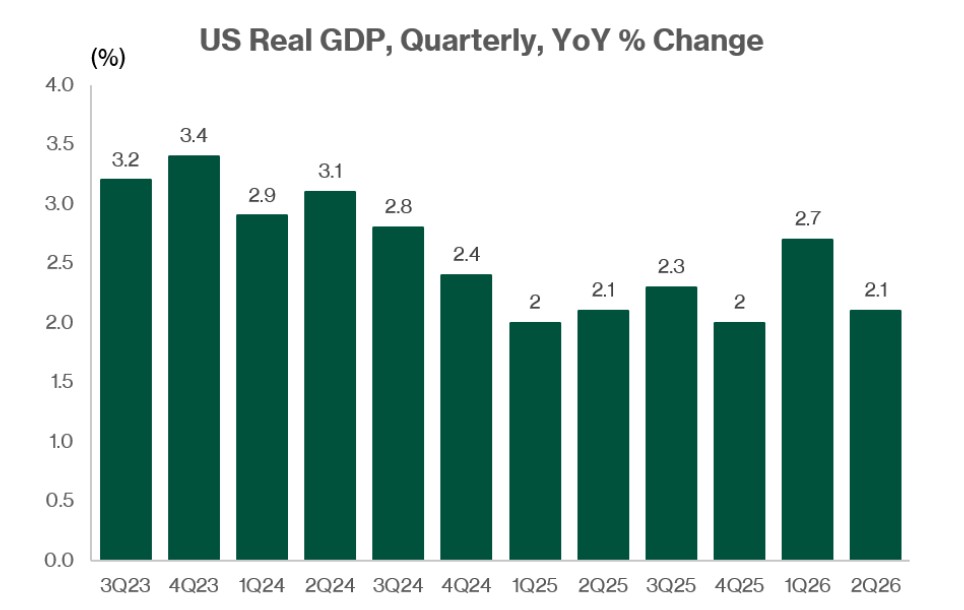
US economic data has remained relatively resilient, making it harder for investors to assume that interest rates will fall quickly.
When economic growth and employment remain firm, the Federal Reserve has less urgency to cut interest rates.
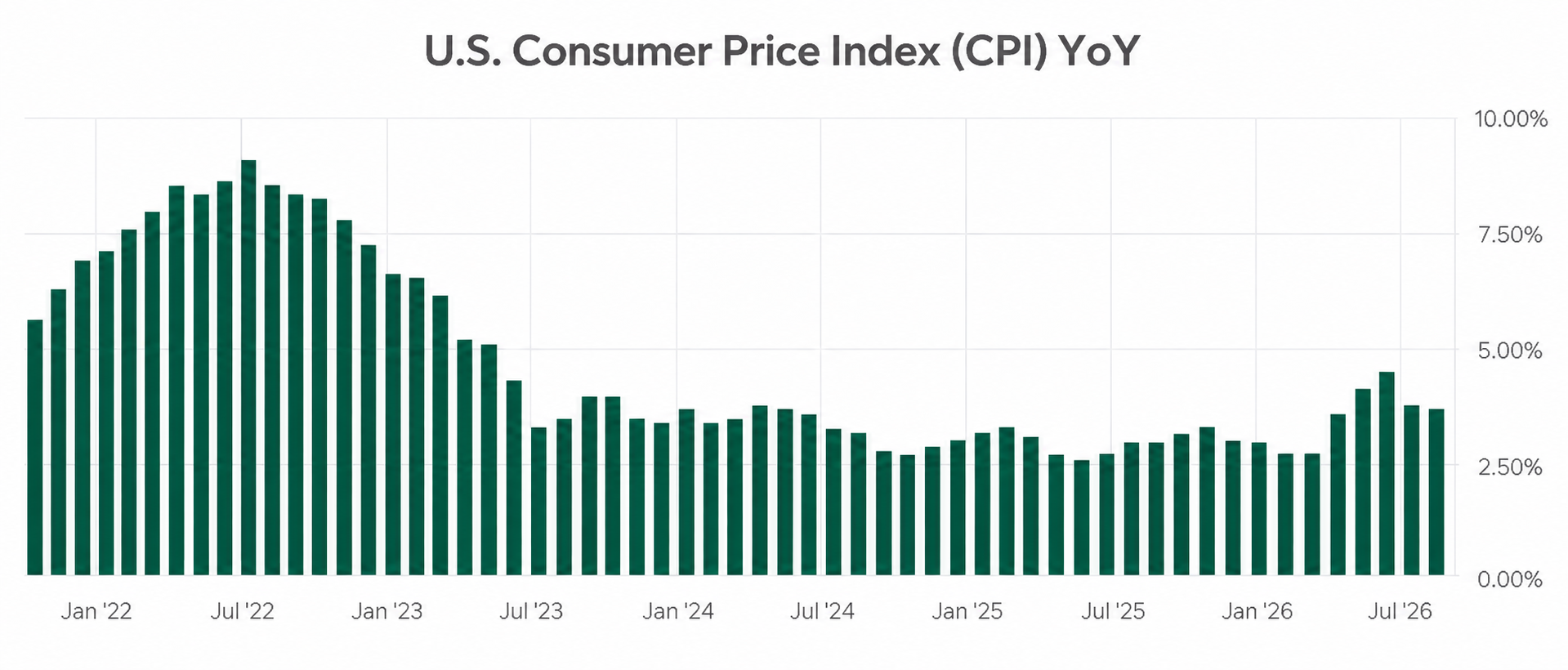
At the same time, inflation has remained a concern.
If investors expect interest rates to stay higher for longer, they may also demand a higher yield to hold longer-term US government bonds.
Uncertainty over the Fed’s next move has also made longer-term Treasury yields more volatile, as investors continually reassess how long interest rates may stay elevated and whether further tightening could be needed.
#2 - Inflation risks remain a concern
Higher energy prices and renewed geopolitical risks have added to concerns that inflation could stay elevated.
This matters because longer-term bond yields reflect not just where interest rates are today, but also investors' expectations for inflation and interest rates over many years.
If investors become less confident that inflation will return quickly towards the Fed's target, they may demand a higher return from longer-term bonds.
#3 - The US government needs to borrow more
US government borrowing is another factor.
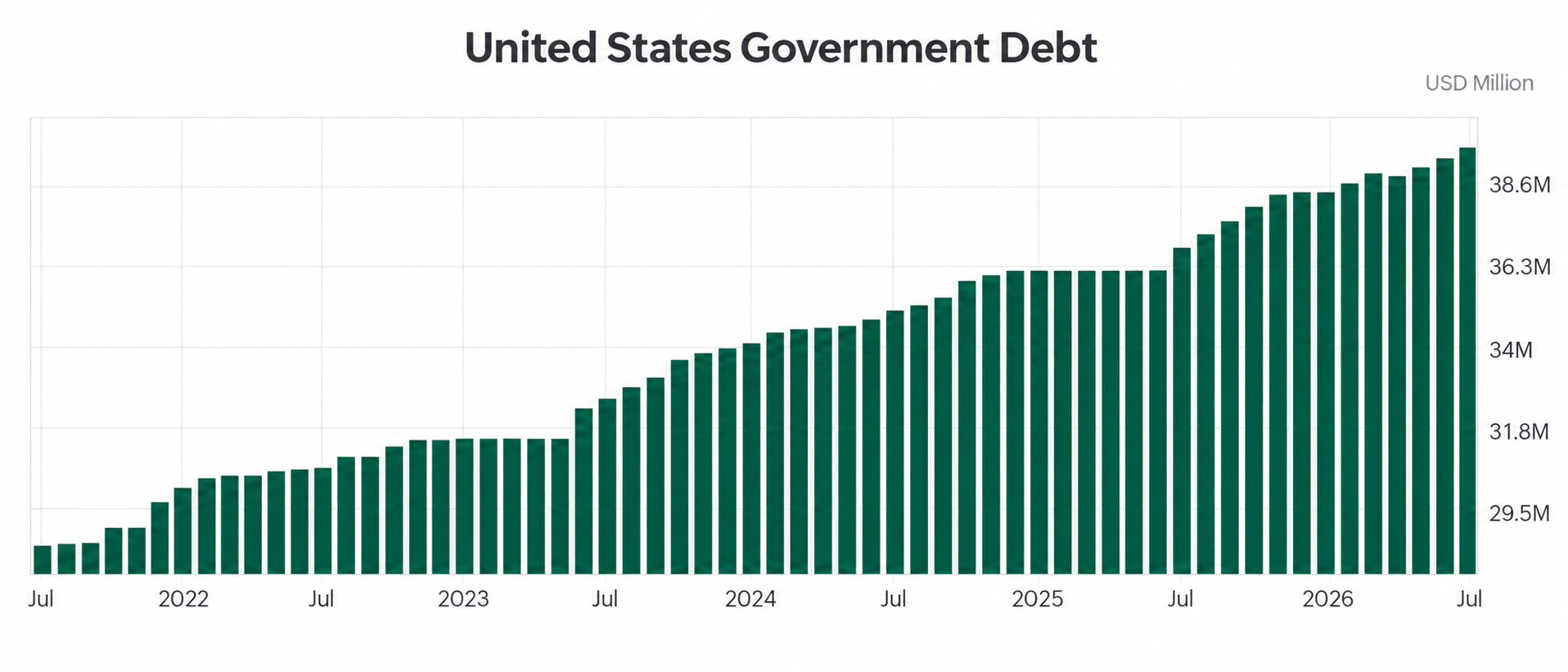
The Congressional Budget Office projects a US federal deficit of about US$2.1 trillion for fiscal 2026, up from its previous estimate of US$1.9 trillion.
A larger deficit generally means the US Treasury needs to issue more bonds.
When there is more bond supply, investors may require a higher yield to absorb it.
There is also growing demand for capital elsewhere, including from companies investing heavily in AI infrastructure and data centres.
Taken together, the rise in US Treasury yields reflects a mix of resilient economic growth, inflation risks and greater demand for capital.
Why do US Treasury yields matter to Singapore investors?
US Treasuries are widely used as a benchmark for interest rates around the world.
When Treasury yields move, they can affect how investors value bonds, REITs and stocks.
Singapore does not simply follow US interest rates. The Monetary Authority of Singapore (MAS) manages monetary policy through the Singapore dollar exchange rate instead of setting a conventional policy interest rate like the US Federal Reserve.
Even so, global bond markets are still connected. Singapore government bond yields have generally moved in the same direction as US Treasury yields over time.
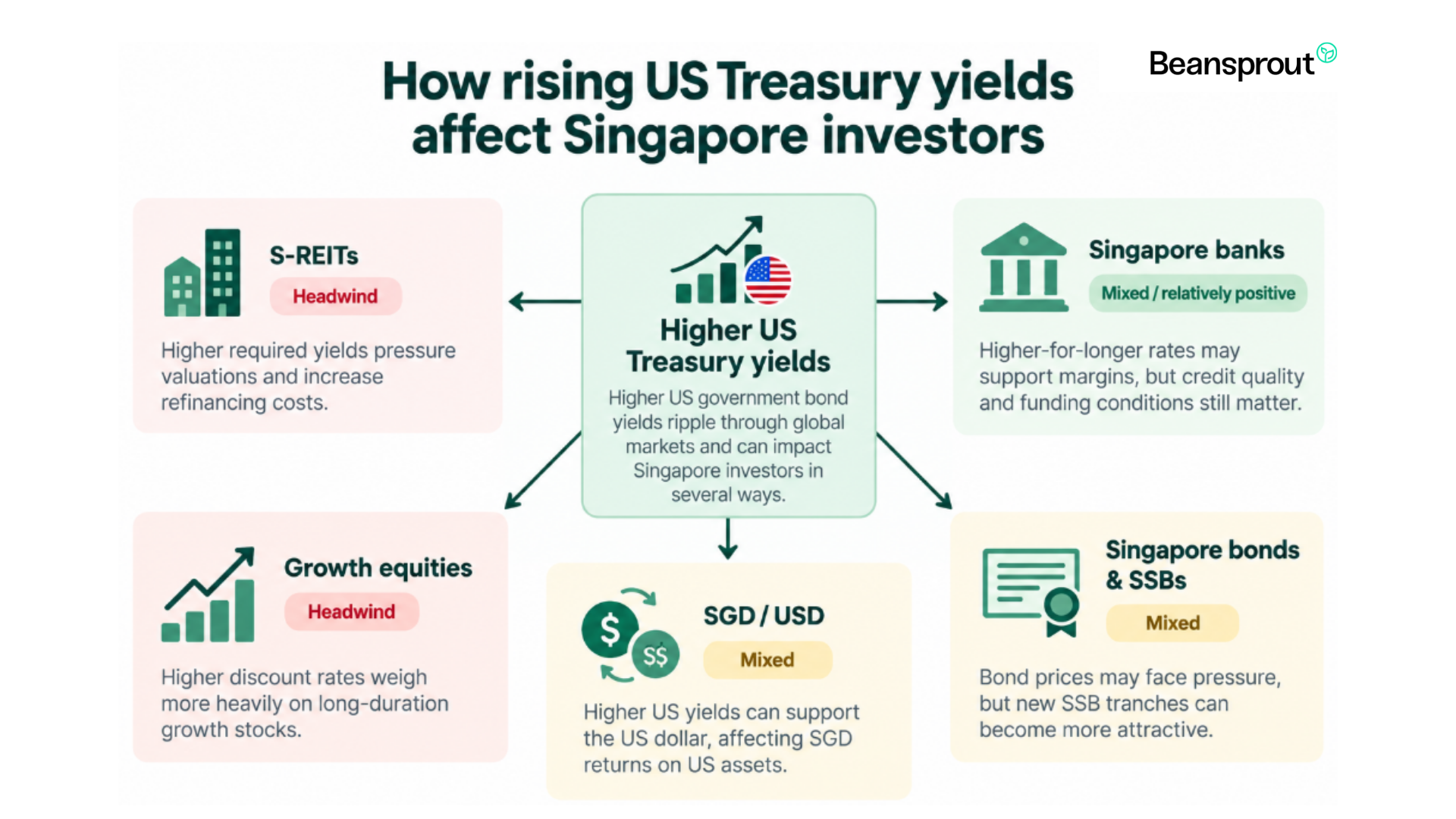
There are five main ways this can affect a Singapore portfolio.
- Stock valuations may be under pressure
- Singapore REITs face the clearest headwinds
- Singapore banks may be relatively better positioned
- Singapore government bond yields have gone up too
- Bond prices may come down
#1 - Stock valuations may be under pressure, particularly for growth stocks with high levels of debt
Higher bond yields can make it harder for stocks to justify high valuations.
When investors can earn a higher return from government bonds, they may be less willing to pay as much today for companies whose profits are expected further into the future.
This tends to affect growth stocks with higher valuations more, as more of their value depends on future earnings.
Highly indebted companies can face another problem if they need to refinance at higher interest rates, could weigh on profits.
On the other hand, companies generating strong cash flows today, with healthy balance sheets and trading at more reasonable valuations may be relatively more resilient.
But this is not a reason to write off technology or growth stocks as a category.
Earnings growth, balance-sheet strength and valuation still matter. A company that can grow profits quickly enough may offset some of the impact of higher interest rates.
#2 - Singapore REITs (S-REITs) face the clearest headwind
S-REITs are often compared with bonds for investors looking for income.
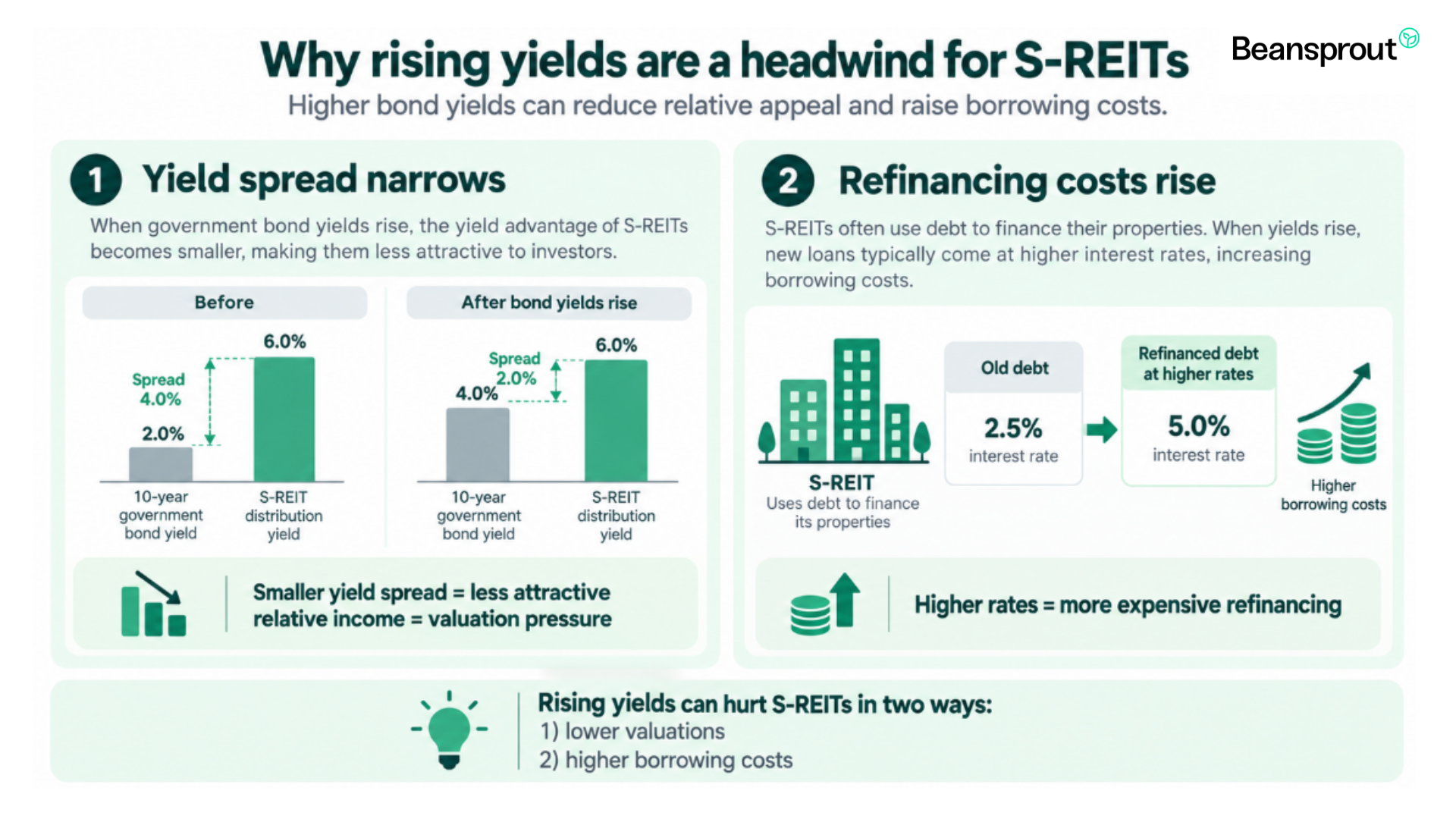
When government bond yields rise, investors may demand a higher yield from REITs as well. If distributions do not change, that usually means REIT prices need to be lower for their yields to become more attractive.
Higher interest rates can also increase refinancing costs.
A REIT that previously borrowed at 2.5%, for example, may need to refinance at a materially higher rate when that debt matures. That leaves less income available for distributions if rental growth does not offset the increase.
This creates two potential pressures at the same time:
- Higher bond yields can weigh on REIT valuations.
- Higher refinancing costs can reduce distributable income.
REITs with higher gearing or a larger proportion of debt maturing in the near term may be more exposed.
The pressure could be even greater if lenders become more cautious and charge REITs a higher premium above government bond yields. That would push refinancing costs up further.
This does not mean all S-REITs will perform poorly.
I would pay more attention to balance-sheet strength, refinancing needs and underlying growth. REITs with manageable leverage and healthy rental growth should be in a better position to absorb higher financing costs.
For a closer look at where income opportunities may still remain, see our review of Singapore REIT dividend yields and the segments with more resilient distributions.
#3 - Singapore banks may be relatively better positioned
Rising US Treasury yields can contribute to higher borrowing and funding costs globally, although the US 10-year Treasury yield itself does not directly determine the margins earned by Singapore banks.
For DBS, OCBC and UOB, local lending rates, deposit competition and funding costs matter more directly.
Higher-for-longer interest rates can support bank margins if the rates earned on loans remain high relative to what banks need to pay depositors.
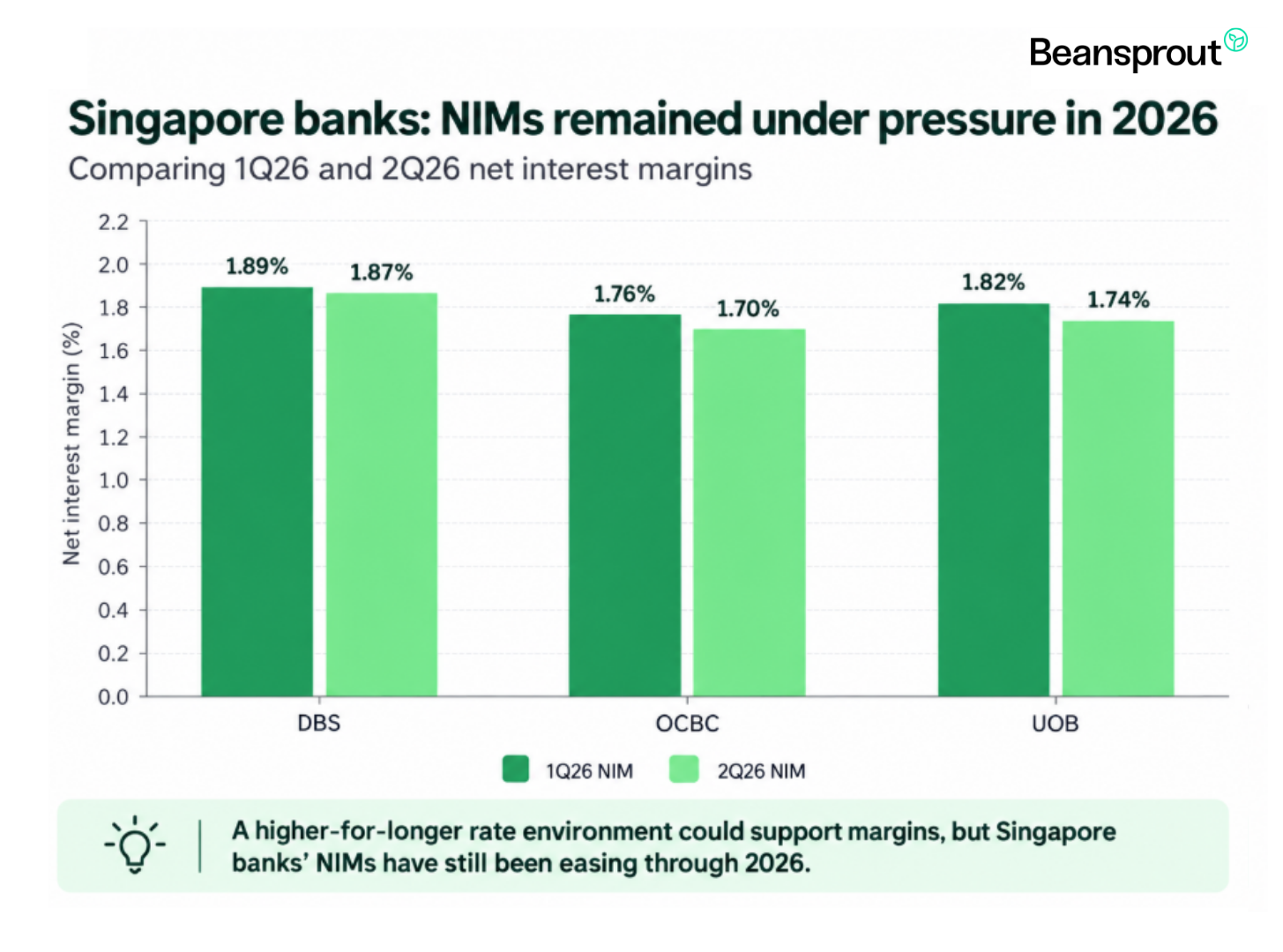
Bank margins have still been under pressure in 2026.
In the second quarter, DBS reported a net interest margin of 1.87%, compared with 1.89% in the first quarter. OCBC's NIM fell to 1.70% from 1.76%, while UOB's declined to 1.74% from 1.82%.
But there is a limit to the benefit.
If higher borrowing costs eventually slow the economy, loan growth could weaken and more borrowers may struggle to repay their loans. This could offset some of the support that higher interest rates provide to bank margins.
I would therefore see higher yields as relatively more supportive for Singapore banks compared with REITs, rather than assume that rising Treasury yields are automatically positive for bank stocks.
You can also compare DBS, OCBC and UOB to see which bank looks better positioned after the recent rally
#4 - Singapore government bond yields have gone up too
Singapore government bond yields have also risen, although they do not move one-for-one with US Treasury yields.
The 10-year Singapore Government Securities (SGS) yield was around 2.36% on 9 September, up from roughly 1.86% a year earlier. The latest 10-year SGS benchmark yield is around 2.3%.
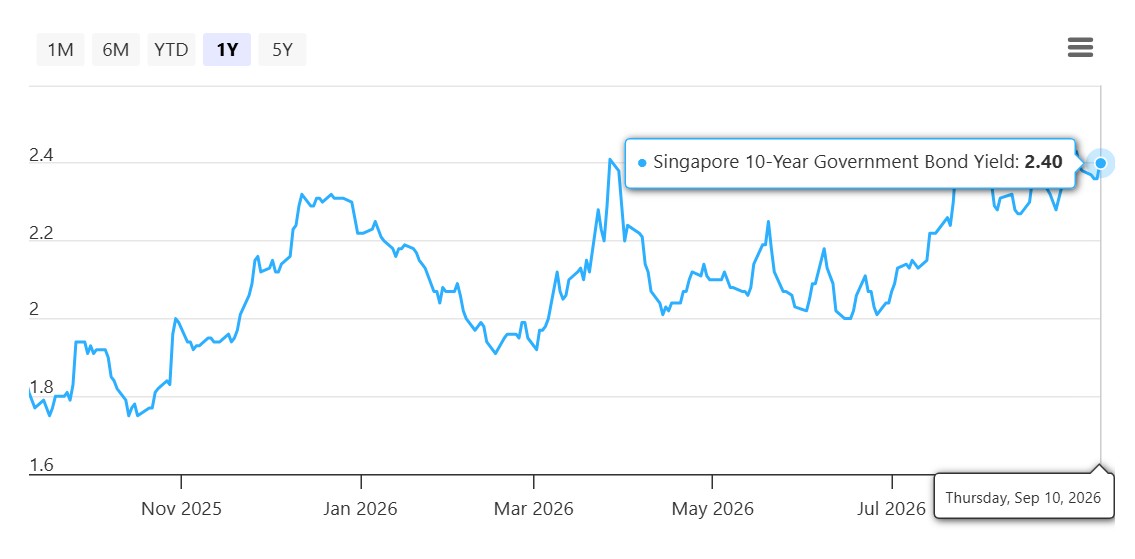
At the shorter end, the latest completed 6-month T-bill auction had a cut-off yield of 1.70%.

Singapore Savings Bond yields have moved up as well. The October SSB offers a 10-year average return of 2.32%, its highest level in 14 months, and is projected to rise further.
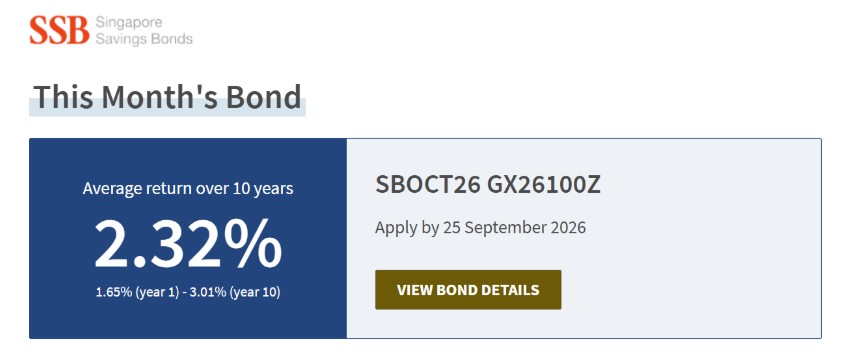
For investors looking to park cash or earn government-backed yields, higher Singapore government bond yields may make T-bills, SGS bonds and SSBs worth comparing again with savings accounts and fixed deposits.
The choice between a 6-month T-bill, a longer-term SGS bond and an SSB depends largely on how long you are prepared to commit your money and how much flexibility you want.
SSBs offer greater flexibility because investors can redeem them at their original investment amount. T-bills and SGS bonds do not offer the same feature if they are sold before maturity.
For the latest rates, you can compare T-bills, fixed deposits and SSBs to find the best places to park your cash in September 2026 here.
#5 - Bond prices can fall when yields rise
For conventional bonds, yields and prices move in opposite directions.
When bond yields rise, newly issued bonds offer investors a higher return. An existing bond paying a lower coupon therefore becomes less attractive, so its market price generally falls until its yield becomes competitive again.
The reverse happens when bond yields fall. Existing bonds paying a higher coupon become more valuable, hence their prices move up such that the yields drop to reflect the market condition.
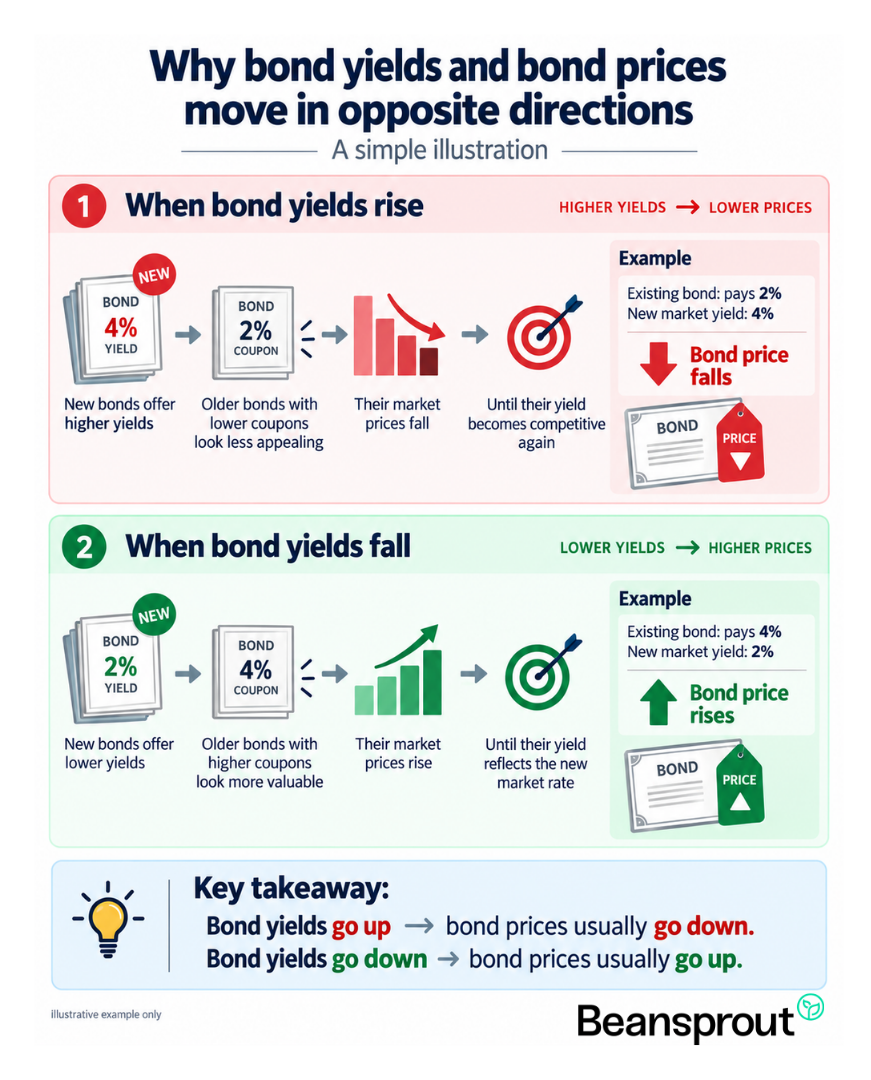
This relationship also affects bond funds.
A bond fund holds a portfolio of bonds whose market values change as yields move. If yields rise sharply, the value of those existing bonds can fall, weighing on the fund's net asset value.
The effect is generally larger for longer-duration bond funds because more of their value depends on payments received further into the future. Shorter-duration funds tend to be less sensitive to changes in bond yields.
There is a second effect over time. As older bonds mature, a bond fund can reinvest the proceeds into newer bonds offering higher coupons. That can gradually lift the income generated by the portfolio.
So rising yields are usually negative for bond prices in the short term, but can improve the income available to bond investors over a longer holding period.
For investors choosing between bond funds today, I would pay particular attention to duration and how quickly the portfolio can reinvest at the higher prevailing yields.
What does this mean across a Singapore portfolio?
| Asset class | Likely impact | Why it matters |
|---|---|---|
| Stocks | Mixed | Growth and tech stocks face more headwinds as higher discount rates may weigh more heavily on profits expected further into the future. Value or cash flow stocks may face relative resilience as more of their value is supported by current cash flow rather than distant earning |
| Singapore banks (DBS, OCBC, UOB) | Mixed | Higher-for-longer rates may support margins if loan yields rise faster than deposit costs, but slower growth or weaker credit quality could offset this. |
| S-REITs | Headwind | Higher government bond yields reduce their relative income appeal while refinancing costs can rise. |
| Singapore government bonds & SSBs, T-bills | Mixed | Existing bond prices can fall as yields rise, while new SSB and bond issues may offer more attractive yields. |
| Bond funds | Mixed | Higher yields can weigh on bond prices in the short term, but funds can gradually reinvest maturing bonds into newer bonds offering higher yields. |
| Cash / Fixed deposits | Relative positive | Newly deployed cash can earn more, reducing the opportunity cost of staying liquid. |
What would Beansprout do?
I would not restructure a portfolio simply because the US 10-year Treasury yield has reached 4.8%.
The more useful approach is to look at where higher yields change the trade-offs across different parts of the portfolio using Beansprout’s Four Pots of Wealth framework.
For cash in my Liquidity Pot , higher yields make it worth comparing savings accounts, T-bills, SSBs and fixed deposits to see which offers the right balance of yield and flexibility for my needs.
For my Income Pot, which includes S-REITs and bonds, I would be more selective about where I take risk to earn income, rather than simply chase the highest yield.
For S-REITs, I would remain selective rather than make a blanket call on the sector. Balance-sheet strength, refinancing needs and valuation matter more when yields stay elevated.
For bonds and bond funds, I would pay closer attention to duration, as longer-term bond prices can be more sensitive if yields rise further.
Beyond income assets, Singapore banks remain relatively better positioned than REITs if higher rates help margins stabilise. But I would still watch credit quality, earnings growth and valuation rather than assume that higher Treasury yields automatically benefit them.
For equities more broadly, I would place greater weight on current cash flow, earnings growth, balance-sheet strength and reasonable valuations while discount rates remain high.
For individual stock ideas, I would still keep them ring-fenced within the Opportunity Pot and focus on building a portfolio rather than picking stocks in isolation, sizing each position based on conviction, company-specific risks and what else I already own.
You can also see how we are currently positioning our portfolio as market conditions change.
The key point is that rising US Treasury yields are not, by themselves, a signal to sell stocks or rebalance a portfolio. They raise the hurdle investors demand from other assets.
Instead, it is knowing whether the assets you own have enough cash flow, balance-sheet strength and valuation support to cope if yields remain higher than expected. That is a more useful way to position a portfolio than trying to predict the US bond market perfectly.
If you are looking for greater clarity on the markets and the investment decisions that matter, explore Beansprout Pro for our latest views, portfolio thinking and the reasoning behind each opportunity.
How are you positioning your portfolio as US Treasury yields stay elevated? Share with us in the comments below or in our Telegram group!
Follow Beansprout on YouTube, Facebook and Instagram, and add Beansprout as your preferred source on Google so you never miss an update.
Read also
Gain financial insights in minutes
Subscribe to our free weekly newsletter for more insights to grow your wealth
Most Popular

Comments
0 comments