
DBS vs OCBC vs UOB: Which Singapore bank looks best for investors after the rally
Stocks
By Gerald Wong, CFA • 16 Aug 2026
Global Wealth Technology Pte. Ltd. is regulated by the Monetary Authority of Singapore (MAS) as a licensed Financial Adviser.
'%3e%3cpath%20fill-rule='evenodd'%20clip-rule='evenodd'%20d='M17.64%209.20455C17.64%208.56637%2017.5827%207.95273%2017.4764%207.36364H9V10.845H13.8436C13.635%2011.97%2013.0009%2012.9232%2012.0477%2013.5614V15.8195H14.9564C16.6582%2014.2527%2017.64%2011.9455%2017.64%209.20455V9.20455Z'%20fill='%234285F4'/%3e%3cpath%20fill-rule='evenodd'%20clip-rule='evenodd'%20d='M9%2018C11.43%2018%2013.4673%2017.1941%2014.9564%2015.8195L12.0477%2013.5614C11.2418%2014.1014%2010.2109%2014.4205%209%2014.4205C6.65591%2014.4205%204.67182%2012.8373%203.96409%2010.71H0.957275V13.0418C2.43818%2015.9832%205.48182%2018%209%2018V18Z'%20fill='%2334A853'/%3e%3cpath%20fill-rule='evenodd'%20clip-rule='evenodd'%20d='M3.96409%2010.71C3.78409%2010.17%203.68182%209.59318%203.68182%209C3.68182%208.40682%203.78409%207.83%203.96409%207.29V4.95818H0.957273C0.347727%206.17318%200%207.54773%200%209C0%2010.4523%200.347727%2011.8268%200.957273%2013.0418L3.96409%2010.71V10.71Z'%20fill='%23FBBC05'/%3e%3cpath%20fill-rule='evenodd'%20clip-rule='evenodd'%20d='M9%203.57955C10.3214%203.57955%2011.5077%204.03364%2012.4405%204.92545L15.0218%202.34409C13.4632%200.891818%2011.4259%200%209%200C5.48182%200%202.43818%202.01682%200.957275%204.95818L3.96409%207.29C4.67182%205.16273%206.65591%203.57955%209%203.57955V3.57955Z'%20fill='%23EA4335'/%3e%3c/g%3e%3cdefs%3e%3cclipPath%20id='clip0_0_2849'%3e%3crect%20width='18'%20height='18'%20fill='white'/%3e%3c/clipPath%3e%3c/defs%3e%3c/svg%3e)
Make Beansprout your preferred source on Google
Add us on Google to see more of our insights in your search results
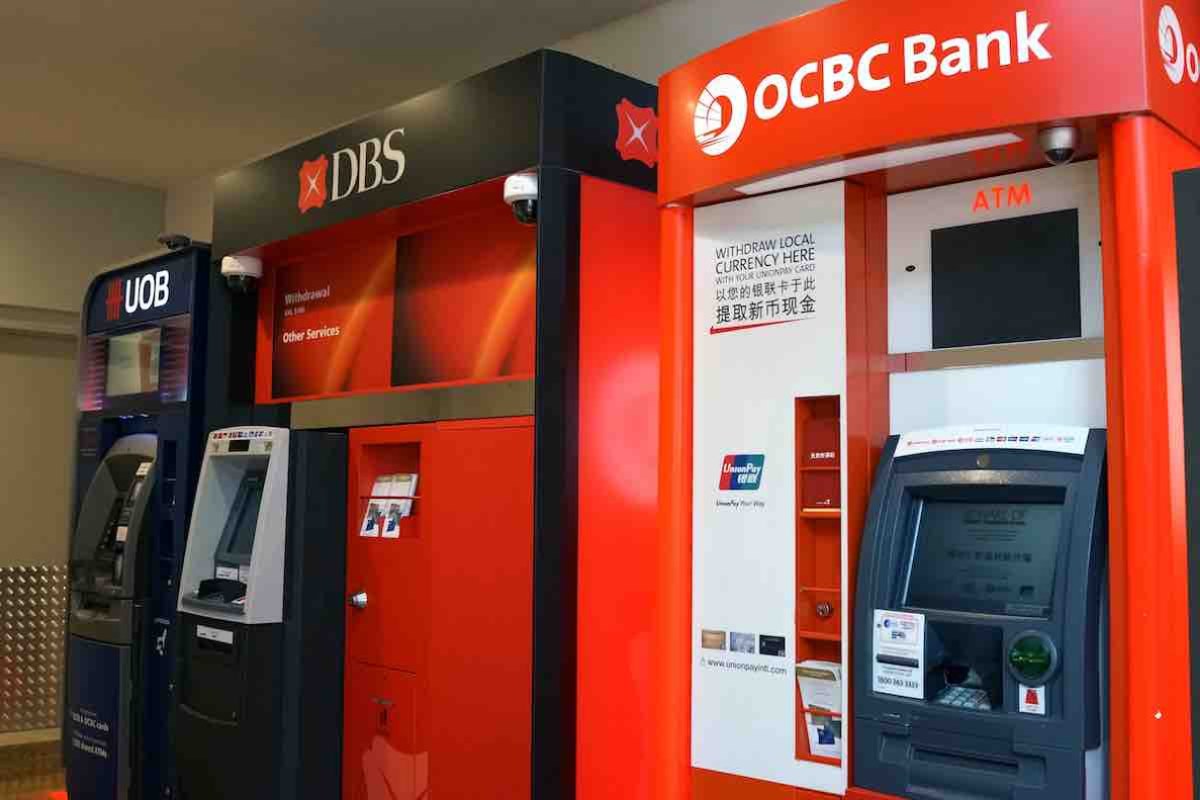
DBS, OCBC are near record highs after their earnings, while UOB has lagged. We compare their earnings and dividend sustainability to see which bank looks most attractive for investors.
What happened?
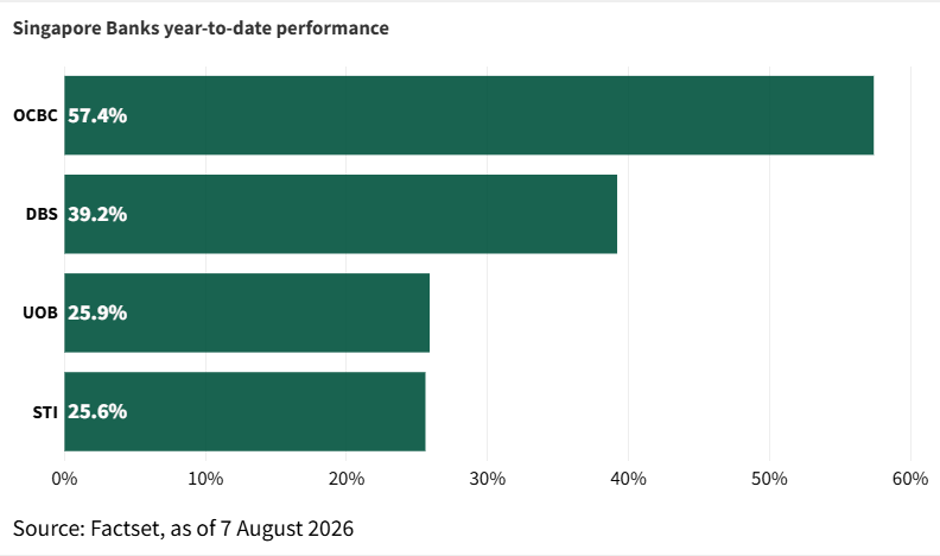
DBS and OCBC reached new all-time highs after their recent earnings.
OCBC has led the pack, crossing S$30 for the first time and ranking among the best-performing Singapore blue chips in July, while DBS continues to trade above S$75. In contrast, UOB slipped after its recent earnings.
The strong performance of the Singapore banks has helped to lift the Straits Times Index (STI) to record highs too.
I have seen some discussion in the Beansprout community on whether DBS, OCBC or UOB still looks attractive for dividend income after the rally.
In this article, I compare DBS, OCBC and UOB across their latest earnings, dividends and Beansprout’s Opportunity Pot framework to find out if it's still worthwhile investing in the Singapore banks.
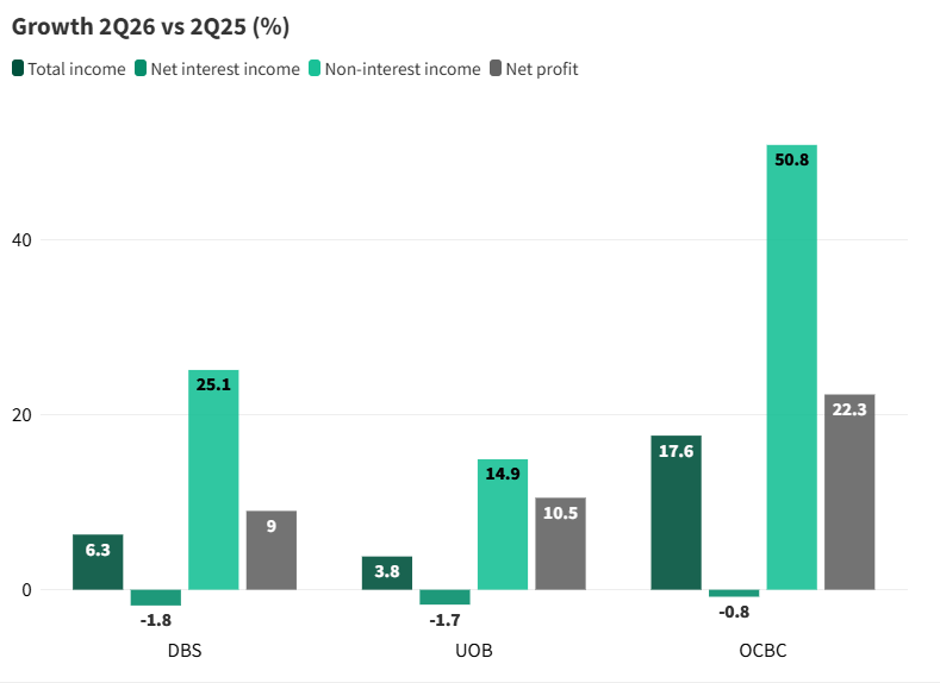
OCBC delivered the strongest year-on-year profit growth in 2Q 2026 compared to DBS and UOB
OCBC delivered a strong quarter in 2Q26.
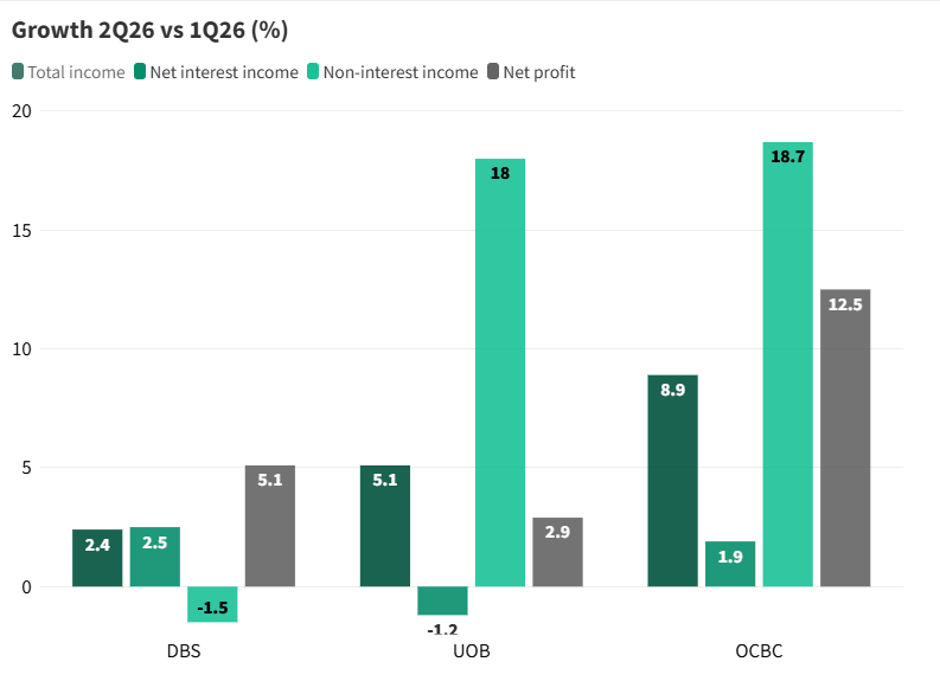
Group net profit rose 22% year-on-year to a record S$2.22 billion, the first time the bank has crossed the S$2 billion mark on a quarterly basis. Compared to the previous quarter, net profit was 12% higher.
Total income also reached a new high of S$4.17 billion, up 18% year-on-year and 9% quarter-on-quarter, driven by a 51% year-on-year jump in non-interest income to a record S$1.91 billion.
For the first half of 2026, OCBC's net profit rose 13% to a record S$4.19 billion, with annualised return on equity of 13.7%, up 1.1 percentage points from a year ago.
DBS also delivered a record quarter. 2Q26 net profit rose 9% year-on-year to a record S$3.08 billion, as record wealth management performance, record treasury customer sales and stronger markets trading income more than offset the impact of lower interest rates.
Total income crossed S$6 billion for the first time, reaching a new high of S$6.09 billion.
For 1H26, net profit rose 5% year-on-year to a record S$6.01 billion.
UOB was the smallest gainer amongst the three.
2Q26 net profit rose 10% year-on-year to S$1.48 billion, supported by underlying business momentum across customer segments and some non-recurring gains from asset divestments.
For 1H26, net profit rose 3% year-on-year to S$2.92 billion.
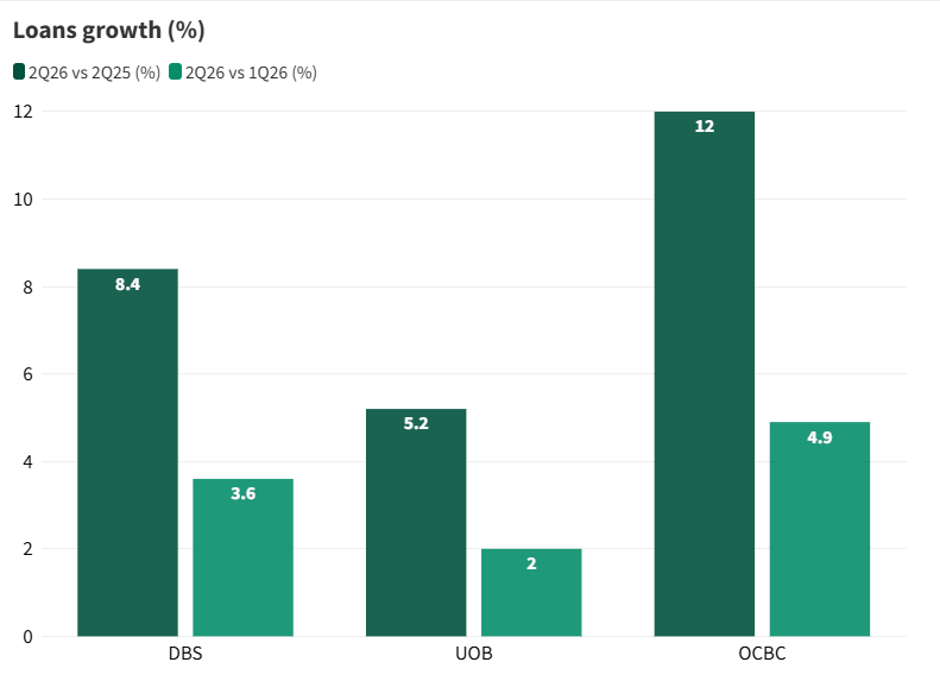
OCBC also continued to lead loan growth in 2Q 2026 compared to DBS and UOB
OCBC continued to lead in loan growth in 2Q26, with its loan book expanding 12% year-on-year (in constant currency terms) and 5% quarter-on-quarter to S$364 billion.
Growth was broad-based across corporate and consumer loans, led by the technology, media and telecommunications, digital infrastructure, energy, and transport sectors.
Given the strong first-half performance, OCBC raised its full-year loan growth guidance to the high single-digit to low double-digit range.
DBS reported an even sharper acceleration in loan growth, with loans up 8.4% year-on-year and 3.6% quarter-on-quarter.
The strong 2Q26 loan growth was partly driven by a Sembcorp-Alinta acquisition bridge financing deal and Government Land Sales financing in Singapore, alongside broader momentum in non-trade corporate loans.
Management noted that this exceptional growth pace was unlikely to continue in the second half, with steady-state growth expected at a more moderate S$4 to S$5 billion per quarter.
UOB's loan growth was more moderate at 5.2% year-on-year, supported by wholesale banking loans which grew 8% year-on-year, while retail banking loans grew 4%. Trade loans grew a strong 33%.
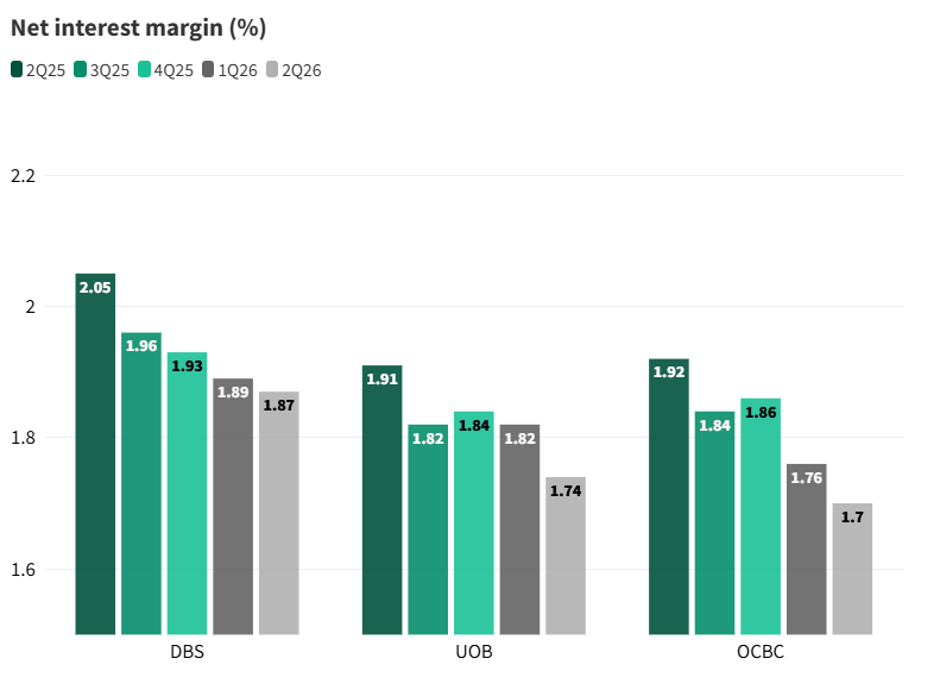
DBS' net interest margin held up best compared to OCBC and UOB
Net interest margins (NIM) continued to come under pressure in 2Q2026, as SORA and HIBOR trended lower.
DBS held up best among the three banks.
Its NIM fell by just 2 basis points quarter-on-quarter to 1.87%, from 1.89% in 1Q2026, supported by hedging activities and balance sheet growth.
Management also maintained its interest rate sensitivity guidance of S$11 million per basis point for the Singapore dollar and negative US$4 million per basis point for the US dollar.
UOB saw the sharpest compression.
Its NIM narrowed by 8 basis points to 1.74%, from 1.82% in 1Q2026, mainly due to loan repricing in a lower rate environment.
UOB exited July with a NIM of 1.71%, though management noted that SORA appears to be bottoming and could trend higher in the second half of 2026.
OCBC’s NIM declined by 6 basis points quarter-on-quarter to 1.70%.
This reflected lower loan yields and higher wholesale funding costs, as the bank supported strong 5% quarter-on-quarter loan growth and continued investing in high-quality treasury assets.
OCBC exited June with a NIM of 1.67%, but expects NIM to stabilise in the second half if SORA strengthens gradually towards year-end.
Overall, NIM pressure remained a common headwind for all three Singapore banks in 2Q2026.
DBS showed the most resilience, UOB saw the sharpest quarter-on-quarter decline, while both UOB and OCBC are looking for SORA stabilisation to support margins in the second half.
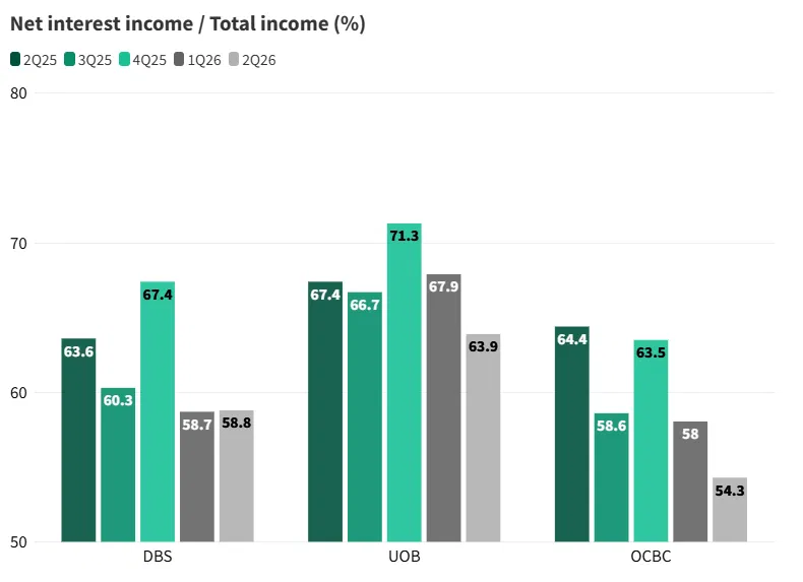
Non-interest income is becoming a bigger earnings driver for DBS, OCBC and UOB
Non-interest income is becoming a more important earnings driver for all three Singapore banks.
This shift continued in 2Q2026, as fee income, trading income and insurance income helped offset pressure from lower net interest margins.
OCBC showed the clearest shift.
Its net interest income share of total income fell to 54.3% in 2Q2026, the lowest among the three banks and down sharply from 63.5% in 4Q2025.
This means non-interest income now accounts for close to 46% of OCBC’s total income, reflecting the growing role of fees, trading and insurance income.
DBS remained more balanced.
Its net interest income share stood at 58.8% in 2Q2026, broadly stable from 1Q2026, as both net interest income and non-interest income grew during the quarter.
UOB still remains the most dependent on interest income.
Its net interest income share fell to 63.9% in 2Q2026, from 67.9% in 1Q2026, as non-interest income rebounded 18% quarter-on-quarter.
However, UOB’s higher reliance on interest income could make its earnings more sensitive if interest rates decline further.
Overall, OCBC has the most diversified income mix today, DBS remains well balanced, while UOB still has the greatest exposure to interest rate movements.
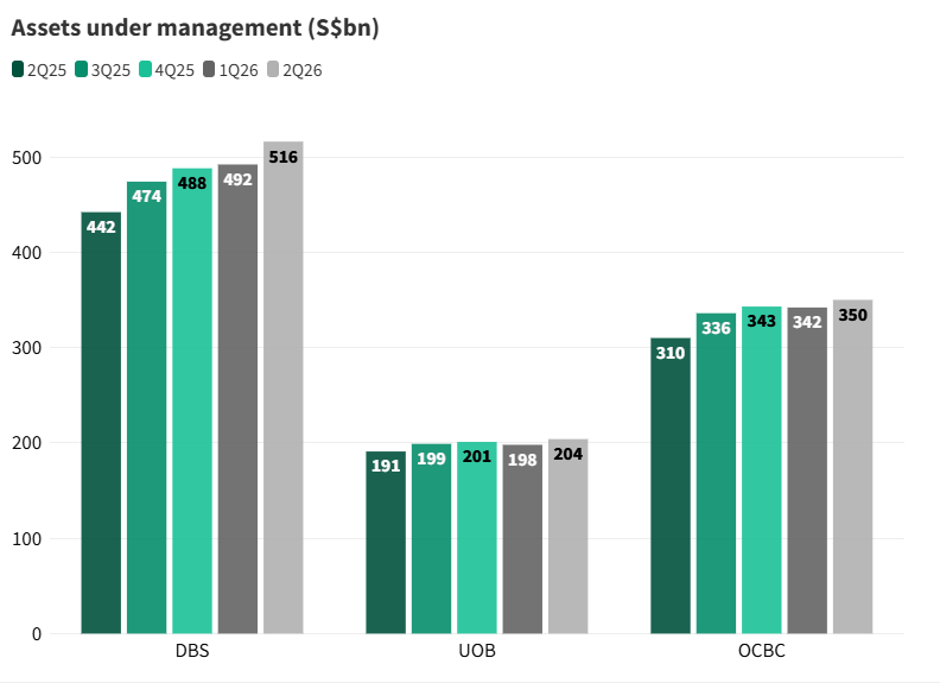
Record wealth management fees lifted non-interest income for DBS, OCBC and UOB
The biggest earnings support in 2Q2026 came from non-interest income, especially wealth management fees.
Wealth management was a key earnings driver for all three banks in 2Q2026, helping to offset continued pressure on net interest margins.
OCBC delivered the strongest non-interest income growth, rising 51% year-on-year to a record S$1.91 billion.
Fee income crossed S$700 million for the first time, while wealth management fees grew 39% in 1H2026.
Trading and investment income also rose 85% in 2Q2026, supported by stronger customer flow income and a recovery in Great Eastern’s investment portfolio.
DBS also saw strong momentum, with non-interest income rising 25% year-on-year.
Wealth management fees and treasury customer sales both reached record levels, supported by investment product sales, discretionary portfolio management, bancassurance and equity-related treasury activity.
Its AUM crossed S$500 billion for the first time to reach S$516 billion.
UOB’s non-interest income rose 14.9% year-on-year, while wealth income increased 16% in 1H2026 and ASEAN-4 wealth income grew 30%.
However, management lowered its full-year fee income growth guidance from high-single-digit to low-single-digit growth, reflecting delayed fee deals and softer credit card income.
Wealth AUM continued to expand across the three banks, reaching S$350 billion at OCBC and S$204 billion at UOB.
DBS is targeting S$1 trillion in total wealth AUM by 2030, while OCBC’s HSBC Indonesia wealth acquisition and UOB’s Allianz partnership should further strengthen their respective wealth franchises.
Overall, OCBC showed the strongest non-interest income growth, DBS delivered broad-based wealth and treasury momentum, while UOB continued to grow its wealth business despite a softer fee income outlook.
Asset quality across DBS, OCBC and UOB remained stable, but Greater China real estate remains a key watchpoint
Asset quality remained broadly stable across the three Singapore banks in 2Q2026.
However, both UOB and OCBC saw new non-performing assets from Greater China real estate accounts, making this an area to watch.
UOB saw a sharper increase in credit costs.
Specific credit costs rose to 39 basis points in 2Q2026, from 29 basis points in 1Q2026.
This was mainly due to the downgrade of one Greater China real estate account that had already been closely monitored.
Total allowances came in at S$211 million for the quarter.
UOB’s total credit costs on loans stood at 28 basis points in 2Q2026, or 27 basis points for the first half, still within its full-year guidance of 25 to 30 basis points.
DBS remained relatively stable.
Specific allowances rose slightly to S$188 million in 2Q2026, equivalent to 16 basis points of loans.
This brought first-half specific allowances to S$345 million, or 15 basis points, still within management’s full-year guidance of 17 to 20 basis points.
DBS’s allowance coverage stood at 130%, or 196% after considering collateral.
OCBC’s asset quality also remained manageable.
Total credit costs were 14 basis points on an annualised basis in 2Q2026, while 1H2026 credit costs stood at 18 basis points, unchanged from a year earlier.
New corporate non-performing asset (NPA) formation came mainly from the downgrade of two Greater China corporate real estate accounts that had been proactively managed.
This was partly offset by net recoveries and upgrades in the same segment.
OCBC now expects full-year credit costs to come in at the lower end of its earlier 20 to 25 basis point guidance.
Overall, asset quality remains resilient across the three banks.
However, UOB’s sharper increase in Greater China NPLs and the continued downgrades in Greater China real estate accounts at both UOB and OCBC suggest that this segment remains the main credit risk to watch.
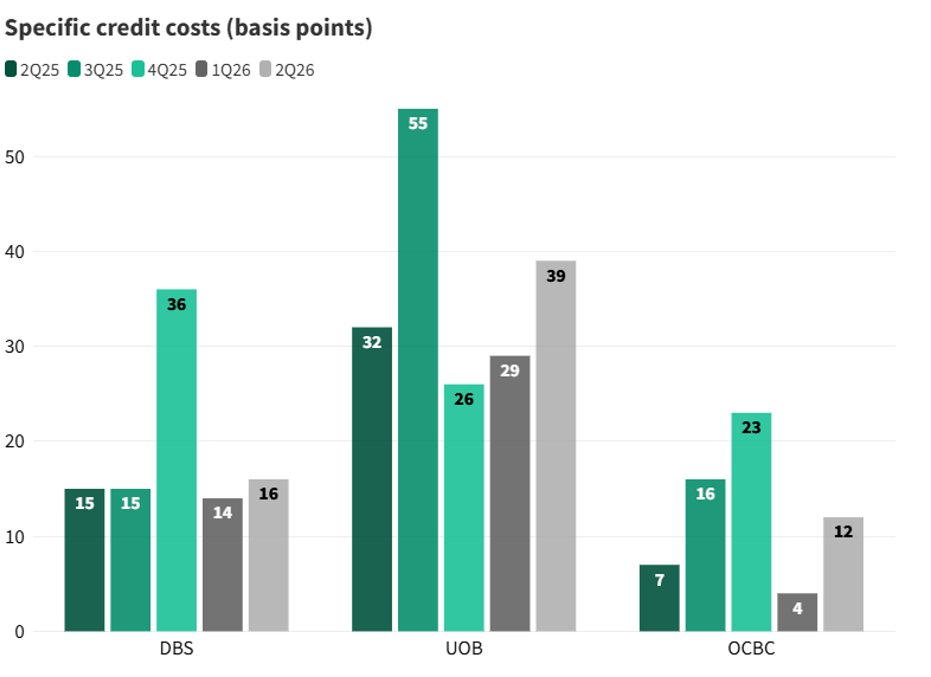
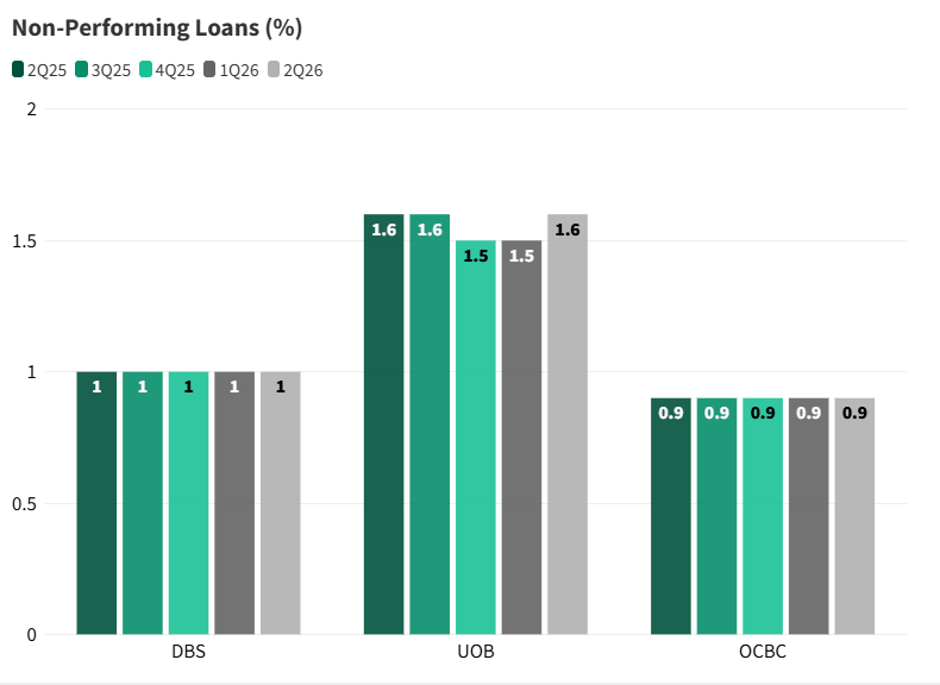
Non-performing loan ratios were largely stable across the three banks in 2Q2026.
OCBC continued to report the lowest NPL ratio at 0.9%, unchanged for eight consecutive quarters.
Its total NPA coverage also rose to 163%, providing a strong buffer against potential losses.
DBS’ NPL ratio stayed stable at 1.0%, with non-performing assets little changed from the previous quarter at S$4.76 billion.
UOB’s NPL ratio edged up to 1.6%, from 1.5% in 1Q2026.
This reflected the impact of the downgraded Greater China real estate account.
However, UOB’s NPA coverage strengthened to 88%, or 306% after taking collateral into account.
Overall, OCBC and DBS continued to show stable asset quality, while UOB’s Greater China exposure remains the key credit risk to monitor.
Singapore banks offer a forward dividend yield of 3.7–4.2%. Both OCBC and UOB declared higher interim dividends.
All three Singapore banks declared interim dividends, giving income investors more visibility on payouts for the rest of 2026.
DBS declared a 2Q2026 ordinary dividend of S$0.66 per share, together with a capital return dividend of S$0.15 per share.
This brings its total dividend for the quarter to S$0.81 per share, unchanged from 1Q2026.
For 1H2026, DBS has paid total dividends of S$1.62 per share.
Management also reaffirmed that the S$0.15 quarterly capital return dividend will be maintained through 2026 and 2027.
DBS still has an ongoing S$3 billion share buyback programme, of which S$0.4 billion has been used.
Management indicated that the remaining S$2.6 billion may be converted into capital return dividends if it is not fully deployed by end-2027, subject to board approval.
UOB declared an interim ordinary dividend of S$0.88 per share for 1H2026.
This is up from S$0.85 a year ago and remains consistent with its 50% dividend payout ratio.
Find out how much dividends you would have received as a shareholder of DBS in the past 12 months with the calculator below.
UOB’s S$2 billion capital return programme is about 40% completed, with approximately S$794 million returned so far.
The bank remains committed to completing the programme by end-2027, either through share buybacks or other means.
Find out how much dividends you would have received as a shareholder of UOB in the past 12 months with the calculator below.
OCBC declared an interim ordinary dividend of S$0.47 per share for 1H2026, up 15% from S$0.41 a year earlier.
This is in line with its 50% ordinary dividend payout ratio.
OCBC also confirmed that the remaining S$800 million of its S$2.5 billion capital return plan will be paid as a special dividend of about S$0.18 per share at the end of FY2026, together with its final FY2026 dividend, if not used for share buybacks.
Find out how much dividends you would have received as a shareholder of OCBC in the past 12 months with the calculator below.
Overall, all three banks continue to return capital to shareholders.
DBS offers the clearest near-term payout visibility through its quarterly capital return dividend, while UOB and OCBC remain anchored by 50% ordinary dividend payout ratios and ongoing capital return plans.
| Dividends | DBS | UOB | OCBC |
| 1H26 ordinary dividend | S$1.32 (2x S$0.66) | S$0.88 | S$0.47 |
| 1H26 capital return / special dividend | S$0.30 (2x S$0.15) | None declared for 1H26 | To be paid in final FY2026 dividend |
| Annualised total DPS (indicative) | S$3.24 | S$1.76 | S$1.12 (including expected S$0.18 special) |
| Forward yield | ~4.1% | ~4.2% | ~3.7% (including special) |
| Source: Company data; Forward yields based on share prices as of 7 August 2026 | |||
Related links:
- DBS dividend history and dividend forecast
- OCBC dividend history and dividend forecast
- UOB dividend history and dividend forecast
What are DBS, OCBC and UOB expecting for the rest of FY2026?
DBS outlook: momentum broadening across loans, wealth and treasury
DBS delivered a strong 1H2026, supported by record income and profit.
Management sounded upbeat on the outlook for the rest of the year, with loan growth expected to continue at a steady pace of S$4 billion to S$5 billion per quarter.
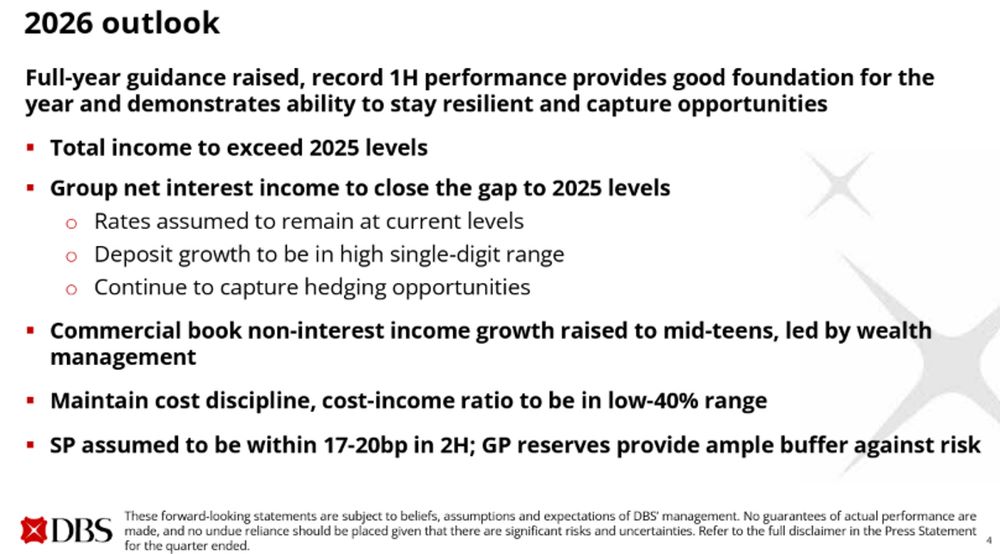
There could also be additional lumpy contributions from acquisition financing deals.
Wealth management momentum also remained solid into July, with early numbers showing broad-based activity across the franchise.
DBS is targeting a cost-to-income ratio in the low-40% range and continues to guide for specific credit costs of 17 to 20 basis points.
Management also noted that general provision reserves provide a buffer against potential stress in the current uncertain macro environment.
CEO Tan Su Shan has also outlined a target to grow DBS’s total wealth AUM to S$1 trillion by 2030.
This implies a mid-to-high single-digit compound annual growth rate from the current S$680 billion base.
UOB outlook: guidance largely unchanged, but fee income outlook cut
UOB kept most of its 2026 guidance unchanged.
The main change was a cut in fee income growth guidance from high-single-digit to low-single-digit growth.
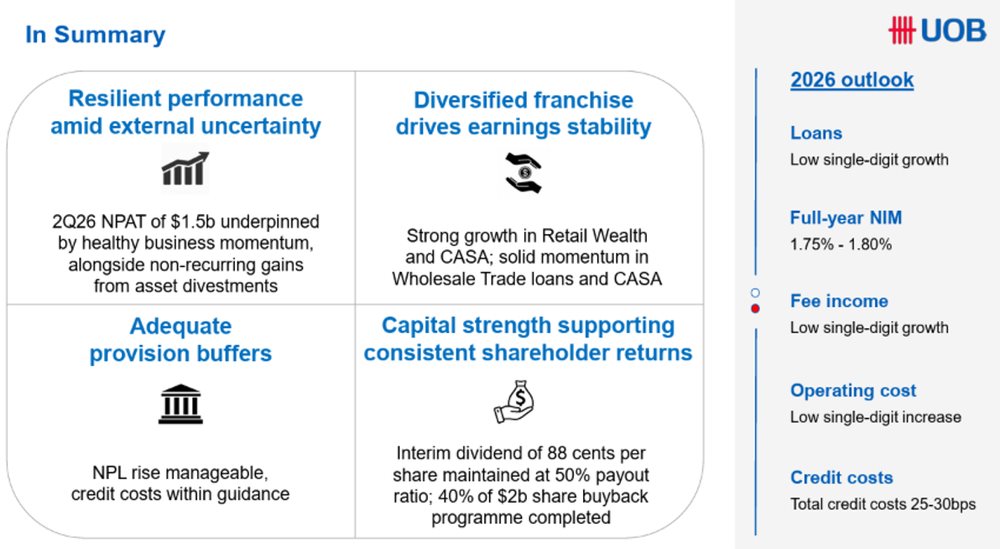
This reflects delays in some fee deals into the second half, as well as softer credit card fee income due to changing consumer spending patterns and higher scheme fees.
UOB expects low-single-digit loan growth, full-year NIM of 1.75% to 1.80%, low-single-digit growth in operating expenses, and total credit costs of 25 to 30 basis points.
The bank is targeting medium-term ROE of 12% to 13%.
CEO Wee Ee Cheong highlighted ASEAN as UOB’s key growth engine, supported by its regional franchise and deepening trade and investment flows across the region.
The Allianz Global Investors partnership is also expected to strengthen UOB’s wealth management franchise and support its ambition to double wealth fees over the medium term.
OCBC outlook: loan growth upgraded, credit cost outlook improved
OCBC raised its FY2026 loan growth guidance to the high-single-digit to low-double-digit range, from mid-single-digit previously.
This reflects strong loan growth momentum in the first half.
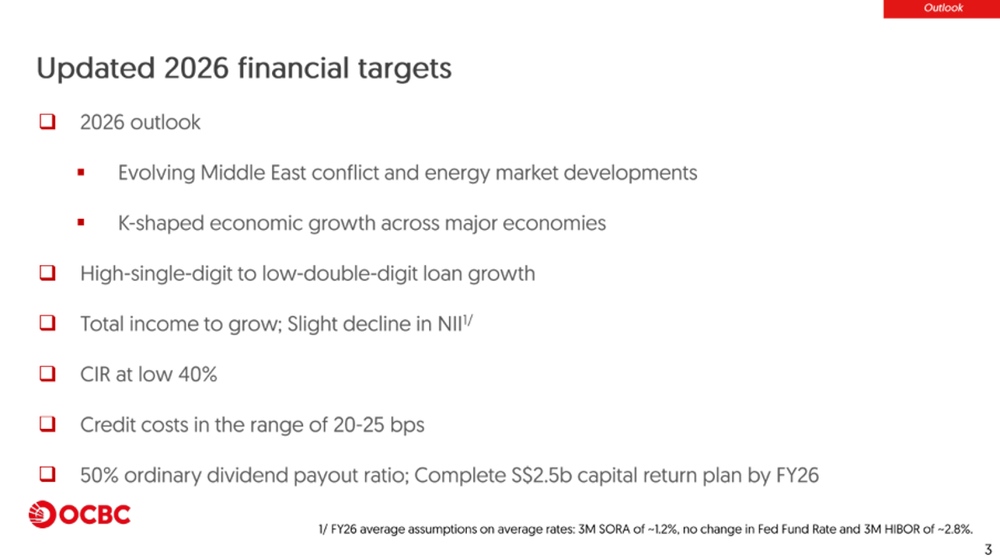
OCBC also now expects full-year credit costs to come in at the lower end of its earlier 20 to 25 basis point guidance.
Total income is expected to grow year-on-year, supported by continued momentum in non-interest income.
However, net interest income is still expected to decline slightly.
The cost-to-income ratio is guided at the low-40% range.
CEO Tan Teck Long highlighted momentum from OCBC’s Next Frontier strategy, especially in wealth management under its Twin Hub strategy in Singapore and Hong Kong.
The bank is also expanding further into Indonesia through the acquisition of HSBC’s wealth business.
Key risks to watch include elevated geopolitical uncertainty, energy market developments and a K-shaped economic outlook across major economies.
Overall, DBS and OCBC sound more upbeat heading into the second half, supported by stronger loan growth and wealth management momentum.
UOB’s ASEAN and wealth strategy remains intact, but the cut to fee income guidance and Greater China credit concerns make its outlook slightly more mixed.
How DBS, UOB and OCBC screen through Beansprout's Opportunity Pot framework
All three banks pass our opportunity pot screening framework, but their strengths differ.
OCBC stands out for earnings momentum, DBS continues to lead on returns, while UOB screens less strongly on underlying growth and ROE.
However, the screen assesses business quality and momentum, not whether today’s share price offers an attractive entry point.
With valuations across all three banks now well above historical averages, price matters more than ever.
| Opportunity Pot check | DBS | OCBC | UOB |
| Revenue & earnings momentum | ✅ Pass — 2Q income +6% YoY; net profit +9% to a record S$3.08b | ✅ Strongest — income +18%; net profit +22% to a record S$2.22b | ✅ Pass, but weaker underlying momentum — income +3.8%; profit +10%, helped by a S$330m one-off gain |
| Balance sheet strength | ✅ Strong — CET1 16.6%; NPL ratio 1.0%; allowance coverage 130% | ✅ Strong — CET1 15.7%; lowest NPL ratio at 0.9%; NPA coverage 163% | ✅ Pass — CET1 15.4%; NPL ratio rose to 1.6%; Greater China exposure worth watching |
| Return on equity | ✅ Strongest — 1H2026 ROE of 17.5% | ✅ Strong — 1H2026 ROE of 13.7%; 2Q annualised ROE 14.4% | ✅ Pass — 2Q2026 ROE of 11.8%, above our 10% threshold |
| Overall | ✅ Pass | ✅ Pass | ✅ Pass |
What would Beansprout do?
OCBC and DBS have continued to climb to record highs after their 2Q2026 results, while UOB has pulled back slightly.
The divergence reflects the market’s different read on each bank.
OCBC delivered the strongest earnings momentum, DBS continues to offer the clearest dividend visibility, while UOB faces more questions around Greater China real estate exposure and its softer fee income outlook.
Overall, Singapore banks remain fundamentally strong.
Earnings are becoming less dependent on net interest margins, with fees, wealth management, trading income and insurance income playing a larger role.
This is where I would consider the banks not just as Income Pot ideas, but also as potential Opportunity Pot candidates within Beansprout’s four pots of wealth.
| Bank | Summary | What to watch |
| DBS | Strongest dividend visibility and record wealth management performance | NIM trend, sustainability of loan growth, and use of remaining share buyback capacity |
| OCBC | Strongest earnings momentum, but valuation has re-rated meaningfully higher | Whether wealth, trading and insurance momentum can hold up; Greater China CRE exposure |
| UOB | Solid recovery aided by Allianz deal; fee income guidance cut | Credit costs from Greater China real estate; recovery in fee income momentum |
OCBC stands out for earnings momentum.
Its 2Q2026 net profit crossed S$2 billion for the first time, while 1H2026 profit reached a record high.
The bank is also executing well on its Next Frontier strategy, including the acquisition of HSBC’s Indonesia wealth business and continued investment in Hong Kong under its Twin Hub strategy.
However, valuation has re-rated meaningfully.
OCBC now trades at about 2.36 times price-to-book, well above its historical average of 1.16 times.
Its forward dividend yield of about 3.7% (including S$0.18 special dividend) is also the lowest among the three banks.
DBS offers the strongest dividend visibility.
Its capital return dividend provides a clear floor on quarterly payouts through FY2026 and FY2027.
Its wealth management franchise also remains a key growth driver, with AUM crossing S$500 billion for the first time.
DBS’s forward dividend yield of about 4.1% remains attractive relative to the other two banks, although its price-to-book ratio of 3.18x is also well above its historical average of 1.52x.
UOB looks more mixed.
Its 2Q2026 earnings recovered, helped partly by the gain from the Allianz Global Investors transaction.
Credit costs remain within guidance, but the rise in Greater China real estate NPLs needs to be monitored closely.
UOB offers a forward dividend yield of about 4.2%, with its ongoing share buyback programme providing additional capital returns.
Among the three banks, OCBC has the strongest earnings momentum, DBS has the clearest income visibility, and UOB offers a cheaper-looking yield but with more near-term uncertainties.
Following the strong rally, we would weigh the fundamentals against their valuations when evaluating the Singapore banks.
DBS and OCBC looking better positioned, while UOB needs clearer evidence that fee income momentum and Greater China credit risks are stabilising.
To find out which of the Singapore banks we would hold in our model portfolio, check out how we would invest $100,000 in Singapore today.
Singapore’s rise as a wealth management hub is one of the structural themes that could continue to support the local banks over time. But it is not the only theme we are watching.
Beyond the banks, there may be other areas of the Singapore market supported by long-term trends, including energy and food security, AI and data centre growth, and continued infrastructure spending. Find out more about the 4 growth themes we are watching in Singapore stocks here.
If you are looking for greater clarity on the markets and the investment decisions that matter, explore Beansprout Pro for our latest views, portfolio thinking and the reasoning behind each opportunity.
Which Singapore bank are you backing at these levels: DBS, OCBC or UOB? Share your thoughts with us in the Beansprout Telegram community.
Planning to invest in the Singapore banks? Compare the best Singapore brokers to find the right trading platform, and see the latest promotions and sign-up rewards available.
Follow Beansprout on YouTube, Facebook and Instagram, and add Beansprout as your preferred source on Google so you never miss an update.
Read also
Gain financial insights in minutes
Subscribe to our free weekly newsletter for more insights to grow your wealth
Most Popular

Comments
0 comments