
How to gain exposure to Alibaba, Tencent and other Hong Kong stocks beyond buying shares
Trading
By Nicole Ng • 01 Sep 2026
Why trust Beansprout? We’ve been awarded Best Investment Website at the SIAS Investors’ Choice Awards 2025
Learn how investors can gain exposure to Alibaba, Tencent and other Hong Kong stocks using Single Stock Options and Weekly Stock Options, and the key risks to understand.

What happened?
For many Singapore investors, Hong Kong has always been known as a gateway to China's growth opportunities.
Names like Tencent, Alibaba, Trip.com, XPeng and Pop Mart are often the first stop through stocks and ETFs.
But investing in Hong Kong goes beyond simply buying and holding shares.
WSOs cover some of the market's most closely watched names across technology, biotechnology, electric vehicles, consumer brands, gold and property.
Here, I’ll take a closer look at how SSOs and WSOs work, some of their common uses, and the risks investors should understand before trading them.
What are Single Stock Options (SSOs) and Weekly Stock Options (WSOs)?
#1 – Single Stock Options
Single Stock Options (SSOs) are listed options contracts based on an individual stock. These are the standard monthly expiry options that most investors know of.
They give buyers the right, but not the obligation, to buy or sell a stock at a predetermined price (the strike price) before or on a specified expiry date.
Call options give the buyer the right to buy the underlying stock, and put options give the buyer the right to sell the underlying stock.
Investors may use stock options in different ways.
For example, you may sell call options to generate premium income on shares you already own, buy put options to help manage downside risk, or buy options to express a short-term view on a stock.
#2 – Weekly Stock Options
Weekly Stock Options (WSOs) work in the same way as traditional Single Stock Options but expire every week instead of every month.
The weekly expiry cycle provides more frequent expiry choices, which may be used for shorter-term positioning or around specific events.
HKEX has continued to expand the number of stocks with Weekly Stock Options available.
In June 2026, HKEX increased the number of Weekly Stock Option underlyings from 16 to 33.
HKEX has also announced the introduction of 18 additional stock option classes, rolled out in three batches on 10 August, 17 August and 31 August 2026. Each offers both monthly and weekly expiries
The newly introduced stock option classes cover companies across industries including artificial intelligence, cloud computing, robotics, electric vehicles, healthcare, mining and advanced manufacturing.
The additions expanded the range of underlying stocks for which listed stock options are available across several sectors.
Since their launch, Weekly Stock Options (WSOs) have gained traction among investors, accounting for around 21% of total trading volume across stock options with both weekly and monthly expiries.
The cumulative trading volume had exceeded 43 million contracts as of 10 July 2026.
Average daily trading volume has also more than doubled, rising from around 60,000 contracts in the fourth quarter of 2024 to over 123,000 contracts in 2026.
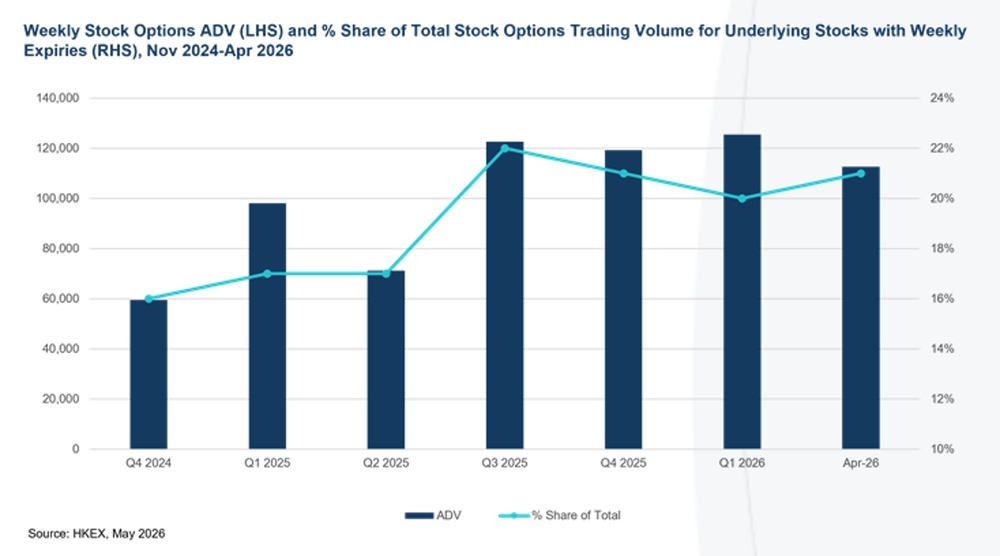
Retail participation in selected WSO contracts has also exceeded 30%, highlighting growing adoption among both institutional and individual investors.
#3 – How are WSOs different from SSOs?
Weekly Stock Options (WSOs) are a type of Single Stock Option (SSO). The main difference is the expiry cycle.
Traditional SSOs typically expire once a month, while WSOs expire every week. This gives you more flexibility to manage exposure around specific events or shorter-term market views.
| Feature | Traditional SSOs | WSOs |
| Expiry frequency | Monthly | Weekly |
| Typical use case | Medium-term positioning, hedging and income strategies | Short-term trading, event-driven trading and short-term risk management |
| Time decay | Slower | Faster |
| Premium outlay | Generally higher | Generally lower in absolute dollar terms |
The shorter expiry cycle can be useful when managing exposure around events such as earnings announcements, product launches, economic data releases or regulatory decisions.
For example, an investor may use a weekly option to hedge an existing position around an earnings announcement, or express a short-term view on a stock without taking exposure for an entire month.
The availability of multiple near-dated expiries also provides greater flexibility when implementing options strategies across different time horizons.
Because WSOs have a shorter expiry, they often require a lower premium than comparable monthly options.
However, time decay also works faster. If the expected move does not happen before expiry, the option can lose value quickly or expire worthless.
And the shorter time to expiry also means Weekly Stock Options are generally more sensitive to movements in the underlying stock.
As a result, WSOs offer more precision for short-term opportunities and risk management, but they also require closer monitoring and a stronger understanding of how options work.
What are Hong Kong stock options used for?
#1 – Generating additional income on existing holdings
One of the most common options strategies is the covered call.
A covered call involves selling a call option against shares that you already own.
In exchange for selling the option, the investor receives an option premium.
The potential benefit is straightforward: the premium can provide additional income on top of any potential dividends received from the stock.
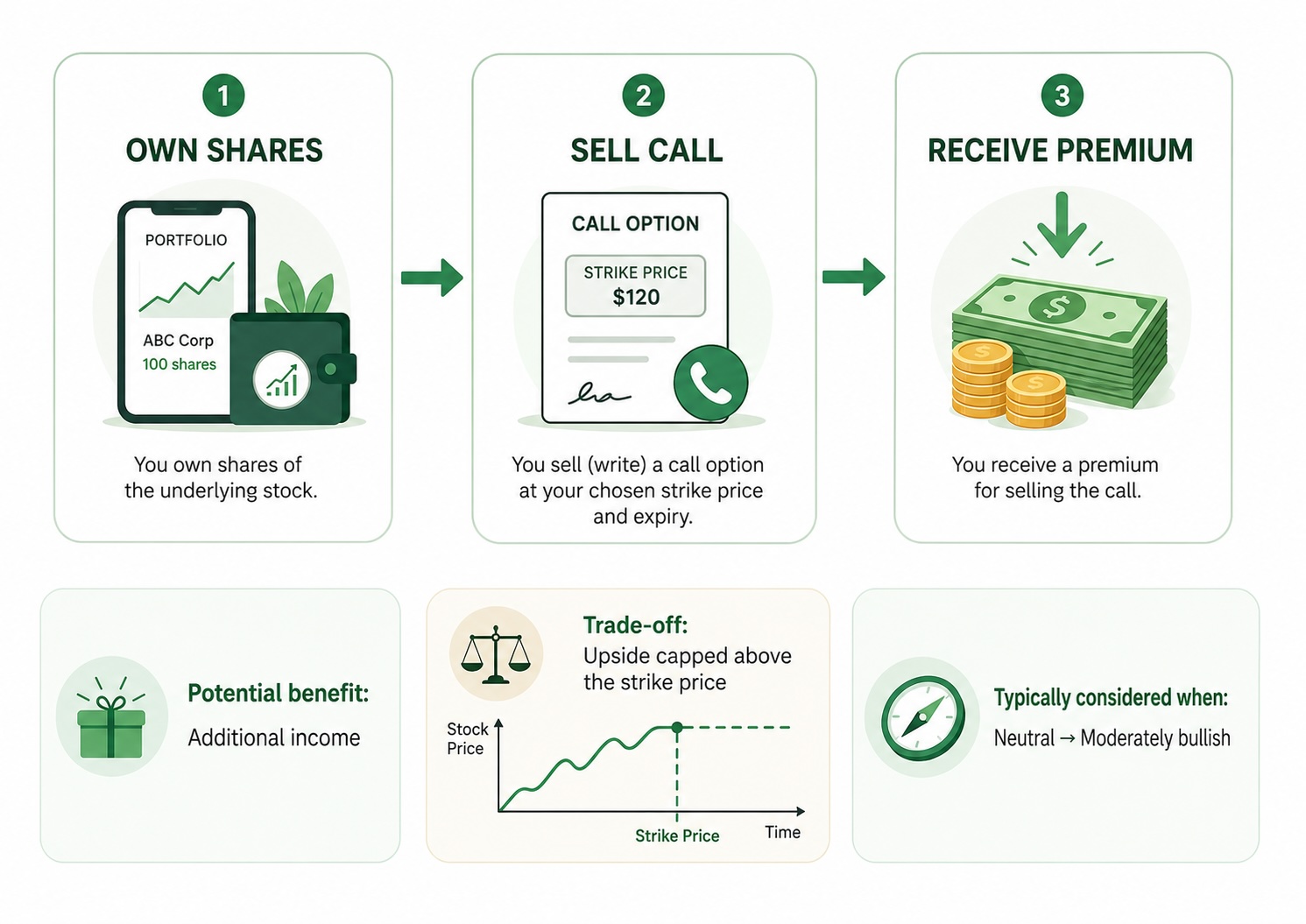
The trade-off is that if the share price rises above the strike price, the investor may be required to sell the stock at that predetermined price and forgo further upside.
As a result, covered calls may be used by investors who are neutral to moderately bullish on a stock rather than expecting a sharp rally.
#2 – Managing downside risk
Another use case is downside protection through put options.
Investors with exposure to Hong Kong or China-related equities may purchase put options, which generally increase in value when the underlying stock declines.
This can help offset some of the losses on the underlying shareholding during periods of market weakness.
If the stock moves sideways or rises, the put may expire worthless, and the premium paid becomes the “cost of insurance”.
It’s not perfect protection, but it provides a structured way to manage risk during volatile periods.
#3 - Expressing short-term market views
Options also allow you to express short-term views on stocks around events like:
- Earnings announcements
- Policy updates
- Economic data releases
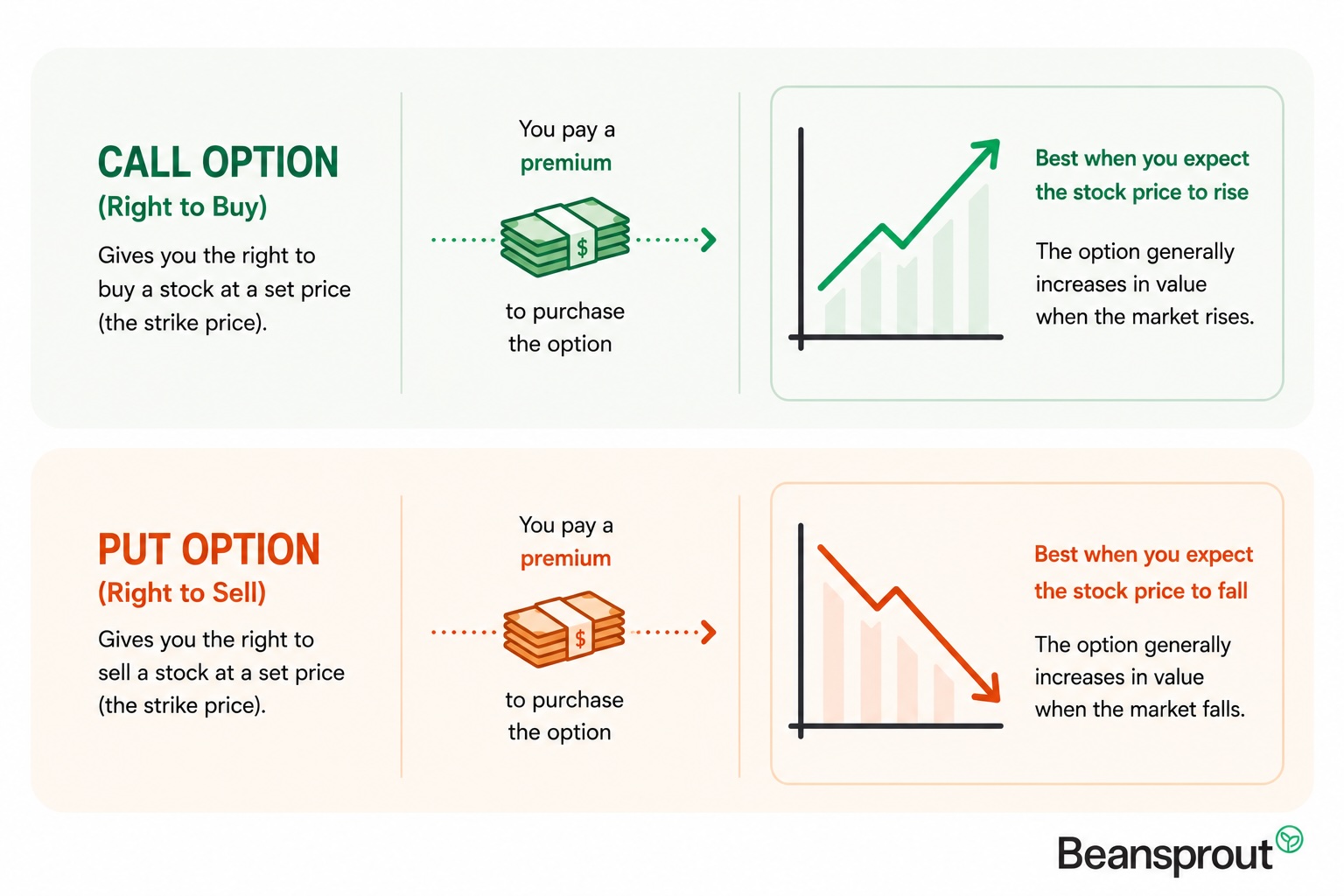
Instead of buying the stock directly, investors who buy options can take a short-term view with less upfront capital.
Their maximum loss is limited to the premium paid, although the option may lose value quickly or expire worthless if the expected move does not happen before expiry.
But in this particular use case, timing matters a lot. If the price move doesn’t happen before expiry, the option can lose value quickly or expire worthless.
What are the risks of SSOs and WSOs?
#1 – Options have an expiry date
If the expected market move does not occur before expiry, an option may lose value rapidly or expire worthless, resulting in the loss of the entire premium paid.
This risk is particularly important for Weekly Stock Options, where the shorter lifespan means time decay works much faster than with monthly options. As a result, timing becomes a critical factor when trading WSOs.
If you’re trading options, ensure that the option's expiry date aligns with the event or market view you are seeking to capture, and only risk capital you are prepared to lose.
#2 – Liquidity may vary between contracts
Lower liquidity may result in wider bid-ask spreads and make it more difficult to enter or exit options positions at desired prices.
Before trading, check the bid-ask spread and trading volume. More actively traded contracts generally offer better liquidity and tighter spreads.
#3 – Sellers may face assignment risk
If you sell options, you may be assigned and required to buy or sell the underlying shares at the strike price.
For example, if you sell a covered call and the share price rises above the strike price, you may have to sell your shares at that price and give up further upside.
Ensure you have sufficient shares or cash to meet potential obligations, and understand the possible outcomes before entering the trade.
#4 – Options have more complexity
SSOs and WSOs are more complex than simply buying shares.
Their prices are influenced by several factors, including the underlying stock price, strike price, expiry date, volatility, interest rates, dividends and time decay.
As a result, you need to evaluate more than just the company's fundamentals when trading options.
You must also understand how these factors can affect an option's value and potential outcomes.
Starting with simpler strategies and smaller position sizes can help build familiarity with the product and its risks.
How to get started with Hong Kong stock options?
Single Stock Options and Weekly Stock Options are accessible through local Singapore brokerages that offer Hong Kong derivatives trading.
However, options trading permissions are typically separate from standard Hong Kong stock trading access.
You should check whether your brokerage supports HKEX stock options and ensure you understand the eligibility requirements, fees, and risks involved before getting started.
What would Beansprout do?
I would view Hong Kong stock options as a tool for investors who already understand the underlying stocks and are comfortable with more advanced market products.
For most investors, the starting point should still be the basics: understanding the company, its fundamentals, valuation, risks, and role within a broader portfolio.
Options may then be considered by more experienced investors who want additional flexibility. They can potentially be used to generate premium income from existing holdings, manage downside risk, or express shorter-term views around specific market events.
The expansion of HKEX's Weekly Stock Options makes Hong Kong's market more versatile.
It gives you more ways to access and manage exposure to some of the region's companies and investment themes.
Before trading options, investors should understand how premiums, strike prices, expiry dates, volatility, liquidity, time decay and assignment can affect the potential outcomes of a position.
Any options strategy should also be considered in the context of an investor's objectives, risk tolerance, financial circumstances and level of experience.
Learn more about Hong Kong stock options
If you’re interested in learning more about Single Stock Options and Weekly Stock Options, you can visit the HKEX website for educational resources, contract specifications, and product information.
Disclaimer
Any information provided in this article is meant purely for informational and investor education purposes and should not be relied upon as financial or investment advice, or advice on corporate finance.
This article is not and does not constitute or form part of any offer, recommendation, invitation or solicitation to purchase any financial product or subscribe or enter any transaction. This article also does not take into account your personal circumstances, e.g. investment objectives, financial situation or particular needs and shall not constitute financial advice. You should consult your own independent financial, accounting, tax, legal or other competent professional advisors.
The information provided in this article are on an “as is” and “as available” basis without warranty of any kind, whether express or implied. Beansprout does not recommend any particular course of action in relation to any investment product or class of investment products. No information is presented with the intention to induce any person to buy, sell, or hold a particular investment product or class of investment products.
Read also
Gain financial insights in minutes
Subscribe to our free weekly newsletter for more insights to grow your wealth
Most Popular

Comments
0 comments