
Guide to South Korea’s stock market and KOSPI
Stocks
By Gerald Wong, CFA • 26 Jul 2026
Why trust Beansprout? We’ve been awarded Best Investment Website at the SIAS Investors’ Choice Awards 2025
'%3e%3cpath%20fill-rule='evenodd'%20clip-rule='evenodd'%20d='M17.64%209.20455C17.64%208.56637%2017.5827%207.95273%2017.4764%207.36364H9V10.845H13.8436C13.635%2011.97%2013.0009%2012.9232%2012.0477%2013.5614V15.8195H14.9564C16.6582%2014.2527%2017.64%2011.9455%2017.64%209.20455V9.20455Z'%20fill='%234285F4'/%3e%3cpath%20fill-rule='evenodd'%20clip-rule='evenodd'%20d='M9%2018C11.43%2018%2013.4673%2017.1941%2014.9564%2015.8195L12.0477%2013.5614C11.2418%2014.1014%2010.2109%2014.4205%209%2014.4205C6.65591%2014.4205%204.67182%2012.8373%203.96409%2010.71H0.957275V13.0418C2.43818%2015.9832%205.48182%2018%209%2018V18Z'%20fill='%2334A853'/%3e%3cpath%20fill-rule='evenodd'%20clip-rule='evenodd'%20d='M3.96409%2010.71C3.78409%2010.17%203.68182%209.59318%203.68182%209C3.68182%208.40682%203.78409%207.83%203.96409%207.29V4.95818H0.957273C0.347727%206.17318%200%207.54773%200%209C0%2010.4523%200.347727%2011.8268%200.957273%2013.0418L3.96409%2010.71V10.71Z'%20fill='%23FBBC05'/%3e%3cpath%20fill-rule='evenodd'%20clip-rule='evenodd'%20d='M9%203.57955C10.3214%203.57955%2011.5077%204.03364%2012.4405%204.92545L15.0218%202.34409C13.4632%200.891818%2011.4259%200%209%200C5.48182%200%202.43818%202.01682%200.957275%204.95818L3.96409%207.29C4.67182%205.16273%206.65591%203.57955%209%203.57955V3.57955Z'%20fill='%23EA4335'/%3e%3c/g%3e%3cdefs%3e%3cclipPath%20id='clip0_0_2849'%3e%3crect%20width='18'%20height='18'%20fill='white'/%3e%3c/clipPath%3e%3c/defs%3e%3c/svg%3e)
Make Beansprout your preferred source on Google
Add us on Google to see more of our insights in your search results
Learn what the KOSPI is, how it differs from the KOSPI 200 and KOSDAQ, its key risks and how Singapore investors can gain exposure to South Korea’s stock market.
What happened?
South Korea’s stock market has been making headlines recently.
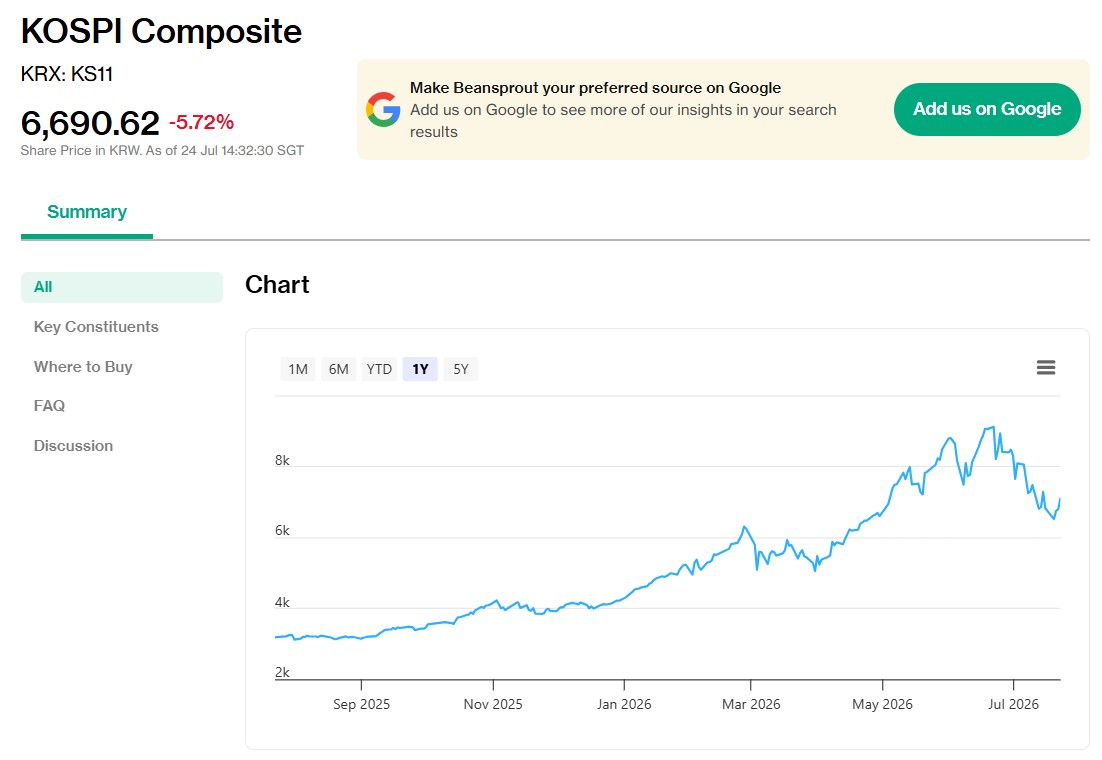
The KOSPI index surged 75.6% in 2025 and continued rising in 2026, reaching a record high of about 9,386 on 19 June.
It later corrected sharply, closing at 6,516 on 20 July, but remained more than 50% higher for the year.
One development that drew further attention was SK Hynix’s Nasdaq cross-listing, which highlighted growing global interest in South Korea’s AI memory-chip companies.
I have also seen more discussion about the KOSPI and its volatility in the Beansprout Telegram community.
This has led to questions about what the KOSPI represents and why its movements can be so significant.
In this guide, I will explain what the KOSPI is, its key constituents and how Singapore investors can gain exposure to South Korea’s stock market.
What is the KOSPI?
KOSPI stands for the Korea Composite Stock Price Index.
It is South Korea’s main stock market index and broadly tracks common shares listed on the KOSPI Market, the main board of the Korea Exchange (KRX).
KRX is South Korea’s securities exchange operator. It also operates the KOSDAQ and KONEX markets.
The KOSPI was launched in 1983, with a base value of 100 as of 4 January 1980.
Like the S&P 500 in the United States, the KOSPI is weighted by market capitalisation. This means companies with a larger market value have a greater influence on the index.
However, the KOSPI is not limited to a fixed number of companies. It broadly covers hundreds of common shares listed on the KOSPI Market.
Similar to how the S&P 500 is widely used as a benchmark for US stocks, the KOSPI is commonly used to assess the performance of South Korea’s stock market.
However, the KOSPI does not represent the entire South Korean stock market.
Is the KOSPI the whole South Korean stock market?
The KOSPI is South Korea’s main stock market index, but it is not the country’s only stock market benchmark.
The Korea Exchange operates three main equity markets:
| Market | What it represents |
| KOSPI Market | The main board for many of South Korea’s larger and more established companies |
| KOSDAQ Market | A market with greater exposure to smaller and growth-oriented companies |
| KONEX Market | A market mainly for start-ups and smaller early-stage companies |
The KOSPI broadly tracks common shares listed on the KOSPI Market.
The KOSDAQ has greater exposure to smaller companies in areas such as technology, biotechnology, healthcare, software and entertainment.
This means a company being listed in South Korea does not necessarily mean it is included in the KOSPI index.
What does the KOSPI provide exposure to?
The KOSPI has historically been heavily exposed to South Korea’s export and manufacturing industries.
Its constituents include major companies in:
- Semiconductors
- Automobiles
- Shipbuilding
- Steel
- Batteries
- Chemicals
- Financial services
- Healthcare
Many of these companies sell their products to customers outside South Korea.
As a result, the KOSPI can be more sensitive to global trade, manufacturing activity, commodity prices and exchange-rate movements than stock indices that are more focused on domestic consumption or services.
The index can therefore perform strongly when global demand for semiconductors, cars and industrial products rises.
However, it can also be more cyclical when global economic growth or export demand weakens.
The KOSPI has also become increasingly influenced by the memory semiconductor industry, particularly through Samsung Electronics and SK Hynix.
Because the index is weighted by market capitalisation, movements in these two companies can have a significant impact on the overall KOSPI.
This means the KOSPI may contain hundreds of companies, but its performance can still be heavily influenced by one industry.
How is the KOSPI calculated?
The KOSPI is a market-capitalisation-weighted index, similar in construction to the S&P 500.
A company’s influence on the index depends on its market value rather than each constituent receiving an equal allocation.
For example, a 5% movement in Samsung Electronics or SK Hynix would have a much greater impact on the KOSPI than a 5% movement in a smaller constituent.
As a result, the KOSPI may rise even when many smaller companies decline, provided its largest constituents perform strongly.
This also means that investing in a KOSPI-linked product does not provide equal exposure to every company in the index.
Which companies are in the KOSPI?
The KOSPI broadly covers common shares listed on the KOSPI Market.
Unlike the KOSPI 200, it does not contain a fixed number of 200 selected companies.
The constituent list can change when companies list, delist or undergo corporate actions.
Some of the better-known KOSPI constituents include:
| Company | KRX ticker | Main business |
| Samsung Electronics | 5930 | Semiconductors, mobile devices and consumer electronics |
| SK Hynix | 660 | Memory semiconductors |
| LG Energy Solution | 373220 | Electric-vehicle and energy-storage batteries |
| Samsung Biologics | 207940 | Biopharmaceutical manufacturing |
| Hyundai Motor | 5380 | Automobiles |
| Kia | 270 | Automobiles |
| Celltrion | 68270 | Biopharmaceuticals |
| NAVER | 35420 | Internet platforms and digital services |
| KB Financial Group | 105560 | Banking and financial services |
| Shinhan Financial Group | 55550 | Banking and financial services |
| POSCO Holdings | 5490 | Steel, materials and battery-related businesses |
| Hanwha Aerospace | 12450 | Aerospace, defence and industrial equipment |
| HD Hyundai Heavy Industries | 329180 | Shipbuilding and marine engineering |
This is not the full list of KOSPI constituents, and the companies are not shown in order of index weight.
While the index provides exposure to a broad range of industries, its largest semiconductor companies can have a much greater influence on its performance than many of its smaller constituents.
What is the difference between the KOSPI, KOSPI 200 and KOSDAQ?
The KOSPI, KOSPI 200 and KOSDAQ are often mentioned together, but they do not represent the same group of stocks.
| Index or market | What it represents |
| KOSPI | The broad benchmark index for common shares listed on the KOSPI Market |
| KOSPI 200 | An index comprising 200 selected large and liquid companies from the KOSPI Market |
| KOSDAQ | A separate market and index with greater exposure to smaller and growth-oriented companies |
| KONEX | A market mainly for start-ups and smaller early-stage companies |
KOSPI versus KOSPI 200
The KOSPI is the broader benchmark for the KOSPI Market.
The KOSPI 200 consists of 200 selected companies from the same market. It generally focuses on larger and more actively traded companies while seeking representation across different sectors.
The KOSPI 200 is commonly used as the underlying benchmark for South Korean futures, options and investment products. The KRX, for example, offers KOSPI 200 futures and options.
KOSPI versus KOSDAQ
The KOSPI generally represents larger and more established companies listed on South Korea’s main market.
The KOSDAQ Market was established with a greater focus on smaller and growth-oriented companies, including businesses in technology, biotechnology, healthcare, software and entertainment.
This means the KOSDAQ may have a different sector mix and experience different levels of volatility from the KOSPI.
A company being listed in South Korea does not necessarily mean it is included in the KOSPI.
Does the KOSPI represent the South Korean economy?
The KOSPI provides an indication of how listed South Korean companies are performing, but it does not perfectly represent the domestic economy.
Many of its largest companies sell semiconductors, cars, batteries, ships and industrial products to customers around the world.
Their earnings may therefore depend more on global demand than on spending by consumers in South Korea.
For example, stronger global semiconductor demand may support major KOSPI companies even when South Korea’s domestic consumption remains weak.
The index can also decline when global trade or manufacturing activity slows, even if some parts of the domestic economy remain resilient.
The KOSPI should therefore be viewed as a measure of South Korea’s listed stock market rather than a direct measure of the entire economy.
Why is the KOSPI concentrated in large business groups?
South Korea’s corporate sector is dominated by large business groups commonly known as chaebol.
These groups typically comprise networks of companies operating across multiple industries, often under the control or influence of a founding family.
Examples include Samsung, SK, Hyundai Motor, LG and Hanwha, which were South Korea’s five largest business groups by assets in 2026. Together, they hold more than US$1 trillion in assets.
Their influence also extends across the broader economy.
In 2023, the combined sales of Samsung, SK, Hyundai Motor and LG were equivalent to 40.8% of South Korea’s nominal GDP. The combined sales of the country’s top 30 business groups were equivalent to 76.9% of GDP.
This concentration existed long before the recent semiconductor rally.
It also helps explain why South Korea’s Value-Up reforms have focused on issues such as corporate governance, complex ownership structures and minority shareholder rights.
Because the KOSPI is weighted by market capitalisation, large listed companies within these groups can also have an outsized influence on the index.
What is the Korea discount?
The Korea discount refers to the tendency for some South Korean companies to trade at lower valuations than overseas companies with similar businesses or financial performance.
Factors commonly associated with the Korea discount include:
- Complex corporate ownership structures
- Cross-shareholdings between related companies
- Concerns about minority shareholder rights
- Historically lower dividend payout ratios
- Corporate governance concerns
- Geopolitical risk
- Barriers faced by overseas investors
South Korea introduced its Corporate Value-Up Program in 2024 to encourage listed companies to improve capital efficiency, corporate governance and shareholder returns.
However, the impact of the reforms may differ between companies.
I would therefore assess each company’s actions rather than assume that every KOSPI constituent will benefit equally.
The Value-Up reforms and other recent market catalysts will be explored in greater detail in our separate guide to what is driving the KOSPI.
How can Singapore investors invest in the KOSPI?
We cannot buy the KOSPI index directly.
Instead, investors can gain exposure through individual South Korean shares, Korea-focused ETFs or broader regional funds.
1. Buy individual South Korean shares
Some brokerage platforms such as Interactive Brokers (IBKR) provide access to shares listed on the Korea Exchange.
This allows investors to choose specific companies rather than owning the broader market.
However, investors may need to consider:
- Whether the brokerage provides access to KRX-listed shares
- Brokerage commissions and custody fees
- Foreign-exchange conversion between Singapore dollars and Korean won
- The availability of English-language company information
- Dividend withholding taxes
- South Korean trading hours and market rules
Investing in individual shares also requires more research because returns will depend heavily on the companies selected.
Learn more about Interactive Brokers (IBKR) here.
2. Invest through a South Korea ETF
A South Korea ETF allows investors to own a portfolio of Korean companies through a single investment.
However, many Korea-focused ETFs do not track the KOSPI directly.
Examples include:
| ETF | Listing | Benchmark |
| iShares MSCI South Korea ETF | NYSE Arca: EWY | MSCI Korea 25/50 Index |
| Franklin FTSE South Korea ETF | NYSE Arca: FLKR | FTSE South Korea RIC Capped Index |
| iShares MSCI Korea UCITS ETF | Various European exchanges: CSKR | MSCI Korea 20/35 Index |
EWY seeks to provide targeted exposure to South Korean equities, while FLKR tracks a market-capitalisation-weighted index of large and mid-sized companies. CSKR is an Ireland-domiciled accumulating UCITS ETF providing exposure to Korean companies.
These funds provide South Korean stock-market exposure, but their holdings and weights may differ from the KOSPI.
Learn more about the best trading platform and online brokerage to invest in ETFs here.
3. Invest through a regional or global ETF
Some Asia-Pacific, emerging-market and global ETFs also hold South Korean companies.
This can provide broader diversification because the South Korean holdings are combined with companies from other markets.
However, the allocation to South Korea may be relatively small and will depend on the fund’s benchmark.
For example, the Amova MSCI AC Asia ex Japan ex China Index ETF provides exposure to large and mid-cap companies across Asia, excluding Japan and China.
The ETF has significant exposure to South Korea, with Samsung Electronics and SK Hynix among its largest holdings. However, it also invests in companies from markets such as Taiwan, India, Singapore and Hong Kong.
Hence, investors should check the country allocation of the fund rather than rely only on labels such as “Asia”, “developed markets” or “emerging markets”.
For broader regional exposure, read our guide to five SGX-listed ETFs offering exposure to Asia’s growth.
Learn more about the best trading platform and online brokerage to invest in ETFs here.
What are the risks of investing in the KOSPI?
1. Concentration risk
A few large companies can have a significant influence on the KOSPI.
This makes the index more dependent on its largest constituents than the total number of companies might suggest.
2. Semiconductor cycle risk
Samsung Electronics and SK Hynix are major global memory-chip producers.
Their profits can rise and fall depending on semiconductor demand, supply, selling prices and capital expenditure.
A downturn in the semiconductor cycle may therefore have an outsized impact on the KOSPI.
3. Global economic risk
Many large KOSPI companies depend on overseas demand.
A slowdown in global trade, manufacturing or consumer spending can affect Korean exporters even when South Korea’s domestic economy remains stable.
4. Currency risk
The value of an investment may be affected by movements in the Korean won.
For a Singapore investor, returns in Singapore-dollar terms may be reduced if the won weakens, even when Korean share prices rise.
Buying an ETF traded in US dollars does not necessarily remove this exposure because the underlying companies remain based in South Korea.
5. Corporate governance risk
South Korea’s Value-Up reforms may support better governance and shareholder returns over time.
However, complex group structures, cross-shareholdings and related-party transactions remain factors to consider when researching individual companies.
6. Geopolitical risk
Tensions involving North Korea can affect investor sentiment and foreign fund flows.
South Korean companies are also sensitive to changes in trade and technology policies involving the United States, China and other major economies.
7. ETF benchmark risk
A South Korea ETF may not track the KOSPI.
Different funds can hold different numbers of companies and apply different limits to their largest constituents.
Fees, taxes, bid-offer spreads and tracking differences can also affect investor returns.
What would Beansprout do?
The KOSPI provides exposure to several globally competitive companies, particularly in semiconductors, automobiles, batteries and industrial sectors.
However, I would not assume that investing in the KOSPI or a South Korea ETF provides evenly diversified exposure to the Korean economy.
I would first examine the investment product’s benchmark, largest holdings and sector weights.
This is especially important given the influence of Samsung Electronics and SK Hynix on the broader market.
For investors who do not intend to research individual Korean companies, an ETF may provide a more diversified way to gain exposure.
Rather than investing through a single-country South Korea ETF, I would be more inclined to gain some exposure through a broader regional ETF listed on the SGX.
This could form part of my Opportunity Pot if I have a strong conviction and investment thesis on investing in the South Korean market.
I would also size any South Korea exposure with the understanding that the market can be cyclical and sensitive to semiconductor prices, global exports and currency movements.
Track the latest KOSPI performance, key statistics and major constituents here.
To understand the current factors affecting the Korean market, read what is driving the KOSPI, including South Korea’s Value-Up reforms and the semiconductor cycle here.
How are you looking to invest in the South Korea stock market? Share with us in the comments below or in our Telegram group!
If you are considering where to buy them, you may also want to check out our review of the best stock trading platforms in Singapore and the latest broker promotions below.
Follow Beansprout on Telegram, Youtube, Facebook and Instagram, and add Beansprout as your preferred source on Google so you never miss an update.
Read also
Gain financial insights in minutes
Subscribe to our free weekly newsletter for more insights to grow your wealth
Most Popular

Comments
0 comments