
Moneymax Financial Services Ltd: Building a regional pawn network
Stocks
By Ng Hui Min • 30 Jul 2026
Global Wealth Technology Pte. Ltd. is regulated by the Monetary Authority of Singapore (MAS) as a licensed Financial Adviser.
'%3e%3cpath%20fill-rule='evenodd'%20clip-rule='evenodd'%20d='M17.64%209.20455C17.64%208.56637%2017.5827%207.95273%2017.4764%207.36364H9V10.845H13.8436C13.635%2011.97%2013.0009%2012.9232%2012.0477%2013.5614V15.8195H14.9564C16.6582%2014.2527%2017.64%2011.9455%2017.64%209.20455V9.20455Z'%20fill='%234285F4'/%3e%3cpath%20fill-rule='evenodd'%20clip-rule='evenodd'%20d='M9%2018C11.43%2018%2013.4673%2017.1941%2014.9564%2015.8195L12.0477%2013.5614C11.2418%2014.1014%2010.2109%2014.4205%209%2014.4205C6.65591%2014.4205%204.67182%2012.8373%203.96409%2010.71H0.957275V13.0418C2.43818%2015.9832%205.48182%2018%209%2018V18Z'%20fill='%2334A853'/%3e%3cpath%20fill-rule='evenodd'%20clip-rule='evenodd'%20d='M3.96409%2010.71C3.78409%2010.17%203.68182%209.59318%203.68182%209C3.68182%208.40682%203.78409%207.83%203.96409%207.29V4.95818H0.957273C0.347727%206.17318%200%207.54773%200%209C0%2010.4523%200.347727%2011.8268%200.957273%2013.0418L3.96409%2010.71V10.71Z'%20fill='%23FBBC05'/%3e%3cpath%20fill-rule='evenodd'%20clip-rule='evenodd'%20d='M9%203.57955C10.3214%203.57955%2011.5077%204.03364%2012.4405%204.92545L15.0218%202.34409C13.4632%200.891818%2011.4259%200%209%200C5.48182%200%202.43818%202.01682%200.957275%204.95818L3.96409%207.29C4.67182%205.16273%206.65591%203.57955%209%203.57955V3.57955Z'%20fill='%23EA4335'/%3e%3c/g%3e%3cdefs%3e%3cclipPath%20id='clip0_0_2849'%3e%3crect%20width='18'%20height='18'%20fill='white'/%3e%3c/clipPath%3e%3c/defs%3e%3c/svg%3e)
Make Beansprout your preferred source on Google
Add us on Google to see more of our insights in your search results
MoneyMax Financial Services Ltd. is a leading Southeast Asian financial services provider, luxury retailer, and trader founded in Singapore in 2008.
Moneymax Financial Services Ltd (5WJ)
About MoneyMax
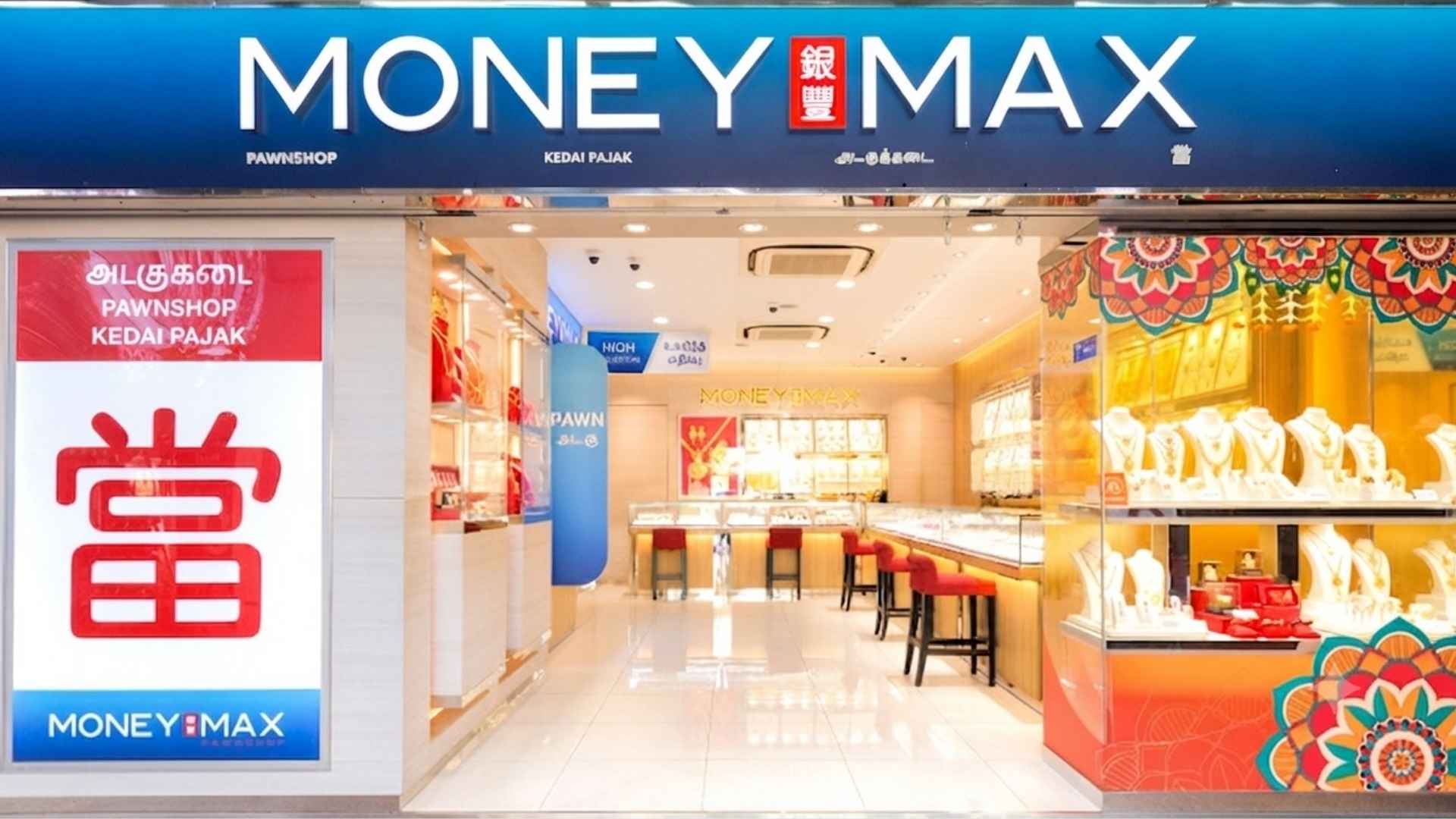
MoneyMax Financial Services Ltd is a Singapore-listed financial services group best known for pawnbroking.
The group also buys and sells gold, jewellery and pre-owned luxury goods, and has a small but growing secured lending business covering auto financing and short-term property-backed loans.
MoneyMax traces its roots to 1996, when the Lim family founded Soo Kee Jewellery.
In 2008, during the global financial crisis, the family used its gold assessment expertise and jewellery retail workforce to enter the pawnbroking industry.
From the start, MoneyMax aimed to modernise the traditional pawnshop format.
Instead of high grilles, enclosed counters and an intimidating store layout, MoneyMax introduced a more open retail-style concept.
Customers could buy a gold chain on one side of the counter and pawn a gold chain on the other.
This helped make pawnbroking feel more accessible, especially for customers who wanted speed, convenience and discretion.
MoneyMax listed on the SGX Catalist board in 2013 and transferred to the SGX Mainboard on 6 May 2026.
One of Singapore’s leading pawnbroking chains
MoneyMax is one of the two leading licensed pawnbroking chains in Singapore by outlet count, and operates the largest combined Singapore-Malaysia network among the three listed pawnbroking groups.
Singapore’s pawnbroking industry is regulated under the Pawnbrokers Act, with 241 registered pawnshops as of September 2025.
MoneyMax has 51 outlets in Singapore, as of 31 Dec 2025, equivalent to about 20% of the market based on management’s estimate. This places it broadly alongside ValueMax, which operates around 50 outlets in Singapore, as one of the two largest licensed pawnbroking chains locally.
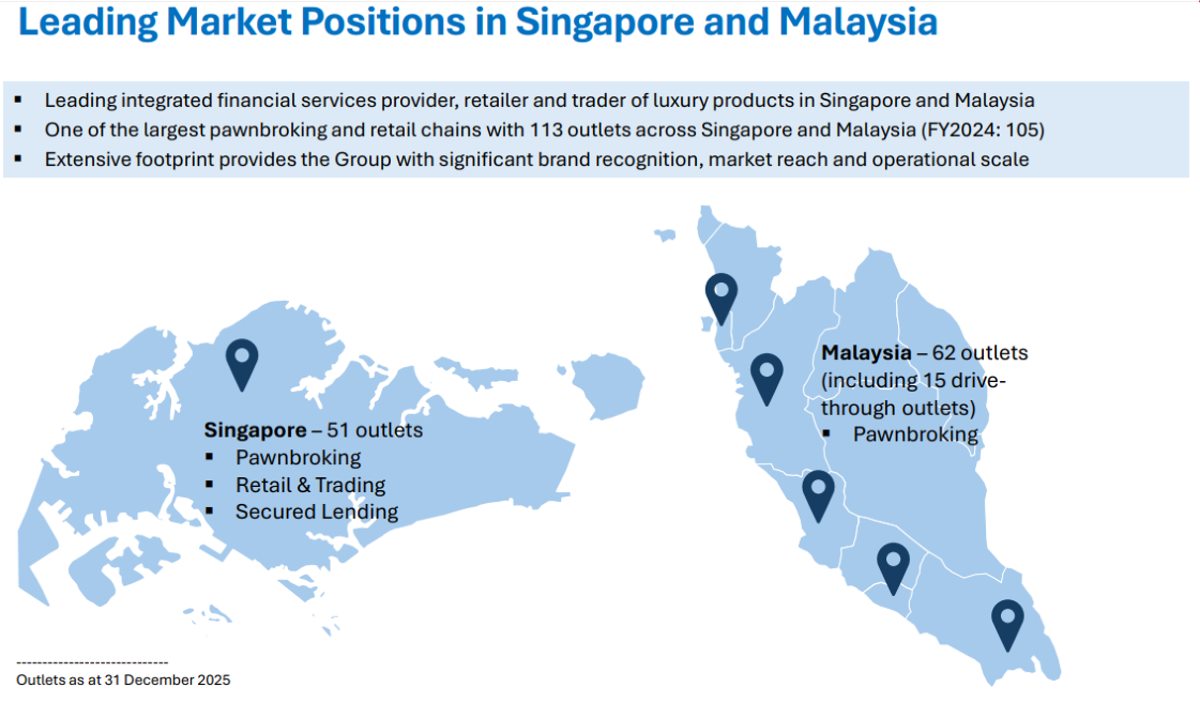
The wider market remains relatively concentrated at the top, but fragmented below. MoneyMax, ValueMax and Maxi-Cash, the pawnbroking arm of Aspial, together account for approximately 51% to 60% of Singapore’s pawnbroking licences. The remaining licences are spread across smaller independent operators.
Management also does not view the Singapore market as saturated. While the industry is mature and highly regulated, MoneyMax points to government data showing growth in total loan value and pledge volume over the past two years.
Overall, MoneyMax is best positioned as a leading Singapore pawnbroker with a sizeable regional network, rather than simply as a domestic outlet-count leader.
Business model: short-duration, gold-backed lending with embedded retail
MoneyMax’s core business is built around short-duration, collateral-backed lending, with gold at the centre of the model.
Management shared that around 98% of items accepted as collateral are gold or gold-based products. This reflects gold’s role as a transparent and liquid asset, with internationally quoted daily prices. It also reflects the deep cultural preference for gold across Southeast Asia, where gold is commonly held as a store of value, investment asset and fashion item.
MoneyMax’s approach to collateral valuation is conservative. Gold items are valued based on their raw material value which is the gold content by weight and the prevailing market gold price. Brand value, craftsmanship and gemstones are not included in the assessed collateral value.
For example, a 916 gold chain would be valued based only on its 91.6% gold content and weight. Any branding or decorative stones would be excluded from the valuation.
This means MoneyMax’s real collateral buffer may be stronger than the headline loan-to-value ratio suggests. While the blended loan-to-value ratio is about 70%, the loan is made against the raw gold value rather than the full resale value of the item.
In practice, this gives MoneyMax an additional margin of safety when the pledged item has resale value beyond its gold content.
One interesting feature of the model is that investment-grade gold bars may receive a lower loan-to-value ratio than personal gold jewellery, even though gold bars are more liquid.
The reason is behavioural.
Customers who pawn personal jewellery, such as a wedding ring or family heirloom, are usually more motivated to redeem the item because of its sentimental value.
By contrast, customers who pawn investment gold bars may treat them more like financial assets and could be more willing to walk away if gold prices fall.
MoneyMax therefore applies a lower loan-to-value ratio to investment gold. This helps protect the group against gold price movements during the typical six-month loan period, when the collateral value could move before the item is redeemed or sold.
Daily price monitoring with conservative adjustment discipline
MoneyMax manages gold price risk by monitoring market prices daily and adjusting collateral valuations when needed.
Its approach is deliberately conservative.
When gold prices fall, MoneyMax moves quickly to reduce loan valuations, helping to prevent the loan book from becoming over-extended. When gold prices rise, the group is more cautious in raising valuations, which creates a buffer against short-term reversals.
This discipline is especially important in a more volatile gold price environment. Because pawn loans are typically written for several months, the value of the collateral can change before the pledged item is redeemed or sold. A cautious valuation approach helps MoneyMax preserve its collateral margin and protect the quality of its loan book.
Loan duration, roll-overs and recurring income
MoneyMax’s pawnbroking loan book is short-duration in nature. Approximately 50% of its receivables have an ageing of less than one month, which helps the group manage collateral and repayment risk more closely.
Pawn loans are typically structured with an initial six-month tenure, followed by a grace period of up to two months. This gives each loan a maximum effective tenure of around eight months before the pledged item may be disposed of.
Customers who are unable or unwilling to fully repay at maturity can roll over their loan. To do so, they pay the accrued interest and receive a new ticket on the same pledged item for another term.
This rollover mechanism gives the business a recurring-income element. MoneyMax continues to earn interest on the renewed loan, while the collateral remains in place and does not need to be moved or reassessed.
In this way, the model combines short loan duration with repeat interest income backed by physical collateral.
Revenue mix
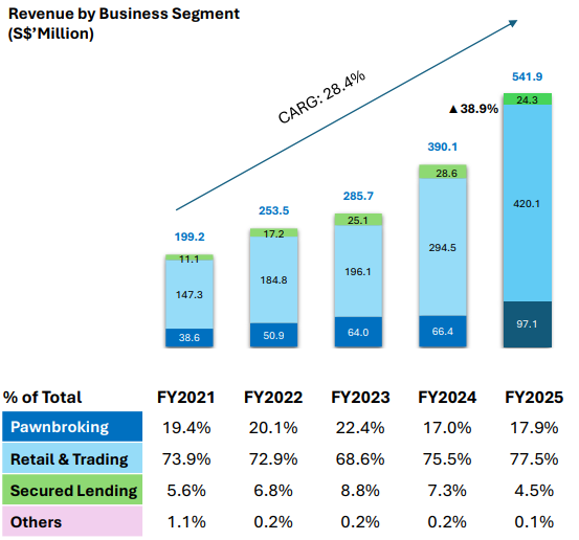
MoneyMax’s reported revenue mix can understate the importance of its pawnbroking business.
This is because the group’s two main segments are accounted for differently.
For pawnbroking, only the interest earned on loans is recorded as revenue.
For retail and trading, the full selling price of gold, jewellery and luxury goods is recorded as revenue.
As a result, the revenue split can look skewed towards retail and trading, even though pawnbroking contributes a much larger share of profit than its revenue share suggests.
In FY2025, pawnbroking revenue was S$97 million, or 18% of total revenue. This reflected interest earned on a loan book of S$842 million.
By contrast, retail and trading recorded S$420 million of revenue, or 78% of total revenue, because the full sale value of goods flowed through the income statement.
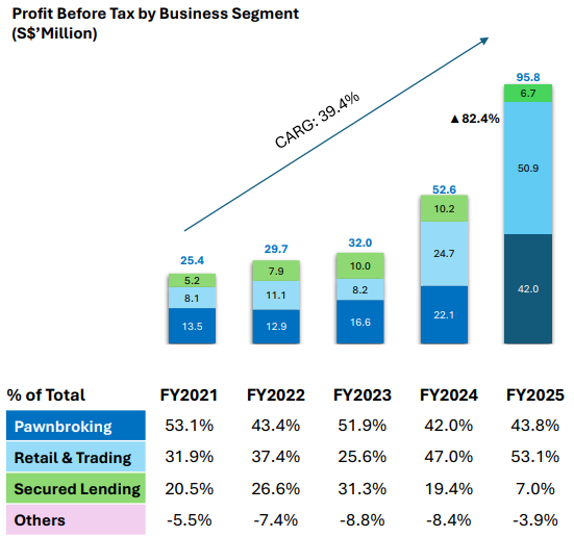
The profit contribution tells a more balanced story.
Pawnbroking generated S$42.0 million of pre-tax profit, representing about 44% of group pre-tax profit. This was close to retail and trading’s S$50.9 million contribution, or 53% of group pre-tax profit, despite pawnbroking having a much smaller reported revenue base.
The segment also benefits from operating leverage.
The cost of running a pawnshop does not rise proportionately with the size of the loan book. A shop serving a S$10 million portfolio may not require much more rent, staffing, security or basic overhead than a shop serving a S$2 million portfolio.
This means that once a shop has crossed its breakeven level, additional interest income can flow through at a high incremental margin.
This helps explain why MoneyMax’s net profit rose 83% in FY2025, while revenue grew by a smaller 39%.
FY2025 financial results: profits accelerating ahead of revenue
MoneyMax delivered a strong set of results in FY2025, with profit growth outpacing revenue growth.
Revenue rose 38.9% year on year to S$541.9 million, supported by growth across pawnbroking, retail and trading, and secured lending. More importantly, net profit increased at a much faster pace, rising 83.2% to S$76.3 million.
This reflects the operating leverage in MoneyMax’s business model. As the pawnbroking loan book grows, additional interest income can flow through at a high incremental margin once outlets have covered their fixed costs. This helped lift net margin to 14.1% in FY2025, from 10.7% in FY2024.
Earnings per share also rose sharply, increasing 87.5% to 8.10 cents. Return on equity improved to 32.3%, from 23.3% a year earlier, reflecting stronger profitability and more efficient use of capital.
The cost structure also explains why profit growth accelerated. Material costs remain the largest expense item, as MoneyMax’s retail and trading segment books the cost of gold and luxury goods sold. In FY2025, material costs rose 37.9% to S$336.5 million, broadly in line with revenue growth.
Other operating costs were more controlled. Employee expenses increased 26.9% to S$44.3 million, while depreciation and amortisation rose 9.0% to S$13.3 million. Finance costs increased by a smaller 8.9% to S$33.8 million, despite the group’s larger loan book and funding needs.
Overall, FY2025 showed that MoneyMax is not just growing its top line. The group is converting revenue growth into faster earnings growth, supported by a larger pawnbroking loan book, improving outlet maturity and disciplined cost control.
Singapore versus Malaysia: different markets, different economics
MoneyMax operates across both Singapore and Malaysia, but the two markets have different competitive dynamics, regulatory frameworks and return profiles.
Singapore is a dense and mature pawnbroking market. MoneyMax has 51 outlets in Singapore and holds roughly 20% of local pawnbroking licences, making it one of the two leading chains by outlet count.
The market is also highly visible. In many urban areas, customers can find a pawnshop within a short walk, which makes location, trust and brand recognition important competitive factors.
However, management does not view Singapore as demand-saturated. Industry data supports this view.
Total pawnbroking loan disbursements in Singapore reached a record S$1308.9 million in March 2026, up 55% year on year, according to the Singapore Department of Statistics and Registry of Pawnbrokers.
This suggests that demand for short-term, collateral-backed liquidity is still growing, even in a mature market.
Singapore’s regulatory framework also shapes the economics of the business. Interest on pawn loans is capped at 1.5% per month, while MoneyMax’s cost of funds in 2025 is about 4.5%.
In short, Singapore is a competitive but profitable core market for MoneyMax. Outlet density is high, but demand remains healthy, and the interest spread provides room for attractive returns when stores operate at sufficient scale.
Malaysia: the main growth lever
Malaysia is where MoneyMax sees the clearest long-term growth opportunity.
Compared with Singapore, Malaysia’s pawnbroking market is more fragmented, giving MoneyMax more room to gain share. The group has an estimated market share of about 10%, according to management, leaving a long runway for consolidation and outlet expansion.
The economics are also structurally attractive. Rental costs are lower, at around 7% of operating expenses, while the permitted interest cap is higher at 2% per month.
Management estimates that MoneyMax earns a net lending spread of about 12% per year in Malaysia, compared with roughly 10% in Singapore.
MoneyMax has grown its Malaysian network to 62 outlets by end-2025, using a mix of new licence applications and acquisitions. This gives the group a meaningful platform in a market where many operators remain smaller and independent.
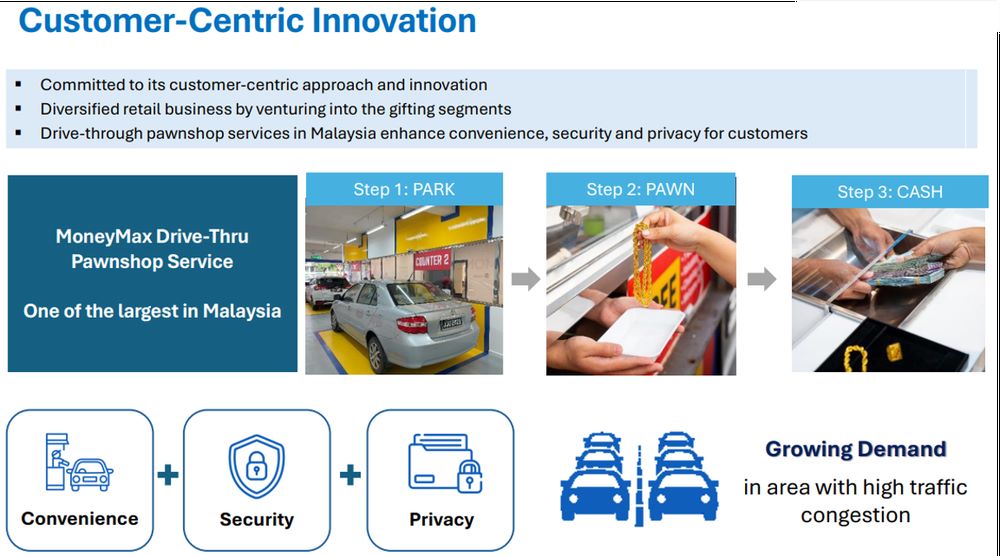
A notable part of the Malaysian strategy is the drive-through pawnshop format. MoneyMax has opened 8 drive-through locations, which management says have been well received by customers. The format is unique to MoneyMax in the region and supports the group’s focus on convenience and accessibility.
Drive-through outlets require higher upfront investment, with capex of around 1.5 times that of a standard outlet. However, the increase is not necessarily double, as several locations use corner-lot configurations rather than requiring a full second unit.
Overall, Malaysia offers MoneyMax a larger expansion runway, better spread economics and a more fragmented market structure. This makes it the group’s key growth lever beyond Singapore.
Expansion strategy and growth outlook
MoneyMax’s growth is driven mainly by adding more pawnbroking licences and contracts.
This can happen through new government licence applications or by acquiring existing operators.
Management said MoneyMax has historically added about 9 licences per year on average, with the recent pace reaching up to 15 additions across Singapore and Malaysia.
Over the next 12 to 24 months, management’s focus is to deepen its pawnbroking presence in both markets.
It sees a “rare window” where market demand, outlet economics and funding access are all supportive at the same time.
Funding access is the key constraint.
As management put it, “cash is inventory” in the pawnbroking business.
This is because MoneyMax needs capital to grow its loan book, since each pawn loan is funded upfront against pledged collateral.
The group funds its pawnbroking portfolio through bank facilities, medium-term notes and equity.
In 2025, MoneyMax launched a S$500 million medium-term note programme and raised S$100 million of 3-year notes at 5.0% per annum.
It also completed a S$44.3 million share placement in late April 2026, which helped meet the public float requirement for its Mainboard transfer on 6 May 2026.
The placement proceeds are being used for general working capital, including pawnbroking portfolio growth.
With the Mainboard transfer completed, management is now focused on building institutional investor familiarity, pursuing a potential bond credit rating and deploying the placement proceeds.
If successful, this could help MoneyMax grow its loan book faster and lower its cost of capital over time.
New store economics: three years to profitability, with recent outlets ramping faster
New MoneyMax outlets typically take time to build their loan books and reach profitability.
The industry rule of thumb is that a new pawnshop is usually loss-making in its first year, reaches break-even around the second year, and becomes profitable from the third year onwards.
This reflects the time needed for a store to build customer awareness, grow its pledge base and cover fixed operating costs such as rent, staff and security.
MoneyMax’s recent experience appears to be slightly better than this historical pattern. New outlets are still generally loss-making in the first year, but management noted that losses have narrowed. Several recent outlets have also reached break-even earlier than the usual industry timeline.
By the third year, most stores should be profitable. Management indicated that almost all outlets, excluding those opened in the second half of FY2025, are tracking comfortably. Some newer stores have also grown their loan books quickly, suggesting that recent expansion has been gaining traction.
Dividend track record
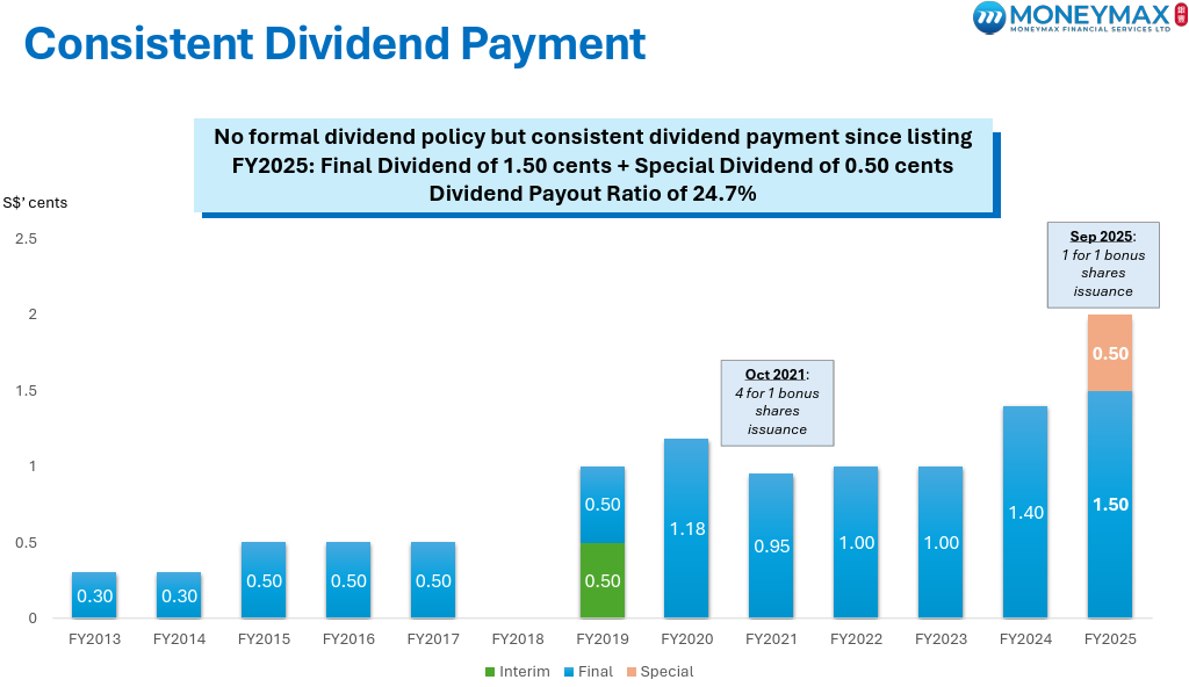
MoneyMax does not have a formal dividend policy though management also described the company as a long-term growth vehicle that still aims to return capital to shareholders consistently.
From FY2021 to FY2025, dividends per share rose from 0.95 cents to 2.00 cents.
This implies a compound annual growth rate of about 16%, broadly in line with the group’s earnings growth.
For FY2025, MoneyMax proposed a total dividend of 2.0 cents per share. This comprises a final dividend of 1.5 cents and a special dividend of 0.5 cents.
The payout ratio was about 25%, up from 16% in FY2024.
Valuation
MoneyMax stands out among its listed peers for its strong earnings growth and profitability.
Revenue rose 38.9% while EPS increased 87.5%, ahead of peers’ average.
Its ROE of 32.8% is also the highest in the group, suggesting that the company is generating attractive returns from shareholders’ capital.
Despite this, MoneyMax trades at 9.8 times 2025 earnings, higher than the peer average of 8.9 times, while its price-to-book ratio of 1.6 times is slightly above the group average. Its dividend yield is 1.9%.
The main trade-off is its more leveraged balance sheet, with net debt-to-equity of 3.4 times, compared with the peer average of 2.5 times.
MoneyMax on Beansprout's Opportunity Pot framework
It passes two of our three opportunity pot checks clearly: revenue and earnings momentum, and return on equity.
The balance sheet is a special case rather than a straightforward fail.
Gearing is elevated, but this is common for a regulated pawnbroker because borrowings are used to fund pawn loans and inventory, which are backed by productive and liquid collateral.
MoneyMax’s ROE of 32.8% is also well above our 8% threshold, while profits have grown faster than revenue for two consecutive years.
This points to strong operating leverage and improving earnings quality.
Key risks
Gold price sensitivity
MoneyMax has about S$842 million in pawn receivables and S$135 million in retail inventory, which means its balance sheet is directly exposed to gold prices.
A sharp fall in gold prices could reduce the resale value of pledged collateral, especially if forfeited items are sold at prices close to or below the outstanding loan amount.
MoneyMax does not have a formal hedging programme, so this risk is managed mainly through conservative loan-to-value ratios and daily gold price monitoring.
Regulatory risk: interest rate cap reductions
Regulatory risk is another key concern.
Pawn loan interest rates are capped at 1.5% per month in Singapore and 2.0% per month in Malaysia.
Any reduction in these caps would directly affect MoneyMax’s interest income, with limited ability to offset the impact through higher pricing elsewhere.
Funding risk
MoneyMax had about S$869 million in total borrowings, and its growth depends on continued access to bank loans and capital markets.
If credit conditions tighten, the group may have to slow loan book growth or sell assets at less favourable prices.
Corporate governance and concentrated ownership
The Lim family has an effective stake of about 84%, which concentrates decision-making power.
The independent board members and annual interested person transaction mandate provide some oversight, but governance remains an important consideration.
Liquidity risk
MoneyMax transferred to the SGX Mainboard on 6 May 2026, removing a structural restriction that may have previously limited institutional ownership.
Investors should watch whether trading liquidity improves meaningfully over the next few months, as this could influence the pace of any valuation re-rating.
Execution risk
MoneyMax’s growth thesis depends partly on expanding further in Malaysia, where the regulatory environment, consumer behaviour, currency exposure and competitive landscape differ from Singapore.
Its newer secured lending businesses, including auto and property-backed financing, are also less proven than its core pawnbroking business.
Related links:
- Moneymax Financial Services Ltd share price and share price target
- Moneymax Financial Services dividend history and forecast
Download the full report here.
Check out Beansprout guide to the best stock trading platforms in Singapore with the latest promotions to invest in Moneymax Financial Services Ltd.
Join the Beansprout Telegram group for the latest insights on Singapore stocks, REITs, bonds and ETFs.
Important Disclosures
Analyst Certification and Disclosures
The analyst(s) named in this report certifies that (i) all views expressed in this report accurately reflect the personal views of the analyst(s) with regard to any and all of the subject securities and companies mentioned in this report and (ii) no part of the compensation of the analyst(s) was, is, or will be, directly or indirectly, related to the specific views expressed by that analyst herein. The analyst(s) named in this report (or their associates) does not have a financial interest in the corporation(s) mentioned in this report.
An associate is defined as (i) the spouse, or any minor child (natural or adopted) or minor step-child, of the analyst; (ii) the trustee of a trust of which the analyst, his spouse, minor child (natural or adopted) or minor step-child, is a beneficiary or discretionary object; or (iii) another person accustomed or obliged to act in accordance with the directions or instructions of the analyst.
Company Disclosure
Global Wealth Technology Pte Ltd (“Beansprout”) does not have any financial interest in the corporation(s) mentioned in this report.
Disclaimer
This report is provided by Beansprout for the use of intended recipients only and may not be reproduced, in whole or in part, or delivered or transmitted to any other person without our prior written consent. By accepting this report, the recipient agrees to be bound by the terms and limitations set out herein.
You acknowledge that this document is provided for general information purposes only. Nothing in this document shall be construed as a recommendation to purchase, sell, or hold any security or other investment, or to pursue any investment style or strategy. Nothing in this document shall be construed as advice that purports to be tailored to your needs or the needs of any person or company receiving the advice. The information in this document is intended for general circulation only and does not constitute investment advice. Nothing in this document is published with regard to the specific investment objectives, financial situation and particular needs of any person who may receive the information.
Nothing in this document shall be construed as, or form part of, any offer for sale or subscription of or solicitation or invitation of any offer to buy or subscribe for any securities. The data and information made available in this document are of a general nature and do not purport, and shall not in any way be deemed, to constitute an offer or provision of any professional or expert advice, including without limitation any financial, investment, legal, accounting or tax advice, and shall not be relied upon by you in that regard. You should at all times consult a qualified expert or professional adviser to obtain advice and independent verification of the information and data contained herein before acting on it. Any financial or investment information in this document are intended to be for your general information only. You should not rely upon such information in making any particular investment or other decision which should only be made after consulting with a fully qualified financial adviser. Such information do not nor are they intended to constitute any form of financial or investment advice, opinion or recommendation about any investment product, or any inducement or invitation relating to any of the products listed or referred to. Any arrangement made between you and a third party named on or linked to from these pages is at your sole risk and responsibility.
You acknowledge that Beansprout is under no obligation to exercise editorial control over, and to review, edit or amend any data, information, materials or contents of any content in this document. You agree that all statements, offers, information, opinions, materials, content in this document should be used, accepted and relied upon only with care and discretion and at your own risk, and Beansprout shall not be responsible for any loss, damage or liability incurred by you arising from such use or reliance.
This document (including all information and materials contained in this document) is provided “as is”. Although the material in this document is based upon information that Beansprout considers reliable and endeavours to keep current, Beansprout does not assure that this material is accurate, current or complete and is not providing any warranties or representations regarding the material contained in this document. All opinions contained herein constitute the views of the analyst(s) named in this report, they are subject to change without notice and are not intended to provide the sole basis of any evaluation of the subject securities and companies mentioned in this report. Any reference to past performance should not be taken as an indication of future performance. To the fullest extent permissible pursuant to applicable law, Beansprout disclaims all warranties and/or representations of any kind with regard to this document, including but not limited to any implied warranties of merchantability, non-infringement of third-party rights, or fitness for a particular purpose.
Beansprout does not warrant, either expressly or impliedly, the accuracy or completeness of the information, text, graphics, links or other items contained in this document. Neither Beansprout nor any of its affiliates, directors, employees or other representatives will be liable for any damages, losses or liabilities of any kind arising out of or in connection with the use of this document. To the best of Beansprout’s knowledge, this document does not contain and is not based on any non-public, material information. The information in this document is not intended for distribution to, or use by, any person or entity in any jurisdiction where such distribution or use would be contrary to law or regulation, or which would subject Beansprout to any registration requirement within such jurisdiction or country. Beansprout is not licensed or regulated by any authority in any jurisdiction or country to provide the information in this document.
As a condition of your use of this document, you agree to indemnify, defend and hold harmless Beansprout and its affiliates, and their respective officers, directors, employees, members, managing members, managers, agents, representatives, successors and assigns from and against any and all actions, causes of action, claims, charges, cost, demands, expenses and damages (including attorneys’ fees and expenses), losses and liabilities or other expenses of any kind that arise directly or indirectly out of or from, arising out of or in connection with violation of these terms, use of this document, violation of the rights of any third party, acts, omissions or negligence of third parties, their directors, employees or agents. To the extent permitted by law, Beansprout shall not be liable to you, any other person, or organization, for any direct, indirect, special, punitive, exemplary, incidental or consequential damages, whether in contract, tort (including negligence), or otherwise, arising in any way from, or in connection with, the use of this document and/or its content. This includes, without limitation, liability for any act or omission in reliance on the information in this document. Beansprout expressly disclaims and excludes all warranties, conditions, representations and terms not expressly set out in this User Agreement, whether express, implied or statutory, with regard to this document and its content, including any implied warranties or representations about the accuracy or completeness of this document and the content, suitability and general availability, or whether it is free from error.
If these terms or any part of them is understood to be illegal, invalid or otherwise unenforceable under the laws of any state or country in which these terms are intended to be effective, then to the extent that they are illegal, invalid or unenforceable, they shall in that state or country be treated as severed and deleted from these terms and the remaining terms shall survive and remain fully intact and in effect and will continue to be binding and enforceable in that state or country.
These terms, as well as any claims arising from or related thereto, are governed by the laws of Singapore without reference to the principles of conflicts of laws thereof. You agree to submit to the personal and exclusive jurisdiction of the courts of Singapore with respect to all disputes arising out of or related to this Agreement. Beansprout and you each hereby irrevocably consent to the jurisdiction of such courts, and each Party hereby waives any claim or defence that such forum is not convenient or proper.
Read also
Gain financial insights in minutes
Subscribe to our free weekly newsletter for more insights to grow your wealth
Most Popular

Comments
0 comments