
6-month T-bill yield jumps to 1.92%, highest in 2026. Here’s what drove the increase
Bonds
By Gerald Wong, CFA • 24 Sep 2026
Why trust Beansprout? We’ve been awarded Best Investment Website at the SIAS Investors’ Choice Awards 2025
'%3e%3cpath%20fill-rule='evenodd'%20clip-rule='evenodd'%20d='M17.64%209.20455C17.64%208.56637%2017.5827%207.95273%2017.4764%207.36364H9V10.845H13.8436C13.635%2011.97%2013.0009%2012.9232%2012.0477%2013.5614V15.8195H14.9564C16.6582%2014.2527%2017.64%2011.9455%2017.64%209.20455V9.20455Z'%20fill='%234285F4'/%3e%3cpath%20fill-rule='evenodd'%20clip-rule='evenodd'%20d='M9%2018C11.43%2018%2013.4673%2017.1941%2014.9564%2015.8195L12.0477%2013.5614C11.2418%2014.1014%2010.2109%2014.4205%209%2014.4205C6.65591%2014.4205%204.67182%2012.8373%203.96409%2010.71H0.957275V13.0418C2.43818%2015.9832%205.48182%2018%209%2018V18Z'%20fill='%2334A853'/%3e%3cpath%20fill-rule='evenodd'%20clip-rule='evenodd'%20d='M3.96409%2010.71C3.78409%2010.17%203.68182%209.59318%203.68182%209C3.68182%208.40682%203.78409%207.83%203.96409%207.29V4.95818H0.957273C0.347727%206.17318%200%207.54773%200%209C0%2010.4523%200.347727%2011.8268%200.957273%2013.0418L3.96409%2010.71V10.71Z'%20fill='%23FBBC05'/%3e%3cpath%20fill-rule='evenodd'%20clip-rule='evenodd'%20d='M9%203.57955C10.3214%203.57955%2011.5077%204.03364%2012.4405%204.92545L15.0218%202.34409C13.4632%200.891818%2011.4259%200%209%200C5.48182%200%202.43818%202.01682%200.957275%204.95818L3.96409%207.29C4.67182%205.16273%206.65591%203.57955%209%203.57955V3.57955Z'%20fill='%23EA4335'/%3e%3c/g%3e%3cdefs%3e%3cclipPath%20id='clip0_0_2849'%3e%3crect%20width='18'%20height='18'%20fill='white'/%3e%3c/clipPath%3e%3c/defs%3e%3c/svg%3e)
Make Beansprout your preferred source on Google
Add us on Google to see more of our insights in your search results
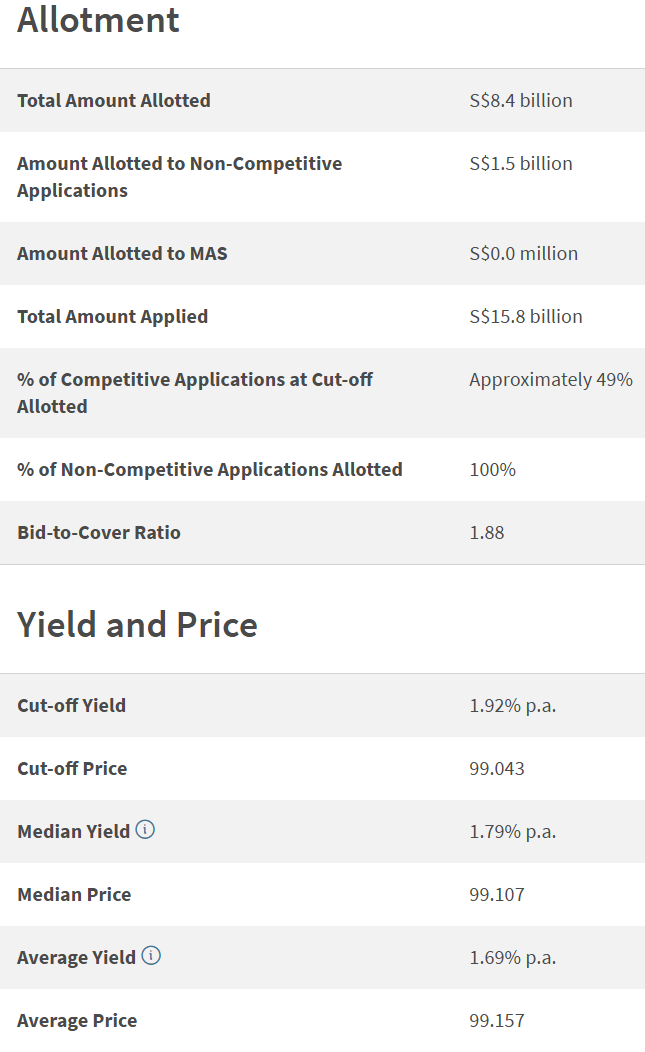
The cut-off yield for the 6-month Singapore T-bill jumped to 1.92% p.a., its highest level in 2026, at the latest auction on 24 September.

What happened?
The latest 6-month Singapore T-bill auction results are out.
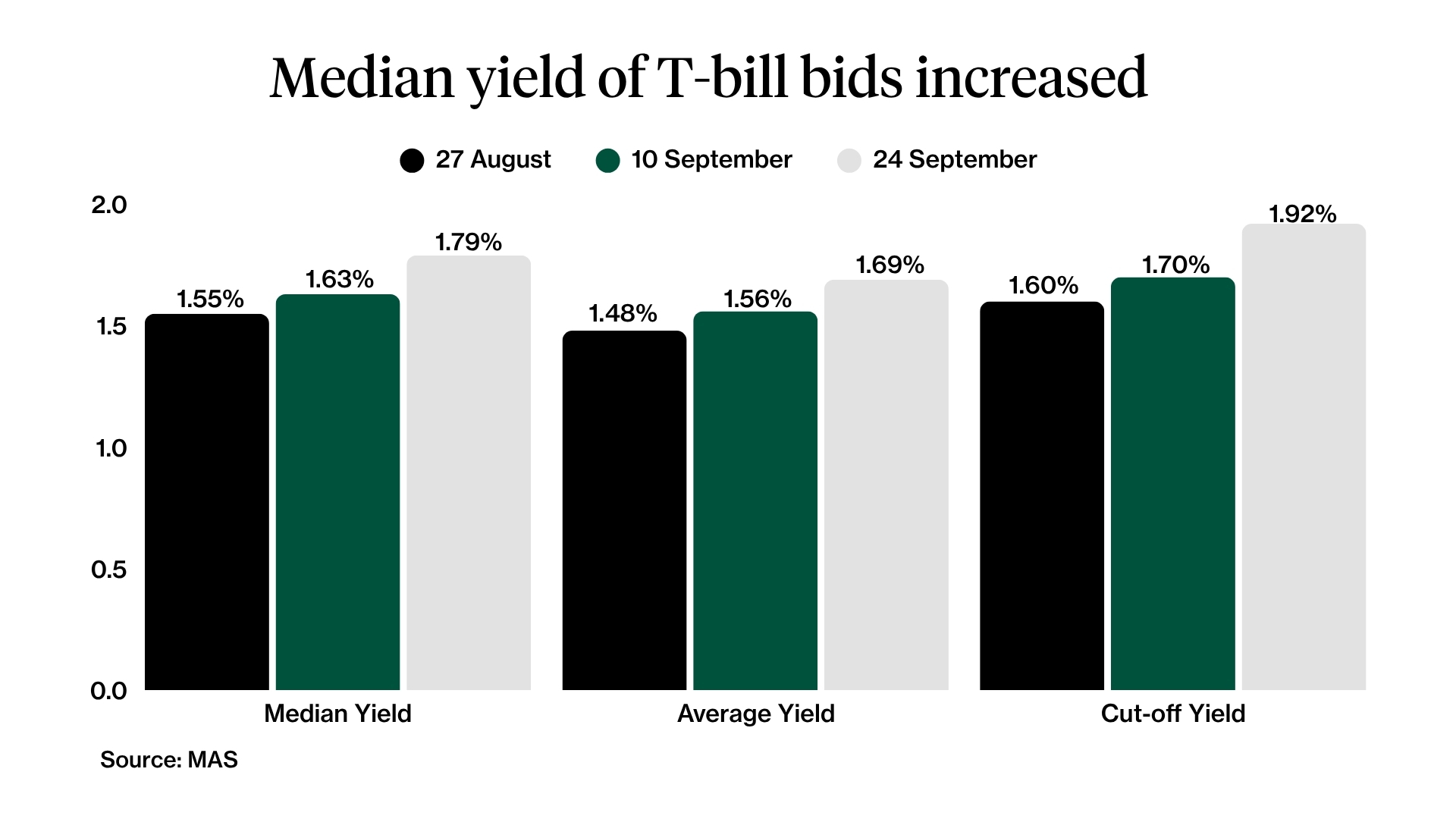
The increase of 22 basis points from 1.70% in the previous auction on 10 September is the largest jump this year, marking the third consecutive rise and taking the yield to a new 2026 high.
We previously highlighted how rising bond yields could keep T-bill yields elevated.
The sharp increase has sparked renewed discussion in the Beansprout Telegram community about where to park our cash, especially as fixed deposit rates have also been rising.
In this article, I’ll look at what drove the increase in the T-bill yield and how it compares with other options for earning a higher return on our spare cash.
What we learnt from the latest 6-month Singapore T-bill auction
#1 - Demand for the Singapore T-bill fell
Total applications for the 6-month Singapore T-bill fell to S$15.8 billion in the latest auction on 24 September from S$16.6 billion in the T-bill auction on 10 September.
T-bill applications had previously reached S$19.4 billion in the auction on 18 June, the highest level recorded since the start of the year.
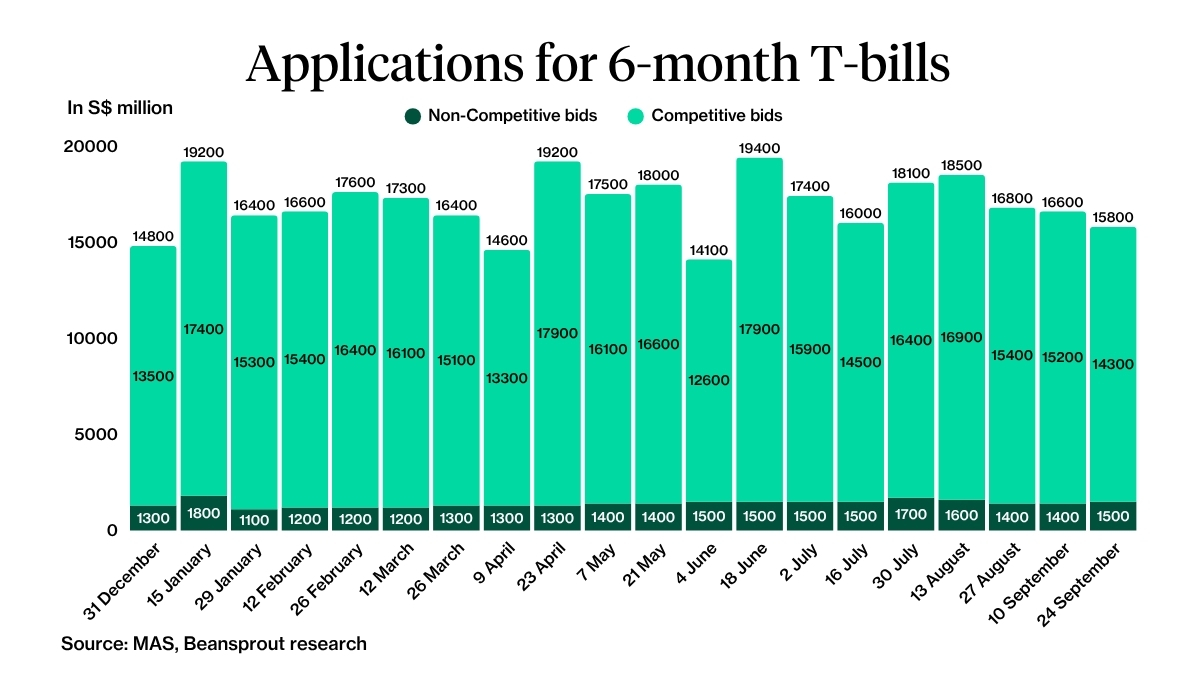
The amount of competitive bids fell to S$14.3 billion on 24 September from S$15.2 billion on 10 September.
If you placed a competitive bid below 1.92%, you would receive 100% of your requested T-bill allocation.
If you bid at exactly 1.92%, the allocation would be around 49%.
The amount of non-competitive bids increased to S$1.5 billion, from S$1.4 billion in the previous T-bill auction on 10 September.
Since the amount of non-competitive bids was within the allocation limit, all eligible non-competitive bids received full allocation for the T-bill.
#2 - T-bills issued remained the same
The amount of T-bills issued was S$8.4 billion, remaining unchanged from the the previous auction on 10 September.
With the drop in the applications of the T-bills but unchanged issuance size, the ratio of applications to T-bills issued (bid-to-cover ratio) dropped to 1.88x from 1.97x in the previous auction on 10 September.

#3 - Median yield of bids submitted rose
The median yield of submitted bids rose to 1.79% from 1.63% in the previous T-bill auction on 10 September.
The average yield of submitted bids also rose to 1.69% from 1.56% in the previous T-bill auction on 10 September.
The increase in the median and average yield of bids submitted reflects rising bond yields in the US as well as globally.
Given the median yield and the cut-off yield, this suggests that a substantial number of bids were placed in the 1.79% to 1.92% range.
What would Beansprout do?
The 6-month T-bill cut-off yield jumped to 1.92% in the latest auction, its highest level in 2026.
This follows a trend of rising T-bill yields in recent months. The US Federal Reserve has also raised interest rates for the first time since 2023, and bond yields are rising globally.
In the latest auction, we have seen bidders submitting higher yields. At the same time, demand for the T-bill has fallen, further supporting the T-bill yield.
With the recent movement in interest rates, I have been reviewing where to park my cash to earn a higher yield, while having sufficient security and peace of mind.
The first step is to make sure I have sufficient cash put aside for emergency uses through my Liquidity Pot within Beansprout's four pots of wealth. Then, I would see how I can earn a higher yield on this pot of emergency cash, while maintaining the liquidity I may need. Learn more about the liquidity pot here.
The T-bill yield of 1.92% is above several 6-month fixed deposit offers at 1.80% p.a., but below Citi’s promotional rate of 2.00% p.a.
Another option to consider is the Singapore Savings Bond (SSB), which the current issuance offers a first-year return of 1.65% and average annual return of 2.32% over 10 years, while having the flexibility to redeem prior to maturity.
There are also some savings accounts in Singapore that offer an interest rate of above 1.92% p.a. which are also worth considering if you prefer to keep your cash more accessible.
For more liquidity than T-bills or fixed deposits, I may also consider money market funds, while remembering that they are not capital guaranteed and are not insured under SDIC.
Longbridge is running a promotion offering 10% p.a. interest boost on S$3,000 with Longbridge Cash Plus for 100 days (worth up to S$82). Also, get a free S$80 Fairprice voucher within 5 working days when you sign up for a Longbridge account via Beansprout. Promo ends on 30 September 2026. Learn more about the Longbridge promo here.
If you are looking for the best place to park your savings, we compare T-bills to fixed deposits, SSBs and savings accounts to find out how to allow our spare cash to work harder.
By finding the best place to park my cash, I can build a stable Liquidity Pot that allows the rest of my portfolio to remain invested through market volatility without being forced to sell at the wrong time.
Do you prefer to park your cash in T-bills, SSB or fixed deposits? Share with us in the comments below or in our Telegram group!
Enjoyed this insight? Follow Beansprout on Telegram, Youtube, Facebook and Instagram, and add Beansprout as your preferred source on Google so you never miss an update.
Read also
Gain financial insights in minutes
Subscribe to our free weekly newsletter for more insights to grow your wealth
Most Popular

Comments
0 comments