
Fed raises interest rates: What it means for T-bills, fixed deposits and blue chip stocks
Stocks
By Ng Hui Min • 17 Sep 2026
Why trust Beansprout? We’ve been awarded Best Investment Website at the SIAS Investors’ Choice Awards 2025
'%3e%3cpath%20fill-rule='evenodd'%20clip-rule='evenodd'%20d='M17.64%209.20455C17.64%208.56637%2017.5827%207.95273%2017.4764%207.36364H9V10.845H13.8436C13.635%2011.97%2013.0009%2012.9232%2012.0477%2013.5614V15.8195H14.9564C16.6582%2014.2527%2017.64%2011.9455%2017.64%209.20455V9.20455Z'%20fill='%234285F4'/%3e%3cpath%20fill-rule='evenodd'%20clip-rule='evenodd'%20d='M9%2018C11.43%2018%2013.4673%2017.1941%2014.9564%2015.8195L12.0477%2013.5614C11.2418%2014.1014%2010.2109%2014.4205%209%2014.4205C6.65591%2014.4205%204.67182%2012.8373%203.96409%2010.71H0.957275V13.0418C2.43818%2015.9832%205.48182%2018%209%2018V18Z'%20fill='%2334A853'/%3e%3cpath%20fill-rule='evenodd'%20clip-rule='evenodd'%20d='M3.96409%2010.71C3.78409%2010.17%203.68182%209.59318%203.68182%209C3.68182%208.40682%203.78409%207.83%203.96409%207.29V4.95818H0.957273C0.347727%206.17318%200%207.54773%200%209C0%2010.4523%200.347727%2011.8268%200.957273%2013.0418L3.96409%2010.71V10.71Z'%20fill='%23FBBC05'/%3e%3cpath%20fill-rule='evenodd'%20clip-rule='evenodd'%20d='M9%203.57955C10.3214%203.57955%2011.5077%204.03364%2012.4405%204.92545L15.0218%202.34409C13.4632%200.891818%2011.4259%200%209%200C5.48182%200%202.43818%202.01682%200.957275%204.95818L3.96409%207.29C4.67182%205.16273%206.65591%203.57955%209%203.57955V3.57955Z'%20fill='%23EA4335'/%3e%3c/g%3e%3cdefs%3e%3cclipPath%20id='clip0_0_2849'%3e%3crect%20width='18'%20height='18'%20fill='white'/%3e%3c/clipPath%3e%3c/defs%3e%3c/svg%3e)
Make Beansprout your preferred source on Google
Add us on Google to see more of our insights in your search results
The Fed has raised rates by 25 basis points and signalled more tightening ahead. Here’s what higher-for-longer rates could mean for bonds, T-bills, SSBs, stocks and REITs.
What happened?
The US Federal Reserve has raised interest rates for the first time since 2023.
At its September meeting, the Fed raised its benchmark interest rate by 25 basis points, bringing the target range to 3.75%–4.00%.
The move may have significant implications for our investments, from T-bills to REITs and blue chip stocks.
For example, we have seen the T-bill yield jump to 1.7% in the recent auction. Fixed deposit rates in Singapore have also been climbing this month.
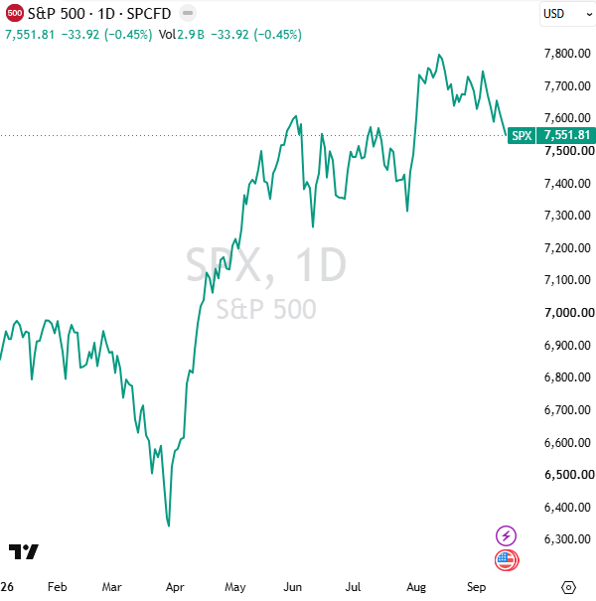
At the same time, the performance of Singapore REITs has weakened, even as Singapore banks such as DBS and OCBC remain close to all time highs.
In this article, we share our key takeaways from the September Fed meeting, and what they could mean for your T-bill, REIT and blue chip stock investments.
What we learnt from the latest Federal Reserve meeting
#1 - Fed raises interest rates by 25 basis points to 3.75%–4.00%
At its meeting on 16 September 2026, the Federal Reserve raised its target range for the federal funds rate by 25 basis points, from 3.50%–3.75% to 3.75%–4.00%.
United States Fed Funds Interest Rate
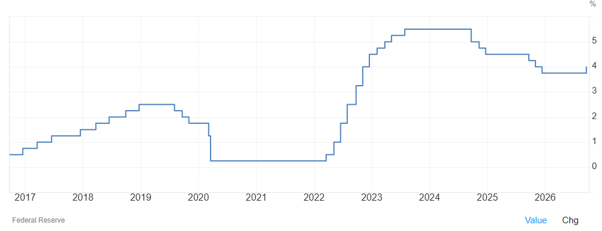
This marks the first Fed rate hike since July 2023 and a reversal from the rate cuts seen through 2024 and 2025.
The decision was unanimous, suggesting policymakers are broadly aligned on the need to keep inflation under control even as the US economy continues to grow.
The more important question is whether September marks a one-off adjustment or the start of several more hikes.
The Fed’s own projections suggest the answer is somewhere in between.
#2 - Fed signals one more rate hike by the end of 2026
Alongside the rate decision, the Fed released its updated Summary of Economic Projections, which includes policymakers’ estimates for where interest rates could end each year.
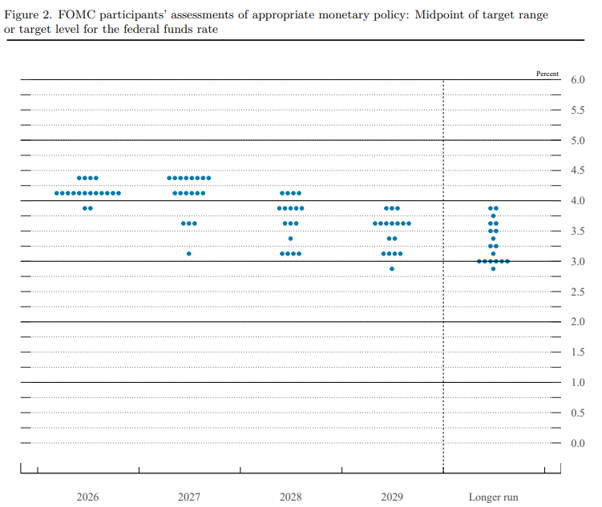
The median projection for the federal funds rate at the end of 2026 rose to 4.1%, from 3.8% in June.
This is consistent with another 25-basis-point hike from the current range.
The Fed also expects the median policy rate to remain at 4.1% at the end of 2027, before falling to 3.9% in 2028 and 3.6% in 2029.
This is an important shift.
The Fed is not only signalling that rates could rise again this year. Its projections also suggest policymakers see little need to reverse those hikes quickly.
In other words, the bigger message may be less about how many more hikes are coming and more about how long rates stay high.
#3 - Investors are pricing in higher rates through 2027
The latest CME FedWatch probabilities show markets are split on whether the Fed hikes again in October.
There is a 50.2% probability of no change, and a 49.8% probability of another 25-basis-point hike.
By December, markets are leaning more clearly towards higher rates, with a 72.7% probability of the federal funds rate reaching 4.00%–4.25%.
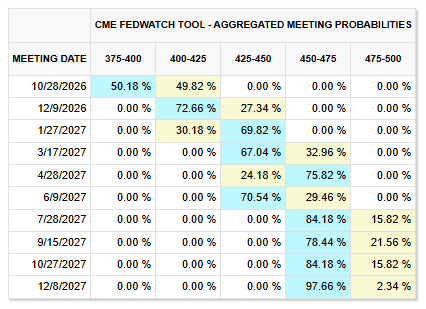
The bigger takeaway is that markets are not expecting rates to fall quickly.
For much of 2027, the highest-probability range shifts to 4.50%–4.75%.
#4 - Bond yields have moved higher
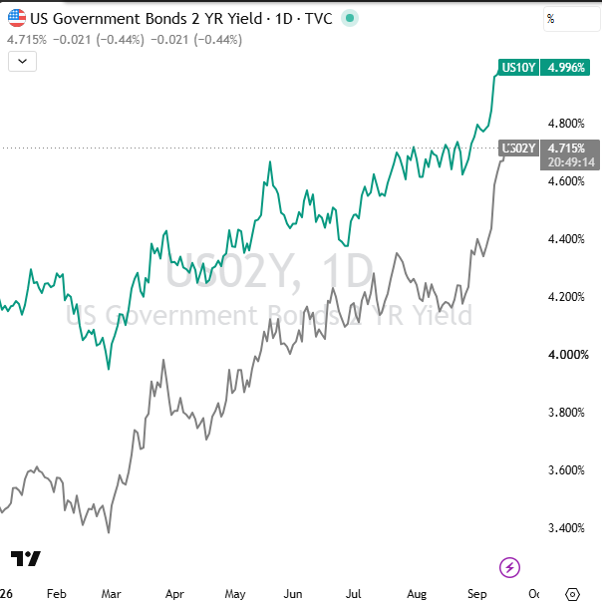
Bond yields have already reflected this higher-for-longer outlook.
The US 2-year Treasury yield has risen to around 4.72%, while the 10-year yield is close to 4.99%.
Higher Treasury yields can make risk-free government bonds more attractive relative to both equities and corporate bonds.
Corporate bonds may need to offer a wider credit spread to compensate investors for taking additional credit risk.
For investors, the key question is no longer just whether the Fed hikes again, but how long rates stay elevated.
#5 - Stronger growth gives the Fed more room to focus on inflation
The Fed also became slightly more optimistic about the US economy.
Its median projection for real GDP growth in 2026 rose to 2.3%, from 2.2% in June. The unemployment-rate forecast was lowered to 4.1% from 4.3%.
At the same time, inflation remains above the Fed’s 2% target.
The Fed now expects headline PCE inflation of 3.7% in 2026, slightly above its June forecast of 3.6%, while core PCE inflation is projected at 3.4%.
That combination helps explain why the Fed has room to raise rates.
Growth has held up, unemployment remains relatively low, and inflation is still too high for the Fed’s comfort.
As long as the economy remains resilient, the Fed has less pressure to bring rates down quickly.
What the Fed rate hike means for T-bills, fixed deposits and Singapore blue chip stocks
#1 - Fixed deposit, savings account rates and T-bill yields could rise
Higher US interest rates tend to keep Treasury yields elevated.
Singapore interest rates do not move one-for-one with US rates, but changes in global bond yields can still influence local government bond and money-market yields.
This could mean T-bill and Singapore Savings Bond yields remain relatively firm rather than falling sharply.
For instance, we have already seen the recent 6-month Singapore T-bill yield jumping to 1.7%, its highest level so far this year.
We have also seen an increase in the best fixed deposit rates and best savings account interest rates in Singapore this month.
You can check our latest T-bill, fixed deposit and SSB comparison when deciding where to park your cash.
#2 - REITs could face more pressure from higher borrowing costs
Higher interest rates are generally less supportive for Singapore REITs.
Higher bond yields give investors another place to earn a return such as Singapore government bonds, and make the yields of REITs relatively less attractive.
For REITs with significant debt, higher rates can also push up refinancing costs.
This is especially relevant for REITs with higher gearing or a large amount of debt coming due in the next few years.
While the higher rates are generally negative for Singapore REITs, the impact may be uneven across the sector.
This is why we will still look at their ability to grow their distribution per unit, their balance sheet strength, as well as the attractiveness of their dividend yields against the Singapore government bond to decide which REIT may still look relatively more attractive.
You can screen for Singapore REITS using our screener here.
#3 - Stocks are likely to be impacted unevenly
While higher rates may make certain assets appear more attractive compared to stocks, they may not automatically mean weaker stock markets.
The Fed is tightening while describing US consumer spending as resilient and business investment as robust. This is why stock markets have been relatively resilient despite the concerns about rate hikes and higher bond yields.
If earnings continue to grow, that could offset some of the pressure from higher interest rates.
I would therefore pay more attention to balance-sheet strength and earnings growth than to the rate hike alone.
Our Growth Stock screener can help identify companies with stronger earnings momentum and balance sheets.
What would Beansprout do?
The September rate hike was largely expected. What matters more from here is whether inflation stays high enough for the Fed to deliver another hike before the end of 2026.
One of the key indicators we would watch closely from here is US inflation. If inflation stays high while growth remains resilient, rates could stay elevated for longer.
Rather than reacting to the Fed rate hike in isolation, we think the more useful approach is to look at where higher interest rates change the trade-offs across different parts of the portfolio using Beansprout’s Four Pots of Wealth framework.
For our cash in the Liquidity Pot, the Fed rate hike may lead to higher fixed deposit and savings account rates, as well as higher T-bill yields. We compare T-bills, SSBs, savings accounts, and fixed deposits to see which offers the right balance of yield and flexibility for our needs.
For our investments, the Fed rate hike alone is not a reason for us to turn negative.
For long-term investors, our starting point would still be the Growth Pot. Regardless of the latest Fed rate decision, regular DCA investing into diversified equities can help us stay invested over the long term, rather than trying to predict when markets will correct.
Where we would be more selective is with individual stocks and REITs, especially with the higher interest rate environment
For our Income Pot, which includes S-REITs and dividend stocks, we would focus on companies with lower gearing and manageable refinancing needs. These businesses should be less exposed if borrowing costs stay higher for longer.
If you are looking for REIT income ideas, use our Income REITs Screener to compare S-REITs across DPU growth, gearing and yield. For dividend stocks, our Income Stock Screener helps us assess companies across three factors, including dividend yield, dividend growth and financial resilience.
For individual stock ideas, we would still keep them ring-fenced within the Opportunity Pot and focus on building a portfolio rather than picking stocks in isolation, sizing each position based on conviction, company-specific risks and what else we already own.
For readers who want to see how we apply this in practice, our latest Beansprout Pro Opportunity Model Portfolio update shows how we would invest S$100,000 in Singapore stocks, including how we think about position sizing and portfolio construction.
How are you positioning your portfolio as US interest rates rise? Share your thoughts in the comments below or in our Telegram group!
Follow Beansprout on YouTube, Facebook and Instagram, and add Beansprout as your preferred source on Google so you never miss an update.
Read also
Gain financial insights in minutes
Subscribe to our free weekly newsletter for more insights to grow your wealth
Most Popular

Comments
0 comments