
Here’s what to expect for the 5-year Singapore government bond (SGS) auction on 28 October
Bonds
By Gerald Wong, CFA • 23 Oct 2026
Why trust Beansprout? We’ve been awarded Best Investment Website at the SIAS Investors’ Choice Awards 2025

Make Beansprout your preferred source on Google
Add us on Google to see more of our insights in your search results
The closing yield on the 5-year Singapore government bond (SGS) was at 2.14% on 22 October 2026. We compare it with T-bills, fixed deposits and SSBs before the auction.
What happened?
There is a 5-year Singapore government bond auction (N526100H) coming up on 28 October 2026.
We have seen the Singapore T-bill and government bond yields rising across the board.
Last week, the 1-year Singapore T-bill also offered a cut-off yield of 1.92%.
The 10-year US government bond yield has also risen above 5%, reaching its highest level since 2002 in early October 2026. However, the yield fell recently as investors looked for safe haven assets away from equities.
With bond yields drawing more attention in the Beansprout community, I will explore the likely yield at the upcoming 5-year SGS bond auction and compare it with T-bills, fixed deposits and Singapore Savings Bonds in this article.
What are the details of the 5-year SGS bond auction?
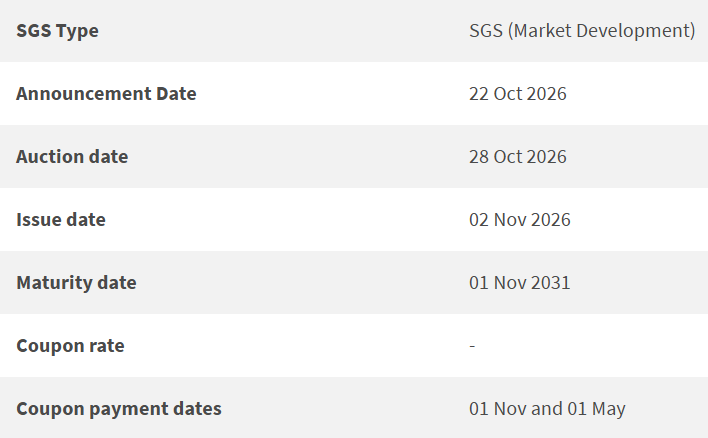
The new 5-year SGS bond (N526100H) will be issued on 2 November 2026, and will mature on 1 November 2031.
As this is a new bond issuance, the coupon rate offered will be determined at auction.
The coupon will be paid every six months, on 1 May and 1 November.
What is a new SGS bond auction?
A new SGS bond auction is where MAS issues a Singapore government bond for the first time. This introduces a new bond into circulation, with its own issue code, coupon rate, coupon payment dates and maturity date.
The upcoming auction is the first issuance of N526100H.
As this is a new bond, its coupon rate has not yet been set. The coupon rate, cut-off yield and cut-off price will be announced after the auction.
Once set, the coupon rate remains fixed throughout the bond’s life. Investors receive coupon payments every six months and the bond’s face value at maturity.
What is the likely yield on the new 5-year SGS bond?
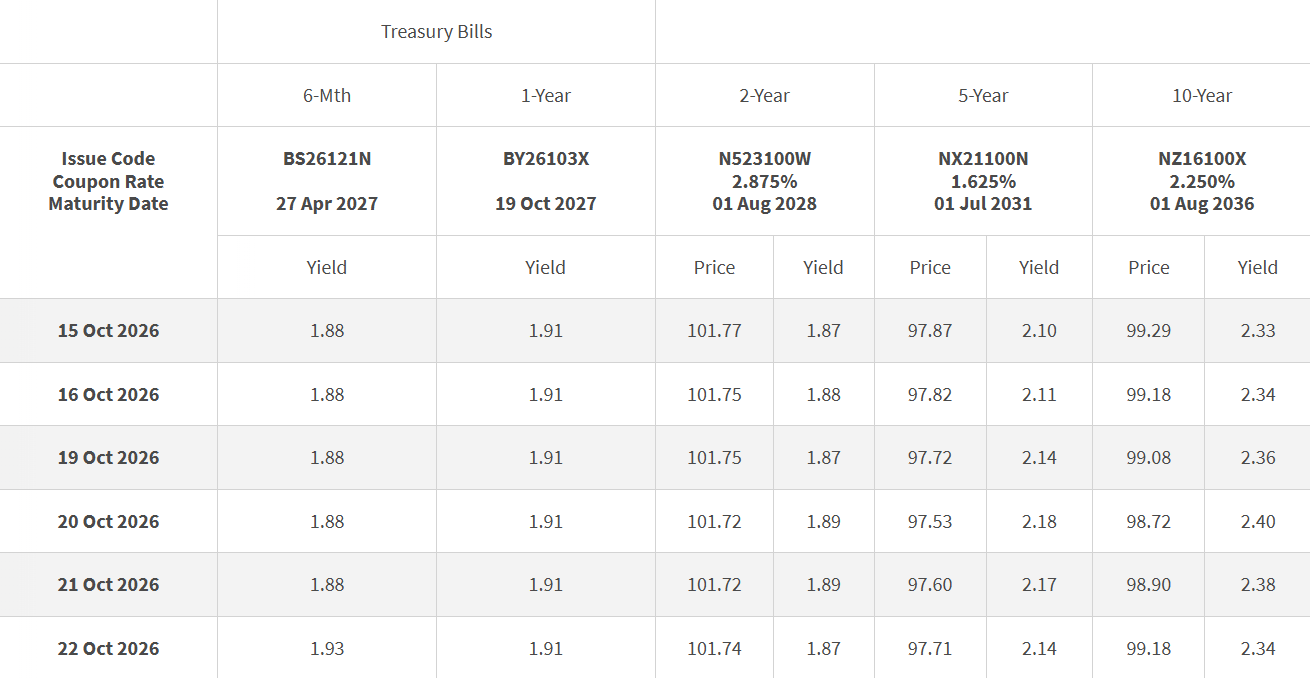
The closing yield on the existing 5-year SGS bond benchmark (NX21100N), was 2.14% on 22 October 2026.
In the previous 5-year SGS bond auction on 26 June 2026, the cut-off yield was 1.75%. This was close to the benchmark 5-year yield of 1.71% on the day before the auction.
The existing 5-year benchmark yield provides a reference point, but the new bond’s cut-off yield will depend on market conditions and bids submitted at the auction.
Buying the 5-year SGS bond: Better than Singapore Savings Bonds?
The latest Singapore Savings Bond offers:
- A first-year return of 1.67%
- An average return of 2.13% per year over 5 years
- An average return of 2.45% per year over 10 years

Based on these rates, the new 5-year SGS bond may offer a slightly higher return for a 5-year holding period based on the existing 5-year benchmark closing yield of around 2.14%.
However, the Singapore Savings Bond provides more flexibility.
SSBs can be redeemed in any month, with investors receiving their principal amount and accrued interest.
In comparison, the SGS bond does not provide monthly redemption at face value.
An investor who wants to exit before 1 November 2031 would have to sell the SGS bond in the secondary market. The price received may be higher or lower than the cut-off price paid at the auction.
Therefore, the SGS bond may offer a higher yield, while the SSB may be more relevant for cash that could be needed earlier.
Apart from offering a 1-year return of 1.67%, the latest SSB also allows us to lock-in a rate of 2.45% over 10 years, while having the flexibility to redeem prior to maturity.
Buying the 5-year SGS bond: Better than T-bills and fixed deposits?
The latest 6-month T-bill offered a cut-off yield of 1.95%, while the latest 1-year T-bill offered 1.92%.
Currently, the best 6-month fixed deposit rate we found is at 2.05% p.a.
Hence, the 5-year SGS bond may offer a higher yield for investors who are comfortable with the longer commitment, although the eventual cut-off yield remains uncertain at this point.

What are the risks of the 5-year SGS bond?
#1 – Potential losses if sold before maturity
The main risk is that investors may incur a loss if they sell the SGS bond before it matures on 1 November 2031.
The market price of an SGS bond moves as interest rates change. If market yields rise after the auction, the price of the bond may fall.
In this case, an investor who needs to sell the bond before maturity may receive a price that is lower than the price paid at the auction.
#2 – Liquidity risk
There may also be limited liquidity in the secondary market if an investor decides to sell the bond before maturity.
If there are few interested buyers, investors may not be able to sell the bond immediately or at their desired price.
This could increase the risk of receiving less than the purchase price, especially if the funds are needed urgently.
Investors who want to reduce the risk of a capital loss should therefore be prepared to hold the SGS bond until it matures on 1 November 2031.
What would Beansprout do?
The existing 5-year SGS bond (NX21100N) had a closing yield of around 2.14% on 22 October 2026.
Based on this benchmark, the new 5-year SGS bond may offer a higher yield compared to the latest 6-month T-bill and fixed deposit. However, the eventual auction yield is not yet known, and I would be mindful about potential losses if I decide to sell the bond before maturity.
This makes the 5-year SGS bond less likely to be something I'd consider for my Liquidity Pot within Beansprout's four pots of wealth.
The current closing yield of 2.14% is only slightly above the current issuance of the Singapore Savings Bonds (SSB) which offers a 5-year average return of 2.13%, and a 10-year average return of 2.45%.
However, SSBs offer higher flexibility compared to the 5-year SGS bond, as they can be redeemed prior to maturity.
It is also worth noting that the eventual cut-off yield of the 5-year SGS bond will depend on market movements and the bids submitted at the auction.
How do I apply for the 5-year SGS bond?
The 5-year Singapore Government Securities (SGS) bond auction is currently open.
The auction will take place on 28 October 2026.
As cash applications for the 5-year Singapore Government Securities (SGS) bond close one business day before the auction date, we would need to put in our cash applications by 9pm on 27 October.
If you prefer a shorter investment period and are comfortable holding your investment until maturity, you may consider Singapore T-bills. Read our guide to SGS bonds and T-bills to learn how they work and how to apply.
If you value the flexibility to redeem your investment in any month without being exposed to market price movements, you may consider Singapore Savings Bonds instead. Read our SSB guide to know more.
For a broader introduction to bonds, read our beginner’s guide to bond investing in Singapore, including how coupons, yields and duration work.
Enjoyed this insight? Follow Beansprout on Telegram, Youtube, Facebook and Instagram, and add Beansprout as your preferred source on Google so you never miss an update.
Read also
Gain financial insights in minutes
Subscribe to our free weekly newsletter for more insights to grow your wealth
Most Popular

Comments
0 comments