
Beyond US tech: How can investors gain exposure to Asia’s next wave of innovation?
ETFs
Powered by

By Nicole Ng • 04 Aug 2026
Why trust Beansprout? We’ve been awarded Best Investment Website at the SIAS Investors’ Choice Awards 2025
'%3e%3cpath%20fill-rule='evenodd'%20clip-rule='evenodd'%20d='M17.64%209.20455C17.64%208.56637%2017.5827%207.95273%2017.4764%207.36364H9V10.845H13.8436C13.635%2011.97%2013.0009%2012.9232%2012.0477%2013.5614V15.8195H14.9564C16.6582%2014.2527%2017.64%2011.9455%2017.64%209.20455V9.20455Z'%20fill='%234285F4'/%3e%3cpath%20fill-rule='evenodd'%20clip-rule='evenodd'%20d='M9%2018C11.43%2018%2013.4673%2017.1941%2014.9564%2015.8195L12.0477%2013.5614C11.2418%2014.1014%2010.2109%2014.4205%209%2014.4205C6.65591%2014.4205%204.67182%2012.8373%203.96409%2010.71H0.957275V13.0418C2.43818%2015.9832%205.48182%2018%209%2018V18Z'%20fill='%2334A853'/%3e%3cpath%20fill-rule='evenodd'%20clip-rule='evenodd'%20d='M3.96409%2010.71C3.78409%2010.17%203.68182%209.59318%203.68182%209C3.68182%208.40682%203.78409%207.83%203.96409%207.29V4.95818H0.957273C0.347727%206.17318%200%207.54773%200%209C0%2010.4523%200.347727%2011.8268%200.957273%2013.0418L3.96409%2010.71V10.71Z'%20fill='%23FBBC05'/%3e%3cpath%20fill-rule='evenodd'%20clip-rule='evenodd'%20d='M9%203.57955C10.3214%203.57955%2011.5077%204.03364%2012.4405%204.92545L15.0218%202.34409C13.4632%200.891818%2011.4259%200%209%200C5.48182%200%202.43818%202.01682%200.957275%204.95818L3.96409%207.29C4.67182%205.16273%206.65591%203.57955%209%203.57955V3.57955Z'%20fill='%23EA4335'/%3e%3c/g%3e%3cdefs%3e%3cclipPath%20id='clip0_0_2849'%3e%3crect%20width='18'%20height='18'%20fill='white'/%3e%3c/clipPath%3e%3c/defs%3e%3c/svg%3e)
Make Beansprout your preferred source on Google
Add us on Google to see more of our insights in your search results
Beyond US tech, Asia is driving innovation in AI, semiconductors and advanced manufacturing. Discover how to gain exposure to this theme through ETFs.
This post was created in partnership with CSOP Asset Management Pte. Ltd. All views and opinions expressed in this article are Beansprout's objective and professional opinions.
What happened?
Artificial intelligence (AI) and new technology breakthroughs have become one of the biggest investment themes globally.
When investors think about AI, many naturally focus on US mega-cap technology stocks.
However, Asia also plays a critical role in the global technology value chain.
It is also a key supplier of the chips, components, platforms and infrastructure needed to power the AI revolution.
In this article, I look at how investors can think about Asia’s innovation opportunities and how SGX-listed ETFs can provide exposure to this growth story.
Learn more about the CSOP FTSE Asia Pacific Select Index ETF (LCS) and CSOP CSI STAR and CHINEXT 50 Index ETF (SCY).
Why investors are looking at Asia’s technology sector
#1 – Asia sits at the heart of the global AI supply chain
The AI boom is more than just software, chatbots, or cloud platforms.
Behind every AI model available online today are large physical infrastructure layers, including sophisticated semiconductor manufacturing, memory chips, and precision components.
Asia plays a major role in this supply chain.
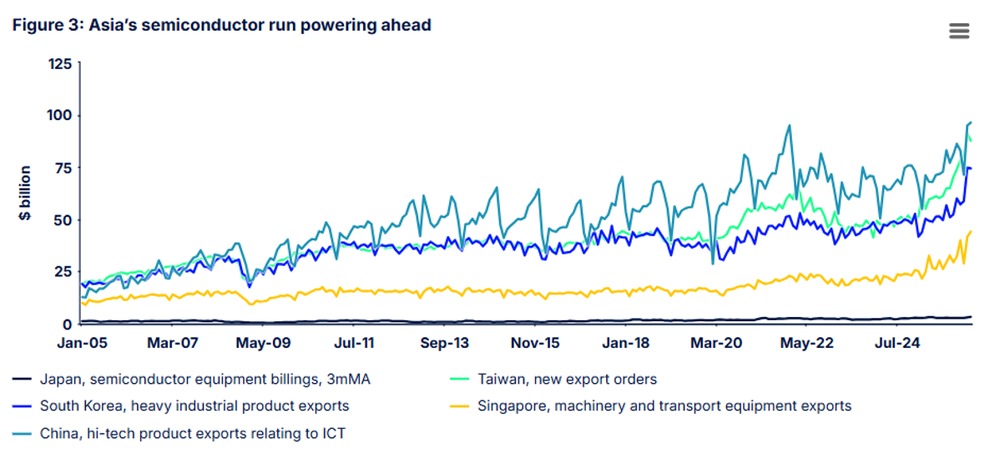
For example, Taiwan is home to some of the world’s most advanced semiconductor manufacturing companies such as Taiwan Semiconductor Manufacturing Company Limited (TSMC).
Global chip designers such as NVIDIA and Apple rely on TSMC to manufacture some of their most advanced chips and processors.
Korea is another important part of the AI hardware ecosystem.
Companies such as Samsung Electronics and SK Hynix are global leaders in memory chips, which are needed in large quantities for AI servers and data centres.
Japan also plays a critical role by supplying materials, chemicals, precision equipment and components used in advanced chip production.
Together, these Asian companies provide the hardware and manufacturing backbone that allows AI applications to scale globally.
This helps power everything from AI servers and cloud computing to smartphones, electric vehicles and autonomous driving.
#2 – Asia's innovation story is expanding beyond semiconductors
Semiconductors remain a key pillar of Asia’s technology story.
However, Asia’s innovation opportunity is no longer limited to chips.
Across the region, technology innovation is spreading into areas such as AI hardware, advanced manufacturing, robotics, optical communication, battery technology and new energy.
China is one example of this broader shift.
Beyond consumer internet platforms, China has been investing heavily in strategic technology sectors that support long-term industrial upgrading.
The STAR Market and ChiNext Market were created to support many of these emerging technology champions.
These markets include companies involved in advanced manufacturing, robotics, new energy, batteries, optical communication and other high-growth technology areas.
This has started to show up in market performance.
The CSI STAR and ChiNext 50 Index, which tracks the 50 largest and most liquid companies listed on China’s STAR Market and ChiNext board, returned more than 35% in the first half of 2026.
This was significantly ahead of the Shanghai Composite Index, which returned about 1% over the same period.
The STAR 50 Index was also the best-performing major equity index globally in June 2026.
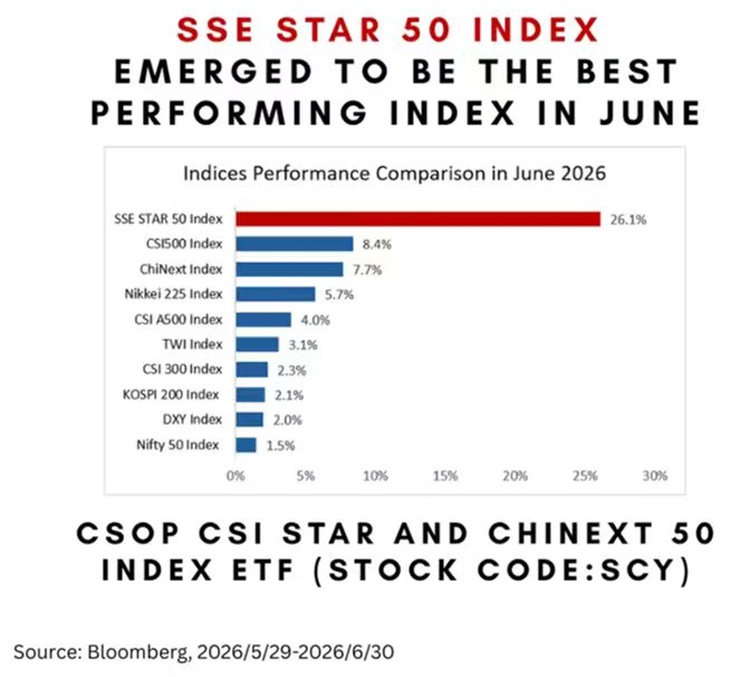
This suggests that even with broader sentiment towards China equities still mixed, investors have been willing to allocate capital to companies exposed to structural innovation themes.
#3 – Investors are seeking broader technology exposure beyond US mega-cap stocks
The strong performance of US technology stocks has benefited many investors. However, it has also increased concentration risk in some portfolios.
For investors who already have meaningful exposure to US mega-cap technology stocks, Asia can offer a way to diversify across different parts of the technology value chain.
This includes companies involved in semiconductor manufacturing, memory chips, precision components, hardware, advanced manufacturing and industrial technologies.
In other words, Asia’s technology sector offers exposure not only to AI applications, but also to the physical infrastructure that makes AI possible.
This can complement US technology exposure and provide a broader source of long-term growth.
How can investors gain exposure to Asia's innovation story?
Investors looking to tap into Asia's technology growth can consider ETFs for diversified exposure.
Rather than picking individual semiconductor, AI or technology companies, investors can gain exposure through the CSOP FTSE Asia Pacific Select Index ETF (LCS) and the CSOP CSI STAR and CHINEXT 50 Index ETF (SCY), both listed on the Singapore Exchange (SGX).
While both ETFs capture Asia's innovation story, they provide exposure to different parts of Asia’s innovation landscape.
LCS focuses on established semiconductor leaders that underpin the global AI supply chain such as TSMC and Samsung Electronics.
In the first half of 2026, TSMC delivered gains of more than 50%, while Samsung Electronics rose nearly 180%, supported by record profits amid continued global demand for AI hardware and memory chips.
Meanwhile, SCY provides access to China's emerging technology champions driving innovation across multiple industries such as Zhongji Innolight and Eoptolink Technology.
Both companies gained about 100% in the first half of 2026, benefiting from strong demand for high-end optical transceivers used in AI data centres and high-speed networking
Together, these ETFs can offer investors broader exposure to the structural trends shaping technology growth across Asia.
# 1 – CSOP FTSE Asia Pacific Select Index ETF (LCS)
The CSOP FTSE Asia Pacific Select Index ETF is traded under the ticker LCS for SGD-denominated trading and LCU for USD-denominated trading. Both provide access to the same ETF.
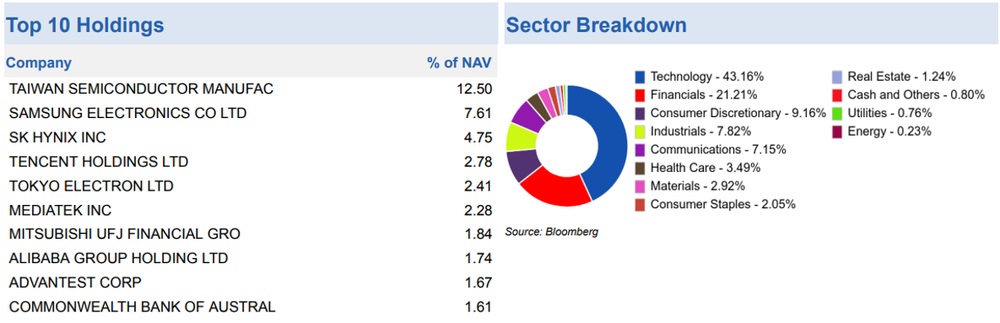
LCS provides a broad Asia-Pacific equity exposure with a meaningful tilt towards Asia’s semiconductor ecosystem.
It invests in companies across Japan, Korea, and Taiwan involved in semiconductor manufacturing, memory chips, and AI infrastructure, including prominent names such as TSMC, Samsung, and SK Hynix.
| Feature | Outline |
| Geographic focus* | Japan: 37.3% Taiwan: 20.3% Korea: 15.6% China: 11.5% Other Asia Pacific Countries: 15.3% |
| Investment theme | Semiconductor manufacturers, memory chip producers and AI infrastructure |
| Representative holdings | TSMC, Samsung Electronics, SK Hynix, Tencent Holdings, Mediatek |
| Why it matters | Exposure to companies powering AI infrastructure, cloud computing, data centres and advanced electronics |
| Performance* | Year to date: 22.1% 1 Year: 40.8% 3 Year: 73.1% |
*As of 30 June 2026. Investment involves risk. Past performance is not indicative of future performance.
Learn more about the CSOP FTSE Asia Pacific Select Index ETF (LCS)
#2 – CSOP CSI STAR and CHINEXT 50 Index ETF (SCY)
The CSOP CSI STAR and CHINEXT 50 Index ETF is traded under the ticker SCY using the currency of SGD.
SCY provides a more targeted exposure to China’s next-generation technology leaders listed on the STAR Market and ChiNext Market, providing exposure to sectors such as AI hardware, semiconductors, advanced manufacturing, optical communication, and new energy technologies in China through companies like Zhongji Innolight, CATL, Cambricon, and more.
SCY is currently the only offshore product tracking the CSI STAR and CHINEXT 50 Index.
This is useful for investors who want access to China’s technology-heavy and innovation-focused STAR Market and ChiNext Market but with the convenience of being listed on the SGX.
| Feature | Outline |
| Geographic focus | China |
| Investment theme | Technology and advanced manufacturing |
| Representative Holdings* | Zhongji Innolight, Eoptolink Technology, CATL, Cambricon Technologies, Montage Technology |
| Key sectors | Information Technology, Communication Services, Industrials |
| Why it matters | Exposure to companies involved in AI hardware, semiconductors, optical communication, advanced manufacturing and new energy technologies |
| Performance** | Year to date: 60.0% 1 Year: 185.1% 3 Year: 136.9% |
*via Master ETF China Southern CSI STAR and CHINEXT 50 ETF
**As of 30 June 2026. Investment involves risk. Past performance is not indicative of future performance.
Learn more about the CSOP CSI STAR and CHINEXT 50 Index ETF (SCY)
Why consider an ETF instead of investing in individual technology stocks?
Buying shares in a technology company can be rewarding if the business performs well. But it also means your returns depend heavily on the fortunes of a single company.
It also requires investors to research each company's business model, competitive position and valuation.
This can be even more challenging when Asia's leading technology companies are listed across different markets, trade in different currencies and operate in highly specialised industries.
Plus, gaining exposure to China's innovation leaders can be less straightforward.
Many of these companies are listed on mainland China's STAR Market and ChiNext Board, which are not available through every brokerage platform or market access route.
An ETF offers a simpler way to gain exposure.
With the CSOP FTSE Asia Pacific Select Index ETF (LCS) and CSOP CSI STAR and CHINEXT 50 Index ETF (SCY), you can invest in a diversified basket of companies through a single trade on the Singapore Exchange (SGX).
LCS provides exposure to leading semiconductor companies such as TSMC, Samsung Electronics and SK Hynix, which form the backbone of the global AI supply chain.
SCY complements this by providing access to China's innovation leaders, including companies such as CATL, across sectors like AI, advanced manufacturing and healthcare.
Together, LCS and SCY allow investors to access Asia's technology leaders while reducing single-company risk and avoiding the complexity of investing across multiple exchanges and markets.
| Investing in individual stocks | Investing through thematic ETFs |
| Concentrated exposure to one company | Diversified exposure across multiple companies |
| Higher company-specific risk | Reduced impact if one company underperforms |
| Requires ongoing research and monitoring | Professional index methodology with periodic rebalancing |
| May require investing across multiple exchanges | Exposure to multiple markets through a single investment |
What are the key risks to consider?
#1 – Technology stocks can be more volatile
Technology and innovation stocks can experience sharp price swings because their valuations often depend heavily on expectations of future growth.
Changes in revenue forecasts, profit expectations or investor sentiment can therefore lead to significant movements in share prices.
The sector also faces execution risk. A successful technological breakthrough may support strong gains, while product delays, weaker-than-expected adoption or failed development projects could weigh heavily on performance.
#2 – The semiconductor industry is cyclical
Semiconductor demand can rise and fall depending on the broader economic cycle, inventory levels, and capital expenditure trends.
Even if long-term demand for AI chips, memory and semiconductor equipment remains positive, the industry can still experience periods of oversupply, weaker pricing and slower orders.
These downturns may lead to sharp declines in semiconductor companies’ revenue, earnings and share prices.
#3 – Geopolitical and policy developments can impact the sector
Technology and semiconductor manufacturing are increasingly viewed as strategic industries that are important to national security and economic competitiveness.
Governments may introduce export controls, trade restrictions, subsidies or policies that favour domestic companies. These measures can disrupt supply chains, limit access to key markets or technologies, and increase operating costs.
Changes in industrial, regulatory or capital-market policies may also affect companies’ earnings outlook, valuations and investor sentiment.
#4 – Currency risk
Although LCS and SCY are traded in Singapore dollars on the SGX, their underlying investments are denominated in foreign currencies.
Changes in currencies such as the Japanese yen, Korean won, New Taiwan dollar, Chinese yuan and US dollar against the Singapore dollar can therefore affect investors’ returns.
What would Beansprout do?
I would not view this as an “Asia vs US” decision.
US technology companies remain global leaders and can still continue to play an important role in a diversified portfolio.
Instead, I would consider whether my technology exposure has become overly concentrated in a small number of US mega-cap stocks.
Asia may offer a way to broaden both sector and geographic exposure.
Asia plays a critical role across the technology value chain, from semiconductors and advanced manufacturing to precision equipment, essential materials, and more.
Investing in the region can therefore provide exposure to parts of the innovation ecosystem that may be underrepresented in a US-focused portfolio.
LCS offers broad Asia-Pacific equity exposure, with meaningful holdings in several of the region’s leading semiconductor companies.
SCY is more targeted, providing access to companies listed on China’s STAR Market and ChiNext across areas such as AI hardware, semiconductors, advanced manufacturing and new energy technologies.
The two ETFs therefore provide exposure to different parts of Asia’s innovation landscape.
I would view both ETFs as long-term thematic investments rather than short-term trading opportunities.
Given their potential volatility, I would invest based on structural trends instead of trying to time the market.
These ETFs could complement, rather than replace, broad-market funds and existing US technology exposure.
Learn more about the CSOP FTSE Asia Pacific Select Index ETF (LCS) and CSOP CSI STAR and CHINEXT 50 Index ETF (SCY).
Disclaimers:
All information and data presented are based on the latest available data at the time of preparation, unless stated otherwise.
The investment product(s), as mentioned in this document, is/are registered under section 286 of the Securities and Futures Act (Cap. 289) of Singapore (the “SFA”). This material and the information contained in this material shall not be regarded as an offer or solicitation of business in any jurisdiction to any person to whom it is unlawful to offer or solicit business in such jurisdictions.
CSOP Asset Management Pte. Ltd. (“CSOP”) which prepared this document believes that information in this document is based upon sources that are believed to be accurate, complete, and reliable. However, CSOP does not warrant the accuracy and completeness of the information, and shall not be liable to the recipient or controlling shareholders of the recipient resulting from its use. CSOP is under no obligation to keep the information up-to-date. The provision of this document shall not be deemed as constituting any offer, acceptance, or promise of any further contract or amendment to any contract. The information herein shall not be disclosed, used or disseminated, in whole or part, and shall not be reproduced, copied or made available to others without the written consent of CSOP.
Advice should be sought from a financial adviser regarding the suitability of the investment and/or investment product before making an investment. Investment involves risk. The value of investments, and the income from them, can go down as well as up and an investor may get back less than the amount invested. Past performance is not necessarily indicative of future performance. Investor should read the prospectus and product highlights sheet, which can be obtained on CSOP website or authorized participating dealers, before deciding whether to invest. This document has not been reviewed by the Monetary Authority of Singapore.
Index provider disclaimers:
LCU
CSOP FTSE Asia Pacific Select Index ETF (the “ETF”) has been developed solely by CSOP. The ETF is not in any way connected to or sponsored, endorsed, sold or promoted by the London Stock Exchange Group plc and its group undertakings (collectively, the “LSE Group”). FTSE Russell is a trading name of certain of the LSE Group companies.
All rights in the FTSE Asia Pacific Select Index (the “Index”) vest in the relevant LSE Group company which owns the Index. FTSE® is a trademark of the relevant LSE Group company which own the Index and is used by any other LSE Group company under license.
The Index is calculated by or on behalf of FTSE International Limited or its affiliate, agent or partner. The LSE Group does not accept any liability whatsoever to any person arising out of (a) the use of, reliance on or any error in the Index or (b) investment in or operation of the ETF. The LSE Group does not accept any liability whatsoever to any person arising out of the use of the ETF or the underlying data. The LSE Group makes no claim, prediction, warranty or representation either as to the results to be obtained from the ETF or the suitability of the Index for the purpose to which it is being put by CSOP.
SCY
All rights in the Index vest in China Securities Index Company (“CSI”). CSI does not make any warranties, express or implied, regarding the accuracy or completeness of any data related to the Index. CSI is not liable to any person for any error of the Index (whether due to negligence or otherwise), nor shall it be under any obligation to advise any person of any error therein. The Product based on the Index is in no way sponsored, endorsed, sold or promoted by CSI and CSI shall not have any liability with respect thereto.
Read also
Gain financial insights in minutes
Subscribe to our free weekly newsletter for more insights to grow your wealth
Most Popular

Comments
0 comments