
STI pulls back from record high: What to consider before investing
Stocks
By Gerald Wong, CFA • 08 Oct 2026
Why trust Beansprout? We’ve been awarded Best Investment Website at the SIAS Investors’ Choice Awards 2025
'%3e%3cpath%20fill-rule='evenodd'%20clip-rule='evenodd'%20d='M17.64%209.20455C17.64%208.56637%2017.5827%207.95273%2017.4764%207.36364H9V10.845H13.8436C13.635%2011.97%2013.0009%2012.9232%2012.0477%2013.5614V15.8195H14.9564C16.6582%2014.2527%2017.64%2011.9455%2017.64%209.20455V9.20455Z'%20fill='%234285F4'/%3e%3cpath%20fill-rule='evenodd'%20clip-rule='evenodd'%20d='M9%2018C11.43%2018%2013.4673%2017.1941%2014.9564%2015.8195L12.0477%2013.5614C11.2418%2014.1014%2010.2109%2014.4205%209%2014.4205C6.65591%2014.4205%204.67182%2012.8373%203.96409%2010.71H0.957275V13.0418C2.43818%2015.9832%205.48182%2018%209%2018V18Z'%20fill='%2334A853'/%3e%3cpath%20fill-rule='evenodd'%20clip-rule='evenodd'%20d='M3.96409%2010.71C3.78409%2010.17%203.68182%209.59318%203.68182%209C3.68182%208.40682%203.78409%207.83%203.96409%207.29V4.95818H0.957273C0.347727%206.17318%200%207.54773%200%209C0%2010.4523%200.347727%2011.8268%200.957273%2013.0418L3.96409%2010.71V10.71Z'%20fill='%23FBBC05'/%3e%3cpath%20fill-rule='evenodd'%20clip-rule='evenodd'%20d='M9%203.57955C10.3214%203.57955%2011.5077%204.03364%2012.4405%204.92545L15.0218%202.34409C13.4632%200.891818%2011.4259%200%209%200C5.48182%200%202.43818%202.01682%200.957275%204.95818L3.96409%207.29C4.67182%205.16273%206.65591%203.57955%209%203.57955V3.57955Z'%20fill='%23EA4335'/%3e%3c/g%3e%3cdefs%3e%3cclipPath%20id='clip0_0_2849'%3e%3crect%20width='18'%20height='18'%20fill='white'/%3e%3c/clipPath%3e%3c/defs%3e%3c/svg%3e)
Make Beansprout your preferred source on Google
Add us on Google to see more of our insights in your search results
The STI has pulled back from its record high. Find out why the index is falling, how its valuation compares with history, and what investors can consider.

What happened?
The Straits Times Index (STI) has pulled back from its record high.
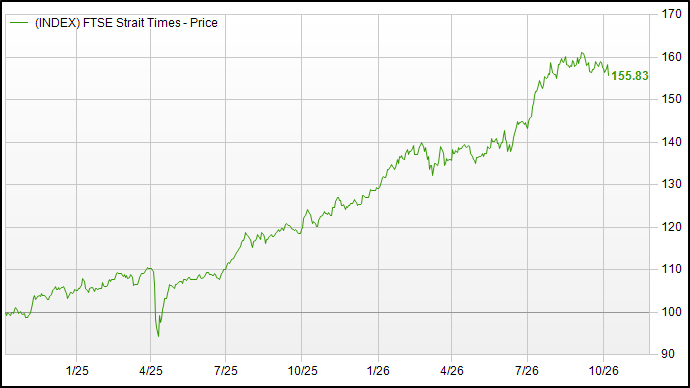
After reaching a record close of 5,801.96 on 4 September 2026, the STI fell about 3.3% to 5,608.44 on 7 October, before opening another 1.2% lower at 5,539.75 on 8 October.
The pullback follows a strong rally, with the STI rising 16.9% in 2024 and another 22.7% in 2025, leaving the recent decline relatively modest compared with those gains.
UOB and OCBC, which were among September’s best-performing Singapore blue chips, have also seen their share prices fall since then.
Following the US Federal Reserve's September interest-rate hike, investors are watching whether higher bond yields could put further pressure on the STI.
Many in the Beansprout community are wondering what is behind the recent decline and whether it is a good time to invest.
In this article, we look at whether the pullback presents an opportunity to invest and what could drive further downside.
Why did the STI pull back?
We see three main factors that may have contributed to the recent decline in the STI.
1. Profit taking after a strong rally
The STI has risen significantly over the past two years, supported by gains in many of its largest constituent stocks.
After gaining about 56% in the last 2 years, some investors may be locking in profits following the strong rally.
The rise also means that more positive expectations may already be reflected in share prices.
As a result, investors may be more inclined to sell when market sentiment weakens, even without a significant deterioration in Singapore's economic outlook.
2. Higher global bond yields are putting pressure on valuations
Another factor is the increase in global bond yields.
The US 10-year Treasury yield was around 5.3% in early October 2026, while Brent crude oil prices rose above US$100 per barrel amid US-Iran tensions.
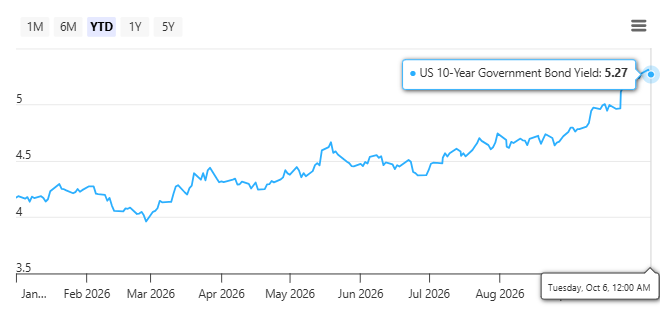
Higher oil prices can add to inflation pressures, potentially keeping interest rates elevated for longer.
When government bond yields rise, investors can earn more income from bonds, which may reduce the relative appeal of dividend-paying stocks.
Higher yields can also weigh on equity valuations because investors may demand higher expected returns to compensate for taking stock market risk.
This matters for the STI, which has significant exposure to established dividend-paying companies.
3. The STI is heavily concentrated in a few large companies
Another factor is the composition of the STI itself.
The index tracks 30 of the largest and most liquid companies listed on the Singapore Exchange, but its weightings are not evenly distributed.
In particular, DBS, OCBC and UOB account for about half of the STI's weight. This means weakness in a few large companies can have a significant impact on the index.
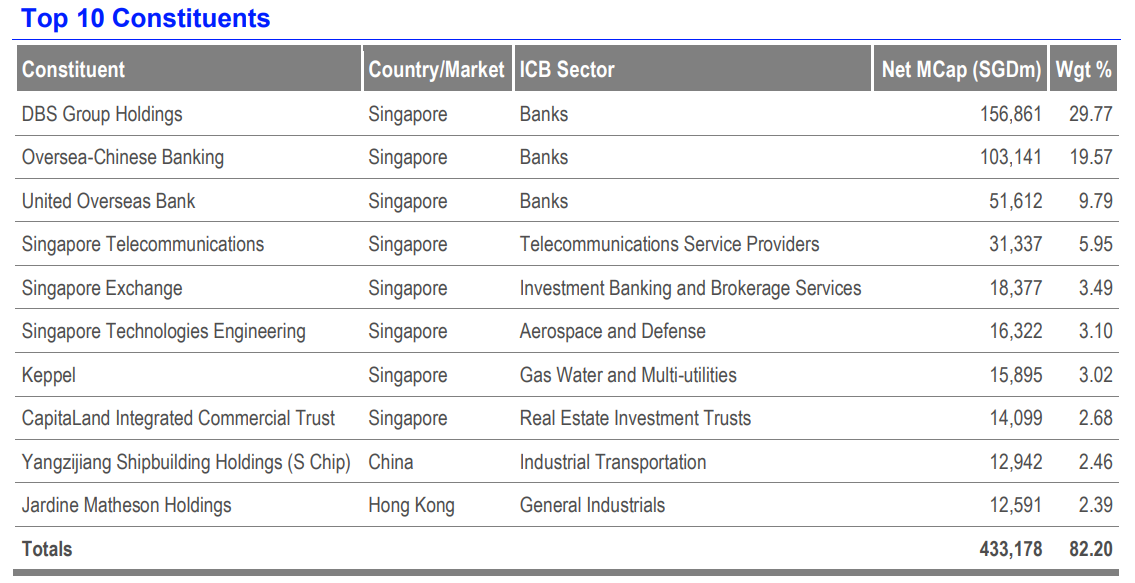
As a result, the STI may decline even when the broader Singapore economy remains healthy.
The index's concentration also means its performance can differ from that of smaller Singapore-listed companies.
What are we watching for in the STI?
With the STI pulling back from its record high, we would focus on four factors to assess whether the index can continue performing well.
These factors could also determine whether the recent pullback remains relatively modest or develops into a larger decline.
1. Whether Singapore's economic growth remains healthy
Singapore's economic fundamentals have remained relatively strong despite uncertainty in global markets.
On 11 August 2026, the Ministry of Trade and Industry (MTI) raised its 2026 gross domestic product (GDP) growth forecast to 4.5% to 5.5%, from 2.0% to 4.0% previously.
Singapore's economy expanded 5.9% year-on-year in the second quarter and 6.1% in the first half of 2026, supported by manufacturing, wholesale trade and finance.
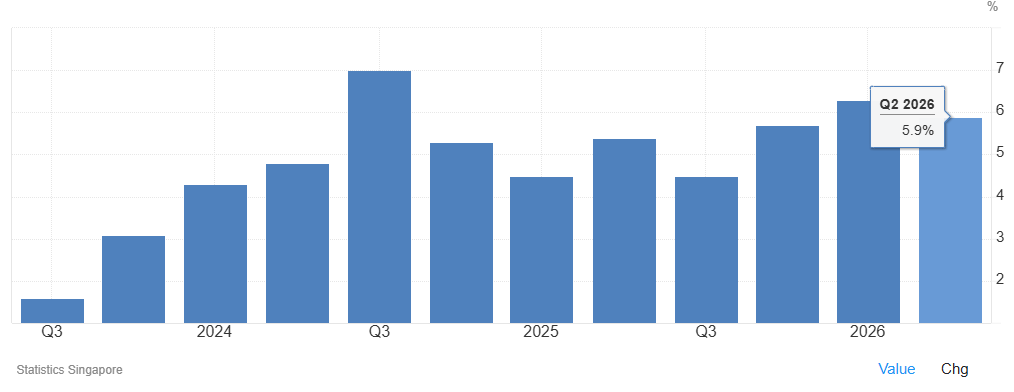
Demand for artificial intelligence infrastructure has also supported parts of Singapore's manufacturing and trade sectors.
Other economic indicators have remained relatively stable.
Singapore's unemployment rate stood at 1.9% in June 2026, while headline inflation was 2.3% in August. The Singapore Overnight Rate Average (SORA) was around 1.3% in early October.
However, MTI has cautioned that growth could moderate in the second half of 2026 as consumption softens and elevated energy prices weigh on parts of the economy.
For the STI, the more important question is whether Singapore's economic growth can continue supporting earnings among its constituent companies.
If corporate earnings remain healthy, they could help support the index even as valuations remain elevated.
2. Whether global interest rates and bond yields stabilise
We would also watch how global bond yields move following the recent increase.
Higher bond yields can make equities less appealing relative to fixed-income investments, particularly for investors seeking dividend income.
They can also weigh on the valuations investors are willing to pay for future corporate earnings.
This means the STI could remain sensitive to changes in US interest-rate expectations, even if Singapore's domestic economy continues to perform well.
If bond yields stabilise or decline, some of the pressure on equity valuations could ease.
However, if inflation remains elevated and bond yields continue rising, the STI may face further pressure.
3. Whether the STI's valuation remains reasonable
After the strong rally, the STI is trading at elevated valuations compared with its recent history.
Based on FactSet data, the SPDR Straits Times Index ETF, which tracks the STI, is trading at about 16.44 times expected earnings over the next 12 months.
This is significantly above its historical average forward price-to-earnings (P/E) ratio of 12.29 times over the period shown, from around 2021 to 2026.
It is also above the upper historical reference level of 14.12 times shown in the chart.
This suggests that investors are paying more for each dollar of expected earnings from STI constituent companies compared with the past few years.
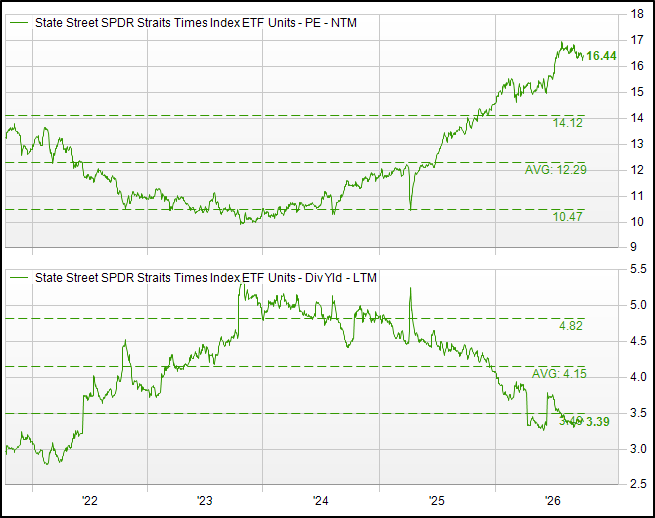
At the same time, the ETF's historical dividend yield has declined to about 3.39%, compared with its average of 4.15% over the same period.
The lower dividend yield partly reflects the increase in share prices, as yields generally fall when prices rise faster than dividend distributions.
For investors seeking dividend income, this means buying the STI at current levels offers a lower historical dividend yield than its average over the past few years.
Taken together, the higher P/E ratio and lower dividend yield suggest that the STI is no longer as attractively valued as it was earlier in the rally.
However, higher valuations do not necessarily mean that the STI will decline.
If constituent companies continue to grow their earnings and dividends, this could help support current valuations.
We would therefore pay more attention to whether future earnings growth can justify the higher valuations, rather than assuming that the STI will continue rising at the same pace as the past two years.
4. Whether concentration in the banks adds to volatility
The STI tracks 30 of the largest and most liquid companies listed on the Singapore Exchange, but its weightings are heavily concentrated.
DBS, OCBC and UOB account for about half of the STI's weight, which means weakness in the three banks can have a significant impact on the index.
This concentration does not necessarily mean the STI will perform poorly, but it means investors are taking more company and sector concentration risk than they might with a broader global equity index.
We would therefore continue monitoring the outlook for the banks alongside Singapore's broader economic growth, rather than treating the STI as a diversified representation of the entire Singapore economy.
What would Beansprout do?
The recent STI pullback has not changed how we would think about our portfolio.
Rather than deciding whether to buy simply because the index has fallen from its record high, we would start with the role Singapore stocks are meant to play within our Four Pots of Wealth framework.
For long-term investors, our starting point would still be the Growth Pot. Regardless of the market sentiment, regular DCA investing into diversified equities can help us stay invested over the long term, rather than trying to predict when markets will correct.
Where we would be more selective is with individual stocks and REITs, especially with the higher interest rate environment
For our Income Pot, which includes S-REITs and dividend stocks, we would focus on companies with lower gearing and manageable refinancing needs. These businesses should be less exposed if borrowing costs stay higher for longer.
For individual stock ideas, we would still keep them ring-fenced within the Opportunity Pot and focus on building a portfolio rather than picking stocks in isolation, sizing each position based on conviction, company-specific risks and what else we already own.
Rather than buying more simply because the stocks have pulled back, we would focus on whether earnings growth can support their valuation and whether they still fit our overall investment allocation.
For now, we would continue watching Singapore's economic growth, movements in global bond yields and whether the valuation moves closer to its historical average.
For readers who want to see how we apply this in practice, our latest Beansprout Pro Opportunity Model Portfolio update shows how we would invest S$100,000 in Singapore stocks, including how we think about position sizing and portfolio construction.
Have you been taking profit after the STI's strong rally, or are you looking to add during the recent pullback? Share your thoughts in the comments or our Beansprout Telegram community.
Enjoyed this insight? Follow Beansprout on Telegram, Youtube, Facebook and Instagram, and add Beansprout as your preferred source on Google so you never miss an update.
Read also
Gain financial insights in minutes
Subscribe to our free weekly newsletter for more insights to grow your wealth
Most Popular

Comments
0 comments