
Why DBS, OCBC and UOB shares are falling and what investors should watch next
Stocks
By Gerald Wong, CFA • 09 Oct 2026
Why trust Beansprout? We’ve been awarded Best Investment Website at the SIAS Investors’ Choice Awards 2025
'%3e%3cpath%20fill-rule='evenodd'%20clip-rule='evenodd'%20d='M17.64%209.20455C17.64%208.56637%2017.5827%207.95273%2017.4764%207.36364H9V10.845H13.8436C13.635%2011.97%2013.0009%2012.9232%2012.0477%2013.5614V15.8195H14.9564C16.6582%2014.2527%2017.64%2011.9455%2017.64%209.20455V9.20455Z'%20fill='%234285F4'/%3e%3cpath%20fill-rule='evenodd'%20clip-rule='evenodd'%20d='M9%2018C11.43%2018%2013.4673%2017.1941%2014.9564%2015.8195L12.0477%2013.5614C11.2418%2014.1014%2010.2109%2014.4205%209%2014.4205C6.65591%2014.4205%204.67182%2012.8373%203.96409%2010.71H0.957275V13.0418C2.43818%2015.9832%205.48182%2018%209%2018V18Z'%20fill='%2334A853'/%3e%3cpath%20fill-rule='evenodd'%20clip-rule='evenodd'%20d='M3.96409%2010.71C3.78409%2010.17%203.68182%209.59318%203.68182%209C3.68182%208.40682%203.78409%207.83%203.96409%207.29V4.95818H0.957273C0.347727%206.17318%200%207.54773%200%209C0%2010.4523%200.347727%2011.8268%200.957273%2013.0418L3.96409%2010.71V10.71Z'%20fill='%23FBBC05'/%3e%3cpath%20fill-rule='evenodd'%20clip-rule='evenodd'%20d='M9%203.57955C10.3214%203.57955%2011.5077%204.03364%2012.4405%204.92545L15.0218%202.34409C13.4632%200.891818%2011.4259%200%209%200C5.48182%200%202.43818%202.01682%200.957275%204.95818L3.96409%207.29C4.67182%205.16273%206.65591%203.57955%209%203.57955V3.57955Z'%20fill='%23EA4335'/%3e%3c/g%3e%3cdefs%3e%3cclipPath%20id='clip0_0_2849'%3e%3crect%20width='18'%20height='18'%20fill='white'/%3e%3c/clipPath%3e%3c/defs%3e%3c/svg%3e)
Make Beansprout your preferred source on Google
Add us on Google to see more of our insights in your search results
Singapore bank stocks have pulled back after a strong rally. We look at DBS, OCBC and UOB, the risks to bank earnings, and what investors should watch.

What happened?
Singapore bank stocks have come under selling pressure.
Shares of DBS, OCBC and UOB weakened as the Straits Times Index (STI) pulled back from its September record high in early October 2026.
The weakness follows a strong rally in Singapore bank stocks, which have been important contributors to the STI's gains over the past two years.
With the US Federal Reserve raising interest rates in September, we previously shared how higher interest rates may impact Singapore banks.
In this article, we will dive deeper to understand what is driving the fall in the share prices of DBS, OCBC, and UOB, and what are some of the key factors that may impact their share prices.
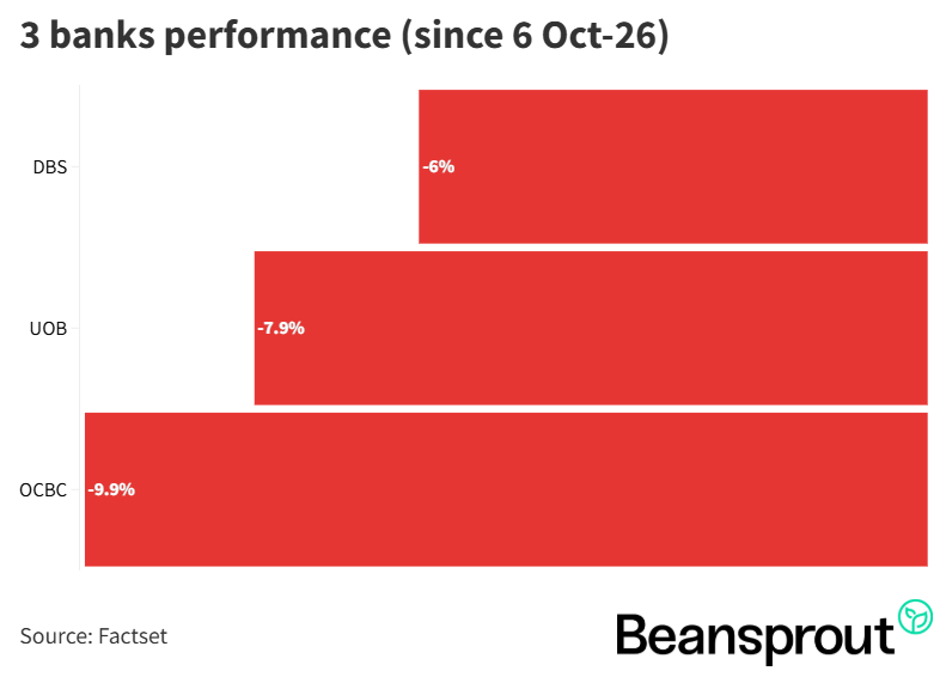
Why did DBS, OCBC and UOB stock pull back?
Singapore bank stocks extended their declines on 8 October, following a broader sell-off in global banking shares.
Bank shares have come under pressure across global markets, including Europe, the US and Singapore.
The selling intensified locally on 8 October, with the Straits Times Index (STI) falling 3.5%, its biggest single-day decline since April 2025.
We see three main factors contributing to the recent weakness.
#1 - The sell-off has spread across global and regional banks
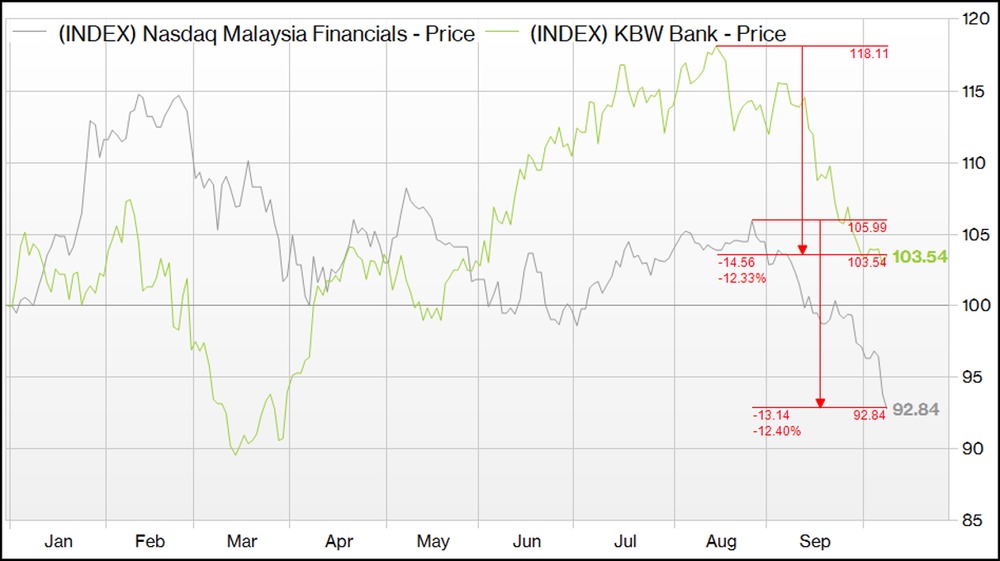
The recent decline in Singapore bank stocks has coincided with a broader sell-off in global banking shares.
The KBW Nasdaq Bank Index (BKX), which tracks major US banking stocks, fell 12.3% from mid-August to 8 October 2026. Similarly, the Nasdaq Malaysia Financials Index declined 12.4% from end-August to 8 October 2026.
This suggests that the weakness is not limited to Singapore banks or driven solely by concerns over their earnings.
Higher global bond yields may have contributed to the broader decline, as investors reassess bank valuations and the potential impact of rising yields on the value of banks' securities portfolios.
#2 - Higher bond yields are putting pressure on valuations and capital
The immediate pressure has come from rising government bond yields.
The US 10-year Treasury yield reached 5.32% on 7 October 2026, an increase of approximately 0.52 percentage points over the past month and 1.2 percentage points from a year ago.
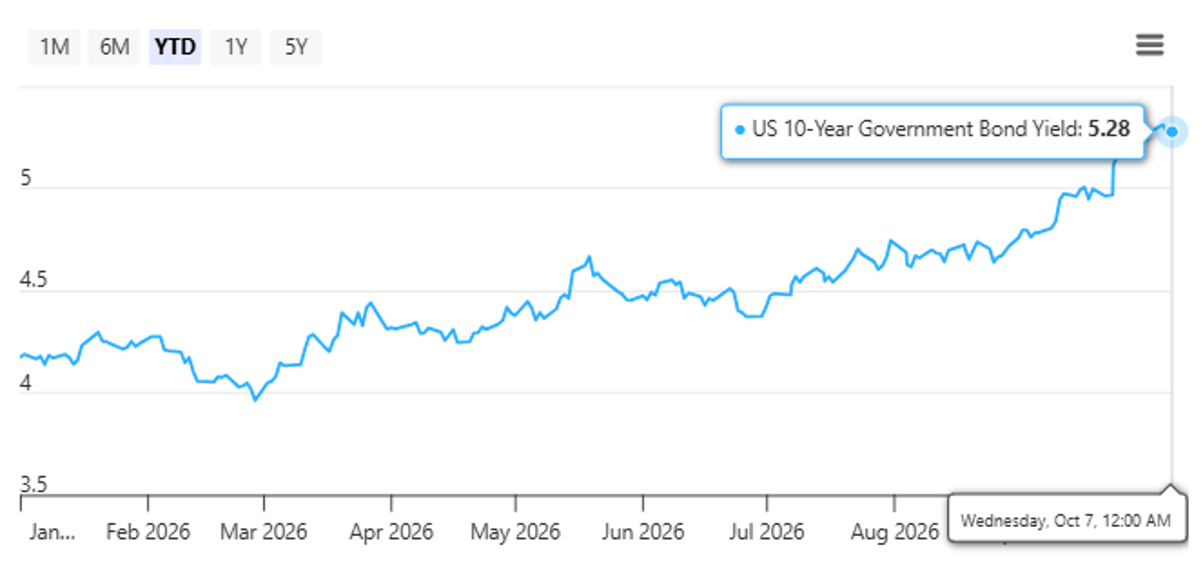
Source: Beansprout, data as of 7 October 2026
The 30-year Treasury yield had earlier reached 5.5% on 24 September, its highest level since 2004. The US Federal Reserve also raised its policy rate by 0.25 percentage points in September, bringing the target range to 3.75% to 4.00%.
In Singapore, we have also seen an increase in the government bond yield over the past few months, though to a smaller extent than the increase in US government bond yields.
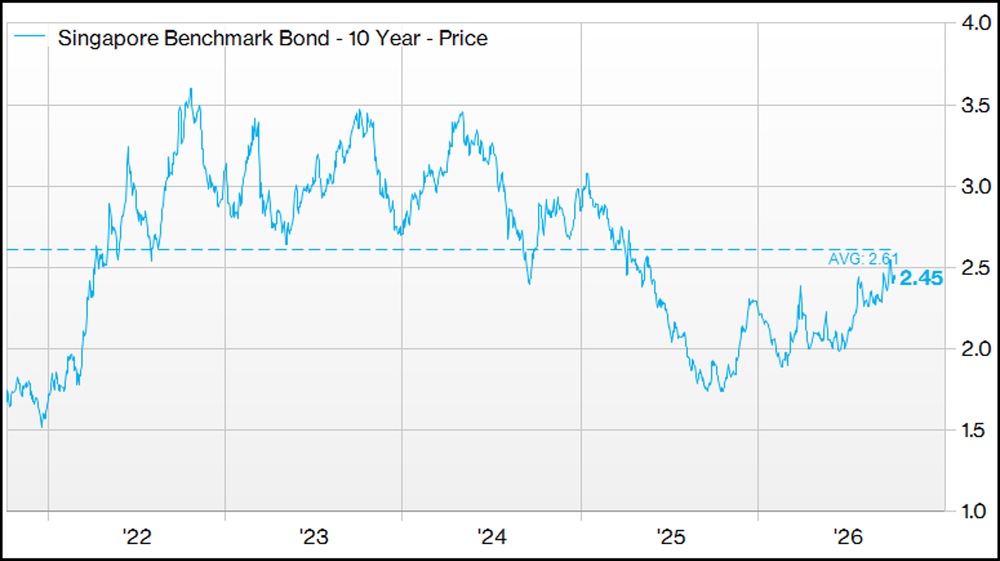
When bond yields rise, investors can earn higher returns from relatively lower-risk assets. They may therefore demand higher expected returns from equities, putting pressure on valuation multiples.
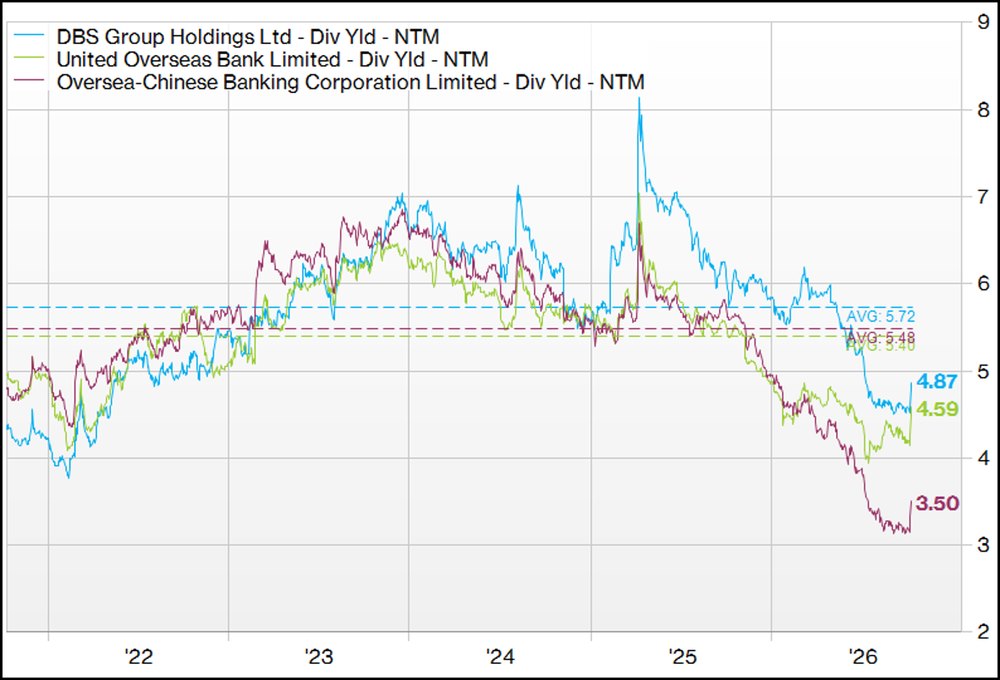
Beyond valuations, rising bond yields can also affect banks' investment portfolios.
When yields rise, the market value of existing fixed-rate bonds generally falls. The impact on bank earnings and capital depends on how these securities are classified.
The global nature of the sell-off matters because Singapore banks have generally maintained healthy underlying business performance.
While there are differences in earnings outlook and balance-sheet exposure across banks, the recent price weakness appears to reflect broader market concerns.
#3 - Broader shift in market sentiment
Technical factors may also be contributing to the selling pressure.
DBS and OCBC reached record highs in early September, while UOB peaked in July.
Singapore banks have delivered substantial share price gains over the past three years, supported by strong profitability, wealth management growth and capital returns.
A meaningful portion of these gains has also come from investors being willing to pay higher valuation multiples.
With bank stocks having performed strongly, investors sitting on significant gains may be more inclined to take profits when market sentiment turns.
We believe this could be amplifying the correction, although it is difficult to determine the extent of profit-taking from share price movements alone.
What are we watching for in Singapore bank stocks
We are watching movements in global bond yields as a key driver of Singapore bank share prices, alongside several factors that could affect the earnings outlook for DBS, OCBC and UOB in their third-quarter 2026 results.
#1 - Stabilisation in bond yields
As discussed earlier, rising government bond yields can put pressure on equity valuations, particularly for dividend-paying stocks such as Singapore banks.
Even if bank earnings remain resilient, a further rise in bond yields could weigh on their share prices. Higher Singapore Government Securities (SGS) yields could also make bank dividend yields less attractive in comparison.
We would therefore look for signs of stabilisation in oil prices and bond yields.
Do you think bond yields are going to move higher or lower? Let us know your thoughts in the Beansprout Telegram group.
With bond yields being a key driver of share prices, we share our thoughts on where bond yields might be headed in Beansprout Pro.
#2 - Signs of stabilisation in net interest income
Net interest income remains a major source of revenue for Singapore banks, driven by loan volumes and net interest margins (NIMs).
NIMs have declined over the past few quarters as interest rates fell, putting pressure on banks' net interest income.
However, the recent rise in interest rates could help reverse this trend, particularly if banks can earn higher yields on loans and other assets without a corresponding increase in funding costs.
The upcoming quarterly results will provide further insights into whether NIMs are stabilising or recovering, and whether loan growth can support net interest income.
We shared how Singapore’s banks’ net interest margins may be impacted by the Fed rate hike earlier.
#3 - Growth in fee income
Growth in wealth management fees and other non-interest income has helped support Singapore banks' earnings in recent quarters, offsetting some of the pressure from declining net interest margins.
The upcoming quarterly results will provide insights into whether banks can sustain this growth, particularly in wealth management with the continued wealth inflow into Singapore.
Sustained growth in fee income could provide further support to bank earnings, even if we do not see an immediate recovery in their net interest income.
#4 - Credit quality
The recent rise in interest rates has raised concerns about higher borrowing costs and whether this could lead to an increase in credit costs for Singapore banks.
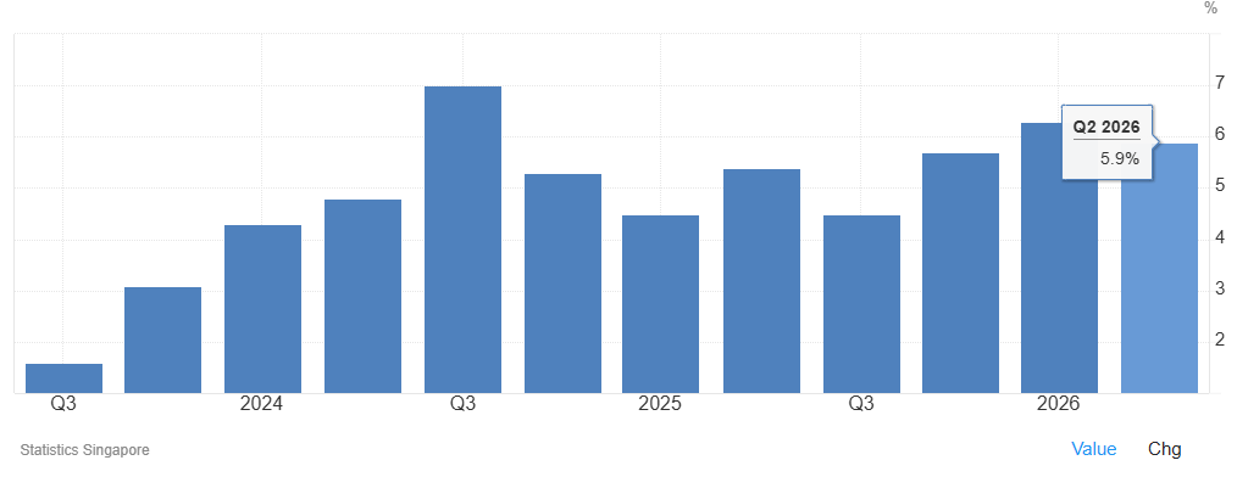
Singapore's economy has remained relatively healthy, with the Ministry of Trade and Industry forecasting GDP growth of 4.5% to 5.5% in 2026 as of August. However, MTI has also flagged the possibility of slower growth in the second half of the year.
Higher borrowing costs, coupled with slower economic growth, could put pressure on borrowers' ability to repay their loans, potentially leading to higher non-performing loans and credit costs.
We would therefore watch asset quality indicators, including non-performing loans and credit-loss allowances, for signs of deterioration.
#5 - Dividend sustainability
Dividends remain an important consideration for investors in DBS, OCBC and UOB, particularly following the strong rally in their share prices.
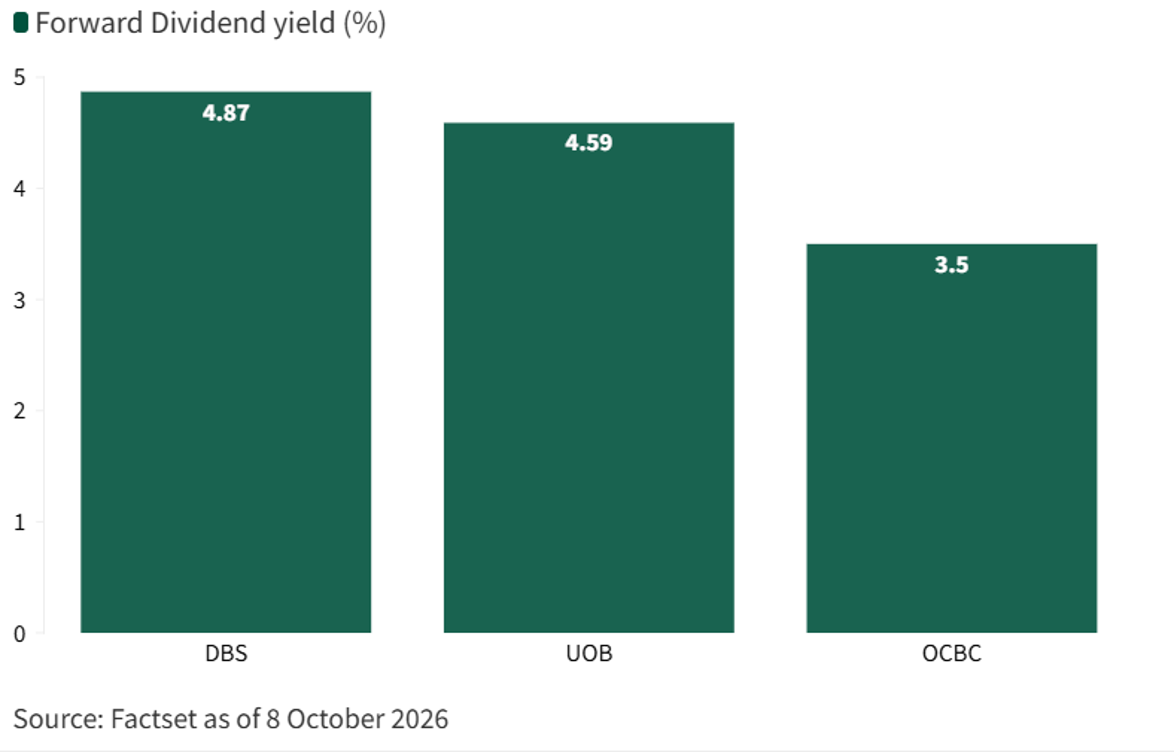
Based on FactSet estimates as of 8 October 2026, DBS offers a forward dividend yield of 4.87%, followed by UOB at 4.59% and OCBC at 3.50%.
We would focus on how these dividend yields compare with Singapore Government Securities (SGS) yields, especially following the recent rise in government bond yields.
Before the recent sell-off, OCBC's forward dividend yield premium over the 10-year SGS yield had narrowed to approximately 0.7 percentage points, close to its lowest level since 2010.
Beyond dividend yields, the banks' earnings, dividend payout ratios and capital positions will be important indicators of their ability to sustain future distributions.
What would Beansprout do?
We think the recent weakness in Singapore bank shares may partly reflect profit taking following their strong rally.
However, we would not assume that DBS, OCBC and UOB have become attractively valued simply because their share prices have fallen.
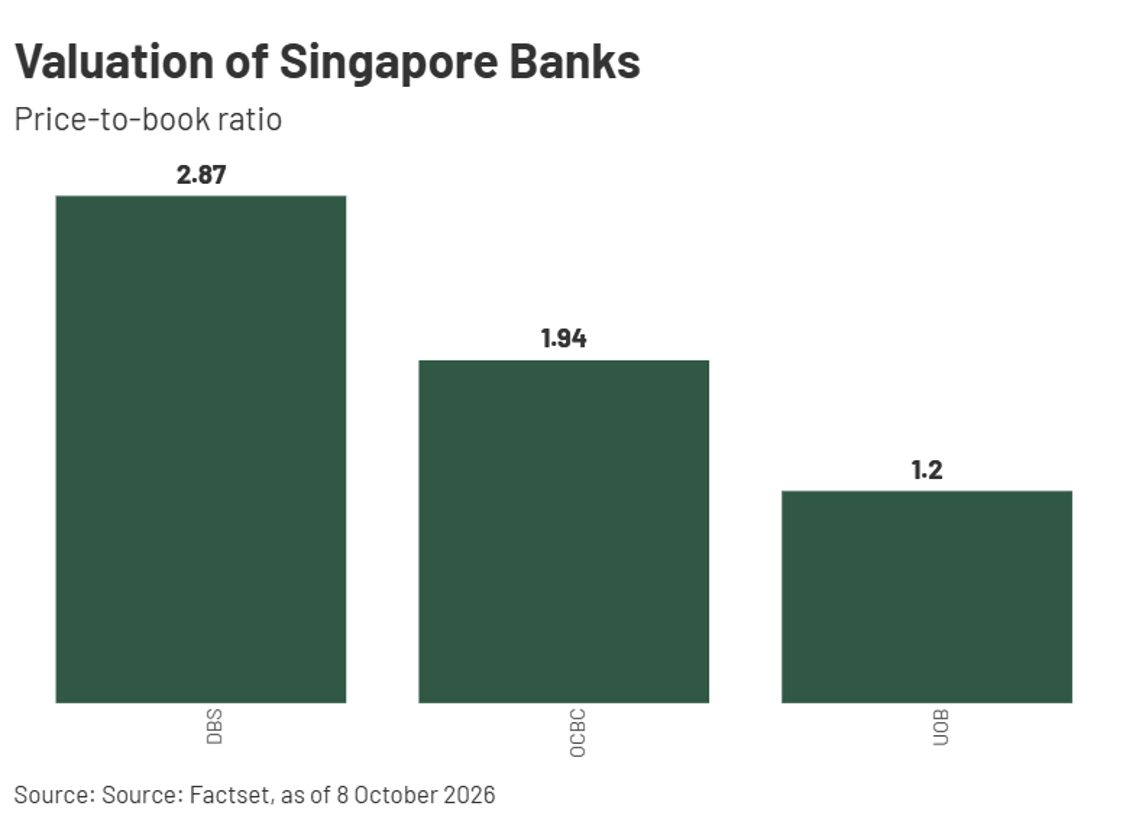
Based on FactSet data as of 8 October 2026, DBS trades at a price-to-book (P/B) ratio of 2.87x, compared with 1.94x for OCBC and 1.20x for UOB.
We believe it is important to assess these valuations against the broader economic landscape with elevated bond yields, as well as each bank's earnings outlook.
Firstly, we would continue to watch global bond yields closely, as a further rise could put pressure on bank share prices.
Next, we would evaluate whether each bank can sustain its earnings and dividends as interest-rate conditions change. We would pay particular attention to net interest margins, fee income growth and credit costs in their upcoming quarterly results.
For individual bank stocks, we would still keep them ring-fenced within the Opportunity Pot and focus on building a portfolio rather than picking stocks in isolation, sizing each position based on conviction, company-specific risks and what else we already own.
For readers who want to see how we apply this in practice, our latest Beansprout Pro Opportunity Model Portfolio update shows how we would invest S$100,000 in Singapore stocks, including how we think about position sizing and portfolio construction.
Have you been taking profit on DBS, OCBC or UOB after their strong rally, or are you looking to add during the recent pullback? Share your thoughts in the comments or our Beansprout Telegram community.
Enjoyed this insight? Follow Beansprout on Telegram, Youtube, Facebook and Instagram, and add Beansprout as your preferred source on Google so you never miss an update.
Read also
Gain financial insights in minutes
Subscribe to our free weekly newsletter for more insights to grow your wealth
Most Popular

Comments
0 comments