
3 Singapore blue chip stocks going ex-dividend in November 2026. Where yields look attractive
Stocks
By Goh Lay Peng • 16 Nov 2026
Why trust Beansprout? We’ve been awarded Best Investment Website at the SIAS Investors’ Choice Awards 2025

Make Beansprout your preferred source on Google
Add us on Google to see more of our insights in your search results
We look at 3 Singapore blue chip stocks that have announced dividends following their latest results, and examine their earnings, dividend yields and whether their payouts appear sustainable.
What happened?
Singapore blue chips have been reporting their latest earnings amid market volatility.
Following the recent global stock market sell-off, I have been taking a closer look at Singapore blue chip stocks for potential dividend income.
The Straits Times Index (STI) fell 5.3% in October, with several blue chip stocks recording even sharper declines.
We recently examined whether DBS, OCBC and UOB still look attractive for income investors following their latest quarterly results and share price pullbacks.
With more companies announcing their latest earnings and dividends, ST Engineering, Singapore Airlines (SIA) and Singtel have caught my attention, as all three have upcoming ex-dividend dates in November 2026.
In this article, I examine their latest financial results, dividend yields and valuations to assess whether they offer attractive opportunities for my Income Pot.
3 Singapore blue chip stocks going ex-dividend in November 2026
| Stock | Latest announced dividend | Ex-dividend date | Payment date | Forward dividend yield* |
| ST Engineering (S63) | S$0.05 | 23 Nov 2026 | 8 Dec 2026 | 2.1% |
| Singapore Airlines (C6L) | S$0.07 | 25 Nov 2026 | 11 Dec 2026 | 3.7% |
| Singtel (Z74) | S$0.09 | 30 Nov 2026 | 11 Dec 2026 | 5.2% |
| Source: Company announcements, SGX and Beansprout. Forward dividend yields are calculated using indicative consensus annual dividends per share of S$0.19 for ST Engineering,S$0.44 for SIA and approximately S$0.207 for Singtel, divided by their closing share prices on 13 November 2026. These are forecasts rather than guaranteed payouts and may include special or value realisation dividends. | ||||
#1 – ST Engineering (SGX: S63)
ST Engineering is a Singapore-based technology, defence and engineering group with businesses spanning commercial aerospace, defence and public security, and urban solutions and satellite communications.
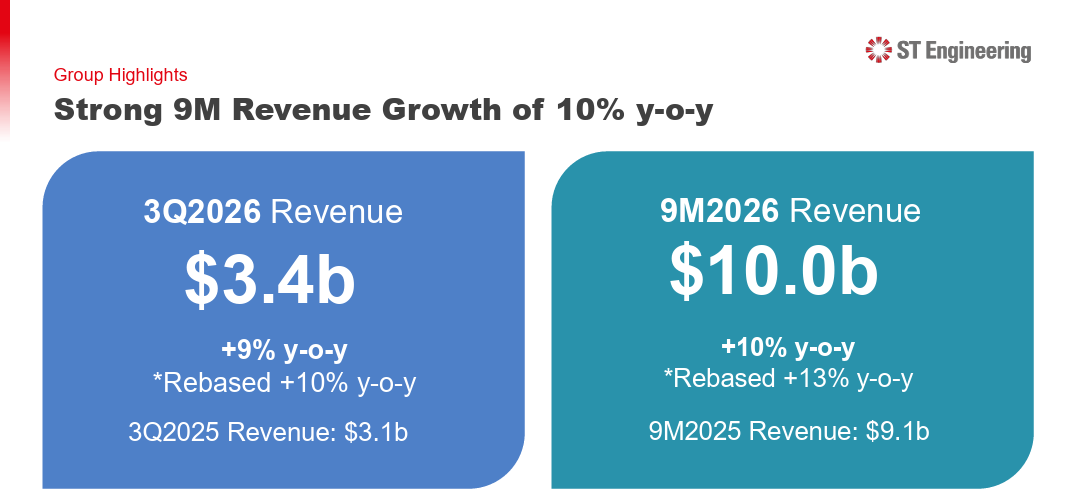
The group reported revenue of S$3.4 billion for the third quarter of 2026, an increase of 9% compared with the previous year.
For the first nine months of 2026, revenue grew 10% year on year to S$10.0 billion, supported by growth across all three business segments.
Its latest third-quarter business update did not include a quarterly net profit figure. However, ST Engineering's earlier first-half results showed that net profit increased 27% year on year to S$512 million.
This suggests that earnings growth had outpaced revenue growth in the first half of the year.
The group's largest business segment, Defence & Public Security, generated revenue of S$1.44 billion in the third quarter, an increase of 8% year on year.
Commercial Aerospace revenue rose 7% to S$1.37 billion, supported by demand for aircraft engine maintenance, repair and overhaul (MRO) services and nacelles.
However, the segment's growth moderated from 15% in the first half of 2026.
Urban Solutions & Satcom recorded stronger growth of 15% year on year, with revenue reaching approximately S$600 million.
Another positive development was ST Engineering's continued growth in new contract wins.
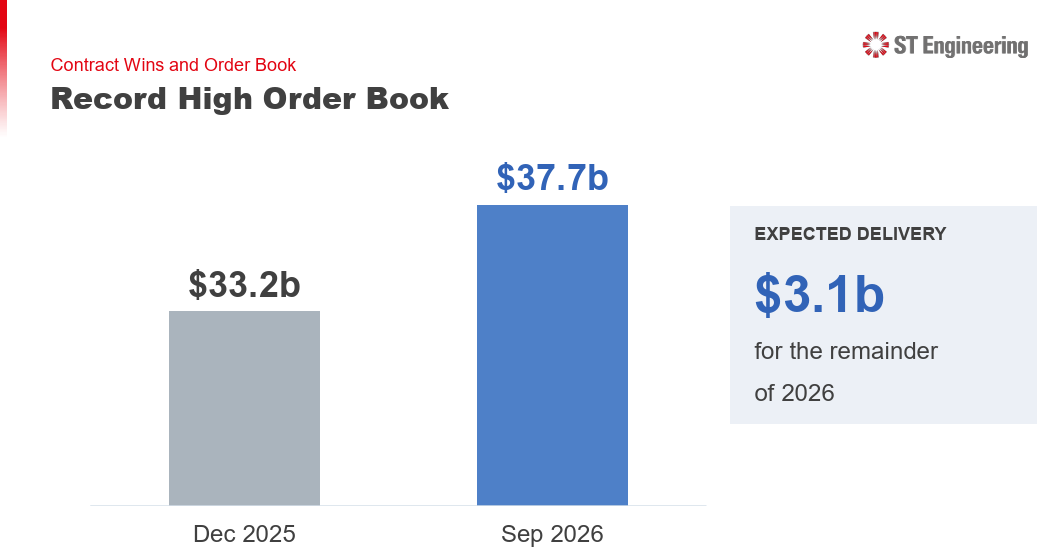
The group secured S$5.6 billion in new contracts during the third quarter, bringing total contract wins for the first nine months of 2026 to S$13.2 billion.
Its outstanding order book reached a record S$37.7 billion as of 30 September 2026, up from S$33.2 billion at the end of 2025.
This provides greater visibility over potential future revenue, although the timing of contract delivery and profitability will still matter.
The company also reported that its operating expenses as a percentage of revenue declined to 9.0% for the first nine months, reflecting improved operating efficiency.
ST Engineering declares higher quarterly dividend of 5 cents per share
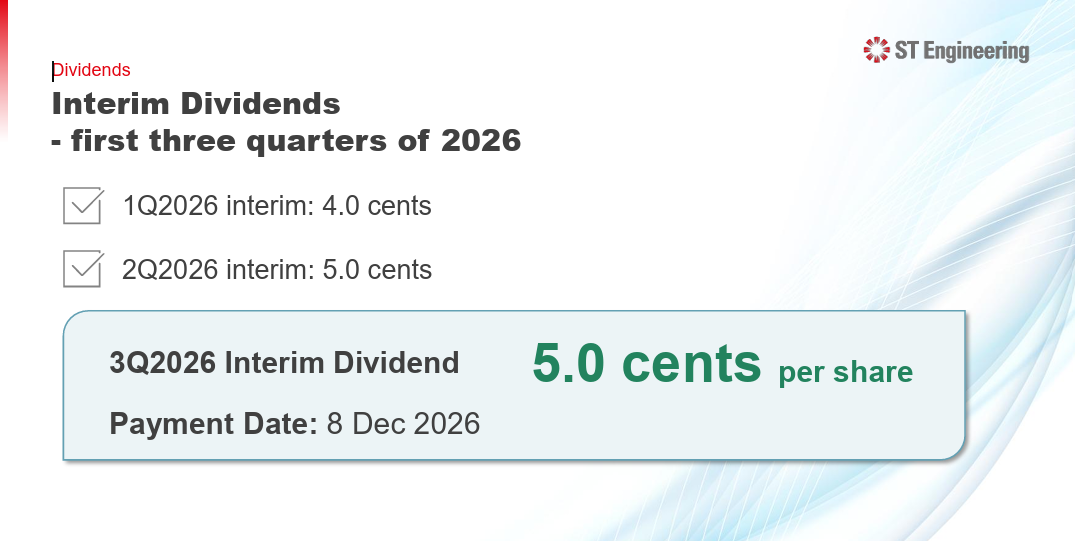
ST Engineering declared a third-quarter interim dividend of S$0.05 per share, an increase of 25% from S$0.04 in the same quarter last year.
Together with its first- and second-quarter dividends of S$0.04 and S$0.05 per share, respectively, dividends declared for the first nine months of 2026 total S$0.14 per share.
The upcoming dividend will go ex-dividend on 23 November 2026 and be paid on 8 December 2026.
ST Engineering distributed a total dividend of S$0.23 per share for FY2025, including a special dividend of S$0.05.
For FY2026, its dividend policy is based on an ordinary dividend of S$0.18 per share, plus one-third of any year-on-year increase in underlying net profit, subject to the company's policy calculations.
This means that future dividend increases will depend partly on whether ST Engineering can continue growing its earnings.
Based on its share price of S$9.67 on 13 November 2026 and consensus estimates, ST Engineering offers a forward dividend yield of approximately 2.1%.
While its dividend has room to grow alongside earnings, the current yield is less compelling for investors primarily seeking higher income.
Find out how much dividend income you would have received as a ST Engineering shareholder over the past 12 months using the dividend calculator below.
How does ST Engineering fare on our Fundamental Checklist?
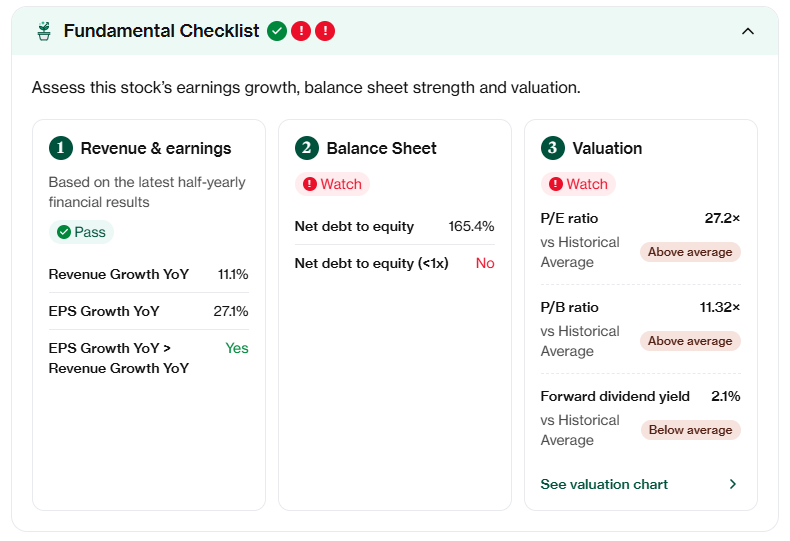
ST Engineering passes one of the three fundamental checks, supported by its revenue and earnings growth.
The group reported revenue growth of 11.1% year on year, while earnings per share (EPS) increased 27.1%, based on the latest half-yearly financial results used in our screener.
With EPS growth outpacing revenue growth, ST Engineering passes our revenue and earnings check.
However, ST Engineering is flagged on its balance sheet, with a net debt-to-equity ratio of 165.4%, above our threshold of 100%.
This suggests that the group carries relatively high leverage, which may limit its financial flexibility and warrants closer monitoring.
Its valuation is also flagged for monitoring. ST Engineering's price-to-earnings (P/E) ratio of 27.2 times and price-to-book (P/B) ratio of 11.32 times are both above their historical averages.
Meanwhile, its forward dividend yield of 2.1% is below its historical average, as of 16 November 2026.
While ST Engineering's earnings growth is encouraging, its relatively high leverage and valuation premium suggest that investors may need to be more selective about its current share price.
What to watch for ST Engineering
ST Engineering's latest results showed continued revenue growth across its business segments, while its record order book of S$37.7 billion provides visibility over future revenue.
However, I would monitor whether the group can convert its growing order book into higher earnings and cash flow, particularly given its relatively high debt levels.
I would also watch whether earnings growth can support further dividend increases under its dividend policy.
With its forward dividend yield of 2.1% below its historical average and valuation multiples above their historical averages, I would assess whether the current share price offers sufficient upside to compensate for these risks.
Related links:
- ST Engineering share price and analysis
- ST Engineering dividend history and forecast
- ST Engineering valuation
#2 – Singapore Airlines (SGX: C6L)
Singapore Airlines (SIA) is Singapore's national carrier, operating both full-service airline Singapore Airlines and low-cost carrier Scoot.
SIA reported record revenue of S$11.3 billion for the first half of FY2026/27, an increase of 16.8% compared with the previous year.
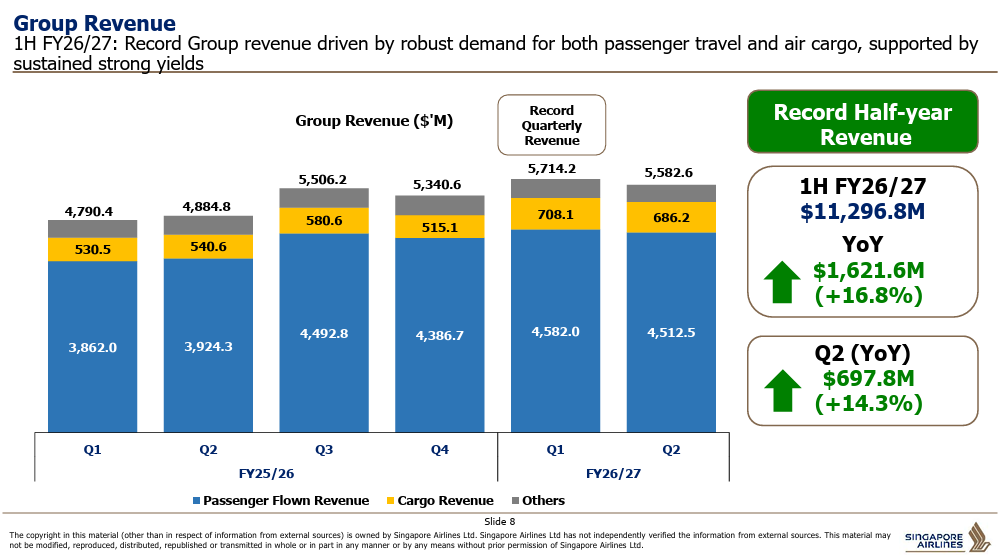
The improvement was supported by stronger passenger demand and higher passenger and cargo yields.
SIA and Scoot carried a record 21.8 million passengers during the six-month period, up 5.0% year on year.
Passenger revenue increased 16.8%, while cargo revenue rose 30.2%, supported by stronger air freight demand and higher cargo yields.
However, higher revenue did not translate into stronger half-year earnings.
SIA's net profit declined 43.9% year on year to S$134 million, compared with S$239 million in the same period last year.
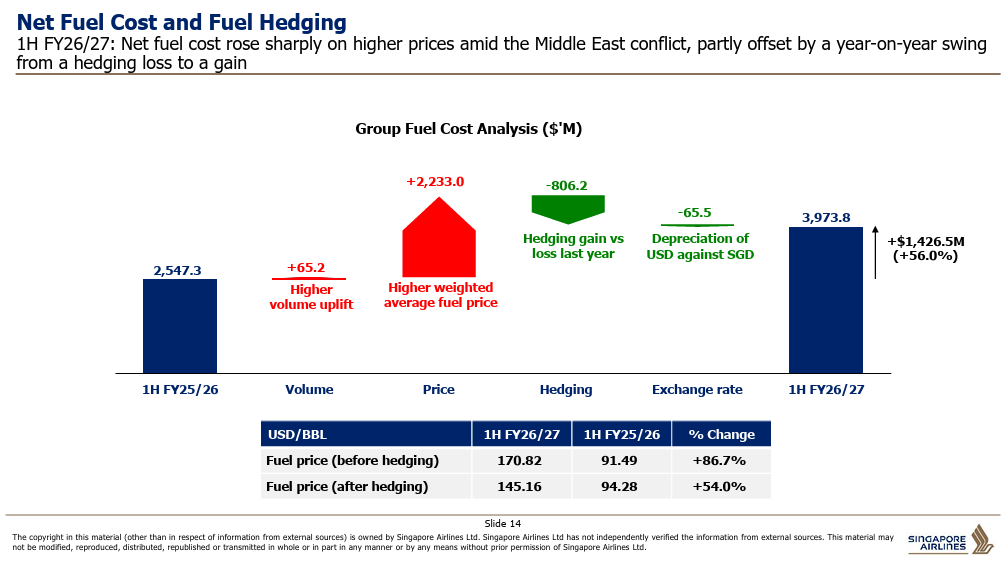
The main reason was a sharp increase in fuel costs. Net fuel costs rose 56.0% year on year to S$3.97 billion, as higher jet fuel prices more than offset the benefit from fuel hedging.
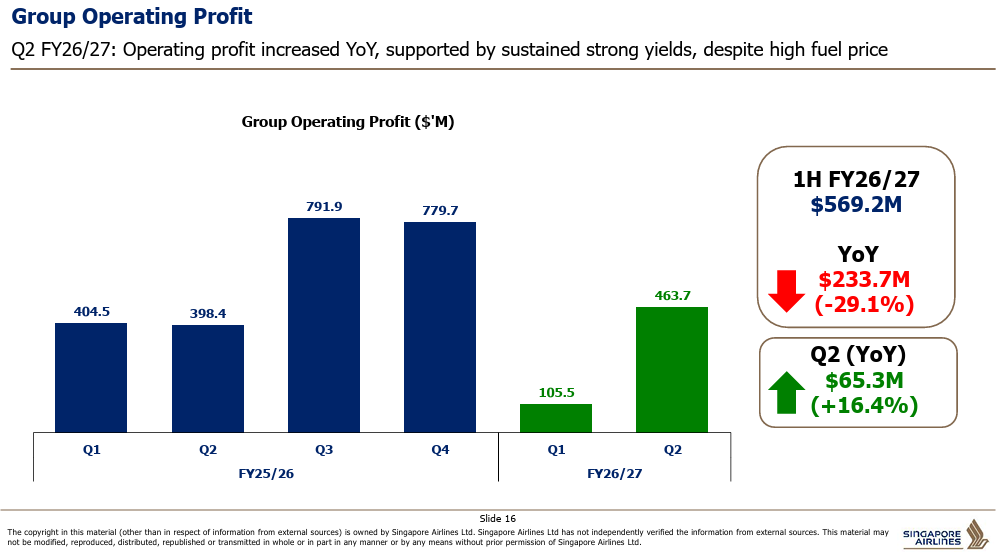
As a result, SIA's operating profit declined 29.1% to S$569 million in the first half.
There were, however, signs of improvement in the latest quarter.
For the second quarter ended 30 September 2026, SIA's operating profit increased 16.3% year on year to S$463 million.
Net profit also rose to S$210 million, compared with S$52 million in the corresponding quarter last year.
This suggests that stronger passenger and cargo yields have helped offset some of the pressure from higher fuel costs.
Nevertheless, the airline continues to face uncertainty from volatile fuel prices, geopolitical developments and higher operating expenses.
SIA declares total interim dividend of 7 cents per share
SIA declared a combined interim dividend of S$0.07 per share for the first half of FY2026/27.
This comprises:
- An ordinary interim dividend of S$0.02 per share
- A special interim dividend of S$0.05 per share
The shares will go ex-dividend on 25 November 2026, with payment expected on 11 December 2026.
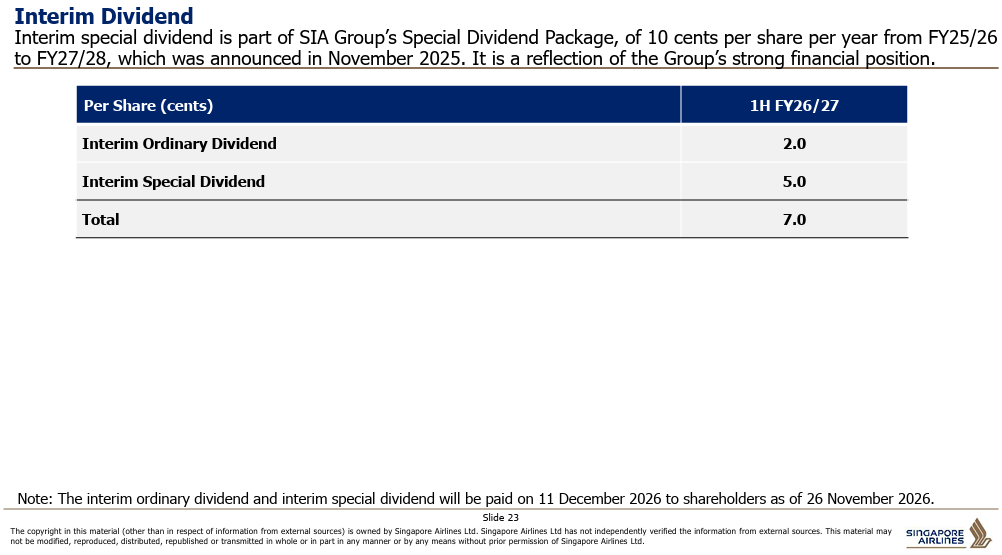
SIA previously announced plans to distribute special dividends totalling S$0.10 per share annually over three financial years, from FY2025/26 to FY2027/28.
For FY2025/26, SIA paid total dividends of S$0.37 per share, comprising ordinary dividends of S$0.27 and special dividends of S$0.10.
Based on its closing share price of S$7.16 on 13 November 2026, its FY2025/26 dividend would translate to a historical yield of approximately 5.2%.
Meanwhile, the indicative consensus forecast implies a forward dividend yield of approximately 3.7% as of 16 November 2026.
One important consideration is that SIA's dividends include special distributions, which should not be treated as a permanent part of its regular payout.
Excluding the special dividend, its FY2025/26 ordinary dividend of S$0.27 per share would translate to a historical yield of approximately 3.8% at the same share price.
I would therefore assess SIA's ordinary dividend separately from its special payouts when considering its potential to generate recurring income.
Find out how much dividend income you would have received as a SIA shareholder over the past 12 months using the dividend calculator below.
How does SIA fare on our Fundamental Checklist?
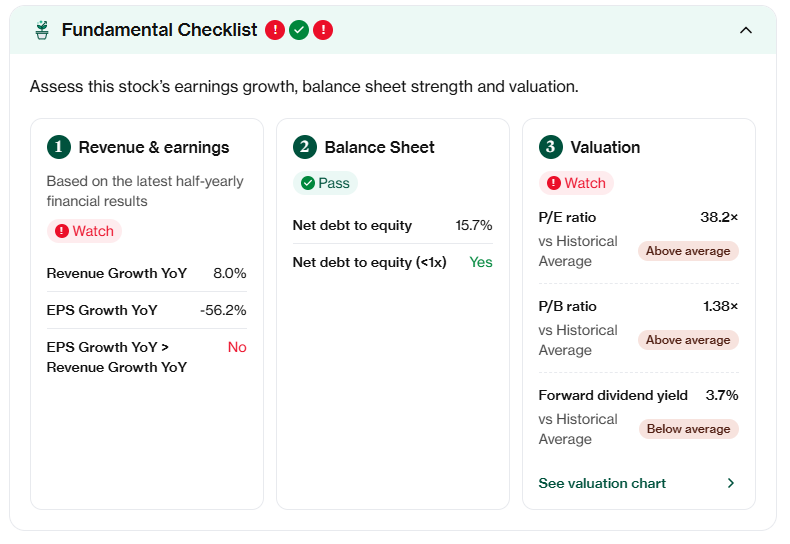
SIA passes one of the three fundamental checks, supported by its balance sheet strength.
However, it is flagged on revenue and earnings, with earnings per share (EPS) declining 56.2% despite revenue growth of 8.0%, based on the financial data used in our screener.
SIA passes the balance sheet check, with a net debt-to-equity ratio of 15.7%.
Its valuation is also flagged for monitoring. SIA's price-to-earnings (P/E) ratio of 38.2 times is above its historical average, while its price-to-book (P/B) ratio of 1.38 times is also above its historical average.
Meanwhile, its forward dividend yield of 3.7% is below its historical average.
This suggests that SIA's current valuation may be less attractive compared with its historical levels, particularly given the decline in earnings.
While SIA's balance sheet remains relatively healthy, I would monitor whether its earnings can recover and support future dividend payments.
What to watch for SIA
SIA's latest results showed record revenue and an improvement in second-quarter operating profit, supported by stronger passenger demand and cargo yields.
However, higher fuel costs continued to weigh on profitability, contributing to a decline in net profit for the first half of FY2026/27.
I would monitor whether stronger passenger and cargo yields can offset fuel costs and support a sustained recovery in earnings.
While SIA's dividend payout may appeal to income investors, I would also distinguish between its recurring ordinary dividend and special dividends, which may not be sustained over the longer term.
Related links:
#3 – Singtel (SGX: Z74)
Singtel is one of Singapore's largest telecommunications groups, with operations and investments spanning Singapore, Australia, India, Thailand and other regional markets.
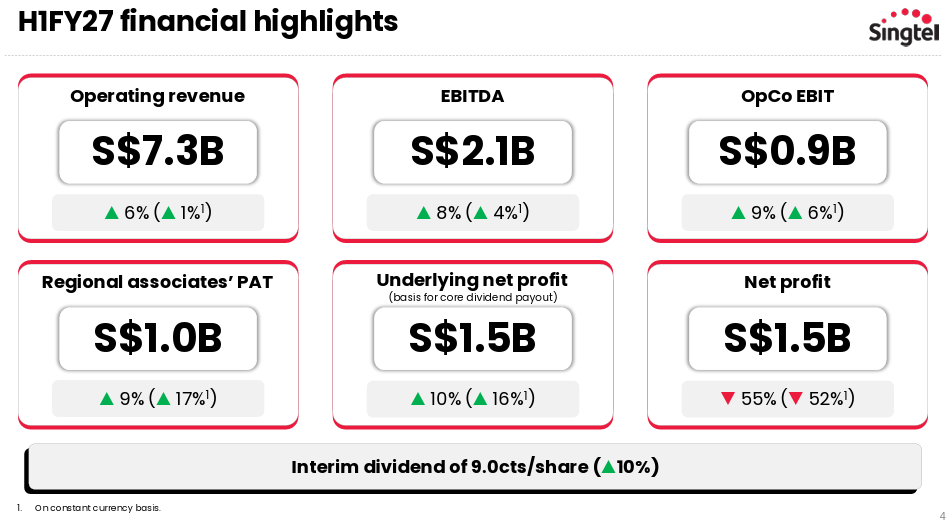
The group reported underlying net profit of S$1.49 billion for the first half of FY2026/27, an increase of 10% year on year.
This was supported by stronger contributions from its operating businesses, including Optus, NCS and Digital InfraCo, as well as higher profits from regional associates Airtel and AIS.
Operating revenue rose 6% year on year to S$7.29 billion, while earnings before interest, tax, depreciation and amortisation (EBITDA) increased 8% to S$2.15 billion.
Operating company earnings before interest and tax (OpCo EBIT) also rose 9% to S$900 million.
However, Singtel's reported net profit declined 55% year on year to S$1.54 billion.
This was largely due to the absence of S$2.21 billion in exceptional gains recorded in the previous corresponding period, including gains linked to its Airtel stake sale and the Intouch-Gulf Energy merger.
Excluding exceptional items, the 10% growth in underlying net profit provides a clearer indication of the group's operating performance.
The group also reported continued improvement across several businesses.
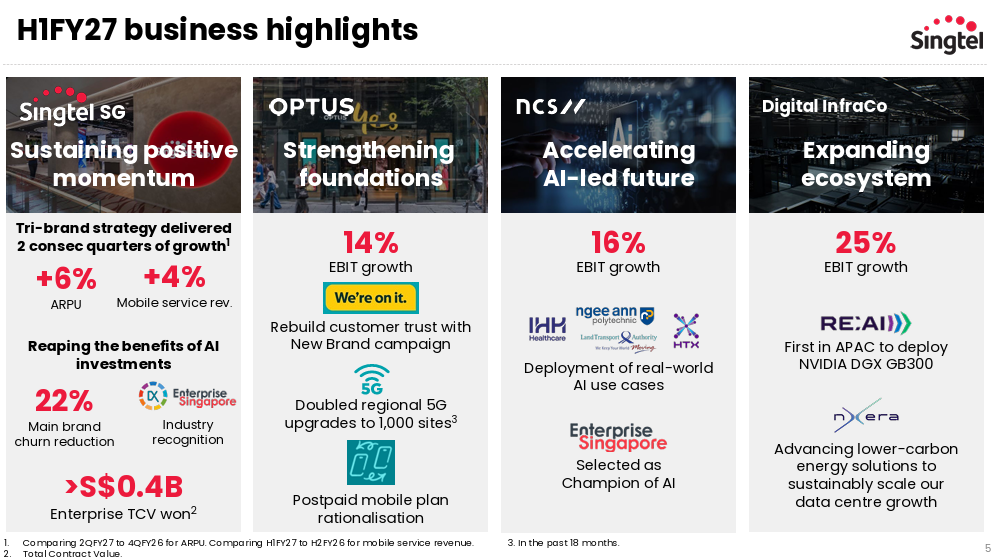
Optus benefited from stronger mobile service revenue, while Singtel Singapore recorded two consecutive quarters of mobile service revenue growth.
Its technology services arm, NCS, and digital infrastructure businesses also contributed to stronger operating earnings.
Following the improved first-half performance, Singtel raised its full-year OpCo EBIT growth guidance to between mid and high single digits, from its earlier low to mid-single-digit outlook.
This provides a more positive earnings outlook, although regional currency movements and competition remain risks.
Singtel also maintained a healthy cash balance of more than S$3 billion and reported strong free cash flow generation.
Singtel raises interim dividend by 10% to 9 cents per share
Singtel declared an interim dividend of S$0.09 per share, an increase of approximately 10% from S$0.082 in the same period last year.
The latest payout comprises:
- Core dividend of S$0.071 per share
- Value realisation dividend of S$0.019 per share
The shares will go ex-dividend on 30 November 2026, with payment expected on 11 December 2026.
The higher payout reflects Singtel's improving underlying earnings and continued focus on returning capital to shareholders.
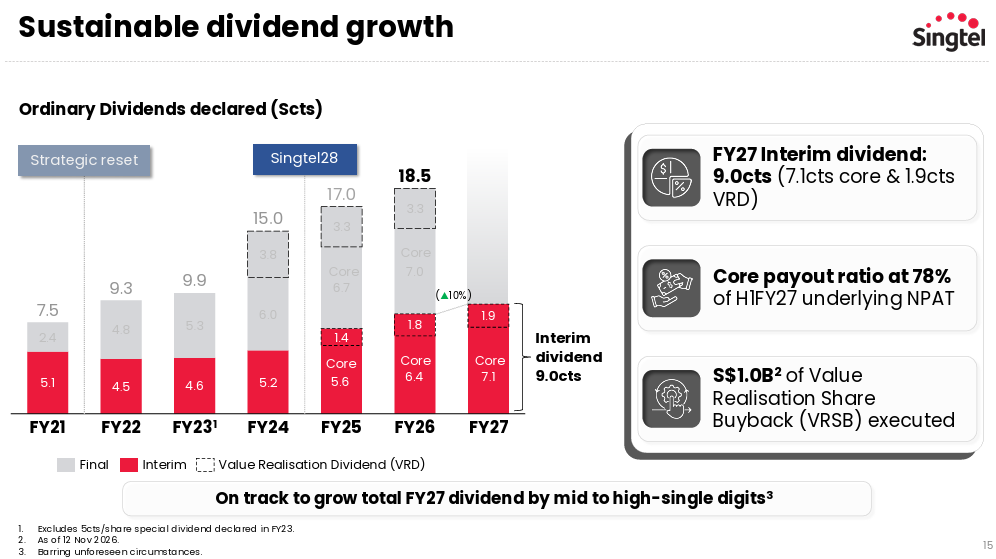
For FY2025/26, Singtel distributed total dividends of S$0.185 per share, comprising S$0.134 in core dividends and S$0.051 in value realisation dividends.
Based on its closing share price of S$4.11 on 13 November 2026, this translates to a historical dividend yield of approximately 4.5%.
Meanwhile, the indicative consensus forecast implies a forward dividend yield of around 5.2% as of 16 November 2026.
However, I would distinguish between Singtel's core dividend and its value realisation dividend.
The core dividend is supported by the group's underlying earnings, while the value realisation dividend reflects its efforts to unlock value from its investment portfolio.
Singtel has also continued its S$2 billion value realisation share buyback programme, with approximately S$1 billion of shares repurchased and cancelled since the programme began.
While these initiatives may enhance shareholder returns, I would assess the recurring core dividend separately from additional capital distributions.
Find out how much dividend income you would have received as a Singtel shareholder over the past 12 months using the dividend calculator below.
How does Singtel fare on our Fundamental Checklist?
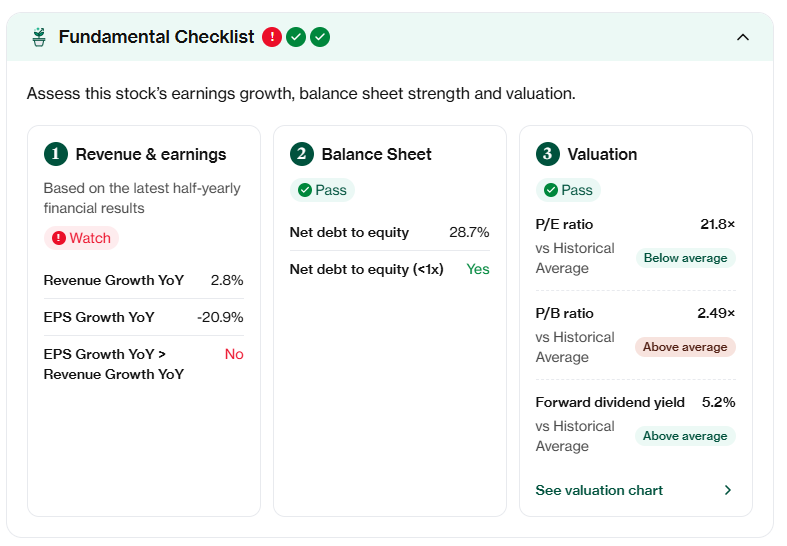
Singtel passes two of the three fundamental checks, supported by its balance sheet strength and valuation.
However, it is flagged on revenue and earnings, with earnings per share (EPS) declining 20.9% despite revenue growth of 2.8%, based on the financial data used in our screener.
Singtel passes the balance sheet check, with a net debt-to-equity ratio of 28.7%.
It also passes the valuation check. Its price-to-earnings (P/E) ratio of 21.8 times is below its historical average, while its forward dividend yield of 5.2% is above its historical average.
However, its price-to-book (P/B) ratio of 2.49 times remains above its historical average.
While Singtel's valuation appears relatively attractive based on its earnings multiple and dividend yield, the decline in EPS suggests that earnings growth remains an important area to monitor.
What to watch for Singtel
Singtel's improving underlying earnings and higher interim dividend are encouraging for income investors.
However, I would monitor whether the growth in underlying net profit can translate into sustained EPS growth, particularly as competition and regional currency movements may affect profitability.
I would also watch whether Singtel can maintain its core dividend through recurring earnings and cash flow, rather than relying on additional value realisation distributions.
While its forward dividend yield of 5.2% is above its historical average, I would assess whether the higher yield adequately compensates investors for these risks.
Related links:
- Singtel latest share price and analysis
- Singtel dividend history and forecast
- Singtel latest valuation
What would Beansprout do?
ST Engineering, SIA and Singtel have announced dividends with ex-dividend dates falling in November 2026, ahead of their payouts in December.
However, I would not assume that these stocks are attractive for dividend income simply because they have upcoming payouts.
For my Income Pot, I would focus on whether their earnings and balance sheets can support sustainable dividends, and whether their valuations offer an attractive dividend yield relative to historical levels.
Here is how the three stocks compare across these fundamental checks and forward dividend yields.
| Stock | Fundamental Checklist result | Forward dividend yield | What stands out | Key risks |
| ST Engineering | 1/3 checks | 2.1% | Strong earnings growth and record order book support potential dividend growth | High leverage, premium valuation and dividend yield below historical average |
| SIA | 1/3 checks | 3.7% | Relatively healthy balance sheet and potential for dividend income | Weak earnings growth, higher fuel costs, premium valuation and reliance on special dividends |
| Singtel | 2/3 checks | 5.2% | Improving underlying earnings, manageable leverage and dividend yield above historical average | Weak EPS growth, competition and sustainability of value realisation dividends |
| Source: Beansprout as of 16 November 2026. Forward dividend yields are estimates and are not guaranteed. | ||||
Singtel stands out to me for its combination of dividend yield and improving underlying earnings. Singtel’s forward dividend yield of around 5.2% is supported by a 10% increase in underlying net profit and a higher core dividend. However, I would assess the core payout separately from its value realisation dividend.
For SIA, I would focus on whether its earnings can recover from higher fuel costs and support recurring dividend payments, particularly as special dividends contribute to its overall payout.
For ST Engineering, its strong earnings growth and record order book are encouraging. However, its relatively high leverage and forward dividend yield below historical levels suggest that I would be more cautious about its current valuation.
I would therefore use the upcoming ex-dividend dates as a starting point for researching these stocks, rather than buying them simply to receive the next dividend.
After all, a dividend payment does not represent a guaranteed gain, as a stock's share price may adjust when it trades ex-dividend.
For my Income Pot, I would prioritise companies that can maintain or grow their recurring dividends, rather than simply choosing the highest yield.
I would also use Beansprout's three checks for dividend stocks to assess earnings growth, financial strength and whether the dividend yield is attractive relative to the risks, including compared with Singapore government bonds.
These checks help me identify stocks worth researching further, rather than serving as standalone buy decisions.
To explore more Singapore dividend stocks, you can use our Income Stock Screener to identify companies based on their fundamental strength, financial health and valuation.
For a closer look at how we would build a Singapore stock portfolio, see how we would invest S$100,000 in Singapore stocks today.
You can also explore Beansprout Pro for our latest market views, portfolio thinking and the reasoning behind our investment decisions.
Find out other Singapore stocks, REITs and ETFs with upcoming dividend payments here.
Which of these blue chips are you watching for your income pot? Share your thoughts in the comments below or join the discussion in our Telegram group!
Planning to invest in Singapore stocks? Compare the best Singapore brokers to find the right trading platform, and see the latest promotions and sign-up rewards available.
Follow Beansprout on YouTube, Facebook and Instagram, and add Beansprout as your preferred source on Google so you never miss an update.
Read also
Gain financial insights in minutes
Subscribe to our free weekly newsletter for more insights to grow your wealth
Most Popular

Comments
0 comments