
DBS vs OCBC vs UOB: Which Singapore bank stands out for income after the pullback and 3Q 2026 results
Stocks
By Ng Hui Min • 11 Nov 2026
Why trust Beansprout? We’ve been awarded Best Investment Website at the SIAS Investors’ Choice Awards 2025

Make Beansprout your preferred source on Google
Add us on Google to see more of our insights in your search results
DBS, OCBC and UOB have pulled back after their 3Q 2026 results. We compare their earnings, margins, dividends and valuations to see which Singapore bank stands out.
What happened?
Singapore bank shares have pulled back from recent highs.
Last month, we looked at why DBS, OCBC and UOB share prices had fallen as higher bond yields prompted investors to reassess bank valuations and potential risks to their securities portfolios.
We also examined whether Singapore bank stocks still looked attractive after the correction, after their strong run earlier in the year.
The banks had previously featured among the best-performing Singapore blue chips, but their latest 3Q26 results have given investors more information to assess whether the fundamentals still justify their valuations.
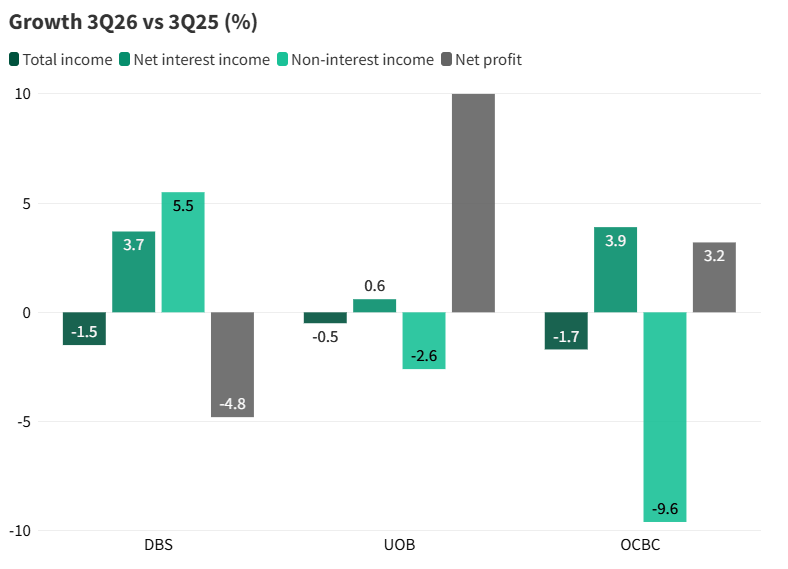
Among the three banks, OCBC was the only one to meet expectations in 3Q26, with net profit rising 3% year-on-year to S$2.04 billion.
DBS reported a 5% year-on-year decline in 3Q26 net profit, while UOB's 3Q26 profit also came in below expectations.
During their earnings briefings, management at all three banks highlighted continued growth in loans and wealth management, but also discussed the impact of higher funding costs, volatile markets and competition for deposits.
This raises the question of which bank now offers the better combination of earnings growth, sustainable dividends and valuation following the recent pullback.
In this article, I compare the three Singapore banks across their 3Q26 results and Beansprout's Fundamental Checklist.
#1 - OCBC delivered the most consistent 3Q26 earnings
OCBC was the only bank to meet earnings expectations in 3Q26, with group net profit rising 3% year-on-year to S$2.04 billion.
Its Banking Operations delivered record net profit of S$1.90 billion, up 16% year-on-year, although weaker investment performance at Great Eastern Holdings (GEH) weighed on group earnings.
During its earnings briefing, management explained that GEH recorded mark-to-market losses on its bond portfolio as interest rates rose, while the equity gains recorded in 2Q26 did not recur.
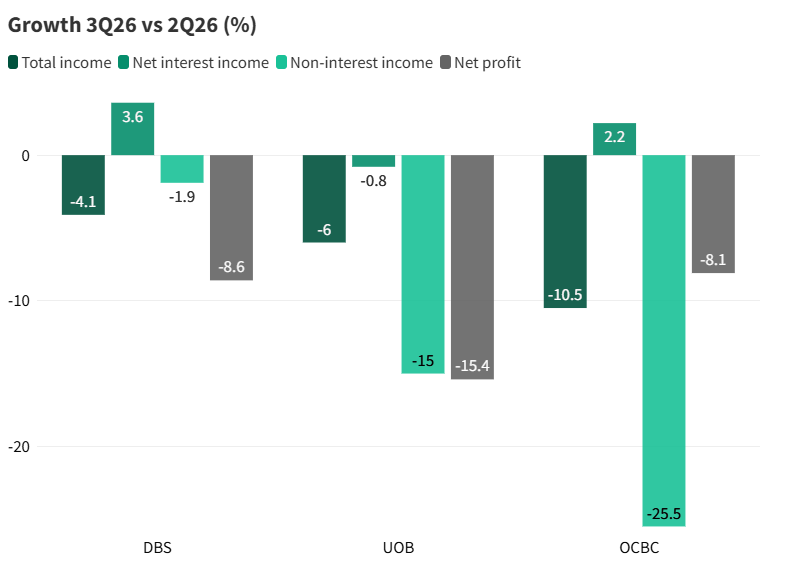
DBS reported net profit of S$2.81 billion, down 5% year-on-year, largely because markets trading income declined 65% to S$152 million.
UOB's net profit rose 182% year-on-year to S$1.25 billion, although this was partly due to significant credit provisions in the previous year; profit fell 15% compared with 2Q26.
Despite the mixed quarterly results, all three banks reported higher net profit for the first nine months of 2026, with DBS continuing to generate the highest return on equity (ROE).
#2 - DBS had the most resilient net interest margin
Net interest margin (NIM) remains an important indicator of how much the banks earn from lending after accounting for their funding costs.
DBS's NIM remained stable at 1.87% in 3Q26, supported by balance sheet growth and hedging activities.
During its 3Q26 analyst briefing, management highlighted its competitive deposit strategy, which helped attract additional customer relationships.
OCBC's NIM declined by 4 basis points quarter-on-quarter to 1.66%, as higher US dollar funding costs offset the benefit of rising Singapore dollar rates.
Management expects some of the benefits from higher interest rates to materialise as assets gradually reprice.
UOB faced the greatest margin pressure, with NIM falling 6 basis points to 1.68%, prompting management to lower its FY2026 NIM guidance to below 1.75%.
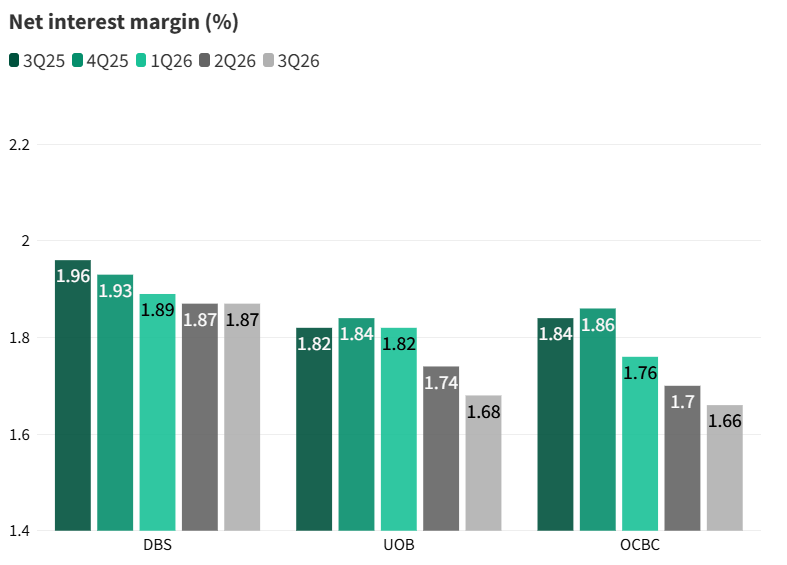
Overall, DBS has demonstrated the most resilient margins, while OCBC expects some improvement as assets reprice and UOB remains under pressure from higher funding costs.
#3 - Loan growth remained strong across DBS, OCBC and UOB
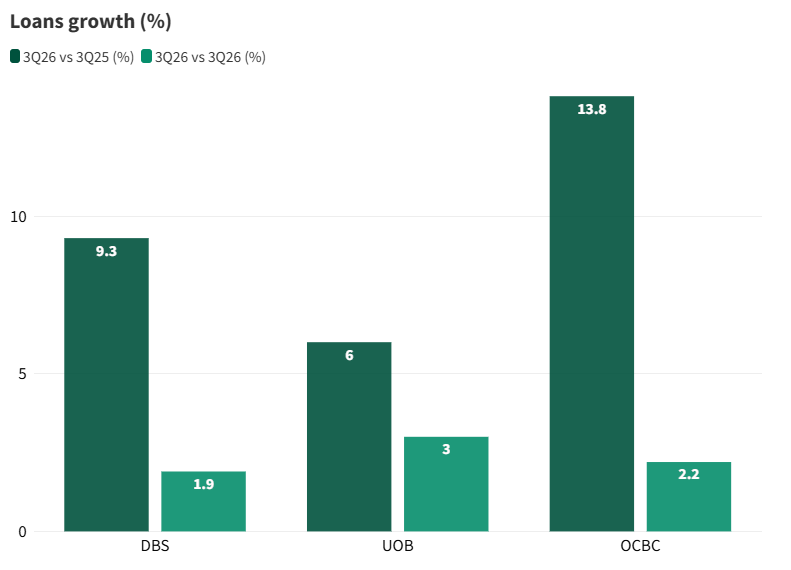
Loan growth continued to support earnings across DBS, OCBC and UOB in 3Q26.
OCBC led the group, with customer loans rising approximately 14% year-on-year to S$372 billion, supported by demand from digital infrastructure, energy, renewable energy and wealth financing.
DBS reported loan growth of 9.3% year-on-year, driven by corporate and wealth-related lending.
During its earnings briefing, DBS management also highlighted new transaction banking mandates, which could generate recurring income from cash management and cross-border payments.
UOB's loans grew 6% year-on-year, supported by wholesale lending, trade financing and mortgages.
UOB management highlighted that trade loans grew 31%, with opportunities to generate additional income from foreign exchange and cash management services.
All three banks are also financing growth areas such as digital infrastructure and AI, although management emphasised the importance of disciplined lending.
OCBC disclosed that data centre financing accounted for less than 3% of its loan book and AI-related financing less than 1%, while UOB reported AI-related financing exposure of less than 5%.
#4 - Wealth management remains a key growth driver for DBS, OCBC and UOB
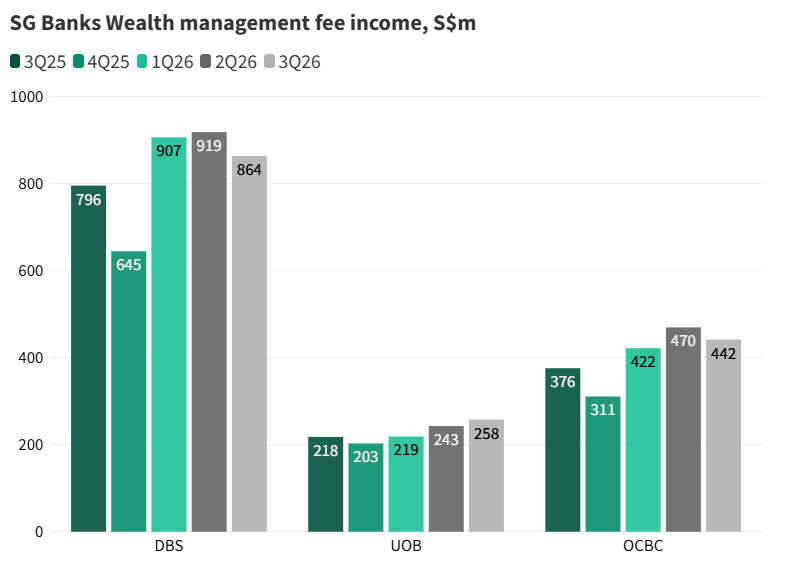
With net interest margins under pressure, wealth management has become an increasingly important source of income for Singapore banks.
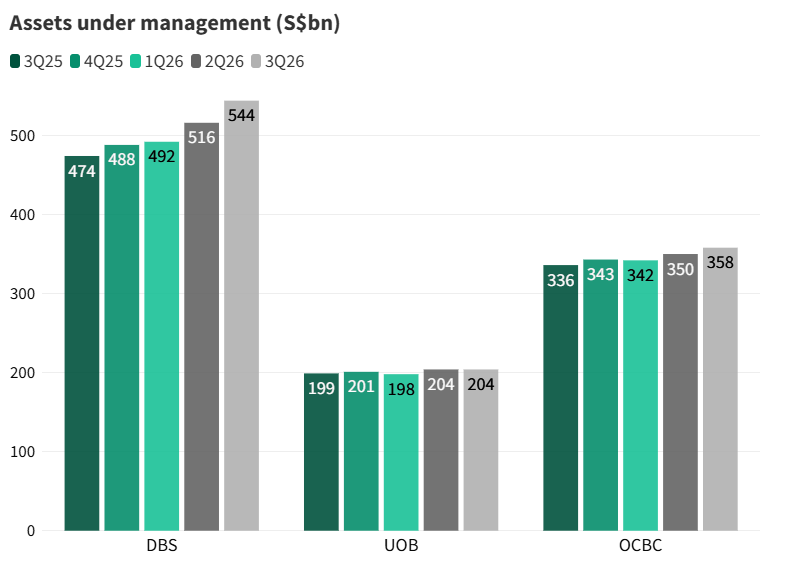
DBS's wealth assets under management (AUM) reached S$544 billion in 3Q26, from S$516 billion in the previous quarter.
During its earnings briefing, DBS management highlighted continued growth in discretionary portfolio management, which could support more recurring fee income over time.
OCBC's banking wealth management AUM rose to S$358 billion, while customer flow trading income increased 29% year-on-year to a record S$480 million as some customers shifted towards more defensive investment products.
UOB's wealth AUM reached S$204 billion, with wealth management fees hitting a record S$258 million in 3Q26.
UOB management reiterated its ambition to double wealth income by 2030, supported by continued investment in relationship managers, advisory capabilities and its regional wealth franchise.
DBS continues to have the largest wealth management franchise, while OCBC is benefiting from stronger customer activity and UOB is investing to expand its business.
However, the ability to grow wealth income sustainably will depend on market conditions, customer activity and whether additional investment spending generates sufficient returns.
#5 - Asset quality improved across the Singapore banks
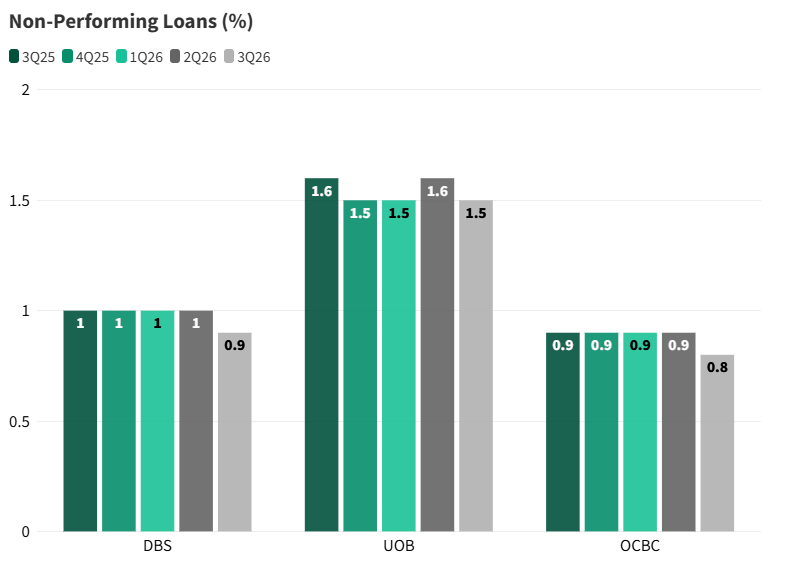
Asset quality improved across all three banks in 3Q26, with non-performing loan (NPL) ratios declining.
OCBC continued to have the lowest NPL ratio at 0.8%, down from 0.9% in the previous quarter, supported partly by recoveries in some Greater China real estate accounts.
DBS's NPL ratio improved to 0.9%, from 1.0% in 2Q26.
UOB's NPL ratio improved to 1.5%, from 1.6%, although management acknowledged that recovery in its Greater China real estate exposures was taking longer than expected.
UOB has been reducing its exposure to property-related lending while expanding into sectors such as digital infrastructure and energy.
Its management also highlighted that the US NPL ratio had improved from around 4% a year earlier to below 2%, while Greater China recoveries remained slower.
The improvement in asset quality provides some comfort, but investors would still need to monitor credit costs and potential losses if economic conditions deteriorate.
DBS offers the highest forward dividend yield
Dividend income remains an important consideration for investors in Singapore bank shares.
DBS declared a total quarterly dividend of S$0.81 per share, comprising an ordinary dividend of S$0.66 and a capital return dividend of S$0.15.
Management reaffirmed that the S$0.15 quarterly capital return dividend will continue through FY2027.
DBS also has approximately S$2.6 billion remaining under its share-buyback programme, although management has not committed to extending its capital return dividend beyond 2027.
UOB and OCBC did not declare dividends with their 3Q26 results, in line with their half-yearly dividend schedules.
OCBC reaffirmed its 50% ordinary dividend payout policy and expects to complete its existing S$2.5 billion capital return plan by FY2026, without announcing an extension into 2027.
| Dividends | DBS | UOB | OCBC |
| 3Q26 dividend declared | S$0.81, including S$0.15 capital return | None, half-yearly schedule | None, half-yearly schedule |
| Indicative annual DPS | S$3.24 | S$1.76 | S$0.99, including expected S$0.18 special dividend |
| Forward dividend yield | ~4.6% | ~4.3% | ~3.5% |
| Capital returns | S$0.15 quarterly capital return through FY2027; remaining buyback capacity | Ongoing share-buyback programme | Existing S$2.5 billion capital return plan expected to complete in FY2026 |
DBS therefore provides the clearest visibility on near-term dividend payments, while OCBC's future capital returns beyond the existing plan remain less certain.
You can also find the dividend history and forecasts for DBS, OCBC and UOB on Beansprout.
Related links:
- DBS dividend history and dividend forecast
- OCBC dividend history and dividend forecast
- UOB dividend history and dividend forecast
What are DBS, OCBC and UOB expecting next?
Management guidance also provides useful clues about the banks' earnings prospects beyond 3Q26.
DBS expects net interest income to grow by just under 5% in 2027, supported by balance sheet expansion and higher Singapore dollar rates, although wealth-related fee income may remain sensitive to market conditions.
OCBC upgraded its FY2026 guidance, expecting low double-digit loan growth, total income growth of at least mid-single digits and credit costs of 15 to 20 basis points.
However, OCBC has not provided FY2027 guidance and expects to share its outlook with the full-year results.
UOB expects mid-single-digit loan growth and higher net interest income in FY2027, supported by further lending growth and investment in wealth management.
At the same time, UOB expects operating expenses to increase at a mid-to-high single-digit rate as it invests in technology and regional expansion.
| Management outlook | DBS | OCBC | UOB |
| Net interest income | Just under 5% growth expected in 2027 | Flat to slight decline expected for FY2026 | Higher in FY2027 than FY2026 |
| Loan growth | Continued balance sheet expansion | Low double-digit FY2026 growth | Mid-single-digit FY2027 growth |
| Main uncertainty | Markets trading and fee income | Funding costs and GEH investment performance | Margin pressure and higher operating expenses |
The key question is whether the banks can turn their growth plans into sustainable earnings improvements without taking on excessive credit risk or increasing costs too quickly.
How DBS, OCBC and UOB fare under Beansprout's Fundamental Checklist
To assess whether the three Singapore banks are worth considering after their recent share-price pullback, we look at three factors: earnings, balance sheet strength and valuation.
While all three banks remain fundamentally strong, their earnings outlook and valuations differ following the latest results.
Fundamental Checklist for DBS
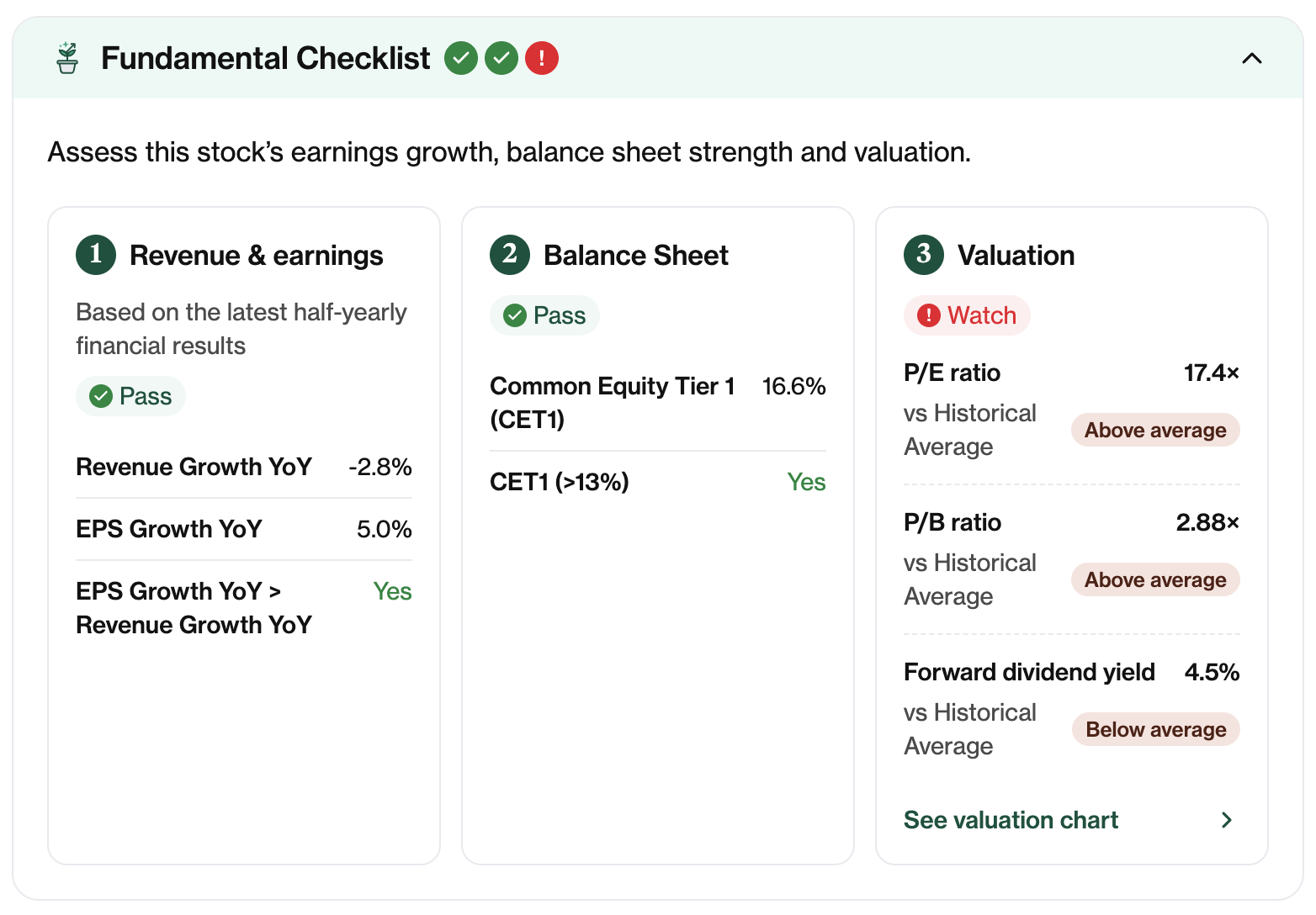
DBS passes our earnings and balance sheet checks, with earnings per share (EPS) growing 5.0% despite a 2.8% decline in revenue, while its CET1 ratio of 16.6% indicates a strong capital position.
However, valuation remains a concern, with its P/E ratio of 17.4x and P/B ratio of 2.88x above historical averages, while its forward dividend yield of 4.5% is below average.
Fundamental Checklist for OCBC
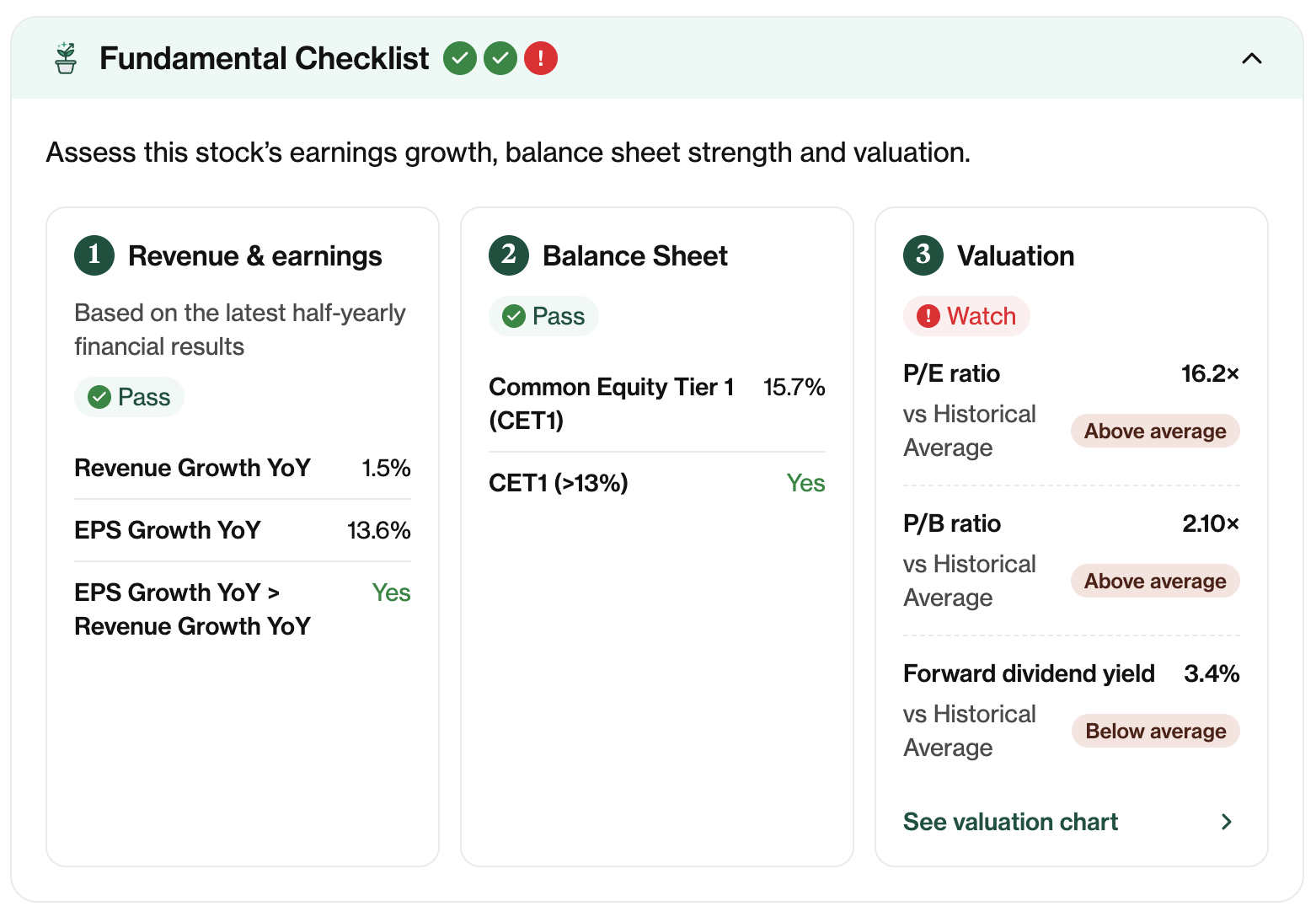
OCBC passes our earnings and balance sheet checks, with revenue growing 15% and earnings per share (EPS) increasing 13.6% year-on-year, while its CET1 ratio of 15.7% indicates a strong capital position.
However, valuation remains a concern, with its P/E ratio of 16.2x and P/B ratio of 2.10x above historical averages, while its forward dividend yield of 3.4% is below average.
Fundamental Checklist for UOB
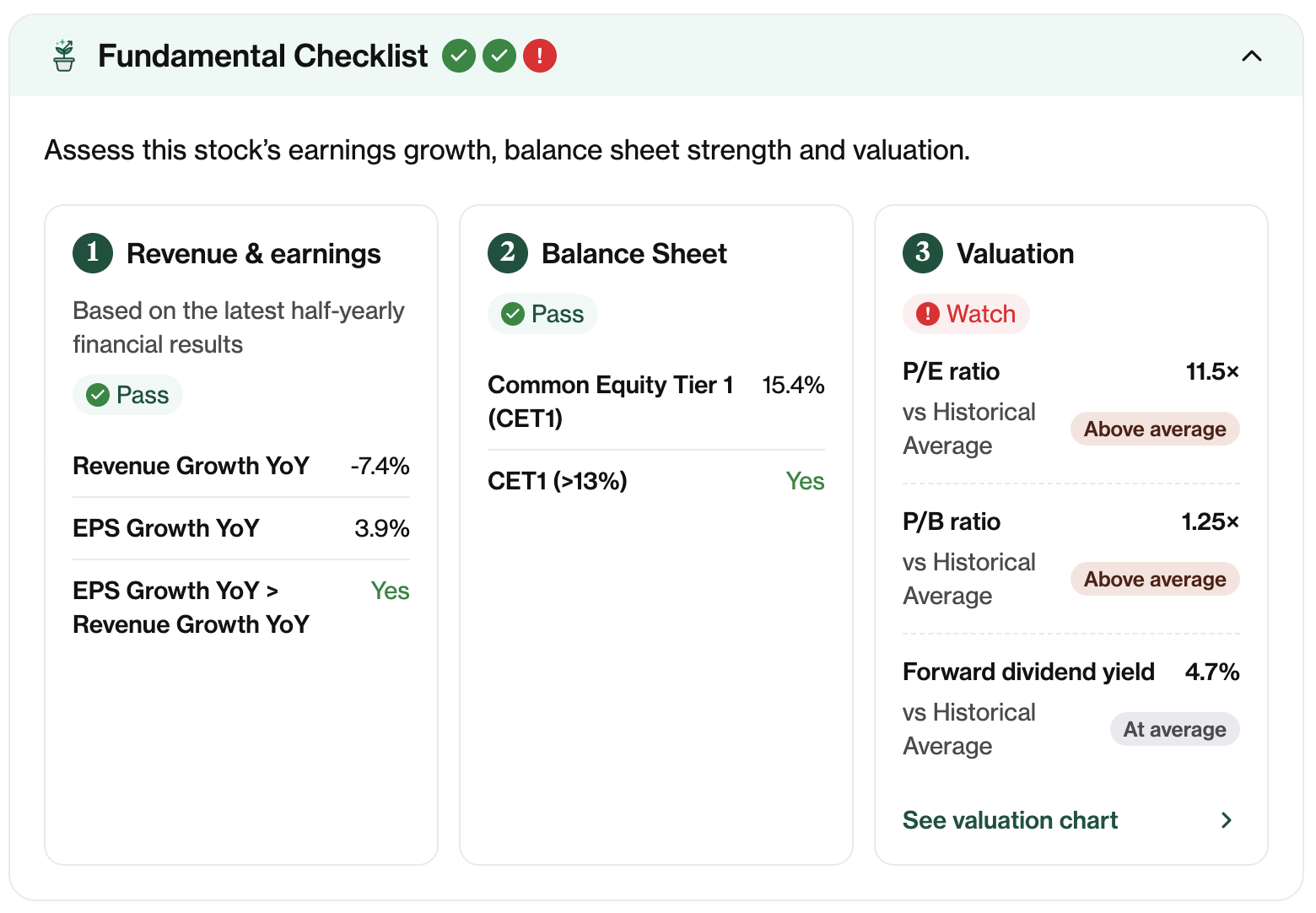
UOB passes our earnings and balance sheet checks, with earnings per share (EPS) growing 3.9% despite a 7.4% decline in revenue, while its CET1 ratio of 15.4% indicates a strong capital position.
However, valuation remains a concern, with its P/E ratio of 11.5x and P/B ratio of 1.25x above historical averages, while its forward dividend yield of 4.7% is in line with its historical average.
Related links:
- DBS current P/E and P/B valuation
- OCBC current P/E and P/B valuation
- UOB current P/E and P/B valuation
What are the key risks for Singapore bank investors?
Despite the generally healthy results, several risks could affect future earnings and dividends.
First, higher funding costs could continue to pressure net interest margins, particularly if competition for deposits remains intense.
Second, trading and investment income may remain volatile as bond yields and equity markets fluctuate, as seen in DBS's markets trading income and GEH's investment performance.
Third, credit quality could weaken if economic conditions deteriorate, particularly in areas where Greater China real estate exposures have yet to fully recover.
Finally, valuations remain important, as strong earnings and dividends do not necessarily translate into attractive investment returns if too much future growth is already reflected in share prices.
What would Beansprout do?
The recent pullback in DBS, OCBC and UOB shares makes them worth revisiting, but I would focus more on their earnings, balance sheet strength and valuations than how far their share prices have fallen.
OCBC delivered the strongest earnings performance, with management upgrading its FY2026 guidance, although its valuation of 2.03 times price-to-book remains well above its historical average of 1.18 times.
For investors seeking dividend income, DBS stands out with the highest indicative forward dividend yield of about 4.6% and management's commitment to maintaining its S$0.15 quarterly capital return dividend through 2027.
DBS also has S$2.6 billion remaining under its share-buyback programme, although future ordinary dividend growth will depend on earnings growth and the timing of additional capital returns remains uncertain.
UOB offers an indicative forward dividend yield of about 4.3%, with management expecting stronger net interest income in 2027 through loan growth and further investment in wealth management.
However, I would want to see clearer evidence that UOB's margins are stabilising and that its investments can translate into higher ROE, particularly as Greater China real estate exposures are recovering more slowly than expected.
Within Beansprout's four pots of wealth, I would consider the banks for our Income Pot, while remaining selective about valuations before considering them for the Opportunity Pot and avoiding excessive concentration in one sector.
Overall, DBS remains my preference for dividend income, OCBC has the strongest earnings momentum but a more demanding valuation, while I would wait for clearer signs of margin stabilisation and improving returns at UOB.
To find out which Singapore banks we would hold in a portfolio, you can also see how we would invest S$100,000 in Singapore stocks today.
If you are looking for greater clarity on the markets and the investment decisions that matter, explore Beansprout Pro for our latest views, portfolio thinking and the reasoning behind each opportunity.
Want to see how the three banks, DBS, OCBC and UOB stack up against each other on valuation, dividend yield and returns? Compare DBS, OCBC and UOB across valuation, dividend yield, profitability and other key financial metrics here.
Related links:
- OCBC reports 3% rise in 3Q26 net profit and upgrades 2026 guidance: Our Quick Take
- DBS profit falls 5% in 3Q26 on lower trading income and declares S$0.81 in total dividends: Our Quick Take
- UOB 3Q26 profit below forecasts as net interest margin declines further: Our Quick Take
If you are considering investing in Singapore bank shares, compare the best Singapore brokerage accounts to find a platform that fits your needs.
Which of the three Singapore banks do you prefer at current levels? Share your thoughts with us in the Beansprout Telegram community.
Enjoyed this insight? Follow Beansprout on Telegram, Youtube, Facebook and Instagram, and add Beansprout as your preferred source on Google so you never miss an update.
Read also
Gain financial insights in minutes
Subscribe to our free weekly newsletter for more insights to grow your wealth
Most Popular

Comments
0 comments