
3 Singapore blue chip stocks near 52-week lows. Which warrant a closer look
Stocks
By Goh Lay Peng • 18 Nov 2026
Why trust Beansprout? We’ve been awarded Best Investment Website at the SIAS Investors’ Choice Awards

Make Beansprout your preferred source on Google
Add us on Google to see more of our insights in your search results
We examine CapitaLand Investment, ComfortDelGro and Sheng Siong, three Singapore blue chip stocks near their 52-week lows, to assess their earnings, balance sheets and valuations.

What happened?
Several Singapore blue chips remain near their 52-week lows.
After examining October’s worst-performing Singapore blue chips, I have been looking more closely at whether recent declines offer opportunities or signal weaker fundamentals.
We recently compared DBS, OCBC and UOB following their pullback and third-quarter results, and examined three Singapore blue chips going ex-dividend in November for potential income.
Beyond these names, CapitaLand Investment, ComfortDelGro and Sheng Siong have also released their latest financial results and business updates, with all three stocks trading near their 52-week lows.
However, lower prices alone do not make a stock attractive, making it important to assess financial performance alongside valuation.
With this in mind, we examine these three blue chips' latest developments to assess whether their financial performance points to potential investment opportunities worth researching further.
3 Singapore blue chip stocks near their 52-week lows
Based on closing prices on 17 November 2026, all three stocks were trading within 2% of their 52-week lows.
Stock | Share price | 52-week low | Above 52-week low | Approximate 1-year price return |
|---|---|---|---|---|
| CapitaLand Investment (9CI) | S$2.33 | S$2.29 | 1.7% | -12.3% |
| ComfortDelGro (C52) | S$1.24 | S$1.24 | 0.0% | -15.0% |
| Sheng Siong (OV8) | S$2.29 | S$2.26 | 1.3% | -15.1% |
| Source: Beansprout 52-week low stock screener and company quote pages as of 17 November 2026. One-year price returns exclude dividends. | ||||
#1 - CapitaLand Investment: Fee-related revenue continues to grow
CapitaLand Investment is a global real asset manager with businesses spanning fund management, commercial property management and lodging.
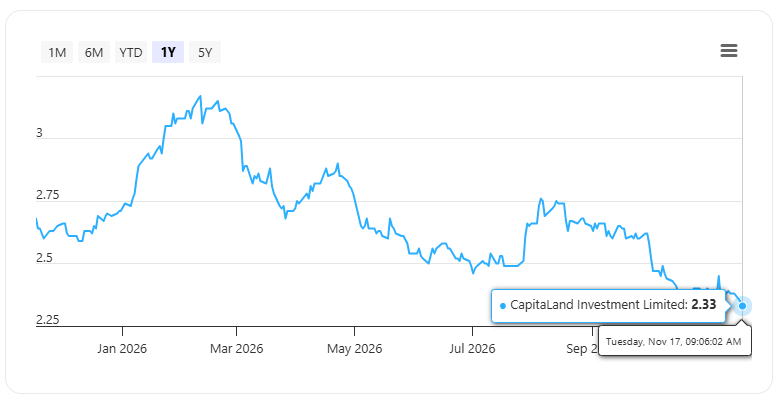
CapitaLand Investment’s share price closed at S$2.33 on 17 November 2026, down approximately 12.3% over the past year and 1.7% above its 52-week low of S$2.29.
Its latest business update showed continued growth in its fee-related business, even as overall revenue declined.
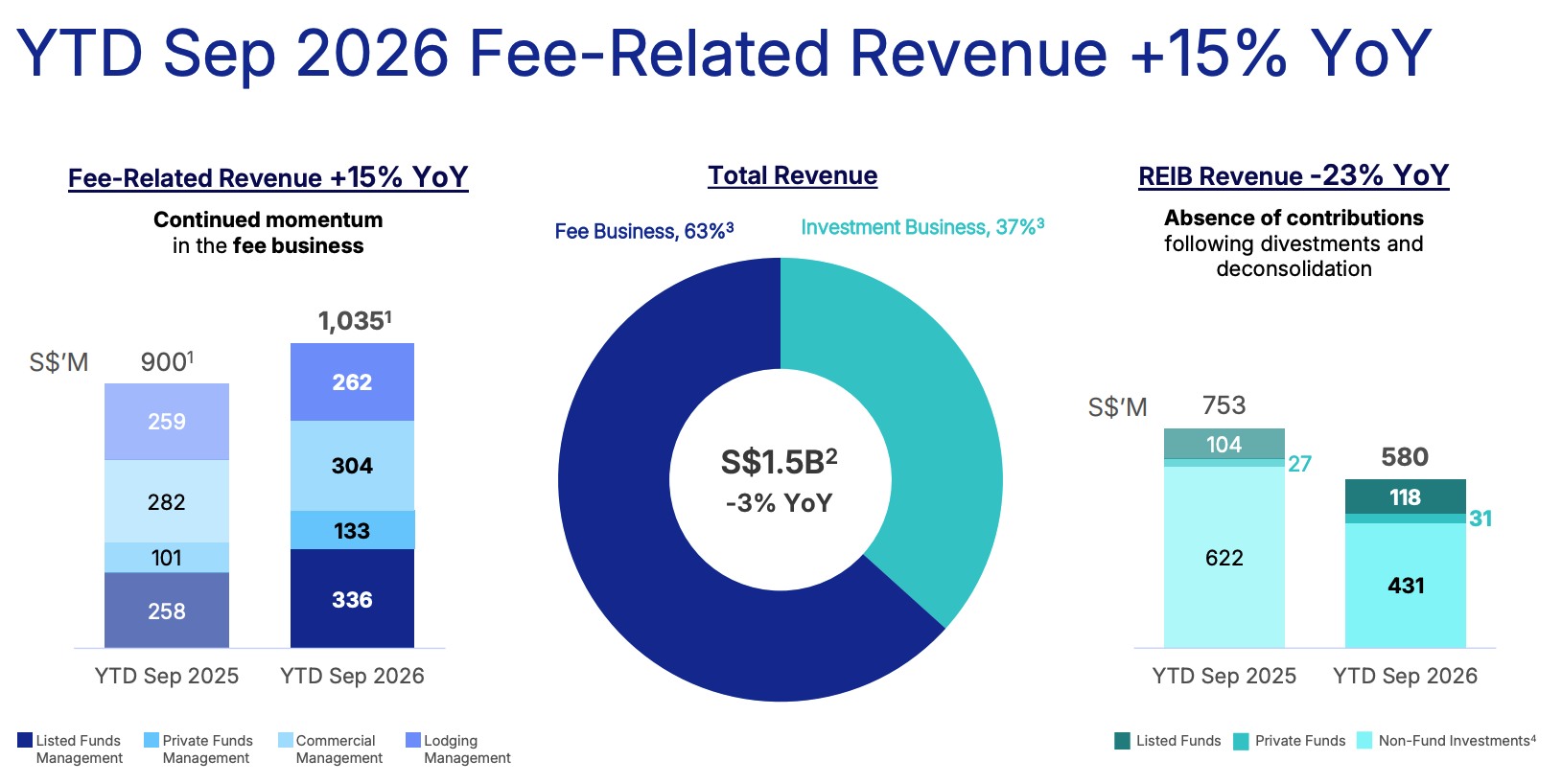
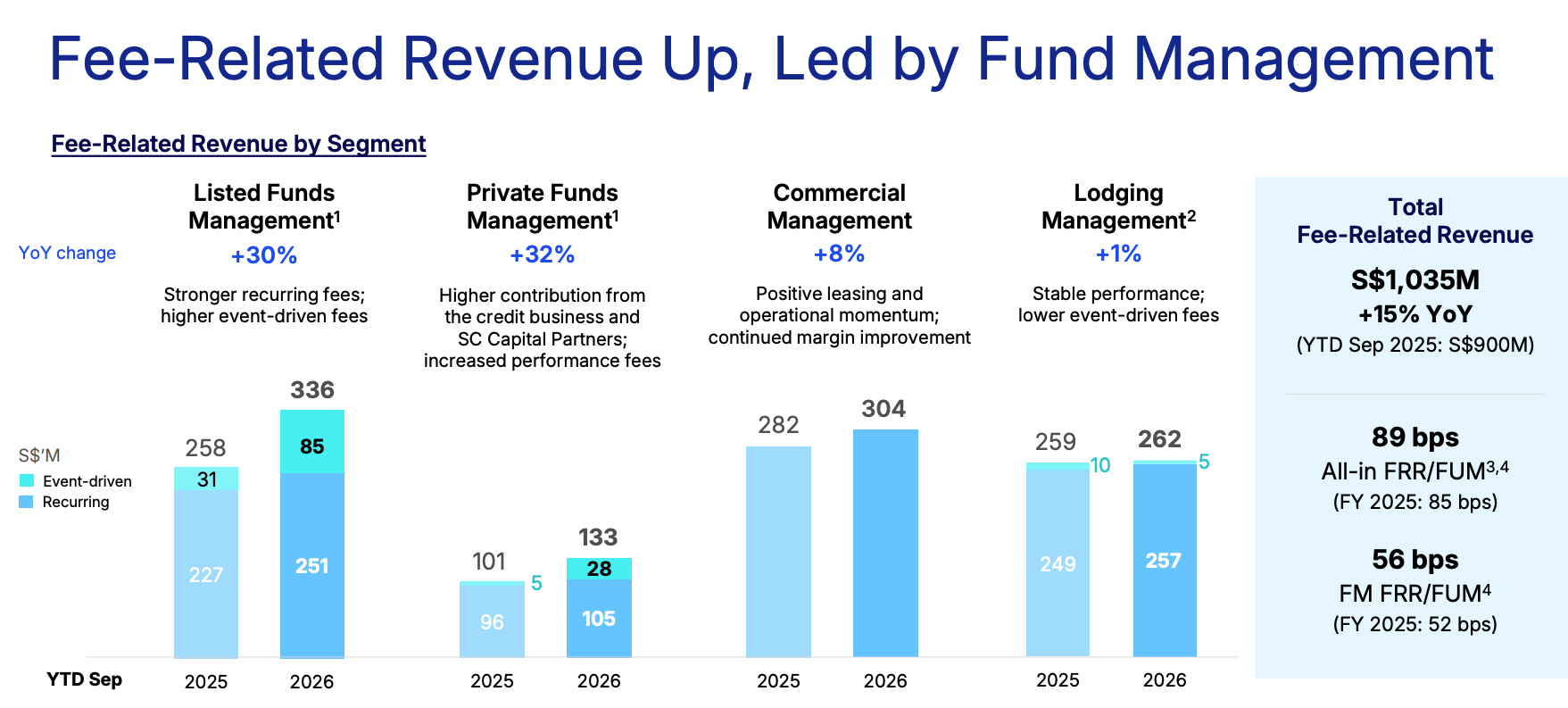
For the nine months ended September 2026, CapitaLand Investment's fee-related revenue increased 15% year-on-year to S$1.04 billion, driven by stronger listed and private fund management fees.
However, total revenue declined 3% to S$1.5 billion, partly reflecting the absence of contributions following property divestments and deconsolidation.
As discussed in our latest Beansprout Pro analysis of CapitaLand Investment’s fee growth and value-unlocking progress, fee-related revenue growth moderated to approximately 6% in the third quarter, compared with 20% in the first half.
From 1 January to 3 November 2026, CapitaLand Investment raised approximately S$4.3 billion in equity, deployed S$9.6 billion and divested S$5.7 billion. Investment and divestment figures represent gross transaction values on a 100% basis, rather than amounts attributable entirely to CapitaLand Investment.
This activity could support future management fees, although the returns generated from capital deployment remain important.
How does CapitaLand Investment fare on our Fundamental Checklist?
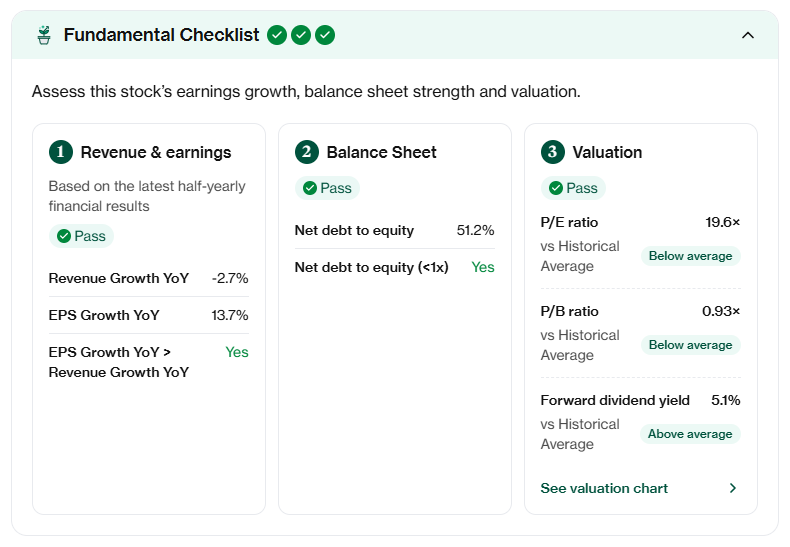
CapitaLand Investment passes all three checks on our Fundamental Checklist.
Based on the latest half-yearly financial results, CapitaLand Investment passes the revenue and earnings check, with EPS rising 13.7% despite a 2.7% revenue decline. Its subsequent nine-month update showed continued fee growth.
Its balance sheet also passes, with the checklist showing net debt-to-equity of 51.2% for its latest half-yearly financial results. Separately, CapitaLand Investment reported net debt-to-equity of 46% at end-September in its latest business update.
CapitaLand Investment passes the valuation check too. The checklist shows a P/E ratio of 19.6 times and a P/B ratio of 0.93 times, both below their historical averages. This discount may warrant a closer look, but I would assess the quality of its investments and sustainable fee earnings before concluding that the stock is undervalued.
What to watch for CapitaLand Investment
I would watch whether CapitaLand Investment can sustain recurring fee growth. Weaker property markets could slow fundraising, asset sales and new investments, while transaction-related fees may fluctuate with deal activity.
The pace and pricing of asset disposals also matter. Progress in reducing CapitaLand Investment’s own investments would provide a clearer indication of whether its value-unlocking programme is advancing.
For me, the potential opportunity depends on these developments translating into stronger sustainable earnings and better returns on shareholders’ capital.
Related links:
- CapitaLand Investment: Fee engine is growing, but value unlocking remains the key test
- CapitaLand Investment latest share price and analysis
- CapitaLand Investment dividend history and forecast
- CapitaLand Investment valuation
#2 - ComfortDelGro: Public transport growth offsets some pressure from its taxi business
ComfortDelGro is one of Singapore's major transport operators, with public transport and taxi businesses across Singapore and overseas markets.
Its share price closed at S$1.24 on 17 November 2026, down approximately 15.0% over the past year and at its 52-week low.
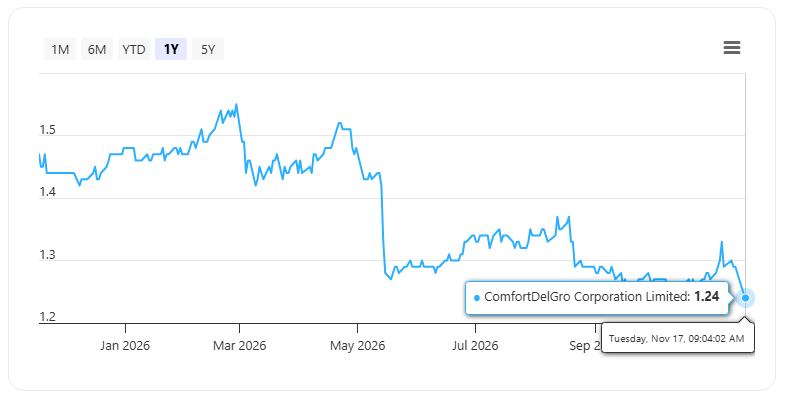
Its latest financial results showed that revenue continued to grow, although profitability remained under pressure.
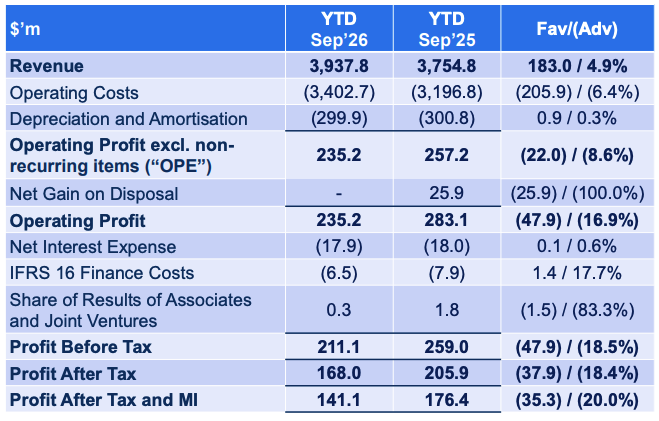
For the nine months ended September 2026, revenue increased 4.9% year-on-year to S$3.94 billion, supported by its public transport business.
However, net profit attributable to shareholders declined 20.0% to S$141.1 million, while operating profit excluding non-recurring items fell 8.6% to S$235.2 million.
The main bright spot was its public transport business, where operating profit excluding non-recurring items grew 18.4% year-on-year to S$131.7 million.
This was supported by improved margins on London bus contracts and contributions from new contracts in Australia.
ComfortDelGro also secured a 12-year Copenhagen Metro contract, with operations expected to begin in September 2027. This could support longer-term earnings growth, although contributions will depend on execution.
In contrast, its taxi business continued to face challenges.
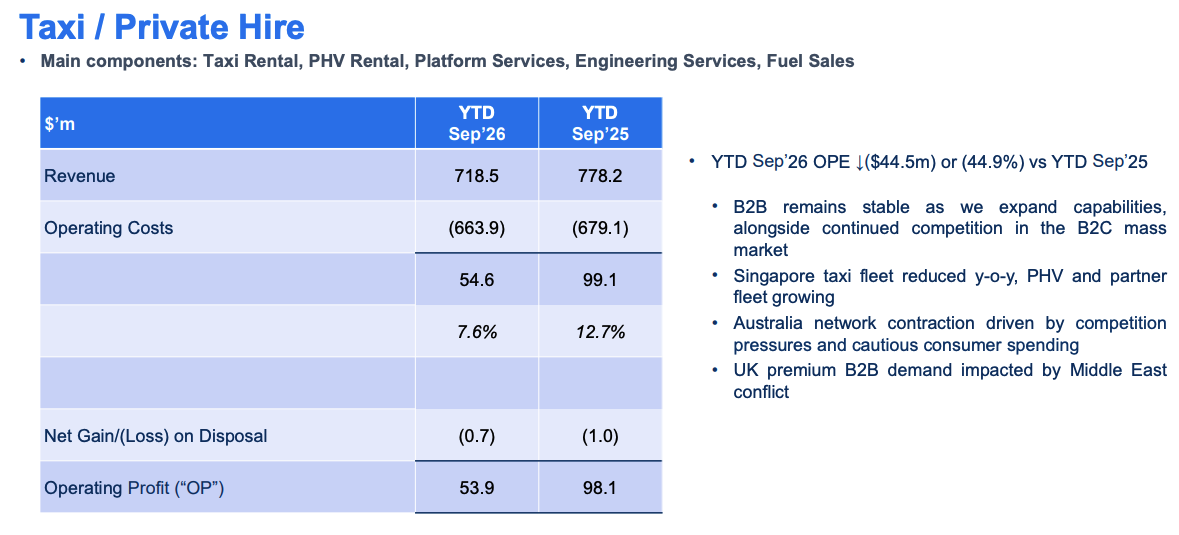
Operating profit excluding non-recurring items for the taxi and private-hire segment declined 44.9% year-on-year to S$54.6 million.
Competition from ride-hailing platforms and cautious consumer spending weighed on demand, particularly in Australia.
How does ComfortDelGro fare on our Fundamental Checklist?
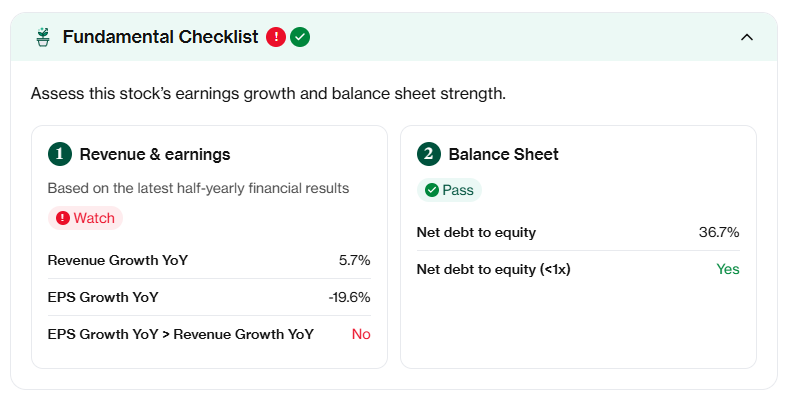
ComfortDelGro is flagged for review on the revenue and earnings check. The half-yearly figures used by the checklist show revenue increasing 5.7%, while EPS declined 19.6%. Its subsequent nine-month results also showed continued pressure on profitability.
Its balance sheet passes, with the checklist showing net debt-to-equity of 36.7%, below the 100% threshold. However, net debt increased to S$1.03 billion at end-September, making cash generation and investment spending important areas to monitor.
Valuation wise, at S$1.24, ComfortDelGro’s estimated P/E of 14.3 times and P/B of 1.04 times were both below their historical averages.
This gives me a reason to research the stock further, although I would assess whether weaker profitability could persist before concluding that the shares are undervalued.
What to watch for ComfortDelGro
I would watch whether taxi and private-hire profitability stabilises, and whether public transport contracts generate better margins as costs rise.
Cash generation also matters. Fleet investment needs to translate into adequate returns without placing excessive pressure on the balance sheet.
The lower share price gives me a reason to revisit the company, but I would want clearer evidence of an earnings recovery before strengthening my investment case.
Related links:
- ComfortDelGro latest share price and analysis
- ComfortDelGro dividend history and forecast
- ComfortDelGro valuation
#3 - Sheng Siong: Earnings growth supported by store expansion
Sheng Siong operates neighbourhood supermarkets selling fresh produce, groceries and household essentials.
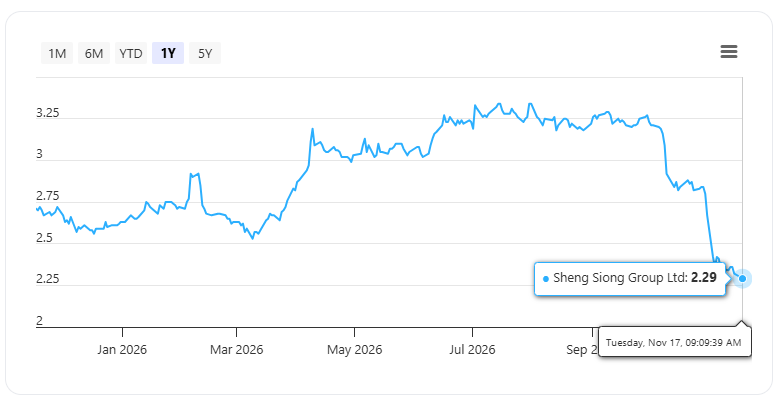
Its share price closed at S$2.29 on 17 November 2026, down approximately 15.1% over the past year and 1.3% above its 52-week low of S$2.26.
Unlike ComfortDelGro, Sheng Siong has continued to deliver earnings growth.
For the nine months ended September 2026, revenue rose 9.9% year-on-year to S$1.30 billion, while net profit increased 8.1% to S$125.5 million.
Its gross profit margin also improved from 31.1% to 32.0%, although operating expenses grew faster than revenue.
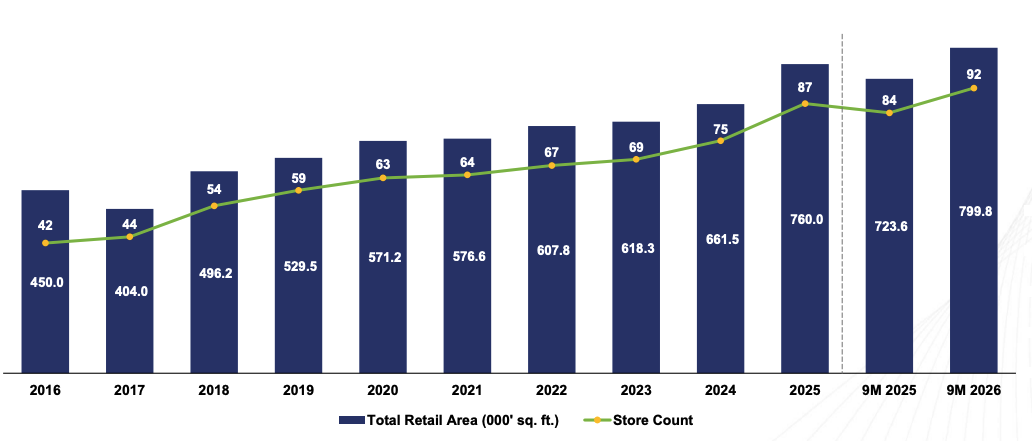
Growth was largely driven by new stores, with seven outlets opened during the first nine months of 2026.
Sheng Siong's Singapore store count reached 92 as of September 2026, compared with 84 a year earlier.
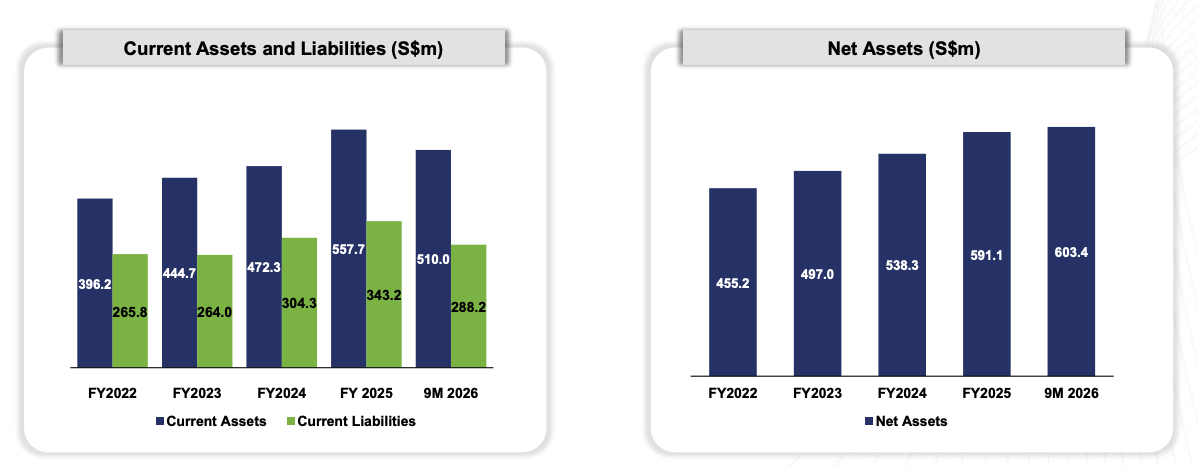
Sheng Siong also maintained a strong balance sheet, with S$388.9 million in cash and no borrowings as of September 2026.
This provides financial flexibility to fund new stores and support dividends without relying heavily on debt.
How does Sheng Siong fare on our Fundamental Checklist?
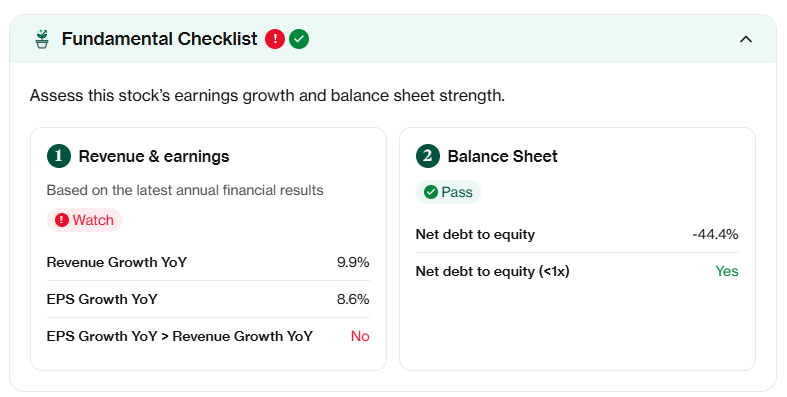
Sheng Siong is flagged for review on the revenue and earnings check.
The annual figures used by the checklist show EPS growth of 8.6%, below revenue growth of 9.9%. Its latest nine-month results also showed earnings growing more slowly than revenue.
Its balance sheet passes, with the checklist showing a net cash position.
In terms of valuation, Sheng Siong traded at a P/E ratio of approximately 21.0 times and a P/B ratio of 5.74 times at S$2.29, both above their historical averages.
Despite trading near its 52-week low, the stock may not be cheap. I would assess whether future earnings growth leaves sufficient room for further gains.
What to watch for Sheng Siong
I would watch how quickly new stores build sales and whether existing stores maintain customer demand.
Margins are another consideration. Wage increases, competition and higher operating costs could limit how much revenue growth reaches the bottom line.
Sheng Siong’s earnings growth and cash position give me reasons to research it further. However, with its P/E and P/B ratios above historical averages, I would assess whether its growth prospects justify the valuation.
Related links:
- Sheng Siong latest share price and analysis
- Sheng Siong dividend history and forecast
- Sheng Siong valuation
What would Beansprout do?
I would use the recent declines in these Singapore blue chip stocks as a reason to revisit their fundamentals.
For my Opportunity Pot, I would look for improving earnings, a balance sheet that can support continued investment, and a credible path to better returns on shareholders’ capital.
Here is how the three stocks compare across these fundamental checks.
| Stock | What stands out | Key risks |
| CapitaLand Investment | EPS growth exceeded revenue growth, net debt-to-equity below 100%, and P/E and P/B below historical averages | Slower fee growth, property market weakness and execution of its value-unlocking plans |
| ComfortDelGro | Public transport earnings provide support while other businesses face pressure | Taxi and private-hire weakness, cost pressures and investment requirements |
| Sheng Siong | Store expansion, growing earnings and a substantial cash balance | Slower quarterly growth, rising operating costs and the valuation investors pay |
| Source: Beansprout | ||
Among the three stocks, I would pay closer attention to CapitaLand Investment, which passes all three Fundamental Checklist checks. Its growing fee business and valuations below historical averages give me reasons to research it further. Our latest Beansprout Pro analysis on CapitaLand Investment examines these developments in greater detail.
Sheng Siong’s continued earnings growth and strong balance sheet also warrant attention, although I would assess its valuation carefully.
For ComfortDelGro, I would look for clearer evidence that taxi and private-hire profitability is stabilising.
In our Beansprout Pro research, we have identified which of these Singapore listed companies trading at a 52 week low offers attractive growth prospects, and examined their valuations and key risks.
Our latest Opportunity Pot Model Portfolio update also shows how we size individual positions so that we can participate in the upside while limiting the impact if the investment case does not play out as expected.
With the recent market volatility, you can continue to monitor and screen for Singapore stocks at 52-week lows here.
Beyond stocks near their 52-week lows, I can use Beansprout’s Growth Stock Screener to identify other companies worth exploring, guided by our Opportunity Pot screening framework.
These checks help me identify stocks worth researching further, rather than serving as standalone buy decisions.
For investors who are looking to gain exposure to Singapore, we share 5 ways to invest in blue chips and growth opportunities here.
Which of these three Singapore blue chip stocks would you consider researching further? Share your thoughts in the comments or our Beansprout Telegram community.
Enjoyed this insight? Follow Beansprout on Telegram, YouTube, Facebook and Instagram, and add Beansprout as your preferred source on Google so you never miss an update.
Read also
Gain financial insights in minutes
Subscribe to our free weekly newsletter for more insights to grow your wealth
Most Popular

Comments
0 comments