
DFI swaps Maxim’s stake for Starbucks: What it means for dividends and income investors
Stocks
By Gerald Wong, CFA • 12 Oct 2026
Why trust Beansprout? We’ve been awarded Best Investment Website at the SIAS Investors’ Choice Awards 2025
'%3e%3cpath%20fill-rule='evenodd'%20clip-rule='evenodd'%20d='M17.64%209.20455C17.64%208.56637%2017.5827%207.95273%2017.4764%207.36364H9V10.845H13.8436C13.635%2011.97%2013.0009%2012.9232%2012.0477%2013.5614V15.8195H14.9564C16.6582%2014.2527%2017.64%2011.9455%2017.64%209.20455V9.20455Z'%20fill='%234285F4'/%3e%3cpath%20fill-rule='evenodd'%20clip-rule='evenodd'%20d='M9%2018C11.43%2018%2013.4673%2017.1941%2014.9564%2015.8195L12.0477%2013.5614C11.2418%2014.1014%2010.2109%2014.4205%209%2014.4205C6.65591%2014.4205%204.67182%2012.8373%203.96409%2010.71H0.957275V13.0418C2.43818%2015.9832%205.48182%2018%209%2018V18Z'%20fill='%2334A853'/%3e%3cpath%20fill-rule='evenodd'%20clip-rule='evenodd'%20d='M3.96409%2010.71C3.78409%2010.17%203.68182%209.59318%203.68182%209C3.68182%208.40682%203.78409%207.83%203.96409%207.29V4.95818H0.957273C0.347727%206.17318%200%207.54773%200%209C0%2010.4523%200.347727%2011.8268%200.957273%2013.0418L3.96409%2010.71V10.71Z'%20fill='%23FBBC05'/%3e%3cpath%20fill-rule='evenodd'%20clip-rule='evenodd'%20d='M9%203.57955C10.3214%203.57955%2011.5077%204.03364%2012.4405%204.92545L15.0218%202.34409C13.4632%200.891818%2011.4259%200%209%200C5.48182%200%202.43818%202.01682%200.957275%204.95818L3.96409%207.29C4.67182%205.16273%206.65591%203.57955%209%203.57955V3.57955Z'%20fill='%23EA4335'/%3e%3c/g%3e%3cdefs%3e%3cclipPath%20id='clip0_0_2849'%3e%3crect%20width='18'%20height='18'%20fill='white'/%3e%3c/clipPath%3e%3c/defs%3e%3c/svg%3e)
Make Beansprout your preferred source on Google
Add us on Google to see more of our insights in your search results
DFI Retail Group is swapping its Maxim’s stake for Starbucks and US$340 million in cash. We look at what the deal means for its earnings, dividends and consensus forward yield of about 4.8%.

What happened?
DFI Retail Group is making a major portfolio change that could affect its earnings and dividends.
Earlier this year, DFI was among three Singapore blue chip stocks that held up during the market volatility, but its share price has since fallen substantially and its forward dividend yield is now roughly 5%.
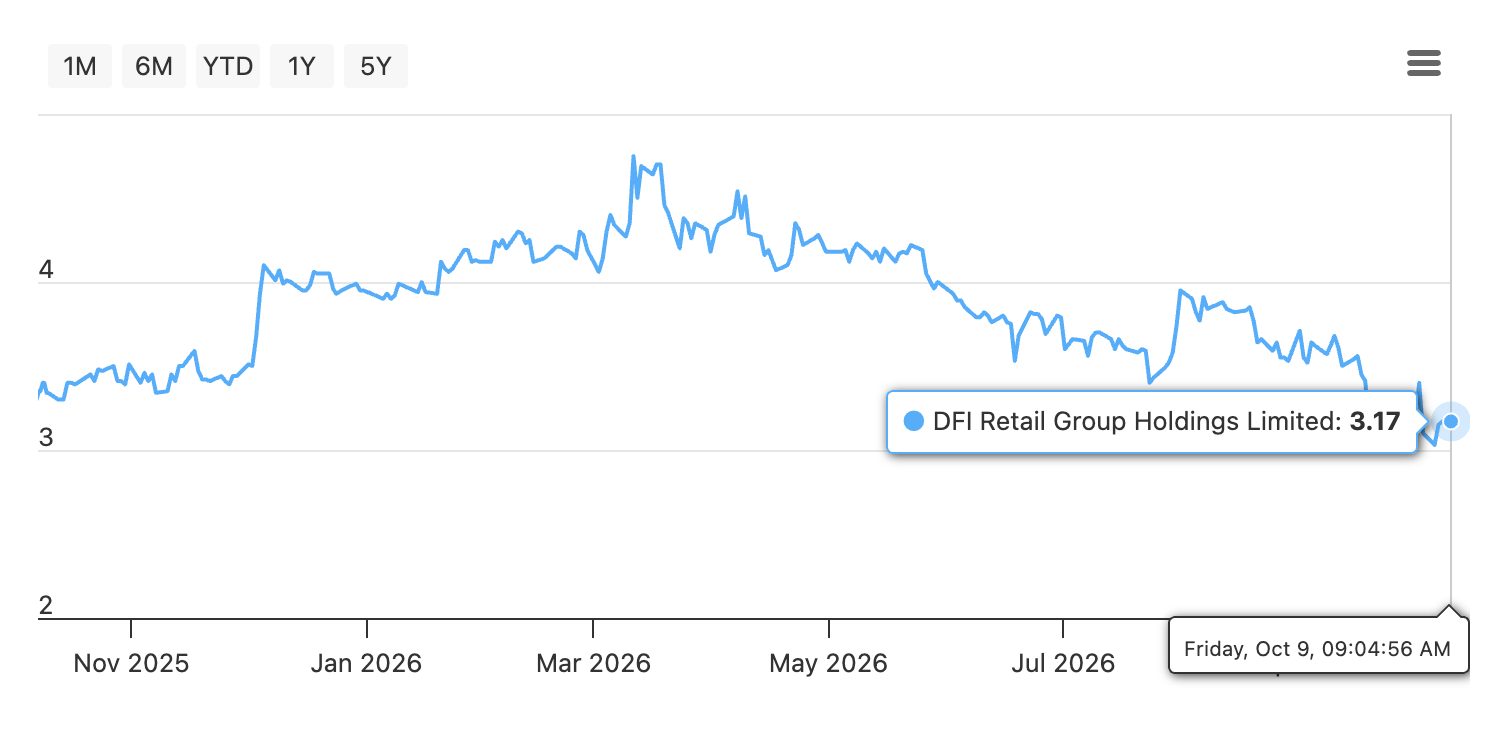
With the US Federal Reserve recently raising interest rates, higher borrowing costs and more competitive bond yields make the sustainability of those dividends more important to income investors.
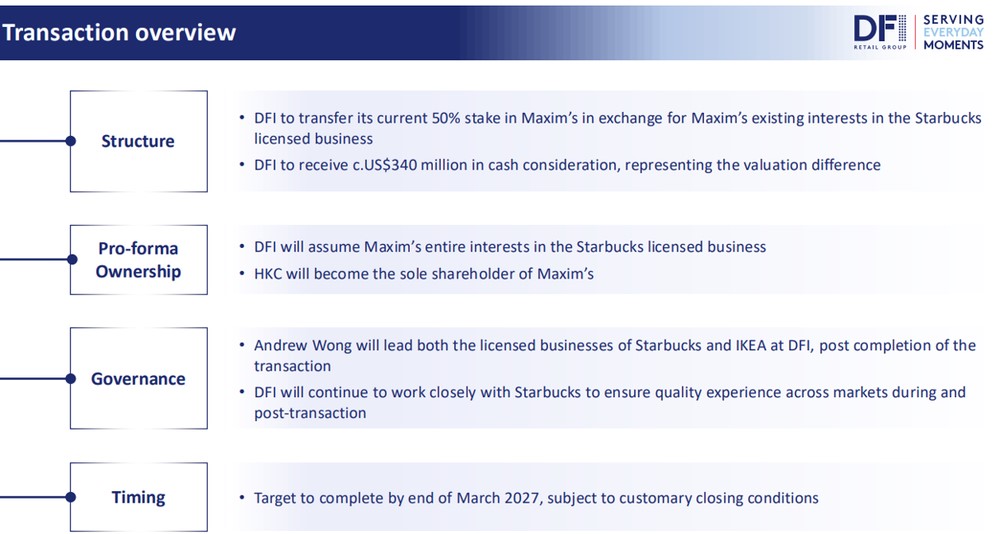
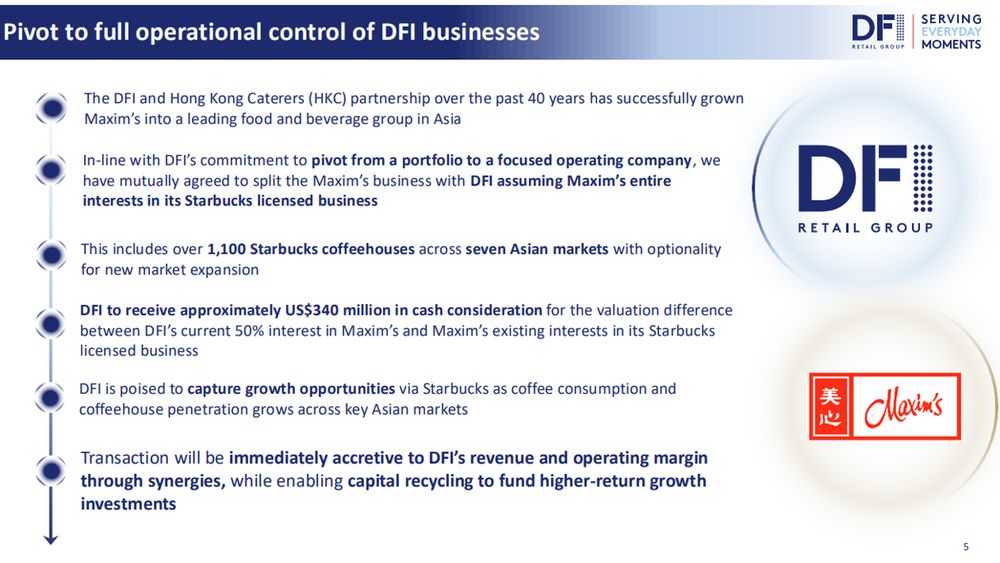
Adding to that assessment is DFI’s plan to exchange its 50% stake in Maxim’s for full ownership of a Starbucks licensed business with more than 1,100 coffeehouses across seven Asian markets, while receiving about US$340 million in cash.
DFI has also raised its targeted dividend payout ratio for 2027 from 70% to 80%, although Starbucks will take time to replace Maxim’s earnings contribution.
We look at how DFI’s Starbucks deal could affect its earnings and dividends, and whether its roughly 5% forward dividend yield remains attractive to income investors as Starbucks grows to replace Maxim’s profit contribution.
What does the Starbucks deal mean for DFI investors looking for income?
DFI has spent the past few years simplifying its portfolio, including exiting Yonghui and Robinsons Retail and selling its Singapore Food business.
Management described the Starbucks transaction as the final step in its shift from minority investments towards businesses it controls.
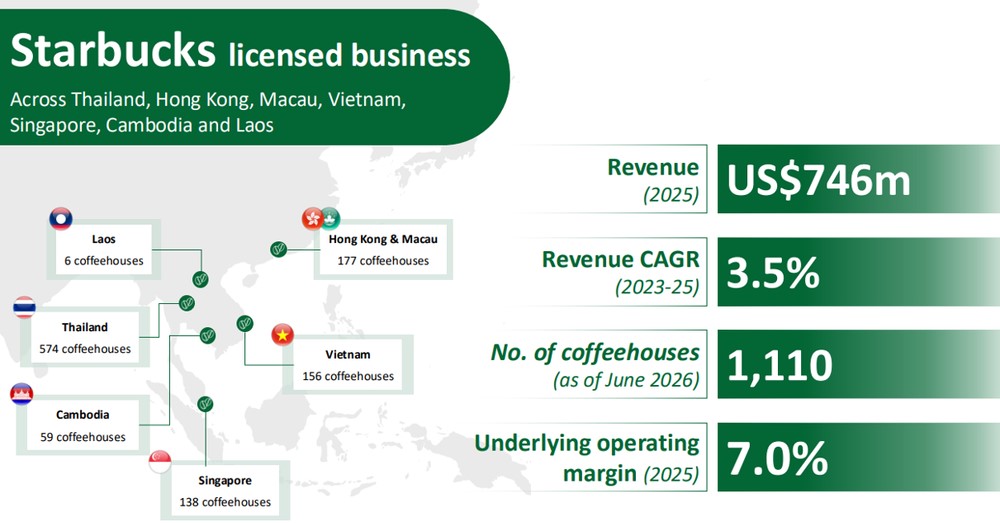
The Starbucks business covers Thailand, Hong Kong, Singapore, Vietnam, Cambodia, Macau and Laos. Completion of the transaction is targeted for the end of March 2027, subject to regulatory approvals and other conditions.
Owning 100% of Starbucks gives DFI greater control over store openings, investment decisions and operations.
Management also sees opportunities to use its procurement scale, property network and yuu loyalty programme across the business.
For income investors, greater control matters if it eventually translates into sustainable earnings and cash flow.
1. Starbucks could become a larger earnings contributor for DFI
The Starbucks business generated close to US$750 million in revenue in 2025, with an underlying operating margin of around 7%.
Revenue grew at an annualised rate of 3.5% between 2023 and 2025.
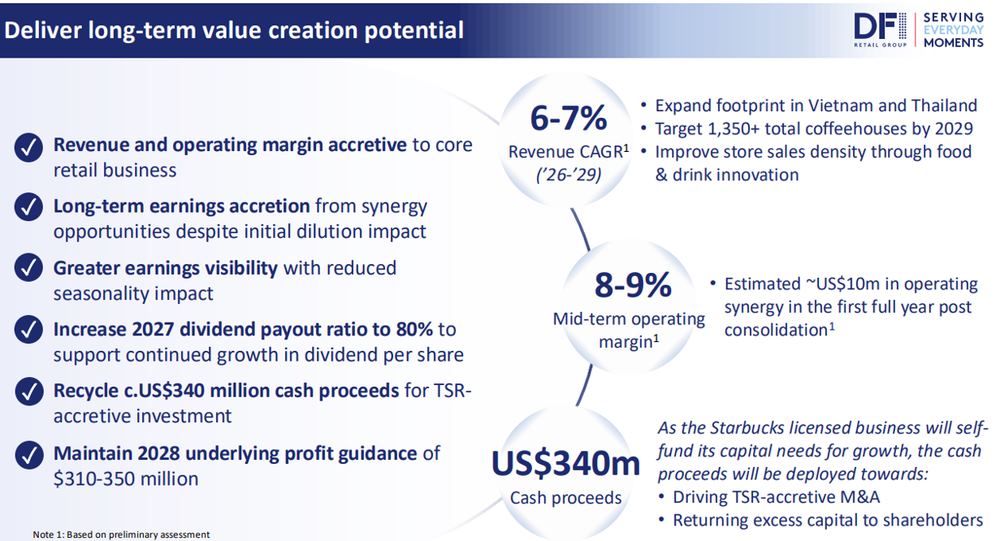
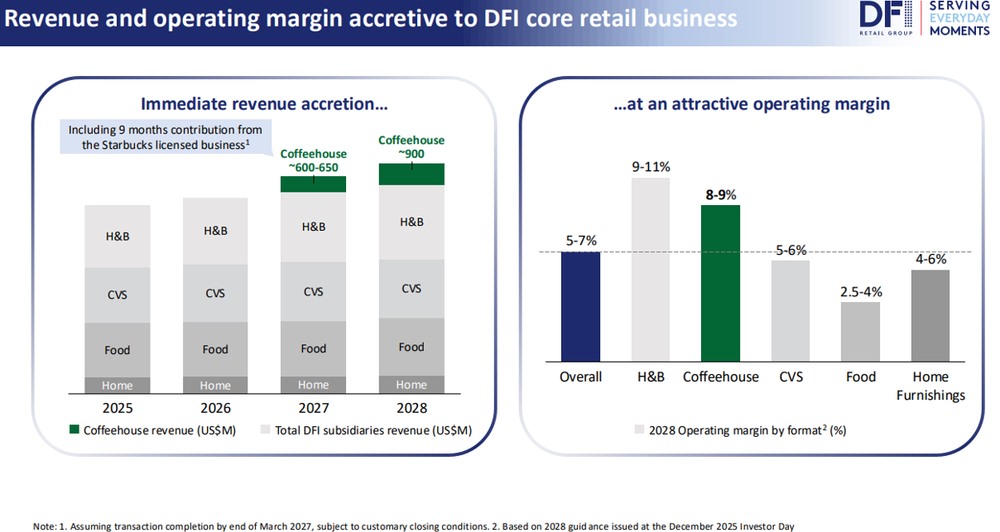
DFI expects Starbucks to contribute US$600 million to US$650 million in revenue between April and December 2027, rising to about US$900 million for the full year in 2028.
DFI is targeting annual revenue growth of 6% to 7% between 2026 and 2029 and an operating margin of 8% to 9%.
It also plans to expand the network to at least 1,350 coffeehouses by 2029, adding around 250 stores mainly in Thailand and Vietnam.
If DFI can deliver faster sales growth and higher margins, Starbucks could become a more meaningful earnings contributor over time.
2. DFI may face an earnings gap in 2027 as Starbucks replaces Maxim’s
Maxim’s contributed around US$16 million to DFI’s earnings in the first half of 2026.
DFI will stop recognising this contribution once the transaction is completed.
Starbucks is not expected to immediately make up the difference.
Management estimates a profit gap of around US$35 million to US$40 million in the first year after completion.
For comparison, DFI is guiding for underlying profit of US$285 million to US$305 million in 2026.
Growth from its other businesses could offset part of the gap, so this does not mean profit will fall by the same amount in 2027.
Management expects Starbucks’ growth and operating synergies to close the gap within around three years.
It has also maintained its 2028 underlying profit target of US$310 million to US$350 million.
For income investors, I would focus on whether DFI can maintain its dividends while waiting for Starbucks to close this earnings gap.
3. DFI’s higher payout ratio could support dividends in 2027
DFI plans to pay out 70% of underlying profit as dividends in 2026 and has raised its targeted payout ratio to 80% for 2027.
The higher payout ratio could provide some support to dividends if earnings weaken temporarily after the Maxim’s transaction is completed.
However, this does not necessarily mean dividends will increase. A higher payout ratio could be partly offset by lower earnings in 2027.
For income investors, the more important question is whether DFI can continue generating enough earnings and cash flow to sustain its dividends while Starbucks grows to replace Maxim’s profit contribution.
4. DFI’s US$340 million cash proceeds could fund acquisitions or shareholder returns
DFI will receive about US$340 million in cash, equivalent to around US$0.25 per share based on roughly 1.35 billion shares outstanding.
Management’s first preference is to look for acquisitions, particularly in businesses where DFI already has scale such as health and beauty and convenience.
If no suitable acquisition emerges within six to 12 months after completion, management has said it would consider returning the cash to shareholders.
A special dividend is possible, but no commitment has been made.
For income investors, we would not build the investment case around a potential special dividend.
What matters more is whether management can use the cash to support sustainable earnings and recurring dividends.
5. DFI's P/E is below average while its dividend yield is higher
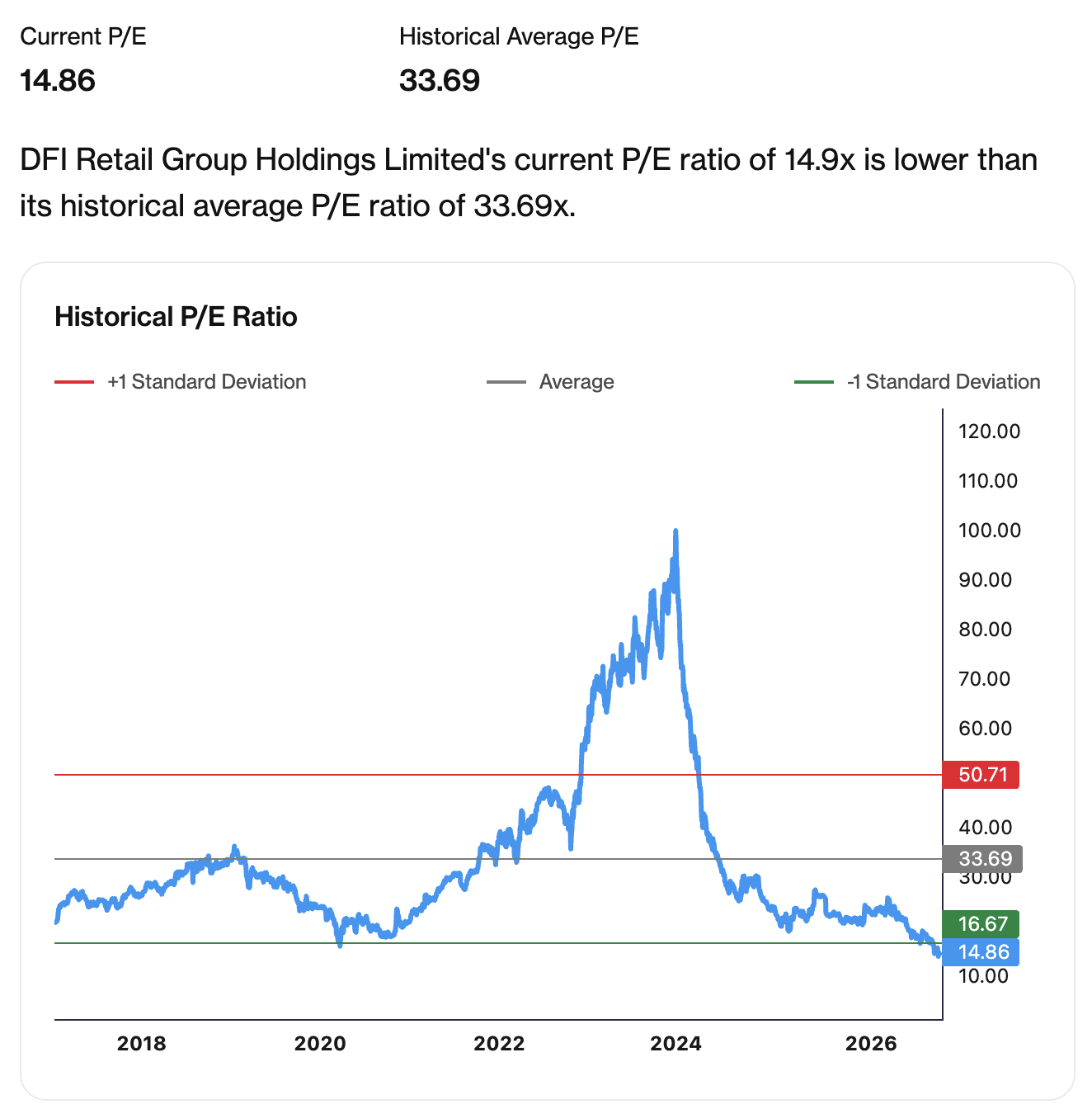
At US$3.17 per share, DFI is trading at a price-to-earnings (P/E) ratio of about 14.9 times, below its historical average of 33.7 times.
However, I would not take the historical average at face value.
Periods of much weaker earnings pushed DFI’s P/E sharply higher and lifted its longer-term average.
Its current P/E is also below the historical one-standard-deviation level of 16.7 times.
This puts DFI towards the lower end of its historical valuation range, although the expected earnings gap in 2027 helps explain why investors may be paying a lower multiple.
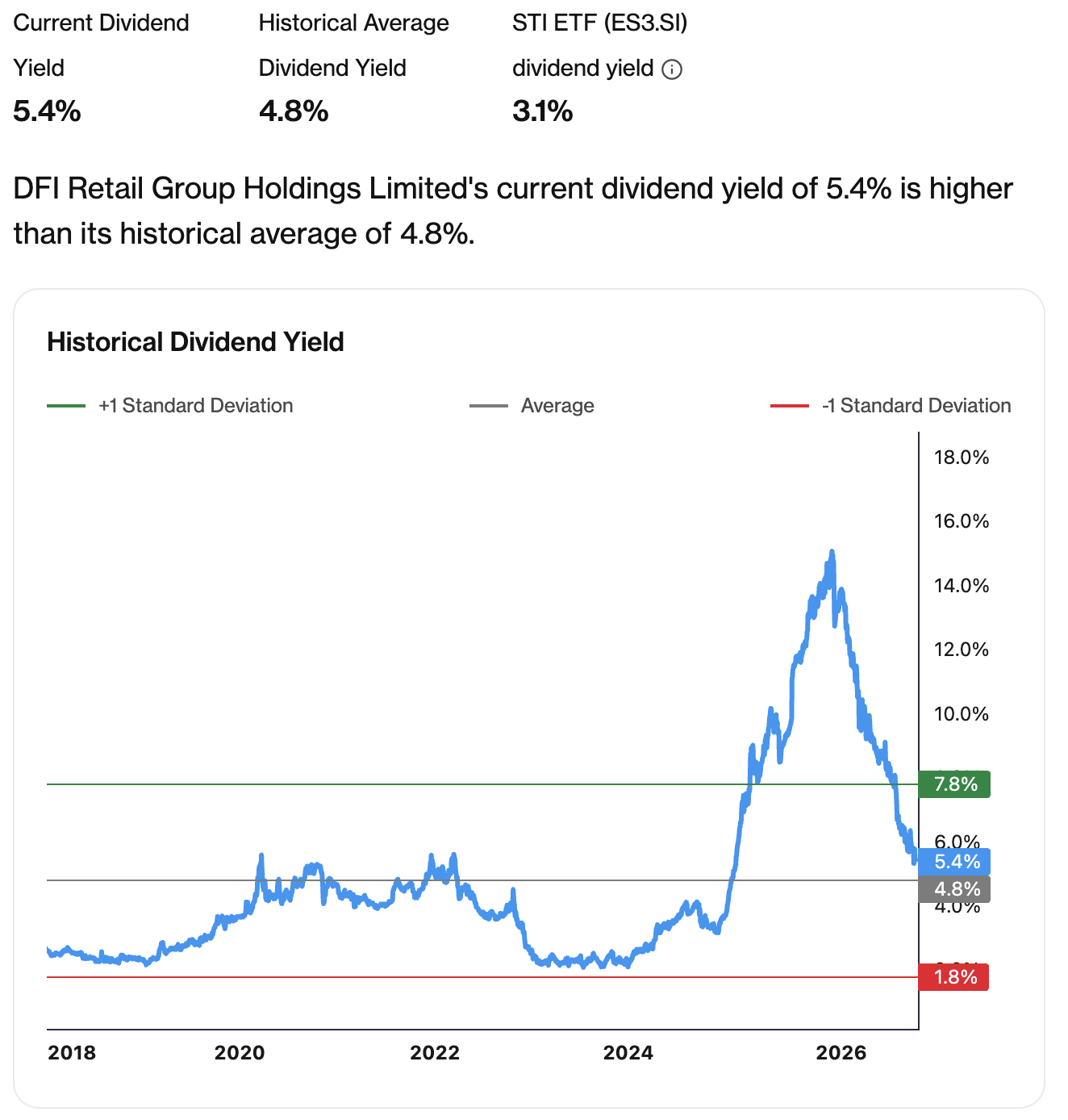
From an income perspective, DFI’s historical dividend yield is about 5.4%, above its historical average of 4.8% and the 3.1% dividend yield of the Straits Times Index ETF (ES3.SI).
The yield remains below the historical one-standard-deviation level of 7.8%, so it is not at the unusually high levels seen previously.
The 5.4% figure reflects DFI’s historical dividend yield, while consensus estimated forward dividend yield of 5.5%.
For us, the forward figure is more useful when assessing the income outlook.
A lower P/E and above-average dividend yield make DFI more relevant for income investors.
But the more important question remains whether earnings and dividends can hold up through 2027.
Related Links:
- DFI Retail Group share price history and share price target
- DFI Retail Group dividend forecast and dividend yield
How we would assess DFI Retail Group for income
We use our Income Pot screening framework to look for companies with growing earnings, a manageable balance sheet and an attractive dividend yield.
Based on its latest results and guidance, DFI passes all three checks.
| Check | What we prefer | DFI | Result |
| Earnings growth | EPS today above three years ago | Underlying EPS of US 20.05 cents in 2025, up from US 2.14 cents in 2022 | Pass |
| Financial strength | Net gearing below 50% | 10.9% as of 30 June 2026 | Pass |
| Income attractiveness | Dividend yield above Singapore 10-year government bond yield | Consensus forward dividend yield of 4.8% vs 2.49% | Pass |
Has DFI's EPS grown?
DFI’s underlying earnings per share (EPS) increased to US 20.05 cents in 2025 from US 2.14 cents in 2022.
Ordinary dividends also rose from US 3.00 cents per share in 2022 to US 14.00 cents in 2025.
The recovery continued into 2026, with underlying EPS rising 12% to US 8.69 cents in the first half.
The key risk is that earnings could dip in 2027 after DFI stops recognising Maxim’s contribution.
Is DFI's balance sheet strong?
As of 30 June 2026, DFI had US$186.4 million of borrowings and US$164.2 million of cash, leaving net debt of US$22.2 million.
Against shareholders’ equity of US$203.2 million, net gearing stood at 10.9%, below our 50% threshold.
DFI also had US$2.2 billion of lease liabilities.
These are not included in our net gearing calculation but remain meaningful commitments for a retailer.
DFI generated US$475.2 million of operating cash flow in the first half of 2026, while free cash flow of US$85 million was broadly in line with the US$83.9 million interim dividend declared.
Is DFI's dividend yield attractive?
Consensus is expecting a forward dividend yield of about 4.8%, according to Factset estimates on 9 October 2026, which is above the Singapore 10-year government bond yield of 2.49%.
The planned 80% payout ratio in 2027 could support dividends if earnings weaken temporarily.
However, the strength of DFI’s cash flow will remain important.
Singapore investors should also remember that DFI declares dividends in US dollars.
The Singapore dollar value of the payout will therefore fluctuate with exchange rates.
What are the key risks to DFI's income outlook?
The first risk is the 2027 earnings gap. If Starbucks takes longer than expected to replace Maxim’s contribution, dividend growth could be harder to sustain.
The second is execution risk. DFI is targeting faster Starbucks revenue growth, around 250 additional stores and higher margins, so weaker expansion or profitability could delay the earnings recovery.
The third is capital allocation. The US$340 million gives DFI flexibility, but any acquisition would need to generate attractive returns rather than simply add scale.
What would Beansprout do?
We think the Starbucks transaction gives DFI greater control over a sizeable consumer business with room to expand across Asia.
For income investors, however, the key question is whether DFI can sustain earnings and dividends through the transition.
DFI currently passes all three checks in our Income Pot screening framework. At US$3.10, consensus is expecting a forward dividend yield of about 5.5%, while net gearing remains low.
However, the higher yield has partly come about because DFI’s share price has fallen as investors weigh the expected earnings gap in 2027.
We would therefore keep DFI on our Income Pot watchlist and look for more evidence that earnings and dividends can remain resilient through the transition.
The key milestones are completion of the Starbucks transaction by March 2027, progress in store openings and margins, DFI’s final dividend for 2026, and how management deploys the US$340 million cash proceeds.
You can screen for Singapore dividend stocks that meet our three checks, learn more about how we build a diversified Income Pot, or explore Beansprout’s Four Pots of Wealth framework.
For dividend income, we prefer to combine quality Singapore blue chip stocks with selected REITs to diversify our income sources and build a more resilient portfolio.
To see how we put this into practice, explore Beansprout Pro to follow how we allocate our S$100,000 model portfolio and which income stocks we include alongside our growth holdings, and why.
Would you consider adding DFI to your Income Pot at a yield of around 5%? Share your thoughts in the comments below or join the discussion in our Beansprout Telegram community.
Enjoyed this insight? Follow Beansprout on Telegram, Youtube, Facebook and Instagram, and add Beansprout as your preferred source on Google so you never miss an update.
Read also
Gain financial insights in minutes
Subscribe to our free weekly newsletter for more insights to grow your wealth
Most Popular

Comments
0 comments