
S&P 500 near record highs: How to use futures and options to protect profits
Trading
By Nicole Ng • 23 Feb 2026
Why trust Beansprout? We’ve been awarded Best Investment Website at the SIAS Investors’ Choice Awards 2025
The S&P 500 is near record highs as volatility rises in 2026. Discover how Singapore investors can use ETFs, futures, and options to hedge risk, protect profits, and tailor their US market exposure.
What happened?
The S&P 500 kicked off 2026 by hitting a fresh record high of 6,986.33 on 12 January.
Meanwhile, US inflation appears relatively stable. The latest US Consumer Price Index (CPI) held steady at 2.7% for December 2025.
In addition, 2026 is also a US midterm election year. Historically, midterm years tend to be the most volatile in the four-year presidential cycle, as policy uncertainty rises and markets reassess fiscal and regulatory direction.
We’re already seeing early signs of this. Implied volatility (IV), which started the year near 13%, is climbing toward 20% for later in 2026.
As a Singapore investor navigating global markets, this combination of record highs and rising volatility has made me think more carefully about risk management.
Increasingly, I’ve noticed more investors moving beyond simply “buying the index.”
Instead, they’re exploring different instruments to tailor their exposure based on their market views, time horizon, and risk tolerance.
In this article, I’ll walk through three main ways to gain exposure to the S&P 500: ETFs, futures, and options, and break down how each works and when investors might use them in their investing strategy.
Understanding the three ways to access the S&P 500
#1 – S&P 500 ETFs
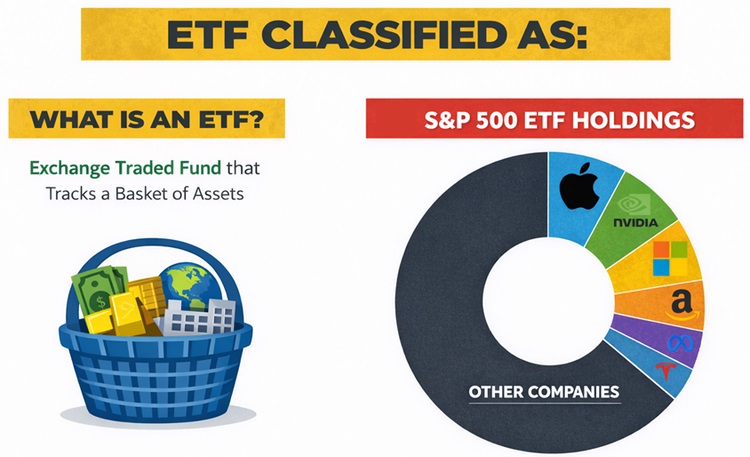
S&P 500 ETFs are the simplest and most accessible way to invest in the US stock market.
These ETFs track the performance of the S&P500 index, giving you exposure to 500 of the largest US-listed companies in a single trade.
They are listed and traded on exchanges, making them easy to buy and sell through most brokerage platforms at a low cost. Popular examples include SPY, VOO, and IVV.
Because of their simplicity and broad diversification, S&P 500 ETFs are commonly used for long-term, buy-and-hold strategies.
However, this simplicity also comes with limitations.
ETFs offer little flexibility. When the market rises, ETF prices go up. But when the market falls, ETF prices fall by the same magnitude.
During periods of heightened volatility, you cannot easily adjust risk, hedge downside exposure, or respond to short-term market moves without selling part or all of your holdings.
Expressing a short-term bearish view can also be less straightforward.
Investors may need to short the ETF or use inverse products, which can involve additional constraints.
And because most US-listed ETFs primarily trade during US market hours, reacting to overnight developments or global news flow may not always be as seamless.
#2 – E-mini, Micro S&P 500 Futures, and Spot Quoted Futures
When investors want more flexibility or tighter control over risk, some would look beyond ETFs and consider S&P 500 futures.
A futures contract represents an agreement to buy or sell the S&P 500 index at a predetermined price on a future date.
In practice, this means you can take a view on where the index is headed, without needing to own all the underlying stocks or put up a lot of capital.
Today, investors can choose between several contract types, including the E-mini S&P 500 futures, Micro E-mini S&P 500 futures, and the newer Spot-Quoted Futures (SQF).
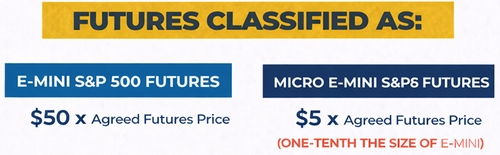
Micro contracts are one-tenth the size of E-mini contracts, which significantly lowers the capital required.
This makes futures more accessible for investors who want to start small and manage risk more carefully.
For investors who like the simplicity of ETFs but want the capital efficiency of futures, CME introduced Spot-Quoted Futures (SQF) in 2025.
Unlike traditional futures contracts, which can trade at a premium or discount to the cash index and require periodic rolling into new expiries, SQF contracts are designed to track the spot price of the index more closely.
This allows investors to gain S&P 500 exposure without worrying about quarterly contract rolls, making the structure more intuitive for those transitioning from ETFs.
Unlike ETFs, futures trade nearly 24 hours a day.
This is particularly relevant for Singapore investors, since market-moving events don’t only happen during US market hours.
Big tech earnings are often released after the US market closes, and geopolitical news can break at any time.
In 2025, a record 21% of Micro E-mini futures volume was traded outside US hours, highlighting how more investors are using these instruments to react to developments during local daylight hours instead of staying up overnight.
While futures trade nearly 24 hours a day, Jonathan Man, CEO of Webull Singapore, shares that disciplined traders are strategic about when they trade. They don’t trade nonstop but instead focus on specific sessions.
He adds, “more screen time doesn’t equal more profit”.
One of the main advantages of futures is capital efficiency.
Instead of paying the full value of the index, you only need to post a margin, which frees up capital for other uses.
Suppose the S&P 500 index is at 6,800 points, and one MES futures contract is worth $5 × 6,800 = $34,000.
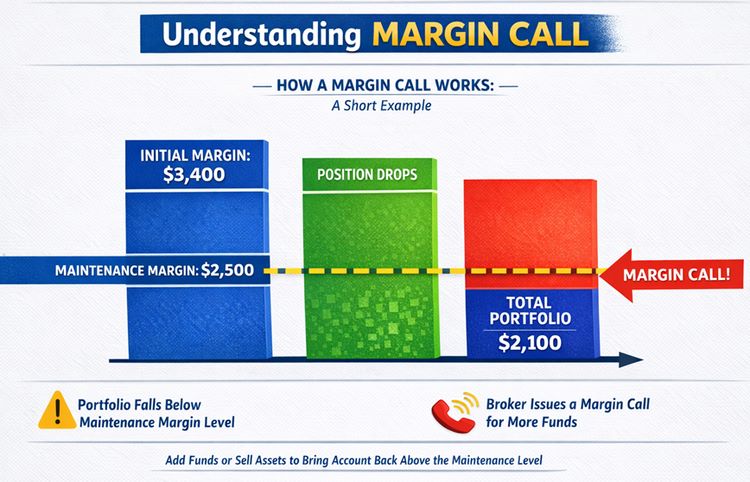
Instead of paying $34,000 upfront, you might only need to post a margin of $3,400.
However, if the market moves against your position and your account falls below the maintenance margin requirement, your broker will ask you to top up your funds immediately.
If you can’t meet the margin call, your holdings may be liquidated at a loss. This means that trading futures requires active monitoring and proper risk management.
Mr Man also highlights that many ETF investors underestimate how different futures trading can be:
“Most beginners don’t fully grasp how leverage amplifies both gains and losses. Margin levels are not static — when markets get volatile, exchanges can raise requirements overnight. This dynamic margin environment can trigger unexpected margin calls or position liquidations.”
He also notes that, unlike ETFs, futures have built-in expiration dates. He shares, “Futures contracts expire, and to maintain a long-term position, traders must roll the contract to a future month. Many beginners are caught off guard when their positions approach expiration.”
Here’s how S&P 500 futures differ from S&P 500 ETFs:
| Key Characteristic | S&P 500 Futures | S&P 500 ETFs |
| Annual Management Fees | No | Yes |
| Potential Cost Efficiencies* | Yes | Depends - Time Horizon, direction & holding costs will impact |
| Nearly 24-Hour Access, 6 days a week | Yes | No |
| Deep Liquidity | Yes | Yes - But core futures can trade many times more notionally per day |
| Pure Price Exposure to Underlying | Yes - Designed to tightly track underlying | No - Funding levels, fees, other factors can affect price |
| Can Go to Delivery | No. Futures are 100% cash settled. | No |
| Offers Portfolio Diversification | Yes | Yes |
| Tax Efficiencies** | No | No - Could trigger relatively expensive short-term capital gains tax. Non-US residents are subjected to with holding dividend tax. |
| *Depends on your time horizon, direction and holding costs **Depends on holding period and time horizon. The information provided should not be considered tax advice. Consult your tax advisor before making any investment. Source: CME Group | ||
#3 - E-mini S&P 500 Options
S&P 500 options offer investors another versatile way to hedge risk, generate income, or express market views with defined parameters.
An S&P 500 option gives you the right, but not the obligation, to buy or sell the S&P500 at a specific price by a certain date.
A call option is used when you think the market will rise, while a put option is used when you want protection or expect the market to fall.
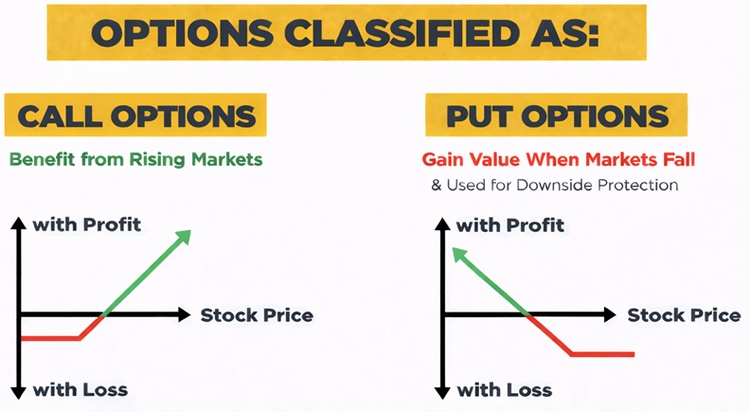
When buying an option, investors typically focus on three key elements to determine the risk-reward profile:
- Strike price: the level at which you can buy (call) or sell (put) the index
- Expiry: how long the option lasts
- Premium: the upfront cost, determined by strike, expiry, and implied volatility
Investors may use options to hedge against downside risk.
Let’s say you hold S&P 500 ETFs as part of your long-term portfolio, but you’re worried about short-term volatility.
Instead of selling your ETFs, you can buy a put option on the S&P 500. This put option increases in value if the market falls, helping to offset losses in your portfolio.
If the S&P 500 doesn’t decline, you can choose to let the options expire.
This is where options differ meaningfully from futures.
With futures, gains and losses move one-for-one with the market, and losses can exceed the initial margin posted.
Positions must also be actively monitored, as sharp market moves can trigger margin calls.
When buying options, your downside risk is clearly defined from the start, which is the premium paid.
There are no margin calls for option buyers, and you’re not forced to act if the market moves against you.
Here are the key differences between futures and options:
| Instrument | Futures | Options |
| Obligation | Buyer and seller are obligated to transact at contract expiry | Buyer has the right, but not the obligation, to exercise the option |
| Cost | Margin required; typically lower than full contract value but higher than option premium | Premium paid upfront; total cost can increase with more contracts |
| Max Loss | Can be as high as full contract value | Limited to premium paid for buyers; writing (uncovered) options may lead to unlimited losses |
| Capital Efficiency | Very High; only margin required | Moderate; premium upfront plus potential margin for spreads |
| Flexibility | Moderate; mostly directional trades | High; can hedge, use spreads, and implement complex strategies |
| Source: CME Group | ||
Investors can access both E-mini S&P 500 options and Micro E-Mini S&P 500 options, allowing for scalable strategies.
| Instrument | E-Mini S&P 500 Options | Micro E-Mini S&P 500 Options |
| Cost | Higher Upfront; as contract size is larger (premium) | Lower Upfront (premium) |
| Contract Size | 50 | 5 |
| Max Loss | Limited to Premium Paid | Limited to Premium Paid |
| Instrument | E-Mini S&P 500 Options | Micro E-Mini S&P 500 Options |
| Source: CME Group | ||
Options can also be used beyond hedging.
Some investors use them to generate income by selling options, while others use them to express bullish or bearish views with smaller amounts of capital.
The ability to combine different options also allows for flexible payoff structures tailored to specific market expectations.
But it’s important to note that options lose value as they approach expiration. This is also known as time decay. So even if the market stays flat, your option loses value every day.
This means that buying options as a hedge has an ongoing cost. Unlike futures, which don’t have time decay, options require more precise timing and understanding of volatility.
Comparing the S&P 500 ETFs, futures, and options
While all three instruments provide exposure to the S&P 500, they behave very differently in practice.
Your choice depends on your objective, time horizon, risk tolerance, and how actively you want to manage your portfolio.
At a high level, ETFs offer simplicity and long-term participation, futures provide capital-efficient and tactical exposure, while options allow for precision in managing risk and shaping payoffs.
| Feature | ETFs | Futures | Options |
| Complexity | Low | Medium | High |
| Capital Required | Higher | Lower | Lower |
| Leverage | No | Yes | Yes |
| Downside Risk | Full market exposure | Potentially high | Defined for buyers |
| Time Horizon | Long-term | Short to medium | Short to medium |
| Best Use Case | Buy-and-hold | Tactical trading & hedging | Hedging, income & strategies |
What would Beansprout do?
If you’re seeking long-term participation in US equity growth with minimal complexity, ETFs are the most accessible starting point.
They move one-for-one with the market and work well as a core holding for investors focused on steady, long-term exposure, even though they offer less flexibility than futures or options.
Futures provide capital-efficient and tactical exposure.
By using margin, investors can gain or hedge S&P 500 exposure without committing the full notional value upfront, while near-24-hour trading allows for faster responses to global market developments.
That said, leverage introduces the risk of margin calls, which means futures require active monitoring and disciplined risk management.
Options offer the greatest precision.
Buying options allows investors to clearly define downside risk upfront, limited to the premium paid, with no margin calls required.
The trade-off is time decay and higher complexity, making options more suitable for investors who understand timing, volatility, and strategy design.
Regardless of the instrument, it’s crucial to understand how each works before deploying it in a live portfolio.
Overuse—or misuse—of leveraged products in an attempt to chase profits can lead to emotional or revenge trading, increasing overall portfolio risk.
Proper position sizing and risk awareness should always come first.
If you are new to futures, it helps to start with the basics on how futures work, including leverage and margin, in our futures guide.
If your goal is portfolio risk management, our hedging with futures article further explains how to think about exposure, position sizing, and when rolling a hedge may be necessary.
If diversification is the goal, our gold futures guide explains how gold futures work and the key risks to watch.
If you are looking at equities specifically, our US index futures article covers the main contracts across the S&P 500, Nasdaq 100, Russell 2000, and the Dow, and explains how Micro contracts can help you scale exposure more precisely.
Before committing real capital, you can familiarise yourself with these instruments through paper trading, learning how different strategies work.
Educational resources from the CME Group and tools like the CME Trading Simulator are useful starting points for understanding futures and options mechanics in a risk-free environment.
For investors who want to explore US ETFs, futures, and options on a single platform, you can also consider opening an account with Webull through Beansprout.
Webull offers a well-curated range of products for trading and recently launched CME Futures trading. Access US futures markets with fast execution, transparent risk tools, and competitive pricing from US$0.90 through Webull.
Diversify your portfolio with futures — from major stock indexes and energy to metals, agriculture, currencies, interest rates, and more.
Get started with a Webull Futures account and unlock rewards. Get up to S$100^ voucher plus up to S$1,888* in welcome rewards. Learn more about the Webull promo here.
Disclaimers
Any information provided in this article is meant purely for informational and investor education purposes and should not be relied upon as financial or investment advice, or advice on corporate finance.
This article is not and does not constitute or form part of any offer, recommendation, invitation or solicitation to purchase any financial product or subscribe or enter any transaction. This article also does not take into account your personal circumstances, e.g. investment objectives, financial situation or particular needs and shall not constitute financial advice. You should consult your own independent financial, accounting, tax, legal or other competent professional advisors.
The information provided in this article are on an “as is” and “as available” basis without warranty of any kind, whether express or implied. Beansprout does not recommend any particular course of action in relation to any investment product or class of investment products. No information is presented with the intention to induce any person to buy, sell, or hold a particular investment product or class of investment products
All content presented herein may contain advertisements. No content should be construed as investment advice or recommendation, or an offer or solicitation, to deal in any investment product. All investors should consider for themselves if the investment products are suitable. Investors are advised to seek advice from a professional financial adviser if they are uncertain if the investment products are suitable for them. Principal is not guaranteed. Past performance of any investment products is not indicative of future performance. The value of the investment products and the income from them may fall as well as rise. Investing in investment products contains risks and investors may lose all their investments. Margin trading increases the risk of loss and clients’ losses may exceed the deposits placed.
This advertisement has not been reviewed by the Monetary Authority of Singapore
Read also
Gain financial insights in minutes
Subscribe to our free weekly newsletter for more insights to grow your wealth
Most Popular

Comments
0 comments
