
LionGlobal Singapore Physical Gold ETF vs SPDR Gold Shares - Which gold ETF to choose?
ETFs
By Gerald Wong, CFA • 13 Mar 2026
Why trust Beansprout? We’ve been awarded Best Investment Website at the SIAS Investors’ Choice Awards 2025
'%3e%3cpath%20fill-rule='evenodd'%20clip-rule='evenodd'%20d='M17.64%209.20455C17.64%208.56637%2017.5827%207.95273%2017.4764%207.36364H9V10.845H13.8436C13.635%2011.97%2013.0009%2012.9232%2012.0477%2013.5614V15.8195H14.9564C16.6582%2014.2527%2017.64%2011.9455%2017.64%209.20455V9.20455Z'%20fill='%234285F4'/%3e%3cpath%20fill-rule='evenodd'%20clip-rule='evenodd'%20d='M9%2018C11.43%2018%2013.4673%2017.1941%2014.9564%2015.8195L12.0477%2013.5614C11.2418%2014.1014%2010.2109%2014.4205%209%2014.4205C6.65591%2014.4205%204.67182%2012.8373%203.96409%2010.71H0.957275V13.0418C2.43818%2015.9832%205.48182%2018%209%2018V18Z'%20fill='%2334A853'/%3e%3cpath%20fill-rule='evenodd'%20clip-rule='evenodd'%20d='M3.96409%2010.71C3.78409%2010.17%203.68182%209.59318%203.68182%209C3.68182%208.40682%203.78409%207.83%203.96409%207.29V4.95818H0.957273C0.347727%206.17318%200%207.54773%200%209C0%2010.4523%200.347727%2011.8268%200.957273%2013.0418L3.96409%2010.71V10.71Z'%20fill='%23FBBC05'/%3e%3cpath%20fill-rule='evenodd'%20clip-rule='evenodd'%20d='M9%203.57955C10.3214%203.57955%2011.5077%204.03364%2012.4405%204.92545L15.0218%202.34409C13.4632%200.891818%2011.4259%200%209%200C5.48182%200%202.43818%202.01682%200.957275%204.95818L3.96409%207.29C4.67182%205.16273%206.65591%203.57955%209%203.57955V3.57955Z'%20fill='%23EA4335'/%3e%3c/g%3e%3cdefs%3e%3cclipPath%20id='clip0_0_2849'%3e%3crect%20width='18'%20height='18'%20fill='white'/%3e%3c/clipPath%3e%3c/defs%3e%3c/svg%3e)
Make Beansprout your preferred source on Google
Add us on Google to see more of our insights in your search results
Compare LionGlobal Singapore Physical Gold ETF and SPDR Gold Shares to find out which gold ETF may be better for Singapore investors, based on fees, trading market, CPF/SRS eligibility and gold exposure.

What happened?
Gold is back in focus for investors.
We recently shared about the LionGlobal Singapore Physical Gold ETF and how it offers Singapore investors a simpler way to gain exposure to physical gold.
This has sparked interest in the Beansprout community, with many discussing how it compares with more established gold ETFs like SPDR Gold Shares (GLD).
After all, gold has demonstrated an ability to help diversify our portfolios, especially during periods of geopolitical tensions.
It also got me thinking about a more practical question: if I want gold exposure through an ETF, which option makes more sense for a Singapore investor like me?
Hence, I decided to take a closer look at how each ETF works, how they compare, and what I would consider before deciding between the two.
What is the LionGlobal Singapore Physical Gold ETF* (GLU)?
LionGlobal Singapore Physical Gold ETF* is Singapore’s first gold ETF backed by physical gold, insured and vaulted in Singapore.
It is expected to start trading on 26 March 2026 on SGX under GLU (USD) and GLS (SGD), and it seeks to track the LBMA Gold Price AM as closely as possible before fees and expenses.
The LionGlobal Singapore Physical Gold ETF* has an IOP price of US$5.00 per unit.
This means if the fund buys gold at US$5,000 per ounce, 1,000 units would roughly correspond to 1 ounce of gold exposure. This is only an illustration, as the final gold purchase price is not predetermined and the amount of gold exposure per unit can change over time.
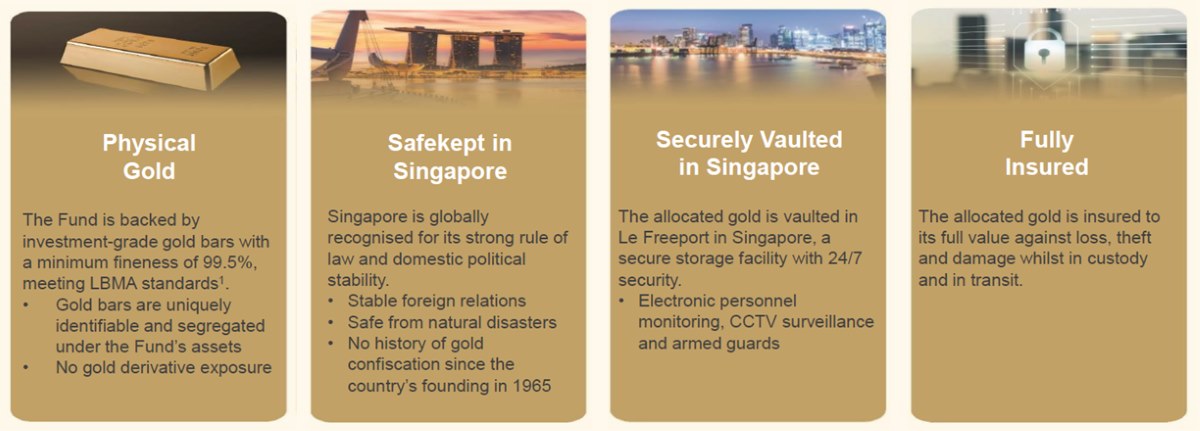
More importantly, it is backed by investment-grade gold bars, with the allocated gold vaulted in Singapore and fully insured while in custody and transit.
For investors who care not just about gold exposure, but also about how the gold is held and protected, I think this is one of the clearest things that sets GLU apart.
Learn more about the LionGlobal Singapore Physical Gold ETF* here.
What is the SPDR Gold Shares (GLD)?
SPDR Gold Shares is the first US-traded gold ETF and the first US-listed ETF backed by a physical asset.
SPDR Gold Shares is a US-domiciled gold ETF, but Singapore investors can access it on SGX through the USD counter O87 and the SGD counter GSD.
The trust was launched on 18 November 2004, and it is designed to reflect the performance of the price of gold bullion, less the trust’s expenses.
This long history gives me some assurance because it means the fund has already been tested across many different market cycles.
Each SPDR Gold Shares share was initially priced based on 1/10th of an ounce of gold. Over time, that amount falls slightly as gold is sold to pay the trust’s expenses. As of 31 January 2026, each share represented about ~0.092 ounce of gold exposure, so it would take roughly 10.9 shares to correspond to 1 ounce.
What gives me more confidence in the SPDR Gold Shares is that it is backed by physical gold bullion.
The trust holds physical gold bullion in the form of London Good Delivery bars, and these are held in an allocated account.
SPDR Gold Shares also stands out because of its sheer size. As of 31 January 2026, the trust had total net assets of about US$174.1 billion.
Learn more about the SPDR Gold Shares here.
What’s the difference between GLD and GLU ETF?
When I compare SPDR Gold Shares and LionGlobal Singapore Physical Gold ETF*, both serve to track the performance of the price of gold and offer a straightforward way to gain exposure to gold through SGX.
But since both can be traded in SGD and USD on SGX, I do not think the real difference comes down to currency access alone.
Instead, I would pay more attention to the differences that may actually matter to me as an investor.
Here are a few considerations that I would look at.
#1 – Years of inception
The first difference investors may notice is the length of track record.
SPDR Gold Shares was launched on 18 November 2004, while the LionGlobal Singapore Physical Gold ETF* is scheduled to list on 26 March 2026.
This means SPDR Gold Shares has a much longer history since inception, which may provide investors with greater familiarity and a longer performance record to assess.
That said, the LionGlobal Singapore Physical Gold ETF* is not entirely new in terms of underlying structure.
The ETF is a listed share class of the LionGlobal Singapore Physical Gold Fund*, which was incepted on 1 December 2025.
While the ETF itself will only begin trading upon listing, it is built on an underlying physical gold fund that has already been in operation prior to the ETF launch.
#2 - Assets under management
Another key difference is the size of assets under management (AUM), which can affect liquidity and trading activity.
SPDR Gold Shares is one of the largest gold ETFs globally, with about US$179.47 billion in AUM as of 11 March 2026.
On SGX alone, the ETF had already exceeded S$5 billion in AUM and recorded an average daily turnover of about S$29.1 million in January 2026, reflecting its established investor base.
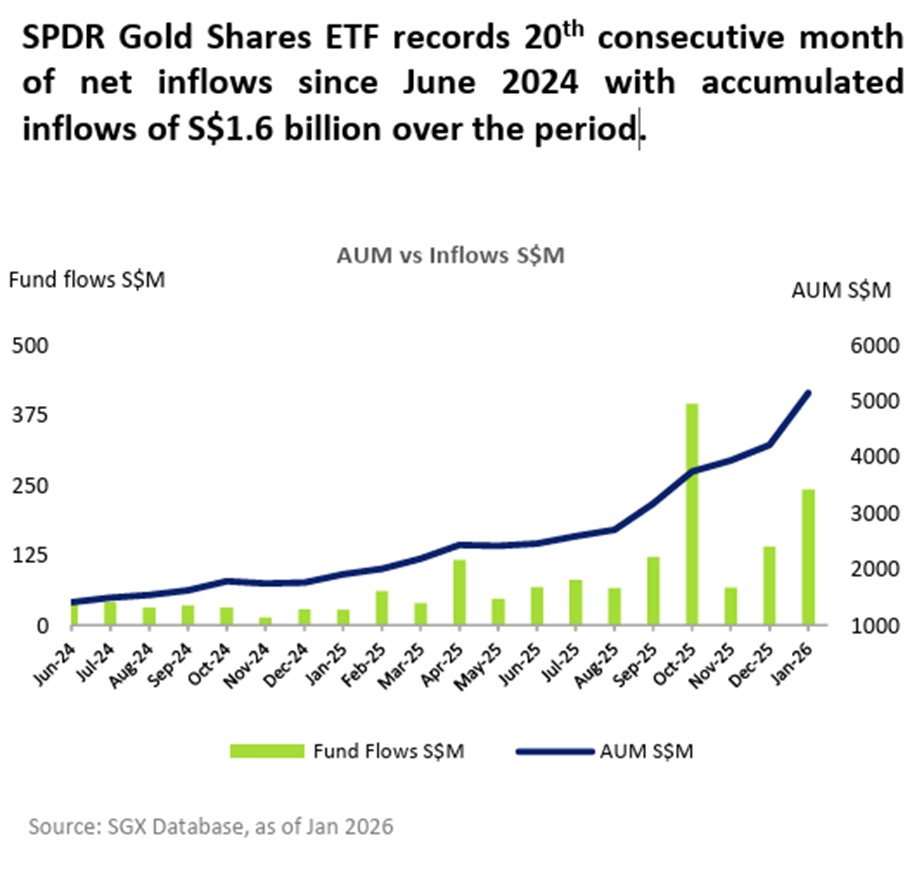
In comparison, the LionGlobal Singapore Physical Gold ETF* does not yet have post-listing AUM figures, as it has not started trading.
However, the underlying LionGlobal Singapore Physical Gold Fund* had grown to about S$502.2 million in AUM as of 27 February 2026.
While smaller in size, the fund has seen significant asset growth in the few months since inception.
#3 - Where the gold is stored and insured
Another area where the differences become more noticeable is how the physical gold is held.
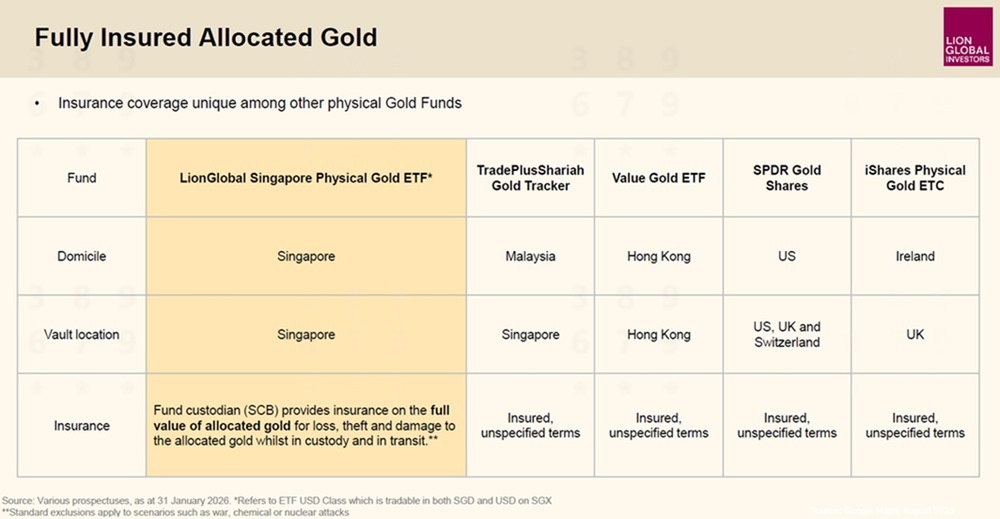
SPDR Gold Shares is a physically backed gold trust that holds gold bullion in the form of London Good Delivery bars in allocated accounts.
The gold is held with custodians including HSBC Bank plc and JPMorgan Chase Bank, and is stored in secure vaults located in London, New York and Zurich.
The LionGlobal Singapore Physical Gold ETF* also provides physically backed exposure, but with a more localised structure.
It is designed as Singapore’s first gold ETF backed by physical gold that is vaulted in Singapore.
The fund invests in investment-grade gold bars with a minimum fineness of 99.5%, with the allocated gold stored at Le Freeport in Singapore under secured storage conditions.
The gold is insured to its full value against loss, theft and damage while in custody and in transit, based on disclosures in the fund’s prospectus.
In practical terms, both ETFs provide exposure to the price of physical gold, but the custody arrangements differ. SPDR Gold Shares has a long-established global vaulting structure, while the LionGlobal Singapore Physical Gold ETF* emphasises local vaulting and insurance coverage within Singapore.
For investors who are primarily focused on price exposure, this difference may not materially affect the investment outcome. However, for those who place importance on where and how the physical gold is stored, the custody structure could be a relevant consideration when comparing the two ETFs.
#4 - Expense ratio broadly similar
If we look only at headline fees, the difference between the two ETFs is relatively small.
SPDR Gold Shares has an expense ratio of 0.40%, while the LionGlobal Singapore Physical Gold ETF* charges a management fee of 0.39%.
Given the narrow gap, the fee difference alone is unlikely to be a decisive factor for most investors.
Instead, it may be more useful to consider the total cost of investing, which includes bid-ask spreads, brokerage commissions, and any foreign exchange conversion charges.
#5 – CPF and SRS eligibility
One of the more practical differences for Singapore investors is eligibility under CPFIS and SRS.
SPDR Gold Shares is already included under both CPFIS and SRS, making it a readily available option for investors who wish to gain gold exposure for their retirement savings. In fact, GLD was among the top 10 ETF held by SRS investors as of October 2025, reflecting its established usage within the scheme.
For the LionGlobal Singapore Physical Gold ETF*, investors will be able to use SRS funds to invest after the ETF is listed on SGX on 26 March 2026, subject to platform availability. However, CPFIS eligibility has not been indicated at this point.
In practical terms, this means SPDR Gold Shares currently offers greater flexibility for investors who want to invest using CPF funds, while both ETFs may be viable options for SRS investors once the LionGlobal Singapore Physical Gold ETF* begins trading.
#6 – Benchmark and gold price reference
Another difference is the benchmark each ETF tracks.
SPDR Gold Shares uses the LBMA Gold Price PM, while the LionGlobal Singapore Physical Gold ETF* tracks the LBMA Gold Price AM. Both are part of the same LBMA pricing framework, but they refer to different fixing times during the day.
In practice, this difference is unlikely to matter much for long-term investors, as both ETFs aim to reflect movements in the price of physical gold.
However, the different fixing times may lead to small short-term differences in pricing and performance, especially when gold prices move sharply during the day.
How the GLD and GLU compare
The table below summarises the main differences:
| Feature | SPDR Gold Shares (GLD: O87 / GSD) | LionGlobal Singapore Physical Gold ETF (GLU / GLS) |
| Primary market identity | Established global gold ETF | First Singapore-vaulted Physical Gold ETF |
| Listing / trading venue | Listed in the US, and cross-listed on SGX | Listed on SGX |
| SGX trading counters | O87 (USD), GSD (SGD) | GLU (USD), GLS (SGD) |
| Trading currency options on SGX | Available in USD and SGD | |
| Track record | Inception on 18 Nov 2004 | Scheduled to list on 26 Mar 2026 |
| Benchmark / reference | Tracks gold based on the LBMA Gold Price PM | Designed to track the LBMA Gold Price AM as closely as possible, before fees and expenses |
| Underlying assets | Physical gold bullion in the form of London Good Delivery bars | Investment-grade physical gold bars with minimum fineness of 99.5% |
| Expense ratio / fee | 0.40% expense ratio | 0.39% management fee, with TER capped at 0.39% |
| AUM | US$174.1 billion | Underlying LionGlobal Singapore Physical Gold Fund had S$453 million AUM as of 30 Jan 2026; ETF AUM not yet available before listing. |
| Gold storage | Physical gold-backed structure with institutional custodians, vaulted in London, New York and Zurich. | Physical gold is vaulted in Singapore and fully insured while in custody and transit. |
| SRS eligibility | Available for SRS | SRS eligible after listing on SGX on 26 Mar 2026 |
| CPF eligibility | Included under CPFIS (subject to applicable limits) | Not eligible currently. |
| Source: Various factsheet and prospectuses, as at 31 January 2026. | ||
Factors to consider before investing in the gold ETFs
#1 - Gold prices can still be volatile
Gold prices are influenced by factors such as interest rates, inflation expectations, movements in the US dollar, and overall investor sentiment.
As a result, gold does not always rise during periods of uncertainty, and its performance can vary depending on the broader macro environment.
Both GLD and the LionGlobal Singapore Physical Gold ETF* are linked to the price of physical gold, so investors should expect their prices to fluctuate along with the gold market.
Track the latest price of gold in Singapore here.

#2 - Gold does not generate income
Another important consideration is that gold does not generate regular income.
Unlike dividend stocks, REITs or bonds, holding gold does not provide coupons, dividends or distributions. Returns depend mainly on changes in the gold price over time.
For this reason, gold is often viewed as a diversification asset within a long-term portfolio, rather than as an income-generating investment.
It may help reduce overall portfolio volatility, but it does not provide the steady cash flow that income-focused assets can offer.
#3 - ETF exposure is not the same as holding physical gold directly
When I buy a gold ETF, I am buying units in a fund. I am not personally holding gold bars or coins.
That makes things much more convenient. But it also means I am relying on the ETF structure, custody arrangements, and how the product is managed.
That’s why it is still important to understand the ETF structure, custody arrangement, and how the product fits into your own overall portfolio.
What would Beansprout do?
When comparing between the two ETFs, the first question I would ask myself is the role of gold in my portfolio.
For most investors, gold is not held for income or short-term speculation, but as a long-term diversifier that may help reduce overall portfolio volatility.
Both GLD and GLU provide a simple way to gain exposure to the price of gold. Both ETFs are backed by physical gold and have broadly similar expense ratios.
GLD has a much longer track record and significantly larger assets under management, which may appeal to investors who prefer a more established global ETF.
It is also currently available under CPFIS, making it the clearer choice for those who wish to invest using CPF funds. Learn more about the SPDR Gold Shares here.
On the other hand, GLU may be more relevant for investors who value the fact that the physical gold is vaulted and insured in Singapore.
For some investors, the local structure and custody arrangements may provide additional comfort, especially for those who prefer to keep their investments within the Singapore regulatory framework. Learn more about the LionGlobal Singapore Physical Gold ETF* here.
If you are interested in other gold ETFs, check out our comparison of the best gold ETF in Singapore here.
Beyond ETFs, you can also find out how to invest in gold in Singapore here.
If you are interested to learn more about investing in gold, you can read our guide on why invest in gold here.
Track the latest gold prices in Singapore here.
Check out Beansprout's guide to the best stock trading platforms in Singapore with the latest promotions to invest in gold ETFs.
Enjoyed this insight? Follow Beansprout on Telegram, Youtube, Facebook and Instagram, and add Beansprout as your preferred source on Google so you never miss an update.
*Refers to ETF USD Class which is tradable in SGD and USD on SGX
Read also
Gain financial insights in minutes
Subscribe to our free weekly newsletter for more insights to grow your wealth
Most Popular

Comments
1 comments
- Elena Cairo • 13 Mar 2026 09:58 PM