
How to build a Singapore dividend portfolio in 2026 and earn more from it with IG Markets
Brokerage Account
Powered by

By Nicole Ng • 03 Jul 2026
Why trust Beansprout? We’ve been awarded Best Investment Website at the SIAS Investors’ Choice Awards 2025
'%3e%3cpath%20fill-rule='evenodd'%20clip-rule='evenodd'%20d='M17.64%209.20455C17.64%208.56637%2017.5827%207.95273%2017.4764%207.36364H9V10.845H13.8436C13.635%2011.97%2013.0009%2012.9232%2012.0477%2013.5614V15.8195H14.9564C16.6582%2014.2527%2017.64%2011.9455%2017.64%209.20455V9.20455Z'%20fill='%234285F4'/%3e%3cpath%20fill-rule='evenodd'%20clip-rule='evenodd'%20d='M9%2018C11.43%2018%2013.4673%2017.1941%2014.9564%2015.8195L12.0477%2013.5614C11.2418%2014.1014%2010.2109%2014.4205%209%2014.4205C6.65591%2014.4205%204.67182%2012.8373%203.96409%2010.71H0.957275V13.0418C2.43818%2015.9832%205.48182%2018%209%2018V18Z'%20fill='%2334A853'/%3e%3cpath%20fill-rule='evenodd'%20clip-rule='evenodd'%20d='M3.96409%2010.71C3.78409%2010.17%203.68182%209.59318%203.68182%209C3.68182%208.40682%203.78409%207.83%203.96409%207.29V4.95818H0.957273C0.347727%206.17318%200%207.54773%200%209C0%2010.4523%200.347727%2011.8268%200.957273%2013.0418L3.96409%2010.71V10.71Z'%20fill='%23FBBC05'/%3e%3cpath%20fill-rule='evenodd'%20clip-rule='evenodd'%20d='M9%203.57955C10.3214%203.57955%2011.5077%204.03364%2012.4405%204.92545L15.0218%202.34409C13.4632%200.891818%2011.4259%200%209%200C5.48182%200%202.43818%202.01682%200.957275%204.95818L3.96409%207.29C4.67182%205.16273%206.65591%203.57955%209%203.57955V3.57955Z'%20fill='%23EA4335'/%3e%3c/g%3e%3cdefs%3e%3cclipPath%20id='clip0_0_2849'%3e%3crect%20width='18'%20height='18'%20fill='white'/%3e%3c/clipPath%3e%3c/defs%3e%3c/svg%3e)
Make Beansprout your preferred source on Google
Add us on Google to see more of our insights in your search results
Learn how to build a Singapore dividend portfolio with IG Markets (share trading), and earn additional 3% p.a. interest* on top of dividends.
This post was created in partnership with IG Markets All views and opinions expressed in this article are Beansprout's objective and professional opinions.
What happened?
Singapore dividend stocks are back in focus.
In early 2026, the Straits Times Index (STI) crossed 5,000 for the first time in its history, before pulling back amid global macro uncertainty.
At the same time, volatility across global markets and currencies has increased, while the Singapore dollar has remained relatively resilient.
If you’re focused on building a steadier portfolio that can generate income while waiting for long-term growth, you may be thinking of investing in Singapore stocks, which have historically provided consistent dividend income for investors.
And if you’re looking for a broker that allows you to earn more from your investments, IG Markets (share trading) offers 3% p.a. interest on eligible invested shares and ETFs.
Here I’ll share how to build a simple Singapore dividend portfolio using IG Markets (share trading), while potentially earning up to an additional 3% p.a.* on eligible holdings alongside dividend income.
How I'm building a Singapore dividend income portfolio in 2026
A Singapore dividend portfolio can provide exposure to familiar companies, Singapore-dollar income, and sectors that have historically paid regular dividends.
The aim is not to find the highest-yielding stock in the market. It is to build a portfolio that can provide income across different market cycles, while still leaving room for long-term capital growth.
With that in mind, a simple and diversified portfolio can be built around three building blocks: Singapore banks for quality dividend exposure, S-REITs for yield, and selected defensive blue chip stocks for stability.
#1 - Singapore banks as the dividend anchor
DBS, OCBC, and UOB are often-cited examples of established dividend-paying companies in Singapore.
Together, the three local banks account for roughly half of the Straits Times Index (STI).
They are large, profitable businesses with established dividend policies, although their payouts can still be affected by interest rates, credit costs, and regulatory guidance.
As of May 2026, the three local banks offered dividend yields of around 4.3% to 5.0%.
All three banks have also held or grown their dividends through the recent interest rate cycle.
#2 - S-REITs for yield focus
S-REITs can offer a higher income profile than many blue-chip stocks because they distribute a large portion of their taxable income and typically pay distributions on a quarterly or semi-annual basis.
For example, the CSOP iEdge S-REIT Leaders Index ETF yielded around 5.7% in April 2026, near its three-year average, while some industrial and data centre REITs were yielding above 6%.
However, relying on a single REIT sector may increase concentration risk.
As such, it's important to diversify sub-segments such as industrial, retail, logistics or data centre REITs to reduce concentration risk.
#3 - Telcos and utility-linked stocks for portfolio stability
The third building block would be selected defensive blue-chip stocks, such as telcos and utility-linked companies.
Blue-chip stocks such as Singtel and Sembcorp Industries are not risk-free, but they provide exposure to businesses with more recurring demand than highly cyclical sectors.
For this part of the portfolio, the focus is less on maximising dividend yield and more on the visibility of earnings and cash flows.
A roughly even weighting across the three building blocks can help create a diversified income portfolio, with flexibility to adjust allocations based on factors such as yield, balance sheet strength, and earnings volatility.
With the shape of the portfolio decided, the next question is how returns may potentially be enhanced from the same holdings.
Stacking dividend income with the 3% p.a. interest on shares* with IG Markets (share trading)
Most income portfolios usually earn from dividends alone.
But building your Singapore income portfolio with IG Markets (share trading) allows you to earn additional income.
With most brokerage platforms, the arrangement is straightforward.
You hold shares, receive dividends when companies pay them, and total returns depend on both dividend income and share price movements.
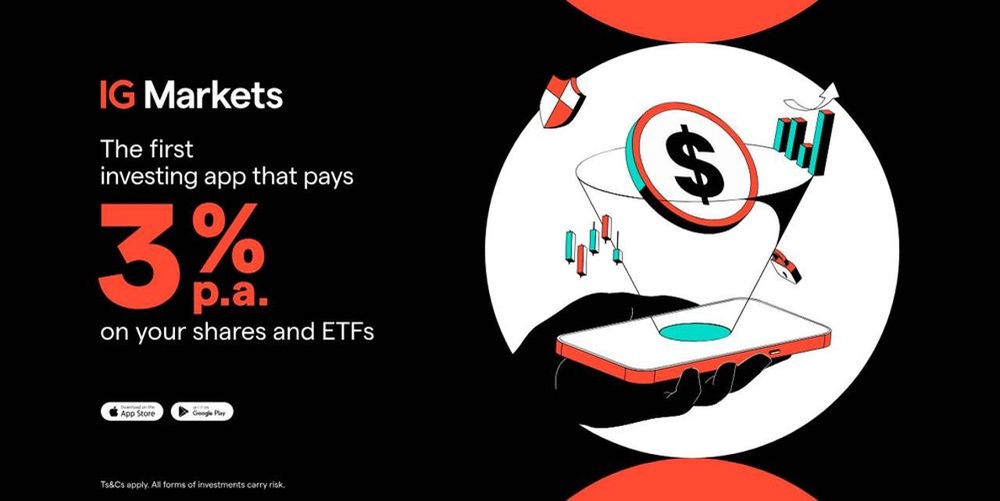
IG Markets (share trading) is currently the first brokerage in Singapore where eligible investors can earn up to 3% p.a.* on the first S$50,000 of qualifying invested shares and ETFs, subject to at least one qualifying trade per month.
The interest is paid separately from any dividends generated by the underlying stocks or ETFs.
In practice, this means you may benefit from two potential return components from the same portfolio, without changing the underlying shares or ETFs held.
Return layer 1: Dividends from Singapore stocks
The first return layer comes from the portfolio itself.
A balanced Singapore dividend portfolio could be made up of banks, REITs, and defensive income stocks that could potentially generate an illustrative blended dividend yield of around 5% p.a., depending on the final mix of holdings.
On a S$50,000 portfolio, that would work out to about S$2,500 a year in dividend income.
Return layer 2: Interest on holdings with IG Markets (share trading)
The second return layer comes from IG Markets’ interest-on-holdings feature.
For a S$50,000 qualifying portfolio, the 3% p.a.* interest could amount to up to S$1,500 a year.
This would be on top of any dividends from the underlying stocks and ETFs held within the portfolio.
The benefit is capped at the first S$50,000 of qualifying holdings.
For investors who are still building a dividend portfolio, this could provide an additional stream of potential income.
Illustrative example: S$50,000 invested with IG Markets (share trading)
| Return layer | Assumption | Potential annual return |
| Dividends from Singapore stocks | ~5% p.a. blended yield on S$50,000 | ~S$2,500 |
| Interest on holdings (IG Markets share trading account) | Up to 3% p.a. on first S$50,000 | Up to S$1,500 |
| Total potential return | Up to S$4,000 | |
| Note: The ~5% blended yield is illustrative, based on Singapore bank and S-REIT yields as of May 2026. Actual dividends depend on your holdings. Interest on holdings is subject to IG Markets’ terms, including the qualifying trade requirement. Past dividends do not guarantee future dividends. | ||
For example, a S$50,000 portfolio of eligible Singapore stocks and ETFs could potentially generate up to S$4,000 a year in combined dividend income and interest on eligible holdings through IG Markets (share trading).
This would be about S$2,500 in potential dividend income, and up to S$1,500 from IG Markets (share trading)’s 3% p.a. interest on eligible holdings.
The interest is paid on top of any dividends generated by the underlying portfolio holdings.
The underlying portfolio is the same. The difference is that eligible holdings may also qualify for interest from IG Markets interest-on-holdings feature.
Of course, this is not a guaranteed total return. Share prices can fall, dividends can be reduced, and the 3% p.a. interest is subject to IG Markets (share trading)’s eligibility criteria and terms and conditions.
One of the requirements for earning the 3% p.a. interest is making at least one qualifying trade a month.
If you’re a long-term investor, you may be able to meet the monthly qualifying trade through dollar cost averaging (DCA).
DCA involves investing a fixed amount into the same stocks or ETFs at regular intervals over time.
And you can combine DCA with dividend reinvestment.
When dividends are reinvested, they are used to purchase additional shares or units, which may subsequently generate additional dividend income.
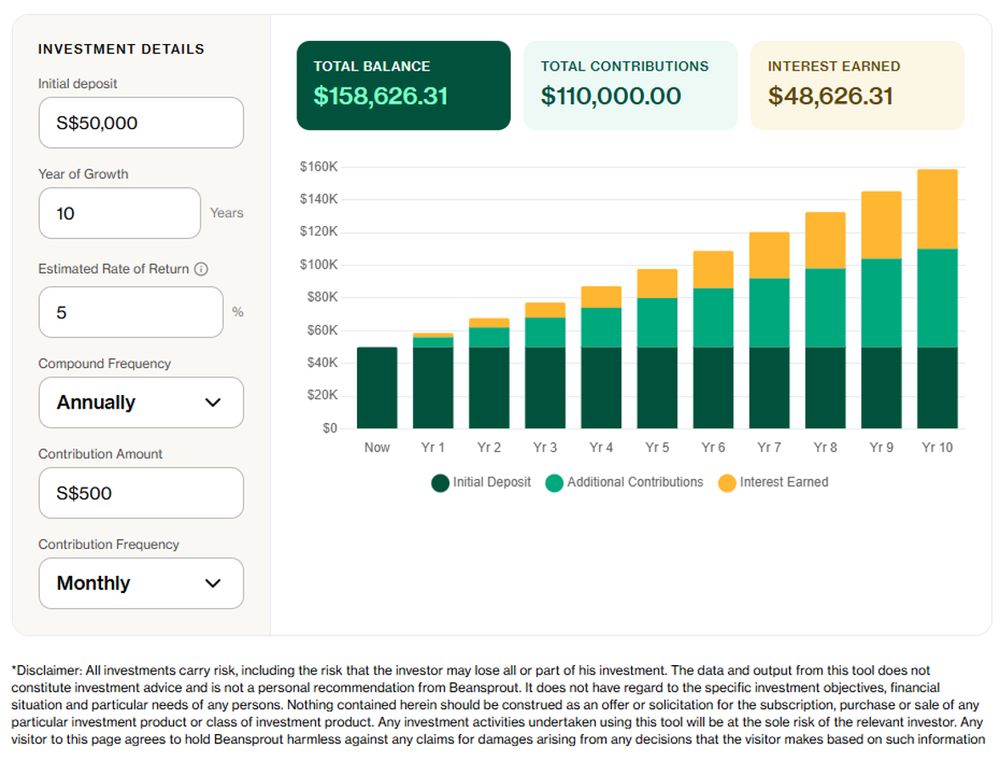
Although the effects may appear minor at first, reinvestment and compounding can have a more significant impact over longer periods of time.
Additional IG Markets (share trading) welcome rewards and platform features
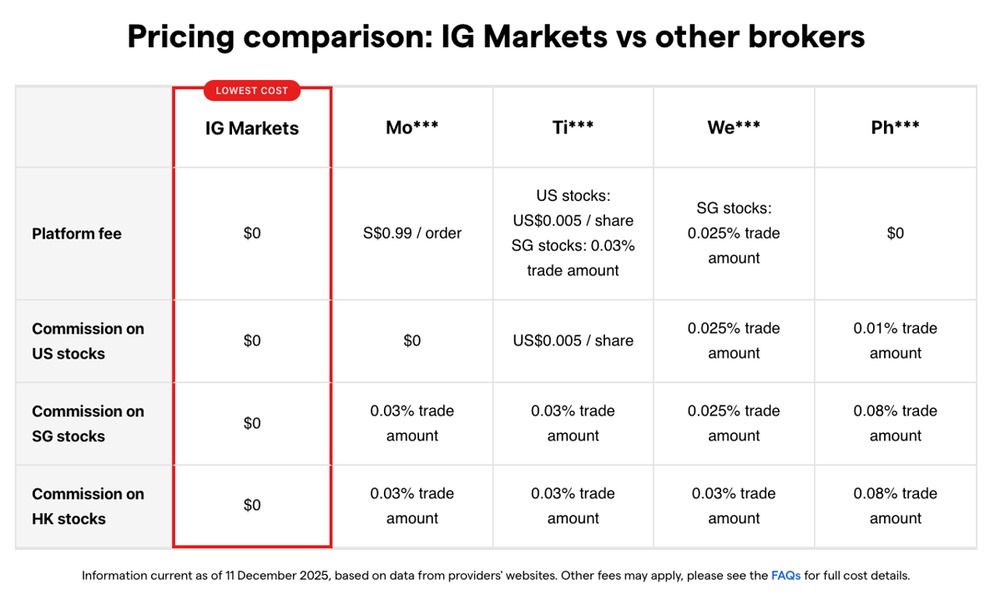
In addition to the 3% p.a. interest on eligible holdings, IG Markets (share trading) has S$0 commission and S$0 platform fees on Singapore shares and ETFs.
IG Markets (share trading) currently offers:
- S$0 commission on Singapore shares and ETFs
- No platform or settlement fees, although other fees and charges may apply
- Access to Singapore, US, UK, Hong Kong and Japan markets through a single account
- US fractional shares from as little as S$1
- Interest on eligible invested shares and ETFs, rather than just idle cash
Source: IG Markets
You can also access multiple markets if you wish to expand beyond Singapore dividend stocks over time.
For example, a portfolio may initially focus on SGX-listed banks and REITs before expanding to include global ETFs, US equities, UK-listed income stocks or Hong Kong-listed companies, without the need to open a separate brokerage account.
I covered this broader approach in a previous article on building a global stock portfolio with IG Markets here.
If you have yet to open an IG Markets share trading account, you can also enjoy additional welcome rewards under its July 2026 campaign:
- Receive up to S$258 welcome bonus when you sign up, fund at least S$500, hold your deposit for 30 days, and make 1 trade within 7 days from the date of account activation. This promotion runs from 1 July to 31 July 2026.
- Get a S$80 FairPrice voucher when you sign up through Beansprout and fund at least S$500 by 31 July 2026.
- These promotions apply to IG Markets (share trading) accounts only.
This means you could potentially earn dividends from your portfolio, receive up to 3% p.a. interest on eligible holdings, and enjoy additional welcome rewards when getting started.
Learn more about the IG Markets (share trading) welcome rewards here.
Key things to consider when building a Singapore dividend portfolio
This approach works best for long-term investors who are prepared to hold through market cycles, reinvest their dividends, and focus on compounding rather than trading in and out.
The reason is simple. Compounding only works when dividends are put back to work.
By using each payout to buy more shares, the next round of dividends is paid on a slightly larger base. The effect may look small in the first year, but it can become more meaningful over three to five years.
However, dividend investing is not risk-free.
Singapore banks, REITs, and blue chip stocks can still experience price declines during market sell-offs, and some companies may reduce their dividends during periods of economic or market stress.
So it’s important to size your positions carefully, diversify across banks, REITs and defensive income stocks, and keep reinvesting through both strong and weak markets.
The goal is not necessarily to avoid market volatility completely, but to stay invested long enough for the income stream to compound over time.
What would Beansprout do?
A common approach to building a simple, diversified dividend portfolio using Singapore stocks and ETFs, and look for ways to earn more from the same holdings without more risk.
Here are three things to keep in mind:
First, focus on compounding dividends over the long term rather than chasing short-term yield. The real power of a dividend portfolio shows up over five to ten years, not the first twelve months, which means reinvesting payouts and topping up through monthly DCA.
Second, enhance returns without increasing risk. Keep costs low and use platform features that genuinely add to returns. An extra 3% p.a. on the first S$50,000, on top of the dividends, is a real incremental return that requires no change to the portfolio.
Third, choose the platform deliberately. Factors such as fees, market access, available features, and investment flexibility may influence the overall investing experience and the range of investment opportunities available over time.
Hence, if you are already investing in Singapore dividend stocks, it might be worth seeing whether IG Markets (share trading) can help you get more from the same portfolio, with up to 3% p,a, on the first S$50,000 of holdings*, plus welcome rewards for eligible new accounts.
Exclusive IG Markets (share trading) new user promotion
These promotions are applicable to IG Markets (share trading) accounts only.
*Terms and conditions apply.
Learn more about the IG Markets (share trading) welcome rewards here.
Disclaimer: This article is meant for information only and should not be relied upon as financial advice. Terms and conditions apply. Please refer to IG Markets’ official website for complete terms and conditions, disclaimers and disclosures. Trading is a high-risk activity, and it is possible to lose your initial investment. Investments are not covered by the Singapore Deposit Insurance Corporation (SDIC).
All content presented herein may contain advertisements. No content should be construed as investment advice, a recommendation, or an offer or solicitation to deal in any investment product. All investors should consider for themselves if the investment products are suitable. Investors are advised to seek advice from a professional financial adviser if they are uncertain if the investment products are suitable for them. Principal is not guaranteed. Past performance of any investment products is not indicative of future performance. The value of the investment products and the income from them may fall as well as rise. Investing in investment products contains risks and investors may lose all their investments. Margin trading increases the risk of loss and clients’ losses may exceed the deposits placed. All investments involve risks and are not suitable for every investor.
The images shown in this advertisement are for illustrative purposes only.
This advertisement has not been reviewed by the Monetary Authority of Singapore.
This article contains affiliate links. Beansprout may receive a share of the revenue from your sign-ups to keep our site sustainable. You can view our editorial guidelines here.
Read also
Gain financial insights in minutes
Subscribe to our free weekly newsletter for more insights to grow your wealth
Most Popular

Questions and Answers
0 questions