
Compound Interest Calculator
Discover how your savings and investments can grow over time with our compound interest calculator, tapping into the power of compounding to boost your financial growth.
Investment Details
Initial deposit
Year of Growth
Estimated Rate of Return
Compound Frequency
Contribution Amount
Contribution Frequency
Estimated Portfolio Value
$27,383.96
Total Contributions
$22,000.00
Estimated Growth
$5,383.96
*Disclaimer: All investments carry risk, including the risk that the investor may lose all or part of his investment. The data and output from this tool does not constitute investment advice and is not a personal recommendation from Beansprout. It does not have regard to the specific investment objectives, financial situation and particular needs of any persons. Nothing contained herein should be construed as an offer or solicitation for the subscription, purchase or sale of any particular investment product or class of investment product. Any investment activities undertaken using this tool will be at the sole risk of the relevant investor. Any visitor to this page agrees to hold Beansprout harmless against any claims for damages arising from any decisions that the visitor makes based on such information
Using this Compound Interest Calculator
Tip: Calculate with or without monthly or annual contributions to compare how small regular savings can amplify growth over time.
This calculator includes an example rate of return. For a benchmark of the best annual yield, check out our guide to the best savings account in Singapore or the best fixed deposit in Singapore. If you are open to more asset classes, learn more about where to park your cash for higher yield (Tbill vs Fixed Deposit vs SSB).
What is compound interest?
Compound interest is the magic behind growing your wealth exponentially—it's the interest you earn on your original amount plus the interest that accumulates over time. With our Compound Interest Calculator, you can see this power in action, whether you're saving in a CPF account, investing in Singapore Savings Bonds (SSBs), or exploring stocks. Unlike simple interest, our Compound Interest Calculator shows how your money compounds, accelerating growth year after year.
Compound interest calculator example
Use our Compound Interest Calculator to see how $10,000 grows in a Singapore savings account with a 3% annual yield, compounded monthly.
Here's what you'd enter into the calculator:
- Initial Deposit: $10,000
- Years of Growth: 10
- Estimated Rate of Return: 3%
- Compound Frequency: Monthly
- Contribution Amount: $0
- Contribution Frequency: Monthly
After 10 years, you'll have a total balance of $13,493.54. This includes your total contributions of $10,000 and $3,493.54 in interest earned through compounding.
Power of additional contributions to compounding
While compound interest alone can significantly boost your savings, consistent contributions can supercharge your growth. In the example above, starting with $10,000 at a 3% annual yield, compounded monthly over 10 years without additional contributions, yields approximately $3,439.37 in interest, bringing your total balance to $13,439.37.
However, by adding $100 at the end of each month, your total contributions rise to $22,000 ($10,000 initial + $12,000 from monthly deposits), and the interest earned jumps to $5,467.68, resulting in a total balance of $27,467.68.
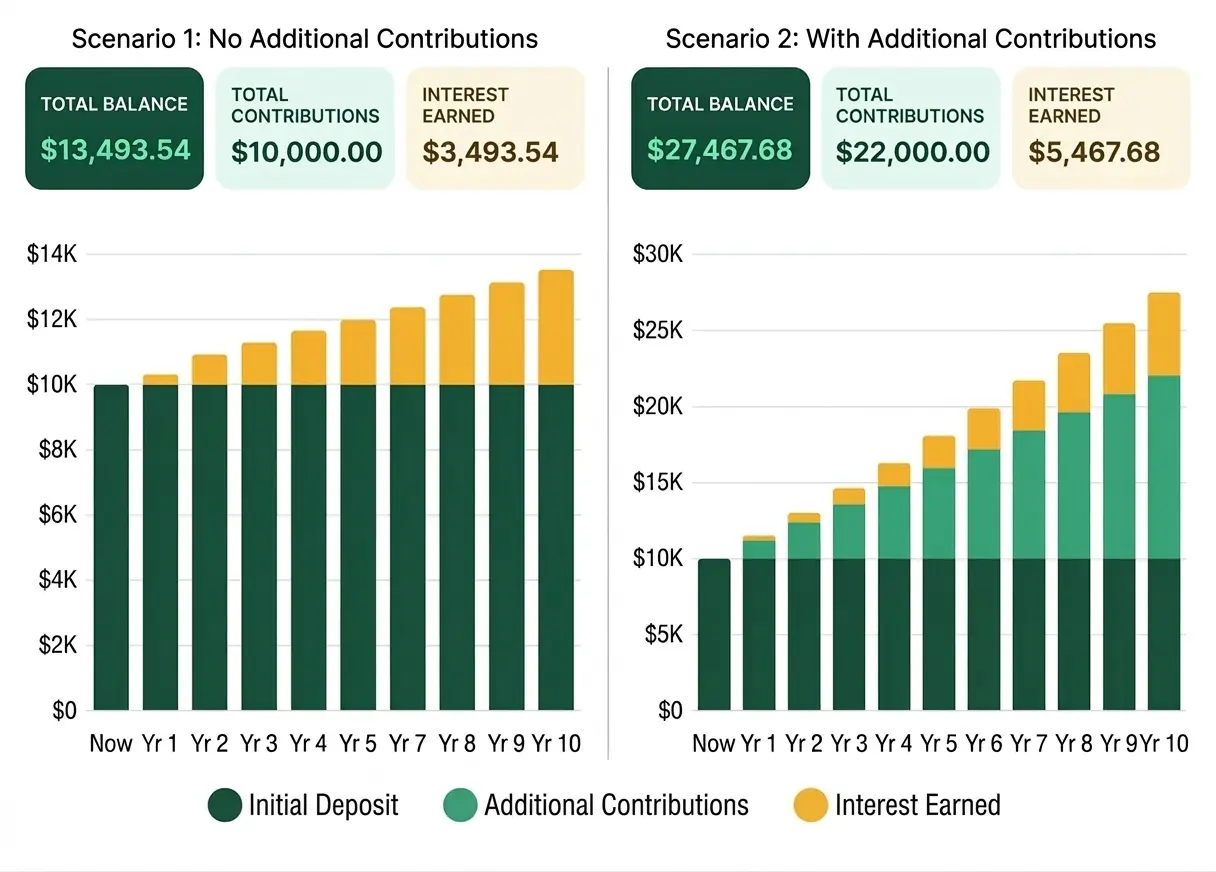
Curious about your situation? Try adjusting the contribution amounts within the compound interest calculator—or remove them entirely—to see how your savings could grow over time, tailored to your financial habits.
Harnessing compound growth for your financial future
Compound interest isn't just for savings—it's a powerful force in the world of investments, where returns can fluctuate based on market performance rather than a fixed rate. When you invest, say $10,000 in a diversified portfolio like a Singapore STI ETF, with an average 10-year return of approximately 5%. In the first year, you would gain $500 and your investment would be worth $10,500. If that growth continues at 5% annually over the next 10 years, your investment could rise to $16,470, with returns building on themselves over time. While market values can dip in the short term, especially with riskier assets like stocks, historical data shows that a well-balanced portfolio can grow significantly over decades, demonstrating how compounding can turn a modest starting amount into substantial wealth over time.
To make the most of this potential, consider these strategies:
- Begin Soon: Starting early gives your money more time to benefit from compounding, turning even modest initial investments into substantial gains.
- Contribute regularly: Consistently contributing to your investment portfolio—say, with monthly CPF contributions or ETF purchases—amplifies the compounding effect, as each addition earns its returns.
- Reinvest Gains: Channel dividends or profits back into your investments to fuel further growth, a strategy easily tracked with our calculator.
- Set Up Automation: Automate your investment contributions to maintain steady progress without manual effort, ideal for you if you do not have the time to actively manage your investment.
- Leverage Tax Benefits: Utilize tax-advantaged options like the Supplementary Retirement Scheme (SRS) to let your returns compound tax-free until withdrawal, maximizing your net growth.
By experimenting with these approaches in our Compound Interest Calculator, you can visualize how time and consistency transform your investments, aligning with your unique financial goals in Singapore.
Top Singapore Investment Options for Compounding
Compounding is one of the most effective ways to grow wealth over time. When you reinvest the returns from your investments, your money can continue to grow on both your original amount and the gains you have already earned. Over the long run, this snowball effect can make a meaningful difference to your portfolio.
For investors in Singapore, compounding can come from a mix of different investment options, depending on your goals, risk appetite, and investment horizon. Whether you are looking for broad market exposure, regular income, or long-term capital growth, understanding your options can help you build a strategy that works for you.
Explore these popular investment options in Singapore and use our Compound Interest Calculator to see how different return assumptions and monthly contributions could grow over time.
- Singapore STI ETF: A Singapore STI ETF gives you exposure to the Straits Times Index, which tracks some of the largest listed companies in Singapore. It can be a simple way to build long-term wealth through diversified exposure to the Singapore stock market. Learn more about Straits Times Index
- Mutual Funds: Mutual funds let you invest in a professionally managed portfolio of assets, which may include equities, bonds, or a mix of both. They can be useful for investors who want diversification without having to pick individual securities themselves.
- ETFs: Exchange-traded funds, or ETFs, offer a convenient way to invest in a basket of securities through a single product. They can help investors gain exposure to global markets, sectors, themes, or asset classes while keeping their portfolio diversified. Explore Singapore ETFs.
- Singapore REITs: Singapore REITs are a popular option for investors seeking exposure to income-generating real estate assets such as malls, offices, industrial properties, and data centres. They are often considered by investors looking to combine income potential with long-term compounding through reinvestment. Explore REITs in Singapore to find out more.
- Singapore Dividend Stocks: Singapore dividend stocks are commonly used by investors looking to build passive income while growing their capital over time. Reinvesting dividends can help strengthen the compounding effect and support long-term portfolio growth. Check out our Income Stock Screener to screen for dividend stocks in Singapore.
Experiment with these options in our Compound Interest Calculator by adjusting your estimated rate of returns, and contributions to find the best fit for your financial goals.