
Singapore REITs have bounced back. Are dividend yields still attractive?
REITs
By Gerald Wong, CFA • 25 Apr 2026
Why trust Beansprout? We’ve been awarded Best Investment Website at the SIAS Investors’ Choice Awards 2025
'%3e%3cpath%20fill-rule='evenodd'%20clip-rule='evenodd'%20d='M17.64%209.20455C17.64%208.56637%2017.5827%207.95273%2017.4764%207.36364H9V10.845H13.8436C13.635%2011.97%2013.0009%2012.9232%2012.0477%2013.5614V15.8195H14.9564C16.6582%2014.2527%2017.64%2011.9455%2017.64%209.20455V9.20455Z'%20fill='%234285F4'/%3e%3cpath%20fill-rule='evenodd'%20clip-rule='evenodd'%20d='M9%2018C11.43%2018%2013.4673%2017.1941%2014.9564%2015.8195L12.0477%2013.5614C11.2418%2014.1014%2010.2109%2014.4205%209%2014.4205C6.65591%2014.4205%204.67182%2012.8373%203.96409%2010.71H0.957275V13.0418C2.43818%2015.9832%205.48182%2018%209%2018V18Z'%20fill='%2334A853'/%3e%3cpath%20fill-rule='evenodd'%20clip-rule='evenodd'%20d='M3.96409%2010.71C3.78409%2010.17%203.68182%209.59318%203.68182%209C3.68182%208.40682%203.78409%207.83%203.96409%207.29V4.95818H0.957273C0.347727%206.17318%200%207.54773%200%209C0%2010.4523%200.347727%2011.8268%200.957273%2013.0418L3.96409%2010.71V10.71Z'%20fill='%23FBBC05'/%3e%3cpath%20fill-rule='evenodd'%20clip-rule='evenodd'%20d='M9%203.57955C10.3214%203.57955%2011.5077%204.03364%2012.4405%204.92545L15.0218%202.34409C13.4632%200.891818%2011.4259%200%209%200C5.48182%200%202.43818%202.01682%200.957275%204.95818L3.96409%207.29C4.67182%205.16273%206.65591%203.57955%209%203.57955V3.57955Z'%20fill='%23EA4335'/%3e%3c/g%3e%3cdefs%3e%3cclipPath%20id='clip0_0_2849'%3e%3crect%20width='18'%20height='18'%20fill='white'/%3e%3c/clipPath%3e%3c/defs%3e%3c/svg%3e)
Make Beansprout your preferred source on Google
Add us on Google to see more of our insights in your search results
Singapore REITs have rebounded in April as government bond yields eased. We look at their latest dividend yields and what income investors may watch.
What happened?
Singapore REITs have bounced back.
Earlier, I looked at whether the March pullback in Singapore REITs had created a buying opportunity for income investors.
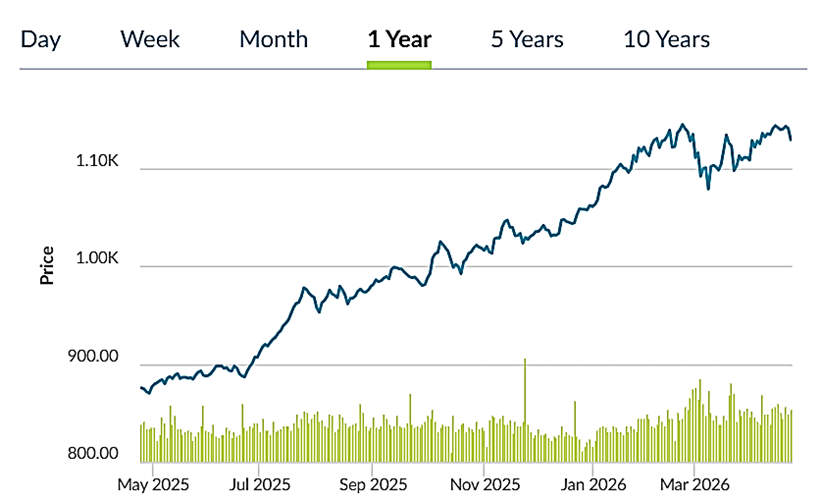
Since then, the FTSE ST All-Share REIT Index rebounded 5.1% as of 17 April. This follows a 6.9% decline in March as higher oil prices, inflation concerns, and rising bond yields weighed on sentiment.
Many in the Beansprout Telegram group are now asking whether Singapore REITs dividend yields are still attractive after the recent bounce.
In this article, I compare Singapore REIT dividend yields with government bond yields and assess whether valuations are still attractive after the recent rebound.
Singapore REIT dividend yields look more attractive as government bond yields fall
One reason sentiment has improved is that government bond yields have moved lower again.
Many investors compare Singapore REIT yields with what they can earn from safer assets such as government bonds.
Singapore government bonds have acted as a regional safe haven, outperforming Southeast Asian peers.
When bond yields fall, the income offered by Singapore REITs can start to look more appealing again.
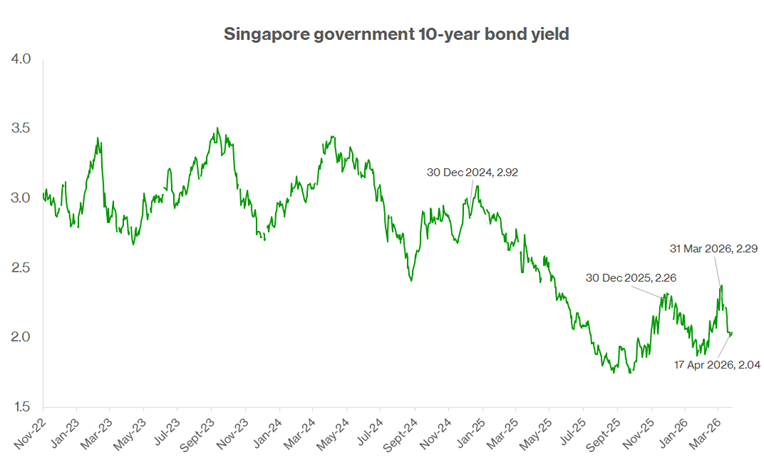
This helps explain why the recent rebound in Singapore REITs has come alongside the decline in government bond yields.
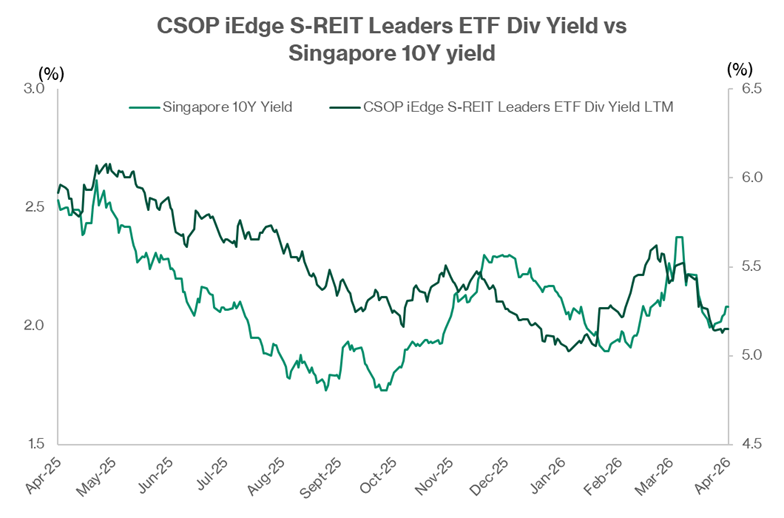
As at 17 April 2026, the Singapore 10-year government bond yield had fallen from 2.29% as of 31 March 2026 to 2.04%.
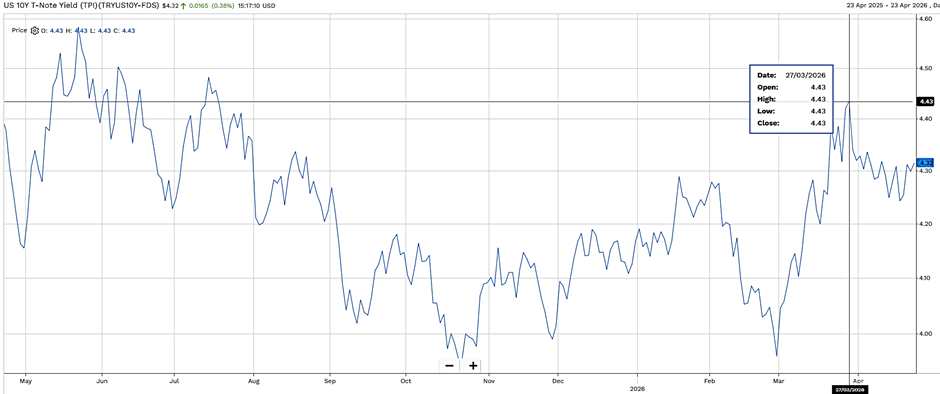
The US 10-year Treasury yield also eased to 4.32%, down about 0.12% from recent highs. This reflected lower inflation concerns as oil prices retreated after the ceasefire.
Taken together, lower bond yields and calmer market sentiment have provided a more supportive backdrop for Singapore REITs.
That has helped improve the sector's income appeal again after the weakness in March.
Singapore REITs face a mixed backdrop from MAS tightening and a stronger Singapore dollar
Singapore REITs may also be affected by another important macro development in Singapore.
The Monetary Authority of Singapore (MAS) slightly increased the rate of appreciation of the Singapore dollar policy band, while leaving the width and centre unchanged. This was the first tightening since October 2022.
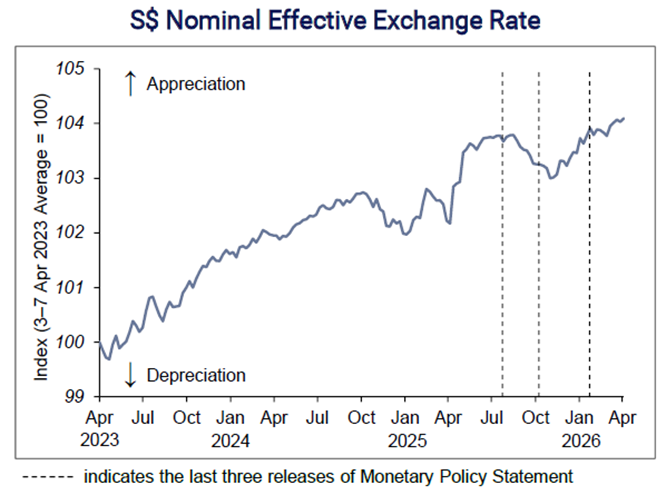
In simple terms, MAS is allowing the Singapore dollar to strengthen a little faster. The move reflects the pass-through of higher energy import costs into domestic electricity, gas and transport prices.
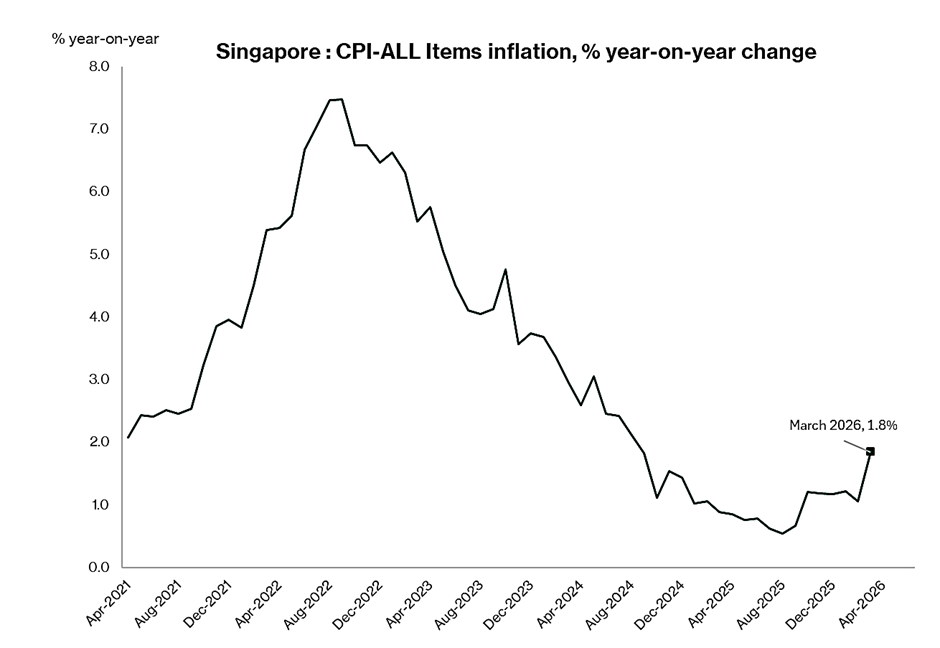
MAS also raised its 2026 inflation forecast to 1.5% to 2.5% for both core and headline inflation, up from the earlier 1.0%–2.0% range.
A stronger Singapore dollar is intended to offset rising imported energy costs.
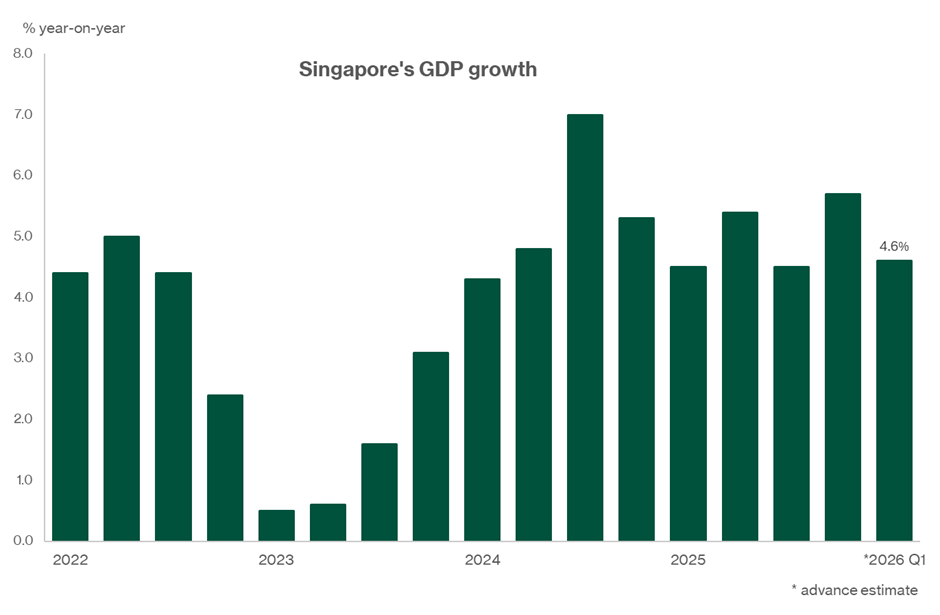
At the same time, MAS noted that Singapore’s economy grew 4.6% year on year in the first quarter of 2026, supported by the global artificial intelligence investment cycle.
For Singapore REITs, the MAS tightening has a mixed impact.
A stronger Singapore dollar may help ease imported cost pressures, which would be positive for REITs' operating costs.
However, the higher rate environment may keep borrowing costs elevated for longer.
Higher refinancing costs may drive up interest expense, compressing earnings and reducing distributable income for unitholders.
One encouraging sign is that government bond yields still moved lower despite the MAS decision.
This suggests the market sees the move as measured, rather than the start of a more aggressive tightening cycle.
Singapore REIT valuations remain reasonable after the recent rebound
Against this backdrop, Singapore REIT valuations still look reasonable in our view.
For most income investors, the two most common valuation yardsticks are dividend yield and price-to-book ratio.
Dividend yield shows the income a REIT is offering based on its share price.
At the sector level, the broader picture still does not look stretched.
CSOP iEdge S-REIT Leaders Index ETF’s forward dividend yield is 5.74%, compared with a three-year average of 5.88%.
This suggests valuations have recovered from the March lows, but are still not far from historical averages.
More importantly, the forward yield of 5.74% represents a spread of about 3.7% over the Singapore 10-year government bond yield of 2.04%.
That still looks fairly attractive from an income perspective.
In other words, the recent rebound does not necessarily mean Singapore REITs now look expensive.
For investors focused on income, the sector may still be relevant as long as bond yields remain contained and REIT distributions stay resilient.
You can get screen for the Singapore REITs with an dividend yield with our best Singapore REITs screener here.
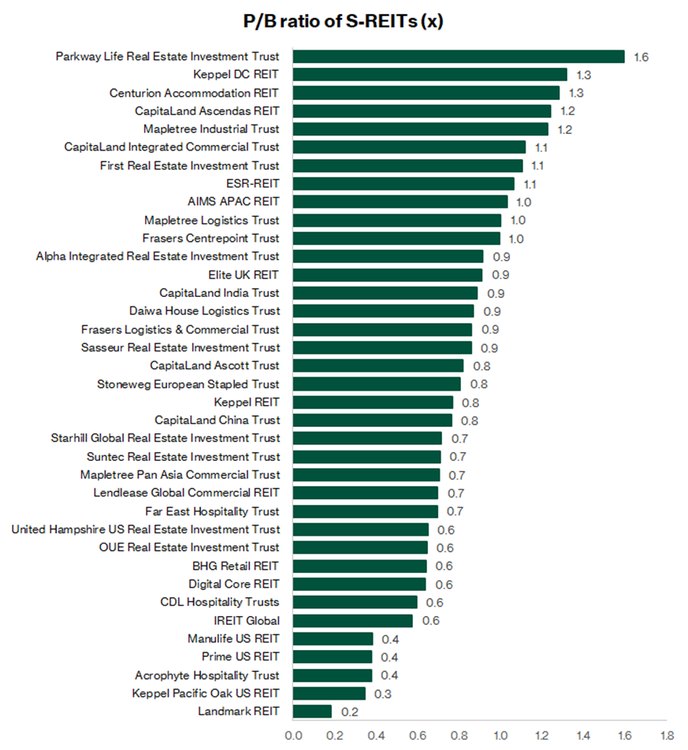
Another valuation metric to look at is the price-to-book ratio.
The price-to-book ratio shows how the market is valuing a REIT relative to its underlying assets.
A price-to-book ratio below 1.0 times can look attractive at first glance. But it can also reflect concerns about asset quality, earnings, or debt levels.
Thus, assessing whether a REIT's valuation is truly attractive requires a closer look at its underlying fundamentals, including asset quality, income stability, and balance sheet strength.
The CSOP iEdge S-REIT Leaders Index ETF is trading at FY2026E P/B 0.97x, close to its three-year average of 0.94 times.
As can be seen in the chart below, there are still several REITs that continue to trade at a price-to-book valuation of below 1.0x.
You can get screen for the Singapore REITs with an attractive price-to-book valuation with our best Singapore REITs screener here.
Singapore REIT recovery remains selective across sectors
But even if sector valuations still look reasonable, not all Singapore REITs are likely to recover in the same way.
Investors are likely to pay more attention to quality, balance sheet strength, and the ability to protect distributions.
One reason is that inflation risks have not fully gone away. If financing costs stay high for longer, weaker REITs may find it harder to grow distributions meaningfully.
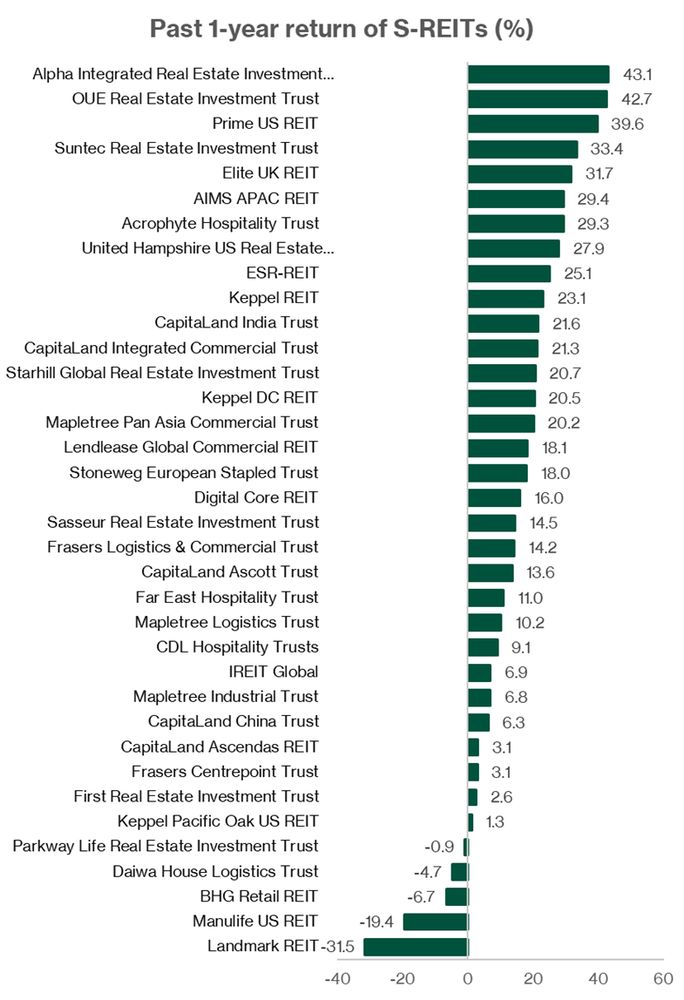
That is also why investors are paying closer attention to which REITs still have room to grow in a tougher environment.
Acquisition and capital recycling activity has remained active, but investor support appears to be more selective.
In April, CapitaLand Ascendas REIT announced S$1.4 billion investments in Singapore and Japan assets, and CapitaLand Ascendas received an overwhelming participation. The strong take-up reflected continued investor interest in quality industrial REITs.
This suggests that investors are still willing to support growth, but may prefer REITs with stronger assets and clearer earnings visibility.
In the current environment, sectors such as Singapore office, logistics, data centres, and purpose-built accommodation may hold up better where demand has been more stable.
REITs with overseas assets that actively manage currency risks may also be better placed.
More broadly, investors may want to focus on REITs that can sustain and grow distributions through active portfolio management, such as asset enhancements, acquisitions and rental growth.
What would Beansprout do?
In our view, Singapore REITs can still play a role in an income-focused portfolio.
The recent fall in government bond yields has made the sector's income appeal more attractive again, even after the rebound in share prices.
That said, the backdrop is still mixed. MAS tightening may help ease imported cost pressures, but borrowing costs may also stay elevated for longer.
As a result, I would be more selective rather than expect a broad recovery across all Singapore REITs.
To start, I would screen for the Singapore REITs with an attractive price-to-book valuation with our best Singapore REITs screener here.
The gap between stronger and weaker names may become clearer if inflation stays firm and financing costs remain high.
Quality and active portfolio management may matter more than simply chasing the highest headline yield.
I would pay closer attention to REITs with stronger assets, steadier demand, and a clearer ability to sustain distributions through a tougher environment.
That is why I have also been diversifying to other high-quality dividend-paying stocks to grow my Income Pot. Explore other income ideas here.
Which REIT is on your watchlist? Share with us in the comments below or join the discussion in Beansprout telegram group.
Planning to invest in REITs? Compare the best Singapore brokers to find the right trading platform, and see the latest promotions and sign-up rewards available.
If you are new to investing in Singapore REITs, you can start to learn more about Singapore REITs here.
[Beansprout Exclusive Longbridge Promotion] Get bonus S$50 FairPrice voucher within 5 working days, plus 5% p.a. interest boost coupon (worth ~S$100) when you sign up for a Longbridge account via Beansprout. Promo ends on 30 April 2026. T&Cs apply. Learn more about the Longbridge promotion here.
Enjoyed this insight? Follow Beansprout on Telegram, Youtube, Facebook and Instagram, and add Beansprout as your preferred source on Google so you never miss an update.
Read also
Gain financial insights in minutes
Subscribe to our free weekly newsletter for more insights to grow your wealth
Most Popular

Comments
0 comments