
SRS withdrawal guide: Age, tax rules and how to plan your withdrawals [2026]
CPF & Retirement
By Gerald Wong, CFA • 17 Oct 2026
Why trust Beansprout? We’ve been awarded Best Investment Website at the SIAS Investors’ Choice Awards 2025

Make Beansprout your preferred source on Google
Add us on Google to see more of our insights in your search results
Learn when you can withdraw your SRS savings, how the 50% tax concession and 10-year withdrawal period work, and how to plan around your retirement income.
What happened?
The Supplementary Retirement Scheme, or SRS, can help us save on taxes while building up our retirement savings.
We have previously looked at how an SRS account works and the ways to invest your SRS savings.
But there is another part of SRS that matters just as much as contributing. How do we eventually take the money out?
This matters because SRS withdrawals can be taxable. When you start withdrawing, how much you withdraw each year and whether you have other taxable income can all affect how much tax you eventually pay.
In this guide, we look at when you can withdraw your SRS savings, how withdrawals are taxed, and how I would think about planning SRS withdrawals in retirement.
How do SRS withdrawals work?
You can technically withdraw money from your SRS account at any time.
However, the tax treatment can be very different depending on when and why you make the withdrawal.
For most investors, the main distinction is whether the withdrawal is made before or after your prescribed retirement age.
| Type of SRS withdrawal | Amount subject to tax | 5% penalty |
| On or after prescribed retirement age | 50% of withdrawal | No |
| Before prescribed retirement age | 100% of withdrawal | Yes, generally |
| Qualifying withdrawal on medical grounds | 50% of withdrawal | No |
| Withdrawal due to bankruptcy | 100% of withdrawal | No |
| Qualifying full withdrawal by a foreigner | 50% of withdrawal | No |
| Source: IRAS rules on SRS withdrawals | ||
For a normal retirement withdrawal made on or after your prescribed retirement age, only 50% of the amount withdrawn is treated as taxable income. There is also no 5% early withdrawal penalty.
This is why the timing of SRS withdrawals can make a meaningful difference.
What is the SRS withdrawal age?
Your SRS withdrawal age is based on the statutory retirement age that applied when you made your first SRS contribution.
This is known as your prescribed retirement age.
Singapore’s statutory retirement age increased to 64 on 1 July 2026. However, this does not mean that everyone with an SRS account now has to wait until age 64 before making penalty free retirement withdrawals.
For example, if the statutory retirement age was 62 when you made your first SRS contribution, your prescribed retirement age generally remains 62.
Likewise, if your first contribution is locked in a prescribed retirement age of 63, a subsequent increase in the statutory retirement age does not change it.
| Date of your first SRS contribution | Prescribed retirement age for SRS withdrawals |
| Before 1 July 2022 | 62 |
| 1 July 2022 to 30 June 2026 | 63 |
| From 1 July 2026, under current rules | 64 |
This is one reason why some people make a small first contribution to their SRS account even if they are not yet ready to contribute a meaningful amount.
The important point is that simply opening an SRS account is not enough. It is the first contribution that matters for determining your prescribed retirement age.
How can I check my SRS withdrawal age?
You can check when you made your first SRS contribution through your SRS operator, which would be DBS, OCBC or UOB.
You can then determine the statutory retirement age that applied at that time.
If you are unsure, it may be worth confirming your prescribed retirement age with your SRS operator before making a withdrawal.
How are SRS withdrawals taxed after retirement age?
Once you reach your prescribed retirement age, only 50% of qualifying withdrawals is generally treated as taxable income. There is also no 5% early withdrawal penalty.
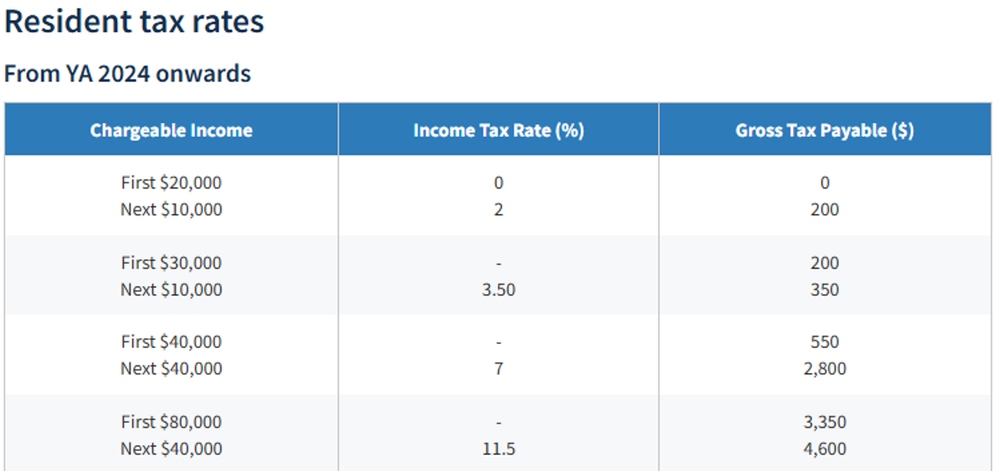
The taxable portion is then assessed based on Singapore’s personal income tax rates.
For example:
| SRS withdrawal | Amount treated as taxable income |
| S$20,000 | S$10,000 |
| S$40,000 | S$20,000 |
| S$60,000 | S$30,000 |
| S$100,000 | S$50,000 |
The taxable portion is added to your other taxable income for the year and taxed at the prevailing personal income tax rates.
This last point is important. It does not mean that withdrawing S$40,000 from SRS is always tax free.
If you have no other taxable income, the S$20,000 taxable portion currently falls within the first S$20,000 of chargeable income, which is taxed at 0%.
But if you are still working, receiving rental income, or have other taxable income, the taxable portion of your SRS withdrawal will be added to that income.
Your actual tax bill therefore depends on your overall tax position.
What is the 10-year SRS withdrawal period?
Once you make your first penalty free retirement withdrawal, you can spread your SRS withdrawals over a period of up to 10 years.
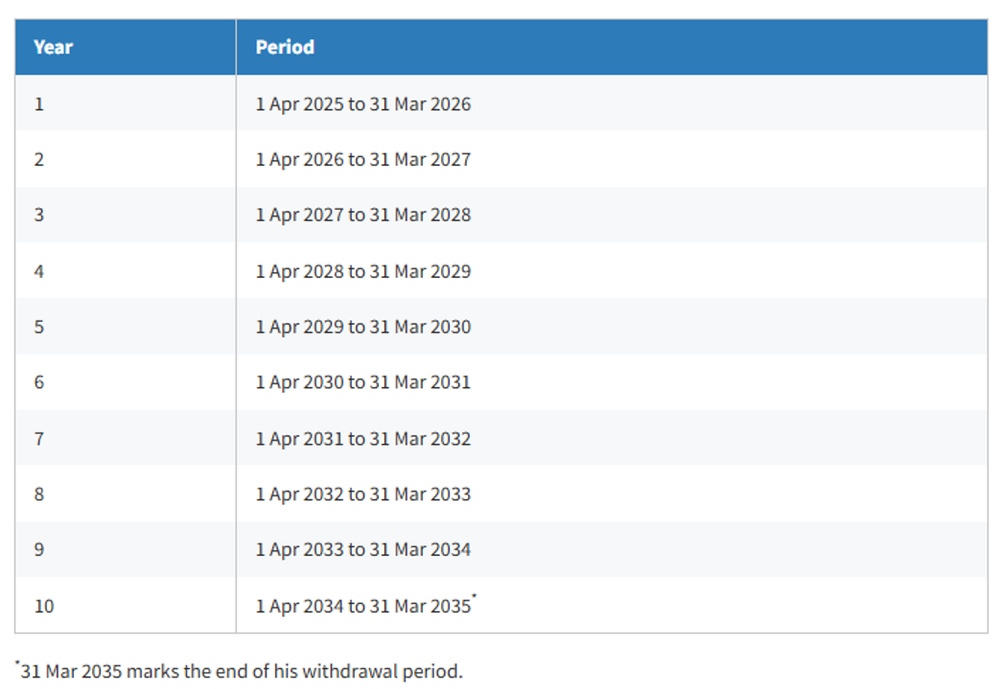
Importantly, the 10-year period is counted from the date of your first penalty free withdrawal. It is not simply 10 calendar years.
IRAS gives the example of an SRS member who made their first penalty free withdrawal on 1 April 2025. Their 10-year withdrawal period runs until 31 March 2035.
There is a separate point to keep in mind for tax.
The withdrawal window is based on the date of your first penalty free withdrawal, while your withdrawals are subject to tax in the Year of Assessment following the calendar year in which the withdrawal was made.
For example, a withdrawal in calendar year 2026 is generally included in YA 2027. Several withdrawals within the same calendar year are considered together.
The April-to-March example above touches 11 calendar years, from 2025 to 2035. That does not extend the 10-year withdrawal period.
Skipping a withdrawal in one year also does not pause the clock. It is therefore useful to keep track of both your final withdrawal date and the calendar years in which your withdrawals are made.
How much SRS can I withdraw each year?
There is no general rule requiring you to withdraw the same amount every year.
You can withdraw more, take different amounts each year or make no withdrawal in some years within the permitted period.
S$40,000 is also not an annual SRS withdrawal limit.
You may sometimes see the S$40,000 figure because only 50% of a qualifying retirement withdrawal is taxable.
A S$40,000 withdrawal therefore creates S$20,000 of taxable income. Based on current resident income tax rates, someone with no other chargeable income would pay no income tax on that amount.
| Annual withdrawal choice | What to consider |
| Withdraw S$40,000 | The taxable portion is S$20,000, but other taxable income can still create a tax bill. |
| Withdraw more than S$40,000 | A larger withdrawal may create tax, but can help meet spending needs or reduce a large remaining balance. |
| Withdraw less, or nothing | This may help in a high-income year, but does not extend the withdrawal deadline. |
The more useful question is how much to withdraw given your remaining balance, retirement spending, other taxable income and time left in the withdrawal period.
How should I plan my SRS withdrawals?
A common approach is to spread withdrawals across the 10-year period rather than take everything out at once.
Singapore has progressive income tax rates, so a large withdrawal in one year can push more of the taxable amount into higher tax brackets.
Spreading withdrawals can therefore generally result in greater tax savings.
However, that does not mean everyone should automatically divide their SRS balance by 10.
There are four things I would look at.
1. How much do you have in SRS?
Someone retiring with S$100,000 in SRS faces a very different decision from someone with S$800,000.
The larger your balance, the more important it becomes to think about how to use the full 10-year withdrawal period.
Your investments may also continue to grow after withdrawals begin. A schedule based only on your starting balance could therefore leave more money than expected at the end.
2. Will you still have other taxable income?
If you are still working when you start withdrawing from SRS, the taxable portion of your withdrawal will be added to your employment income.
The same applies to other taxable income such as rental income.
It may therefore be useful to consider your SRS withdrawals alongside when your other taxable income is expected to fall.
3. How much cash do you actually need?
Tax should not be the only consideration.
You may need more money in the earlier years of retirement for travel, housing, healthcare or other expenses.
There is little point in optimising purely for tax if the withdrawal schedule does not support your actual retirement needs.
4. How is the remaining SRS money invested?
If much of your SRS balance remains invested, your investment strategy should also evolve as your withdrawal horizon gets shorter.
Money you expect to withdraw soon may need to be managed differently from money that could remain invested for another eight or ten years.
Should I delay my first SRS withdrawal?
There is another decision to think about before the 10-year clock even starts.
Just because you have reached your prescribed retirement age does not necessarily mean you have to make your first withdrawal immediately.
If you are still working and earning significant taxable income, starting SRS withdrawals at the same time could add to your taxable income.
Depending on your circumstances, it may make sense to consider whether you actually need to start withdrawing immediately or whether you expect your taxable income to decline later.
However, delaying withdrawals also means your eventual withdrawal period starts later.
Your decision should therefore take into account your age, retirement plans, SRS balance and expected future income.
Can I still contribute after starting SRS withdrawals?
This is another reason to think carefully before making a small first retirement withdrawal merely to test the process. It starts your withdrawal window and affects your ability to make further contributions.
Should I withdraw everything at once or spread it out?
From a tax perspective, spreading withdrawals can often be more efficient.
If you have S$400,000 and withdraw it all in a single qualifying year, S$200,000 would be treated as taxable income.
That could result in a significantly larger tax bill than spreading the same withdrawals across multiple years.
| Withdrawal approach for S$400,000 | Taxable amount | Illustrative income tax |
| Withdraw everything in one year | S$200,000 in that year | S$21,150 |
| Withdraw S$40,000 in each of 10 separate calendar years | S$20,000 each year | S$0 across the 10 years |
But spreading withdrawals does not necessarily mean taking exactly one tenth of your SRS balance every year.
You may want to withdraw more in years when:
- you have little or no employment income
- other taxable income is lower
- you need more cash for retirement spending
- your SRS balance is large enough that withdrawing too little could leave a sizeable balance after 10 years
You may want to withdraw less when your other taxable income is unusually high.
The withdrawal plan can therefore change from year to year.
SRS withdrawal examples: S$400,000 versus S$600,000
Example 1: Withdrawing S$400,000 from SRS
Suppose you reach your prescribed retirement age with S$400,000 in your SRS account and have no other taxable income.
One possible approach would be to withdraw S$40,000 each year for 10 years.
Only 50% of each qualifying retirement withdrawal is taxable, so S$20,000 would be treated as taxable income each year.
| Annual SRS withdrawal | Taxable portion | Tax payable based on current resident rates, assuming no other chargeable income |
| S$40,000 | S$20,000 | S$0 |
IRAS provides the same S$400,000 example.
An individual with no other taxable income withdraws S$40,000 each year, of which S$20,000 is taxable. Based on current tax rates, no tax is payable on the first S$20,000 of chargeable income.
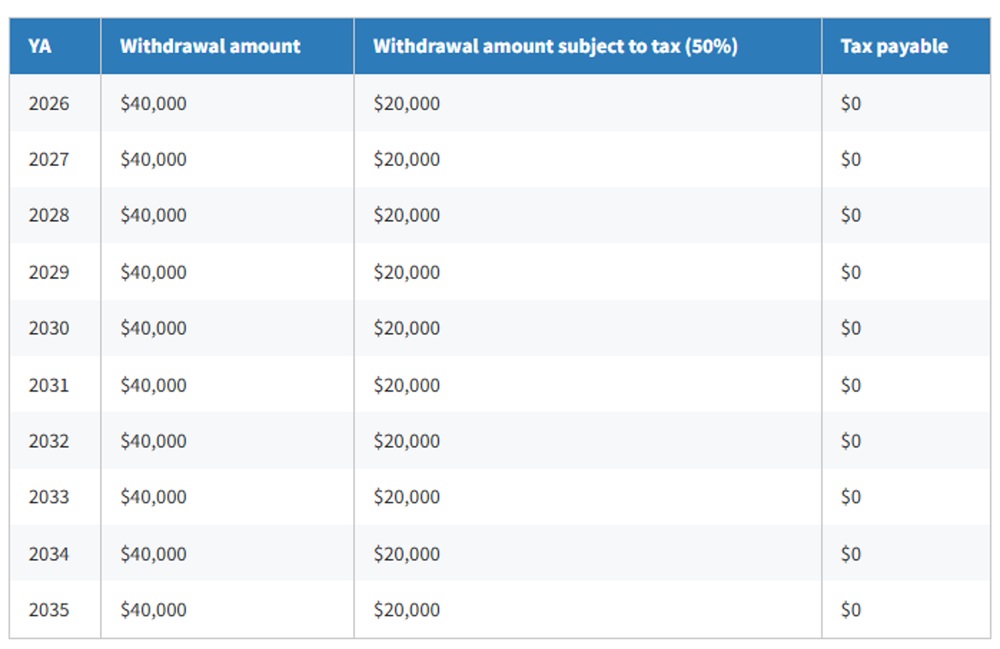
Over 10 years, the full S$400,000 could therefore potentially be withdrawn without income tax under those assumptions.
But there are two important caveats.
First, this assumes you have no other chargeable income.
Second, it assumes the prevailing tax rules and rates remain unchanged.
So I would not think of S$400,000 as some form of permanently guaranteed tax free SRS limit.
Example 2: What if you have S$600,000 in SRS?
This is where withdrawal planning becomes more interesting.
Suppose you have S$600,000 in your SRS account when you start your 10-year withdrawal period.
For simplicity, let us assume the balance does not earn any further investment return during the withdrawal period.
If you focus only on withdrawing S$40,000 every year to avoid paying tax, you would take out S$400,000 over 10 years. You would still have S$200,000 remaining.
According to IRAS, apart from life annuities, the remaining cash and market value of investments in the SRS account are deemed to be withdrawn immediately after the 10-year withdrawal period. The SRS operator will report 50% of this balance to IRAS, which is then subject to tax in the following year.
So let us compare two simplified approaches.
| Approach | Annual withdrawal | Taxable income each year | Balance after 10 years |
| Withdraw S$40,000 a year | S$40,000 | S$20,000 | S$200,000 |
| Withdraw evenly over 10 years | S$60,000 | S$30,000 | S$0 |
Under the first approach, someone with no other taxable income might pay no tax on the S$40,000 annual withdrawals.
But after 10 years, the S$200,000 balance would be deemed withdrawn.
Half of that, or S$100,000, would generally be taxable.
Based on current resident tax rates and assuming no other chargeable income, tax on S$100,000 of chargeable income would be about S$5,650
Now consider the second approach.
If you withdraw S$60,000 each year, only S$30,000 is taxable.
Based on current resident tax rates and assuming no other chargeable income, tax on S$30,000 of chargeable income would be about S$200 a year.
Over 10 years, that would amount to about S$2,000 in tax, assuming tax rates remain unchanged.
| Tax comparison | S$40,000-a-year approach | S$60,000-a-year approach |
| Tax on the 10 scheduled withdrawals | S$0 | S$2,000 |
| Tax on the remaining deemed withdrawal | S$5,650 | S$0 |
| Total illustrative income tax | S$5,650 | S$2,000 |
This is only an illustration. Actual outcomes will depend on future tax rates, your investment returns, your other income and the exact timing of withdrawals.
But it highlights an important point.
The goal should not necessarily be to pay zero tax every single year.
For someone with a larger SRS balance, it may make more sense to accept a small amount of tax along the way rather than leave a large balance to be deemed withdrawn at the end of the 10-year period.
Should I keep my SRS money invested during the withdrawal period?
You do not necessarily need to sell every SRS investment once you reach your prescribed retirement age.
If you still have a long withdrawal horizon, part of your SRS portfolio may remain invested.
For example, money you expect to withdraw eight years from now has a very different time horizon from money you need next year.
One way to think about this is to progressively separate your SRS assets according to when they may be needed.
Money required in the nearer term may be invested more conservatively.
Money that is unlikely to be needed for many years may have greater capacity to remain invested, depending on your risk tolerance.
The key is that your SRS investment strategy and withdrawal strategy should work together.
You can learn more in our guide to SRS investment options.
Can I withdraw SRS investments without selling them?
In certain qualifying situations, yes.
SRS members can apply to withdraw investments directly from their SRS accounts without first selling them.
This is available for several forms of penalty free withdrawal, including withdrawals on or after the prescribed retirement age and actual withdrawals after an SRS account has been deemed closed.
This can be useful if you want to continue holding an investment outside your SRS account rather than sell it simply to make a withdrawal.
You should check the operational process and applicable fees with your SRS operator.
What happens if I withdraw SRS before retirement age?
You can withdraw your SRS savings before reaching your prescribed retirement age.
However, the tax treatment is much less favourable.
For a normal premature withdrawal:
- 100% of the amount withdrawn is taxable
- a 5% penalty generally applies
For example, if you withdraw S$40,000 early, the full S$40,000 would generally be treated as taxable income.
You would also incur a S$2,000 penalty, representing 5% of the withdrawal.
The 5% penalty and income tax are two separate costs.
This is why I would be cautious about contributing money to SRS if there is a meaningful chance that you will need to withdraw it before your prescribed retirement age.
Can you withdraw SRS early without the 5% penalty?
There are specific exceptions where the 5% early withdrawal penalty does not apply.
These include withdrawals in certain circumstances involving:
- medical grounds
- terminal illness
- bankruptcy
- death
- qualifying full withdrawals by foreigners
The tax treatment can still vary depending on the type of withdrawal.
For example, withdrawals due to bankruptcy are fully taxable even though the 5% penalty does not apply. Certain qualifying medical withdrawals receive the 50% tax concession.
Because these situations involve more specific conditions, I would check the prevailing IRAS rules before making the withdrawal.
How do SRS withdrawals work for foreigners?
Foreigners may qualify to make a one time full withdrawal without the 5% penalty, with only 50% of the withdrawal treated as taxable.
Among the requirements, the person must generally:
- Not be a Singapore Citizen or Permanent Resident on the date of withdrawal and for the continuous 10 years before the withdrawal
- Have maintained the SRS account for at least 10 years from the date of the first contribution
- Make a one time full withdrawal
Foreigners and Permanent Residents should also be aware that withholding tax rules may apply when money is withdrawn.
The amount withheld is not necessarily the same as the individual's final tax liability.
What happens after the 10-year SRS withdrawal period?
You cannot simply extend the concessionary withdrawal period indefinitely.
At the end of the 10-year period, remaining cash and the market value of most investments in your SRS account are deemed to have been withdrawn.
The SRS operator reports 50% of this remaining balance to IRAS, and this amount is subject to tax in the following year.
Life annuities are treated differently. The 10-year withdrawal period does not apply in the same way to qualifying life annuity payments. Instead, 50% of the annuity payments can continue to be subject to tax as they are received.
If you choose not to physically withdraw the balance after the account has been deemed closed, future investment returns are no longer sheltered under the SRS tax treatment and will generally receive the same tax treatment as investments outside SRS.
This is why I would avoid entering the final years of the withdrawal period with a large SRS balance without a plan.
What happens to my SRS if I die?
Special rules apply when an SRS account holder dies.
The remaining SRS balance is treated as a deemed withdrawal, with specific tax concessions and exemption calculations depending on whether the member had already begun making penalty free withdrawals.
The detailed calculations can be more complicated than a normal retirement withdrawal.
For someone with a sizeable SRS balance, I would therefore consider SRS alongside broader estate planning rather than assuming the account will simply pass to beneficiaries with no tax consequences.
How I would think about an SRS withdrawal strategy
For me, the key question would not simply be: How much can I withdraw without paying tax?
I would start with what I actually need from my SRS savings.
Then I would look at:
- How large my SRS balance is
- When my employment and other taxable income are likely to fall
- How much retirement income I need each year
- How long the remaining SRS money can stay invested
- Whether my withdrawal plan makes good use of the 10-year period
- How much is likely to remain at the end
For someone with little other taxable income and an SRS balance of around S$400,000 withdrawing about S$40,000 a year may work quite neatly under current tax rules.
But someone with S$600,000 or S$800,000 should not simply follow the same S$40,000 rule.
They may need to accept some tax during the withdrawal period to avoid recognising a much larger taxable amount at the end.
Likewise, someone who is still earning a high salary may want to think carefully about starting withdrawals immediately.
This is why I would treat SRS withdrawal planning as part of the broader retirement income plan, rather than as a simple tax optimisation exercise.
Frequently asked questions about SRS withdrawal
Can I withdraw SRS before retirement?
Yes. However, a normal premature withdrawal is generally fully taxable and attracts a 5% penalty.
What is the SRS withdrawal age?
It is based on the statutory retirement age prevailing when you made your first SRS contribution. This is known as your prescribed retirement age.
Does opening an SRS account lock in my retirement age?
No. What matters is when you make your first SRS contribution.
Is my entire SRS withdrawal taxable after retirement?
No. For qualifying withdrawals on or after your prescribed retirement age, only 50% of the withdrawal is generally treated as taxable income.
Is there a S$40,000 annual SRS withdrawal limit?
No. S$40,000 is commonly used in tax illustration because 50% of the withdrawals, or S$20,000, is taxable.
For someone with no other chargeable income, that S$20,000 currently falls within the 0% tax bracket.
Can I withdraw more than S$40,000 a year?
Yes. However, the taxable half of your withdrawal may result in income tax depending on your other income and prevailing tax rates.
Can I spread my SRS withdrawals over 10 years?
Yes. The 10-year withdrawal period starts from the date of your first penalty free retirement withdrawal.
Do the 10 years follow calendar years?
Not necessarily. The period runs for 10 years from the date of your first penalty free withdrawal.
Tax is separately assessed based on the calendar year in which each withdrawal takes place.
What if I have money left after 10 years?
The remaining cash and market value of most investments are generally deemed withdrawn at the end of the 10-year period.
Half of the deemed withdrawal is then reported to IRAS and subject to tax in the following year.
Can I withdraw SRS investments without selling them?
For certain qualifying withdrawals, you may be able to transfer investments out of your SRS account rather than liquidating them first.
Check the operational requirements with your SRS operator.
What would Beansprout do?
SRS gives us tax benefits when we contribute, but how we eventually withdraw the money matters too.
Once we reach our prescribed retirement age, only 50% of qualifying withdrawals is generally taxable. We can also spread withdrawals across a 10-year period.
That flexibility allows us to plan withdrawals around our retirement needs and other taxable income.
The S$400,000 example is a useful starting point, but I would not treat S$40,000 a year as a rule.
If our SRS balance is larger, trying to pay zero tax every year could simply leave us with a large taxable balance at the end of the withdrawal period.
Instead, I would ask: How much should I withdraw each year so that my SRS supports my retirement needs, while managing my taxes sensibly across the full 10-year period?
I would also review how my SRS money is invested as the withdrawal period gets shorter. One way to do this is to use Beansprout’s 4 Pots of Wealth framework to match different parts of the portfolio to when the money may be needed.
Money that may be withdrawn soon could sit closer to the Liquidity Pot, where the focus is on preserving capital and keeping funds accessible. The Income Pot may be relevant for money that still needs to generate income, while the Growth Pot can be used for funds that are not needed for several years and can tolerate greater market swings.
Our guide to SRS investment options explains the investments available within SRS. The key is to match those investments to when you expect to withdraw the money, rather than treating your investment and withdrawal plans separately.
If you are weighing up whether to contribute, our SRS account Singapore guide can help you understand how SRS fits into your retirement plan, from opening an account to investing and withdrawing your savings.
If you are looking to understand how SRS can help save tax, read our guide to SRS tax savings and use our SRS tax savings calculator.
How are you planning to withdraw your SRS savings? Share in the comments, or join the discussion in our Telegram group.
Follow Beansprout on Telegram, Youtube, Facebook and Instagram, and add Beansprout as your preferred source on Google so you never miss an update.
Read also
Gain financial insights in minutes
Subscribe to our free weekly newsletter for more insights to grow your wealth
Most Popular

Comments
0 comments