
SRS account Singapore guide: How it works, benefits, investments and withdrawals [2026]
CPF & Retirement
By Gerald Wong, CFA • 02 Oct 2026
Why trust Beansprout? We’ve been awarded Best Investment Website at the SIAS Investors’ Choice Awards 2025
'%3e%3cpath%20fill-rule='evenodd'%20clip-rule='evenodd'%20d='M17.64%209.20455C17.64%208.56637%2017.5827%207.95273%2017.4764%207.36364H9V10.845H13.8436C13.635%2011.97%2013.0009%2012.9232%2012.0477%2013.5614V15.8195H14.9564C16.6582%2014.2527%2017.64%2011.9455%2017.64%209.20455V9.20455Z'%20fill='%234285F4'/%3e%3cpath%20fill-rule='evenodd'%20clip-rule='evenodd'%20d='M9%2018C11.43%2018%2013.4673%2017.1941%2014.9564%2015.8195L12.0477%2013.5614C11.2418%2014.1014%2010.2109%2014.4205%209%2014.4205C6.65591%2014.4205%204.67182%2012.8373%203.96409%2010.71H0.957275V13.0418C2.43818%2015.9832%205.48182%2018%209%2018V18Z'%20fill='%2334A853'/%3e%3cpath%20fill-rule='evenodd'%20clip-rule='evenodd'%20d='M3.96409%2010.71C3.78409%2010.17%203.68182%209.59318%203.68182%209C3.68182%208.40682%203.78409%207.83%203.96409%207.29V4.95818H0.957273C0.347727%206.17318%200%207.54773%200%209C0%2010.4523%200.347727%2011.8268%200.957273%2013.0418L3.96409%2010.71V10.71Z'%20fill='%23FBBC05'/%3e%3cpath%20fill-rule='evenodd'%20clip-rule='evenodd'%20d='M9%203.57955C10.3214%203.57955%2011.5077%204.03364%2012.4405%204.92545L15.0218%202.34409C13.4632%200.891818%2011.4259%200%209%200C5.48182%200%202.43818%202.01682%200.957275%204.95818L3.96409%207.29C4.67182%205.16273%206.65591%203.57955%209%203.57955V3.57955Z'%20fill='%23EA4335'/%3e%3c/g%3e%3cdefs%3e%3cclipPath%20id='clip0_0_2849'%3e%3crect%20width='18'%20height='18'%20fill='white'/%3e%3c/clipPath%3e%3c/defs%3e%3c/svg%3e)
Make Beansprout your preferred source on Google
Add us on Google to see more of our insights in your search results
Learn how SRS accounts work in Singapore, including contribution limits, tax relief, investment options and withdrawal rules in 2026.
What happened?
The Supplementary Retirement Scheme, or SRS, is a voluntary scheme that helps you save more for retirement on top of CPF.
One of its biggest attractions is tax relief. When you contribute to SRS, your contribution can reduce your taxable income, subject to the annual contribution limit and overall personal income tax relief cap.
But SRS is more than a way to save tax.
You can invest the money in your SRS account, and investment returns are not taxed before withdrawal. When you eventually make qualifying withdrawals in retirement, only 50% of the amount withdrawn is taxable.
The trade-off is that SRS is designed for retirement. If you withdraw your money from SRS early, the withdrawal is generally fully taxable and a 5% penalty applies.
So, is an SRS account worth opening?
In this guide, I look at how SRS works, how much you can contribute, the tax benefits, what you can invest in, and what happens when you eventually withdraw the money.
SRS account at a glance
| SRS | |
| What is it? | A voluntary retirement savings scheme that complements CPF |
| Who can open one? | Singapore Citizens, Permanent Residents and eligible foreigners |
| SRS operators | DBS, OCBC and UOB |
| Maximum annual contribution, Singapore Citizens and PRs | S$15,300 |
| Maximum annual contribution, foreigners | S$35,700 |
| Tax relief | Eligible contributions can reduce taxable income, subject to the S$80,000 overall personal relief cap |
| Interest on uninvested cash | DBS currently lists 0.05% p.a.; check your operator’s prevailing rate |
| Can the money be invested? | Yes |
| When can you generally withdraw without the 5% early withdrawal penalty? | From your prescribed retirement age |
| Tax on qualifying retirement withdrawals | 50% of the withdrawal is taxable |
| Retirement withdrawal age | Based on the statutory retirement age when you made your first contribution |
| Early withdrawals | Generally 100% taxable plus a 5% penalty, subject to specified exceptions |
What is the Supplementary Retirement Scheme (SRS) and how does it work?
SRS was introduced to encourage people to save more for retirement on top of their CPF savings.
Unlike CPF, SRS is voluntary. You decide whether to open an account and how much to contribute, up to the annual limit.
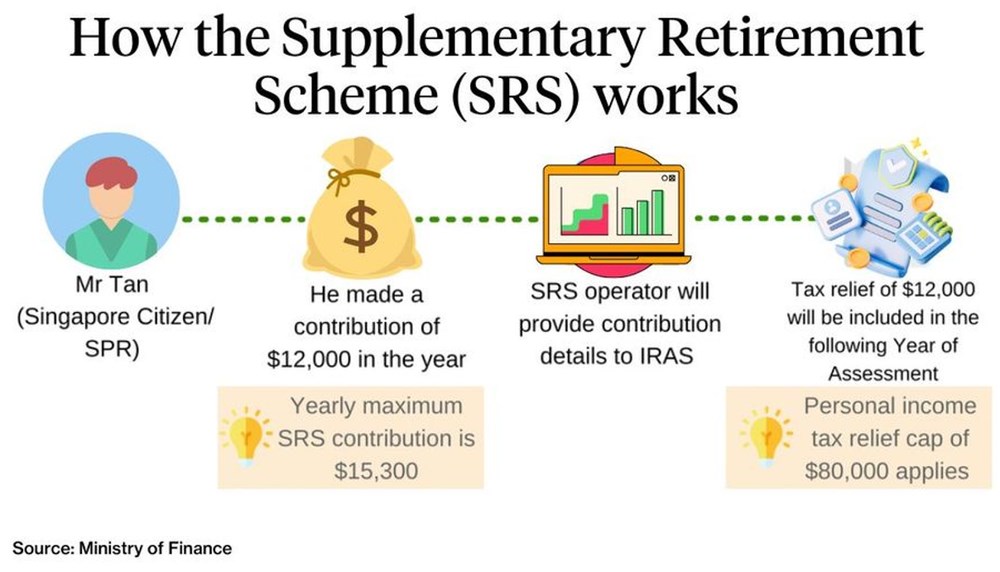
There are three potential tax benefits:
- Eligible contributions can reduce your taxable income.
- Investment returns within SRS are not taxed before withdrawal.
- Only 50% of qualifying withdrawals in retirement is taxable.
The trade-off is that you give up some flexibility because SRS is intended for retirement.
Is an SRS account worth it?
The main reason many of us contribute to SRS is to save on taxes. But I would not look at the tax benefit alone.
Before contributing, there are three things I would consider.
#1 - The tax savings you may receive
An SRS contribution can reduce your taxable income, but the amount of tax you save depends on your marginal tax rate.
This means SRS may be more useful if you are already paying a meaningful amount of income tax.
For example, someone in a higher tax bracket will generally save more tax from the same SRS contribution than someone in a lower tax bracket.
Read our SRS tax relief guide for examples of potential tax savings and use the SRS tax savings calculator below to estimate your own.
#2 - Your liquidity needs before retirement
SRS is meant for retirement.
If you withdraw your money before your prescribed retirement age, the withdrawal is generally fully taxable and a 5% penalty applies.
So I would make sure I have enough savings outside SRS for nearer term needs before contributing.
#3 - How you plan to use your SRS funds
Putting money into SRS gives you the tax relief, but it does not automatically help your retirement savings grow.
If I still have many years until retirement, I would also think about how my SRS funds should be invested based on my time horizon and risk tolerance.
For me, SRS is most useful when the tax savings today are meaningful, I do not need the money in the near term, and I have a plan for how the funds can support my retirement.
The main benefits of an SRS account
The first benefit is the tax relief.
Singapore Citizens and Permanent Residents can currently contribute up to S$15,300 per year, while foreigners can contribute up to S$35,700. Eligible contributions can reduce taxable income, subject to the overall S$80,000 personal relief cap.
The second benefit is that SRS funds can be invested. This gives your retirement savings an opportunity to grow rather than simply remaining as cash.
The third benefit comes when you withdraw.
Once you qualify for penalty-free retirement withdrawals, only 50% of each withdrawal is taxable. You can generally spread your withdrawals over 10 years from your first penalty-free withdrawal.
The trade-offs of using an SRS account
The biggest drawback is liquidity.
If you withdraw before your prescribed retirement age, the withdrawal is generally fully taxable and a 5% penalty applies. There are specified exceptions, including certain withdrawals on medical grounds, bankruptcy, death and qualifying withdrawals by foreigners.
The second consideration is that the tax benefit is mainly deferred rather than completely eliminated.
You may save tax when you contribute, but part of your future withdrawals may still be taxable.
Lastly, SRS is only an account. If the money is not invested appropriately for your objectives, opening an SRS account alone will not necessarily improve your retirement outcome.
Who is eligible to open an SRS account
Singapore Citizens, Permanent Residents and eligible foreigners can open an SRS account.
You must generally be at least 18 years old, not be an undischarged bankrupt, and be capable of managing your own affairs.
You can only have one SRS account at any point in time.
Where to open an SRS account
There are three SRS operators in Singapore:
You can open an account directly with one of these banks. But only one SRS account may be held at a time.
You can also transfer your SRS account from one operator to another.
How to open an SRS account
Opening an SRS account is generally straightforward.
First, choose one of the three SRS operators, DBS/POSB, OCBC or UOB.
You will need to confirm that you do not already have another SRS account. Singapore Citizens and Permanent Residents can generally apply through the bank, while foreigners may need to provide additional documentation.
Once the account is open, you can contribute cash into it and decide whether to leave the money as cash or invest it.
SRS contributions must be made in cash, and you can contribute at any time and as often as you like, subject to the annual contribution limit.
Why some people contribute S$1 to their SRS account
You may have heard of people contributing just S$1 into their SRS account.
The reason is the SRS prescribed retirement age.
The age from which you can generally start making penalty-free retirement withdrawals is based on the statutory retirement age that applies when you make your first SRS contribution.
Once you have made that first contribution, subsequent increases in Singapore's statutory retirement age do not change your prescribed retirement age.
The important distinction is that simply opening the account is not enough. You need to make your first contribution.
This is why someone who does not yet intend to make a large SRS contribution may still choose to contribute a small amount.
Before deciding whether to contribute more, read our SRS tax relief guide to understand the potential tax savings and the conditions that apply.
How the SRS prescribed retirement age works
Singapore's statutory retirement age became 64 from 1 July 2026.
Your SRS prescribed retirement age, however, depends on the statutory retirement age in force when you made your first SRS contribution.
For example, if your first contribution was made when the statutory retirement age was 62, a subsequent increase in the retirement age does not move your SRS prescribed retirement age.
So when thinking about SRS withdrawals, I would check my own prescribed retirement age rather than simply looking at Singapore's current retirement age.
We explain the wider changes in our guide to how the higher retirement age affects CPF, SRS and investments.
SRS contribution limits
The annual contribution limit depends on your residency status.
| SRS account holder | Maximum annual contribution |
| Singapore Citizen or Permanent Resident | S$15,300 |
| Foreigner | S$35,700 |
Contributions must be made in cash.
You do not have to contribute the maximum amount. You can make multiple contributions during the year, as long as the total stays within your annual limit.
How SRS tax relief works
If you qualify for SRS tax relief, your contribution can reduce your taxable income.
For example, suppose your taxable income before your SRS contribution is S$100,000 and you contribute S$10,000.
All else being equal, your taxable income would fall to S$90,000.
But this does not mean you save S$10,000 in tax.
Your actual tax saving depends on your marginal tax rate.
There is also an overall personal income tax relief cap of S$80,000 per Year of Assessment, including SRS relief. If you have already reached the cap, an additional SRS contribution may not provide further tax relief.
For a detailed breakdown of the potential savings, read our SRS tax relief guide or use our SRS tax savings calculator below to estimate how much a contribution could reduce your tax bill.
What happens to cash in my SRS account?
Contributing to SRS does not automatically invest your money.
If you leave the money as cash, it will earn the prevailing interest rate offered by your SRS operator.
For example, DBS currently states that its SRS account interest rate is 0.05% per year.
For someone with many years before retirement, this means what you do with your SRS savings after contributing may matter.
That does not mean the money has to be invested immediately or that everyone should take more risk.
Rather, I would think about whether leaving the funds in cash is consistent with what I need the money to achieve over my retirement horizon.
SRS investment options
SRS funds can be used for a range of eligible investments, including:
- Singapore shares and REITs
- ETFs
- Unit trusts
- Singapore Government Securities and T-bills
- Fixed deposits and Singapore Savings Bonds
- Insurance products
- Professionally managed portfolios
The right choice depends on what you need the money to do.
A T-bill, for example, serves a very different purpose from a diversified equity fund. One may be used for lower risk yield, while the other may offer more long term growth potential but with larger market fluctuations.
So I would start with my objective, time horizon and risk tolerance rather than simply looking for the investment with the highest potential return.
For a closer look at the products available and what to consider before choosing, read our guide to investing your SRS funds.
When you can withdraw your SRS savings
You can withdraw your SRS money at any time, but the tax and penalty treatment depends on when and why you withdraw.
For most people, the key milestone is their prescribed retirement age.
Once you reach this age and make your first penalty-free withdrawal, you generally have a 10 year period over which to withdraw your SRS savings.
How SRS withdrawals are taxed
For qualifying withdrawals from your prescribed retirement age, only 50% of the amount withdrawn is taxable.
For example, if you withdraw S$40,000 in a year, S$20,000 is treated as taxable income.
The actual tax payable then depends on your other income and the prevailing tax rates.
If someone has no other taxable income, a S$40,000 qualifying withdrawal would result in S$20,000 of taxable income, with no tax payable under the current tax brackets.
This is why how you spread your SRS withdrawals can matter.
What happens when you withdraw SRS funds early
Early withdrawals before your prescribed retirement age are generally:
- 100% subject to tax
- Subject to a 5% penalty
There are exceptions for specified circumstances such as medical grounds, bankruptcy and qualifying withdrawals by foreigners.
Because of this, I would generally treat money contributed to SRS as money set aside for retirement rather than money I may need in the next few years.
How SRS works for foreigners
Foreigners can also open SRS accounts if they meet the eligibility requirements.
The annual contribution limit is currently S$35,700, compared with S$15,300 for Singapore Citizens and Permanent Residents.
Foreigners may also qualify for a penalty-free full withdrawal after maintaining the SRS account for at least 10 years from the first contribution, subject to the relevant conditions. In that case, 50% of the qualifying lump sum withdrawal is taxable.
There are additional tax and withholding considerations for foreigners and Permanent Residents making SRS withdrawals, so I would check the applicable rules before withdrawing.
SRS vs CPF: What is the difference?
Both SRS and CPF can help us prepare for retirement, but they play different roles.
CPF savings earn the applicable CPF account interest rates, while returns within SRS depend on whether you leave the money as cash or invest it, and which investments you choose.
| CPF | SRS | |
| Participation | Generally mandatory for eligible employees | Voluntary |
| Main purpose | Retirement, housing and healthcare | Supplementary retirement savings |
| Contributions | Based on CPF contribution rules | You decide how much to contribute up to the annual limit |
| Tax benefit | CPF contributions and top-ups have their own tax treatment | Eligible SRS contributions can reduce taxable income |
| Investments | Subject to CPF investment rules | Range of eligible SRS investments |
| Access | Governed by CPF withdrawal rules | Designed mainly for withdrawal from prescribed retirement age |
| Retirement withdrawals | Generally not subject to income tax | 50% of qualifying SRS withdrawals is taxable |
I would therefore think of SRS as a supplement to CPF rather than a replacement for it.
How SRS may fit into your retirement plan
I would think of SRS as more than a way to reduce my tax bill.
There are three decisions to make.
First, should I contribute?
This depends on how much tax I can save and whether I am comfortable setting the money aside for retirement.
Our SRS tax relief guide explains the potential savings and the conditions to consider.
Second, how should I invest the money?
SRS is only the account. What ultimately determines how much I accumulate is what I do with the money inside it.
If I have a longer time horizon, I may have more capacity to invest for growth. If I am closer to retirement, preserving capital and generating income may become more important.
Our SRS investment guide compares the main options and what to consider before choosing.
Third, how should I withdraw the money?
Once I reach my prescribed retirement age, only 50% of qualifying withdrawals is taxable, and withdrawals can generally be spread over 10 years.
How I manage those withdrawals alongside my other retirement income can affect the tax I eventually pay.
So I would not contribute to SRS just because there is a tax benefit.
I would look at the full journey, how much I save on tax today, how the money can grow, and how I eventually use it for retirement.
Frequently asked questions about SRS
Can I have more than one SRS account?
No. You can only have one SRS account at any point in time.
Does opening an SRS account lock in my retirement age?
No. Your prescribed retirement age is determined when you make your first SRS contribution, not when you simply open the account.
What happens to my SRS account after 10 years?
For most Singapore Citizens and Permanent Residents, the 10-year period that matters starts when you make your first penalty-free withdrawal at or after your prescribed retirement age. You generally have up to 10 years to complete your qualifying withdrawals.
There is a different 10 year rule for foreigners. A foreigner may qualify for a penalty-free lump sum withdrawal after maintaining the SRS account for at least 10 years from the date of the first contribution, subject to the relevant conditions.
Can I withdraw SRS before retirement?
Yes. However, premature withdrawals are generally fully taxable and subject to a 5% penalty unless an exception applies.
Can I invest my SRS money?
Yes. SRS funds can be invested in a range of eligible investments rather than remaining as cash.
Our SRS investment guide compares the main options and what to consider before choosing.
How much can I contribute each year?
Singapore Citizens and Permanent Residents can currently contribute up to S$15,300 a year, while foreigners can contribute up to S$35,700.
Do I have to contribute the maximum amount?
No. You can contribute less than the annual limit and make multiple contributions during the year.
Does SRS always reduce my tax?
Not necessarily. You need to qualify for SRS tax relief, and the overall S$80,000 personal income tax relief cap still applies. Your actual tax saving also depends on your marginal tax rate.
Is it better to top up SRS or CPF?
They serve different purposes.
An SRS contribution may provide tax relief while giving you access to a range of investments, but the money is generally intended to remain in the account until your prescribed retirement age.
CPF top-ups have different tax relief rules and strengthen your CPF retirement savings, but the money is subject to CPF's rules on interest, retirement sums such as the BRS, FRS and ERS, and withdrawals.
Rather than looking only at which provides more tax relief, I would consider what role the money needs to play in my retirement plan.
What would Beansprout do?
An SRS account can help you reduce taxes today while building additional retirement savings on top of CPF.
But the tax relief is only one part of the decision.
Before contributing, I would consider how much tax I could save based on my income and existing reliefs, whether I am comfortable setting the money aside for retirement, and what I plan to do with the funds once they are in SRS.
Our SRS tax savings calculator can help estimate the potential benefit before deciding how much to contribute.
Under our Four Pots of Wealth framework, I would keep my Liquidity Pot outside SRS so that emergency savings and money for near-term expenses remain accessible.
For money set aside for retirement, I would consider how eligible diversified investments within SRS could support my Growth Pot, taking account of my time horizon, fees and market fluctuations.
As retirement approaches, I would review how these holdings could support my Income Pot alongside CPF LIFE payouts and other retirement income.
If SRS makes sense for me, the next questions are how much to contribute, how to invest my SRS funds, and how to eventually withdraw them.
I would think about withdrawals alongside my other taxable income, as this can affect the tax eventually payable.
Those decisions are what ultimately determine how useful SRS becomes as part of my retirement plan.
Are you planning to contribute to your SRS account this year? Share in the comments, or join the discussion in our Telegram group.
Follow Beansprout on Telegram, Youtube, Facebook and Instagram, and add Beansprout as your preferred source on Google so you never miss an update.
Read also
Gain financial insights in minutes
Subscribe to our free weekly newsletter for more insights to grow your wealth
Most Popular

Comments
0 comments