
Retirement age raised to 64. How this affects your CPF, SRS and investments
CPF & Retirement
By Gerald Wong, CFA • 24 Jul 2026
Why trust Beansprout? We’ve been awarded Best Investment Website at the SIAS Investors’ Choice Awards 2025
'%3e%3cpath%20fill-rule='evenodd'%20clip-rule='evenodd'%20d='M17.64%209.20455C17.64%208.56637%2017.5827%207.95273%2017.4764%207.36364H9V10.845H13.8436C13.635%2011.97%2013.0009%2012.9232%2012.0477%2013.5614V15.8195H14.9564C16.6582%2014.2527%2017.64%2011.9455%2017.64%209.20455V9.20455Z'%20fill='%234285F4'/%3e%3cpath%20fill-rule='evenodd'%20clip-rule='evenodd'%20d='M9%2018C11.43%2018%2013.4673%2017.1941%2014.9564%2015.8195L12.0477%2013.5614C11.2418%2014.1014%2010.2109%2014.4205%209%2014.4205C6.65591%2014.4205%204.67182%2012.8373%203.96409%2010.71H0.957275V13.0418C2.43818%2015.9832%205.48182%2018%209%2018V18Z'%20fill='%2334A853'/%3e%3cpath%20fill-rule='evenodd'%20clip-rule='evenodd'%20d='M3.96409%2010.71C3.78409%2010.17%203.68182%209.59318%203.68182%209C3.68182%208.40682%203.78409%207.83%203.96409%207.29V4.95818H0.957273C0.347727%206.17318%200%207.54773%200%209C0%2010.4523%200.347727%2011.8268%200.957273%2013.0418L3.96409%2010.71V10.71Z'%20fill='%23FBBC05'/%3e%3cpath%20fill-rule='evenodd'%20clip-rule='evenodd'%20d='M9%203.57955C10.3214%203.57955%2011.5077%204.03364%2012.4405%204.92545L15.0218%202.34409C13.4632%200.891818%2011.4259%200%209%200C5.48182%200%202.43818%202.01682%200.957275%204.95818L3.96409%207.29C4.67182%205.16273%206.65591%203.57955%209%203.57955V3.57955Z'%20fill='%23EA4335'/%3e%3c/g%3e%3cdefs%3e%3cclipPath%20id='clip0_0_2849'%3e%3crect%20width='18'%20height='18'%20fill='white'/%3e%3c/clipPath%3e%3c/defs%3e%3c/svg%3e)
Make Beansprout your preferred source on Google
Add us on Google to see more of our insights in your search results
Singapore’s retirement age is now 64. Find out how CPF, SRS and investments can support retirement adequacy and strengthen your retirement plan.

What happened?
Singapore’s statutory retirement age rose from 63 to 64 on 1 July 2026.
When the change was first announced, much of the attention was on whether people should make their first Supplementary Retirement Scheme, or SRS, contribution before July 2026.
Doing so would lock in an earlier prescribed retirement age of 63.
Now that the change has taken effect, the more useful question is not whether we missed the opportunity to withdraw our SRS funds one year earlier.
It is what we can do to grow our SRS and CPF savings before we need them.
In this article, I will look at what the higher retirement age means for our CPF, SRS and investments, and how we can bring them together when planning for retirement.
How the the retirement age change 1 July 2026 affects your CPF and SRS
There are a few key implications of the change in retirement age to understand:
- Singapore’s statutory retirement age increased from 63 to 64.
- The re employment age increased from 68 to 69.
- The CPF payout eligibility age remains unchanged at 65.
- For someone making their first SRS contribution from 1 July 2026, the prescribed retirement age is generally 64 rather than 63.
These ages serve different purposes.
The statutory retirement and re employment ages relate to employment. The CPF payout eligibility age determines when CPF LIFE payouts can begin.
The SRS prescribed retirement age is based on the statutory retirement age in place when the first SRS contribution is made. As a result, the July 2026 change has a more direct impact on new SRS savers than on CPF members.
You can refer to our earlier write-up on how the retirement age change affects CPF and SRS for more details.
What does the change mean for your SRS?
Someone who made their first SRS contribution before July 2026 may have locked in a prescribed retirement age of 63.
Someone starting SRS from July 2026 will generally have to wait until 64 to begin making penalty free withdrawals.
Qualifying withdrawals made from the prescribed retirement age do not attract the usual 5% early withdrawal penalty. Only 50% of the withdrawal amount is subject to tax, and the withdrawals may generally be spread over ten years.
On the surface, being able to withdraw at 63 appears better than waiting until 64.
However, the one year difference should not be considered in isolation.
The more important question is how much we have accumulated in SRS by the time we reach retirement.
How to make better use of your SRS savings for retirement
The bigger question is what I do with my SRS money before I reach retirement.
Before July 2026, there was significant attention on making a first SRS contribution, sometimes as little as S$1, to lock in a prescribed retirement age of 63.
But locking in at an earlier age does not by itself build retirement adequacy.
This gives me more flexibility, but it does not by itself help me build enough savings for retirement.
The eventual value of my SRS account may depend more on:
- How consistently I contribute
- Whether I save or invest the tax savings
- How my SRS money is invested
- The fees and returns earned over time
- How I manage my withdrawals in retirement
Once I reach my prescribed retirement age, I can generally make SRS withdrawals without the 5% early withdrawal penalty.
Only 50% of each withdrawal is generally treated as taxable income, and I can spread my withdrawals over ten years. This may help me manage the amount of taxable income recognised each year.
Find out more about how SRS tax savings and withdrawals work in Singapore.
However, SRS funds do not grow automatically.
Cash left idle in an SRS account currently earns only 0.05% a year. Leaving the money uninvested for many years may therefore make it harder for my savings to keep pace with inflation and support my future retirement needs.
So, one of the most practical things I would do is check whether my SRS funds are sitting in cash.
If I am closer to retirement, lower-volatility investments may play a larger role in my SRS portfolio. These might include fixed deposits, Singapore Government Securities such as T-bills and Singapore Savings Bonds, money market funds or bond funds.
If I have a longer investment runway, I may consider diversified equity funds, ETFs, stocks or REITs for greater long-term growth potential, while recognising that returns are not guaranteed.
For a closer look at the available choices, read our guide to the different ways to invest your SRS funds in Singapore.
The priority was not only to secure an earlier withdrawal age. It is also to contribute consistently and give my long-term retirement savings the opportunity to grow.
How long-term SRS investing can affect retirement savings
This brings me to another question: which matters more, being able to withdraw my SRS savings one year earlier or how I invest the money over the next 20 years?
Consider two hypothetical investors.
Person A made a small contribution before July 2026 and locked in a prescribed retirement age of 63. However, most of the SRS balance was subsequently left in cash.
Person B made a first contribution after July 2026 and can only begin penalty free withdrawals at 64. But Investor B contributes regularly and invests the funds over the next 20 years.
Suppose both investors contribute S$10,000 at the end of each year for 20 years.
| Person A | Person B | |
| Prescribed retirement age | 63 | 64 |
| Annual SRS contribution | S$10,000 | S$10,000 |
| Illustrative annual return | 0% | 4% |
| Illustrative balance after 20 years | S$200,000 | About S$297,800 |
Person A has access one year earlier.
In this illustration, Person B may have built a much larger retirement pool of about S$97,800 more after 20 years, before accounting for fees.
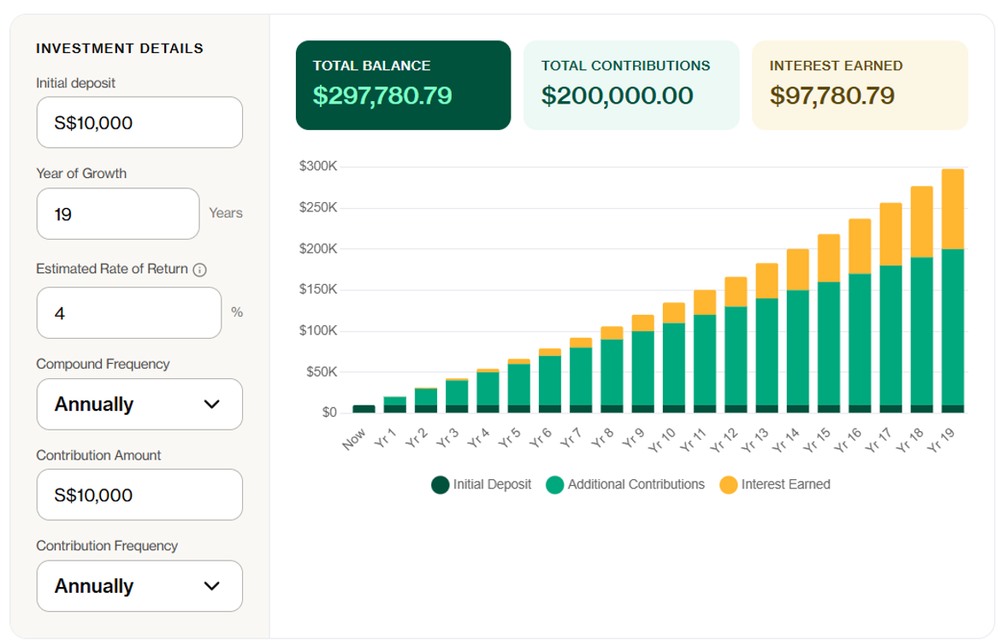
Investment returns are uncertain and losses are possible. The value of investments may rise or fall, and the actual outcome may be very different.
The purpose of the comparison is not to suggest that everyone should invest their SRS funds in the same way.
Instead, it shows that the long-term decision on how we invest our SRS savings may have a much larger impact than a one-year difference in the withdrawal age.
Being able to access a smaller SRS balance one year earlier may be less useful than building a significantly larger pool of retirement savings over time.
This is where my Growth Pot within the Four Pots of Wealth may play a role.
If I do not expect to need the money for many years, I may be able to invest it for long-term growth based on my risk tolerance and retirement horizon.
Making a first SRS contribution to secure an earlier prescribed retirement age provided useful flexibility.
However, what matters after that is whether I continue contributing and put my long-term retirement savings to work.
Find out how you can invest your SRS funds across fixed deposits, bonds, funds, ETFs, stocks and REITs in our complete SRS investment guide.
Discover how your savings and investments can grow over time with our compound calculator.
Retirement planning for the one-year SRS gap
The one year difference may still matter for someone who wants to stop working at 63.
If SRS withdrawals can only begin at 64, another source of money will be needed to fund the first year.
As a starting point, I would estimate how much I need to cover one year of essential expenses and check whether that amount is available outside CPF and SRS.
For example, someone expecting to spend S$3,000 a month would need about S$36,000 to fund the year.
This money should generally be held outside CPF and SRS, where it remains accessible.
This could come from:
- Cash and short-term investments
- Investments held outside my SRS account
- Part-time or other employment income
- Dividends and other passive income
The aim is not necessarily to earn the highest return.
It is to avoid being forced to continue working, cut spending or sell longer term investments during an unfavourable market.
Depending on when the money is needed, this could be held in cash or lower volatility investments within the Liquidity Pot within the Four Pots of Wealth.
CPF retirement income before and after age 65
As we shared earlier, the increase in the retirement age does not mean that CPF payouts will start later.
The CPF payout eligibility age remains at 65.
If I am eligible for CPF LIFE payouts, I can still choose to start receiving them from age 65, and the increase in retirement age does not change this.
CPF LIFE can therefore form the foundation of our retirement income by providing monthly payouts for as long as we live.
The first practical step is to estimate how much CPF LIFE may provide, then compare the payout with our expected essential expenses.
If I expect to spend S$4,000 a month and my estimated CPF LIFE payout is S$1,800, I would still need to fund the remaining S$2,200 through my SRS savings, investments or other sources of income.
To get a better idea of what I may receive, I can refer to the estimated CPF LIFE payouts based on the latest retirement sums in 2026.
You can also read our guide to CPF LIFE to understand how the different plans work and what to consider when choosing one.
The CPF Retirement Payout Planner allows me to estimate future payouts and simulate the effect of actions such as making top ups.
There are several ways to consider growing our CPF savings, including:
- Contributing towards CPF
- Saving more with CPF
- Earning higher returns on your CPF savings
You can learn more about growing your CPF for retirement adequacy here.
Read here to find out how much CPF savings you need to get $5,000 a month from CPF LIFE.
How I would bring SRS and CPF together
I would think of CPF, SRS and personal investments within Beansprout's four pots of wealth as serving different but complementary roles in retirement.
CPF LIFE can provide a lifelong income foundation for essential expenses.
SRS can supplement these payouts through a tax efficient investment portfolio that is gradually drawn down in retirement.
Investments outside CPF and SRS provide flexibility, particularly before these funds become available and when unexpected expenses arise.
If CPF LIFE is expected to cover most of my essential spending, I may be able to use my SRS and other investments more flexibly for discretionary expenses, inflation and unforeseen costs.
If there is still a meaningful shortfall, I would need to build a larger pool of SRS and personal investments to close the gap.
How retirement age fits into your broader retirement plan
Singapore is targeting a statutory retirement age of 65 and a re employment age of 70 by 2030.
The prescribed SRS retirement age could also rise again for someone who makes their first contribution only after a future increase.
However, the statutory retirement age is only one consideration when planning for retirement.
The age at which we stop working may depend on our health, family responsibilities, lifestyle goals, employment opportunities and financial position.
Some of the questions I would consider include:
- At what age would I like work to become optional?
- How much accessible savings would I need before CPF and SRS income becomes available?
- When can I begin making penalty free SRS withdrawals?
- When do I plan to start CPF LIFE payouts?
- How much do I expect to spend each month in retirement?
- How much of my portfolio should remain invested for longer term growth and income?
The answers can help determine how savings are allocated across the Four Pots of Wealth.
Money needed in the near term can remain in the Liquidity Pot.
Investments intended to generate recurring income can form part of the Income Pot. Our guide to earning passive income in Singapore covers some of the available options.
Funds that will not be needed for many years can remain in the Growth Pot where they have more time to recover from short term market volatility and potentially compound.
The aim is not necessarily to retire at a specific age. It is to build enough flexibility to adjust the plan if our circumstances, priorities or retirement rules change.
What would Beansprout do?
The increase in the retirement age has a more direct impact on SRS than CPF.
For someone starting SRS from July 2026, penalty free withdrawals will generally begin at 64 rather than 63. This may require an additional year of accessible savings for someone who wants to stop working earlier.
However, the one year difference may matter less than how effectively our retirement savings grow over the decades before then.
I would therefore plan for retirement using a combination of SRS, CPF and other investments, with each playing a different role.
For SRS, I would first check whether my contributions are invested appropriately. Money that will not be needed for many years should not be left idle in cash without considering its long term growth potential. Our guide to investing your SRS explains the available options.
For CPF, I would look at ways to strengthen my retirement savings, such as making additional contributions, saving more within CPF or considering investments that may offer higher potential returns. Before investing my CPF savings, I would compare the expected return and risk with the interest I would otherwise earn by leaving the money in CPF. Read our guide to growing your CPF savings which covers these options in more detail.
For other investments, the Four Pots of Wealth framework can help me structure my retirement plan by giving each part of my portfolio a clear role in providing liquidity, income and long-term growth.
Money needed for near term retirement expenses can remain in the Liquidity Pot, investments intended to provide passive income can form part of the Income Pot, while funds that will not be needed for many years can remain in the Growth Pot to support long term capital appreciation.
The aim is to use CPF, SRS and other investments together, so that we can choose when to stop working, even as retirement rules change.
Follow Beansprout on Telegram, Youtube, Facebook and Instagram, and add Beansprout as your preferred source on Google so you never miss an update.
Read also
Gain financial insights in minutes
Subscribe to our free weekly newsletter for more insights to grow your wealth
Most Popular

Comments
0 comments