
What the recent market pullback reminded me about building a resilient portfolio
CPF & Retirement
By Gerald Wong, CFA • 07 Nov 2026
Why trust Beansprout? We’ve been awarded Best Investment Website at the SIAS Investors’ Choice Awards 2025

Make Beansprout your preferred source on Google
Add us on Google to see more of our insights in your search results
The recent decline in share prices is a reminder to review our safety buffer, position sizes and how the Four Pots support our financial goals.

What happened?
A market pullback can test our confidence even before it becomes a headline-grabbing selloff.
Over the past few weeks, investors have had to contend with both Singapore shares having already been retreating when the sharp US selloff on 5 November added to the uncertainty.
When our investments are doing well, it is easy to spend more time thinking about the gains we could make than the losses we might face.
As prices fall, the questions change. Will the market recover? Should we reduce our exposure? Would buying more be an opportunity or a mistake?
For me, the recent weakness brings the importance of portfolio construction back into focus.
Choosing promising investments is only part of the task. We also need to organise our money in a way that allows us to hold through difficult periods without putting our financial commitments at risk.
The recent stock market pullback explained
The weakness in share prices had already been unfolding for several weeks before the US selloff on 5 November.
In Singapore, the Straits Times Index (STI) had fallen from around 5,700 in early October to around 5,200 at its early November trading lows, a decline of roughly 9%.
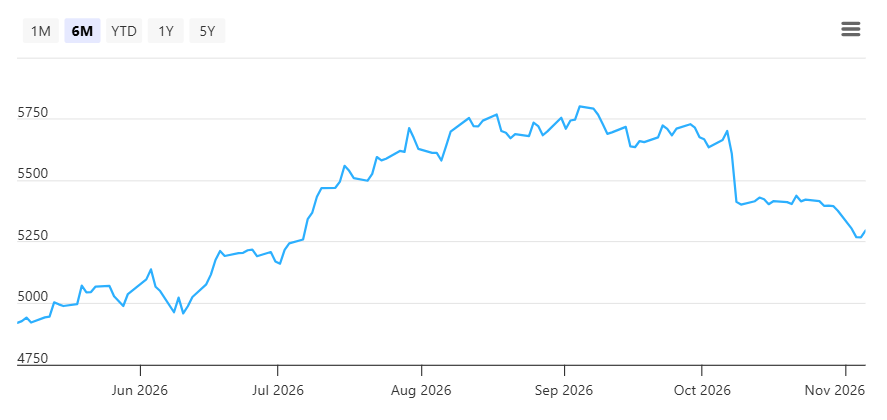
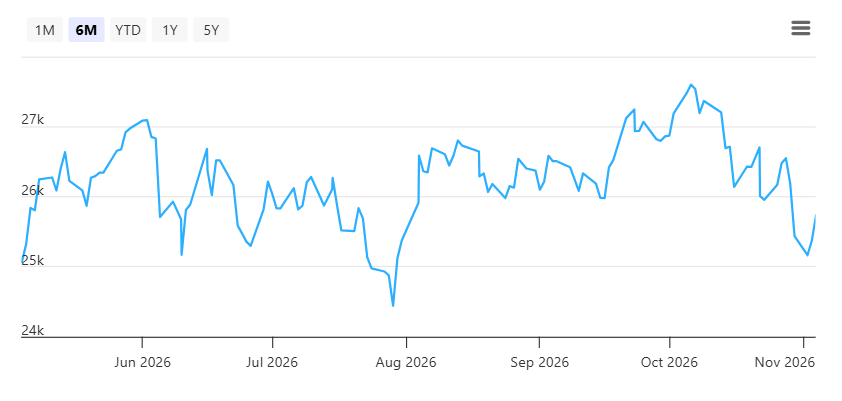
To me, the speed and scale of that selloff may reflect some panic selling, alongside investors reassessing the outlook for these companies.
Whether a decline develops over several weeks or accelerates in a single session, it tests the same thing: our ability to remain invested when markets move against us.
Three lessons from the recent market pullback
I do not see the recent weakness as a reason to avoid Singapore shares, US technology companies or artificial intelligence related investments altogether.
Instead, it reinforces the need to leave room for outcomes that differ from our expectations.
Even a well-researched investment can disappoint. What matters is whether our portfolio can absorb that disappointment while continuing to support the goals we are working towards.
These are the three lessons I would keep in mind.
Lesson #1: Preserve our ability to wait
We often assess a falling investment by asking whether it will recover.
An equally important question is whether we can afford to wait for that recovery.
Investors using leverage may face margin calls as share prices decline. If they cannot provide the additional funds required, their positions may be closed even if their view of the underlying companies has not changed.
This is how leverage can take the timing of an investment decision out of our hands. A decline we might otherwise have been able to hold through can become a realised loss.
The same problem can arise without borrowing. An unexpected expense, a period without income or an upcoming financial commitment may require us to raise cash. Without sufficient savings outside our investments, we could find ourselves selling into a weak market.
Trying to sell first and return when conditions improve introduces another challenge: getting both decisions right.
In a historical illustration, J.P. Morgan Asset Management calculated that US$10,000 invested in the S&P500 over 20 years would have grown to US$80,619 if it had remained fully invested.
Missing just the market’s 10 best days would have reduced the ending value to US$35,866.
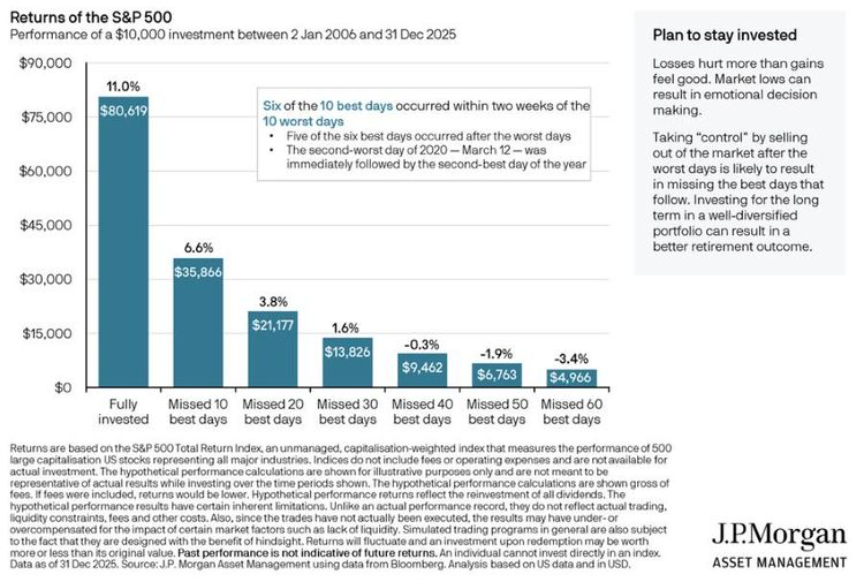
Strong recovery days also tend to occur close to sharp declines. Selling after a fall can therefore leave us out of the market when an important part of the rebound happens.
Having the financial ability to wait gives us more control over that decision.
Lesson #2: Leave room for an investment to disappoint
There are many reasons an investment can look attractive. We may see a business with strong growth prospects, an appealing dividend or exposure to a promising industry.
But a convincing investment case does not remove uncertainty.
Earnings could fall short of expectations. The price we paid may have assumed too much growth. A theme we believe in may take much longer to translate into profits.
While we cannot decide how far a share price might fall, we can decide how much of our money is exposed to that possibility.
Consider a S$100,000 portfolio and an investment that loses half its value.
| Exposure to one opportunity | Amount invested | Loss if it falls by 50% | Impact on total portfolio |
| 1% | S$1,000 | S$500 | 0.5% |
| 5% | S$5,000 | S$2,500 | 2.5% |
| 10% | S$10,000 | S$5,000 | 5.0% |
| 20% | S$20,000 | S$10,000 | 10.0% |
| Illustration assumes no leverage and that all other holdings remain unchanged. | |||
If the investment accounts for 1% of the portfolio, the loss reduces the overall portfolio by 0.5%. That is disappointing, but it is less likely to disrupt an important financial goal.
At a 20% allocation, the same investment decline takes 10% off the portfolio.
The difference comes from how much we committed to the idea.
Position sizing allows us to invest with conviction while acknowledging that our assessment may be wrong. We can give an idea enough room to contribute without allowing it to determine the outcome of our entire financial plan.
Lesson #3: Keep our financial goals at the centre of investment decisions
A loss on a trading screen has consequences beyond the number displayed.
Depending on its size, it could delay retirement, reduce the support we can provide to our family or limit our ability to take time away from work. It could also leave us less prepared for an emergency.
That is why I would assess an investment by considering both its potential return and the effect a large loss could have on my life.
What would a decline of 30%, 50% or more mean for the plans this money is supposed to fund?
Losing half the value of a small position may be manageable. A similar loss on an investment that represents a large share of our savings could require difficult changes to our housing, retirement or family plans.
Investing should expand our choices over time. Our ability to meet essential goals should not rest on the success of a single company, market or investment theme.
How Beansprout’s Four Pots put these lessons into practice
These three lessons are why we set up Beansprout’s Four Pots of Wealth, a simple framework to help us think more clearly about how we structure money.
The Four Pots of Wealth starts by giving every dollar in my portfolio a specific role, instead of treating it as one big pool of money.

The Opportunity Pot allows us to invest in high conviction ideas, while limiting how much one investment can hurt us. The Liquidity Pot helps ensure that we are not forced to sell. The Growth Pot and Income Pot keep the bulk of our investments focused on our longer term financial goals.
The Four Pots cannot prevent individual investments from falling. What they can do is help prevent one loss from derailing our entire financial future.
#1 - The Opportunity Pot puts a limit around conviction
The Opportunity Pot gives us room to pursue individual stocks, emerging themes and other investments with greater uncertainty. At the same time, it places a clear limit around how much of our portfolio we are prepared to expose to these opportunities.
Suppose the Opportunity Pot represents 10% of the overall portfolio. If an individual stock represents 10% of the Opportunity Pot, the stock accounts for just 1% of the total portfolio.
Even if the share price falls by 50%, the overall portfolio would decline by only 0.5%, assuming the other holdings remain unchanged. We might still need to reassess the investment case, but the loss would be unlikely to affect our retirement plans or ability to meet an important financial commitment.
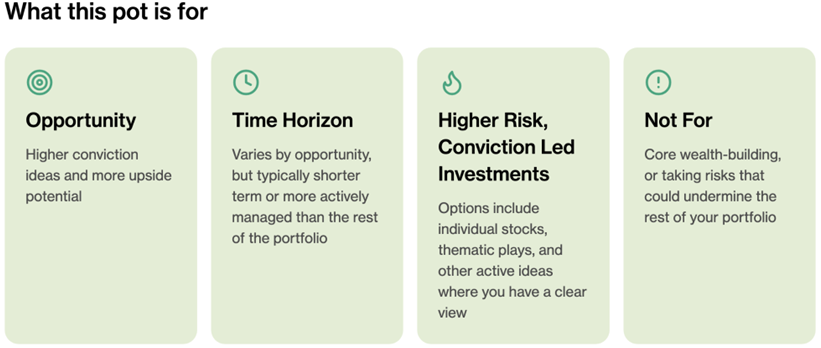
This is why we set limits not only for the Opportunity Pot, but also for each investment within it. Learn more about our four stage process to pick growth stocks and size them in our portfolios here.
The Opportunity Pot gives conviction a place in the portfolio, while putting a fence around the possible consequences if the investment does not work out.
Learn more about the Opportunity Pot here.
#2 - The Liquidity Pot protects our ability to wait
The Liquidity Pot holds the money that we may need for emergencies and near term expenses. If an unexpected financial need arises, we can draw on this money rather than selling our longer term investments during a market decline.
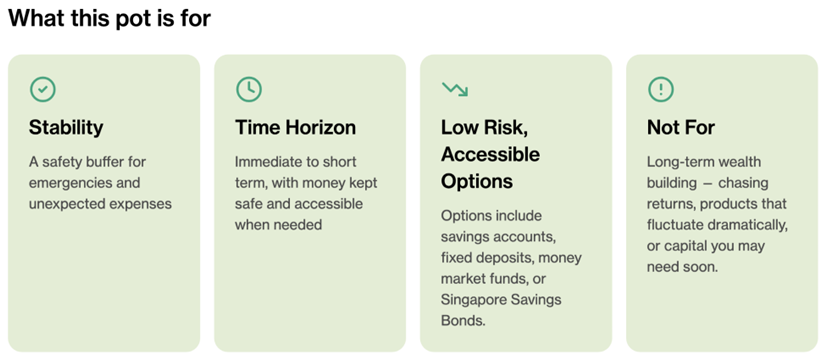
This gives our investments time to recover and allows us to decide whether the investment case has genuinely changed. We are not selling simply because we urgently need cash.
The Liquidity Pot may not offer the highest potential return, but that is not its purpose. Its role is to ensure that a temporary financial need does not turn a temporary market decline into a permanent investment loss.
Together with avoiding leverage, it helps us retain control over when we sell.
Learn more about the Liquidity Pot here.
#3 — The Growth and Income Pots keep our goals on track
The Opportunity Pot should not carry the responsibility of funding our entire financial future. The bulk of our portfolio should remain in the Growth and Income Pots, where it can remain focused on our longer term financial goals.
The Growth Pot is where diversified investments can compound over time, while the Income Pot can provide recurring cash flow for investors who require it. Most importantly, these Pots help ensure that our retirement and other financial goals do not depend on one higher risk investment working out.
Consider a S$100,000 portfolio with 10% in the Liquidity Pot, 55% in the Growth Pot, 25% in the Income Pot and 10% in the Opportunity Pot.
If the entire Opportunity Pot falls by 50%, it would decline from S$10,000 to S$5,000. The overall portfolio would fall by 5%, assuming the other Pots remain unchanged.
| Pot | Initial allocation | Initial value | Value after Opportunity Pot falls 50% |
| Liquidity Pot | 10% | S$10,000 | S$10,000 |
| Growth Pot | 55% | S$55,000 | S$55,000 |
| Income Pot | 25% | S$25,000 | S$25,000 |
| Opportunity Pot | 10% | S$10,000 | S$5,000 |
| Total portfolio | 100% | S$100,000 | S$95,000 |
| This illustration isolates a loss in the Opportunity Pot. During a broad market pullback, the Growth and Income Pots may also fall in value. | |||
The loss would be painful, but it would not be the same as losing half of the entire portfolio. The Liquidity Pot would remain available for emergencies, while the Growth and Income Pots would remain focused on the investor’s longer term goals.
One market theme would not have been allowed to determine the outcome of the whole financial plan.
The Opportunity Pot allows us to pursue additional upside. The other Pots ensure that our financial goals do not depend on achieving it.
Learn more about the Growth Pot and Income Pot here.
What would Beansprout do?
For me, the recent pullback is a reason to revisit how our portfolios are structured.
Each investment should have a place within a financial plan that can cope when things do not work out as expected.
Beansprout’s Four Pots of Wealth helps us put that into practice.
The Opportunity Pot gives us room to act on higher conviction ideas, while placing a clear limit around the risk we take.
The Liquidity Pot gives us the ability to wait through periods of market weakness. The Growth and Income Pots remain focused on our longer term needs.
This matters because a portfolio serves a life outside the market. It may be funding retirement, supporting family members or creating the freedom to make different choices about work.
We cannot know every risk in advance. We can, however, avoid making those plans depend too heavily on one investment decision.
The same thinking applies to our other savings, including money in our CPF and SRS accounts.
Before deciding where to invest, I would first ask what the money needs to do and when it may be needed. That gives us a clearer starting point for deciding which Pot it belongs in, and how much risk we can reasonably take.
Follow Beansprout on YouTube, Facebook and Instagram, and add Beansprout as your preferred source on Google so you never miss an update.
Read also
Gain financial insights in minutes
Subscribe to our free weekly newsletter for more insights to grow your wealth
Most Popular

Comments
0 comments