
What the South Korean stock selloff taught me about building a resilient portfolio
CPF & Retirement
By Gerald Wong, CFA • 01 Aug 2026
Why trust Beansprout? We’ve been awarded Best Investment Website at the SIAS Investors’ Choice Awards 2025
'%3e%3cpath%20fill-rule='evenodd'%20clip-rule='evenodd'%20d='M17.64%209.20455C17.64%208.56637%2017.5827%207.95273%2017.4764%207.36364H9V10.845H13.8436C13.635%2011.97%2013.0009%2012.9232%2012.0477%2013.5614V15.8195H14.9564C16.6582%2014.2527%2017.64%2011.9455%2017.64%209.20455V9.20455Z'%20fill='%234285F4'/%3e%3cpath%20fill-rule='evenodd'%20clip-rule='evenodd'%20d='M9%2018C11.43%2018%2013.4673%2017.1941%2014.9564%2015.8195L12.0477%2013.5614C11.2418%2014.1014%2010.2109%2014.4205%209%2014.4205C6.65591%2014.4205%204.67182%2012.8373%203.96409%2010.71H0.957275V13.0418C2.43818%2015.9832%205.48182%2018%209%2018V18Z'%20fill='%2334A853'/%3e%3cpath%20fill-rule='evenodd'%20clip-rule='evenodd'%20d='M3.96409%2010.71C3.78409%2010.17%203.68182%209.59318%203.68182%209C3.68182%208.40682%203.78409%207.83%203.96409%207.29V4.95818H0.957273C0.347727%206.17318%200%207.54773%200%209C0%2010.4523%200.347727%2011.8268%200.957273%2013.0418L3.96409%2010.71V10.71Z'%20fill='%23FBBC05'/%3e%3cpath%20fill-rule='evenodd'%20clip-rule='evenodd'%20d='M9%203.57955C10.3214%203.57955%2011.5077%204.03364%2012.4405%204.92545L15.0218%202.34409C13.4632%200.891818%2011.4259%200%209%200C5.48182%200%202.43818%202.01682%200.957275%204.95818L3.96409%207.29C4.67182%205.16273%206.65591%203.57955%209%203.57955V3.57955Z'%20fill='%23EA4335'/%3e%3c/g%3e%3cdefs%3e%3cclipPath%20id='clip0_0_2849'%3e%3crect%20width='18'%20height='18'%20fill='white'/%3e%3c/clipPath%3e%3c/defs%3e%3c/svg%3e)
Make Beansprout your preferred source on Google
Add us on Google to see more of our insights in your search results
What the South Korean stock selloff taught me about having a safety buffer, position sizing and using the Four Pots to protect our long-term goals.
What happened?
Sometime in May this year, someone suggested that I buy a leveraged product linked to a South Korean technology stock.
Artificial intelligence (AI) related stocks were performing strongly back then, and the product offered the possibility of earning multiple times the stock’s daily return.
However, it did not fit what I was looking for at the time. I had been more focused on income opportunities within my portfolio, and I was not comfortable taking on the additional risks that came with leverage, so I decided not to invest.
A few months later, the South Korean stock market fell sharply. In one online trading forum, a South Korean investor reportedly wrote, “Give me my money back.”
I can understand why an investor would feel that way. When markets are rising, we naturally focus on how much more we could make.
But when they fall, our attention quickly shifts to how much we have lost, whether the market will recover, and whether we should sell before things get worse.
The recent events in South Korea are therefore a reminder that investing well is not only about identifying the right stocks or investment themes.
It is also about building a portfolio that gives us the ability to stay invested when markets move against us.
The South Korean stock market selloff explained
South Korean shares had been among the world’s strongest performing markets, driven by enthusiasm around artificial intelligence and the rally in Samsung Electronics and SK Hynix.
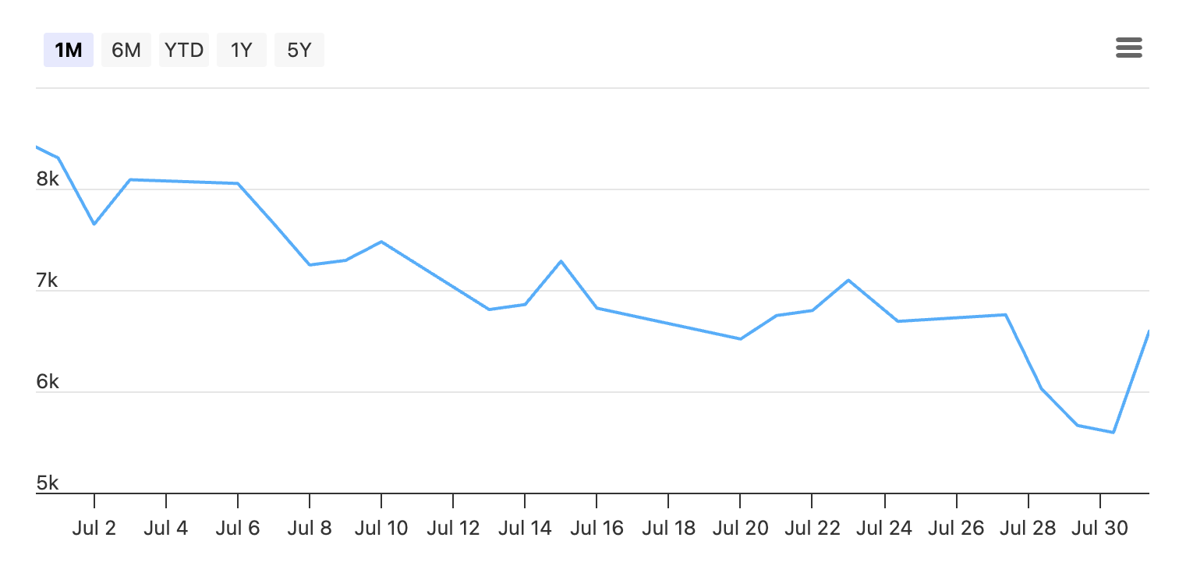
The KOSPI reached a record closing high of 9,114.55 on 22 June 2026, but the rally reversed sharply as investors began to question whether expectations for artificial intelligence spending and semiconductor earnings had become too optimistic.
As the chart below shows, the KOSPI had fallen more than 20% from its record high by 8 July. The selloff deepened later in the month, with the index falling almost 40% from its peak by 29 July.
Even after rebounding as much as 17% on 31 July, the KOSPI was still on track to lose almost 25% for the month, which would mark its largest monthly decline since the Asian financial crisis in 1997.
The decline was especially painful for retail investors who had built up significant leveraged exposure through single stock leveraged exchange traded funds linked to Samsung Electronics and SK Hynix during the rally.
These products aimed to deliver twice the daily movement of the underlying shares, allowing investors to amplify their gains when prices rose, but also magnifying their losses when the market turned.
According to the Bank of Korea, leveraged equity investments by retail investors reached a record 60 trillion won, or about US$39 billion, by the end of May 2026.
On 10 July 2026, SK Hynix shares closed at 2.18 million won in Seoul, while the leveraged ETF closed at HK$89.40 in Hong Kong.
When SK Hynix fell 15.4% to 1.845 million won on 13 July, the leveraged ETF declined by 33.0% to HK$59.90.
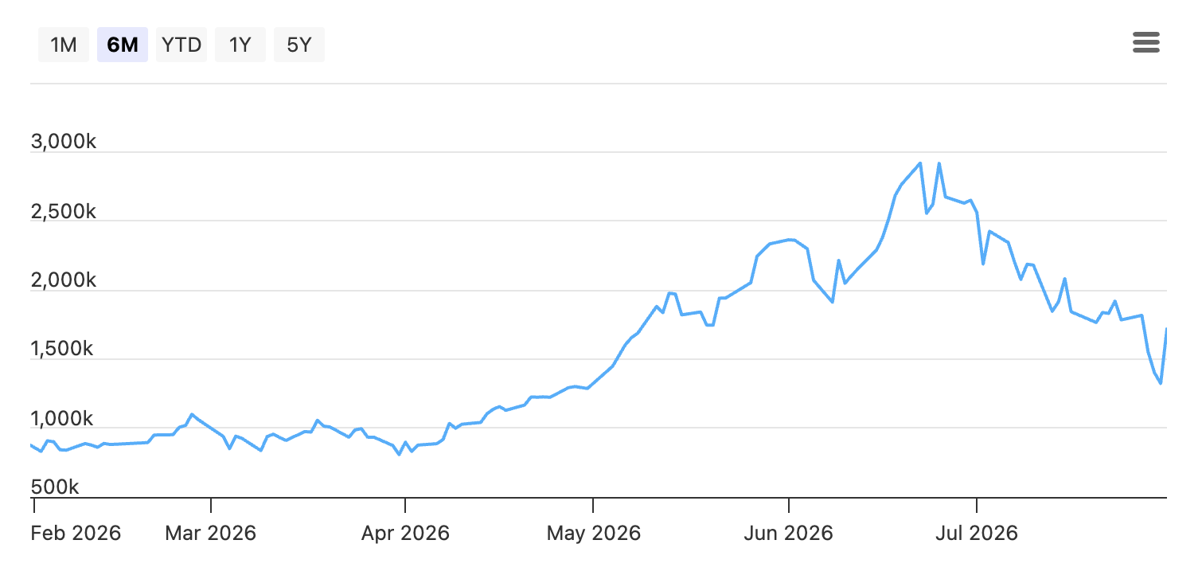
In other words, SK Hynix shareholders lost about 15% of their investment in a single trading day, while investors in the leveraged ETF lost about one third. Reuters reported that this was the ETF’s biggest one day decline since it was listed in October 2025.
According to Goldman Sachs estimates reported by Reuters, more than 1.2 million leveraged retail trading accounts had received margin calls by 13 July, while between 320,000 and 360,000 accounts had been fully liquidated.
Many investors therefore lost the ability to decide whether they wanted to hold their investments and wait for a recovery, as their brokers closed the positions for them.
Citi also estimated that Korean retail investors suffered cumulative losses of about US$38.7 billion from leveraged exchange traded funds during the downturn.
This was not an official nationwide loss figure, but it gives an indication of the scale of the damage experienced by investors who had taken on significant leveraged exposure.
What the South Korean stock selloff taught me about building a resilient portfolio
To me, the lesson is not simply that investors should avoid Korean shares, semiconductor companies or artificial intelligence related investments.
It is that we need to build a portfolio that can withstand being wrong, especially when we are investing in areas where expectations and volatility are high.
Here are the three lessons I took away from what happened.
Lesson #1: Protect yourself from being forced to sell
When we invest, we often ask whether an investment will eventually recover. However, this assumes that we have the financial ability to wait.
Many leveraged investors in South Korea did not have that choice. As share prices fell, margin calls were triggered and positions had to be closed, regardless of whether the investors still believed in the companies.
This is one of the biggest risks of leverage. It can turn a temporary market decline into a permanent loss by forcing us to sell when prices are weakest.
Leverage is not the only reason we may be forced to sell. An emergency, a loss of income or another financial commitment may also require us to raise cash. If all our money is invested, we may have no choice but to sell on a down day.
Historical market data also shows how difficult it is to sell during a decline and return at the right time.
J.P. Morgan Asset Management calculated that US$10,000 invested in the S&P 500 over 20 years would have grown to US$80,619 if it had remained fully invested.
Missing only the market’s 10 best days would have reduced the ending value to US$35,866.
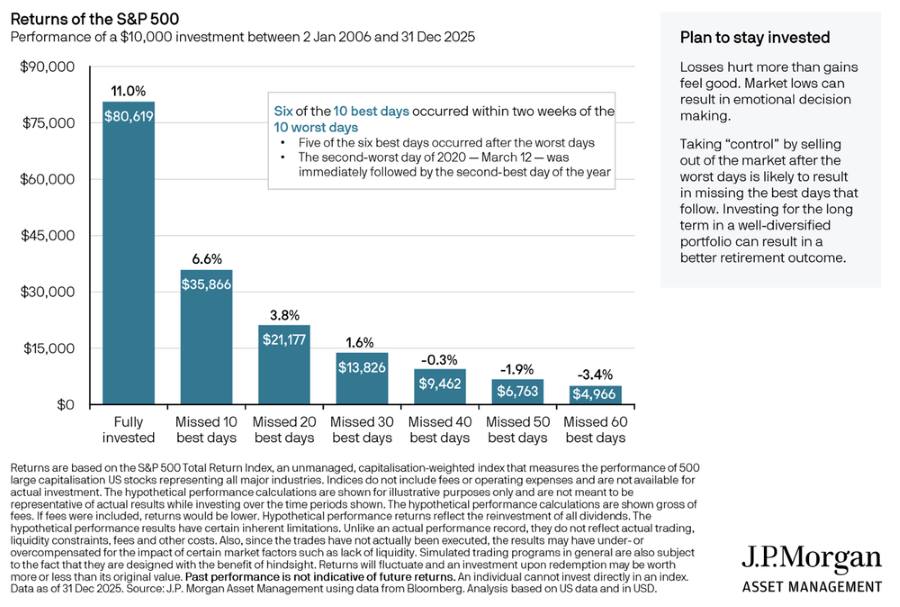
The best market days also tend to occur close to the worst ones. This means that an investor who sells after a sharp decline may miss an important part of the eventual recovery.
Lesson #2: Build room for investments to disappoint
The investment case for South Korean semiconductor companies appeared compelling. Spending on artificial intelligence infrastructure was growing, while Samsung Electronics and SK Hynix were seen to be benefitting from demand for advanced memory chips.
However, no matter how convincing an investment case appears, there is always a chance that we may be wrong. The company’s earnings may disappoint, the valuation may have become too demanding, or the investment theme may take longer to play out than expected.
We cannot control how far an investment falls, but we can control how much of our portfolio is exposed to it.
Consider the impact of a 50% decline on a portfolio worth S$100,000.
| Exposure to one opportunity | Amount invested | Loss if it falls by 50% | Impact on total portfolio |
| 1% | S$1,000 | S$500 | 0.5% |
| 5% | S$5,000 | S$2,500 | 2.5% |
| 10% | S$10,000 | S$5,000 | 5.0% |
| 20% | S$20,000 | S$10,000 | 10.0% |
If an investment represents only 1% of the overall portfolio, a 50% decline reduces the portfolio by 0.5%. This would still be disappointing, but it would be unlikely to affect the investor’s retirement plans or ability to meet an important financial commitment.
If the same investment represents 20% of the portfolio, the 50% decline would reduce the overall portfolio by 10%.
The investment has performed in exactly the same way, but the consequence for the investor is very different. Position sizing allows us to act on our conviction while recognising that even our strongest investment ideas can disappoint.
Having conviction does not mean that we need to bet everything. It means that we are prepared to take a considered position, while still leaving room for the possibility that we may be wrong.
Lesson #3: Investing should support our financial goals, not derail them
An investment loss is not just a red number on a trading platform. There is always a life behind the portfolio.
A large loss may affect when we are able to retire, whether we can support our family, or whether we can take time away from work. It may also reduce our ability to manage a period without income or pay for an unexpected expense.
This is why I do not think we should judge an investment only by how much it could potentially make. We should also consider what would happen to our lives if it fell by 30%, 50% or more.
A 50% loss on an investment representing 1% of our portfolio would reduce the overall portfolio by 0.5%. It may hurt, but it is unlikely to change our lives.
A 50% loss on a leveraged position representing a large part of our savings could have much more serious consequences for our home, retirement and family plans.
Investing should give us more choices in life. It should not make our financial future dependent on one stock, one market or one investment theme.
How Beansprout’s Four Pots put these lessons into practice
These three lessons are why we set up Beansprout’s Four Pots of Wealth, a simple framework to help us think more clearly about how we structure money.
The Four Pots of Wealth starts by giving every dollar in my portfolio a specific role, instead of treating it as one big pool of money.

The Opportunity Pot allows us to invest in high conviction ideas, while limiting how much one investment can hurt us. The Liquidity Pot ensures that we are not forced to sell. The Growth Pot and Income Pot keep the bulk of our investments focused on our longer term financial goals.
The Four Pots cannot prevent individual investments from falling. What they can do is prevent one loss from derailing our entire financial future.
#1 - The Opportunity Pot puts a limit around conviction
The Opportunity Pot gives us room to pursue individual stocks, emerging themes and other investments with greater uncertainty. At the same time, it places a clear limit around how much of our portfolio we are prepared to expose to these opportunities.
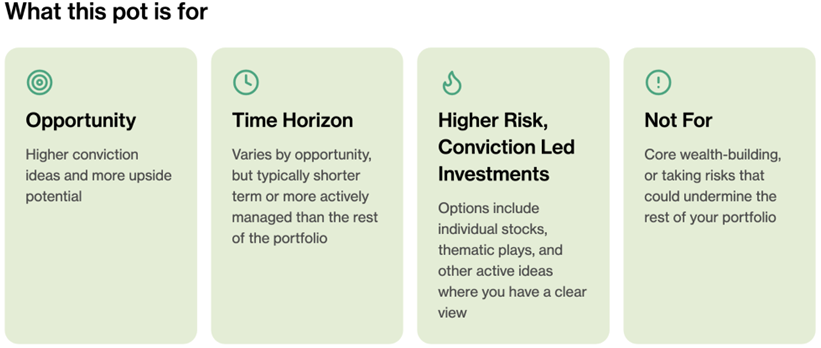
Suppose the Opportunity Pot represents 10% of the overall portfolio. If an individual stock represents 10% of the Opportunity Pot, the stock accounts for just 1% of the total portfolio.
Even if the share price falls by 50%, the overall portfolio would decline by only 0.5%. We might still need to reassess the investment case, but the loss would be unlikely to affect our retirement plans or ability to meet an important financial commitment.
This is why we set limits not only for the Opportunity Pot, but also for each investment within it. Learn more about our four stage process to pick growth stocks and size them in our portfolios here.
The Opportunity Pot gives conviction a place in the portfolio, while putting a fence around the possible consequences if the investment does not work out.
Learn more about the Opportunity Pot here.
#2 - The Liquidity Pot protects our ability to wait
The Liquidity Pot holds the money that we may need for emergencies and near term expenses. If an unexpected financial need arises, we can draw on this money rather than selling our longer term investments during a market decline.
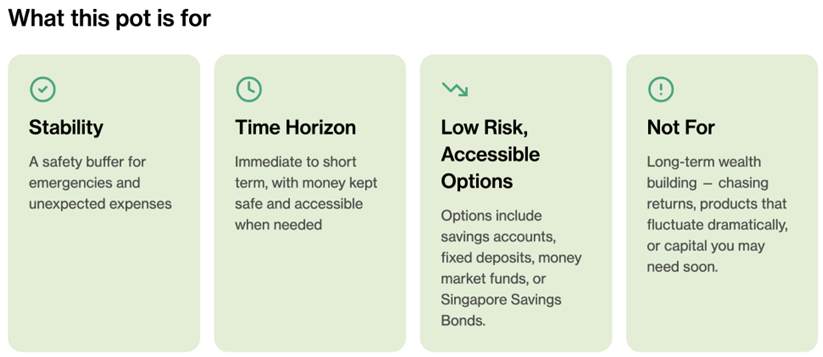
This gives our investments time to recover and allows us to decide whether the investment case has genuinely changed. We are not selling simply because we urgently need cash.
The Liquidity Pot may not offer the highest potential return, but that is not its purpose. Its role is to ensure that a temporary financial need does not turn a temporary market decline into a permanent investment loss.
Together with avoiding leverage, it helps us retain control over when we sell.
Learn more about the Liquidity Pot here.
#3 - The Growth and Income Pots keep our goals on track
The Opportunity Pot should not carry the responsibility of funding our entire financial future. The bulk of our portfolio should remain in the Growth and Income Pots, where it can remain focused on our longer term financial goals.
The Growth Pot is where diversified investments can compound over time, while the Income Pot can provide recurring cash flow for investors who require it. Most importantly, these Pots ensure that our retirement and other financial goals do not depend on one higher risk investment working out.
Consider a S$100,000 portfolio with 10% in the Liquidity Pot, 55% in the Growth Pot, 25% in the Income Pot and 10% in the Opportunity Pot.
If the entire Opportunity Pot falls by 50%, it would decline from S$10,000 to S$5,000. The overall portfolio would fall by 5%.
Consider a S$100,000 portfolio allocated across the Four Pots as follows:
| Pot | Initial allocation | Initial value | Value after Opportunity Pot falls 50% |
| Liquidity Pot | 10% | S$10,000 | S$10,000 |
| Growth Pot | 55% | S$55,000 | S$55,000 |
| Income Pot | 25% | S$25,000 | S$25,000 |
| Opportunity Pot | 10% | S$10,000 | S$5,000 |
| Total portfolio | 100% | S$100,000 | S$95,000 |
Even if the entire Opportunity Pot falls by 50%, the overall portfolio would decline by 5%. The loss would be painful, but the remaining Pots would continue to support the investor’s liquidity needs and longer term financial goals.
That would be painful, but it would not be the same as losing half of the entire portfolio. The Liquidity Pot would remain available for emergencies, while the Growth and Income Pots would remain focused on the investor’s longer term goals.
One market theme would not have been allowed to determine the outcome of the whole financial plan.
The Opportunity Pot allows us to pursue additional upside. The other Pots ensure that our financial goals do not depend on achieving it.
Learn more about the Growth Pot and Income Pot here.
What would Beansprout do?
The lesson from the Korean stock selloff is not that we should avoid investing.
It is that every opportunity should sit within a portfolio that can absorb disappointment without disrupting the rest of our financial plan.
This is the purpose of Beansprout's Four Pots of Wealth.
The Opportunity Pot gives us room to act on higher conviction ideas, while placing a clear limit around the risk we take. We share a four stage process for picking growth stocks, covering how to find and screen ideas, research the company, determine an entry price and set exit rules here.
The Liquidity Pot gives us the ability to wait through periods of market weakness. The Growth and Income Pots remain focused on our longer term needs.
The consequences of getting this wrong go beyond investment returns. A large loss can delay retirement, reduce our ability to support our family, or take away the freedom to step back from work when we need to.
We cannot remove uncertainty from investing, but we can structure our portfolio so that one mistake does not change the life we are working towards.
The same framework can guide the other financial decisions we make, from building sufficient emergency savings to investing our CPF and SRS funds.
These pools of money may sit in different accounts, but the underlying principle is the same. Money intended for retirement, housing or near term expenses should not depend on one higher risk investment working out.
Before investing, we should therefore ask not only how much we could earn, but what role the money is meant to play in our lives. This helps us decide which Pot it belongs in, and how much risk we can afford to take.
Follow Beansprout on YouTube, Facebook and Instagram, and add Beansprout as your preferred source on Google so you never miss an update.
Read also
Gain financial insights in minutes
Subscribe to our free weekly newsletter for more insights to grow your wealth
Most Popular

Comments
0 comments