
20-year green SGS bond offers 2.40% yield. What investors should know
Bonds
By Gerald Wong, CFA • 23 Jul 2026
Why trust Beansprout? We’ve been awarded Best Investment Website at the SIAS Investors’ Choice Awards 2025
'%3e%3cpath%20fill-rule='evenodd'%20clip-rule='evenodd'%20d='M17.64%209.20455C17.64%208.56637%2017.5827%207.95273%2017.4764%207.36364H9V10.845H13.8436C13.635%2011.97%2013.0009%2012.9232%2012.0477%2013.5614V15.8195H14.9564C16.6582%2014.2527%2017.64%2011.9455%2017.64%209.20455V9.20455Z'%20fill='%234285F4'/%3e%3cpath%20fill-rule='evenodd'%20clip-rule='evenodd'%20d='M9%2018C11.43%2018%2013.4673%2017.1941%2014.9564%2015.8195L12.0477%2013.5614C11.2418%2014.1014%2010.2109%2014.4205%209%2014.4205C6.65591%2014.4205%204.67182%2012.8373%203.96409%2010.71H0.957275V13.0418C2.43818%2015.9832%205.48182%2018%209%2018V18Z'%20fill='%2334A853'/%3e%3cpath%20fill-rule='evenodd'%20clip-rule='evenodd'%20d='M3.96409%2010.71C3.78409%2010.17%203.68182%209.59318%203.68182%209C3.68182%208.40682%203.78409%207.83%203.96409%207.29V4.95818H0.957273C0.347727%206.17318%200%207.54773%200%209C0%2010.4523%200.347727%2011.8268%200.957273%2013.0418L3.96409%2010.71V10.71Z'%20fill='%23FBBC05'/%3e%3cpath%20fill-rule='evenodd'%20clip-rule='evenodd'%20d='M9%203.57955C10.3214%203.57955%2011.5077%204.03364%2012.4405%204.92545L15.0218%202.34409C13.4632%200.891818%2011.4259%200%209%200C5.48182%200%202.43818%202.01682%200.957275%204.95818L3.96409%207.29C4.67182%205.16273%206.65591%203.57955%209%203.57955V3.57955Z'%20fill='%23EA4335'/%3e%3c/g%3e%3cdefs%3e%3cclipPath%20id='clip0_0_2849'%3e%3crect%20width='18'%20height='18'%20fill='white'/%3e%3c/clipPath%3e%3c/defs%3e%3c/svg%3e)
Make Beansprout your preferred source on Google
Add us on Google to see more of our insights in your search results
The new 20-year green SGS bond offers a 2.40% p.a. yield and will close on 28 July. We examine its returns, risks and whether it may be worth applying for.
What happened?
We have seen a bounce in the Singapore T-bill yield recently.
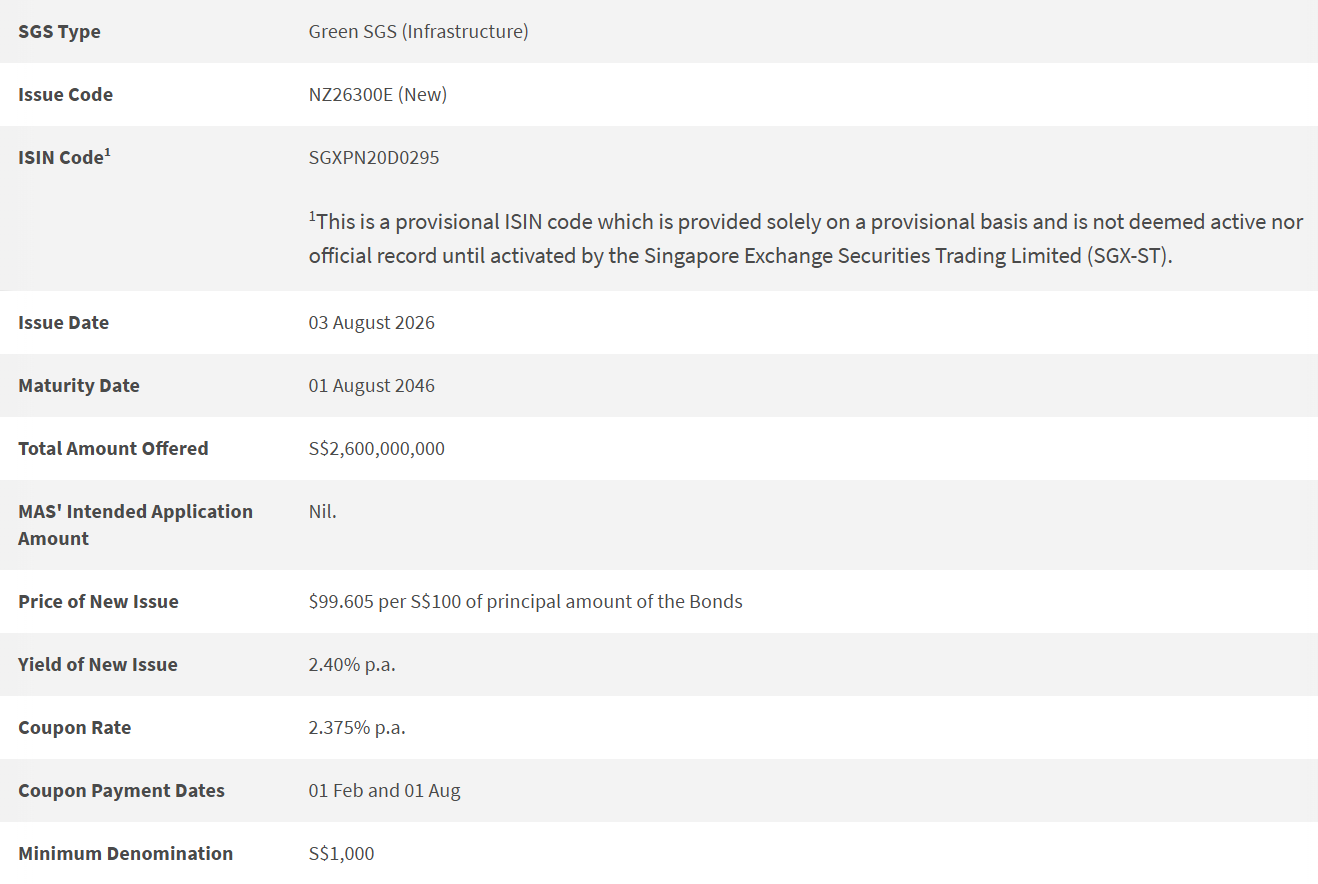
As a result, I have seen more discussion about the new 20-year green SGS bond (NZ26300E) with a yield of 2.40% p.a.
The headline yield appears higher than the latest six-month T-bill cut-off yield of 1.55% p.a.
It is also above the latest Singapore Savings Bond, which offers a first-year return of 1.46% p.a. and a 10-year average return of 2.06% p.a.
However, investors would need to accept a much longer investment period and potential price fluctuations if they sell the bond before maturity.
For investors who might be new to the SGS bond, I will take a closer look at the 20-year green SGS bond and the key considerations before deciding whether it may be worth applying for.
What is the Green SGS (Infrastructure) bond?
Green bonds are bonds issued by the government to finance major, long term green infrastructure projects.
As you might be aware, Singapore has a target to get to net-zero emission by 2050. To finance the infrastructure required to combat climate change, the government will take the lead by issuing up to S$35 billion of green bonds by 2030.
This will support Singapore’s decarbonisation efforts and deepen Singapore’s green finance market.
How is the Green SGS bond different from other SGS bonds?
There are a few key differences between the SGS Green (Infra) bond and other SGS bonds.
The SGS Green (Infra) bond can only be used to finance major, long-term green infrastructure projects.
The other key difference lies largely in the application process. While SGS are usually issued via auction, the Green SGS (Infrastructure) is being issued via syndication.
What this means is that yield of the SGS Green (Infra) bond has already been determined through a bookbuilding process with institutional and accredited investors.
If you are interested in the SGS Green (Infra) bond, what is important for you here is that the application process is slightly different from the usual SGS bonds, which we will share later in the article.
How is the Green SGS bond different from the SSB?
We thought it might be useful to compare the SGS Green (Infra) bond to the Singapore Savings Bond, since that is what most bond investors in Singapore are familiar with.
Like the Singapore Savings Bonds, the SGS Green (Infra) bond is fully backed by the Singapore Government.
They offer a sound way for you to diversify your investment portfolios, while earning a regular interest payment.
The key difference is that the Singapore Savings Bonds offer more flexibility compared to the SGS Green (Infra) bond.
The SGS Green (Infra) bond has a fixed maturity of 20 years, which means that you need to be comfortable holding on to the bond for this period of time.
While the SGS can be traded in the secondary market, the price you will receive may be lower than what you paid if you decide to sell them before maturity.
On the other hand, the SSBs can be redeemed in any month with no penalty. You will receive the initial investment amount plus accrued interest upon redemption.
How does the 20-year green SGS bond compare with the latest Singapore Savings Bond?
The latest Singapore Savings Bond offers a first-year return of 1.46% p.a. and a 10-year average return of 2.06% p.a., below the 2.40% p.a. yield on the 20-year green SGS bond.
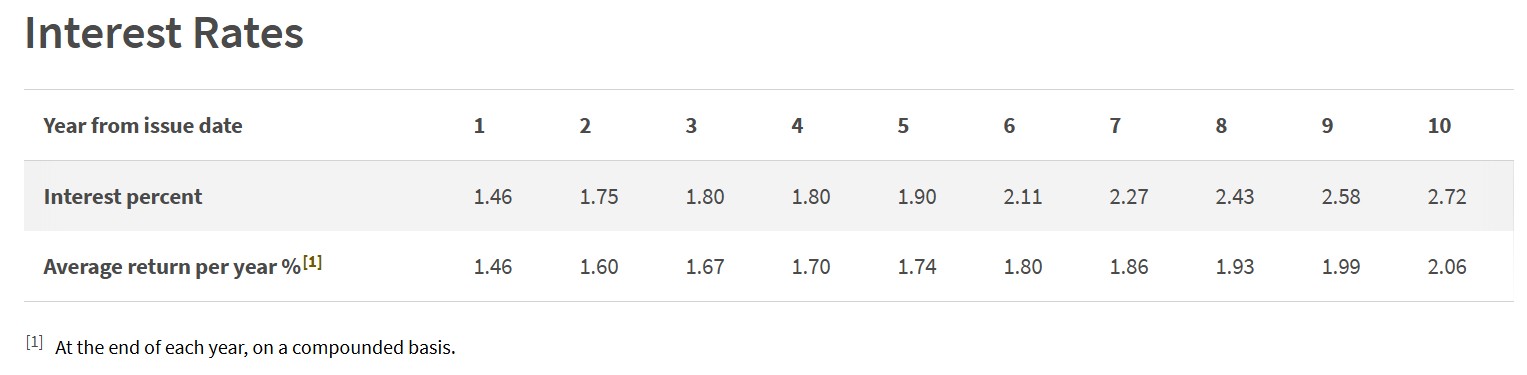
However, the SSB offers greater flexibility as it can be redeemed in any month without being exposed to changes in its market price.
In comparison, the 20-year SGS bond may fall below its issue price if interest rates rise and you sell it before maturity.
Hence, investors would need to consider whether the higher yield is enough to compensate for the longer maturity and lower flexibility.
As of 23 July 2026, our SSB interest rate projection estimates that the next SSB may offer a 10-year average return of approximately 2.21%.
How does the 20-year green SGS bond yield compare with the 10-year SGS bond yield?
The benchmark 10-year Singapore government bond offered a yield of about 2.30% p.a. as of 22 July 2026.
This is only 0.10 percentage point below the 2.40% p.a. yield offered by the 20-year green SGS bond.
This means investors are receiving only a small increase in yield for investing in a bond with a maturity that is 10 years longer.
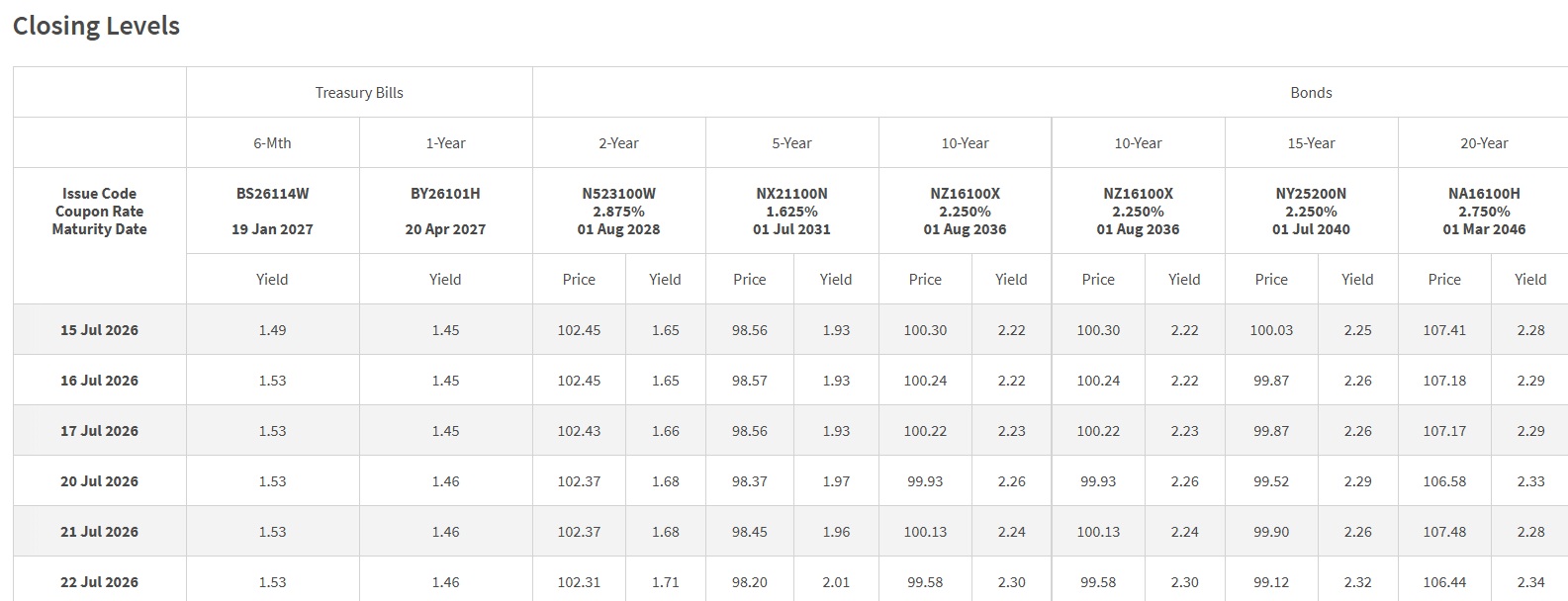
The difference is important because a 20-year bond is generally more sensitive to changes in interest rates than a 10-year bond.
If market interest rates rise, the price of the 20-year bond may fall more sharply. Investors would therefore be taking on greater interest-rate risk for a relatively small increase in yield.
Hence, investors would need to consider whether the small increase in yield is enough to compensate for the longer maturity and greater potential price fluctuations.
What we would consider before investing in the 20-year SGS bond
#1 – Interest rate risk
So having shared the lack of flexibility compared to the Singapore Savings Bond, it is worthwhile highlighting the risks of the SGS Green (Infra) bond.
Top of the list is interest rate risk, where you may incur a loss if you sell the bonds before their maturity in 2046.
If interest rates continue to go up, the price of the bond will decline. And if you need to sell to bond to buy a house or pay for your children’s education (in say 2038), you will be getting back an amount that is below your initial capital.
What is even more important to note here is that with a maturity of 20 years, the SGS Green (Infra) bond is considered a long-tenor bond.
As a long tenor bond, it will be more sensitive to changes in market interest rates than shorter-tenor ones.
If you want a detailed explanation of how this happens, you can ask us on our Telegram group.
To illustrate how sensitive the price of a long-tenor bond can be to changes in interest rates, we look at the 30-year SGS bond, which was issued in October 2021.
From a price of 98.30 at issuance, it fell to 90.51 as of 23 July 2026.
You’d need to brace yourself for such price swings if you’re holding on to the SGS Green (Infra) bond, or be prepared to hold it till maturity in 2046.
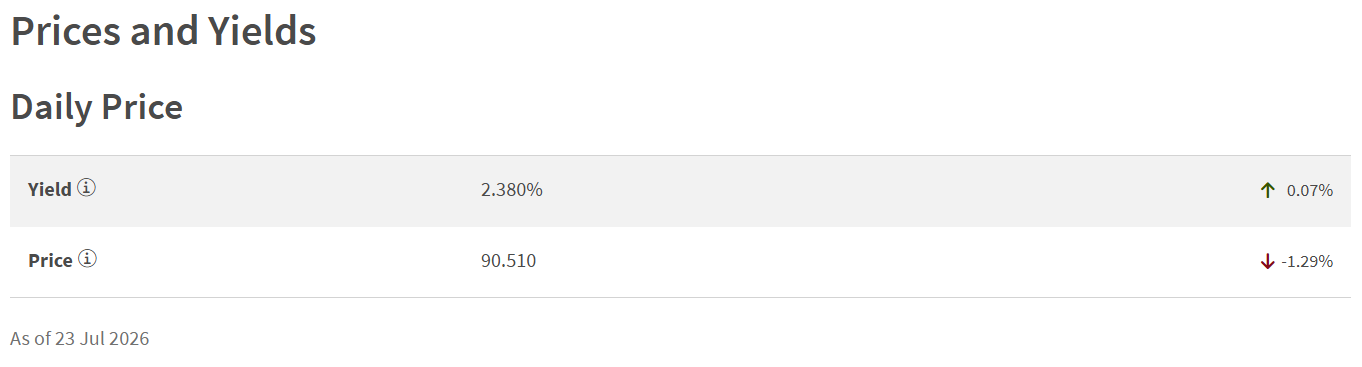
Investors who are looking at investing in the 20-year SGS bond should be aware of such price risks.
One instance where the SGS Green (Infra) bond might be of interest would be if you expect to make a capital gain out of it by selling it before maturity.
This could be the case if you expect interest rates to fall, which will cause the price of the bond to increase.
#2 – Liquidity
The other key risk is liquidity risk as there might be limited liquidity in the secondary market if you decide to sell the 20-year green SGS bond before its maturity.
If there are few interested buyers in the market, you may not be able to sell the bonds at your desired price.
What would Beansprout do?
The yield on the 20-year green SGS bond of 2.4% is higher than the 10-year average return on the latest Singapore Savings Bonds (SSBs).
Hence, for those looking for higher yields, they must be comfortable holding on the the 20-year green SGS bond through its maturity in 2046 if they are looking to reduce the risk of any capital loss.
Conversely, if interest rates were to fall sharply, then the SGS Green (Infra) bond may offer potential capital gains for investors who sell them before maturity.
For reference, the 2.40% p.a. yield on the 20-year SGS bond is also lower than the CPF Ordinary Account interest rate of 2.5% p.a. and the 4% p.a. interest rate on the Special, MediSave and Retirement Accounts.
When considering, we would just need to be aware of the potential interest rate and liquidity risks relating to the 20-year green SGS bond.
Within my Liquidity Pot within Beansprout's four pots of wealth, I would still prefer shorter-term options such as SSBs and T-bills because they provide greater flexibility and less exposure to long-term interest rate movements.
The SSB offers us the flexibility to redeem before the maturity, while we may incur losses if we sell the 20-year SGS bond before maturity.
For my Income Pot, the 2.4% p.a. appears below my benchmark to generate passive income for my portfolio.
How do I apply for the 20 year green SGS bond?
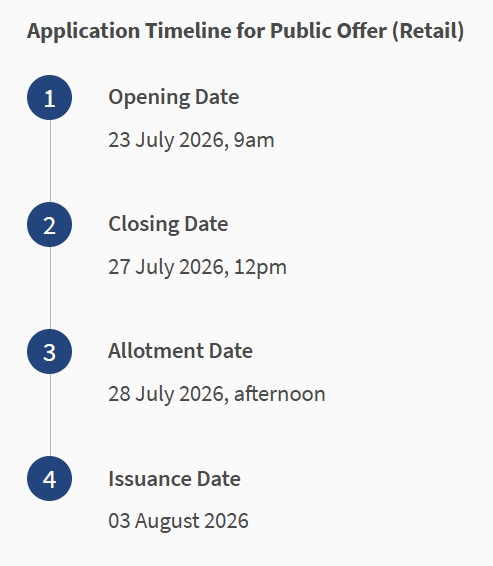
If you are interested in the Green SGS bond, do take note of the following timeline.
The closing date for applications is at 12 noon on 27 July 2026 (Mon).
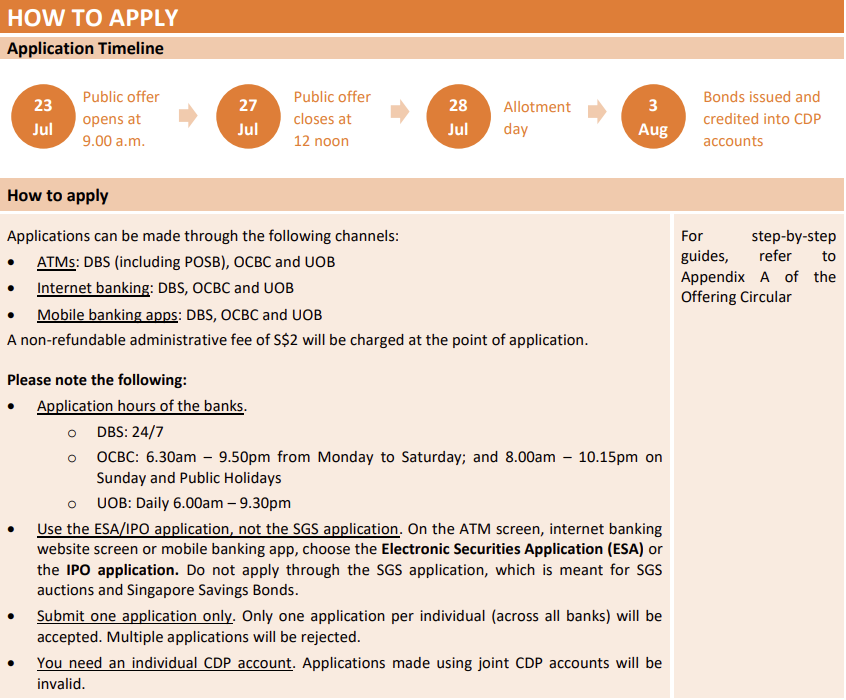
Applications can be made through the following channels:
- ATMs: DBS (including POSB), OCBC and UOB
- Internet banking: DBS (including POSB), OCBC and UOB
- Mobile banking apps: DBS, OCBC and UOB
A non-refundable administrative fee of S$2 will be charged at the point of application
Please note the following:
- Use the ESA/IPO application, not the SGS application. On the ATM screen, internet banking website screen or mobile banking app, choose the Electronic Securities Application (ESA) or the IPO application. Do not apply through the SGS application, which is meant for SGS auctions and Singapore Savings Bonds.
- Submit one application only. Only one application per individual (across all banks) will be accepted. Multiple applications will be rejected.
- You need an individual CDP account. Applications made using joint CDP accounts will be invalid.
Can I apply for the Green SGS (Infra) bond using CPF?
Only cash applications are accepted for this issue. CPF funds and SRS funds cannot be used for your application.
After the issuance and the listing of the Bonds, you can check with your relevant bank and/or stockbroker if you wish to purchase the Bonds from the secondary market using CPF funds or SRS funds.
If you prefer a shorter investment period and are comfortable holding your investment until maturity, you may consider Singapore T-bills. Read our guide to SGS bonds and T-bills to learn how they work and how to apply.
If you value the flexibility to redeem your investment in any month without being exposed to market price movements, you may consider Singapore Savings Bonds instead. Read our SSB guide to know more.
Would you apply for the 20-year green SGS bond at a yield of 2.40% p.a., or would you prefer shorter-term options such as SSBs and T-bills? Share in the comments, or join the discussion in our Telegram group.
Follow Beansprout on Telegram, Youtube, Facebook and Instagram, and add Beansprout as your preferred source on Google so you never miss an update.
Read also
Gain financial insights in minutes
Subscribe to our free weekly newsletter for more insights to grow your wealth
Most Popular

Comments
0 comments