
City Developments targets S$6 billion of divestments: Why its share price fell after strategic review
Stocks
By Gerald Wong, CFA • 29 Sep 2026
Why trust Beansprout? We’ve been awarded Best Investment Website at the SIAS Investors’ Choice Awards 2025
'%3e%3cpath%20fill-rule='evenodd'%20clip-rule='evenodd'%20d='M17.64%209.20455C17.64%208.56637%2017.5827%207.95273%2017.4764%207.36364H9V10.845H13.8436C13.635%2011.97%2013.0009%2012.9232%2012.0477%2013.5614V15.8195H14.9564C16.6582%2014.2527%2017.64%2011.9455%2017.64%209.20455V9.20455Z'%20fill='%234285F4'/%3e%3cpath%20fill-rule='evenodd'%20clip-rule='evenodd'%20d='M9%2018C11.43%2018%2013.4673%2017.1941%2014.9564%2015.8195L12.0477%2013.5614C11.2418%2014.1014%2010.2109%2014.4205%209%2014.4205C6.65591%2014.4205%204.67182%2012.8373%203.96409%2010.71H0.957275V13.0418C2.43818%2015.9832%205.48182%2018%209%2018V18Z'%20fill='%2334A853'/%3e%3cpath%20fill-rule='evenodd'%20clip-rule='evenodd'%20d='M3.96409%2010.71C3.78409%2010.17%203.68182%209.59318%203.68182%209C3.68182%208.40682%203.78409%207.83%203.96409%207.29V4.95818H0.957273C0.347727%206.17318%200%207.54773%200%209C0%2010.4523%200.347727%2011.8268%200.957273%2013.0418L3.96409%2010.71V10.71Z'%20fill='%23FBBC05'/%3e%3cpath%20fill-rule='evenodd'%20clip-rule='evenodd'%20d='M9%203.57955C10.3214%203.57955%2011.5077%204.03364%2012.4405%204.92545L15.0218%202.34409C13.4632%200.891818%2011.4259%200%209%200C5.48182%200%202.43818%202.01682%200.957275%204.95818L3.96409%207.29C4.67182%205.16273%206.65591%203.57955%209%203.57955V3.57955Z'%20fill='%23EA4335'/%3e%3c/g%3e%3cdefs%3e%3cclipPath%20id='clip0_0_2849'%3e%3crect%20width='18'%20height='18'%20fill='white'/%3e%3c/clipPath%3e%3c/defs%3e%3c/svg%3e)
Make Beansprout your preferred source on Google
Add us on Google to see more of our insights in your search results
CDL has unveiled its GET+ strategic review, targeting S$6 billion of divestments and S$5 billion of new investments.

What happened?
City Developments Limited, or CDL, has unveiled the outcome of its long awaited strategic review.
The property group is targeting S$6 billion of divestments over the next three years, while setting aside S$5 billion for new investments.
This comes against a backdrop of rising interest rates, which has put pressure on Singapore property stocks and REITs, while lifting the share prices of banks.
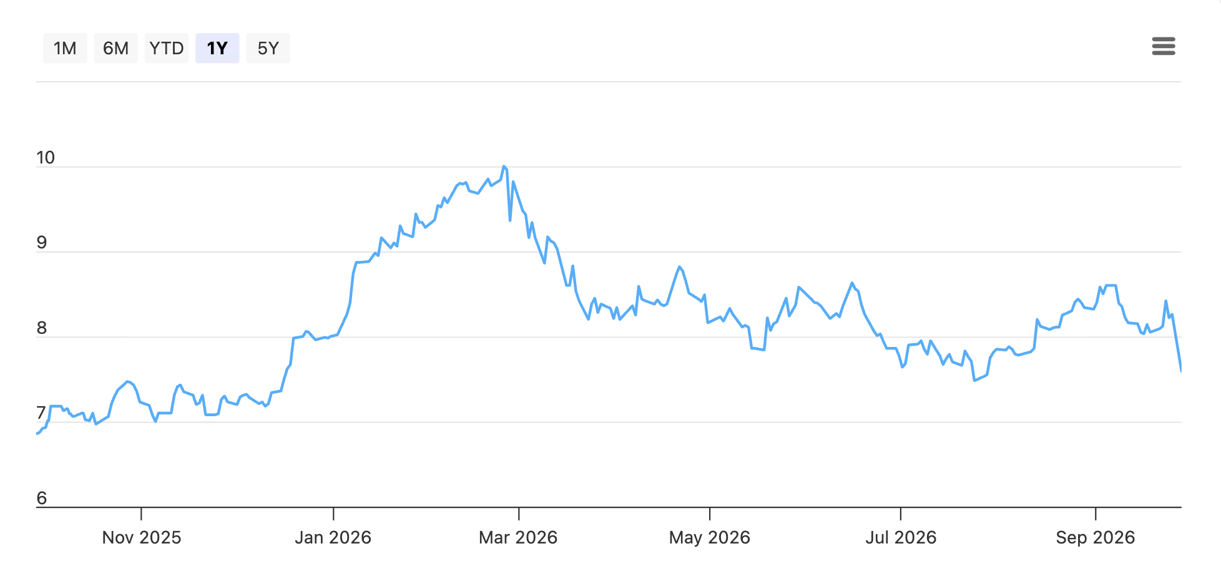
At first glance, the strategic review announcements sound like potentially positive steps. Yet CDL's share price fell 8.1% on 28 September to close at S$7.59, making it the worst performer in the Straits Times Index that day, while the STI gained 0.3%.
In this article, I look at what CDL announced, why investors may have reacted cautiously, and the key areas I would be watching to assess whether the strategic review can improve shareholder returns.
What happened?
CDL unveiled a refreshed strategy called GET+, covering FY2027 to FY2029.
The strategy builds on its existing Growth, Enhancement and Transformation, or GET, framework, but adds clearer capital allocation and financial targets.
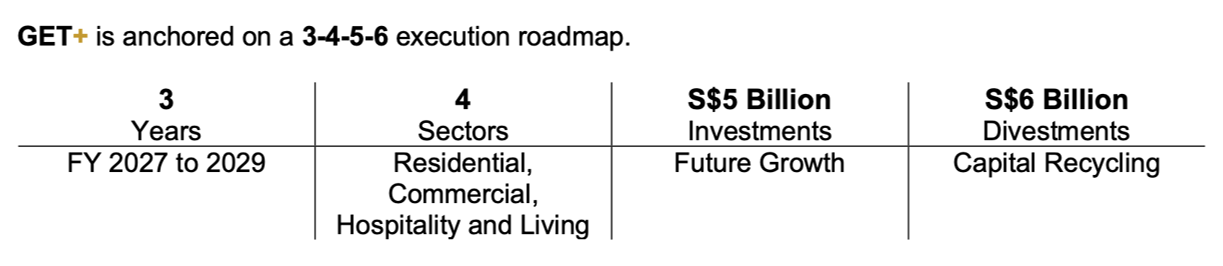
CDL summarises the new roadmap as "3, 4, 5, 6":
- 3 years, from FY2027 to FY2029
- 4 sectors, residential, commercial, hospitality and living
- S$5 billion of new investments
- S$6 billion of divestments
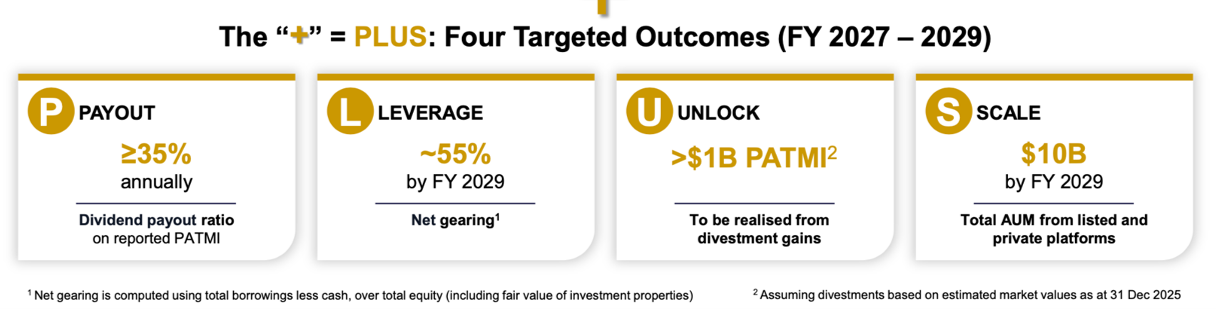
It has also introduced four measurable targets. CDL plans to:
- maintain an annual dividend payout ratio of at least 35% of reported profit after tax and minority interests,
- reduce net gearing to about 55% by FY2029,
- realise more than S$1 billion of PATMI from divestment gains,
- increase AUM from S$5 billion to S$10 billion.
Here are five things we think investors should know.
1. CDL plans to divest at least S$6 billion of assets
The biggest number in the strategic review is the S$6 billion divestment target.
About 45% of the target will come from commercial properties, 30% from hotels, 20% from legacy residential and other assets, and 5% from its living portfolio.
This works out to roughly S$2.7 billion of commercial assets and S$1.8 billion of hotels.
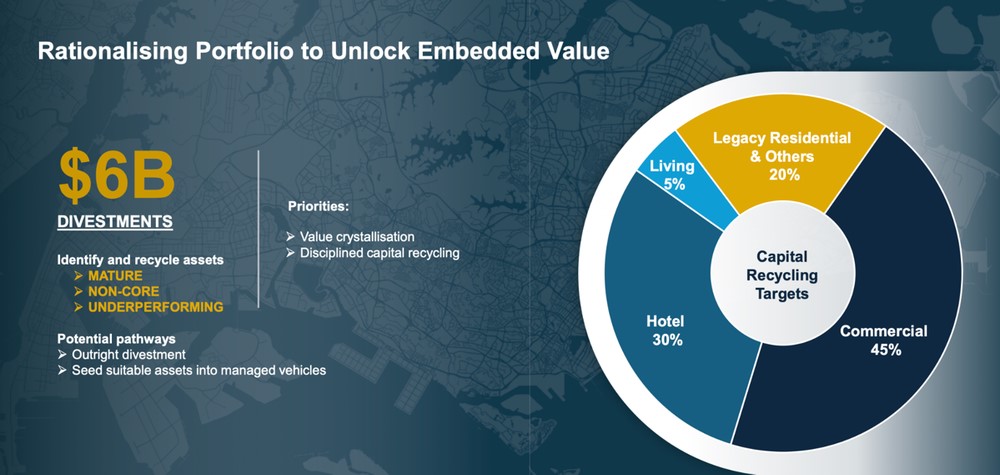
CDL intends to recycle mature, non core and underperforming assets, either through outright sales or by transferring suitable assets into vehicles managed by its fund management business.
Importantly, management indicated during the briefing that the S$6 billion target should not be seen as the maximum it can sell.
Group CEO Sherman Kwek said CDL's potential divestment list is larger than S$6 billion, describing the target as a "floor" rather than a ceiling.
This also excludes the cash CDL expects to receive from its normal property development business.
The group projects more than S$6 billion of additional cash inflows from existing development projects through FY2029, including contracted Singapore sales, five unlaunched Singapore projects and two projects in China.
In other words, CDL could potentially generate significant cash over the next three years if it delivers on both its development pipeline and asset sales.
2. CDL is not simply selling assets, it plans to reinvest S$5 billion
The strategic review is not a plan to shrink CDL.
Alongside S$6 billion of targeted divestments, CDL has set out a S$5 billion growth capital framework.
Around 60% will be allocated to Singapore, while China and Japan together will account for 30%. The remaining 10% will go to other markets.
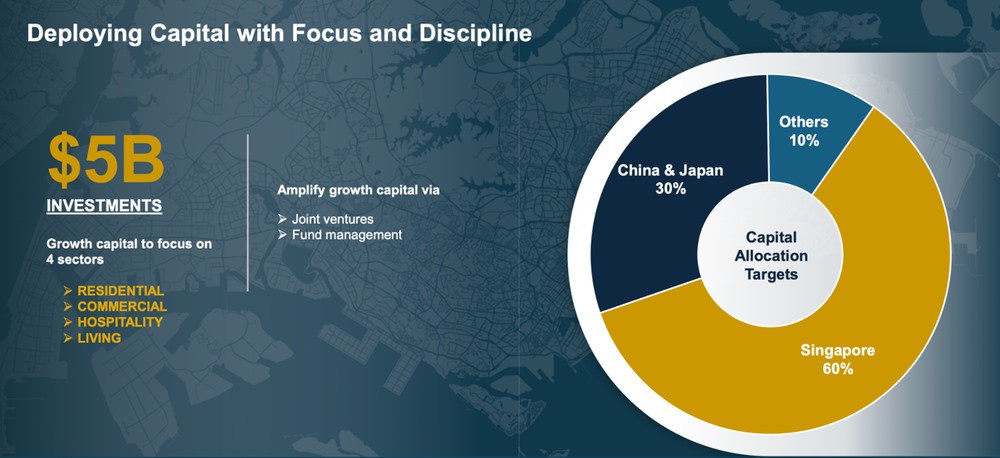
Singapore will remain CDL's key market.
For residential development, CDL intends to focus on Singapore and China. Commercial investments will be centred on Singapore, while the group sees Singapore and Japan as its priority markets for the living sector.
At the same time, CDL plans an orderly exit from most of its Australian exposure outside hospitality. Management acknowledged that it has struggled to build sufficient scale in the market. CDL also plans to accelerate the exit from its UK legacy residential portfolio.
The S$5 billion is not a rigid spending commitment. Management said investments will depend on the opportunities available and whether they meet its return requirements.
This means that the success of GET+ will depend not just on whether CDL can sell S$6 billion of assets, but whether it can redeploy capital into assets capable of generating better returns.
3. Reducing debt is an important part of the plan
CDL's net gearing reached 75% as at June 2026, partly following recent Singapore land acquisitions. It is now targeting net gearing of about 55% by FY2029.
That makes deleveraging one of the clearest measures of whether the strategic review is working.
During the briefing, management said divestment proceeds would initially go towards reducing net debt, rather than being automatically distributed to shareholders.
This could have several benefits.
Lower debt would reduce balance sheet risk and potentially bring down financing costs. It could also give CDL more flexibility to invest when attractive opportunities emerge.
However, we would watch whether the S$5 billion of planned investments offset some of the progress from asset sales.
For us, the key question is therefore not simply how many assets CDL sells, but whether its balance sheet becomes meaningfully stronger as a result.
4. Shareholder returns are clearer, but there is no immediate windfall
CDL has committed to paying out at least 35% of reported PATMI annually.
Management clarified that this is a minimum rather than a fixed payout ratio, with the actual dividend depending on financial performance and board approval.
CDL also expects to recognise more than S$1 billion of PATMI from its targeted divestments.
But investors should distinguish between divestment gains and divestment proceeds.
Selling S$6 billion of assets does not mean that S$6 billion will be available for distribution. Management has indicated that debt reduction remains an important use of the proceeds.
This may partly explain why the strategic review did not provide the immediate catalyst some investors were hoping for.
Expectations going into the review had also been elevated. Before its release, several analysts had highlighted accelerated asset recycling, deleveraging and fund management growth as potential catalysts for CDL.
5. CDL wants to build a larger fund management business
Perhaps the more significant long term change is CDL's ambition to become more capital efficient.
The group wants to double AUM from about S$5 billion in June 2026 to S$10 billion by FY2029.
It plans to establish a dedicated fund management entity and grow through its existing REITs, private funds, partnerships and joint ventures.
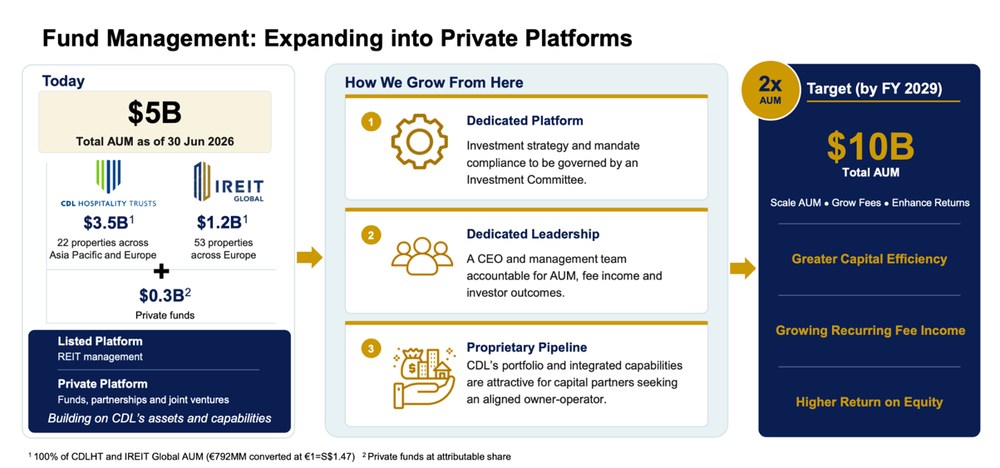
The idea is that CDL would not need to own 100% of every asset on its own balance sheet.
For private funds, Sherman Kwek said his preference would be for CDL to hold 20% or less of the limited partner equity. This would allow the group to bring in third party capital while continuing to earn fees from managing the assets.
If successfully executed, this could free up capital, increase recurring fee income and improve returns on equity.
Why did City Developments' share price fall?
It is difficult to attribute a one day share price movement to any single factor. However, we think there are a few possible reasons why the market reaction was disappointing.
First, expectations ahead of the strategic review were already high. The S$6 billion divestment target was below what some analysts had expected, and may also have appeared less significant relative to CDL's recent pace of asset sales.
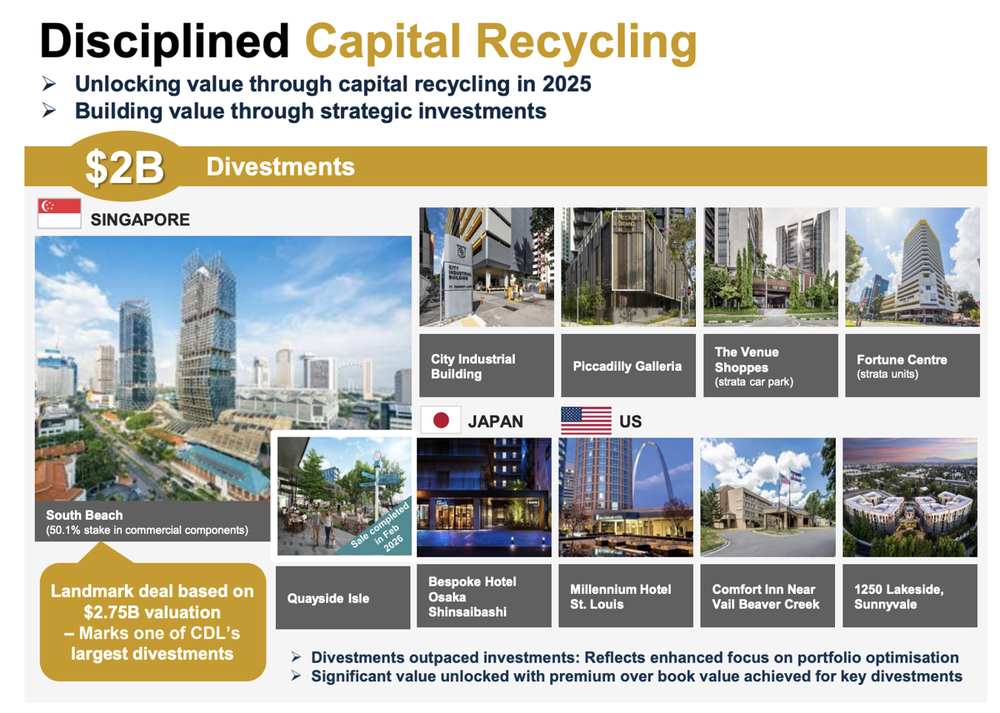
CDL achieved about SS$2 billion of contracted divestments in FY2025. Spread over three years, the new S$6 billion target works out to roughly $2 billion per year, although still an acceleration compared with S$5.8 billion of strategic divestments completed between 2018 and June 2026.
Second, much of the value creation will take time. The divestment, gearing and fund management targets stretch through FY2029.
Third, CDL is recycling rather than simply returning capital. While it plans S$6 billion of divestments, it has also set aside S$5 billion for potential new investments.
Lastly, much now rests on execution. CDL itself described the targets as a "report card" against which management can be assessed over the next three years.
What we would be looking for
1. Can CDL recycle capital while meaningfully reducing gearing?
Selling S$6 billion of assets does not automatically create shareholder value.
What matters first is whether CDL can sell mature, non core or lower return assets at attractive valuations. If assets have to be sold at significant discounts simply to meet the target, the benefits of capital recycling would be reduced.
The next question is what happens to the proceeds.
CDL expects more than S$6 billion of property development cashflows through FY2029, on top of the S$6 billion divestment programme. However, it also plans to invest up to S$5 billion over the same period.
Not all incoming cash will therefore translate into lower debt.
For us, the key test is whether CDL can continue investing for growth while bringing net gearing meaningfully down from 75% towards its 55% target.
We would therefore look at both the valuations achieved on asset sales and whether gearing declines progressively over the next three years.
2. Can CDL improve its ROE?
This may be the most important measure of whether GET+ succeeds.
CDL's ROE currently stands at 6.6%, below the 8% threshold in our Opportunity Pot screen.
Selling assets alone does not solve this. CDL also needs to redeploy capital into opportunities that generate better returns than the assets being sold.
Its push into fund management could help. By growing through REITs, private funds, partnerships and joint ventures, CDL could use more third party capital and require less of its own balance sheet to support growth.
If successful, this could improve capital efficiency while adding recurring management fee income.
We would therefore look beyond whether CDL reaches S$10 billion of AUM. The more important question is whether capital recycling and a more asset light model actually lift ROE and recurring earnings over time.
3. Do the improvements translate into better shareholder returns?
Ultimately, investors will want to see whether the changes in CDL's balance sheet and business model translate into better shareholder returns.
The minimum 35% dividend payout ratio provides some visibility, but the payout floor itself is not new.
A higher payout ratio also does not guarantee higher dividends if earnings do not grow.
For sustainable dividend growth, we would rather see stronger recurring earnings.
What would Beansprout do?
One of the reasons we are positive on Singapore stocks is the growing focus on corporate restructuring, which could support better shareholder returns.
City Development’s strategic review reflects this broader trend. However, the share price decline after the announcement seems to reflect that its plan has not been seen as favourably compared with some of the strategic reviews announced by other Singapore corporates.
Expectations also appear to be high going into the announcement, which may partly explain the muted market reaction.
Based on Beansprout's growth stock screener, CDL does not pass the checks currently as its ROE is below our preferred threshold of 8%.
However, its strategic review plan could improve its ROE if capital is redeployed into higher return opportunities.
Following the share price correction, City Developments currently trades at about 0.73x P/B, below its historical average of 0.77x.
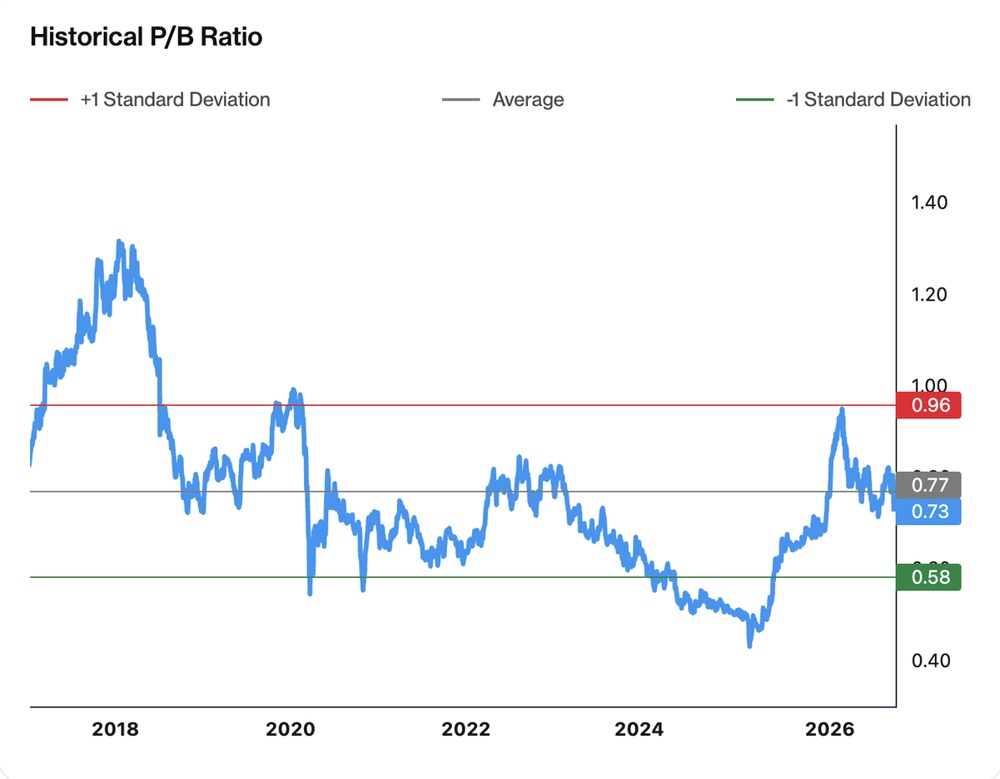
We would therefore watch whether CDL can divest assets at sensible valuations, bring gearing down meaningfully and improve ROE.
We would also look for its growing fund management business to translate into meaningful recurring income, rather than AUM growth alone.
Beyond its bottom up initiatives, we expect CDL’s share price to also be driven by broader trends in Singapore’s property sector, especially again a backdrop of easing property prices in 2Q 2026, and rising interest rates which may dampen demand.
To screen for Singapore listed stocks that meet our checks for earnings momentum, balance sheet strength and return on equity, check out our growth stock screener.
For individual stocks holdings, we would still keep them ring-fenced within the Opportunity Pot within Beansprout’s four pots of wealth, sizing each position based on conviction, company-specific risks and what else we already own.
If you would like to see how we apply this in practice, our latest Beansprout Pro Opportunity Model Portfolio update shows how we would invest S$100,000 in Singapore stocks, including how we think about position sizing and portfolio construction.
Follow Beansprout on Youtube, Facebook and Instagram, and add Beansprout as your preferred source on Google so you never miss an update.
Read also
Gain financial insights in minutes
Subscribe to our free weekly newsletter for more insights to grow your wealth
Most Popular

Comments
0 comments