
Can you retire at 50 in Singapore? Here’s how much you may need
CPF & Retirement
By Gerald Wong, CFA • 19 Sep 2026
Why trust Beansprout? We’ve been awarded Best Investment Website at the SIAS Investors’ Choice Awards 2025
'%3e%3cpath%20fill-rule='evenodd'%20clip-rule='evenodd'%20d='M17.64%209.20455C17.64%208.56637%2017.5827%207.95273%2017.4764%207.36364H9V10.845H13.8436C13.635%2011.97%2013.0009%2012.9232%2012.0477%2013.5614V15.8195H14.9564C16.6582%2014.2527%2017.64%2011.9455%2017.64%209.20455V9.20455Z'%20fill='%234285F4'/%3e%3cpath%20fill-rule='evenodd'%20clip-rule='evenodd'%20d='M9%2018C11.43%2018%2013.4673%2017.1941%2014.9564%2015.8195L12.0477%2013.5614C11.2418%2014.1014%2010.2109%2014.4205%209%2014.4205C6.65591%2014.4205%204.67182%2012.8373%203.96409%2010.71H0.957275V13.0418C2.43818%2015.9832%205.48182%2018%209%2018V18Z'%20fill='%2334A853'/%3e%3cpath%20fill-rule='evenodd'%20clip-rule='evenodd'%20d='M3.96409%2010.71C3.78409%2010.17%203.68182%209.59318%203.68182%209C3.68182%208.40682%203.78409%207.83%203.96409%207.29V4.95818H0.957273C0.347727%206.17318%200%207.54773%200%209C0%2010.4523%200.347727%2011.8268%200.957273%2013.0418L3.96409%2010.71V10.71Z'%20fill='%23FBBC05'/%3e%3cpath%20fill-rule='evenodd'%20clip-rule='evenodd'%20d='M9%203.57955C10.3214%203.57955%2011.5077%204.03364%2012.4405%204.92545L15.0218%202.34409C13.4632%200.891818%2011.4259%200%209%200C5.48182%200%202.43818%202.01682%200.957275%204.95818L3.96409%207.29C4.67182%205.16273%206.65591%203.57955%209%203.57955V3.57955Z'%20fill='%23EA4335'/%3e%3c/g%3e%3cdefs%3e%3cclipPath%20id='clip0_0_2849'%3e%3crect%20width='18'%20height='18'%20fill='white'/%3e%3c/clipPath%3e%3c/defs%3e%3c/svg%3e)
Make Beansprout your preferred source on Google
Add us on Google to see more of our insights in your search results
Can you retire at 50 in Singapore? See how much you may need to fund the 15 years before CPF LIFE starts and the decades after.

What happened?
A recent story about a Singaporean who retired at the age of 35 sparked plenty of discussion about what it really takes to stop working early.
After losing his job, Colin Lau chose to live very simply and stopped working full time. Some admired the freedom he had created, while others questioned whether they would want the same lifestyle.
The discussion also comes as Singapore’s statutory retirement age has risen to 64, putting more attention on when we choose to stop working and whether we are financially ready to do so.
Retiring at 35 may not be realistic, or desirable, for most of us. But it got me thinking about a question I hear fairly often: can I retire at 50?
Stopping work at 50 means potentially funding another 15 years without employment income before CPF LIFE payouts can begin from age 65. At the same time, our savings may still need to support us for several more decades.
So I looked at the available Singapore retirement data to understand what retiring at 50 might actually require.
#1: Retiring at 50 could mean funding another 15 years before CPF LIFE starts
The estimates assume that retirement starts at age 65 and that the savings are drawn down over 20 years. DBS also assumed inflation of 2.5% per year.
The three retirement lifestyles we looked at previously were:
| Retirement lifestyle | Monthly expenses |
| Conservative | S$1,600 |
| Moderate | S$2,800 |
| Aspirational | S$4,000 |
But if I want to retire at 50 instead of 65, there is an additional 15 year period I need to fund.
If we use these spending levels as a starting point and apply the same 2.5% annual inflation assumption used by DBS, this is roughly how much I could spend between the ages of 50 and 65.
| Starting monthly expenses | Spending over 15 years without inflation | Spending over 15 years with 2.5% annual inflation |
| S$1,600 | S$288,000 | S$344,000 |
| S$2,800 | S$504,000 | S$603,000 |
| S$4,000 | S$720,000 | S$861,000 |
| For illustration purposes only. The figures assume expenses rise by 2.5% each year and do not account for investment returns. | ||
In other words, retiring at 50 could mean having to fund about S$344,000 to S$861,000 of cumulative spending before CPF LIFE even starts.
Of course, this does not mean I need to keep the entire amount sitting in cash on the day I retire.
Part of my savings could remain invested and potentially continue generating returns.
But it highlights something important.
If I want to retire early, the question is not only whether I have accumulated enough for retirement.
I also need to ask how I am going to fund the years before my retirement income sources such as CPF LIFE start kicking in.
#2: My spending before 65 could actually be higher
There is another reason why simply using the spending of existing retirees could underestimate how much I need if I retire at 50.
DBS found that median expenses among its retired customers aged 65 and above were 62% lower than those of customers aged 55 to 64.
Singapore’s Household Expenditure Survey showed a similar pattern.
Households comprising solely non employed people aged 65 and above spent an average of S$2,349 per month in 2023, compared with S$5,931 across all resident households.
One reason is that many financial commitments fall as we get older.
DBS noted that the vast majority of its retired customers had already paid off their mortgages. Only around 0.3% still had outstanding mortgage balances.
If I stop working at 50, that may not be the case yet.
I could still have a mortgage. I may be supporting my children or ageing parents. I may also want to travel more while I am younger and healthier.
Insurance and healthcare expenses do not necessarily disappear either.
This means I would not start my retirement calculation by asking, “How much does the average retiree spend?”
I would start by looking at how much I am spending today.
I would then go through my expenses to understand which ones will genuinely disappear when I stop working, and which ones are likely to remain.
We previously shared a similar approach when looking at how to work out whether our CPF savings may be enough for retirement, by first estimating the retirement income we want and accounting for inflation.
For someone who wants to retire at 50, this may be a more useful number than the spending of someone already in their seventies.
#3: Retiring at 50 could mean more than 35 years without employment income
According to the latest available data cited by CPF Board, life expectancy at age 65 in Singapore was 21.6 years in 2025.
This means someone who reaches 65 could expect, on average, to live to about 86 years old.
Even using this average, someone retiring at 50 could potentially spend about 36 years in retirement. Some of us may live considerably longer.
This changes how I think about the amount I need and how I invest it. The challenge is not just having enough to fund the 15 years before CPF LIFE starts, but doing so without exhausting the assets I may still need in my seventies and eighties.
This is why I would be cautious about moving my entire retirement portfolio into cash and fixed income simply because I have stopped working.
At 50, part of my money may not be needed for another 20 or even 30 years, which means it may still have a long investment horizon.
#4: CPF LIFE changes the equation from age 65
The retirement journey also changes once I reach age 65.
For members born in 1954 or later, CPF monthly retirement payouts can start from age 65, and members can choose to begin their payouts any time between age 65 and 70. We explain how the scheme works in our CPF LIFE guide.
This means I would think about retirement in two distinct stages. From age 50 to 64, I would largely need to rely on my savings, investments and other sources of income. From age 65 onwards, CPF LIFE can start providing lifelong monthly income, with my investment portfolio covering the remaining gap between my CPF payouts and the lifestyle I want.
The amount of CPF LIFE income will depend on how much I have accumulated in my Retirement Account, the CPF LIFE plan I choose and when I start my payouts. The infographic below shows how the different 2026 retirement sums could translate into estimated monthly CPF LIFE payouts from age 65.
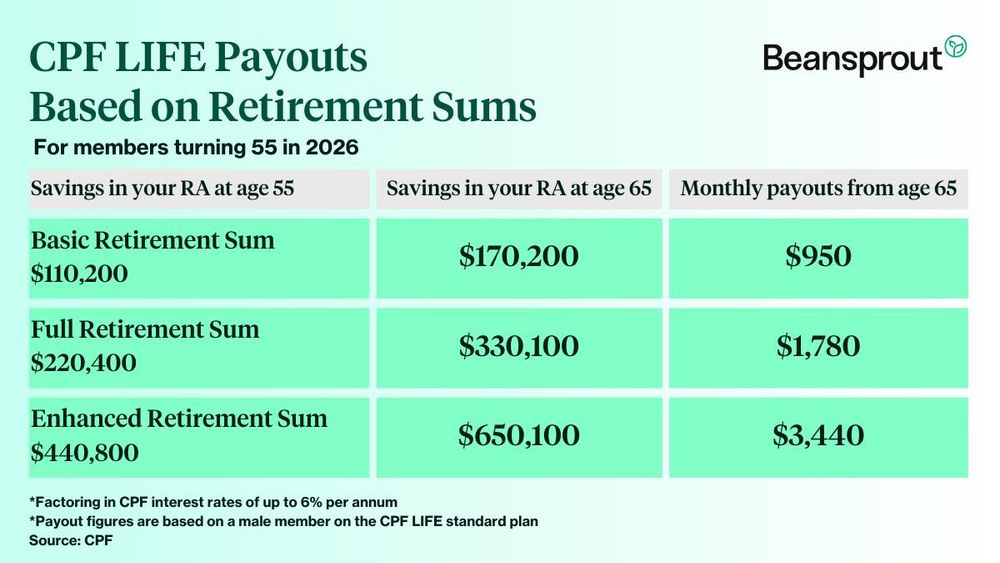
As the chart shows, someone setting aside the Basic Retirement Sum of S$110,200 at age 55 could receive an estimated payout of about S$950 a month from age 65, while the Full Retirement Sum of S$220,400 could provide about S$1,780 a month. Those who build up to the Enhanced Retirement Sum of S$440,800 could receive about S$3,440 a month.
If I wanted CPF LIFE to provide a higher monthly income, the amount I would need to build up would be higher too. For example, we previously estimated that getting about S$5,000 a month from CPF LIFE could require around S$950,000 in the Retirement Account by age 65.
This is also why I would not simply take the S$344,000 to S$861,000 above and add it to DBS’ S$550,000 to S$1.3 million retirement targets. My investments may continue earning returns during retirement, while CPF LIFE will eventually provide another stream of income.
The important point is that retiring at 50 creates an additional funding gap that someone retiring at 65 does not have.
#5: So how much do I actually need to retire at 50?
Unfortunately, I do not think there is one number that works for everyone.
S$1 million may be more than enough for one person and insufficient for another.
Instead, I would break the problem down into three numbers.
First, how much am I spending today?
Rather than starting with somebody else's retirement budget, I would work out what my own lifestyle costs and which expenses are likely to remain after I stop working.
Once I have a realistic spending estimate, I would then think about the two main gaps my savings need to cover.
Second, how much do I need to fund the years between stopping work and CPF LIFE starting?
For someone retiring at 50, this creates an early retirement bridge of about 15 years before CPF LIFE can begin.
DBS’ research used S$2,800 in starting monthly expenses for its “moderate” retirement lifestyle. If I use the same spending level and apply DBS’ 2.5% inflation assumption, my cumulative expenses over the next 15 years could amount to about S$603,000.
That does not mean I need S$603,000 sitting entirely in cash. Part of my savings could remain invested, while recurring investment income or other sources of income may help cover some of my spending.
My SRS savings could also form part of this bridge. Depending on when I made my first SRS contribution, I may be able to start making penalty free withdrawals before CPF LIFE begins, giving me another pool of retirement funds to draw on.
I would still need to plan around the applicable withdrawal and tax rules, especially if I stop working well before my SRS prescribed retirement age. We explain more about how the retirement age affects SRS withdrawals, CPF and investments here.
The more useful question is therefore how much of my expenses can be met from recurring investment income, SRS and other sources of funds, and how much I would still need to draw down from my savings.
Even then, I would be cautious about concluding that having S$603,000 at age 50 means I am ready to retire. Those same assets may still need to support me after CPF LIFE starts at 65.
That is why I would not look at the 15 year funding gap in isolation. It leads to the third number I would consider.
Third, after CPF LIFE begins, how large is the remaining gap between my monthly spending and the income coming from CPF and other sources?
From age 65, I would look at how much of my spending could be covered by CPF LIFE, SRS withdrawals and any other recurring income.
Whatever remains is the gap my investment portfolio still needs to support.
And because retirement could last for decades, I would also need to think about how long that gap needs to be funded.
So rather than asking whether I have reached a particular retirement number at 50, I would ask whether my savings and investments are enough to cover both gaps: the years before CPF LIFE starts, and whatever CPF LIFE and other income do not cover afterwards.
That is why having around S$603,000 at age 50 does not necessarily mean I have enough to retire.
The amount may be enough to illustrate the spending needed for the first 15 years, but I still need my assets to support me after age 65.
The number is only one part of the equation. What matters is how long the money needs to last and what it still needs to fund.
What would Beansprout do?
If I were aiming to retire at 50, I would not start by chasing a magic S$1 million or S$2 million number.
Instead, I would structure my money around when I expect to need it, using Beansprout's Four Pots of Wealth framework.
For my nearer term expenses, my Liquidity Pot would provide a buffer so that I am not forced to sell investments whenever markets fall. Once I stop working, I no longer have a salary to cover my expenses, so having enough liquidity can help me avoid selling investments at lower prices just to fund my spending.
I would also use my Income Pot to generate recurring cash flow, reducing how much I need to draw down from my savings.
My SRS savings could provide another source of funds before age 65, depending on when I am able to start making penalty free withdrawals.
At the same time, retiring at 50 does not mean all my money becomes short term. Some of it may not be needed for another 20 or even 30 years, so I would keep my Growth Pot invested for longer term growth.
From age 65, I would look at how much of my spending can be covered by CPF LIFE and whether my CPF savings are on track to provide the retirement income I expect.
Ultimately, retiring at 50 is not just about reaching a certain net worth. I would want enough to fund the years before CPF LIFE starts, while leaving enough invested to support the decades that may still lie ahead.
Do you feel confident about retiring? Share with us in the comments below or in our Telegram group!
Enjoyed this insight? Follow Beansprout on Telegram, Youtube, Facebook and Instagram, and add Beansprout as your preferred source on Google so you never miss an update.
Read also
Gain financial insights in minutes
Subscribe to our free weekly newsletter for more insights to grow your wealth
Most Popular

Comments
1 comments
- zz • 21 Sep 2026 01:03 AM