
CGS Fullgoal Singapore Next 50 ETF: Exposure beyond blue chips
ETFs
Powered by

By Gerald Wong, CFA • 24 Aug 2026
Why trust Beansprout? We’ve been awarded Best Investment Website at the SIAS Investors’ Choice Awards 2025
'%3e%3cpath%20fill-rule='evenodd'%20clip-rule='evenodd'%20d='M17.64%209.20455C17.64%208.56637%2017.5827%207.95273%2017.4764%207.36364H9V10.845H13.8436C13.635%2011.97%2013.0009%2012.9232%2012.0477%2013.5614V15.8195H14.9564C16.6582%2014.2527%2017.64%2011.9455%2017.64%209.20455V9.20455Z'%20fill='%234285F4'/%3e%3cpath%20fill-rule='evenodd'%20clip-rule='evenodd'%20d='M9%2018C11.43%2018%2013.4673%2017.1941%2014.9564%2015.8195L12.0477%2013.5614C11.2418%2014.1014%2010.2109%2014.4205%209%2014.4205C6.65591%2014.4205%204.67182%2012.8373%203.96409%2010.71H0.957275V13.0418C2.43818%2015.9832%205.48182%2018%209%2018V18Z'%20fill='%2334A853'/%3e%3cpath%20fill-rule='evenodd'%20clip-rule='evenodd'%20d='M3.96409%2010.71C3.78409%2010.17%203.68182%209.59318%203.68182%209C3.68182%208.40682%203.78409%207.83%203.96409%207.29V4.95818H0.957273C0.347727%206.17318%200%207.54773%200%209C0%2010.4523%200.347727%2011.8268%200.957273%2013.0418L3.96409%2010.71V10.71Z'%20fill='%23FBBC05'/%3e%3cpath%20fill-rule='evenodd'%20clip-rule='evenodd'%20d='M9%203.57955C10.3214%203.57955%2011.5077%204.03364%2012.4405%204.92545L15.0218%202.34409C13.4632%200.891818%2011.4259%200%209%200C5.48182%200%202.43818%202.01682%200.957275%204.95818L3.96409%207.29C4.67182%205.16273%206.65591%203.57955%209%203.57955V3.57955Z'%20fill='%23EA4335'/%3e%3c/g%3e%3cdefs%3e%3cclipPath%20id='clip0_0_2849'%3e%3crect%20width='18'%20height='18'%20fill='white'/%3e%3c/clipPath%3e%3c/defs%3e%3c/svg%3e)
Make Beansprout your preferred source on Google
Add us on Google to see more of our insights in your search results
The CGS Fullgoal Singapore Next 50 Active ETF (Q50) offers investors exposure to Singapore mid-cap stocks beyond the Straits Times Index’s blue chips through an actively managed strategy. Here’s what I would consider before investing.
This post was created in partnership with SGX. All views and opinions expressed in this article are Beansprout's objective and professional opinions.
What happened?
A new Singapore equity ETF is set to be listed on the Singapore Exchange soon.
Earlier, we share that there are reasons to stay positive on Singapore stocks, as its structural growth themes are still intact, and a diversified portfolio of blue chip Singapore equities may fit into our growth pot within Beansprout’s four pots of wealth.
This has also led to questions about the CGS Fullgoal Singapore Next 50 Active ETF (Q50), and whether it offers investors a different way to gain exposure to the Singapore market.
It is the first ETF benchmarked to the iEdge Singapore Next 50 Index, which represents the next tier of sizeable Singapore-listed companies beyond the Straits Times Index’s 30 constituents.
However, CGS Fullgoal Singapore Next 50 Active ETF (Q50) does not simply track the index. It is actively managed with the aim of outperforming its benchmark.
In this article, I will look at how CGS Fullgoal Singapore Next 50 Active ETF (Q50) works and the key factors investors should consider before deciding if it is suitable for their portfolio.
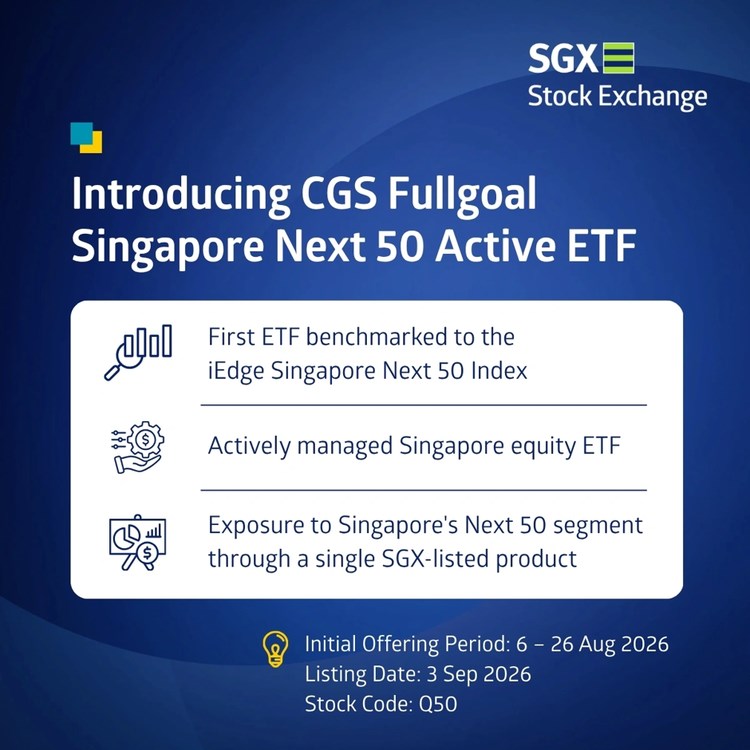
What is the CGS Fullgoal Singapore Next 50 Active ETF (Q50)?
The CGS Fullgoal Singapore Next 50 Active ETF (Q50) is an actively managed Singapore equity ETF managed by CGS International Securities Singapore, with Fullgoal Asset Management (HK) as its investment adviser.
Its objective is to achieve long-term capital growth through a portfolio of Singapore equities while seeking to outperform the iEdge Singapore Next 50 Index.
Here are some of its key product details.
| Product information | CGS Fullgoal Singapore Next 50 Active ETF |
| SGX stock code | Q50 |
| Reference benchmark | iEdge Singapore Next 50 Index |
| Manager | CGS International Securities Singapore Pte. Ltd. |
| Investment adviser | Fullgoal Asset Management (HK) Limited |
| Trading currency | SGD |
| IOP unit price | S$1.00 |
| Trading board lot | 1 share |
| Target holdings | Approximately 30 to 50 stocks |
| Maximum weight per stock | 10% |
| Management fee | 0.65% p.a. |
| Total expense ratio | Capped at 1.50% p.a. |
| Distribution policy | Semi-annually, targeted around June and December, at the company's discretion |
| Investment mode | Cash and SRS |
| IOP | 6 to 26 August 2026 |
| Expected SGX listing | 3-Sep-26 |
| Source: SGX, CGS Fullgoal Singapore Next 50 Active ETF Prospectus, CGS International | |
There are three features of CGS Fullgoal Singapore Next 50 Active ETF (Q50) that stand out to me.
#1 – CGS Fullgoal Singapore Next 50 Active ETF (Q50) invests mainly in Singapore's Next 50 companies
Under normal market conditions, at least 80% of CGS Fullgoal Singapore Next 50 Active ETF (Q50)'s portfolio will be invested in constituents of the iEdge Singapore Next 50 Index.
The iEdge Singapore Next 50 Index represents the next 50 sizeable and liquid companies listed on the SGX Mainboard beyond Singapore's 30 largest companies by market capitalisation.
This gives CGS Fullgoal Singapore Next 50 Active ETF (Q50) a different investment universe from an STI ETF.
As at 30 June 2026, real estate and REITs made up 39.4% of the Next 50 Index, while the STI was dominated by financials and banks at 58.3%.
In other words, the CGS Fullgoal Singapore Next 50 Active ETF (Q50) can help to broaden my exposure to other parts of the Singapore market beyond the Singapore banks or the Straits Times Index.
However, CGS Fullgoal Singapore Next 50 Active ETF (Q50) is not restricted entirely to Next 50 companies. Up to 20% of its portfolio can be invested in other SGX-listed companies, including potentially some STI constituents.
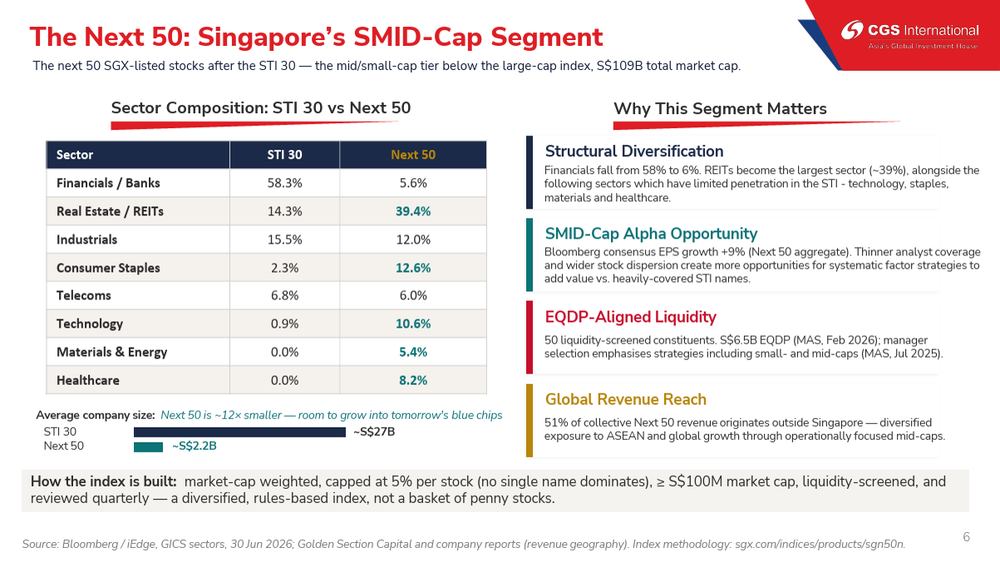
*Sector weights refer to the iEdge Singapore Next 50 Index and STI as at 30 June 2026, and do not represent CGS Fullgoal Singapore Next 50 Active ETF (Q50)'s actual portfolio holdings.
#2 – CGS Fullgoal Singapore Next 50 Active ETF (Q50) is actively managed rather than a passive index tracker
Unlike a passive ETF that aims to replicate an index, CGS Fullgoal Singapore Next 50 Active ETF (Q50) uses the iEdge Singapore Next 50 Index as a reference benchmark.
The fund manager can deviate significantly from the weights of individual companies in the benchmark and can also invest in stocks that are not part of the Next 50 Index.
The active ETF portfolio is expected to hold around 30 to 50 stocks, with a maximum weight of 10% in an individual company, and its portfolio is reviewed and rebalanced monthly.
The active approach may be particularly relevant for small- and mid-cap companies, which tend to receive less analyst coverage than Singapore's largest blue chips.
This could create more opportunities for the strategy to identify differences in company fundamentals and valuations.
To give investors a better sense of how this could look in practice, the fund pitch deck includes a model portfolio as at 17 July 2026.
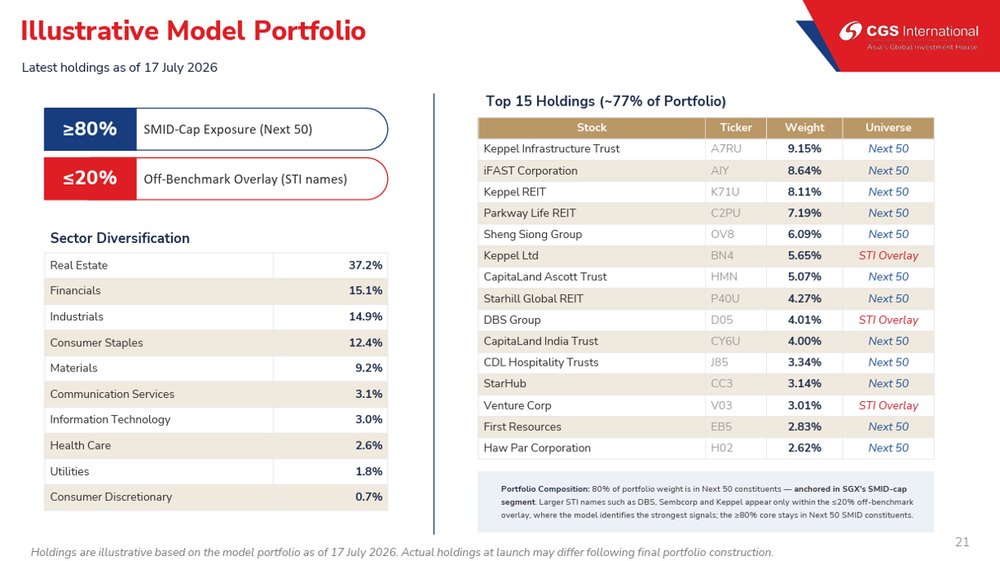
The model portfolio was mainly invested in Next 50 companies, but also included larger STI stocks such as Keppel and DBS within the portion that can be invested outside the benchmark.
| Stock | Weight (%) | Universe |
| Keppel Infrastructure Trust | 9.15 | Next 50 |
| iFast Corporation | 8.64 | Next 50 |
| Keppel Reit | 8.11 | Next 50 |
| Parkway Life Reit | 7.19 | Next 50 |
| Sheng Siong Group | 6.09 | Next 50 |
| Keppel | 5.65 | STI overlay |
| CapitaLand Ascott Trust | 5.07 | Next 50 |
| Starhill Global Reit | 4.27 | Next 50 |
| DBS Group | 4.01 | STI overlay |
| CapitaLand India Trust | 4 | Next 50 |
| CDL Hospitality Trusts | 3.34 | Next 50 |
| StarHub | 3.14 | Next 50 |
| Venture Corp | 3.01 | STI overlay |
| First Resources | 2.83 | Next 50 |
| Haw Par | 2.62 | Next 50 |
| Source: CGS International Securities Singapore. Illustrative model portfolio as at 17 July 2026. Actual holdings at launch may differ following final portfolio construction | ||
#3 – CGS Fullgoal Singapore Next 50 Active ETF (Q50) uses six factors to select stocks
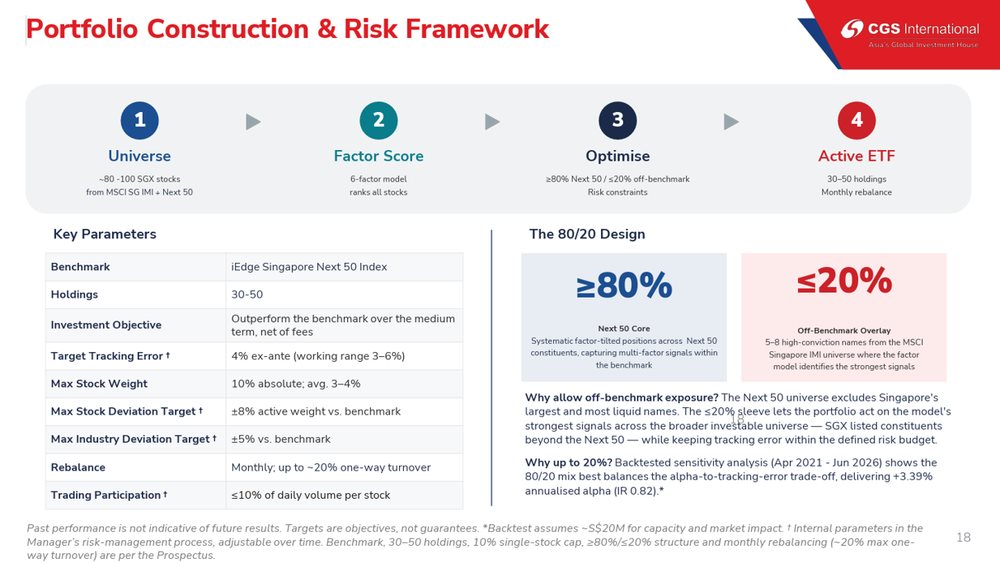
CGS Fullgoal Singapore Next 50 Active ETF (Q50) uses a quantitative multi-factor model to assess companies across six areas.
Valuation looks at whether a company appears relatively expensive or cheap compared with its fundamentals, using measures such as its price-to-earnings and price-to-book ratios.
Growth looks at expected sales and earnings growth.
Earnings surprise considers whether a company's reported or pre-announced earnings have come in above or below market expectations.
Analyst sentiment looks at changes in analyst ratings, price targets and earnings forecasts.
Earnings quality considers how reliable and sustainable a company's reported earnings are, including measures such as cash flow, return on equity and accruals.
Finally, the market factor assesses characteristics such as trading turnover, liquidity and stock-specific risk.
These factors are combined as part of the portfolio construction process.
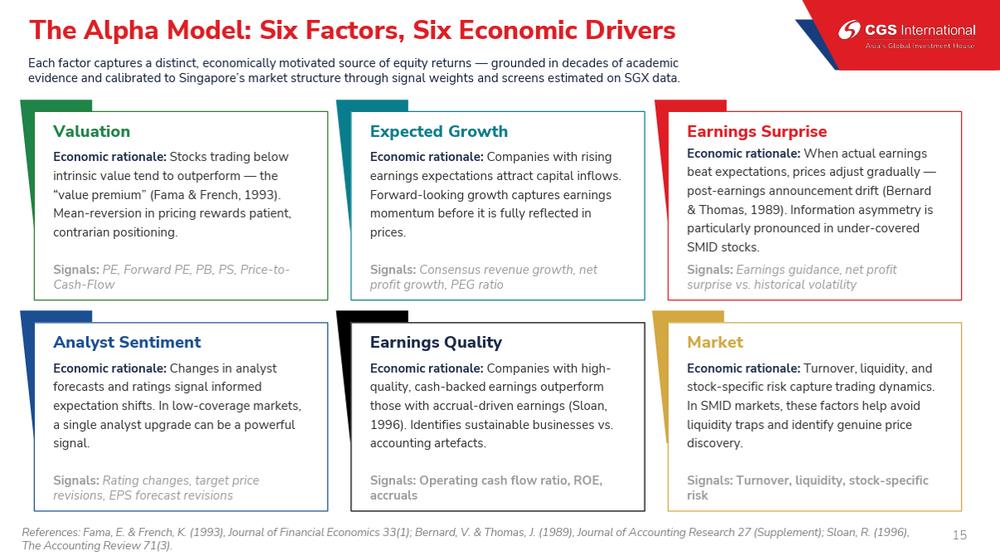
In terms of costs, CGS Fullgoal Singapore Next 50 Active ETF (Q50) charges a management fee of 0.65% per annum, with its total expense ratio capped at 1.50% per annum.
Since this is higher than many passive Singapore equity ETFs, one thing I would watch is whether its active strategy can generate enough excess returns over time to justify the additional cost.
CGS Fullgoal Singapore Next 50 Active ETF (Q50) also intends to make semi-annual distributions, targeted around June and December, although distributions are at the company's discretion and are not guaranteed.
What are the risks of investing in CGS Fullgoal Singapore Next 50 Active ETF (Q50)?
There are also several risks I would pay attention to.
#1 – The actual portfolio can differ from the Next 50 Index
Because CGS Fullgoal Singapore Next 50 Active ETF (Q50) is actively managed, I would also be careful not to assume that the holdings of the iEdge Singapore Next 50 Index are the same as CGS Fullgoal Singapore Next 50 Active ETF (Q50)'s holdings.
The portfolio may differ materially from the benchmark, and the fund can also invest up to 20% outside the Next 50 universe.
I would therefore look at CGS Fullgoal Singapore Next 50 Active ETF (Q50)'s actual disclosed portfolio holdings to help me understand where the manager is taking active positions and whether those positions are consistent with why I invested in the ETF in the first place.
#2 – Small- and mid-cap stocks may be more volatile and less liquid
CGS Fullgoal Singapore Next 50 Active ETF (Q50)'s benchmark is focused on smaller and mid-sized Singapore companies.
Some of these companies may have lower daily trading volumes compared with large STI stocks.
The prospectus notes that this could make it harder for the manager to execute portfolio changes at desired prices during stressed market conditions and may result in higher transaction costs or delays.
CGS Fullgoal Singapore Next 50 Active ETF (Q50) itself is also relatively concentrated, with around 30 to 50 holdings and a maximum weight of 10% in a single stock.
This means the performance of an individual company could have a greater impact on the fund compared with a more broadly diversified equity portfolio.
#3 – The active strategy may not outperform
The most important risk to me is also the feature that differentiates CGS Fullgoal Singapore Next 50 Active ETF (Q50) from a passive ETF.
The fund aims to outperform the iEdge Singapore Next 50 Index, but there is no guarantee that it will achieve this.
Its quantitative strategy relies on historical and current data to identify factors that may predict future stock returns.
The prospectus notes that changes in market conditions, inaccurate data or a decline in the effectiveness of individual factors could affect the model's performance.
This matters particularly because CGS Fullgoal Singapore Next 50 Active ETF (Q50) is a new ETF and does not yet have a live investment track record for me to assess.
I would therefore place more weight on its actual performance against the benchmark over time rather than backtested results.
What would Beansprout do?
The CGS Fullgoal Singapore Next 50 Active ETF (Q50) offers investors another way to gain exposure to Singapore equities beyond the largest companies in the STI.
Unlike a passive ETF, CGS Fullgoal Singapore Next 50 Active ETF (Q50) uses factors such as valuation, growth, earnings quality and analyst sentiment to select around 30 to 50 stocks from the Next 50 universe.
However, active management does not guarantee better returns. CGS Fullgoal Singapore Next 50 Active ETF (Q50) has yet to establish a live track record, while its management fee of 0.65% per annum is higher than that of passive STI ETFs.
We would also be mindful that the fund may include smaller companies with greater volatility or lower liquidity.
The Initial Offering Period (IOP) for the ETF runs from 6 August 2026 at 9am to 26 August 2026 at 11am, with trading on SGX expected to commence thereafter.
The IOP unit price is S$1.00 per share, and the ETF is expected to begin trading on SGX at 9am on 3 September 2026.
To subscribe to the ETF during the IOP, you can do so via the following participating dealers:
- CGS International Securities Singapore
- FSMOne
- Lim & Tan Securities Pte Ltd
- Moomoo
- Phillip Securities
Read here to find out more about the CGS Fullgoal Singapore Next 50 Active ETF.
Are there any promotions for subscription during the IOP?
Some brokerages and investment platforms may run promotional offers around the Initial Offering Period (IOP).
| Broker | Period | Promotion |
| FSM Global | 6 - 26 August 2026 | Receive $10 cashback for every $5,000 invested, capped at $500. T&Cs apply. More details here. |
| Lim & Tan Securities | Ongoing | Please check with your remisier for more details. T&Cs apply. |
| Phillip Nova | 17 - 24 August 2026 | Receive $10 for every $5,000 invested, capped at $500. T&Cs apply. More details here. |
| Phillip Securities | 6 - 25 August 2026 | Receive $10 cash credit for every $5,000 invested, capped at $500. T&Cs apply. More details here. |
| Moomoo | 12 – 26 August 2026 | Waived subscription and settlement fees. T&Cs apply. |
| *Terms and conditions of participating brokers apply. Please refer to their website for more details. | ||
Disclaimer
This advertisement has not been reviewed by the Monetary Authority of Singapore.
Any information provided in this article is meant purely for informational and investor education purposes and should not be relied upon as financial or investment advice, or advice on corporate finance.
This article is not and does not constitute or form part of any offer, recommendation, invitation or solicitation to purchase any financial product or subscribe or enter any transaction. This article also does not take into account your personal circumstances, e.g. investment objectives, financial situation or particular needs and shall not constitute financial advice. You should consult your own independent financial, accounting, tax, legal or other competent professional advisors.
The information provided in this article are on an “as is” and “as available” basis without warranty of any kind, whether express or implied. Beansprout does not recommend any particular course of action in relation to any investment product or class of investment products. No information is presented with the intention to induce any person to buy, sell, or hold a particular investment product or class of investment products.
Read also
Gain financial insights in minutes
Subscribe to our free weekly newsletter for more insights to grow your wealth
Most Popular

Comments
0 comments