
How we research stocks before investing
Investing
By Gerald Wong, CFA • 07 Sep 2026
Why trust Beansprout? We’ve been awarded Best Investment Website at the SIAS Investors’ Choice Awards 2025
'%3e%3cpath%20fill-rule='evenodd'%20clip-rule='evenodd'%20d='M17.64%209.20455C17.64%208.56637%2017.5827%207.95273%2017.4764%207.36364H9V10.845H13.8436C13.635%2011.97%2013.0009%2012.9232%2012.0477%2013.5614V15.8195H14.9564C16.6582%2014.2527%2017.64%2011.9455%2017.64%209.20455V9.20455Z'%20fill='%234285F4'/%3e%3cpath%20fill-rule='evenodd'%20clip-rule='evenodd'%20d='M9%2018C11.43%2018%2013.4673%2017.1941%2014.9564%2015.8195L12.0477%2013.5614C11.2418%2014.1014%2010.2109%2014.4205%209%2014.4205C6.65591%2014.4205%204.67182%2012.8373%203.96409%2010.71H0.957275V13.0418C2.43818%2015.9832%205.48182%2018%209%2018V18Z'%20fill='%2334A853'/%3e%3cpath%20fill-rule='evenodd'%20clip-rule='evenodd'%20d='M3.96409%2010.71C3.78409%2010.17%203.68182%209.59318%203.68182%209C3.68182%208.40682%203.78409%207.83%203.96409%207.29V4.95818H0.957273C0.347727%206.17318%200%207.54773%200%209C0%2010.4523%200.347727%2011.8268%200.957273%2013.0418L3.96409%2010.71V10.71Z'%20fill='%23FBBC05'/%3e%3cpath%20fill-rule='evenodd'%20clip-rule='evenodd'%20d='M9%203.57955C10.3214%203.57955%2011.5077%204.03364%2012.4405%204.92545L15.0218%202.34409C13.4632%200.891818%2011.4259%200%209%200C5.48182%200%202.43818%202.01682%200.957275%204.95818L3.96409%207.29C4.67182%205.16273%206.65591%203.57955%209%203.57955V3.57955Z'%20fill='%23EA4335'/%3e%3c/g%3e%3cdefs%3e%3cclipPath%20id='clip0_0_2849'%3e%3crect%20width='18'%20height='18'%20fill='white'/%3e%3c/clipPath%3e%3c/defs%3e%3c/svg%3e)
Make Beansprout your preferred source on Google
Add us on Google to see more of our insights in your search results
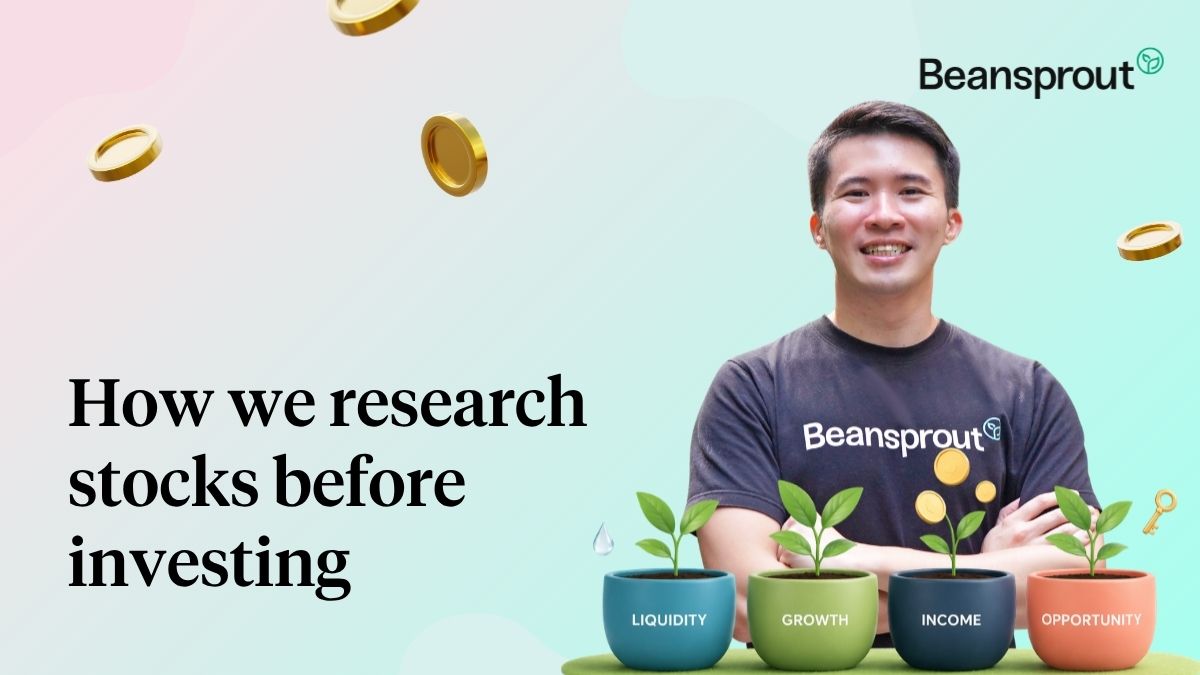
See how we research stocks in our Opportunity Pot by assessing business quality, management, catalysts, valuation and risks before forming an investment thesis.
Screening helps us find companies that look promising on the surface.
A company may be growing its earnings, generating attractive returns and maintaining a healthy balance sheet. These are useful signals, but strong financial metrics alone are not enough for me to decide that a stock deserves a place in the Opportunity Pot.
Numbers tell me what has happened. They do not tell me whether the business can keep growing, whether management can execute, what could cause the market to value the company differently, or whether the potential return is attractive enough for the risks involved.
This is Stage 3 of our Opportunity Pot investment process, where we move from screening a company to developing an investment view.
At this stage, I focus on four areas:
- Business and management quality
- Catalysts
- Valuation.
- Risks
The aim is to bring these together into a clear investment thesis that explains why I want to own the stock, what I think it is worth and what could prove me wrong.
#1 - Business and management quality
Is this a high-quality business with capable management?
The first question I ask is whether the company has a strong business that can continue creating value over the long term, and whether management is capable of turning that potential into results.
I start by understanding what the company does, how it makes money, who its customers are and why those customers choose it instead of a competitor.
The more important question is whether those advantages can last.
A company may benefit from scale, a strong brand, lower costs, intellectual property, network effects, regulatory barriers or long-standing customer relationships. These advantages can make it harder for competitors to take market share and give the company greater ability to sustain its margins and returns.
However, competitive advantages can weaken. Technology can change, new competitors can emerge and customer preferences can shift. This is why I do not just ask whether the business is strong today. I also ask what could make its competitive position stronger or weaker over the next few years.
But even a strong business still needs capable management.
Where possible, I look beyond the numbers in the financial statements by reviewing results briefings, investor presentations, management commentary and company visits. I want to understand not just what management says today, but whether its past actions and results support what it is saying.
Some of the questions I consider include:
- Does the company have a sustainable competitive advantage?
- Has management delivered on its previous targets and guidance?
- What is management's track record in growing the business through different market cycles?
- Has capital been allocated sensibly between reinvestment, acquisitions, dividends and share buybacks?
- Have past acquisitions created value for shareholders?
- Does management recognise the key risks facing the business?
- How does it respond when conditions become more difficult?
- Is management willing to acknowledge mistakes and change course when necessary?
Capital allocation is particularly important. A company can have a strong underlying business and generate healthy cash flow, but still destroy shareholder value if management overpays for acquisitions or invests heavily in projects that earn poor returns.
I also look at whether management's interests are aligned with shareholders. This can include management and founder ownership, remuneration structures, insider buying or selling, dividend and buyback decisions, and whether capital allocation has consistently created value for minority shareholders.
Another useful exercise is comparing what management said in the past with what actually happened. A consistent track record of meeting targets, managing costs and allocating capital well can increase my confidence in future guidance. Repeated missed targets, changing explanations or poor capital allocation may be warning signs.
I also pay attention to how management behaves when things are not going well. Strong management teams are often willing to address problems early, communicate clearly and take corrective action rather than allowing them to become larger.
Ultimately, I am looking for the combination of a durable business and management that can execute. A strong business can sometimes overcome mediocre management for a period of time, while even excellent management may struggle with a structurally weak business. The strongest investment cases tend to have both.
#2 - Catalyst
A good company is not automatically a good stock.
Sometimes a business can remain undervalued for a long time because there is no reason for investors to reassess it.
This is why I look for catalysts, developments that could cause the company's earnings, cash flow or valuation to improve.
These may include:
- Stronger earnings growth
- Margin recovery
- New products or business lines
- Expansion into new markets
- Cost reductions
- Business restructuring
- Asset sales
- Share buybacks or special dividends
- Mergers and acquisitions
- Changes in government policy or industry conditions
The catalyst also helps me think about timing.
If I believe a company's earnings could improve because a new factory is opening, for example, I want to understand when production will begin, how quickly utilisation could rise and when that might start showing up in its financial results.
Without a catalyst, I may still like the business, but there may be less reason to expect the investment thesis to play out within my intended investment horizon.
#3 - Valuation
The third part of the research is valuation, or whether I am paying a reasonable price
Even an outstanding company can become a poor investment if I pay too much for it.
I therefore ask whether the current share price already reflects the company's future prospects and whether there is enough potential upside to compensate me for the risks I am taking.
There is no single valuation measure that works for every company.
Depending on the business, I may look at price to earnings, EV to EBITDA, dividend yield, price to book, discounted cash flow, or how the stock trades relative to its own history and comparable companies.
The objective is not to find one precise number that tells me exactly what a company is worth. Valuation always involves assumptions.
Instead, I think through different possible outcomes.
In the base case, what could the company be worth if the investment thesis develops broadly as expected?
In the bear case, what happens if earnings disappoint, margins weaken or the expected catalyst does not materialise?
In the bull case, what could the company be worth if growth turns out stronger than expected?
This helps me compare the possible upside with the downside before putting any capital at risk.
#4 - Risks
The final area I assess is what could cause the investment thesis to go wrong.
Every investment has risks. The aim is not to find a company with no risks, but to understand which ones matter most and whether the potential return is sufficient to compensate me for taking them.
The risks will differ depending on the company. They may include weaker demand, greater competition, execution problems, customer concentration, higher debt, regulatory changes, commodity or currency movements, or management making poor capital allocation decisions.
I also ask whether these risks are already reflected in my bear case and valuation. A risk that could significantly change the company's earnings or long-term prospects deserves more attention than one that may only create short-term volatility.
Most importantly, I want to know what evidence would tell me that the investment thesis is no longer working. Identifying these warning signs before investing makes it easier to reassess the stock objectively when new information emerges.
Developing the investment thesis
Once I have assessed the business and management, catalysts, valuation and risks, I bring the research together into a written investment thesis.
Writing the thesis forces me to explain clearly why I want to own the company before investing. If I cannot explain the investment case simply, there is a good chance I do not understand it well enough yet.
My investment thesis usually answers five questions:
| Element | Key question |
| Investment rationale | Why am I interested in this company now? |
| Growth catalysts | What could drive earnings or the share price higher? |
| Key risks | What could cause the investment thesis to fail? |
| Valuation | What do I believe the company is worth? |
| Exit strategy | What would cause me to change my view or sell? |
The thesis is also useful after I invest.
Rather than reacting to every headline or share price movement, I can compare new information with the original investment case.
If the share price falls but the business continues to perform as expected, the investment thesis may still be intact. On the other hand, a rising share price does not necessarily mean the thesis is becoming stronger if the company's fundamentals are deteriorating.
The important question is whether the facts supporting the investment have changed.
How research translates into conviction
By the end of Stage 3, I should have more than a target price.
I should understand how strong the investment case is, how much uncertainty remains and how confident I am that the catalysts identified in my research will materialise.
We use this research to form our conviction rating.
A company where the business quality is strong, the catalysts are visible, valuation is attractive and the key risks appear manageable may deserve a higher rating. A company where more needs to go right, or where the valuation leaves less room for error, may receive a lower rating even if we still see some upside.
The rating is therefore a way of summarising our research conclusion rather than a separate stock picking process.
You can read more about how we translate our investment research into our five level conviction rating in our Beansprout Stock Rating Framework.
What happens after Stage 3?
By the end of the research stage, I want to be able to explain the investment in a few sentences.
- Why is the company interesting?
- What could drive the investment higher?
- What do I think it is worth?
- What are the biggest risks?
- What would change my mind?
Only companies where I can develop a clear investment thesis move to the final stage of the Opportunity Pot process.
Stage 4 is where the question changes from “Do I want to own this stock?” to “How much should I own?”
That means considering the conviction rating alongside the risks of the individual company, what else is already in the portfolio, how much exposure I have to similar themes and whether I should invest the full amount immediately or allow the position to grow as the thesis develops.
Good research helps me decide what I want to own. Portfolio construction determines how much capital I am prepared to put behind that view.
These individual stock ideas sit within the Opportunity Pot, where I keep higher-conviction investments ring-fenced from the rest of the portfolio and size them within clear limits.
If you want to revisit how an idea gets to this stage, you can go back to our full Opportunity Pot investment process, starting with Stage 1, how we find growth stock ideas, followed by Stage 2, where we screen them to see whether the numbers support the story.
You can screen for growth stocks that meet Beansprout’s 3 simple checks here.
If you are looking for greater clarity on the markets and the investment decisions that matter, explore Beansprout Pro for our latest views, portfolio thinking and the reasoning behind each opportunity.
See how we would invest S$100,000 in Singapore stocks today with Beansprout Pro's model portfolio.
Follow Beansprout on Youtube, Facebook and Instagram, and add Beansprout as your preferred source on Google so you never miss an update.
Read also
Gain financial insights in minutes
Subscribe to our free weekly newsletter for more insights to grow your wealth
Most Popular

Comments
0 comments