
Why we take a portfolio approach to investing
Investing
By Gerald Wong, CFA • 07 Sep 2026
Why trust Beansprout? We’ve been awarded Best Investment Website at the SIAS Investors’ Choice Awards 2025
'%3e%3cpath%20fill-rule='evenodd'%20clip-rule='evenodd'%20d='M17.64%209.20455C17.64%208.56637%2017.5827%207.95273%2017.4764%207.36364H9V10.845H13.8436C13.635%2011.97%2013.0009%2012.9232%2012.0477%2013.5614V15.8195H14.9564C16.6582%2014.2527%2017.64%2011.9455%2017.64%209.20455V9.20455Z'%20fill='%234285F4'/%3e%3cpath%20fill-rule='evenodd'%20clip-rule='evenodd'%20d='M9%2018C11.43%2018%2013.4673%2017.1941%2014.9564%2015.8195L12.0477%2013.5614C11.2418%2014.1014%2010.2109%2014.4205%209%2014.4205C6.65591%2014.4205%204.67182%2012.8373%203.96409%2010.71H0.957275V13.0418C2.43818%2015.9832%205.48182%2018%209%2018V18Z'%20fill='%2334A853'/%3e%3cpath%20fill-rule='evenodd'%20clip-rule='evenodd'%20d='M3.96409%2010.71C3.78409%2010.17%203.68182%209.59318%203.68182%209C3.68182%208.40682%203.78409%207.83%203.96409%207.29V4.95818H0.957273C0.347727%206.17318%200%207.54773%200%209C0%2010.4523%200.347727%2011.8268%200.957273%2013.0418L3.96409%2010.71V10.71Z'%20fill='%23FBBC05'/%3e%3cpath%20fill-rule='evenodd'%20clip-rule='evenodd'%20d='M9%203.57955C10.3214%203.57955%2011.5077%204.03364%2012.4405%204.92545L15.0218%202.34409C13.4632%200.891818%2011.4259%200%209%200C5.48182%200%202.43818%202.01682%200.957275%204.95818L3.96409%207.29C4.67182%205.16273%206.65591%203.57955%209%203.57955V3.57955Z'%20fill='%23EA4335'/%3e%3c/g%3e%3cdefs%3e%3cclipPath%20id='clip0_0_2849'%3e%3crect%20width='18'%20height='18'%20fill='white'/%3e%3c/clipPath%3e%3c/defs%3e%3c/svg%3e)
Make Beansprout your preferred source on Google
Add us on Google to see more of our insights in your search results
Learn why we take a portfolio approach to building the Opportunity Pot, using position sizing, diversification and cash management to balance conviction and risk.
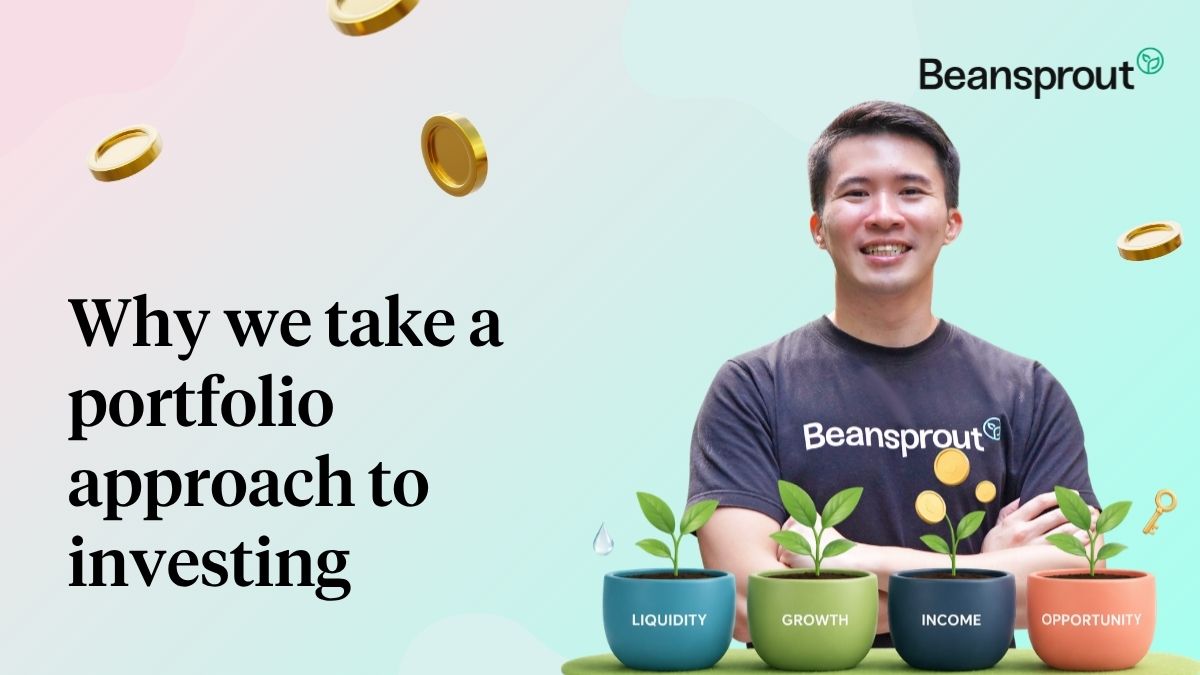
When we share a stock idea, one of the questions I often get is: “Which stock should I buy?”
But investing is not about finding one best stock and putting as much money into it as possible.
It is about building a portfolio that can perform across different outcomes, including the ones we do not expect.
That means looking beyond whether a stock is attractive on its own.
We also consider how it fits with what we already own, how much capital to allocate, and what happens if our investment thesis is wrong.
Two stocks can both be rated positively but still deserve very different position sizes depending on their risk, expected return and relationship with the rest of the portfolio.
Concentrating heavily in a single idea can work well when we are right, but one mistake can also have an outsized impact.
A portfolio approach spreads capital across multiple ideas while sizing each position deliberately.
That is why at Beansprout, we take a portfolio approach to investing. We do not just ask what we want to own, but also how much to own, and how each position contributes to the portfolio as a whole.
Diversification and position sizing are therefore not an afterthought. They are what turn good investment ideas into a more durable, risk-managed portfolio.
How the portfolio approach fits into our investment framework
Our Four Pots of Wealth framework starts one level higher. Before deciding what to invest in, I first think about what I need my money to do.
The Liquidity Pot is for near term needs, the Income Pot is for recurring income, the Growth Pot is for long term compounding, and the Opportunity Pot gives me room to express higher conviction within clear limits.
For individual stocks in the Opportunity Pot, we then follow our four stage Opportunity Pot investment process.
| Stage | What we do |
| 1. Find ideas | Start with macro trends, industry developments and company specific catalysts |
| 2. Screen | Look at revenue and earnings momentum, balance sheet strength and return on equity |
| 3. Research | Assess business quality, management, catalysts and valuation, then develop an investment thesis |
| 4. Invest using a portfolio approach | Decide the entry price, expected return and position size, then manage the investment within the broader portfolio |
Our growth stocks screening criteria are deliberately concrete. We generally prefer net debt to equity below 1.0x, become more cautious above 1.5x, and look for return on equity above 8%.
You can use our Growth Stock Screener to see how these screening criteria are applied across Singapore-listed companies.
By the end of Stage 3, where we research a company and develop our investment thesis, I should know why I want to own the company, what could drive its share price higher, what could prove my thesis wrong, and what I think it is worth.
Stage 4 is where I decide how to actually put capital behind that idea. Our existing framework generally looks for at least 15% to 20% potential upside before initiating a position, targets an annualised return of around 8% to 12%, and typically works with a one to three year investment horizon.
But even if a stock meets those criteria, I still need to decide how much to invest and how it fits with everything else I own.
This article goes deeper into that fourth stage.
1. A portfolio is more than a collection of good stocks
Suppose I find five companies that pass our investment process. I could simply put 20% into each, but that assumes every company carries the same risk, I have the same conviction in each one, and they all give me sufficiently different exposures.
That is rarely the case.
A well constructed portfolio combines different sources of return, different risks and different position sizes. Stock selection, position sizing, cash management and sell discipline all contribute to how diversified the eventual portfolio really is.
Picking a good stock is therefore only one part of the investment decision. I also need to decide what role it should play and how much of my capital I am prepared to depend on it.
2. Position size should reflect conviction and risk
Our starting point for position sizing is conviction.
Within the Opportunity Pot, we use our five levels of conviction rating framework to translate our level of conviction into a range for how much capital an idea might deserve.
| Rating | Conviction | Typical allocation within the Opportunity Pot |
| ★★★★★ | Highest conviction | 15% to 25% |
| ★★★★☆ | Strong conviction | 8% to 20% |
| ★★★☆☆ | Moderate conviction | 3% to 10% |
| ★★☆☆☆ | Low conviction | Reduce or exit |
| ★☆☆☆☆ | Avoid | 0% |
These are guidelines rather than fixed allocations. Even two companies with the same rating may receive different weights depending on their liquidity, risk, how much uncertainty remains in the investment case, and what else is already in the portfolio.
Regardless of conviction, we cap any individual position at 25% of the Opportunity Pot.
That limit matters because conviction is not certainty. An earnings miss, regulatory change, execution problem or unexpected change in the economy can affect even an investment where the original case appeared strong.
This is why stock selection and position sizing are separate decisions. A stock can deserve a place in the portfolio without deserving a large place in the portfolio.
3. A stock can earn the right to become a bigger position
I also do not need to make the entire sizing decision on day one.
For a newer investment where there is still significant uncertainty, I may start with a 3% to 5% position. If the company subsequently delivers stronger results, the catalyst becomes clearer, the share price becomes more attractive or my conviction increases, I can add to it over time.
This gives me room to learn. If the thesis strengthens, I can put more capital behind it. If it weakens, I have limited the amount of capital exposed.
I think of this as allowing a stock to earn a larger place in the portfolio.
4. Different holdings can give us exposure to different themes
Another reason we take a portfolio approach is that I do not want the outcome to depend on a single investment theme.
At different points in the market cycle, different parts of the economy can drive returns. Rather than trying to identify the one theme that will perform best, I can build exposure to several themes where I see attractive opportunities.
For example, the Beansprout Pro model portfolio has included exposure to several themes we have been watching in Singapore:
These examples are an illustration rather than a target allocation. The important point is that each theme can be driven by different developments, so I do not need one view on the market to be right for the entire portfolio to work.
There can also be overlap. What matters is understanding where the returns are expected to come from, rather than assuming that owning more stocks automatically gives me more diversification.
5. Diversification is about what can go wrong together
Owning stocks across several themes does not automatically mean I am diversified either.
Imagine I own three banks, two REITs and several companies exposed to data centre investment. They are different companies and may even sit in different sectors, but some of the underlying risks can still overlap.
The banks may be affected by the same interest rate and credit environment, while the REITs may both be sensitive to funding costs. Several technology and infrastructure companies may ultimately depend on the same data centre spending cycle.
So I would ask two questions when putting a portfolio together:
- What different sources of return am I getting exposure to?
- What could cause several of those investments to disappoint at the same time?
Diversification does not require every company to have a completely unrelated business. What matters is avoiding a portfolio where one company, customer, sector, theme or economic outcome determines the entire result.
For me, diversification is therefore not just about owning more stocks. It is about combining different sources of return while understanding where the risks still overlap.
6. The market environment affects how we build the portfolio
Our investment process starts with the macro environment for a reason. Interest rates, economic growth, inflation and corporate earnings can affect which businesses are attractive, but they can also affect how much risk I want to take across the portfolio.
I would broadly think about four different environments.
| Market environment | What we would look for | How we may position |
| Resilient growth, contained inflation | Quality growth, cyclicals, companies with earnings momentum | More willing to deploy capital |
| Strong growth, but inflation or rates remain high | Pricing power, low leverage, selected financials and commodity beneficiaries | Stay invested, but be more selective |
| Weak growth, high inflation or high rates | Pricing power, strong balance sheets, resilient earnings | More selective, smaller positions, more cash |
| Weak growth, falling interest rates | Quality growth, income stocks, selected REITs and rate-sensitive companies | Gradually redeploy as valuations and earnings outlook improve |
When growth is resilient, inflation is contained and corporate earnings remain supportive, I would generally be more willing to deploy capital across quality growth and cyclical companies.
If growth remains strong but inflation or interest rates stay high, I would stay invested but be more selective. Companies with pricing power, low leverage and the ability to sustain margins may be better positioned, while highly rate-sensitive businesses could remain under pressure.
If growth weakens while inflation or interest rates remain high, I would become more defensive. Position sizes may be smaller, cash levels higher, and the bar for adding a new stock higher, while companies with pricing power, low debt and resilient earnings become more attractive.
If growth weakens and interest rates fall, opportunities may emerge for quality growth companies, income stocks and selected REITs. I may then gradually redeploy cash as valuations and the outlook become more attractive.
The objective is not to predict every turn in the economy. It is to recognise the environment we are in and adjust how the portfolio is positioned rather than remaining fully exposed to a scenario that may no longer apply.
Sometimes the right response is not to sell a stock completely. It is simply to own less.
7. Cash is part of the portfolio too
I also do not believe the Opportunity Pot always needs to be fully invested.
As a starting point, around 5% to 10% in cash can provide useful flexibility, although we do not treat this as a fixed target. When valuations are high and few ideas meet our criteria, holding more cash may make sense.
When markets correct and quality companies become available at more attractive prices, that cash can be deployed. The cost is that cash may drag on returns when markets rise, but the benefit is having capital available when better opportunities emerge.
Cash is therefore an active portfolio decision, rather than simply whatever happens to be left over.
What would Beansprout do?
I keep high conviction ideas ring-fenced within the Opportunity Pot as part of Beansprout's Four Pots of Wealth, so that these opportunities can contribute to returns without determining the outcome of the entire portfolio.
Then, I would think about managing my opportunity pot through four stages.
First, find ideas by looking at the market environment, industry developments and company specific catalysts.
Second, screen those ideas based on earnings momentum, balance sheet strength and returns.
You can also use our Growth Stock Screener to see how these screening criteria are applied across Singapore-listed companies.
Third, research the strongest candidates to understand the business, management, catalysts, risks and valuation.
Finally, invest using a portfolio approach. Before putting capital to work, I would consider:
- How strong is my conviction?
- How much could go wrong if my thesis is incorrect?
- How much still needs to be proven?
- How much exposure do I already have to similar risks?
- Does the position make sense in the current market environment?
- Should I invest the full amount now or allow the position to grow as the thesis develops?
- What would cause me to add, trim or sell?
Finding the right stocks still matters. But good investing does not end with deciding what to buy.
It is about deciding how much capital each idea deserves, putting those investments together deliberately, and building a portfolio that can still work when some of my views turn out to be wrong.
The Beansprout Pro model portfolio provides an illustration of how we apply these principles. It is not intended to suggest that investors should reproduce the same holdings or weights.
If you want to revisit how a stock reaches this point, you can go back to our full Opportunity Pot investment process, from finding an idea and screening the numbers to researching the investment thesis and deciding how much to own.
Follow Beansprout on Youtube, Facebook and Instagram, and add Beansprout as your preferred source on Google so you never miss an update.
Read also
Gain financial insights in minutes
Subscribe to our free weekly newsletter for more insights to grow your wealth
Most Popular

Comments
0 comments