
Keppel DC REIT buys two data centres in Japan. What it means for unitholders
REITs
By Gerald Wong, CFA • 01 Sep 2026
Why trust Beansprout? We’ve been awarded Best Investment Website at the SIAS Investors’ Choice Awards 2025
'%3e%3cpath%20fill-rule='evenodd'%20clip-rule='evenodd'%20d='M17.64%209.20455C17.64%208.56637%2017.5827%207.95273%2017.4764%207.36364H9V10.845H13.8436C13.635%2011.97%2013.0009%2012.9232%2012.0477%2013.5614V15.8195H14.9564C16.6582%2014.2527%2017.64%2011.9455%2017.64%209.20455V9.20455Z'%20fill='%234285F4'/%3e%3cpath%20fill-rule='evenodd'%20clip-rule='evenodd'%20d='M9%2018C11.43%2018%2013.4673%2017.1941%2014.9564%2015.8195L12.0477%2013.5614C11.2418%2014.1014%2010.2109%2014.4205%209%2014.4205C6.65591%2014.4205%204.67182%2012.8373%203.96409%2010.71H0.957275V13.0418C2.43818%2015.9832%205.48182%2018%209%2018V18Z'%20fill='%2334A853'/%3e%3cpath%20fill-rule='evenodd'%20clip-rule='evenodd'%20d='M3.96409%2010.71C3.78409%2010.17%203.68182%209.59318%203.68182%209C3.68182%208.40682%203.78409%207.83%203.96409%207.29V4.95818H0.957273C0.347727%206.17318%200%207.54773%200%209C0%2010.4523%200.347727%2011.8268%200.957273%2013.0418L3.96409%2010.71V10.71Z'%20fill='%23FBBC05'/%3e%3cpath%20fill-rule='evenodd'%20clip-rule='evenodd'%20d='M9%203.57955C10.3214%203.57955%2011.5077%204.03364%2012.4405%204.92545L15.0218%202.34409C13.4632%200.891818%2011.4259%200%209%200C5.48182%200%202.43818%202.01682%200.957275%204.95818L3.96409%207.29C4.67182%205.16273%206.65591%203.57955%209%203.57955V3.57955Z'%20fill='%23EA4335'/%3e%3c/g%3e%3cdefs%3e%3cclipPath%20id='clip0_0_2849'%3e%3crect%20width='18'%20height='18'%20fill='white'/%3e%3c/clipPath%3e%3c/defs%3e%3c/svg%3e)
Make Beansprout your preferred source on Google
Add us on Google to see more of our insights in your search results
Keppel DC REIT has announced the acquisition of an 88.62% interest in Tokyo Data Centre 4 and Tokyo Data Centre 5 for approximately S$1.37 billion, as it further expands its presence in Japan.
What happened?
Keppel DC REIT has been growing its data centre portfolio.
The REIT has announced the acquisition of an 88.62% effective interest in Tokyo Data Centre 4 and Tokyo Data Centre 5, two freehold hyperscale data centres in Greater Tokyo.
This follows the acquisition of Tokyo Data Centre 3 and increased interests in several Singapore data centres last year.
The latest acquisition will add two large-scale data centres to Keppel DC REIT’s portfolio and deepen its exposure to the Japan market.
In this article, we look at what you need to know about the acquisition, how it will be funded, and what it could mean for Keppel DC REIT unitholders.
6 things you need to know about Keppel DC REIT's Tokyo data centre acquisition
#1 — Keppel DC REIT is buying two freehold Tokyo data centres
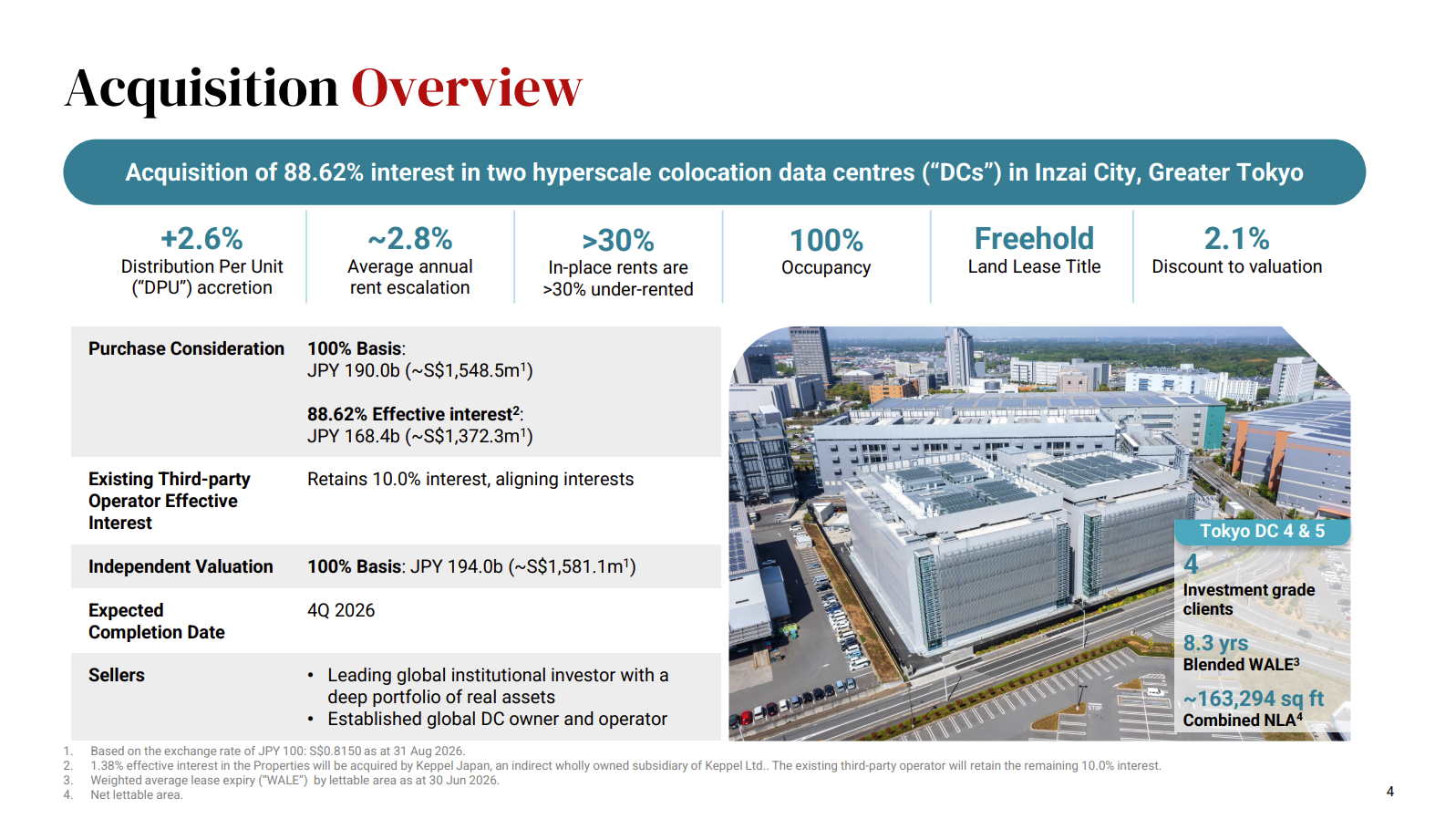
Keppel DC REIT is acquiring an 88.62% effective interest in Tokyo Data Centre 4 and Tokyo Data Centre 5.
The two properties are located in Inzai City, Greater Tokyo, one of Japan's major data centre clusters.
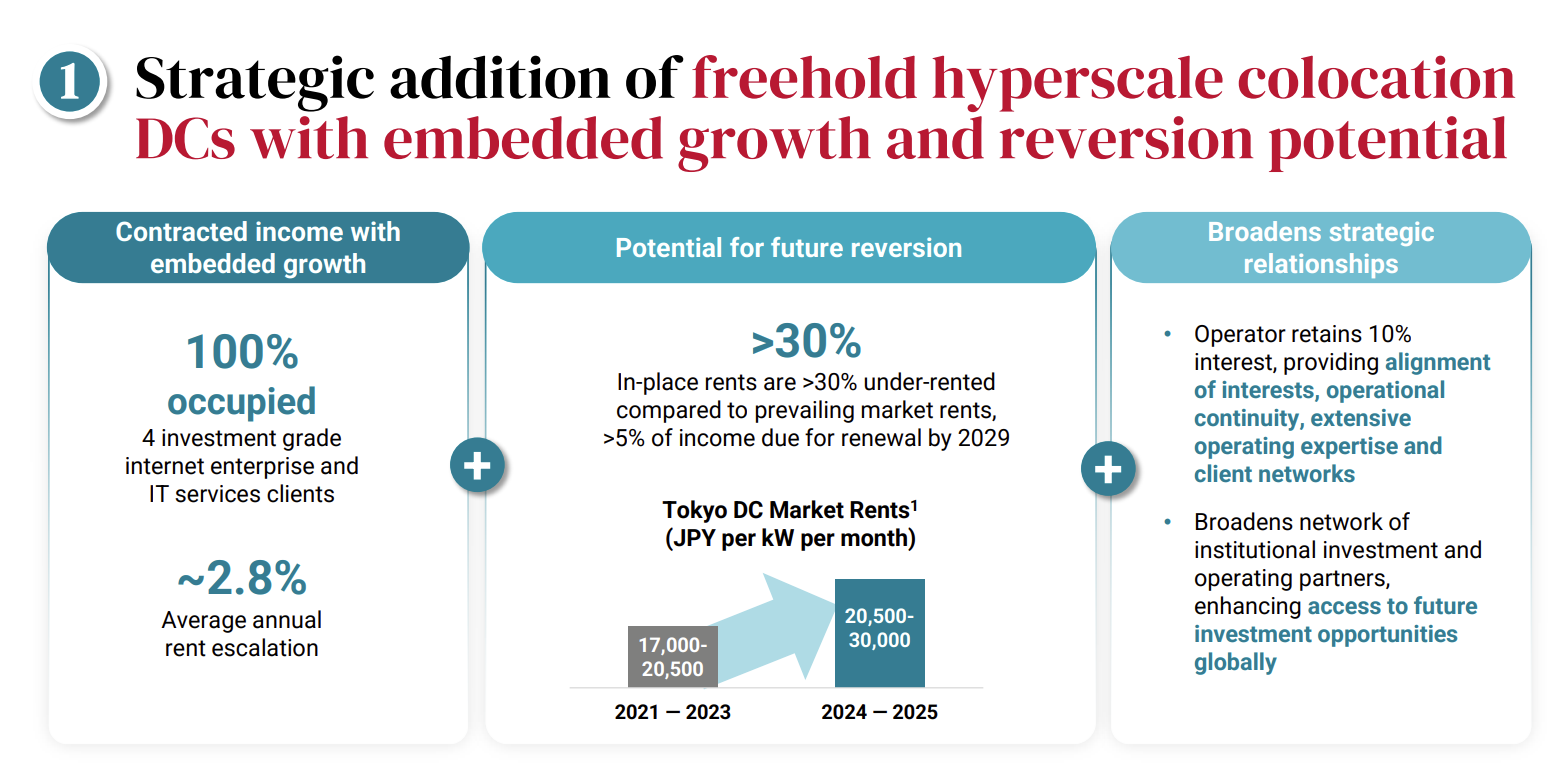
Tokyo Data Centre 4 was completed in 2021 and has a net lettable area of approximately 62,134 square feet, while Tokyo Data Centre 5 was completed in 2024 and is larger at approximately 101,160 square feet.
Both are freehold, fully fitted colocation data centres and are 100% occupied.
The acquisition price for the properties is JPY190 billion, compared with an independent valuation of JPY194 billion as at 31 July 2026.
This means Keppel DC REIT is acquiring the properties at approximately a 2.1% discount to valuation.
Following the acquisition, Keppel DC REIT will own 88.62% of the properties, Keppel will indirectly own another 1.38%, while the existing data centre operator will retain a 10% interest.
Management believes retaining the operator as a co-investor helps align interests while maintaining operational continuity.
#2 — Existing rents are more than 30% below market rents
One of the more interesting aspects of the acquisition is the potential for rental growth.
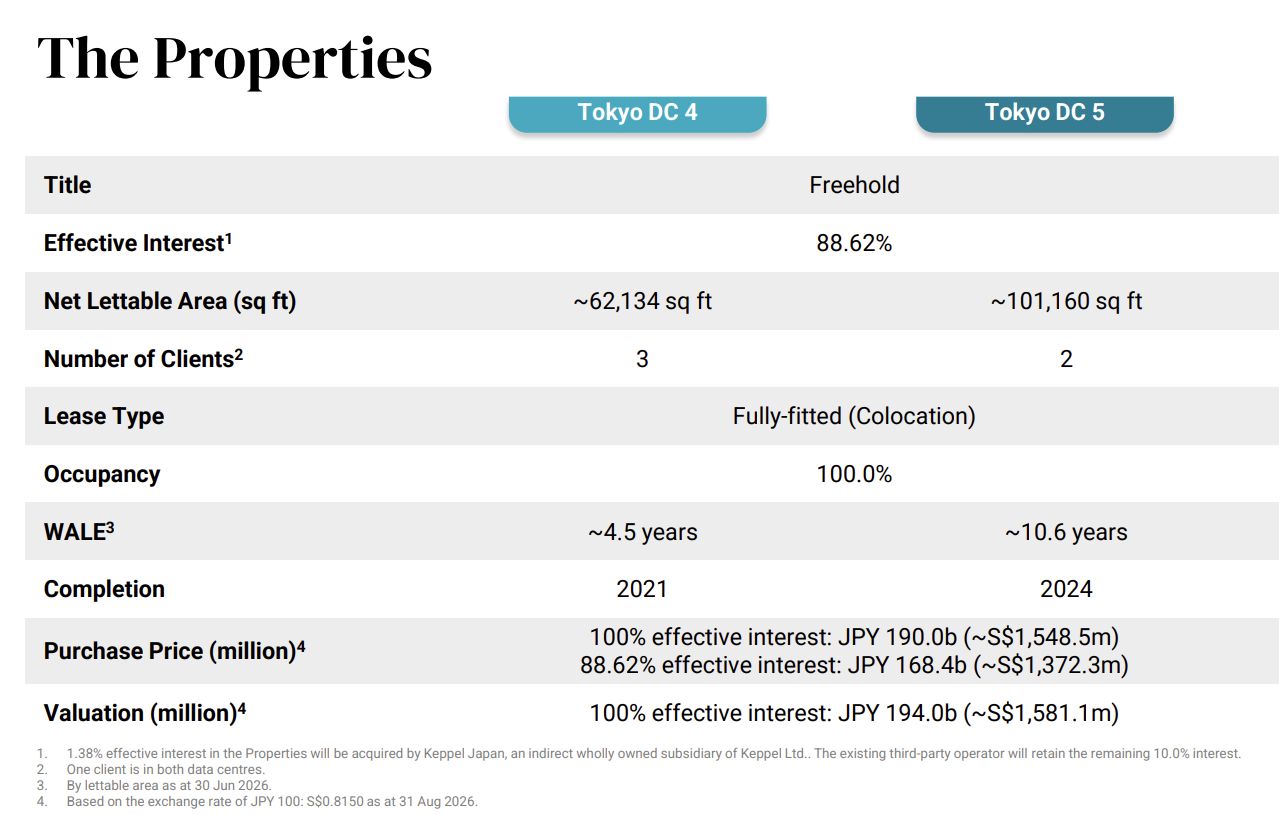
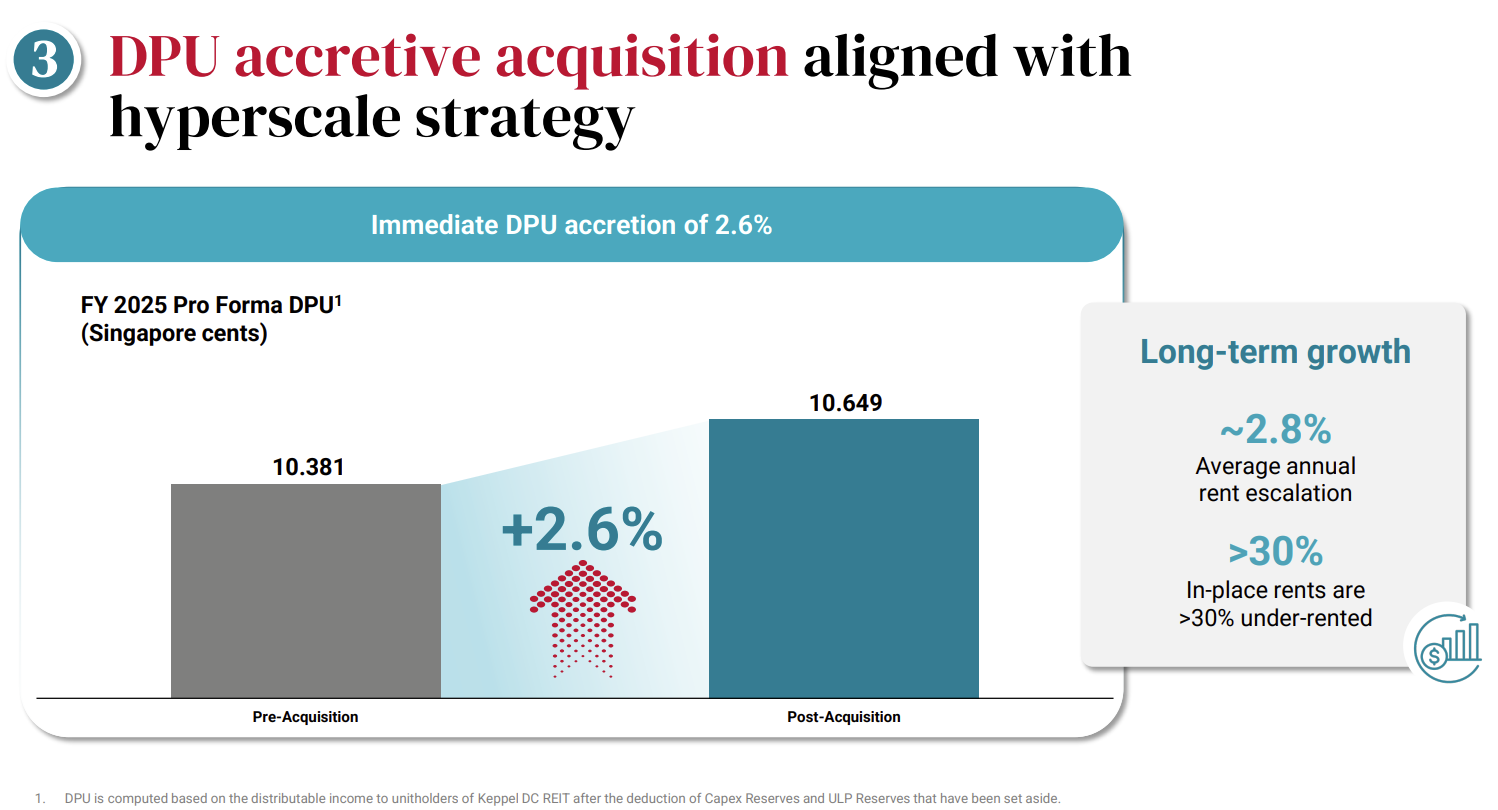
The properties are currently leased to four investment-grade internet enterprise and IT services clients and come with average contracted annual rental escalations of about 2.8%.
This provides some built-in rental growth even before leases come up for renewal.
More importantly, Keppel DC REIT estimates that existing rents at Tokyo Data Centre 4 and 5 are more than 30% below prevailing market rents.
Market rents for Tokyo data centres have risen from about JPY17,000-20,500 per kilowatt per month in 2021-2023 to JPY20,500-30,000 in 2024-2025.
More than 5% of the properties' contracted income is due for renewal by 2029.
If market rents remain above the current contracted rents when these leases are renewed, this could provide additional rental income growth on top of the existing 2.8% annual escalations.
However, I would not assume that being more than 30% under-rented means rents will automatically rise by the same amount.
The actual increase will depend on market rents and lease negotiations when the contracts are renewed.
#3 — Japan will become a much bigger part of Keppel DC REIT's portfolio
The acquisition will also meaningfully increase Keppel DC REIT's exposure to Japan.
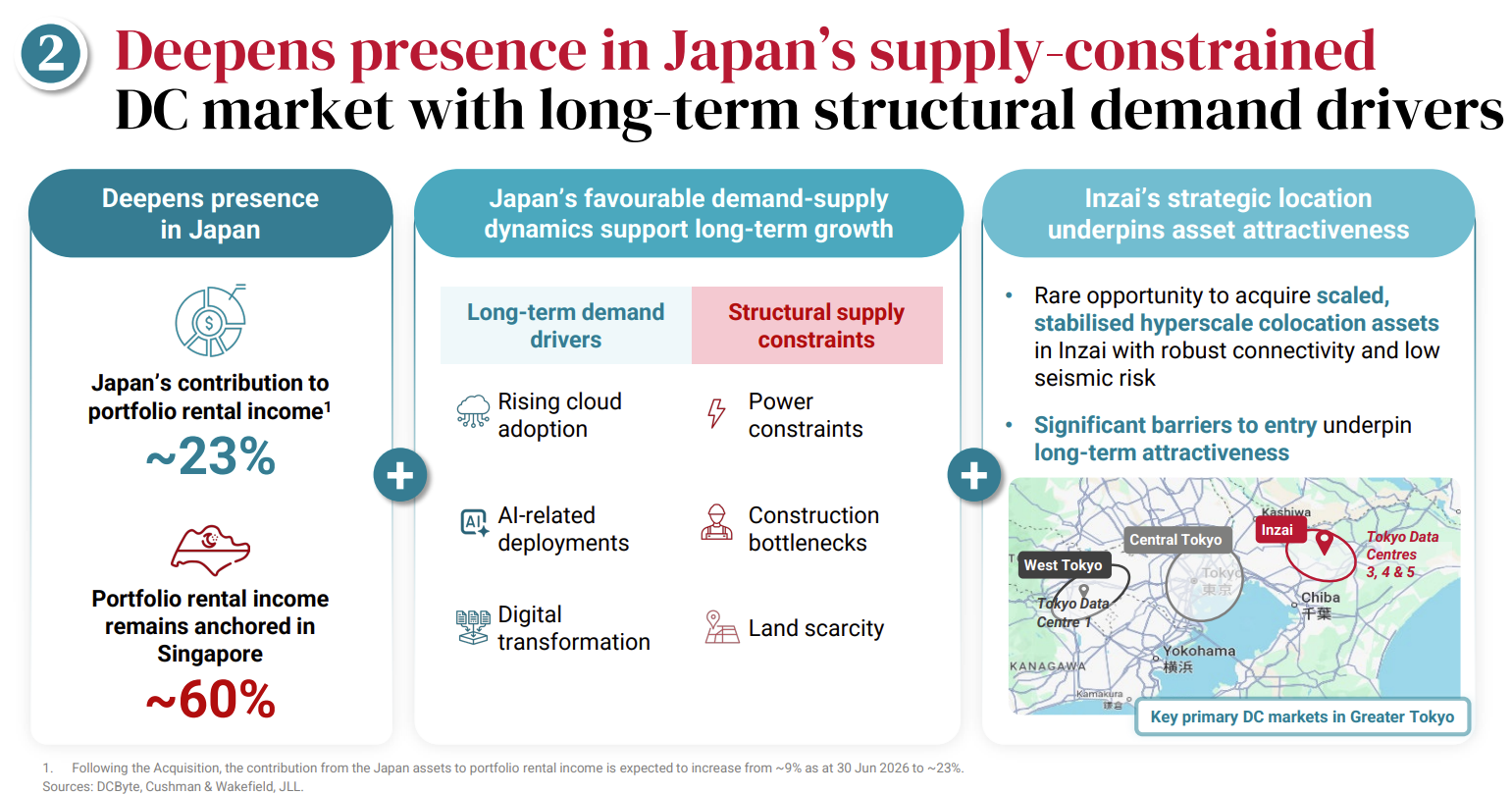
Japan currently contributes approximately 9% of portfolio rental income.
Following the acquisition, this is expected to rise to around 23%.
Singapore will remain the REIT's largest market, accounting for approximately 60% of rental income.
Japan's share of Keppel DC REIT's assets under management will also reach about 28.7% after the acquisition.
Management sees the Tokyo market as attractive because demand for data centres is being supported by cloud adoption, artificial intelligence-related deployments and digital transformation.
At the same time, new supply faces constraints from access to power, construction bottlenecks and land scarcity. Keppel DC REIT noted that Inzai City may continue to face power supply constraints towards 2030.
The acquisition therefore increases Keppel DC REIT's exposure to a market where management expects demand growth to remain ahead of new supply.
#4 — The acquisition would have raised FY2025 DPU by 2.6% on a pro forma basis
For income investors, one of the most important questions is whether the additional income from the assets can offset the dilution from issuing new units.
Based on Keppel DC REIT’s pro forma analysis, FY2025 DPU would have increased by 2.6%.
On a pro forma basis, if the acquisition and private placement had been completed on 1 January 2025, Keppel DC REIT's FY2025 DPU would have increased from 10.381 cents to 10.649 cents.
This represents a 2.6% increase.
Distributable income would have increased from about S$268.1 million to S$305.0 million, or approximately 13.8%.
However, the number of units entitled to distributions would also increase from about 2.44 billion to 2.73 billion units as new units are issued to partly fund the purchase.
Based on the pro forma numbers, the additional income from the two Tokyo properties is expected to more than offset both the new units issued and the higher interest expense.
#5 — Keppel DC REIT will become larger and slightly more diversified
The acquisition will increase Keppel DC REIT's assets under management from around S$6.3 billion to S$7.6 billion.
Its portfolio will expand to 27 data centres across 10 countries.
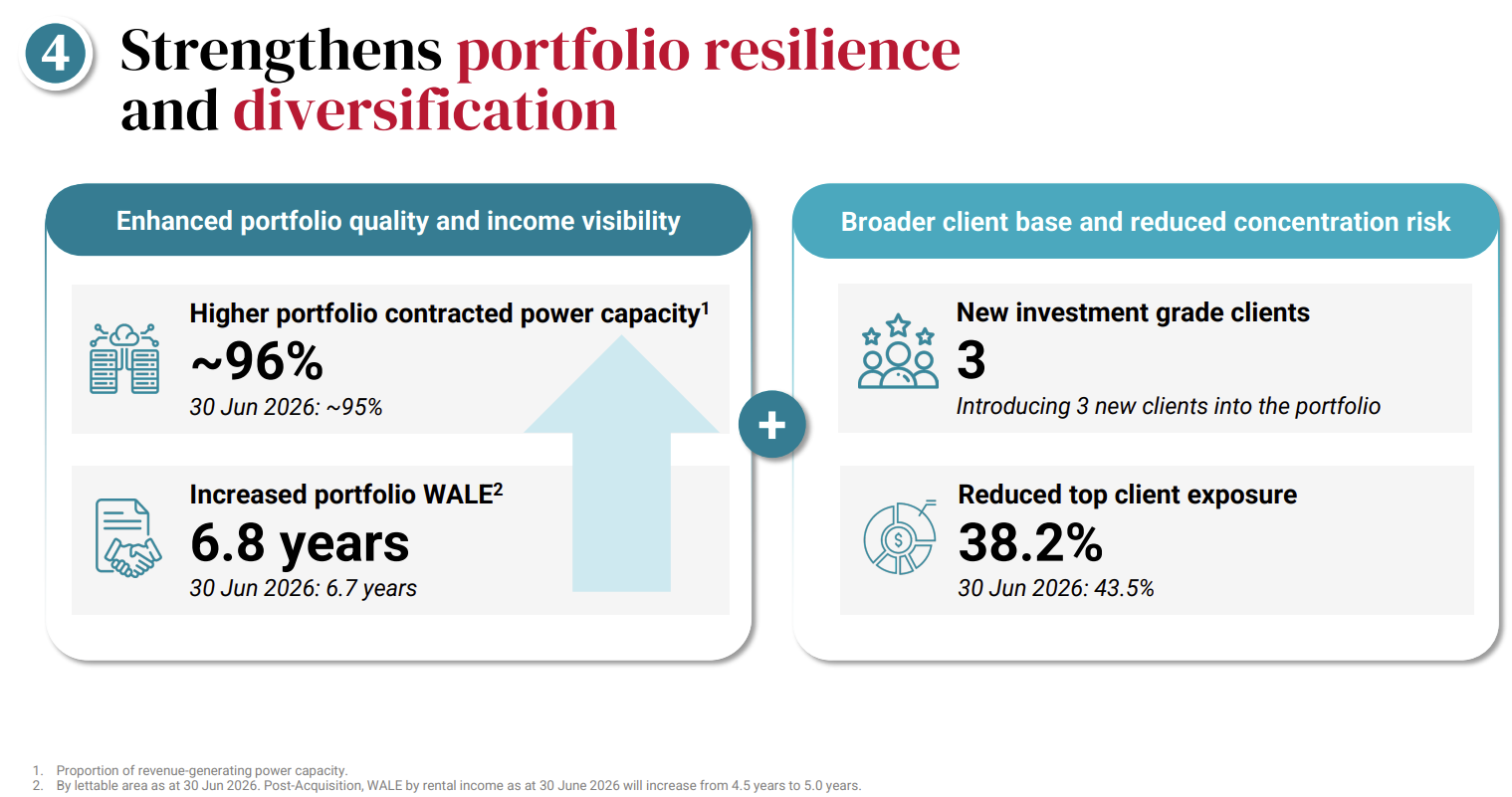
The two new assets will also bring three new investment-grade customers into the portfolio.
This reduces Keppel DC REIT's dependence on its largest customer.
Its biggest customer's contribution to portfolio rental income is expected to fall from 43.5% to 38.2%.
This remains a relatively large customer exposure, but it represents an improvement in diversification.
Portfolio weighted average lease expiry, or WALE, by lettable area is also expected to improve slightly from 6.7 years to 6.8 years.
Tokyo Data Centre 4 has a relatively shorter WALE of about 4.5 years, while Tokyo Data Centre 5 has a much longer WALE of about 10.6 years.
This gives the two properties a combined WALE of around 8.3 years, providing a mix of longer-term income visibility and nearer-term opportunities for rental reversion.
#6 — Leverage will rise from 34% to 38%, but remains below 40%
The acquisition will be funded through a mix of equity and debt.
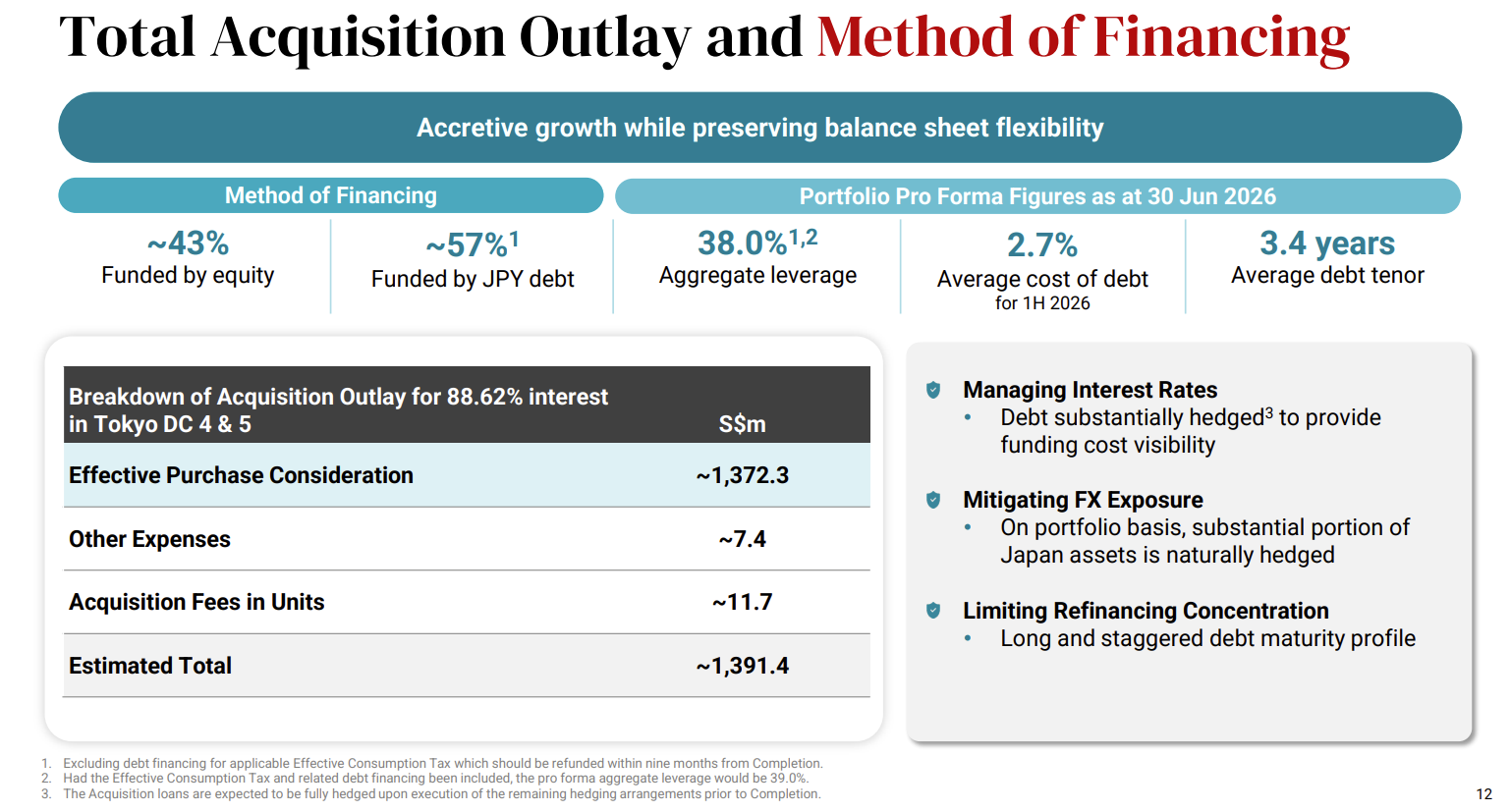
The total acquisition outlay is expected to be about S$1.39 billion.
This includes the effective purchase consideration, transaction and financing costs, and the acquisition fee payable in units.
About S$591.1 million, or 43% of the total outlay, will be funded through the private placement.
Another S$788.6 million, or 57%, will be funded through JPY-denominated debt.
The remaining S$11.7 million will be paid through units issued to the Manager as the acquisition fee.
Following the acquisition, Keppel DC REIT’s pro forma aggregate leverage is expected to rise from 34.0% to 38.0%.
That four-percentage-point increase is meaningful because it leaves the REIT with less room to take on additional debt.
If financing for refundable Japanese consumption tax is included, aggregate leverage would temporarily reach 39.0%. The tax is expected to be refunded within nine months after completion.
However, the REIT would still remain below the 40% level that we typically watch for when assessing a REIT's balance sheet flexibility.
Keppel DC REIT's average cost of debt is expected to rise only slightly, from 2.6% as at 30 June 2026 to around 2.7%.
Its weighted average debt tenor is expected to improve to 3.4 years.
The acquisition loans are also expected to be substantially hedged. Borrowing in Japanese yen provides some natural currency matching against the REIT's Japanese assets and income.
Keppel DC REIT is raising at least S$600 million through a private placement
To partly fund the acquisition, Keppel DC REIT has launched a private placement to raise gross proceeds of at least S$600 million.
Approximately S$591.1 million of the proceeds will be used to fund the acquisition, while around S$8.9 million will go towards placement-related expenses.
The new units will be issued at a price between S$2.096 and S$2.142 per unit. This represents a discount of approximately 2.5% to 4.6% to the S$2.1974 volume-weighted average price on 31 August 2026.
At the top end of the issue price range, around 280.1 million new units would be issued. That is equivalent to around 11.4% of Keppel DC REIT's existing unit base.
The placement is therefore fairly sizeable. However, the dilution needs to be considered alongside the income generated by the assets being acquired. Based on management's pro forma calculations, the transaction would still have lifted FY2025 DPU by 2.6%.
Existing unitholders will also receive an advanced distribution for the period from 1 July 2026 to the day before the new units are issued.
Management currently estimates this at between 2.241 cents and 2.281 cents per unit.
Keppel DC REIT on REIT Income Pot framework
We apply Beansprout's REIT screening framework; DPU growth, gearing, and distribution yield, to assess whether Keppel DC REIT remains suitable for an income-focused portfolio after the acquisition of Tokyo Data Centre 4 and 5.
Check | Keppel DC REIT |
| DPU growth – able to generate stable earnings | ✅ Pass — 1H26 DPU of 5.714 cents, up 11.3% year-on-year |
| Aggregate leverage < 45% | ✅ Pass — pro forma aggregate leverage of 38.0% after the acquisition |
| Dividend yield > 5% | ✅ Pass — annualised 1H26 DPU implies a yield of 5.2% at S$2.20 |
| Overall | 3/3 checks |
| Source: Beansprout | |
Check #1: DPU growth remains healthy
Keppel DC REIT’s 1H26 DPU rose 11.3% year-on-year to 5.714 cents, supported by positive rental reversions, escalations and contributions from recent acquisitions.
This allows it to pass our first Income Pot check.
Check #2: Gearing remains manageable
Pro forma aggregate leverage is expected to rise from 34.0% to 38.0% after the acquisition.
While this reduces debt headroom, gearing remains below our 45% threshold, allowing Keppel DC REIT to pass the second check.
Check #3: Distribution yield is above 5%
Annualising Keppel DC REIT’s 1H26 DPU gives 11.428 cents per year, based on 5.714 cents × 2.
At a unit price of S$2.20, this implies a distribution yield of about 5.2%, above our preferred 5% threshold.
Keppel DC REIT therefore passes all 3 Income Pot checks.
What would Beansprout do?
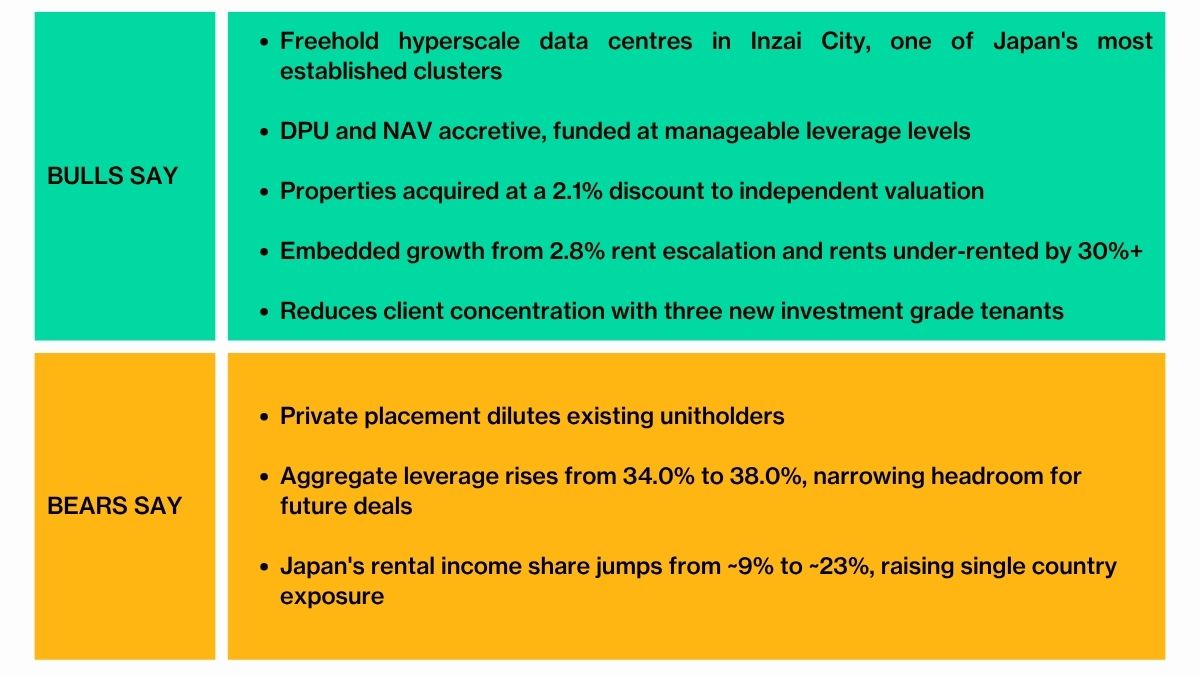
Keppel DC REIT’s acquisition of two data centres in Tokyo aligns with our AI and data centre growth theme for the Singapore market, and allows the REIT to strengthens its income growth potential.
The two freehold, fully occupied data centres are backed by investment-grade customers. Their leases already provide average annual rental escalations of about 2.8%, while current rents are estimated to be more than 30% below market levels. This provides potential for further rental growth when leases are renewed.
The acquisition also appears supportive of distributions. Despite the increase in the unit base, Keppel DC REIT estimates that FY2025 DPU would have been 2.6% higher on a pro forma basis.
However, the acquisition also comes with a clear trade-off. I would watch its balance sheet more closely, as aggregate leverage is expected to rise from 34.0% to 38.0%, leaving the REIT with less financial flexibility for future acquisitions or unexpected needs.
Keppel DC RET's pro forma NAV per unit would increase from S$1.71 to S$1.75. At S$2.20 per unit, this would imply that Keppel DC REIT trades at a price-to-book valuation ratio of approximately 1.26x.
Based on the closing price of S$2.20 on 31 August 2026 and annualised 1H26 DPU of 11.428 cents, Keppel DC REIT would offer an implied distribution yield of around 5.2%, above its historical average yield of 4.5%..
Keppel DC REIT continues to pass all three of our Income Pot checks. DPU growth remains healthy, gearing stays below our 45% threshold, and its implied distribution yield remains above 5%.
As such, I will consider Keppel DC REIT for my income pot within Beansprout's four pots of wealth.
To find other REITs that meet Beansprout's income pot checks, check out our income pot screener for Singapore REITs.
To screen for Singapore REITs with lowest price-to-book valuation or highest dividend yield, check out our best Singapore REIT screener.
If you are new to investing in Singapore REITs, you can start to learn more about Singapore REITs here.
What do you think of Keppel DC REIT's acquisition of Tokyo Data Centre 4 and 5? Share with us in the comments below or in our Telegram group!
Follow Beansprout on Youtube, Facebook and Instagram, and add Beansprout as your preferred source on Google so you never miss an update.
Read also
Gain financial insights in minutes
Subscribe to our free weekly newsletter for more insights to grow your wealth
Most Popular

Comments
0 comments