
Worth a look for income? 3 Singapore blue chip REITs raised dividends in August 2026
REITs
By Goh Lay Peng • 20 Aug 2026
Why trust Beansprout? We’ve been awarded Best Investment Website at the SIAS Investors’ Choice Awards 2025
'%3e%3cpath%20fill-rule='evenodd'%20clip-rule='evenodd'%20d='M17.64%209.20455C17.64%208.56637%2017.5827%207.95273%2017.4764%207.36364H9V10.845H13.8436C13.635%2011.97%2013.0009%2012.9232%2012.0477%2013.5614V15.8195H14.9564C16.6582%2014.2527%2017.64%2011.9455%2017.64%209.20455V9.20455Z'%20fill='%234285F4'/%3e%3cpath%20fill-rule='evenodd'%20clip-rule='evenodd'%20d='M9%2018C11.43%2018%2013.4673%2017.1941%2014.9564%2015.8195L12.0477%2013.5614C11.2418%2014.1014%2010.2109%2014.4205%209%2014.4205C6.65591%2014.4205%204.67182%2012.8373%203.96409%2010.71H0.957275V13.0418C2.43818%2015.9832%205.48182%2018%209%2018V18Z'%20fill='%2334A853'/%3e%3cpath%20fill-rule='evenodd'%20clip-rule='evenodd'%20d='M3.96409%2010.71C3.78409%2010.17%203.68182%209.59318%203.68182%209C3.68182%208.40682%203.78409%207.83%203.96409%207.29V4.95818H0.957273C0.347727%206.17318%200%207.54773%200%209C0%2010.4523%200.347727%2011.8268%200.957273%2013.0418L3.96409%2010.71V10.71Z'%20fill='%23FBBC05'/%3e%3cpath%20fill-rule='evenodd'%20clip-rule='evenodd'%20d='M9%203.57955C10.3214%203.57955%2011.5077%204.03364%2012.4405%204.92545L15.0218%202.34409C13.4632%200.891818%2011.4259%200%209%200C5.48182%200%202.43818%202.01682%200.957275%204.95818L3.96409%207.29C4.67182%205.16273%206.65591%203.57955%209%203.57955V3.57955Z'%20fill='%23EA4335'/%3e%3c/g%3e%3cdefs%3e%3cclipPath%20id='clip0_0_2849'%3e%3crect%20width='18'%20height='18'%20fill='white'/%3e%3c/clipPath%3e%3c/defs%3e%3c/svg%3e)
Make Beansprout your preferred source on Google
Add us on Google to see more of our insights in your search results
We look at 3 Singapore blue chip REITs that raised their dividends in August 2026. We compare their latest results and screen them for income investors.

What happened?
Singapore REITs have faced a challenging backdrop in 2026.
Higher bond yields and uncertainty over the interest-rate outlook have weighed on the sector, yet some blue-chip REITs have continued to grow their distributions.
Last month, I looked at three Singapore blue-chip REITs near their 52-week lows and whether their dividend yields could be sustained.
With the latest earnings season underway, I also reviewed the dividends from DBS, OCBC and UOB, as well as three Singapore blue-chip stocks that raised their dividends in August.
Some members of the Beansprout community then asked if there were any Singapore REITs that had also managed to raise their distributions.
In this article, I look at three Singapore blue-chip REITs that increased their dividends in August 2026, what drove the increases, and whether they stand out based on my initial checks for sustainable income.
| REIT | Latest DPU | Year-on-year change | Unit price used | Annualised distribution yield* |
| CapitaLand Integrated Commercial Trust | 6.02 cents, 1H2026 | +7.1% | S$2.44 as of 17 Aug 2026 | 4.9% |
| Keppel DC REIT | 5.714 cents, 1H2026 | +11.3% | S$2.32 as of 17 Aug 2026 | 4.9% |
| Mapletree Logistics Trust | 1.816 cents, 1Q FY26/27 | +0.2% | S$1.30 as of 17 Aug 2026 | 5.6% |
| *Data as of 17 August 2026. For comparison, the latest reported DPU is based on each REIT's distribution frequency. Distribution yields change with unit prices. CapitaLand Integrated Commercial Trust and Keppel DC REIT distribute semi-annually, while Mapletree Logistics Trust distributes quarterly. | ||||
#1 – CapitaLand Integrated Commercial Trust (SGX: C38U)
CapitaLand Integrated Commercial Trust (CICT) is Singapore's largest listed REIT, with a portfolio spanning retail malls, offices and integrated developments.
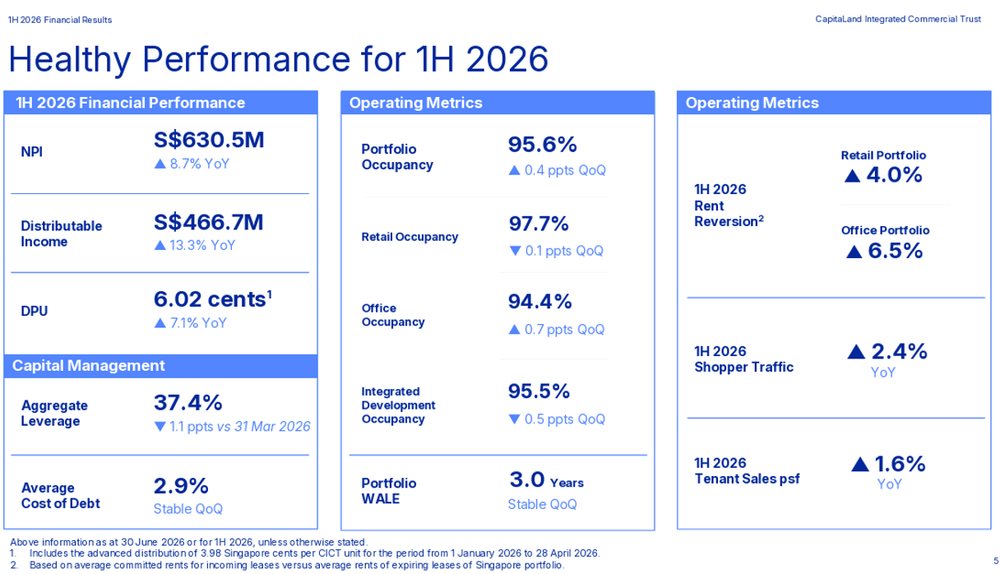
CapitaLand Integrated Commercial Trust continued to grow its distributions in 1H 2026.
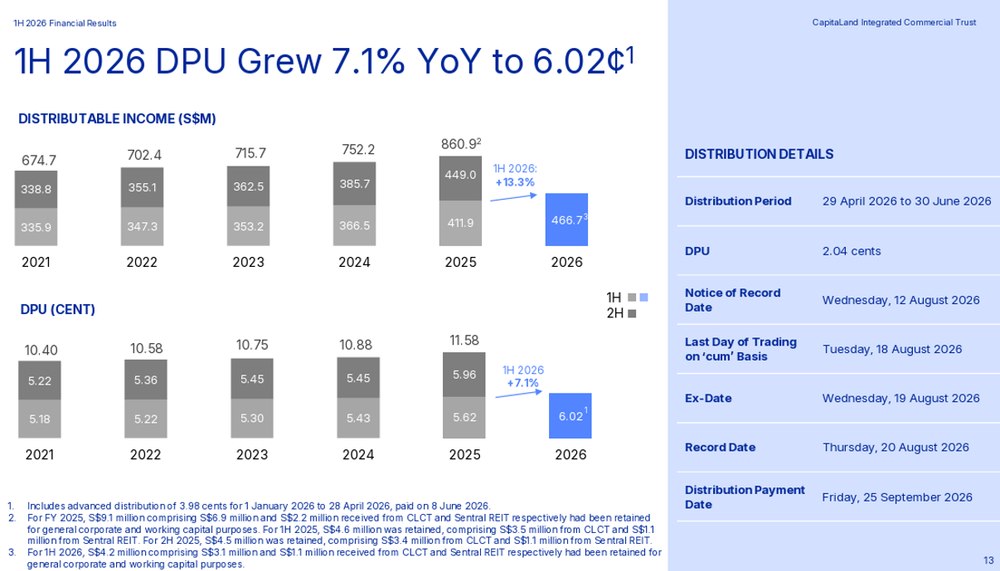
Its DPU rose 7.1% year on year to 6.02 cents, from 5.62 cents in 1H 2025. This follows a strong FY2025, when CapitaLand Integrated Commercial Trust's full-year DPU increased by 6.4% to 11.58 cents.
The increase was mainly supported by the full contribution from CapitaSpring and the progressive income contribution from Gallileo, alongside positive rental reversions across CapitaLand Integrated Commercial Trust's portfolio.
CapitaLand Integrated Commercial Trust has also continued to reshape its portfolio.
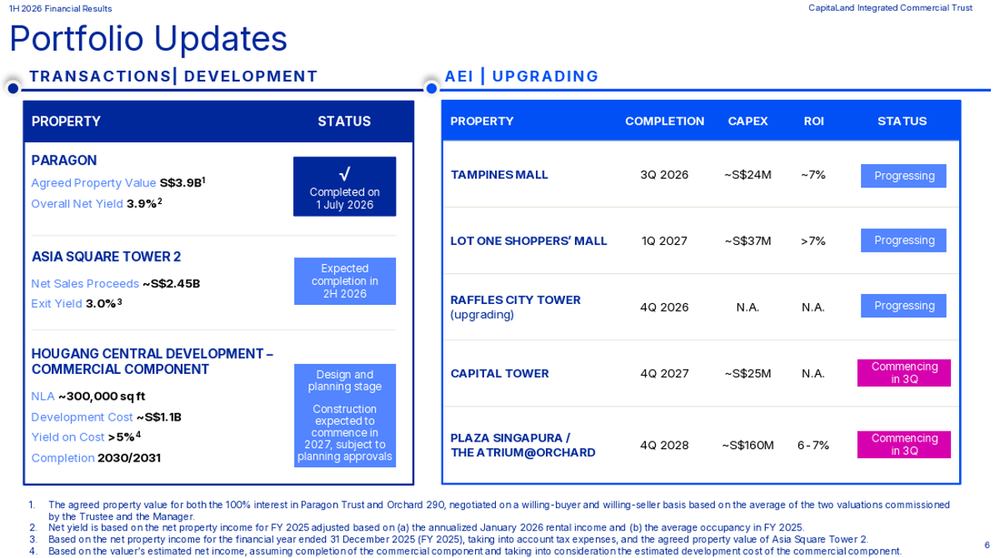
It completed the acquisition of Paragon in July 2026 after raising S$750 million through a private placement to partly fund the transaction.
The Orchard Road mall adds another major retail asset to CapitaLand Integrated Commercial Trust's portfolio, while the proposed divestment of Asia Square Tower 2 would allow it to recycle capital from an office property into Paragon.
For my first check, I look at whether a REIT has been able to maintain or grow its DPU over the latest full financial year.
CapitaLand Integrated Commercial Trust passes this check.
Its DPU increased from 10.88 cents in FY2024 to 11.58 cents in FY2025, and the latest 1H 2026 results suggest that distribution growth has continued.
For the second check, I look at the REIT's aggregate leverage to see whether its balance sheet provides sufficient room to manage its debt and fund future investments.
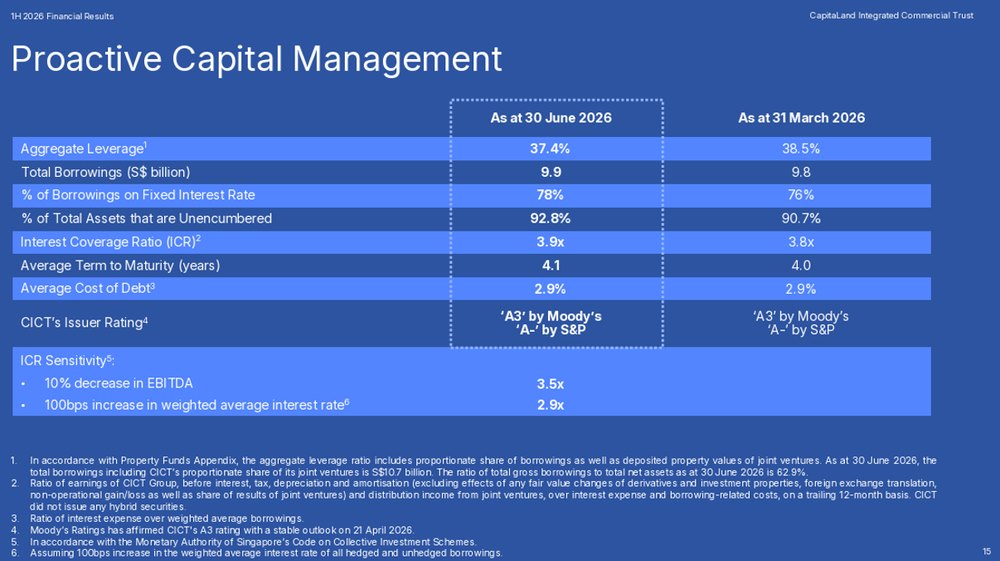
CapitaLand Integrated Commercial Trust's aggregate leverage remained below 40% following its recent equity fundraising.
CapitaLand Integrated Commercial Trust therefore passes the net gearing ratio check, although I would continue monitoring its leverage following the completion of the Paragon acquisition and proposed divestment of Asia Square Tower 2.
The final check is whether its distribution yield offers a meaningful premium over lower-risk alternatives.
CapitaLand Integrated Commercial Trust's annualised distribution yield stood at about 4.9%, based on its unit price of S$2.44 as of 17 August 2026 and annualising its latest 1H 2026 DPU of 6.02 cents.
For comparison, the Singapore 10-year government bond yield was around 2.3% in mid-August 2026, giving CapitaLand Integrated Commercial Trust a yield spread of about 2.6 percentage points.
This is slightly below the spread of around three percentage points that I generally look for when screening a REIT for income.
CapitaLand Integrated Commercial Trust therefore does not pass the yield check, although its yield spread is relatively close to the three percentage-point level I generally look for.
Overall, CapitaLand Integrated Commercial Trust passes two of my three initial screening checks.
Its DPU has continued to grow and its balance sheet remains manageable. However, the rise in its unit price has reduced the income premium available to investors.
I would continue watching whether Paragon can deliver the expected increase in income and whether CapitaLand Integrated Commercial Trust can maintain its DPU growth after accounting for the enlarged unit base from its recent equity fundraising.
Find out how much distributions you would have received as a CapitaLand Integrated Commercial Trust unitholder in the past 12 months with the dividend calculator below.
Related links:
- CICT raises 1H 2026 DPU by 7.1% to 6.02 cents: Our Quick Take
- CapitaLand Integrated Commercial Trust (SGX: C38U) latest valuation, unit price and analysis
- CapitaLand Integrated Commercial Trust (SGX: C38U) dividend history and forecast
#2 – Keppel DC REIT (SGX: AJBU)
Keppel DC REIT owns a portfolio of data centres across Singapore, Australia, Japan, Europe and other markets.
Among the three REITs, Keppel DC REIT recorded the strongest increase in its latest DPU.
For 1H 2026, gross revenue rose 14.5% year on year to S$242.0 million, while net property income increased 15.1% to S$210.4 million.
Distributable income grew even faster, rising 18.5% to S$150.7 million.
As a result, DPU increased 11.3% year on year to 5.714 cents, from 5.133 cents in 1H 2025.
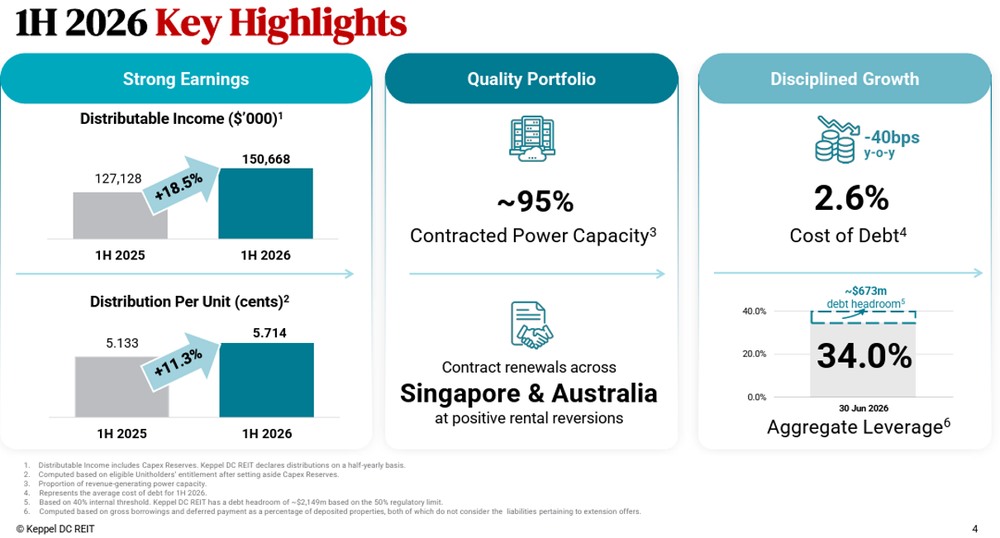
The stronger performance was supported by positive rental reversions and escalations, as well as the acquisition of Tokyo Data Centre 3 and Keppel DC REIT's increased interests in Keppel DC Singapore 3 and 4.
These were partly offset by higher finance costs and the absence of income from the divested Kelsterbach Data Centre.
There were also some encouraging operating indicators.
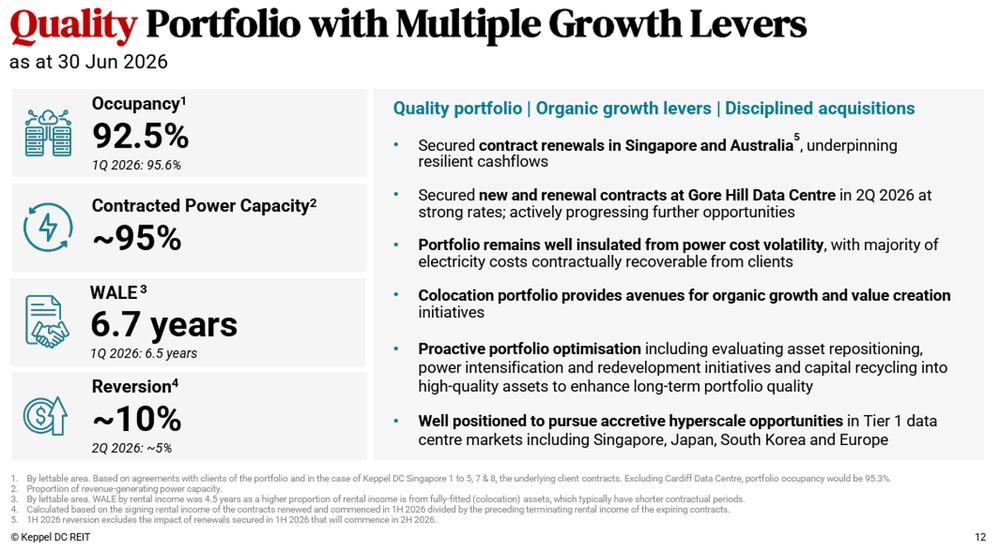
Keppel DC REIT achieved portfolio rental reversions of around 10% in 1H 2026, while about 95% of its revenue-generating power capacity was contracted.
Its weighted average lease expiry by lettable area increased to 6.7 years, which provides some visibility over future rental income.
However, portfolio occupancy declined to 92.5% as of 30 June 2026, from 95.6% in the previous quarter.
Excluding Cardiff Data Centre, occupancy would have been higher at 95.3%.
Looking at my first screening check, Keppel DC REIT has a strong recent DPU track record.
Full-year DPU increased from 9.451 cents in FY2024 to 10.381 cents in FY2025, an increase of about 9.8%.
The latest 11.3% year-on-year increase in 1H 2026 DPU means that the positive trend has continued.
Keppel DC REIT therefore passes the DPU growth check.
It also has the lowest aggregate leverage among the three REITs in this article.
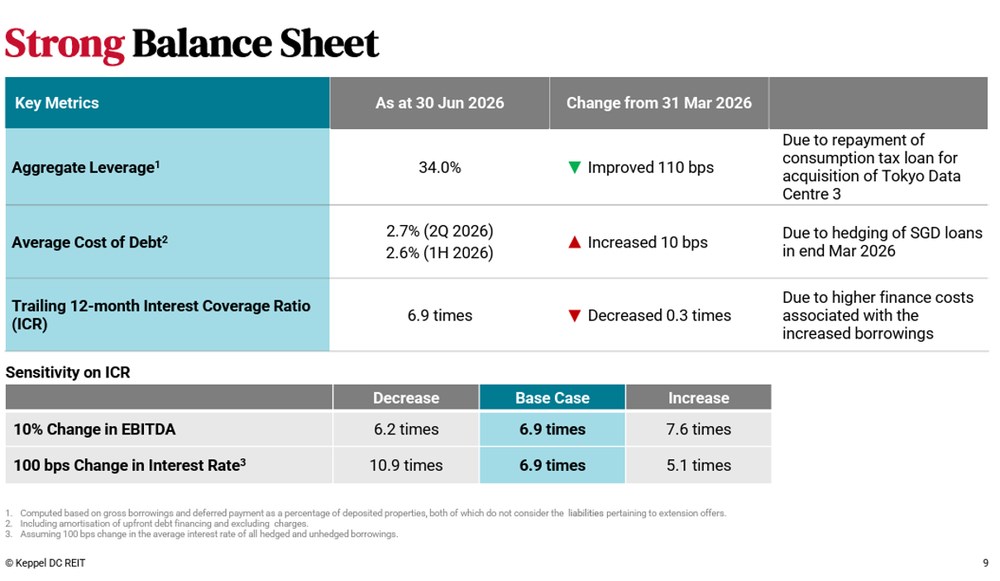
Aggregate leverage stood at 34.0% as of 30 June 2026, while its average cost of debt was 2.6% for 1H 2026.
About 87% of its debt was on fixed rates, while its trailing 12-month interest coverage ratio stood at 6.9 times.
Keppel DC REIT therefore comfortably passes the net gearing ratio check.
For the yield check, Keppel DC REIT's annualised distribution yield stood at about 4.9%, based on its unit price of S$2.32 as of 17 August 2026.
Compared with the Singapore 10-year government bond yield of around 2.3% in mid-August 2026, this represents a spread of about 2.6 percentage points.
This is slightly below the three percentage-point spread I generally look for.
Keppel DC REIT therefore does not pass the yield check, although its yield spread is relatively close to my rule of thumb.
Among the three REITs, Keppel DC REIT stands out for its combination of DPU growth and relatively low leverage.
However, its strong operating performance has also been reflected in its unit price, which means the yield spread is less compelling than some other REITs.
I would continue monitoring occupancy, particularly at Cardiff Data Centre, as well as whether positive rental reversions and acquisitions can continue translating into DPU growth after financing costs.
Find out how much distributions you would have received as a Keppel DC REIT unitholder in the past 12 months with the dividend calculator below.
Related links:
- Keppel DC REIT (SGX: AJBU) latest valuation, unit price and analysis
- Keppel DC REIT (SGX: AJBU) dividend history and forecast
#3 – Mapletree Logistics Trust (SGX: M44U)
Mapletree Logistics Trust (MLT) owns logistics properties across nine markets in Asia Pacific, including Singapore, China, Hong Kong, Japan and Australia.
When I looked at Mapletree Logistics Trust last month, one of the key questions was whether its distributions were starting to stabilise.
Its latest results provided some encouraging signs.
For 1Q FY26/27, Mapletree Logistics Trust's gross revenue increased 0.8% year on year to S$178.9 million, while net property income rose 2.0% to S$156.4 million.
DPU edged up 0.2% year on year to 1.816 cents, compared with 1.812 cents in the same quarter last year.
The improvement was supported by contributions from its acquisition in India, a full quarter of contribution from Mapletree Joo Koon Logistics Hub, and stronger contributions from existing properties in Singapore and South Korea.
These were partly offset by weaker contributions from China, the absence of income from divested properties and currency movements.
Excluding foreign-exchange movements, gross revenue and net property income would have increased by 2.0% and 3.1% respectively.
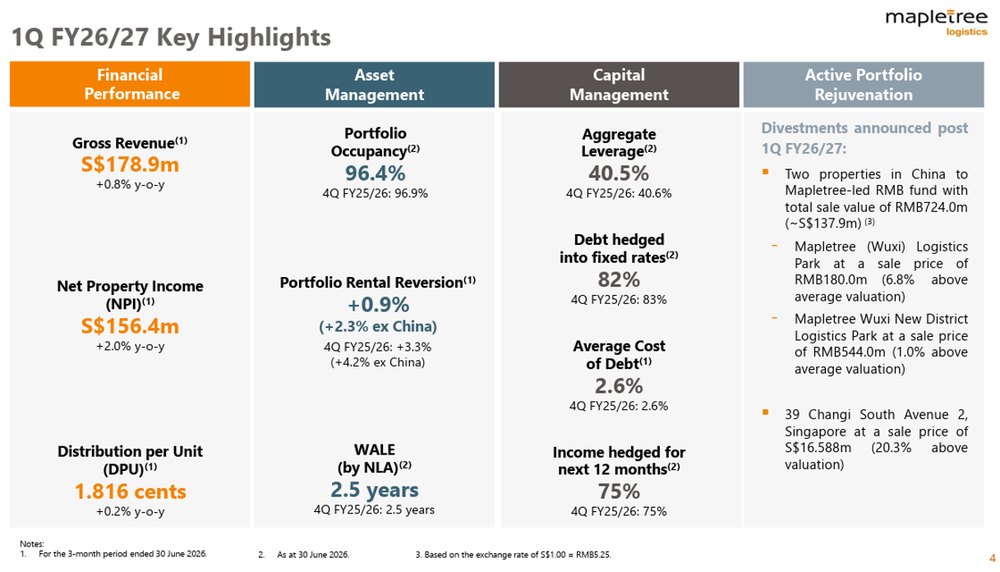
Mapletree Logistics Trust maintained a high portfolio occupancy of 96.4% as of 30 June 2026, although this was slightly lower than 96.9% in the previous quarter.
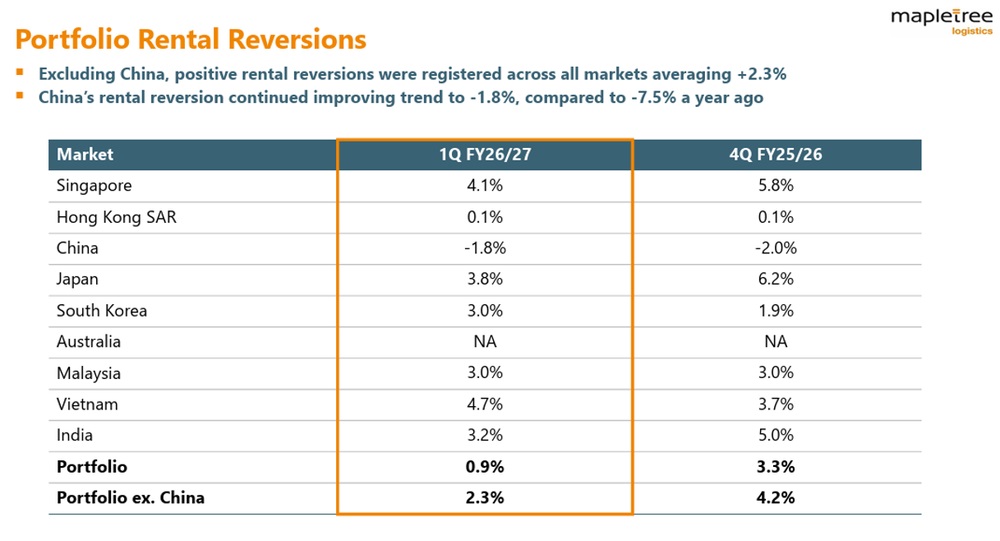
Portfolio rental reversion remained positive at 0.9%, improving to 2.3% excluding China.
However, both figures were lower than in the preceding quarter, highlighting that rental conditions in China remain a key area to watch.
While the latest DPU increase is encouraging, I would not consider Mapletree Logistics Trust to have passed the DPU growth check yet.
Under my Singapore REIT screening framework, I prefer to look at the latest full financial year rather than a single quarter when assessing whether distributions are stable or growing.
Mapletree Logistics Trust's FY25/26 DPU declined 9.8% to 7.262 cents, from 8.053 cents in FY24/25.
Excluding divestment gains distributed in the previous year, the decline would have been smaller at 3.4%.
The 0.2% year-on-year increase in the latest quarter is therefore a positive development, but I would want to see this sustained for longer before concluding that Mapletree Logistics Trust's distributions have stabilised.
I would not consider Mapletree Logistics Trust to pass the DPU growth check for now.
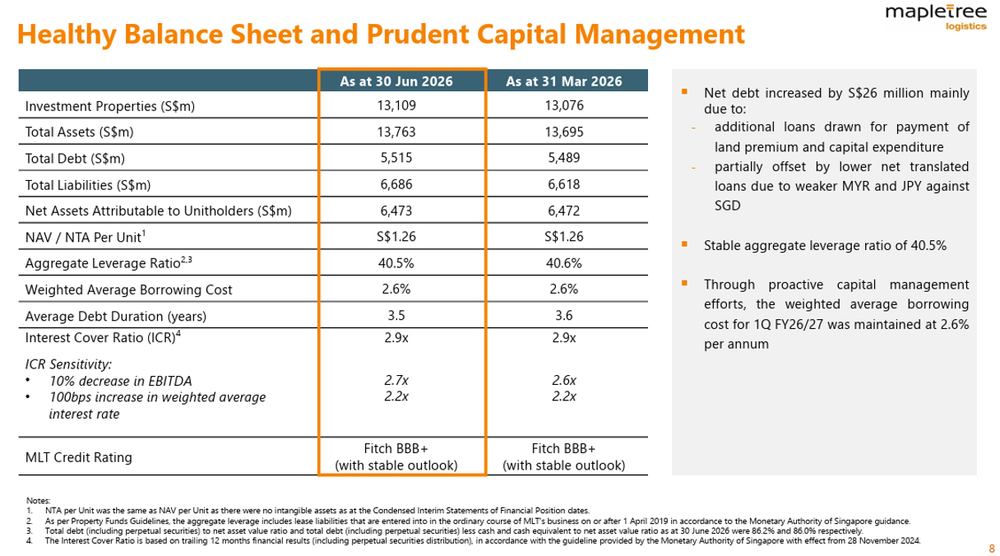
For the net gearing ratio check, aggregate leverage stood at 40.5% as of 30 June 2026, broadly unchanged from 40.6% at the end of March.
Its average cost of debt remained at 2.6%, while 82% of its debt was hedged or on fixed rates. Its interest coverage ratio stood at 2.9 times.
Mapletree Logistics Trust therefore passes the gearing ratio check, although its leverage remains above 40%, which is where I would carry out additional checks on its refinancing needs and interest coverage.
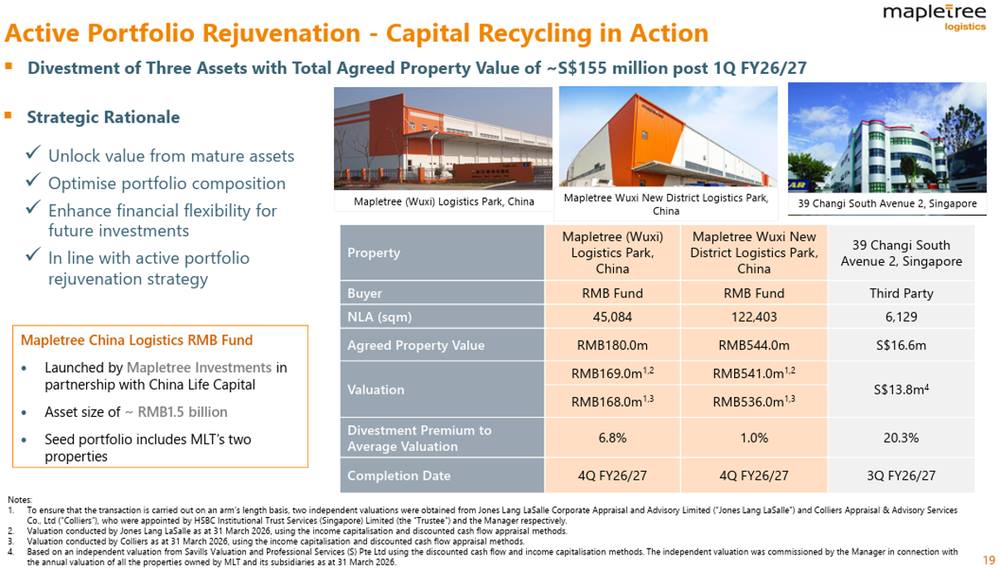
Mapletree Logistics Trust has also continued to recycle capital.
After the quarter ended, it announced the proposed divestment of two logistics properties in China for a total sale value of about S$137.9 million.
It also announced the sale of 39 Changi South Avenue 2 in Singapore for S$16.6 million, about 20.3% above its valuation.
These divestments may provide greater balance-sheet flexibility, although I would also watch whether the income lost from sold assets is replaced through acquisitions or other investments.
Mapletree Logistics Trust's annualised distribution yield stood at about 5.6%, based on its unit price of S$1.30 as of 17 August 2026.
This represents a spread of about 3.3 percentage points over the Singapore 10-year government bond yield of around 2.3% in mid-August 2026.
Mapletree Logistics Trust therefore passes the yield check.
It offers the highest annualised distribution yield of the three REITs, but it also has the weakest full-year DPU trend and the highest leverage.
This is why I would not assess a REIT based on yield alone.
The latest quarterly improvement is encouraging, but I would want to see more evidence that Mapletree Logistics Trust's DPU has stabilised, particularly as it continues to manage weakness in China and recycle assets across its portfolio.
As Mapletree Logistics Trust has previously announced, it has identified S$1 billion of properties for divestment, of which about half from China and Hong Kong. The process is ongoing and in July 2026, Mapletree Logistics Trust announced S$155m of divestments, including two China properties.
As the proceeds are reinvested into modern logistics assets with higher growth potential, we will monitor the positive impact on DPU growth.
Find out how much distributions you would have received as an Mapletree Logistics Trust unitholder in the past 12 months with the dividend calculator below.
Related links:
- Mapletree Logistics Trust (SGX: M44U) latest valuation, unit price and analysis
- Mapletree Logistics Trust (SGX: M44U) dividend history and forecast
What would Beansprout do?
The latest DPU increases from all three REITs are encouraging, but I would focus more on whether those distributions can be sustained and grown over time.
| REIT | DPU check | Net gearing ratio check | Distribution yield check |
| CapitaLand Integrated Commercial Trust (SGX: C38U) | Pass: FY2025 DPU rose 6.4%, with further growth in 1H 2026 | Pass: Aggregate leverage remains below 40% | Does not pass: Annualised yield of about 4.9% gives a spread of about 2.6 percentage points over the 10-year SGS yield |
| Keppel DC REIT (SGX: AJBU) | Pass: FY2025 DPU rose 9.8%, while 1H 2026 DPU increased 11.3% | Pass: Aggregate leverage of 34.0% | Does not pass: Annualised yield of about 4.9% gives a spread of about 2.6 percentage points |
| Mapletree Logistics Trust (SGX: M44U) | Does not pass: FY25/26 DPU fell 9.8%, despite the latest quarterly improvement | Pass with more checks: Aggregate leverage of 40.5% | Pass: Annualised yield of about 5.6% gives a spread of about 3.3 percentage points |
Based on these initial checks, Keppel DC REIT stands out most to me among the three for further research.
Keppel DC REIT’s DPU has grown in both FY2025 and 1H 2026, while its aggregate leverage of 34.0% provides the largest balance-sheet buffer among the three.
Its annualised distribution yield of about 4.9%, based on its unit price of S$2.32 as of 17 August 2026, falls slightly short of my yield-spread check. I would also watch whether portfolio occupancy improves and whether positive rental reversions can continue supporting DPU growth.
CapitaLand Integrated Commercial Trust also screens relatively well. Its DPU has continued to grow, while its balance sheet remains manageable despite its recent acquisitions. Paragon could provide another potential income driver over time.
However, CapitaLand Integrated Commercial Trust's annualised distribution yield of about 4.9%, based on its unit price of S$2.44 as of 17 August 2026, also offers a yield premium over Singapore government bonds that is below the level I generally look for.
Mapletree Logistics Trust offers the highest annualised distribution yield of the three at about 5.6%, based on its unit price of S$1.30 as of 17 August 2026. Its latest quarter also provides an early sign that DPU may be stabilising.
However, its FY25/26 DPU was still lower year on year, while aggregate leverage of 40.5% leaves less balance-sheet headroom. I would want to see a few more quarters of stable or growing DPU before carrying out a deeper review.
Overall, Keppel DC REIT and CapitaLand Integrated Commercial Trust screen better on DPU growth and balance-sheet strength, while Mapletree Logistics Trust offers the wider yield spread but still needs clearer evidence that its distributions have stabilised.
These three checks are the starting point I use when evaluating REITs that may warrant further research for generating passive income. You can learn more about how I use the three simple checks I use to screen Singapore REITs for passive income here.
For a REIT to form part of my Income Pot within the Beansprout's four pots of wealth, I would look beyond its headline yield and assess whether its occupancy, rental growth, balance sheet and DPU can remain resilient through different market conditions.
At Beansprout, we still see Singapore stocks as a core part of a globally diversified portfolio, especially for investors looking for dividend income.
However, rather than relying too heavily on REITs alone, I would build a broader mix of income sources, including quality Singapore blue-chip stocks with sustainable dividends, resilient earnings and strong balance sheets.
To find out which stocks we would hold in our model portfolio, check out how we would invest $100,000 in Singapore today.
If you are looking for greater clarity on the markets and the investment decisions that matter, explore Beansprout Pro for our latest views, portfolio thinking and the reasoning behind each opportunity.
To screen for Singapore REITs with lowest price-to-book valuation or highest dividend yield, check out our best Singapore REIT screener.
If you are new to the sector, you can also learn more about Singapore REITs here, or explore Singapore REIT ETFs if you prefer diversified exposure without selecting individual REITs.
Which Singapore blue chip REIT are you looking out for? Share with us in the comments below or in our Telegram group!
Planning to invest in Singapore blue chip REITs? Compare the best Singapore brokers to find the right trading platform, and see the latest promotions and sign-up rewards available.
Follow Beansprout on YouTube, Facebook and Instagram, and add Beansprout as your preferred source on Google so you never miss an update.
Read also
Gain financial insights in minutes
Subscribe to our free weekly newsletter for more insights to grow your wealth
Most Popular

Comments
0 comments