
3 Singapore blue chip stocks that raised their dividends in August 2026. Which looks attractive for income
Stocks
By Goh Lay Peng • 15 Aug 2026
Why trust Beansprout? We’ve been awarded Best Investment Website at the SIAS Investors’ Choice Awards 2025
'%3e%3cpath%20fill-rule='evenodd'%20clip-rule='evenodd'%20d='M17.64%209.20455C17.64%208.56637%2017.5827%207.95273%2017.4764%207.36364H9V10.845H13.8436C13.635%2011.97%2013.0009%2012.9232%2012.0477%2013.5614V15.8195H14.9564C16.6582%2014.2527%2017.64%2011.9455%2017.64%209.20455V9.20455Z'%20fill='%234285F4'/%3e%3cpath%20fill-rule='evenodd'%20clip-rule='evenodd'%20d='M9%2018C11.43%2018%2013.4673%2017.1941%2014.9564%2015.8195L12.0477%2013.5614C11.2418%2014.1014%2010.2109%2014.4205%209%2014.4205C6.65591%2014.4205%204.67182%2012.8373%203.96409%2010.71H0.957275V13.0418C2.43818%2015.9832%205.48182%2018%209%2018V18Z'%20fill='%2334A853'/%3e%3cpath%20fill-rule='evenodd'%20clip-rule='evenodd'%20d='M3.96409%2010.71C3.78409%2010.17%203.68182%209.59318%203.68182%209C3.68182%208.40682%203.78409%207.83%203.96409%207.29V4.95818H0.957273C0.347727%206.17318%200%207.54773%200%209C0%2010.4523%200.347727%2011.8268%200.957273%2013.0418L3.96409%2010.71V10.71Z'%20fill='%23FBBC05'/%3e%3cpath%20fill-rule='evenodd'%20clip-rule='evenodd'%20d='M9%203.57955C10.3214%203.57955%2011.5077%204.03364%2012.4405%204.92545L15.0218%202.34409C13.4632%200.891818%2011.4259%200%209%200C5.48182%200%202.43818%202.01682%200.957275%204.95818L3.96409%207.29C4.67182%205.16273%206.65591%203.57955%209%203.57955V3.57955Z'%20fill='%23EA4335'/%3e%3c/g%3e%3cdefs%3e%3cclipPath%20id='clip0_0_2849'%3e%3crect%20width='18'%20height='18'%20fill='white'/%3e%3c/clipPath%3e%3c/defs%3e%3c/svg%3e)
Make Beansprout your preferred source on Google
Add us on Google to see more of our insights in your search results
We look at 3 Singapore blue chip stocks that raised their dividends in August 2026. We compare their latest results and screen them for income investors.
What happened?
Singapore blue chip stocks have continued to draw interest.
The Singapore market had its strongest month of 2026 in July, led partly by gains in the banks.
Following the latest bank results, I saw DBS and OCBC hit new highs while UOB dipped.
More recently, I looked at three Singapore blue chip stocks paying dividends in August, and whether their payouts appear sustainable for income investors.
As more companies reported their latest earnings, I noticed some members of the Beansprout Community looking at which blue chip stocks were not just paying dividends, but raising their ordinary dividends as well.
In this article, I look at three Singapore blue chip stocks that raised their dividends in August 2026, and put each through Beansprout's initial Income Pot dividend stock screening checks to see which may warrant deeper research for income investors.
| Stock | Latest ordinary dividend announced | Total dividend announced | Increase in ordinary dividend | Indicative recurring dividend yield |
| SGX (S68) | 11.5 cents quarterly | 24.0 cents | +1.0 cent year on year | ~1.8% |
| Venture (V03) | 30 cents interim | 30 cents | 20% | ~4.7% |
| OCBC (O39) | 47 cents interim | 47 cents | 15% | ~3.0% |
| *Data as of 12 August 2026. SGX's indicative recurring dividend yield is based on forecast ordinary dividends of S$0.45 per share and excludes the 12.5-cent one-off additional dividend. Venture's yield is based on S$0.80 per share of dividends. OCBC's yield is based on annualising its latest 47-cent ordinary interim dividend to S$0.94 per share. | ||||
#1 – OCBC (SGX: O39)
OCBC is Singapore's second-largest bank by assets, with businesses spanning consumer banking, wholesale banking, wealth management and insurance through Great Eastern.
OCBC delivered record earnings in its latest results.
Net profit rose 22% year on year to S$2.22 billion in 2Q2026, crossing S$2 billion in quarterly profit for the first time.
For 1H2026, net profit increased 13% to a record S$4.19 billion.
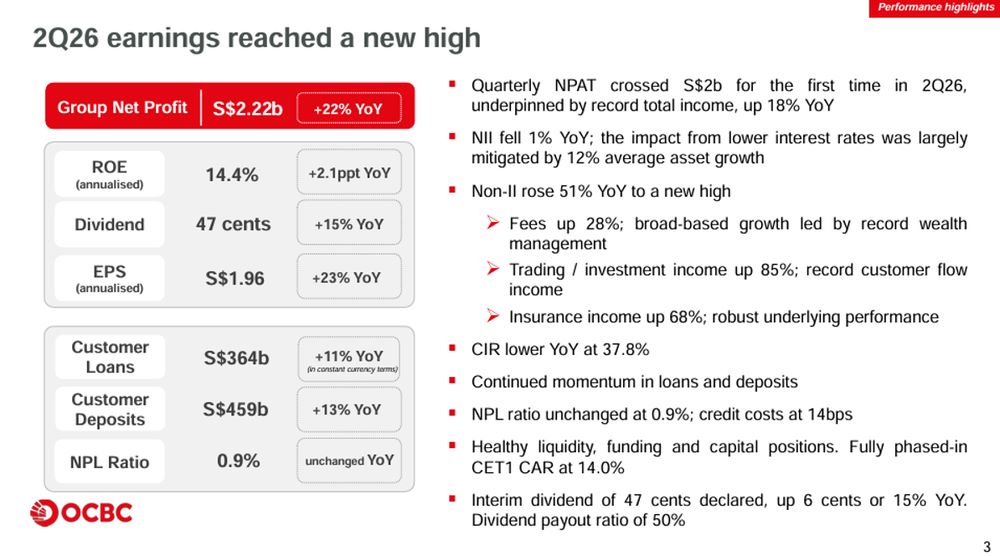
The improvement came even as lower interest rates continued to weigh on interest margins.
Net interest income declined as net interest margin fell, but this was more than offset by growth in other income sources.
Non-interest income rose strongly, supported by higher fees, trading income, insurance income and wealth management activity.
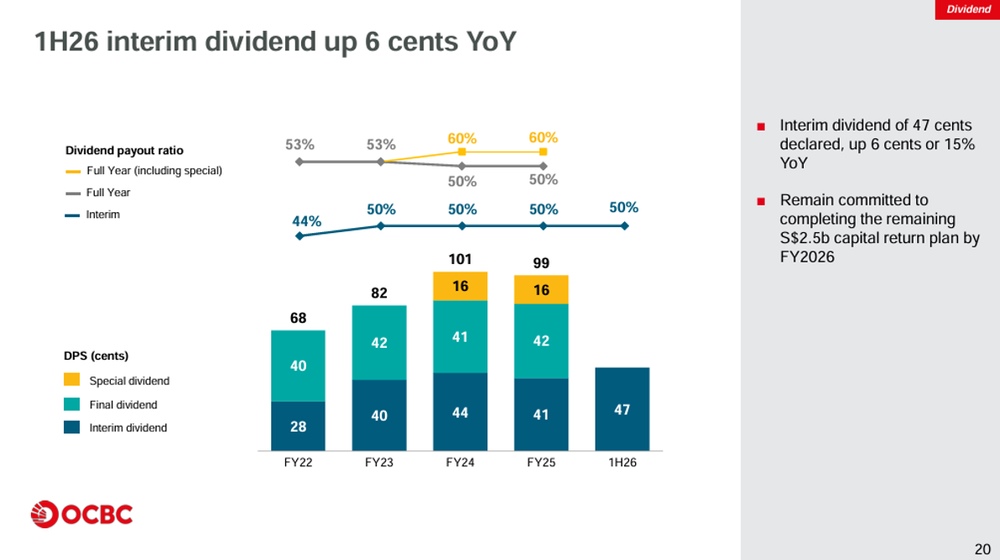
With earnings rising, OCBC increased its interim ordinary dividend to 47 cents per share, up 15% from 41 cents a year earlier.
The dividend represents about 50% of 1H2026 net profit.
OCBC has also reiterated its commitment to completing its previously announced S$2.5 billion capital return by FY2026.
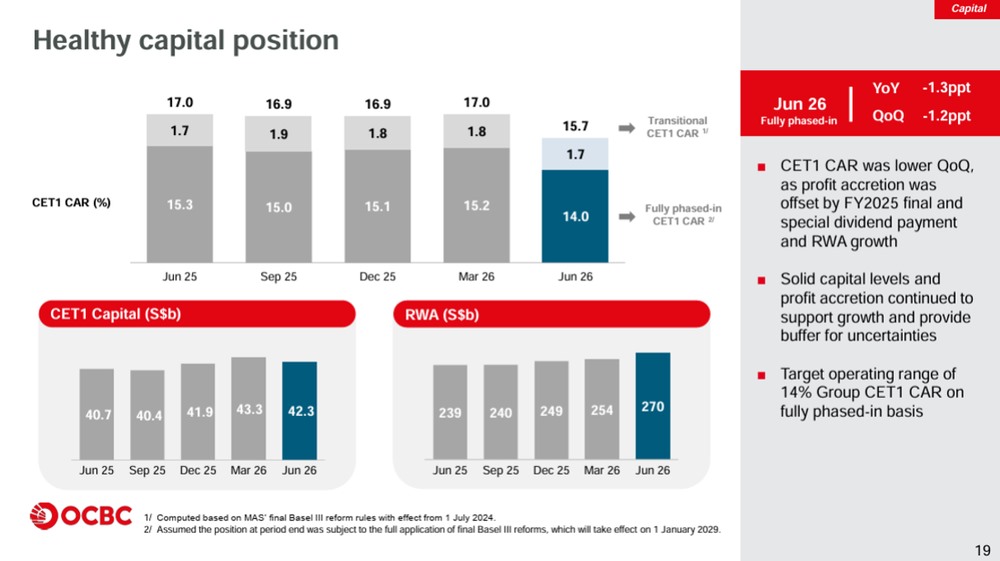
For banks, I would assess financial strength differently from an industrial company.
OCBC's non-performing loan ratio remained low at 0.9%, while its capital position remained healthy.
This provides some buffer for the bank to continue paying dividends while supporting balance-sheet growth and its capital return programme.
OCBC passes four of Beansprout's five initial Income Pot checks.
| Beansprout check | OCBC |
| Earnings growth | Pass |
| Capital adequacy ratio | Pass |
| Dividend payout | Pass |
| Cash and capital generation | Pass |
| Dividend yield | Does not pass |
| Overall | Passes 4 of 5 checks |
OCBC's earnings have grown meaningfully over the past three years, while its latest CET1 capital ratio and non-performing loan ratio indicate that the bank remains financially healthy.
Its 50% ordinary dividend payout ratio is also covered by earnings and provides more flexibility than a company paying out most of its profits.
The main consideration is again the dividend yield after the sharp rise in OCBC's share price.
Annualising its latest ordinary interim dividend of 47 cents would imply dividends of 94 cents per share.
Based on OCBC's share price of S$31.02 on 12 August 2026, this translates to an indicated ordinary dividend yield of around 3.0%, below our 3.5% initial screening threshold and its historical average dividend yield of about 4.7%.
I would also separate OCBC's ordinary dividend from its special capital return when assessing recurring income, as these additional distributions should not automatically be assumed to continue indefinitely.
Find out how much dividend income you would have received as an OCBC shareholder over the past 12 months using the dividend calculator below.
Related links:
- OCBC latest valuation, share price and analysis
- OCBC dividend history and forecast
- OCBC reports 22% rise in net profit and higher interim dividend
- DBS and OCBC hit new highs while UOB dipped after 2Q 2026 results
#2 – Singapore Exchange (SGX: S68)
Singapore Exchange, or SGX, operates Singapore's securities and derivatives markets, with businesses spanning equities, fixed income, currencies, commodities, indices and data.
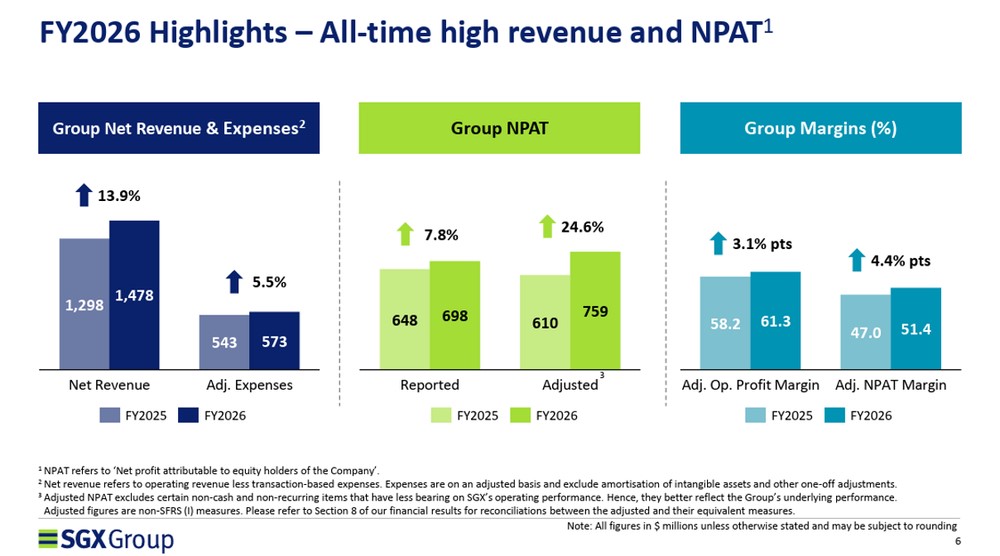
SGX reported record results for FY2026, with net revenue rising 13.9% year on year to S$1.48 billion.
Adjusted net profit increased 24.6% to a record S$759.5 million, while adjusted earnings per share rose to 71.0 cents from 57.0 cents a year earlier.
Growth was also broad-based.
Net revenue from its Equities Cash business increased 28.1%, while Fixed Income, Currencies and Commodities net revenue rose 17.0%.
Securities daily average value increased 34.9% to S$1.8 billion, while SGX FX average daily volume grew 33.1%.
The stronger earnings allowed SGX to continue raising its ordinary dividend.
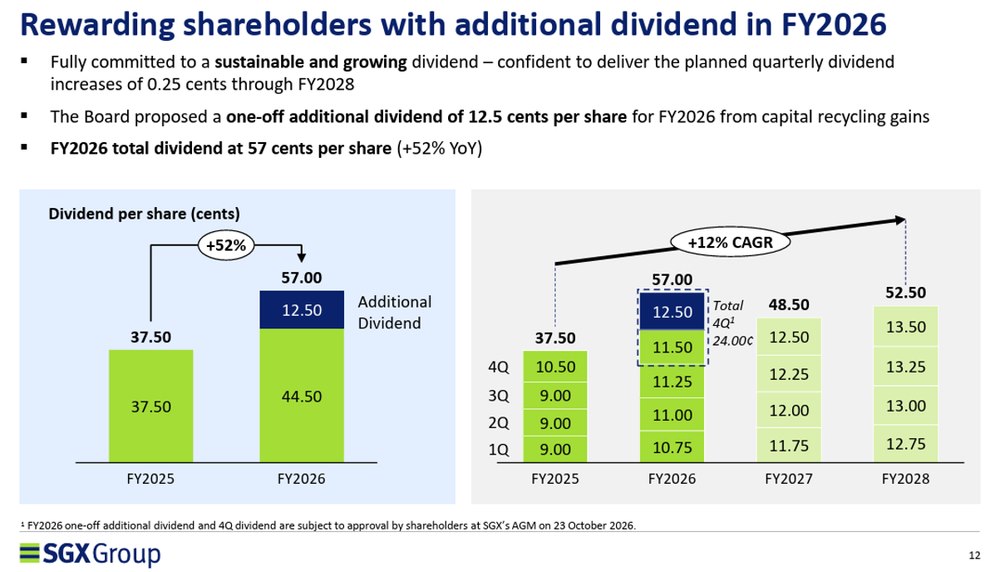
SGX proposed a final quarterly dividend of 11.5 cents per share, compared with 10.5 cents in the corresponding quarter last year.
It also proposed an additional one-off dividend of 12.5 cents per share, bringing total FY2026 dividends to 57.0 cents per share.
However, I would separate the additional dividend from SGX's recurring income.
The 12.5-cent payout was enabled by gains from capital recycling, while SGX's ordinary dividends amounted to 44.5 cents per share for FY2026.
SGX has also reiterated its plan to increase its quarterly dividend by 0.25 cent each quarter through FY2028, barring unforeseen circumstances.
I next put SGX through Beansprout's five initial Income Pot checks for dividend stocks, which look at earnings growth, net gearing, dividend payout, free operating cash flow and dividend yield.
| Beansprout check | SGX |
| Earnings growth | Pass |
| Net gearing | Pass |
| Dividend payout | Pass |
| Free operating cash flow | Pass |
| Dividend yield | Does not pass |
| Overall | Passes 4 of 5 checks |
SGX passes four of Beansprout's five initial checks.
Its earnings have grown meaningfully over the past three years, while its net cash position and strong operating cash flow provide support for its recurring dividend.
Its ordinary FY2026 dividends of 44.5 cents also represent about 68% of reported earnings per share, suggesting that the payout remains covered by earnings.
The main consideration for income investors is the yield.
Based on SGX's share price of about S$25.23 on 12 August 2026, its recurring dividend yield is around 1.8%, below our initial screening threshold and its historical average dividend yield of about 3.3%.
I would therefore not include the 12.5-cent one-off dividend when assessing SGX's recurring income potential.
Find out how much dividend income you would have received as an SGX shareholder over the past 12 months using the dividend calculator below.
Related links:
#3 – Venture Corporation (SGX: V03)
Venture Corporation provides technology services, products and manufacturing solutions across areas including life sciences, test and measurement, networking and communications, and semiconductor-related equipment.
There were signs of an earnings recovery in Venture's latest results.
Revenue rose 7.4% year on year to S$1.35 billion in 1H2026, while net profit increased 5.6% to S$119.3 million.
Momentum strengthened in the second quarter, with revenue increasing 12.5% and net profit rising 10.3% year on year.
Growth was supported by the Test & Measurement Instrumentation, Networking & Communications and Semiconductor Related Equipment domains, including end-markets supporting artificial intelligence-related infrastructure, as well as Life Science.
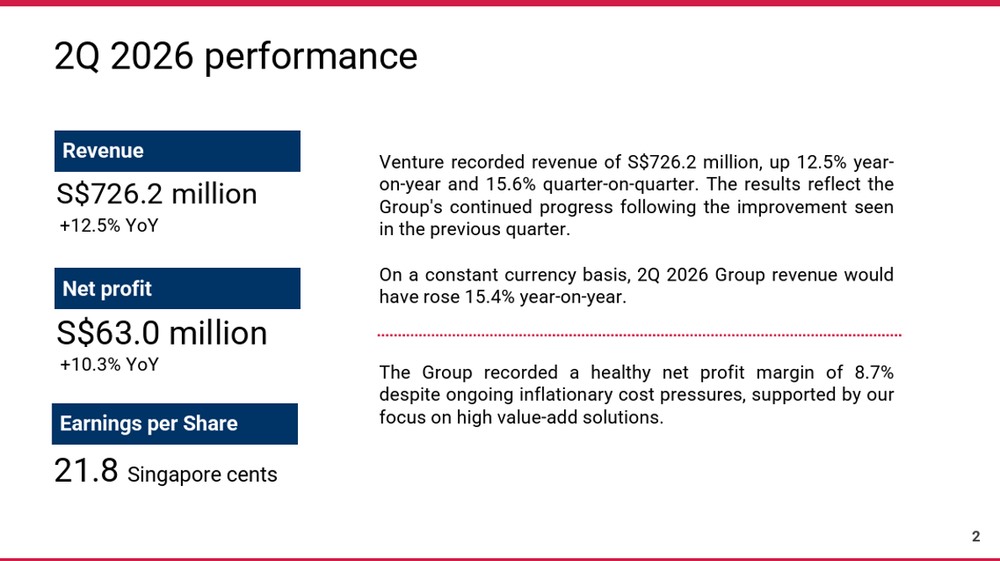
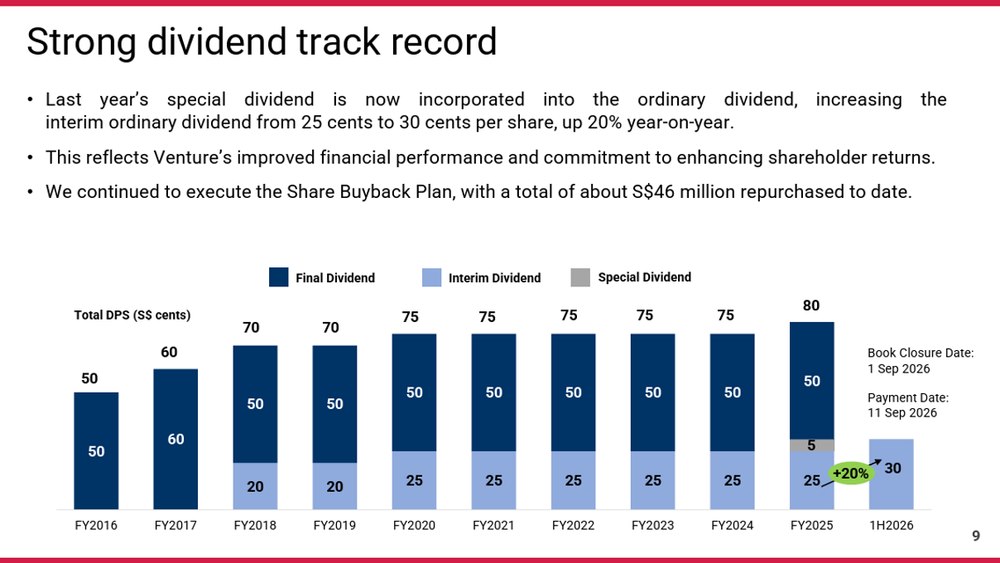
Venture declared an ordinary interim dividend of 30 cents per share, up from its ordinary interim dividend of 25 cents last year. This represents a 20% increase.
However, there is an important distinction when comparing the total cash payout.
Venture paid a 5-cent special dividend on top of its 25-cent ordinary interim dividend in 1H2025, which means its total interim payout was also 30 cents last year.
While shareholders are receiving the same total amount, a larger portion of the payout is now classified as an ordinary dividend.
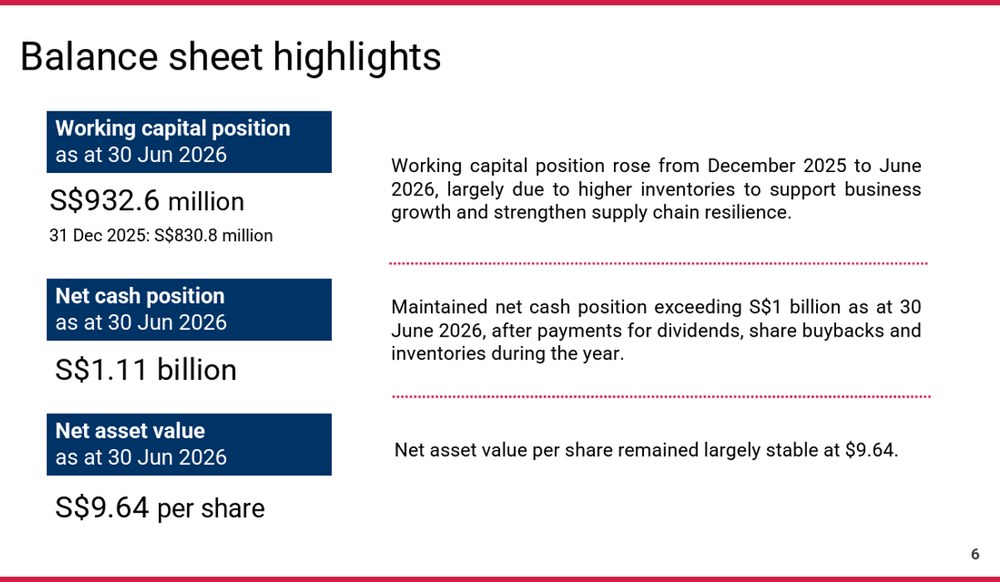
Venture's balance sheet also remains strong, with zero debt and net cash of S$1.11 billion as of 30 June 2026.
However, free operating cash flow weakened in the first half, with net cash generated from operating activities falling to S$12.9 million as inventories were built up to support anticipated business growth and strengthen supply-chain resilience.
Against Beansprout's Income Pot dividend stock checks, Venture presents a more mixed picture.
| Beansprout check | Venture |
| Earnings growth | Does not pass |
| Net gearing | Pass |
| Dividend payout | Does not pass |
| Free operating cash flow | Pass, but watch |
| Dividend yield | Pass |
| Overall | Passes 3 of 5 checks |
Venture passes three of the five initial checks.
Its strongest points are its debt-free balance sheet and dividend yield.
At a share price of S$16.96 on 12 August 2026, Venture offers a dividend yield of about 4.7%, above our screening threshold, although this is slightly below its historical average yield of around 5.0%.
However, earnings remain below where they were three years ago.
The dividend payout is also relatively high, with Venture's FY2025 dividend of 80 cents representing about 102% of earnings. Even excluding the 5-cent special dividend, its ordinary payout was still around 95% of earnings.
I would not fail Venture on free operating cash flow based solely on its weaker 1H2026 cash flow, as the company generated healthy free cash flow in the previous two financial years.
Instead, I would watch whether its recent inventory build translates into stronger revenue, earnings and operating cash flow over the coming quarters.
Find out how much dividend income you would have received as a Venture shareholder over the past 12 months using the dividend calculator below.
Related links:
What would Beansprout do?
OCBC, SGX, and Venture have each raised their ordinary dividends following their latest results, but their income profiles remain quite different.
When evaluating these stocks for my Income Pot as part of Beansprout's four pots of wealth, I would not just look at which stock offers the highest dividend yield or raised its dividend by the most.
I would also consider what is supporting the higher payout, whether earnings are growing, whether the company has sufficient financial strength and free operating cash flow to sustain its dividends, and whether the yield remains attractive at the current share price.
Based on Beansprout's initial screening checks, SGX and OCBC fare better on dividend sustainability, with both passing four of the five checks, while Venture passes three.
| Metric compared | OCBC | SGX | Venture |
| Earnings growth | Pass | Pass | Does not pass |
| Net gearing / Capital adequacy | Pass | Pass | Pass |
| Dividend payout | Pass | Pass | Does not pass |
| Free operating cash flow | Pass | Pass | Pass, but watch |
| Dividend yield | Does not pass | Does not pass | Pass |
| Overall | 4/5 | 4/5 | 3/5 |
| Indicative ordinary dividend yield | ~3.0% | ~1.8% | ~4.7% |
Based on these initial checks, SGX and OCBC fare better on dividend sustainability, with both passing four of the five Income Pot checks.
SGX has delivered the strongest earnings growth of the three, while its healthy balance sheet and free operating cash flow to support its rising ordinary dividend.
However, its share price has also risen significantly, leaving its recurring dividend yield at around 1.8%. I would therefore see SGX more as a dividend growth stock than a high-yield Income Pot opportunity at its current price.
OCBC also passes four of the five checks. Its higher dividend is supported by record first-half earnings, a healthy capital position and a payout ratio of about 50%.
However, with its indicated ordinary dividend yield at around 3.0%, I would want to weigh its dividend growth potential against the higher valuation following the recent rally.
Venture offers the highest dividend yield among the three at around 4.7%, while its debt-free balance sheet and large net cash position provide a useful buffer.
However, earnings remain below where they were three years ago and its payout ratio remains high. I would like to see the recent earnings recovery continue, and for the inventory build to translate into stronger cash generation, before carrying out a deeper review.
Overall, OCBC and SGX screen better than Venture based on my initial Income Pot selection criteria, while Venture would need to show more sustained earnings and cash flow improvement.
However, passing these initial checks does not mean I would automatically add SGX or OCBC to the Income Pot. I would carry out a deeper assessment of their business outlook, dividend sustainability and valuation before making that decision.
You can learn more about the five checks I use to screen dividend stocks for the Income Pot here.
To find out which blue chip stocks we would hold, in our model portfolio, check out how we would invest $100,000 in Singapore today.
If you are looking for greater clarity on the markets and the investment decisions that matter, explore Beansprout Pro for our latest views, portfolio thinking and the reasoning behind each opportunity.
Overall, these blue chips support our view that Singapore stocks are still worth looking at in 2026.
Earlier, we shared that we would consider looking beyond Singapore REITs to Singapore blue chip stocks for more diversified dividend income, especially when the dividends are supported by earnings growth, strong balance sheets and sustainable payout ratios.
By combining different sources of dividends, investors may be able to build a more resilient income portfolio over time. Learn how to build a more dependable stream of income that can hold up across cycles here.
Find out other Singapore stocks, REITs and ETFs with upcoming dividend payments here.
If you’d like to screen for other Singapore stocks with attractive dividend yields and potential upside, you can explore our Singapore high dividend stocks screener.
Which of these blue chips are you watching for your income pot? Share your thoughts in the comments below or join the discussion in our Telegram group!
Planning to invest in Singapore stocks? Compare the best Singapore brokers to find the right trading platform, and see the latest promotions and sign-up rewards available.
Follow Beansprout on YouTube, Facebook and Instagram, and add Beansprout as your preferred source on Google so you never miss an update.
Read also
Gain financial insights in minutes
Subscribe to our free weekly newsletter for more insights to grow your wealth
Most Popular

Comments
0 comments