
3 Singapore blue chip stocks paying out dividends in August 2026. Where yields look attractive
Stocks
By Goh Lay Peng • 07 Aug 2026
Why trust Beansprout? We’ve been awarded Best Investment Website at the SIAS Investors’ Choice Awards 2025
'%3e%3cpath%20fill-rule='evenodd'%20clip-rule='evenodd'%20d='M17.64%209.20455C17.64%208.56637%2017.5827%207.95273%2017.4764%207.36364H9V10.845H13.8436C13.635%2011.97%2013.0009%2012.9232%2012.0477%2013.5614V15.8195H14.9564C16.6582%2014.2527%2017.64%2011.9455%2017.64%209.20455V9.20455Z'%20fill='%234285F4'/%3e%3cpath%20fill-rule='evenodd'%20clip-rule='evenodd'%20d='M9%2018C11.43%2018%2013.4673%2017.1941%2014.9564%2015.8195L12.0477%2013.5614C11.2418%2014.1014%2010.2109%2014.4205%209%2014.4205C6.65591%2014.4205%204.67182%2012.8373%203.96409%2010.71H0.957275V13.0418C2.43818%2015.9832%205.48182%2018%209%2018V18Z'%20fill='%2334A853'/%3e%3cpath%20fill-rule='evenodd'%20clip-rule='evenodd'%20d='M3.96409%2010.71C3.78409%2010.17%203.68182%209.59318%203.68182%209C3.68182%208.40682%203.78409%207.83%203.96409%207.29V4.95818H0.957273C0.347727%206.17318%200%207.54773%200%209C0%2010.4523%200.347727%2011.8268%200.957273%2013.0418L3.96409%2010.71V10.71Z'%20fill='%23FBBC05'/%3e%3cpath%20fill-rule='evenodd'%20clip-rule='evenodd'%20d='M9%203.57955C10.3214%203.57955%2011.5077%204.03364%2012.4405%204.92545L15.0218%202.34409C13.4632%200.891818%2011.4259%200%209%200C5.48182%200%202.43818%202.01682%200.957275%204.95818L3.96409%207.29C4.67182%205.16273%206.65591%203.57955%209%203.57955V3.57955Z'%20fill='%23EA4335'/%3e%3c/g%3e%3cdefs%3e%3cclipPath%20id='clip0_0_2849'%3e%3crect%20width='18'%20height='18'%20fill='white'/%3e%3c/clipPath%3e%3c/defs%3e%3c/svg%3e)
Make Beansprout your preferred source on Google
Add us on Google to see more of our insights in your search results
We look at 3 Singapore blue chip stocks paying out dividends in August 2026, and whether their payouts appear sustainable for income investors.

What happened?
Several Singapore blue chip stocks have announced their latest results and dividend payouts.
Earlier, we examined whether SIA can maintain its 4.8% dividend yield following its latest results.
Recently, we also looked at the latest results from DBS, UOB and OCBC.
At the same time, many blue chips have rallied strongly, as seen among the 3 best-performing Singapore blue chip stocks which outperformed the STI last month.
I have seen discussion in the Beansprout community about which blue chips have upcoming dividends and whether their dividend yields can be sustained.
With valuations having risen for several blue chips, I look at three Singapore blue chip stocks paying dividends in August 2026, their latest results, and whether their dividends remain attractive for income investors.
| Stock | Latest announced dividend | Ex-dividend date | Payment date | Dividend yield |
| DBS | S$0.81 per share | 14-Aug-26 | 25-Aug-26 | 4.3%* |
| Sheng Siong | S$0.0375 per share | 13-Aug-26 | 28-Aug-26 | 2.50% |
| UOB | S$0.88 per share | 17-Aug-26 | 28-Aug-26 | 4.0%* |
| *Based on latest annualised dividend payout | ||||
#1 – DBS Group Holdings (SGX: D05)
DBS is Singapore’s largest bank by total assets, with operations spanning consumer banking, wealth management, corporate banking and financial markets.
DBS reported a net profit of S$3.08 billion for the second quarter of 2026, an increase of 9% compared with the previous year.
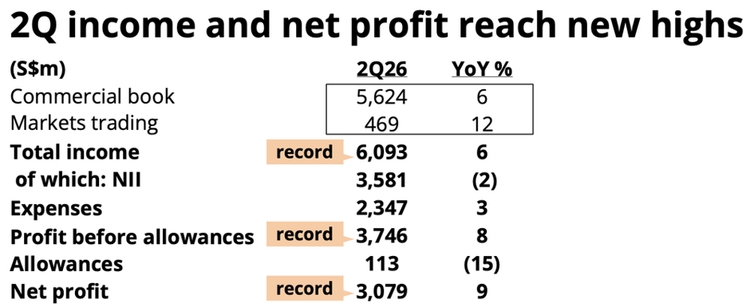
For the first half of 2026, net profit rose 5% year on year to S$6.01 billion, while return on equity remained healthy at 17.5%.
The stronger results came despite pressure from falling interest rates.
DBS’s net interest income declined by 2% year on year to S$3.58 billion in the second quarter, as its net interest margin fell by 18 basis points to 1.87%.
However, this was offset by growth in other parts of the business.
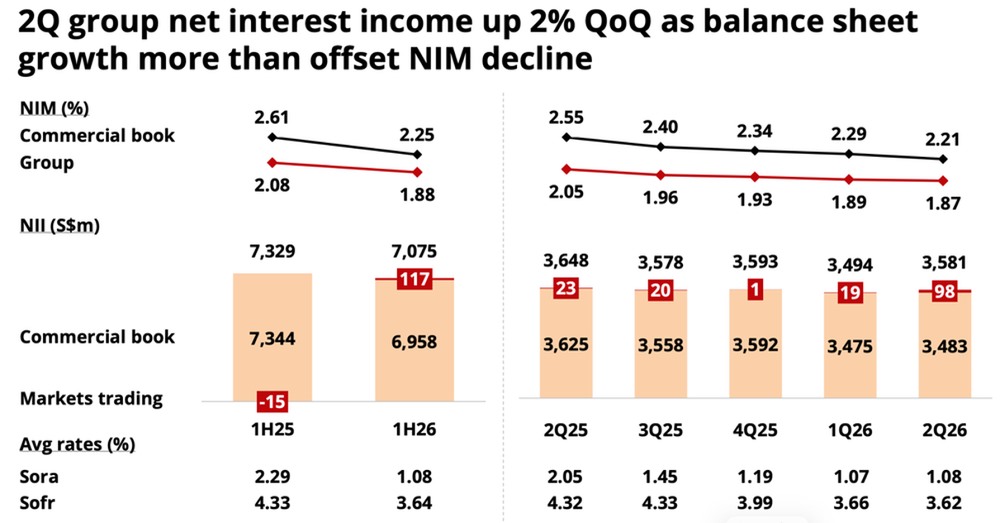
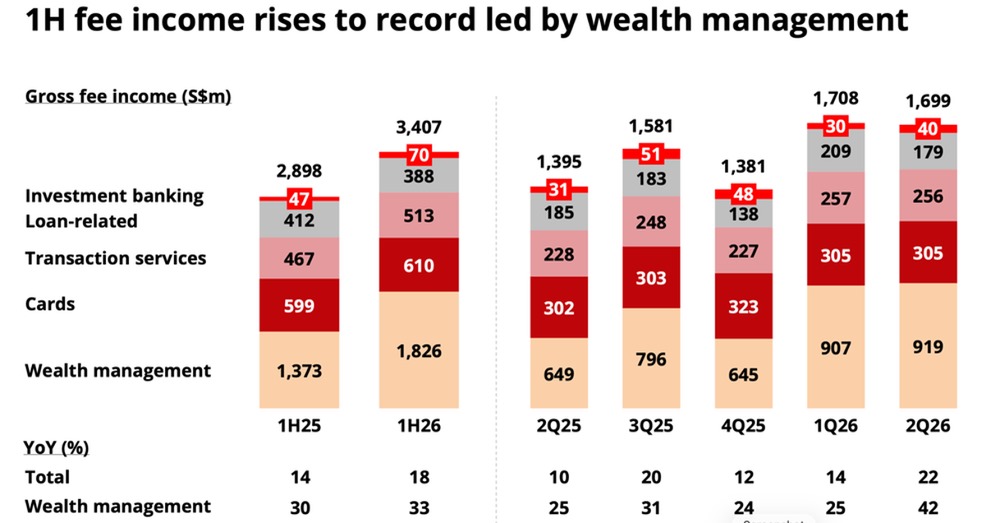
Net fee income rose 25% to S$1.46 billion, supported by a 42% increase in wealth management fees to a record S$919 million.
Loans grew 8% year on year to S$469 billion, while deposits increased by 11% to S$638 billion.
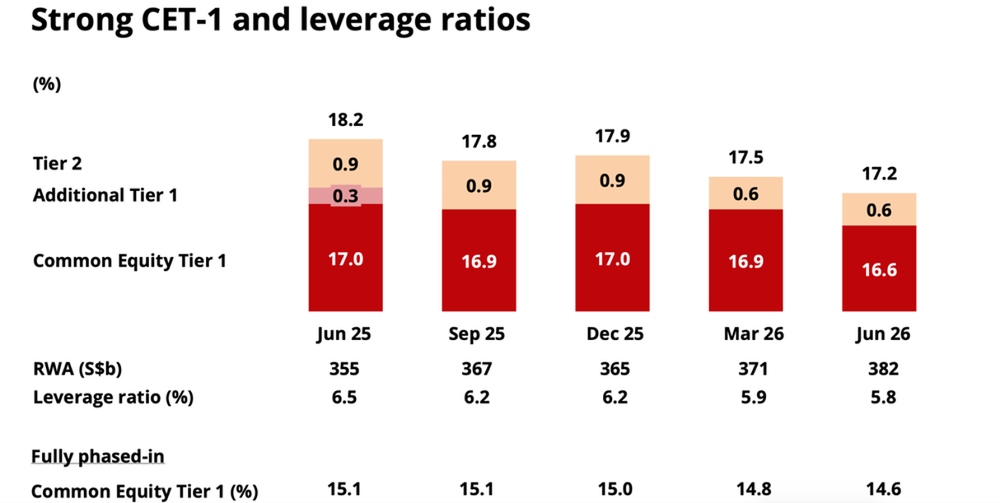
DBS’s non-performing loan ratio remained at 1.0%, while its transitional Common Equity Tier 1, or CET1, capital ratio stood at 16.6%.
This indicates that the bank remains well capitalised, with healthy asset quality despite continued uncertainty in the economic outlook.
DBS declared an ordinary quarterly dividend of S$0.66 per share and a capital return dividend of S$0.15 per share.
This brings its total payout to S$0.81 per share.
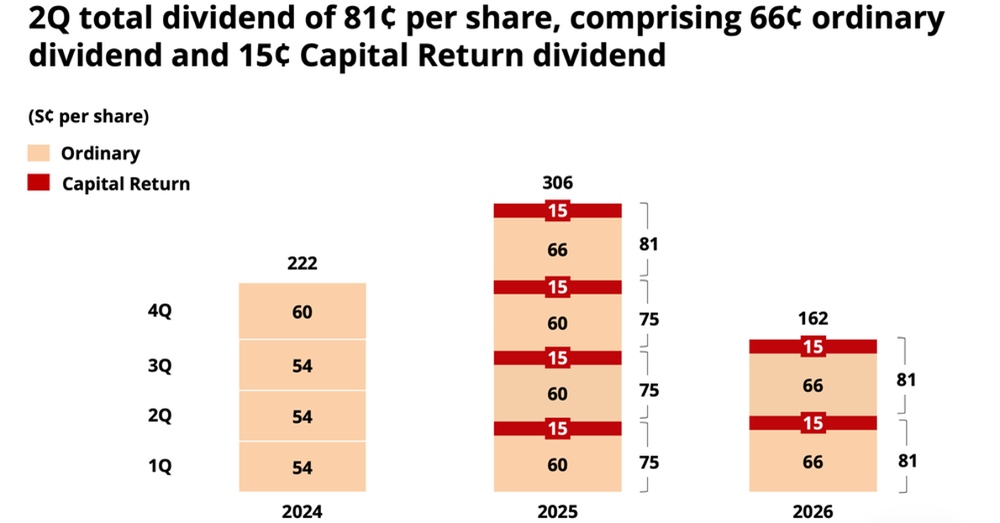
The shares will go ex-dividend on 14 August 2026, with the dividend expected to be paid on 25 August 2026.
Based on DBS’s share price of S$75.08 on 6 August 2026, annualising the total quarterly payout of S$0.81 would translate to a forward dividend yield of about 4.3%.
| Beansprout check | DBS |
| Earnings growth | Pass |
| Financial health | Pass |
| Dividend payout | Pass |
| Cash and capital generation | Pass |
| Dividend yield | Pass |
| Overall | Passes 5 of 5 checks |
DBS passes all five of Beansprout’s initial checks for dividend stocks, which look at earnings growth, financial health, dividend payout, cash or capital generation, and dividend yield.
Its earnings have grown over the past three years, while its CET1 capital ratio and non-performing loan ratio indicate that the bank remains financially healthy.
Its ordinary dividend payout ratio is also covered by earnings, while the total indicated yield of 4.3%, based on its share price on 6 August 2026, remains attractive.
Find out how much dividend income you would have received as a DBS shareholder over the past 12 months using the calculator below.
Related links:
- DBS latest valuation, share price and analysis
- DBS dividend history and forecast
- DBS profit rises 9% and declares S$0.81 in total dividends in 2Q26
#2 – Sheng Siong Group (SGX: OV8)
Sheng Siong operates one of Singapore’s largest supermarket chains, with a focus on stores located close to residential areas.
Sheng Siong reported revenue of S$855.4 million for the first half of 2026, an increase of 11.9% compared with the previous year.
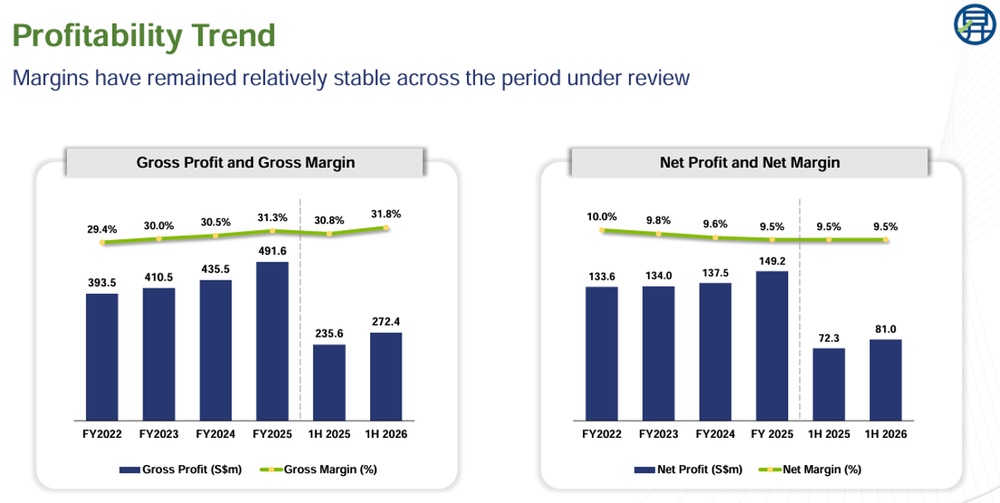
Net profit grew by the same rate to S$81.0 million, while earnings per share rose to S$0.0538 from S$0.0481 in the previous year.
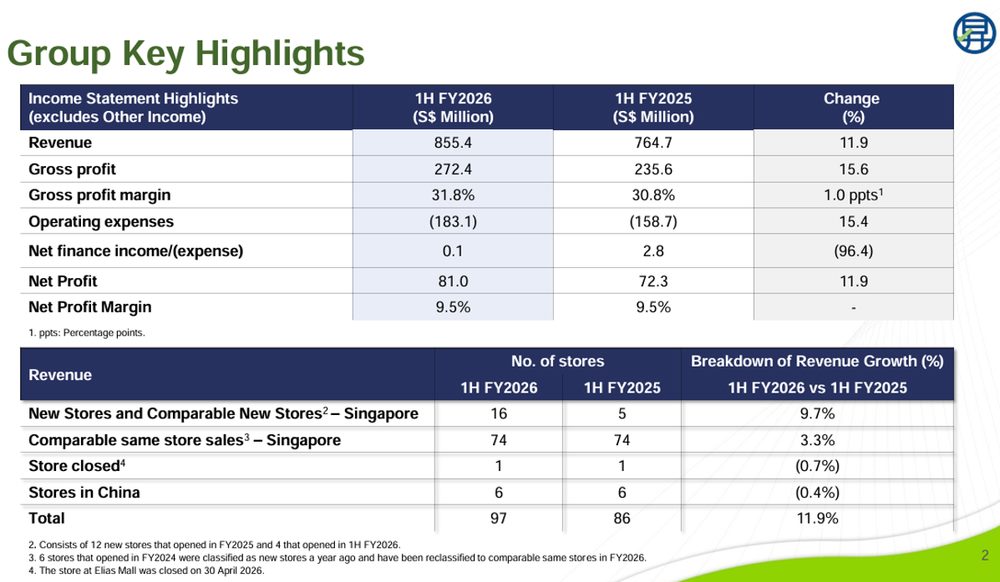
The improvement was supported by contributions from stores opened in 2025 and the first half of 2026, as well as higher same-store sales.
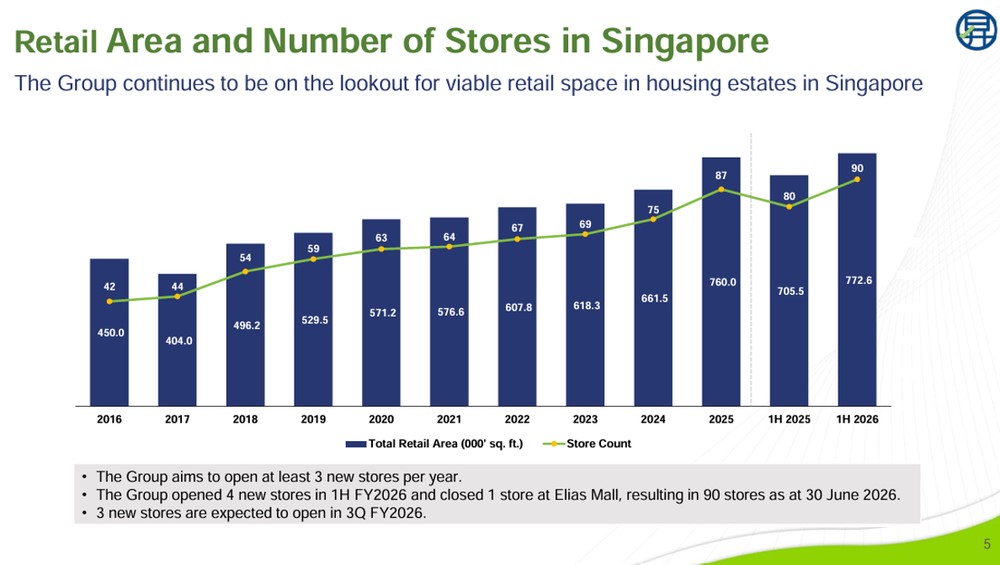
Sheng Siong opened four stores in the first half, while one store at Elias Mall was closed. Another three stores were expected to open during the third quarter.
The group also started a partnership with Foodpanda in June to expand the reach of its online grocery business.
Sheng Siong’s gross profit margin improved to 31.8%, from 30.8% in the previous year.
However, the company continues to face higher staff, transport and electricity costs, as well as competition from other supermarket operators and cross-border grocery spending.
Its balance sheet remained healthy, with cash and cash equivalents of S$402.3 million as of 30 June 2026.
Sheng Siong declared an interim dividend of S$0.0375 per share, up from S$0.032 per share in the previous year. This represents an increase of about 17%.
The dividend will go ex-dividend on 13 August 2026 and be paid on 28 August 2026.
Based on Sheng Siong’s share price of S$3.24 on 6 August 2026, and the trailing twelve month DPS of S$0.0755 will imply a trailing twelve month dividend yield of just 2.3%.
| Beansprout check | Sheng Siong |
| Earnings growth | Pass |
| Financial health | Pass |
| Dividend payout | Pass |
| Free cash flow | Pass, with a caveat |
| Dividend yield | Does not pass |
| Overall | Passes 4 of 5 checks |
Sheng Siong passes four of Beansprout’s five initial checks for dividend stocks, covering earnings growth, financial health, dividend payout, free cash flow and dividend yield.
Its earnings have grown over the past three years, it remains in a net cash position and its dividend payout is supported by profits.
Free cash flow was positive in the first half of 2026, although it was below the dividends paid during the period due partly to the timing of supplier payments.
The main area where Sheng Siong does not pass is its dividend yield.
Sheng Siong’s trailing twelve month dividend yield of about 2.3%, based on its share price of S$3.24 on 6 August 2026, is less attractive for investors primarily seeking income.
I would therefore view Sheng Siong more as a defensive growth stock than a high-yield opportunity at its current price.
Find out how much dividend income you would have received as a Sheng Siong shareholder over the past 12 months using the calculator below.
Related links:
#3 – UOB (SGX: U11)
UOB is Singapore’s third-largest bank by total assets, with a regional presence across Southeast Asia and Greater China.
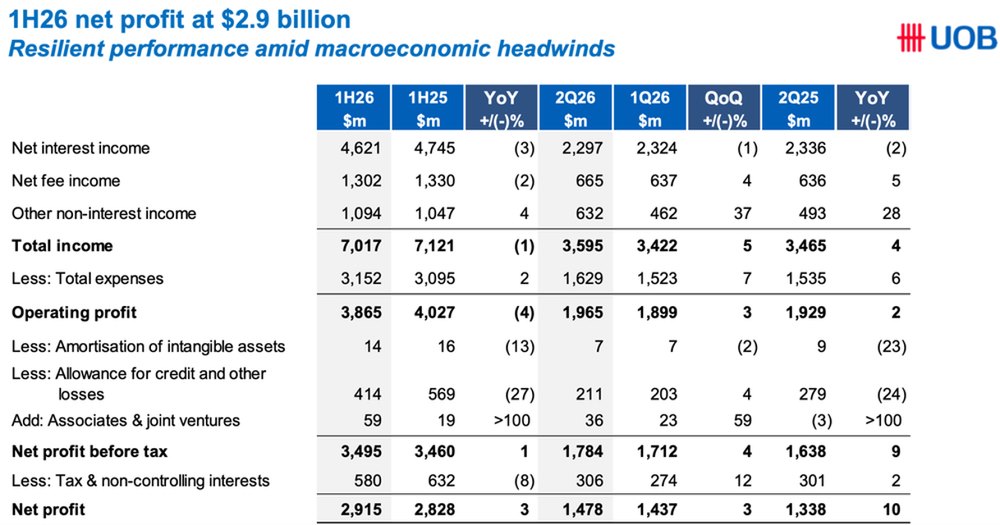
UOB reported a net profit of S$1.48 billion for the second quarter of 2026, an increase of 10% compared with the previous year.
For the first half of 2026, net profit rose 3% year on year to S$2.92 billion.
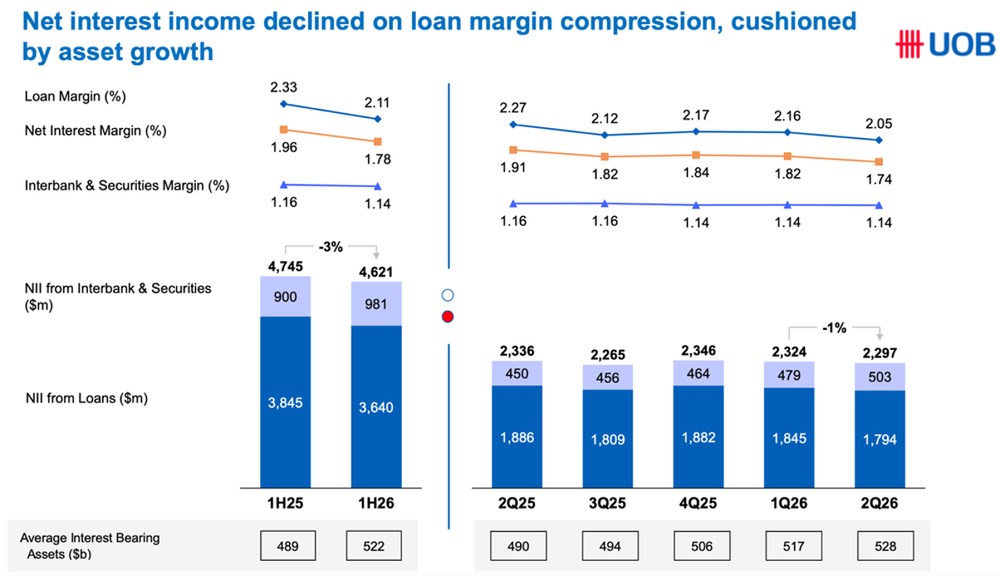
The bank continued to face pressure from lower interest rates.
Net interest income fell 2% year on year in the second quarter, while net interest margin declined to 1.74%.
This was partly offset by stronger fee income.
Net fee income rose 5% year on year, supported by record wealth management fees, while high-net-worth assets under management reached S$204 billion.
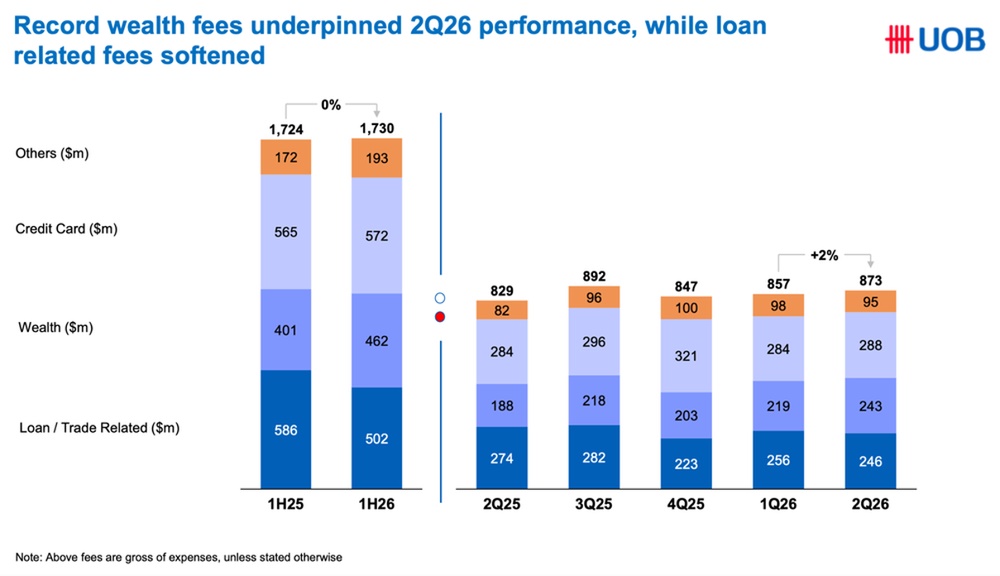
However, loan-related and investment banking fees remained softer amid the more cautious market environment.
Other non-interest income rose by 37% from the preceding quarter to S$632 million, partly due to non-recurring gains from asset divestments.
This means that some of UOB’s latest profit growth may not be repeated in future quarters.
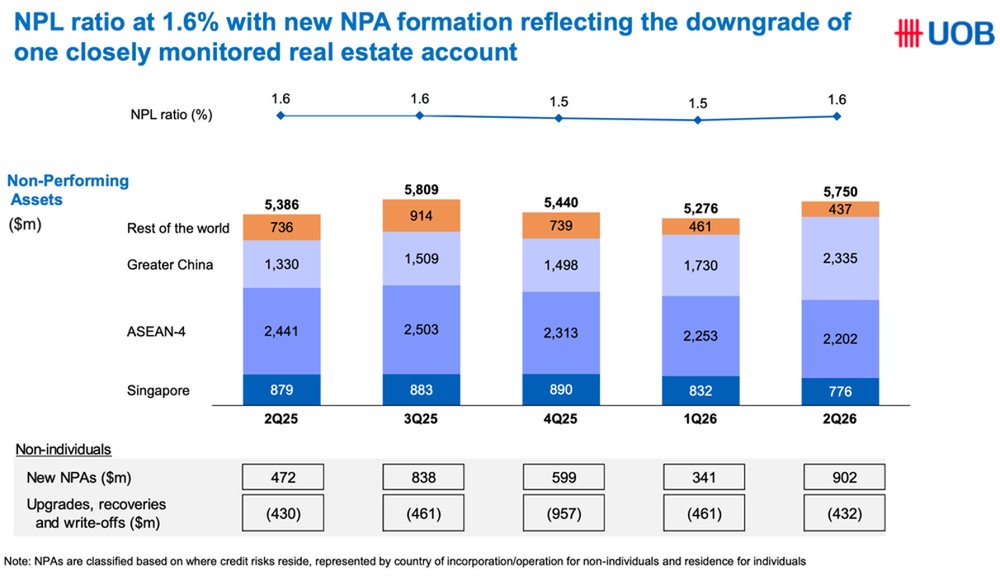
Asset quality weakened slightly, with the non-performing loan ratio rising to 1.6% from 1.5% in the previous quarter, mainly due to a Greater China real estate account.
However, UOB remained well capitalised, with a CET1 capital ratio of 15.4% after accounting for the interim dividend.
UOB raised its interim dividend to S$0.88 per share, from S$0.85 in the previous year, representing a payout ratio of about 50%.
It is expected to go ex-dividend on 17 August 2026 and be paid on 28 August 2026.
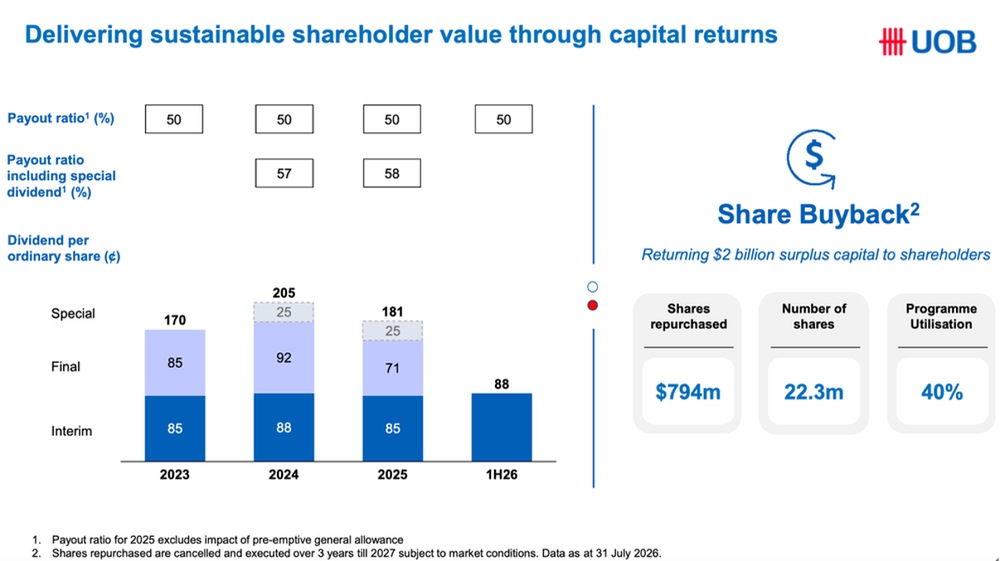
UOB also continued its S$2 billion share buyback programme, with about 40% completed as of 31 July 2026. The cancelled shares could support earnings per share over time.
Management maintained its guidance for low single-digit loan growth and net interest margin of 1.75% to 1.80%, but lowered its fee-income growth outlook to low single digits.
Separately, UOB agreed to sell UOB Asset Management to Allianz Global Investors for S$555 million. The deal is expected to generate a pre-tax gain of about S$330 million when completed in 2027.
The stock closed at S$43.58 on 6 August 2026, before the 2Q2026 results release. If we annualise the 1H26 interim dividend of S$0.88 per share, this would imply a dividend yield of about 4.0%.
| Beansprout check | UOB |
| Earnings growth | Does not pass |
| Financial health | Pass |
| Dividend payout | Pass |
| Cash and capital generation | Pass |
| Dividend yield | Pass |
| Overall | Passes 4 of 5 checks |
UOB passes four of Beansprout’s five initial checks for dividend stocks, which look at earnings growth, financial health, dividend payout, cash or capital generation, and dividend yield.
Its dividend is supported by a healthy capital position and a payout ratio of about 50%, while the higher interim dividend lifts its indicated yield to around 4.0%.
However, earnings growth over the past three years has been modest. I would also watch whether wealth management growth can continue to offset pressure from falling net interest margins, and whether the recent increase in non-performing loans remains contained.
I would also continue monitoring UOB’s net interest margin, the softer fee-income outlook and whether the increase in Greater China non-performing loans remains contained.
Find out how much dividend income you would have received as a UOB shareholder over the past 12 months using the calculator below.
Related links:
- UOB latest valuation, share price and analysis
- UOB dividend history and forecast
- UOB reports 10% increase in 2Q26 profit and higher interim dividend
What would Beansprout do?
DBS, Sheng Siong and UOB are paying dividends in August 2026.
When evaluating these stocks for my income pot as part of Beansprout's four pots of wealth, I would not just look at which offers the highest dividend yield.
I would also consider what supports the payout, whether earnings are growing and whether the company has sufficient financial strength to sustain its dividends through tougher periods.
| Stock | Dividend yield | Key strengths | Key risks |
| DBS | 4.3%* |
|
|
| Sheng Siong | 2.5% |
|
|
| UOB | 4%* |
|
|
| *Based on latest annualised dividend payout | |||
DBS offers the highest headline yield among the three at about 4.3%. Its dividend is supported by strong earnings, growing fee income and a healthy capital position. However, part of its latest payout comes from the capital return dividend, which I would assess separately from its recurring ordinary dividend. You can read more about our key takeaways from DBS's 2Q26 results here.
UOB’s annualised dividend yield is about 4.0%. UOB’s higher dividend, healthy capital ratio and record wealth fees are positive. Its higher dividend, healthy capital ratio and continued share buybacks are positives. However, net interest margins remain under pressure, while management has lowered its fee-income growth outlook. We shared more on the key takeaways from UOB's 2Q26 results here.
Sheng Siong has the lowest yield at about 2.3%. However, its interim dividend increased by 17%, supported by higher earnings, new store contributions and a net cash balance sheet. For now, Sheng Siong looks more like a defensive growth stock than a high-yield income stock. Learn more about Sheng Siong’s latest valuation and dividend analysis here.
Based on Beansprout’s initial screening checks, DBS and UOB fare better among the three and I would carry out deeper research before considering either for the Income Pot.
You can learn more about the three checks I use to screen dividend stocks for the Income Pot here.
To find out which blue chip stocks we would hold, in our model portfolio, check out how we would invest $100,000 in Singapore today.
If you are looking for greater clarity on the markets and the investment decisions that matter, explore Beansprout Pro for our latest views, portfolio thinking and the reasoning behind each opportunity.
Overall, these blue chips support our view that Singapore stocks are still worth looking at in 2026.
Earlier, we shared that we would consider looking beyond Singapore REITs to Singapore blue chip stocks for more diversified dividend income, especially when the dividends are supported by earnings growth, strong balance sheets and sustainable payout ratios.
By combining different sources of dividends, investors may be able to build a more resilient income portfolio over time. Learn how to build a more dependable stream of income that can hold up across cycles here.
Find out other Singapore stocks, REITs and ETFs with upcoming dividend payments here.
If you’d like to screen for other Singapore stocks with attractive dividend yields and potential upside, you can explore our Singapore high dividend stocks screener.
Which of these blue chips are you watching for your income pot? Share your thoughts in the comments below or join the discussion in our Telegram group!
Planning to invest in Singapore stocks? Compare the best Singapore brokers to find the right trading platform, and see the latest promotions and sign-up rewards available.
Follow Beansprout on YouTube, Facebook and Instagram, and add Beansprout as your preferred source on Google so you never miss an update.
Read also
Gain financial insights in minutes
Subscribe to our free weekly newsletter for more insights to grow your wealth
Most Popular

Comments
0 comments