
Fed hikes rates again: What higher interest rates mean for DBS, OCBC and UOB
Stocks
By Ng Hui Min • 24 Sep 2026
Why trust Beansprout? We’ve been awarded Best Investment Website at the SIAS Investors’ Choice Awards 2025
'%3e%3cpath%20fill-rule='evenodd'%20clip-rule='evenodd'%20d='M17.64%209.20455C17.64%208.56637%2017.5827%207.95273%2017.4764%207.36364H9V10.845H13.8436C13.635%2011.97%2013.0009%2012.9232%2012.0477%2013.5614V15.8195H14.9564C16.6582%2014.2527%2017.64%2011.9455%2017.64%209.20455V9.20455Z'%20fill='%234285F4'/%3e%3cpath%20fill-rule='evenodd'%20clip-rule='evenodd'%20d='M9%2018C11.43%2018%2013.4673%2017.1941%2014.9564%2015.8195L12.0477%2013.5614C11.2418%2014.1014%2010.2109%2014.4205%209%2014.4205C6.65591%2014.4205%204.67182%2012.8373%203.96409%2010.71H0.957275V13.0418C2.43818%2015.9832%205.48182%2018%209%2018V18Z'%20fill='%2334A853'/%3e%3cpath%20fill-rule='evenodd'%20clip-rule='evenodd'%20d='M3.96409%2010.71C3.78409%2010.17%203.68182%209.59318%203.68182%209C3.68182%208.40682%203.78409%207.83%203.96409%207.29V4.95818H0.957273C0.347727%206.17318%200%207.54773%200%209C0%2010.4523%200.347727%2011.8268%200.957273%2013.0418L3.96409%2010.71V10.71Z'%20fill='%23FBBC05'/%3e%3cpath%20fill-rule='evenodd'%20clip-rule='evenodd'%20d='M9%203.57955C10.3214%203.57955%2011.5077%204.03364%2012.4405%204.92545L15.0218%202.34409C13.4632%200.891818%2011.4259%200%209%200C5.48182%200%202.43818%202.01682%200.957275%204.95818L3.96409%207.29C4.67182%205.16273%206.65591%203.57955%209%203.57955V3.57955Z'%20fill='%23EA4335'/%3e%3c/g%3e%3cdefs%3e%3cclipPath%20id='clip0_0_2849'%3e%3crect%20width='18'%20height='18'%20fill='white'/%3e%3c/clipPath%3e%3c/defs%3e%3c/svg%3e)
Make Beansprout your preferred source on Google
Add us on Google to see more of our insights in your search results
The Fed has raised rates again. We compare DBS, OCBC and UOB to see how higher SORA could affect net interest margins (NIM), earnings and dividends.

What happened?
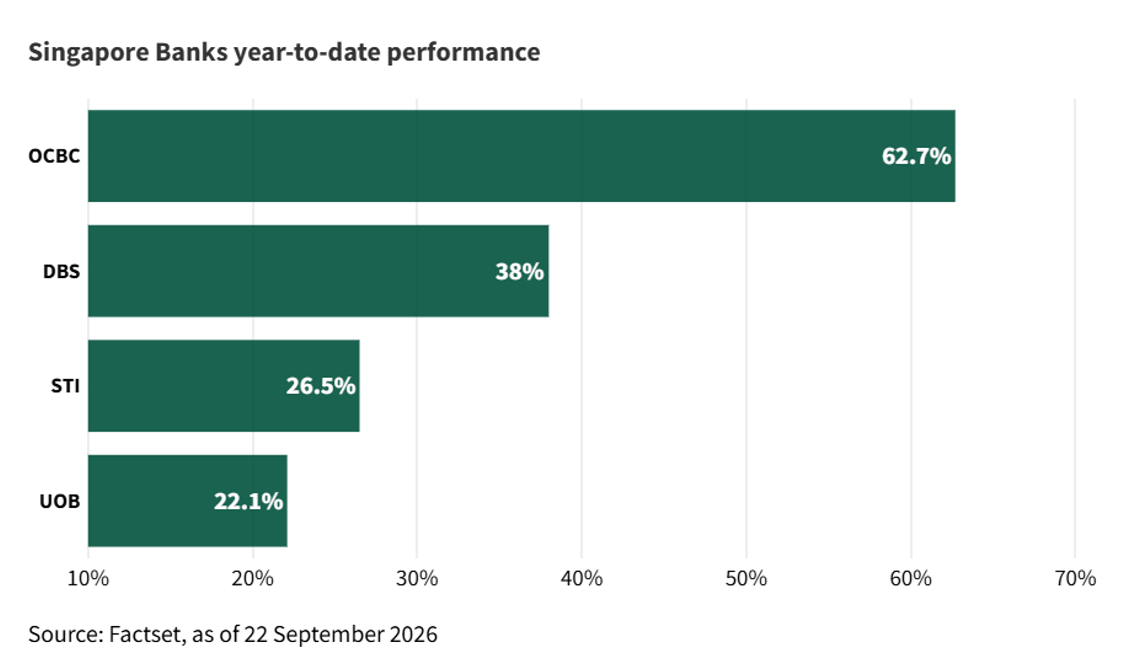
Singapore bank shares are back in focus after the US Federal Reserve raised interest rates for the first time since 2023.
At its 16 September 2026 meeting, the Fed raised its target range by 25 basis points to 3.75%–4.00%, marking a shift from the previous trend of falling rates that had put pressure on Singapore banks’ net interest margins.
If higher US interest rates put upward pressure on Singapore dollar rates such as SORA, bank loan yields and net interest margins (NIMs) could start to recover.
Against this backdrop, we previously compared DBS, OCBC and UOB with Singapore REITs, looking beyond headline dividend yields at factors such as income sustainability and interest-rate sensitivity.
With DBS and OCBC shares trading close to all-time highs while UOB has lagged behind, many in the Beansprout community are asking whether higher rates could provide further support to bank earnings and which would benefit the most.
In this article, we look at what a rising interest-rate environment could mean for DBS, OCBC and UOB, and compare their earnings sensitivity, fundamentals and valuations after the recent rally in Singapore bank shares.
Why higher SORA matters for DBS, OCBC and UOB
Singapore does not set interest rates independently in the same way as the US.
However, changes in US interest rates can influence Singapore dollar interest rates, including the Singapore Overnight Rate Average, or SORA.
The Fed's median projection now points to a policy rate of around 4.1% at the end of 2026 and 2027. This marks a change from the previous assumption that US interest rates would continue falling.
This matters for DBS, OCBC and UOB because many loans in Singapore are priced with reference to SORA.
As these loans are repriced at higher rates, the banks can earn more interest on their loan books.
If the interest banks pay on deposits and other funding rises more slowly than the interest earned on loans, their net interest margins, or NIMs, could improve.
NIM measures the difference between what a bank earns on its interest-earning assets and what it pays to fund them, expressed as a percentage of those assets.
A higher NIM generally supports higher net interest income, which remains an important source of earnings for Singapore banks.
This is relevant because NIMs have been under pressure since the rate-cutting cycle began in the fourth quarter of 2024.
In the second quarter of 2026, DBS, UOB and OCBC reported NIMs of 1.87%, 1.74% and 1.70%, respectively.
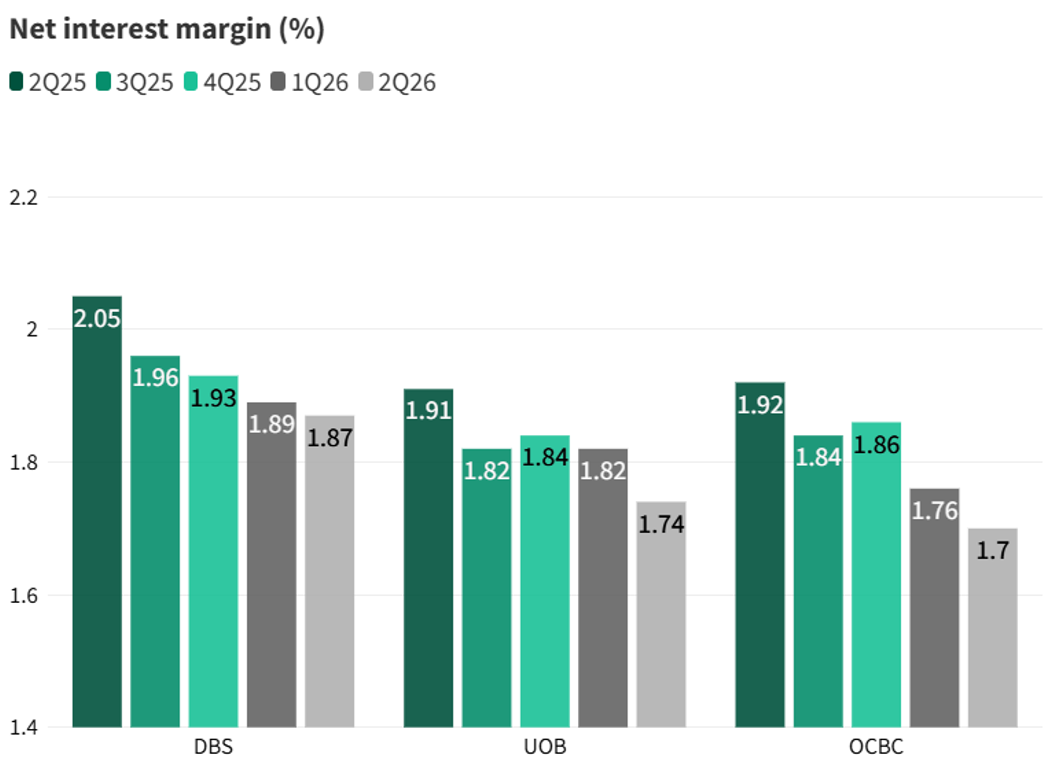
UOB's NIM, for example, fell by 8 basis points from the previous quarter to 1.74%, as lower benchmark rates reduced asset yields.
A reversal in the interest-rate cycle could therefore provide some relief to bank margins.
However, the impact is unlikely to be immediate.
There is typically a lag before changes in market interest rates flow through to loan repricing, while deposit and funding costs can also move higher.
UOB has the largest exposure to Singapore-dollar loans
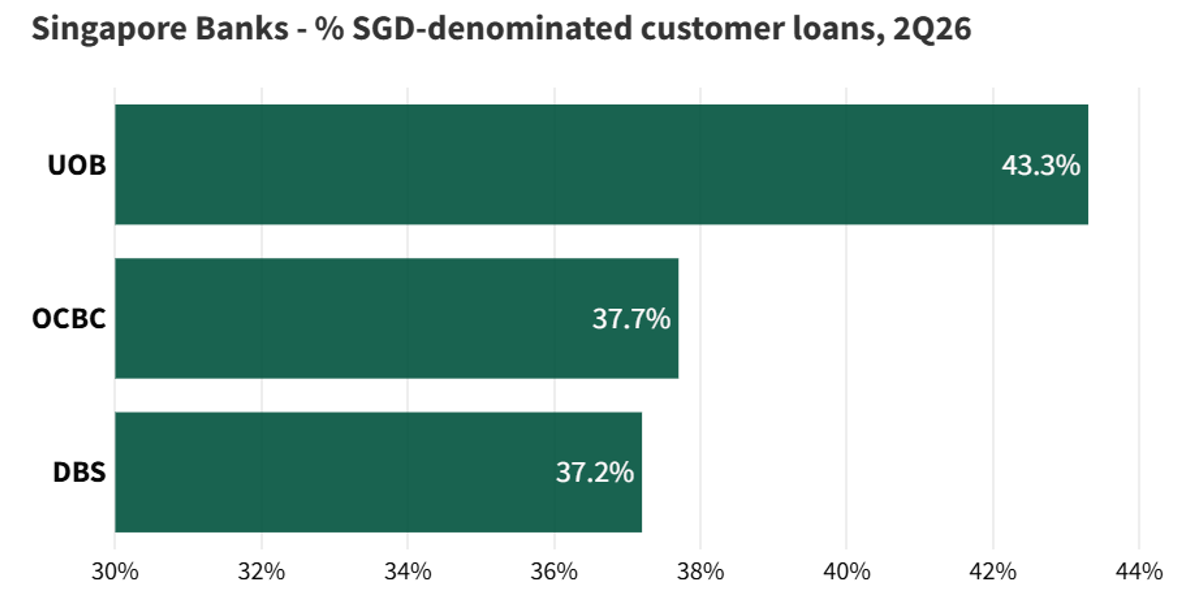
Among the three Singapore banks, UOB has the highest proportion of customer loans denominated in Singapore dollars.
Singapore-dollar loans make up 43.3% of UOB's customer loan book, compared with 37.7% for OCBC and 37.2% for DBS.
This matters because many Singapore-dollar loans are priced with reference to SORA or other domestic interest-rate benchmarks.
If SORA rises, a larger share of UOB's loan book could reprice at higher rates. That could provide more support to its loan yields, net interest margin and net interest income.
The same sensitivity works in reverse. If Singapore rates fall, UOB could also see its Singapore-dollar loan yields reprice down more quickly.
This makes UOB relatively more exposed to changes in the domestic interest-rate cycle than DBS and OCBC.
UOB relies more on net interest income than DBS and OCBC
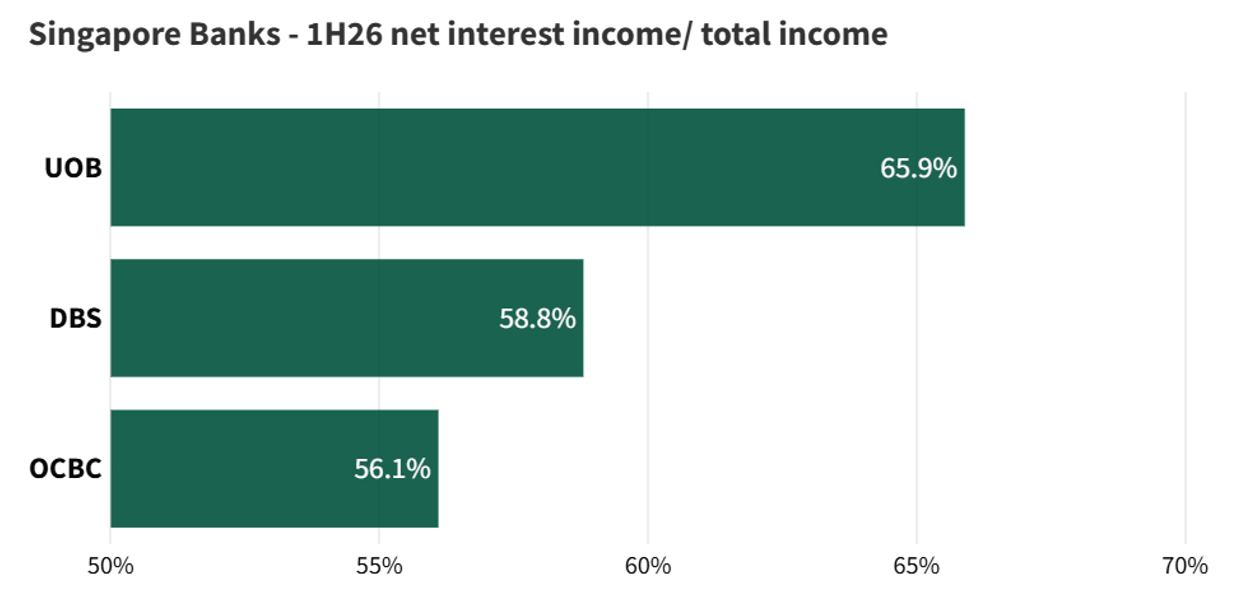
UOB also relies more heavily on net interest income as a source of revenue.
In 1H26, net interest income accounted for around 66% of UOB's revenue, the highest proportion among the three banks.
That means changes in lending margins have a larger influence on UOB's overall earnings.
If higher SORA lifts loan yields faster than funding costs rise, UOB could therefore see a relatively larger earnings benefit from an improvement in NIM.
Higher rates are not automatically positive for banks, however.
More expensive borrowing can weaken loan demand and put greater pressure on households and companies.
If this eventually leads to higher credit costs, part of the benefit from stronger margins could be offset.
DBS and OCBC have more support from fee income
UOB may be more sensitive to higher interest rates, but DBS and OCBC have larger wealth management businesses that provide another source of earnings growth.
In 2Q26, DBS reported record wealth management fees of S$919 million, up 41.6% year on year.
OCBC's wealth management fees rose 45% to S$470 million, while UOB's increased 29.3% to S$246 million.
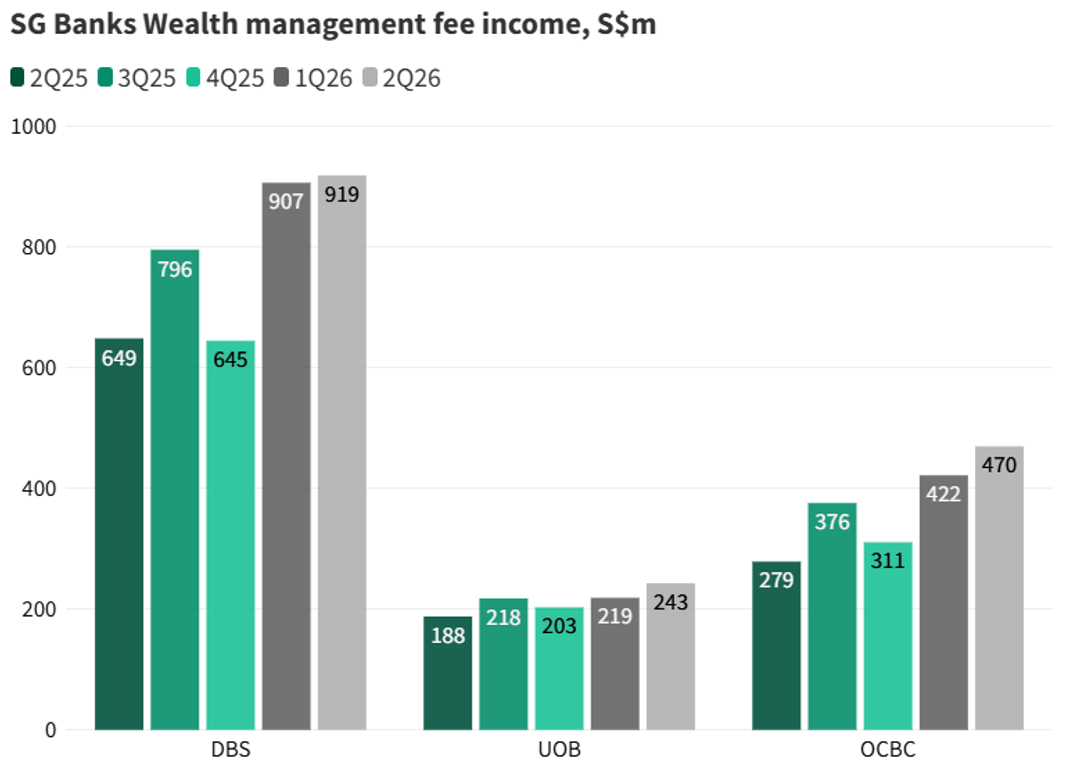
The difference is also reflected in their assets under management. DBS had S$516 billion of AUM in 2Q26, followed by OCBC at S$350 billion and UOB at S$204 billion.
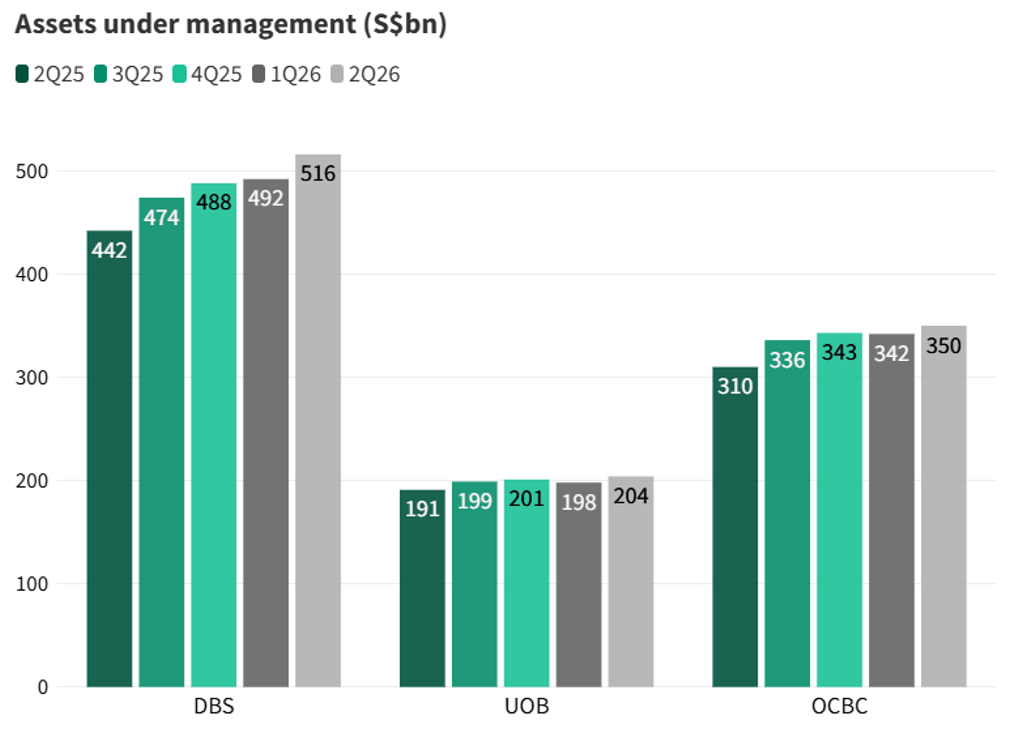
This larger asset base gives DBS and OCBC more scope to generate recurring wealth management fees as markets rise and clients add new funds.
For DBS and OCBC, this provides an earnings driver that is less directly dependent on interest rates.
UOB may therefore have more to gain from a recovery in NIM, while DBS and OCBC have more support from their wealth management businesses.
DBS, OCBC and UOB may only see a bigger earnings impact in 2027
The effect of a Fed rate hike is unlikely to show up immediately in bank earnings.
US interest rates first need to feed through to Singapore's interest-rate environment, including SORA. Banks also need time for existing loans to be repriced.
As a result, any improvement in loan yields and NIM is likely to be gradual.
If higher rates are sustained, a more meaningful impact on earnings could emerge in 2027 as a larger portion of loan books resets at higher rates.
There is also a trade-off.
Higher rates can improve bank margins, but they also increase borrowing costs for households and companies. Over time, this can slow loan demand and make debt servicing more difficult for some borrowers.
That is why asset quality matters alongside NIM.
For now, asset quality across the Singapore banks remains healthy. If rates stay elevated for longer, we would watch whether the improvement in margins starts to come at the expense of weaker loan growth, higher non-performing loans or rising credit costs.
DBS faces a US-dollar offset when interest rates rise
DBS illustrates why higher interest rates are not always straightforwardly positive for banks.
Higher Singapore-dollar rates can benefit DBS because its Singapore-dollar loans can reprice upwards.
At its August 2026 analyst call, DBS indicated that a 1-basis-point increase in Singapore-dollar rates could raise net interest income by around S$11 million.
However, its US-dollar balance sheet works in the opposite direction.
DBS has said that its US-dollar book has net floating-rate liabilities. This means higher US-dollar rates can increase its funding costs.
DBS estimated that a 1-basis-point increase in US-dollar rates could reduce net interest income by around S$4 million.
The result is a partial offset.
Higher SORA remains supportive for DBS, but higher US-dollar rates can dilute some of that benefit. This makes DBS's overall rate sensitivity more nuanced than simply assuming that higher rates lead to higher earnings.
Compared with UOB, DBS therefore appears less directly geared to a rise in Singapore interest rates, especially given UOB's larger Singapore-dollar loan exposure.
Which Singapore bank is most sensitive to higher interest rates?
Based on these factors, UOB appears to have the greatest sensitivity to higher Singapore interest rates.
It has the largest proportion of Singapore-dollar loans among the three banks and derives a larger share of revenue from net interest income.
That gives it more potential upside if higher SORA leads to wider lending margins.
DBS and OCBC should also benefit if margins improve, but their earnings are supported to a greater extent by fee income and other non-interest income sources.
DBS also faces a partial offset from its US-dollar balance sheet, where higher US-dollar rates can increase funding costs.
The key distinction is therefore not that higher rates are positive for one bank and negative for another. It is how much each bank's earnings depend on the rate cycle.
| Factor | DBS | OCBC | UOB |
| Exposure to SGD rates | Moderate | Moderate | Higher |
| Dependence on net interest income | Lower | Lower | Higher |
| USD rate offset | Yes | Less significant | Less significant |
| Non-interest income strength | Strong | Strong | Improving |
| Sensitivity to higher rates | Positive | Positive | Most sensitive |
DBS vs OCBC vs UOB after the Fed rate hike: How do fundamentals and valuations compare?
The Fed hike improves the earnings backdrop for Singapore banks, but we would not assess them based on interest-rate sensitivity alone.
Under our Opportunity Pot screening framework, we would look at three areas: earnings momentum, balance-sheet strength and return on equity.
| Opportunity Pot check | DBS | OCBC | UOB |
| Revenue & earnings momentum | ✅ Pass — 1H26 total income +3% YoY; net profit +5% to a record S$6.01b | ✅ Pass — 1H26 total income +11%; net profit +13% to a record S$4.2b | ✅ Pass, but weaker underlying momentum — 1H26 total income -1.0%; net profit +3%, helped by a S$330m one-off gain |
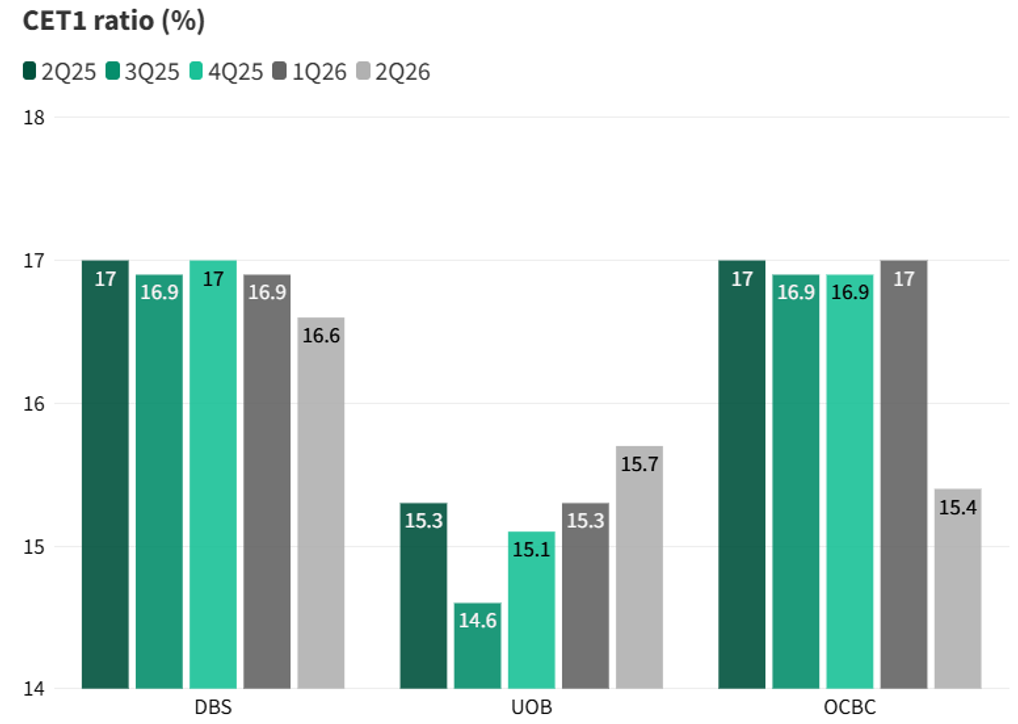
| Balance sheet strength | ✅ Strong — CET1 16.6%; | ✅ Strong — CET1 15.7%; | ✅ Pass — CET1 15.4%; |
| Return on equity | ✅ Strongest — 1H2026 ROE of 17.5% | ✅ Strong — 1H2026 ROE of 13.7%; 2Q annualised ROE 14.4% | ✅ Pass — 1H2026 ROE of 11.6%, above our 10% threshold |
| Overall | ✅ Pass | ✅ Pass | ✅ Pass |
All three banks pass the framework, although their strengths differ.
OCBC currently stands out for earnings momentum. Its earnings have been supported by continued growth in wealth management and other fee income, giving it a broader source of growth beyond net interest income.
DBS continues to stand out for profitability. It has the strongest return on equity among the three banks, while its wealth management business remains an important growth driver, with assets under management exceeding S$500 billion.
UOB appears more sensitive to a recovery in interest margins because it has a larger proportion of Singapore-dollar loans and relies more heavily on net interest income. However, its underlying growth and return on equity currently screen less strongly than DBS and OCBC.
Balance-sheet strength also remains important, particularly if higher rates begin to put more pressure on borrowers.
For UOB, we would continue to monitor Greater China real estate non-performing loans, even though credit costs remain within guidance.
On valuations, OCBC trades at around 2.3 times price-to-book, compared with its historical average of about 1.17 times.
DBS trades at around 3.2 times price-to-book, versus a historical average of about 1.54 times.
Both therefore trade at sizeable premiums to their historical valuations.
As we have looked at previously when comparing Singapore bank valuations, a higher valuation does not automatically mean a bank is expensive if profitability and earnings growth are structurally stronger than in the past.
But it does mean investors are already paying more for that stronger outlook.
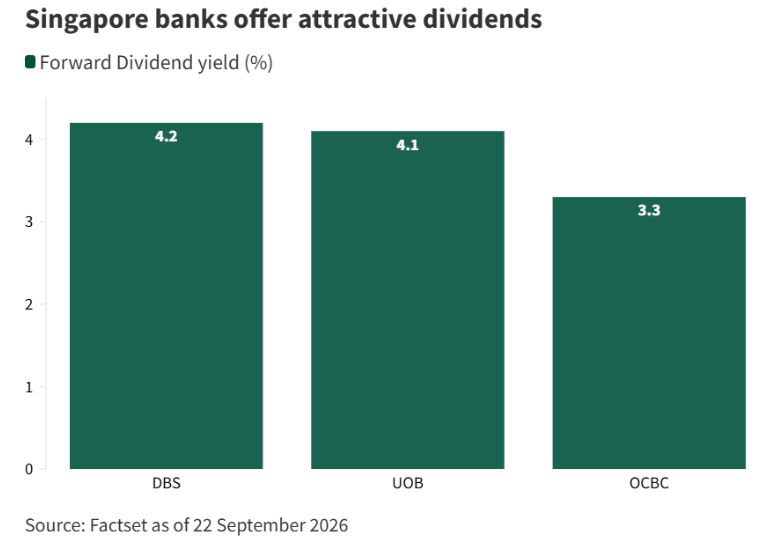
UOB offers a forward dividend yield of around 4.1%, close to DBS at about 4.2%, while OCBC's forward dividend yield is lower at around 3.3%, including its S$0.18 special dividend.
What would Beansprout do?
We would not simply choose the bank that benefits most from higher interest rates.
Higher SORA could provide the biggest relative boost to UOB because of its greater exposure to Singapore-dollar loans and higher dependence on net interest income.
But we would place more weight on whether earnings can continue growing even if rates stop rising.
That is where DBS and OCBC currently look stronger.
Both have larger wealth management businesses and stronger fee-income growth, giving them additional earnings drivers beyond net interest margins.
Between the two, DBS offers stronger income visibility. Its capital return dividend provides a clearer floor for quarterly payouts through FY2026 and FY2027, while its wealth management franchise continues to grow.
OCBC has stronger recent earnings momentum, but its lower dividend yield and higher valuation relative to its own history suggest more of that strength may already be reflected in the share price.
UOB remains the most direct way among the three banks to benefit from a stronger-for-longer interest-rate environment.
We would, however, want to see clearer improvement in fee income and greater comfort around Greater China credit risks before placing more weight on that rate sensitivity.
After the strong rally in Singapore bank shares, the question for us is therefore not simply which bank benefits most from higher rates.
It is which bank offers the best combination of earnings growth, business quality and valuation from here.
For individual bank stocks, we would still keep them ring-fenced within the Opportunity Pot and focus on building a portfolio rather than picking stocks in isolation, sizing each position based on conviction, company-specific risks and what else we already own.
For readers who want to see how we apply this in practice, our latest Beansprout Pro Opportunity Model Portfolio update shows how we would invest S$100,000 in Singapore stocks, including how we think about position sizing and portfolio construction.
Which of the three banks are you looking closely at? Share your thoughts in the comments below or in our Telegram group!
Follow Beansprout on YouTube, Facebook and Instagram, and add Beansprout as your preferred source on Google so you never miss an update.
Read also
Gain financial insights in minutes
Subscribe to our free weekly newsletter for more insights to grow your wealth
Most Popular

Comments
0 comments