
DBS, OCBC and UOB dividend yields below REIT yields of 5.6%. Here’s where to look for income
Stocks
By Goh Lay Peng • 16 Sep 2026
Why trust Beansprout? We’ve been awarded Best Investment Website at the SIAS Investors’ Choice Awards 2025
'%3e%3cpath%20fill-rule='evenodd'%20clip-rule='evenodd'%20d='M17.64%209.20455C17.64%208.56637%2017.5827%207.95273%2017.4764%207.36364H9V10.845H13.8436C13.635%2011.97%2013.0009%2012.9232%2012.0477%2013.5614V15.8195H14.9564C16.6582%2014.2527%2017.64%2011.9455%2017.64%209.20455V9.20455Z'%20fill='%234285F4'/%3e%3cpath%20fill-rule='evenodd'%20clip-rule='evenodd'%20d='M9%2018C11.43%2018%2013.4673%2017.1941%2014.9564%2015.8195L12.0477%2013.5614C11.2418%2014.1014%2010.2109%2014.4205%209%2014.4205C6.65591%2014.4205%204.67182%2012.8373%203.96409%2010.71H0.957275V13.0418C2.43818%2015.9832%205.48182%2018%209%2018V18Z'%20fill='%2334A853'/%3e%3cpath%20fill-rule='evenodd'%20clip-rule='evenodd'%20d='M3.96409%2010.71C3.78409%2010.17%203.68182%209.59318%203.68182%209C3.68182%208.40682%203.78409%207.83%203.96409%207.29V4.95818H0.957273C0.347727%206.17318%200%207.54773%200%209C0%2010.4523%200.347727%2011.8268%200.957273%2013.0418L3.96409%2010.71V10.71Z'%20fill='%23FBBC05'/%3e%3cpath%20fill-rule='evenodd'%20clip-rule='evenodd'%20d='M9%203.57955C10.3214%203.57955%2011.5077%204.03364%2012.4405%204.92545L15.0218%202.34409C13.4632%200.891818%2011.4259%200%209%200C5.48182%200%202.43818%202.01682%200.957275%204.95818L3.96409%207.29C4.67182%205.16273%206.65591%203.57955%209%203.57955V3.57955Z'%20fill='%23EA4335'/%3e%3c/g%3e%3cdefs%3e%3cclipPath%20id='clip0_0_2849'%3e%3crect%20width='18'%20height='18'%20fill='white'/%3e%3c/clipPath%3e%3c/defs%3e%3c/svg%3e)
Make Beansprout your preferred source on Google
Add us on Google to see more of our insights in your search results
Singapore banks or S-REITs for income? We compare DBS, OCBC and UOB with REITs on dividend yields, balance sheets, interest rate sensitivity and income sustainability.
What happened?
For investors looking for passive income in Singapore, the local banks and Singapore REITs are often two of the first places to look.
Right now, against a backdrop of rising bond yields, there is a fairly significant difference in the yields they offer.
With the rally in the share prices of Singapore banks, DBS, OCBC and UOB offer dividend yields of between 3.5% and 4.6%.
Singapore REITs, on the other hand, now offer an average dividend yield of 5.6%, based on an a basket of Singapore REITs as measured by the Lion-Philip S-REIT ETF as of 16 September 2026.
As can be seen in the chart below, Singapore REITs offer distribution yields ranging from about 4.4% to as high as 10% based on FY2027 estimates.
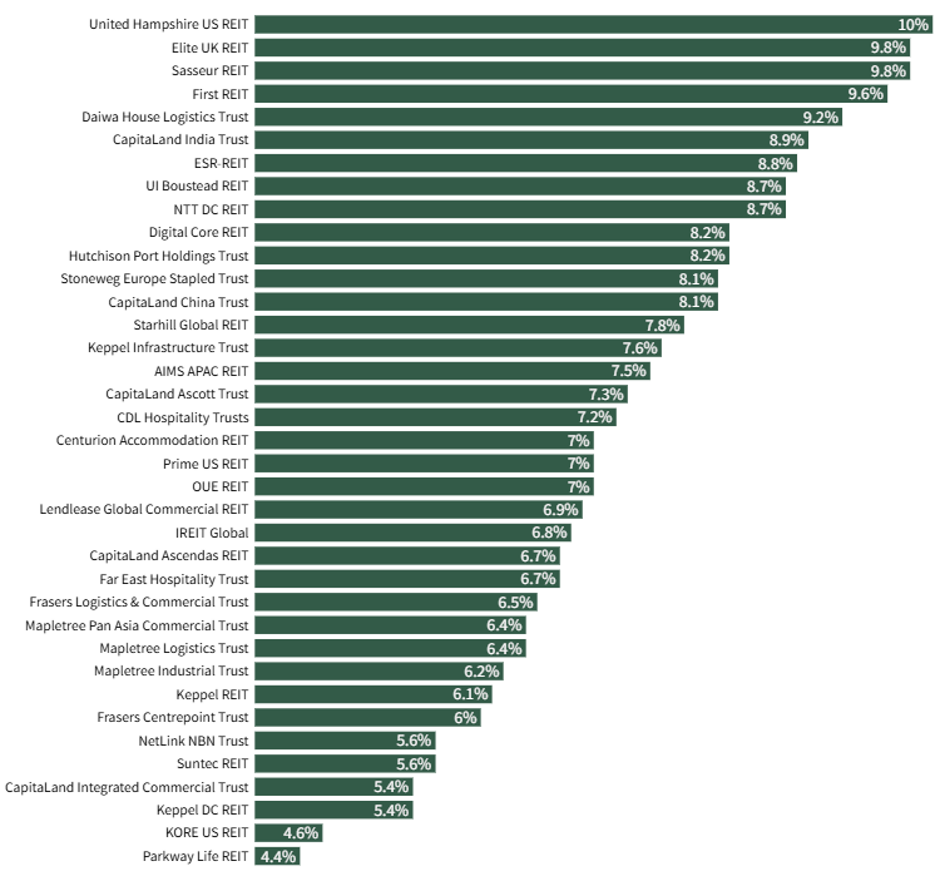
At first glance, this may make REITs look more attractive. But I would not make the decision based on yield alone.
A higher yield is useful only if the income can be sustained. It also needs to compensate us adequately for the additional risks we are taking.
So let us look beyond the headline yield and compare the banks and REITs more closely.
Why are Singapore REIT yields so much higher than banks?
One reason is that REIT share prices have significantly lagged the broader Singapore market, even as the Straits Times Index (STI) reached record highs.
The chart below shows the divergence clearly.
Over the past year, the share prices of DBS, OCBC and UOB have reached new highs, driving the Straits Times Index (STI) to record levels.
On the other hand, an index of the share prices of Singapore REITs has fallen by more than 5%.
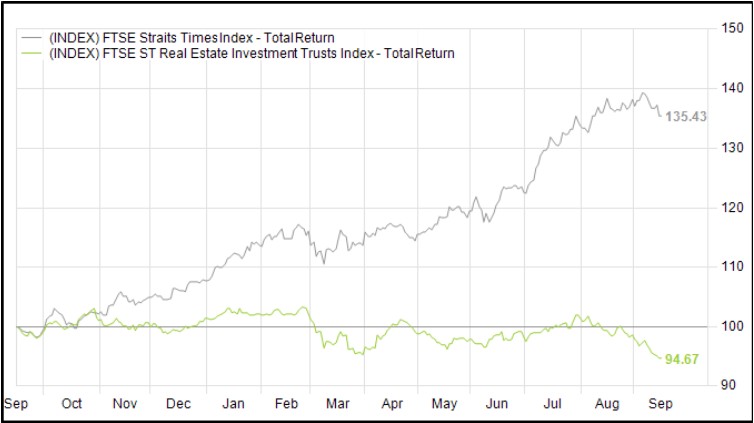
The decline in the share prices of Singapore REITs has led to a higher distribution yield. The distribution yield is calculated based on the distribution received relative to the unit price.
If the unit price falls while the distribution remains unchanged, the yield rises.
So part of the higher yields we are seeing among S-REITs today reflects their weaker share price performance.
This does not necessarily mean S-REITs are unattractive. In fact, lower prices can create opportunities if the underlying income remains resilient.
But it does mean I would want to understand why a REIT is yielding 7%, 8% or even 10% before assuming that it represents better value.
Comparing Singapore banks and REITs for Beansprout’s Income Pot
When we look for investments for the Beansprout Income Pot, we do not start with the highest yield.
For dividend stocks, we first ask whether earnings are growing, whether the balance sheet is strong, and whether the dividend is sustainable. Only then do we look at whether the yield is attractive enough for the risks we are taking.
This is the approach behind our Income Pot stock screening framework.
We apply the same principle to Singapore REITs. We look at whether DPU is stable or growing, whether gearing is manageable, and only then whether the distribution yield is attractive. You can see the full approach in our Singapore REIT screening framework.
So rather than simply asking whether banks or REITs offer the higher yield, I would focus on three questions:
- What happens if interest rates stay higher?
- Which has the stronger balance sheet?
- Which can deliver more sustainable income?
Check #1: What happens to banks and REITs if interest rates stay higher?
The interest rate backdrop has changed again.
Markets are now expecting the US Federal Reserve to raise rates at its September meeting, following stronger inflation data and the rise in oil prices. At the same time, the 10 year US Treasury yield has climbed above 5%, its highest level in years.
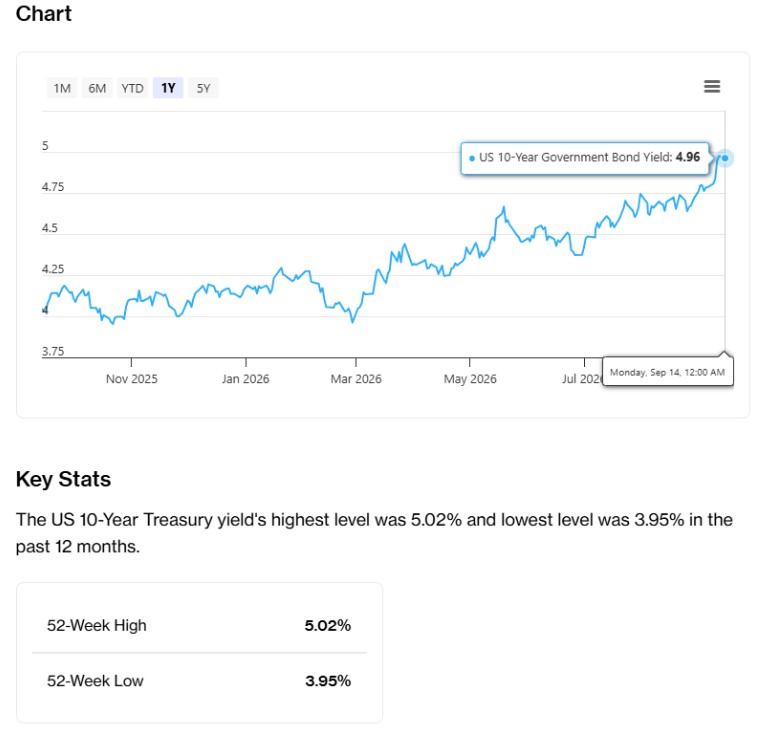
This has implications for the performance of Singapore banks vs REITs because higher interest rates affect banks and REITs very differently.
For the Singapore banks, the decline in interest rates over the past year has already put pressure on net interest margins.
DBS's net interest margin fell from 2.05% in 2Q25 to 1.87% in 2Q26. UOB's declined from 1.91% to 1.74%, while OCBC's fell from 1.92% to 1.70%.
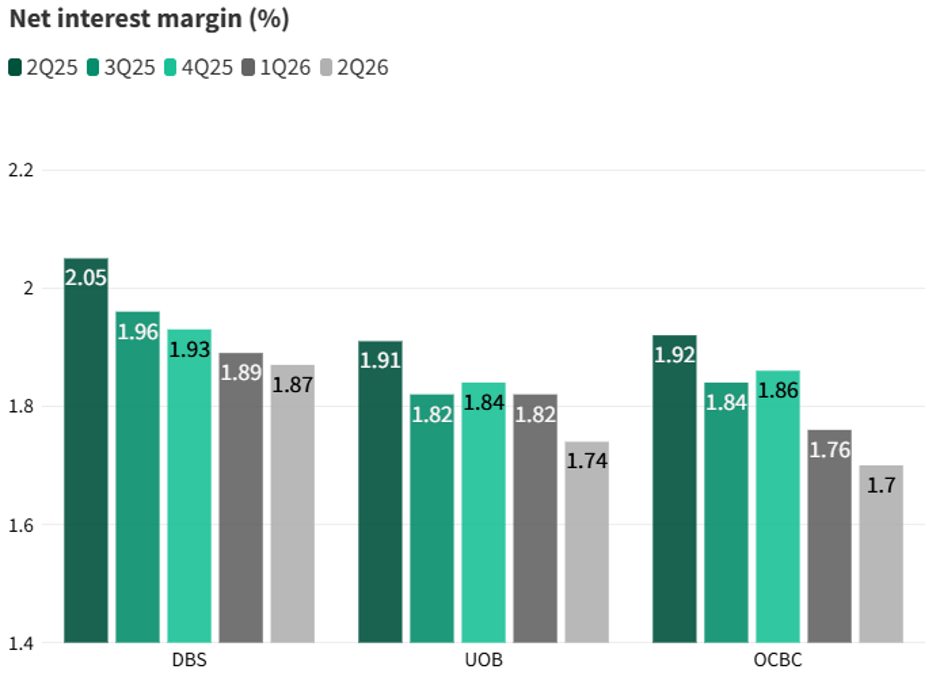
Despite this, all three banks have continued to grow their profits, helped by stronger fee and non interest income.
If interest rates now stay higher for longer, or start rising again, the pressure on bank margins could ease. This does not mean higher rates are automatically positive for banks, as they could also weigh on loan growth and eventually lead to higher credit costs. But compared with an environment of steadily falling rates, the outlook for net interest income could become more supportive.
For REITs, the implications are less favourable.
One reason investors had turned more positive on S-REITs was the expectation that falling interest rates would gradually reduce borrowing costs as debt is refinanced.
A renewed rate hike cycle could slow this benefit. More importantly, higher bond yields raise the hurdle rate for REITs.
With the 10 year US Treasury yield now above 5%, investors can earn a higher return from government bonds. They may therefore demand a higher distribution yield from REITs to compensate for taking on additional risk.
For REIT yields to rise, unit prices may have to fall if distributions do not increase sufficiently.
This means that even if a REIT's operating performance remains resilient and its borrowing costs have yet to rise materially, its valuation can still come under pressure when bond yields move higher.
Against this backdrop, I see the interest rate environment as becoming relatively more supportive for the banks than for REITs.
Check #2: Do Singapore banks or REITs have a stronger balance sheet?
The next question I would ask is what risks I am taking to earn that additional income?
This is where the difference between a bank dividend and REIT distribution becomes more apparent.
The three Singapore banks continue to have strong capital positions.
As of 1H26, DBS had a Common Equity Tier 1, or CET1, ratio of 16.6%. UOB's stood at 15.7%, while OCBC's was 15.4%.
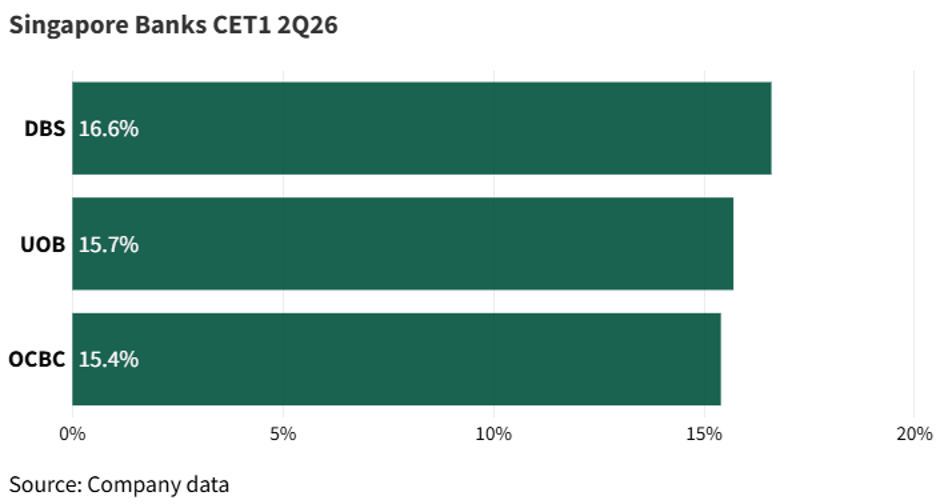
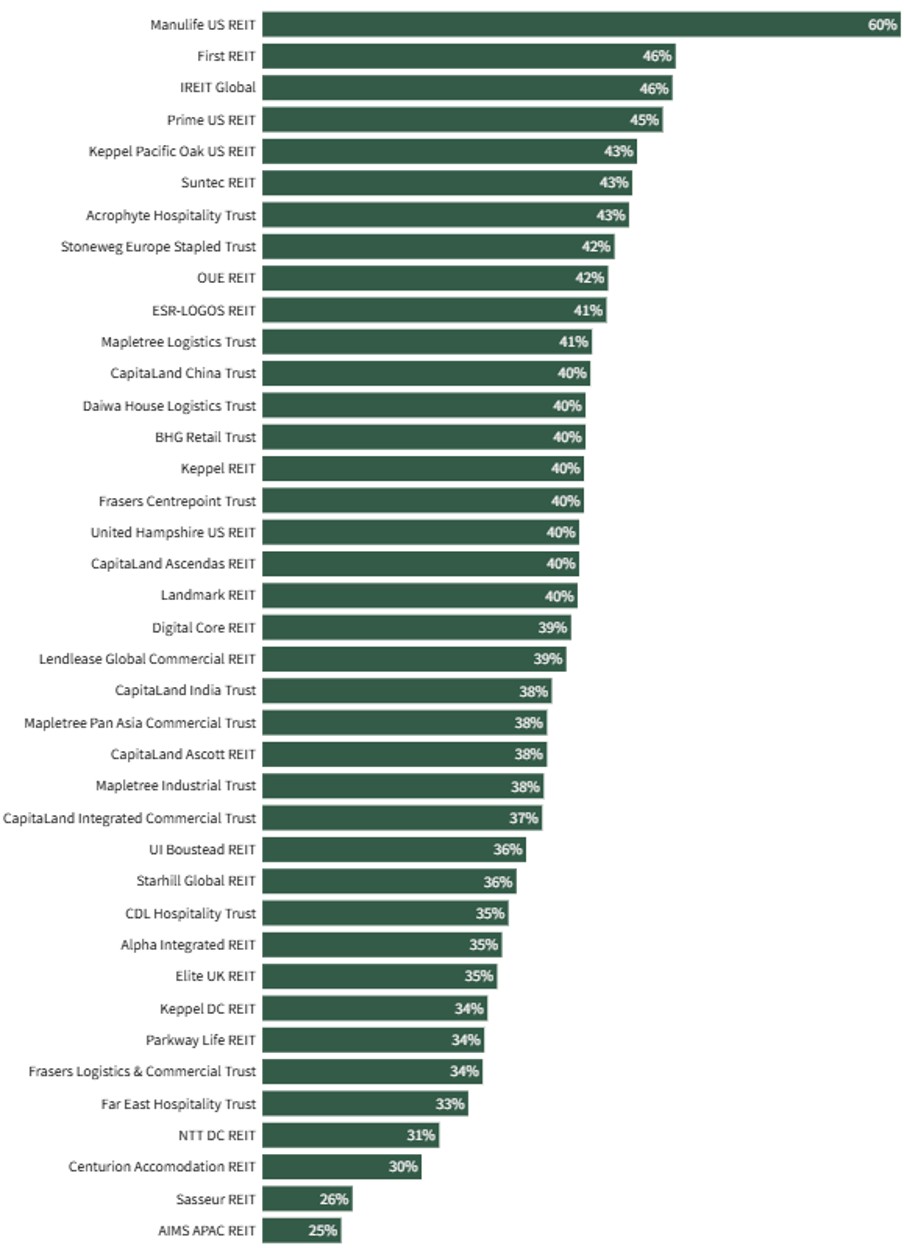
For REITs, leverage is part of the business model. But the chart below shows just how wide the differences are across the sector.
Aggregate leverage ranges from around 25% for the least leveraged REITs to close to 50% at the upper end.
The difference becomes even more important when we look at financing costs.
The average cost of debt ranges from less than 2% for some REITs to more than 6% for others.
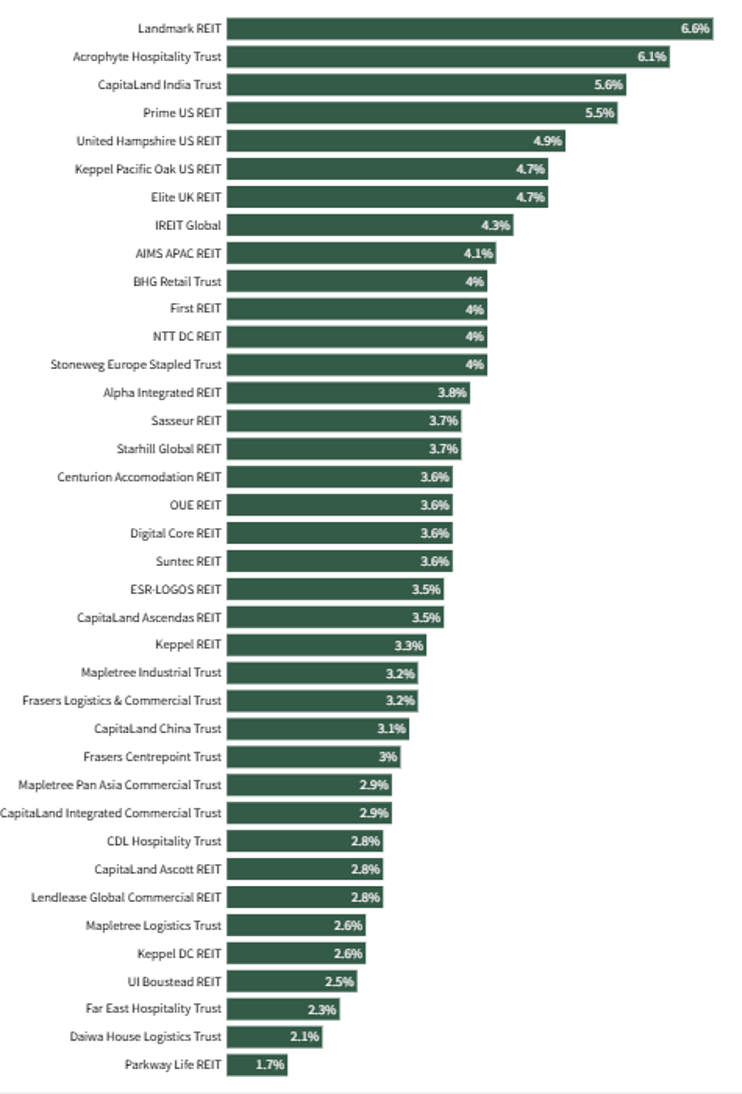
This means two REITs offering the same 7% yield could carry very different levels of risk.
A REIT with moderate gearing, a low cost of debt and growing DPU is very different from one offering the same yield with high gearing, expensive financing and falling distributions.
In our S-REIT screening framework, we generally prefer gearing below 45%, with a stable or declining trend. Higher gearing does not automatically make a REIT unattractive, but it leaves less room to deal with refinancing, vacancies or falling property values.
This is why I would not compare a 7% REIT yield directly with a 4% bank dividend yield and conclude that I am simply getting an extra 3 percentage points of income.
I am also taking on additional balance sheet and refinancing risk. The question is whether I am being adequately compensated for it.
Check #3: Are Singapore banks or REITs more likely to provide sustainable income?
Another thing I would look at is whether the income supporting the dividend or distribution is growing.
For the Singapore banks, the latest results have been fairly resilient.
In 2Q26, DBS grew net profit by 9% year on year, UOB by 10.5% and OCBC by 22.3%.
What I find more interesting is where the growth came from.
Net interest income fell by 1.8% for DBS, 1.7% for UOB and 0.8% for OCBC. However, non interest income grew by 25.1%, 14.9% and 50.8% respectively.
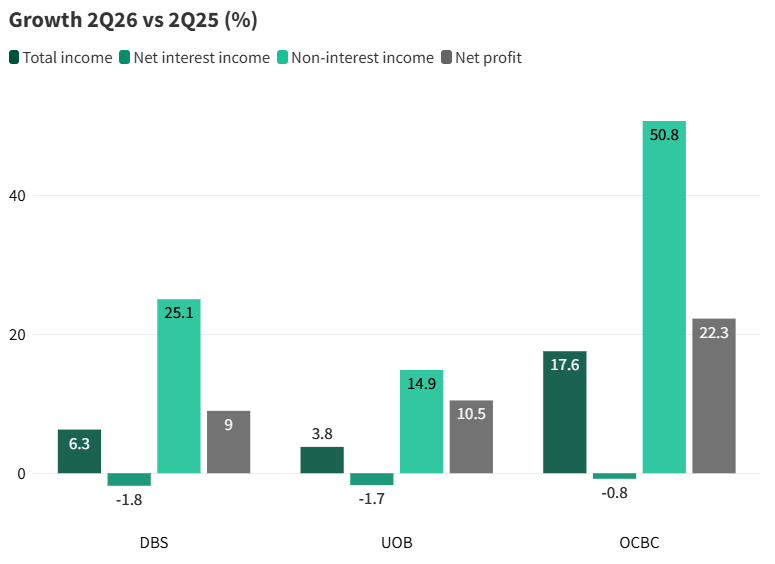
In other words, the banks have been able to grow their profits even as the tailwind from higher interest rates starts to fade.
One reason has been the growth of their wealth management businesses.
Assets under management at DBS rose from S$442 billion in 2Q25 to S$516 billion in 2Q26. OCBC's increased from S$310 billion to S$350 billion, while UOB's rose from S$191 billion to S$204 billion.
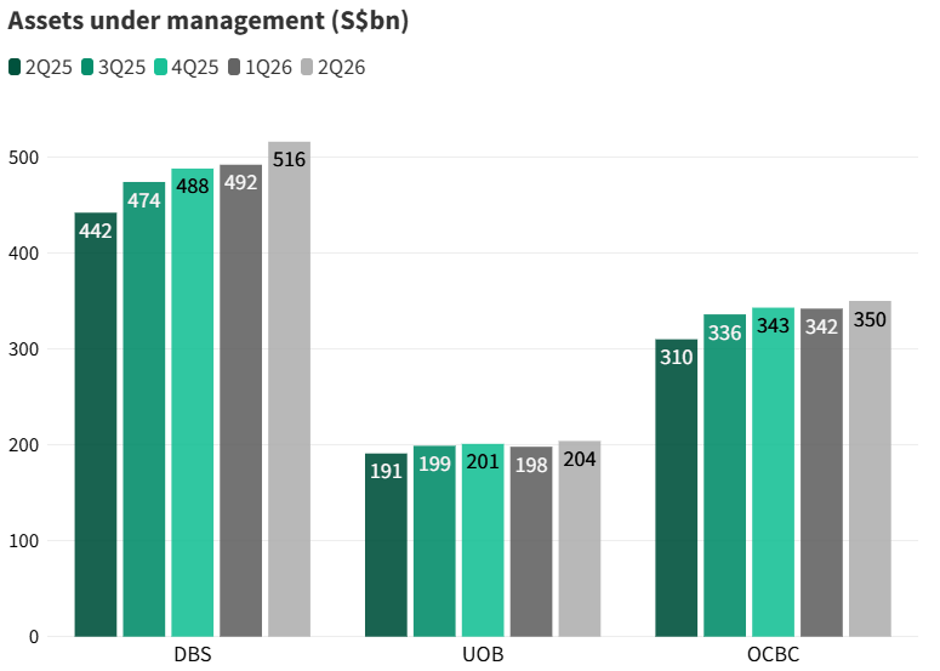
We have previously highlighted how wealth management is becoming a more important source of fee income for all three banks as Singapore attracts more private wealth. This gives the banks another earnings driver beyond lending and helps to reduce their dependence on net interest income alone.
The picture is more mixed when we look at S-REITs.
The chart below shows the year on year change in DPU across S-REITs in 1H26.
At one end, OUE REIT grew DPU by 28.6% and Suntec REIT by 25.6%. Parkway Life REIT and Keppel DC REIT also delivered double digit growth.
But there were also REITs where distributions fell sharply. BHG Retail REIT's DPU declined by 45.5%, while IREIT Global's fell by 47.9%.
Even amongst the larger REITs, the outcome was mixed. CapitaLand Integrated Commercial Trust grew DPU by 7.1%, while Keppel REIT and Mapletree Industrial Trust recorded declines of 4.0% and 4.9% respectively.
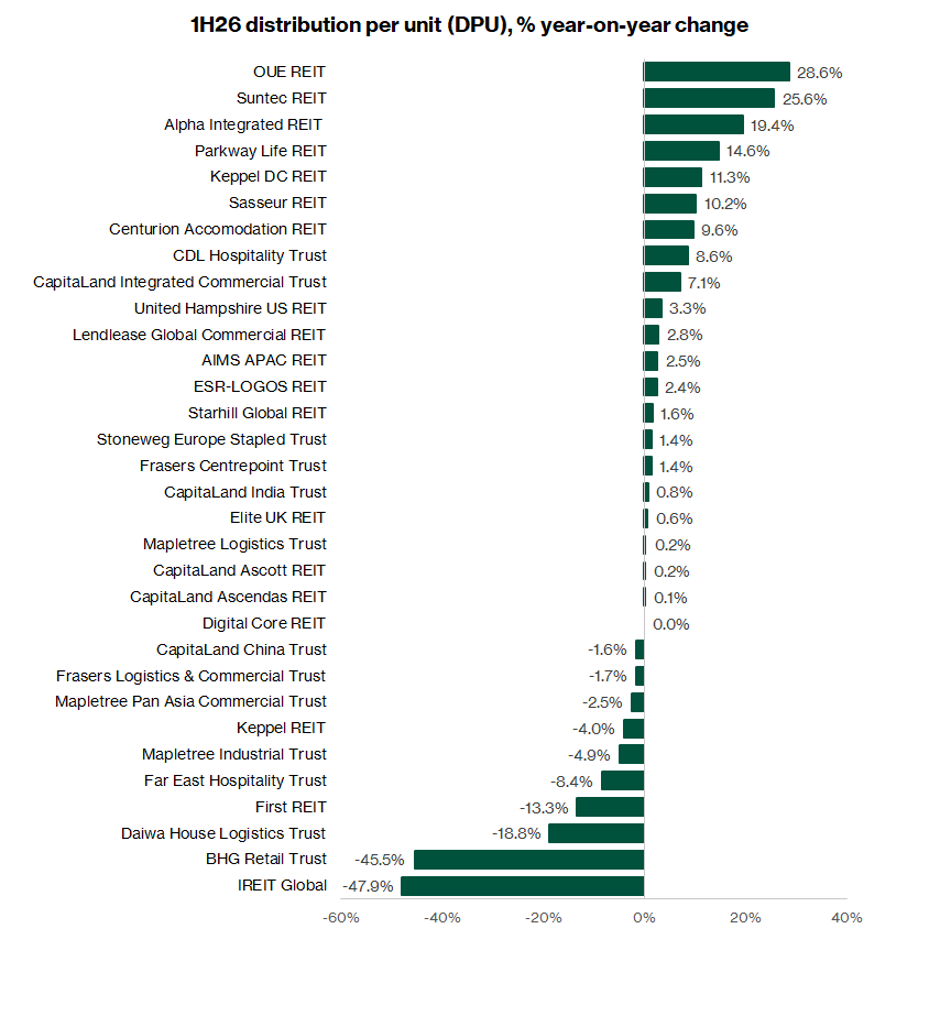
This is why I would be careful about treating S-REITs as a single asset class when hunting for yield.
Lower interest rates may help the sector overall, but the income received by investors will still depend on factors such as rental growth, property performance, financing costs and acquisitions or divestments.
For an income investor, I would therefore start by asking whether DPU is stable or growing, rather than simply looking for the REIT with the highest distribution yield. This is also the first check in our REIT income screening framework.
Based on the latest numbers, I see greater consistency in earnings growth across the three banks. For S-REITs, I think investors need to be much more selective.
Related links:
- DBS dividend history and dividend forecast
- OCBC dividend history and dividend forecast
- UOB dividend history and dividend forecast
What would Beansprout do?
At Beansprout, we still see Singapore stocks as a core part of a globally diversified portfolio.
For a core income position within my Income Pot as part of Beansprout's four pots of wealth today, Singapore banks still have its appeal despite the share price rally.
The Singapore banks’ dividend yields of around 3.5% to 4.6% may be lower than what many S REITs offer, but all three banks have continued to grow profits even as net interest margins came under pressure.
Growth in non-interest income and wealth management has helped to support earnings, while CET1 ratios of more than 15% across DBS, OCBC and UOB point to strong capital positions.
The caveat is valuation. Singapore banks are trading at elevated price to book valuations, which suggests that a fair amount of their strong fundamentals is already reflected in share prices. This is also one reason their dividend yields are now lower than what investors may have been used to.
At the same time, that does not mean I would avoid Singapore REITs. I would be selective, focusing on those where distributions are growing, gearing remains manageable and borrowing costs are under control.
With bond yields rising again, I would also want the higher REIT yield to provide enough compensation for the additional leverage, refinancing and interest rate risks.
If you are looking for REIT income ideas, use our REITs Screener to compare S-REITs across DPU growth, gearing and yield.
More importantly, I would not treat this as a simple choice between banks and REITs.
When evaluating S-REITs and banks, the key is to take a portfolio approach to investing to diversify the sources of income while looking for opportunities where the fundamentals justify the additional risk.
Rather than asking which investment offers the highest yield, I would ask how each position fits within the portfolio, and whether the overall mix gives me the income, diversification and risk I am looking for.
This is also how we approach investing in Beansprout Pro, where we look beyond individual stock ideas to consider position sizing, portfolio construction and how each investment fits together.
Learn more about how we build and manage our Model Portfolio with Beansprout Pro.
Which banks or S-REITs are you watching for your income pot? Share your thoughts in the comments below or join the discussion in our Telegram group!
Follow Beansprout on YouTube, Facebook and Instagram, and add Beansprout as your preferred source on Google so you never miss an update.
Read also
Gain financial insights in minutes
Subscribe to our free weekly newsletter for more insights to grow your wealth
Most Popular

Comments
0 comments