
3 best-performing Singapore blue chip stocks in July 2026. What to watch after the rally
Stocks
By Ng Hui Min • 05 Aug 2026
Why trust Beansprout? We’ve been awarded Best Investment Website at the SIAS Investors’ Choice Awards 2025
'%3e%3cpath%20fill-rule='evenodd'%20clip-rule='evenodd'%20d='M17.64%209.20455C17.64%208.56637%2017.5827%207.95273%2017.4764%207.36364H9V10.845H13.8436C13.635%2011.97%2013.0009%2012.9232%2012.0477%2013.5614V15.8195H14.9564C16.6582%2014.2527%2017.64%2011.9455%2017.64%209.20455V9.20455Z'%20fill='%234285F4'/%3e%3cpath%20fill-rule='evenodd'%20clip-rule='evenodd'%20d='M9%2018C11.43%2018%2013.4673%2017.1941%2014.9564%2015.8195L12.0477%2013.5614C11.2418%2014.1014%2010.2109%2014.4205%209%2014.4205C6.65591%2014.4205%204.67182%2012.8373%203.96409%2010.71H0.957275V13.0418C2.43818%2015.9832%205.48182%2018%209%2018V18Z'%20fill='%2334A853'/%3e%3cpath%20fill-rule='evenodd'%20clip-rule='evenodd'%20d='M3.96409%2010.71C3.78409%2010.17%203.68182%209.59318%203.68182%209C3.68182%208.40682%203.78409%207.83%203.96409%207.29V4.95818H0.957273C0.347727%206.17318%200%207.54773%200%209C0%2010.4523%200.347727%2011.8268%200.957273%2013.0418L3.96409%2010.71V10.71Z'%20fill='%23FBBC05'/%3e%3cpath%20fill-rule='evenodd'%20clip-rule='evenodd'%20d='M9%203.57955C10.3214%203.57955%2011.5077%204.03364%2012.4405%204.92545L15.0218%202.34409C13.4632%200.891818%2011.4259%200%209%200C5.48182%200%202.43818%202.01682%200.957275%204.95818L3.96409%207.29C4.67182%205.16273%206.65591%203.57955%209%203.57955V3.57955Z'%20fill='%23EA4335'/%3e%3c/g%3e%3cdefs%3e%3cclipPath%20id='clip0_0_2849'%3e%3crect%20width='18'%20height='18'%20fill='white'/%3e%3c/clipPath%3e%3c/defs%3e%3c/svg%3e)
Make Beansprout your preferred source on Google
Add us on Google to see more of our insights in your search results
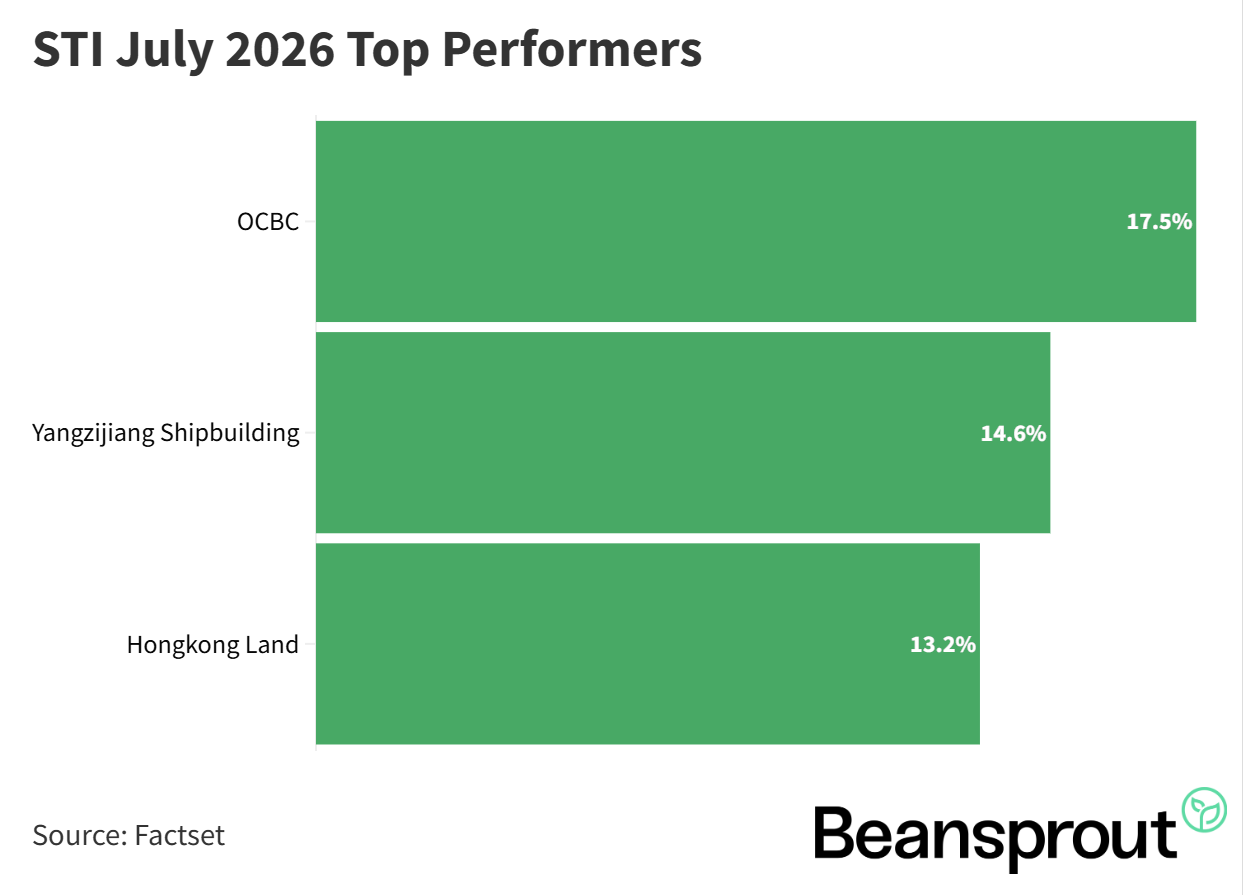
We look at the top three Singapore blue chip stocks in July which saw gains of about 13% or more, and what investors should watch after the rally.
What happened?
Singapore blue chips rallied strongly in July.
We continue to see DBS, OCBC and UOB reach record highs over the past month.
At the same time, we saw SIA report its first quarterly loss since 2022 and examined why Keppel’s headline profit fell even as its core business continued to grow.
With the August earnings season getting underway, we also looked at 3 Singapore blue-chip stocks due to report in the weeks ahead.
Investors may be wondering whether July’s strongest blue-chip stocks can continue to outperform, or whether some of the good news has already been priced in.
In this article, I look at what drove the gains in July’s top performers, how they fare under Beansprout’s Opportunity Pot screen and what investors may want to watch next.
3 best-performing Singapore blue-chip stocks in July 2026
#1 – OCBC (SGX: O39)
OCBC is Singapore’s second-largest bank by assets and has banking operations across Singapore, Malaysia, Indonesia and Greater China.
It also owns private bank Bank of Singapore and holds a significant stake in insurer Great Eastern.
OCBC’s share price rose 17.5% in July to close at S$29.13, extending its year-to-date gain to 47.4%. This made it the best-performing STI stock during the month.
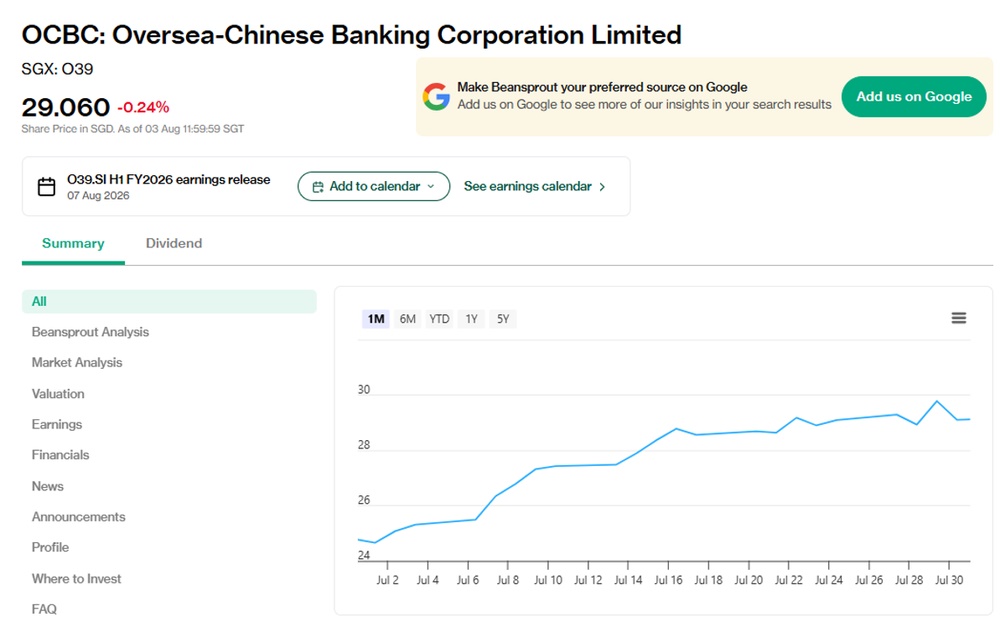
The rally appeared to reflect continued optimism towards Singapore banks, as investors looked beyond the impact of lower interest rates and focused on loan growth, wealth management fees and other sources of non-interest income.
OCBC reported a net profit of S$1.97 billion for the first quarter of 2026, up 5% year on year and 13% from the preceding quarter.
Total income also rose 5% to a record S$3.83 billion.
The growth was driven by non-interest income, which increased 23% to a record S$1.61 billion and made up more than 40% of total income.
Net fee income rose 24% to S$675 million, supported by a 34% rise in wealth management fees.
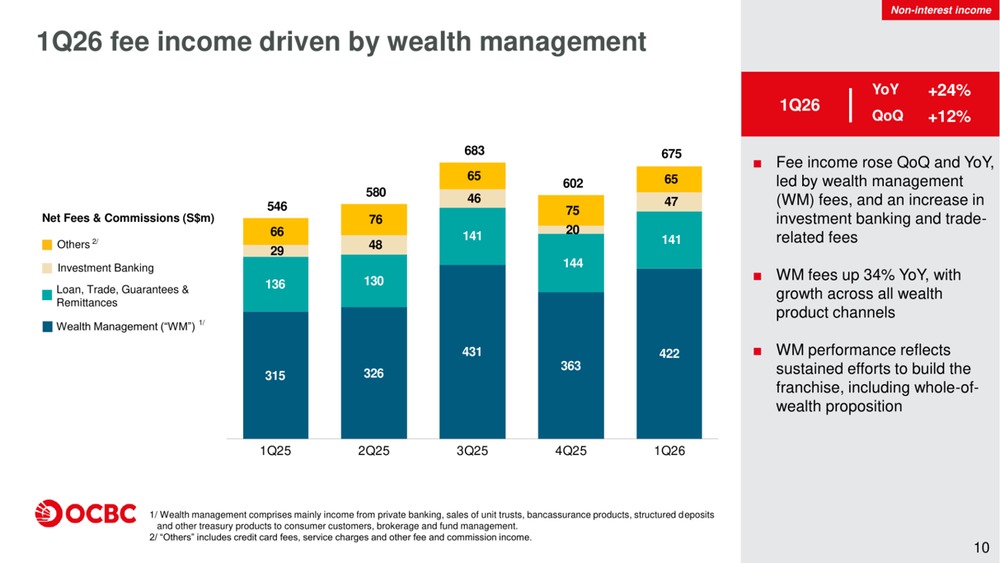
Insurance income also increased 34% to S$409 million, while trading income grew 10% to S$434 million.
OCBC’s total wealth-management income reached S$1.48 billion, representing 39% of group income. Banking wealth-management assets under management grew 12% year on year to S$342 billion.
This helped offset weaker net interest income, which declined 5% to S$2.22 billion as lower interest rates reduced asset yields.
OCBC’s net interest margin fell by 28 basis points year on year to 1.76%.
Its non-performing loan ratio remained at 0.9%, while total coverage for non-performing assets improved to 163%.
OCBC’s fully phased-in Common Equity Tier 1 capital adequacy ratio stood at 15.2%, providing the bank with a healthy buffer to absorb potential credit losses and support future growth.
Its annualised return on equity was 13.0% in the first quarter, unchanged from the previous year.
OCBC has also been investing more heavily in its wealth franchise.
The bank is rolling out an AI-native app for wealth customers, with digital avatars that can act as round-the-clock advisers.
This forms part of OCBC’s broader “next frontier” strategy, where AI, digital tools and data are expected to support future growth.
At the same time, OCBC is not relying on technology alone.
The bank plans to add 600 relationship managers to its consumer banking business over the next three years, showing that it still sees human advisers as an important part of the wealth management model.
OCBC has also expanded its precious metals offering.
From 10 June, the bank began offering physical gold trading and custody to institutional clients and high-net-worth customers of Bank of Singapore.
The gold will be stored in a Singapore-based vault.
This move taps into rising demand for physical gold and growing client preference to transact and hold bullion locally.
It also adds to OCBC’s broader wealth-management push, which is already showing up through stronger fee income and insurance-related earnings.
Based on Beansprout's Opportunity Pot screen, OCBC passes two of the three checks.
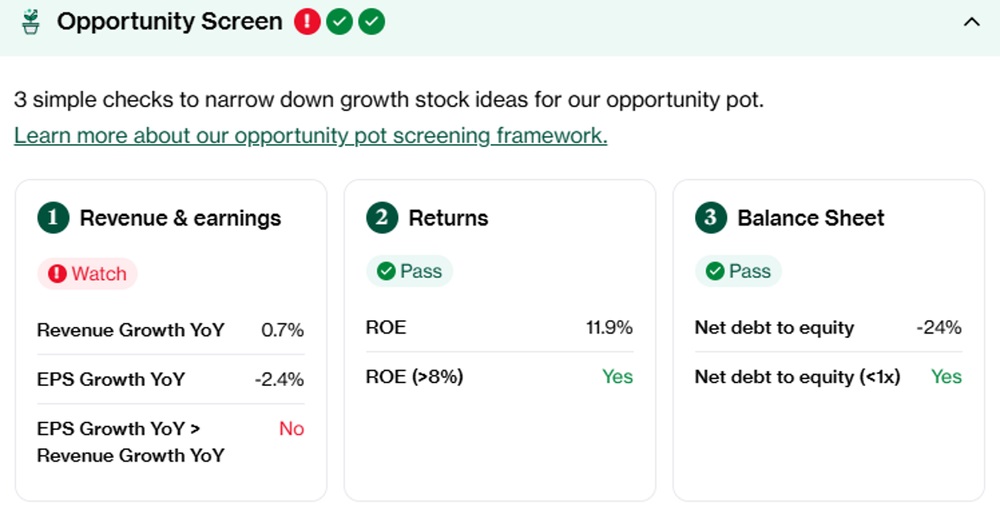
For a bank, I would also supplement the screen with capital adequacy and asset quality, where OCBC's latest figures remained resilient.
After the strong share-price rally, I would pay closer attention to whether growth in wealth management and insurance can continue to offset pressure on net interest margins, and whether the improved outlook is already reflected in its valuation.
OCBC is due to announce its first-half 2026 results on 7 August. I would watch its net interest margin, fee income, net new money inflows and guidance for credit costs.
As of 3 August 2026, OCBC was trading at a price-to-earnings ratio of about 16.87 times, above its historical average of 10.81 times.
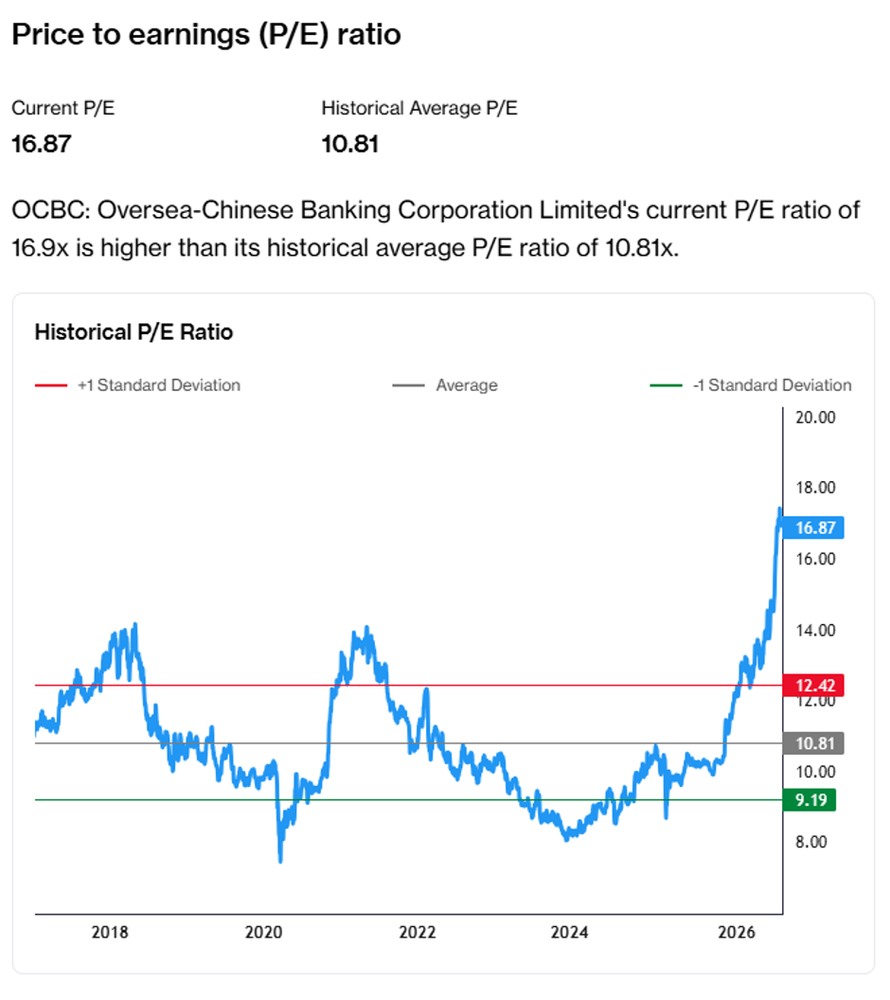
The higher valuation suggests that investors have already priced in expectations of resilient profitability, wealth-management growth and continued capital returns.
Estimate a potential entry or exit price for OCBC based on its historical price-to-earnings ratio using the P/E price target estimator below.
Related links:
- What Great Eastern’s 43% profit jump means for OCBC
- Can Singapore bank shares keep climbing? What US bank results and global valuations tell us
- OCBC latest valuation, share price and analysis
- OCBC dividend history and dividend forecast
#2 – Yangzijiang Shipbuilding (SGX: BS6)
Yangzijiang Shipbuilding is one of China’s largest privately owned shipbuilders.
The group constructs commercial vessels including containerships, bulk carriers, oil tankers and gas carriers at its shipyards in Jiangsu, China.
Its share price gained 14.6% in July to close at S$3.92.
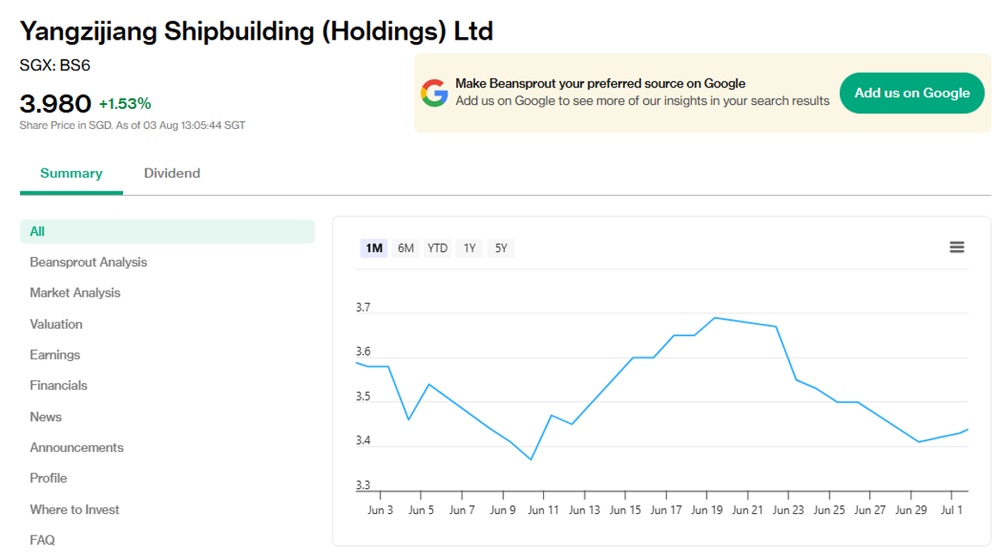
The rally came ahead of Yangzijiang Shipbuilding’s first-half results, with investors watching whether it could continue converting its record order book into higher revenue and earnings.
Yangzijiang Shipbuilding delivered record revenue and profit for FY2025.
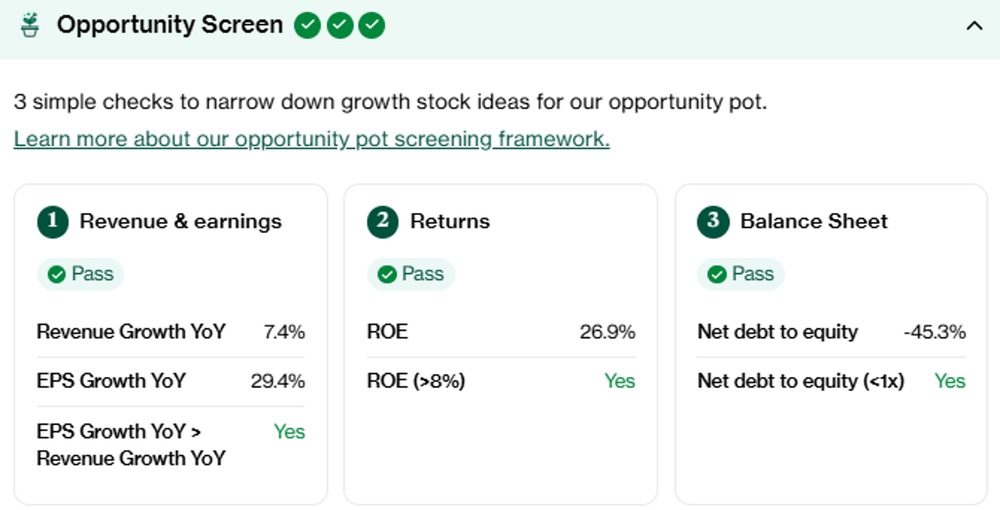
For FY2025, Yangzijiang Shipbuilding’s revenue rose 7.4% to RMB28.5 billion.
Gross profit grew at a faster pace of 28.3% to RMB9.8 billion, while its gross profit margin expanded from 28.7% to 34.2%.
Net profit attributable to shareholders increased 30.2% to a record RMB8.6 billion.
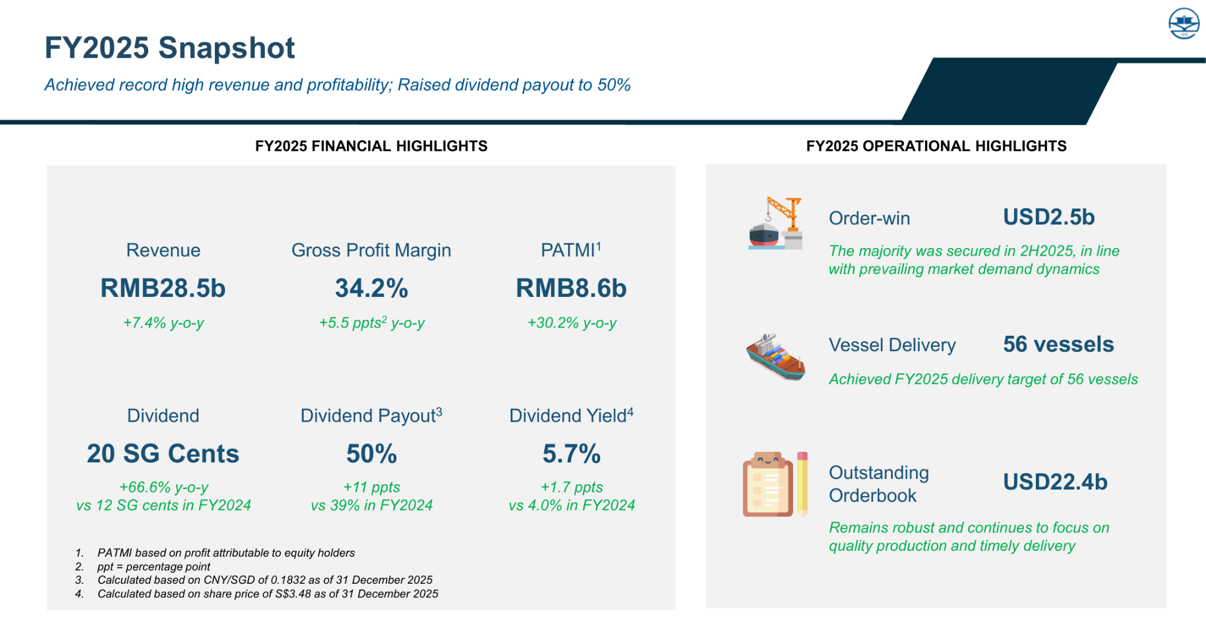
The stronger performance was driven mainly by its shipbuilding business.
Shipbuilding revenue grew 6.4% to RMB26.8 billion as the group recognised revenue from vessels secured at higher prices.
Shipbuilding gross profit rose 34.2% to RMB9.4 billion, with its gross margin expanding to 35.1%.
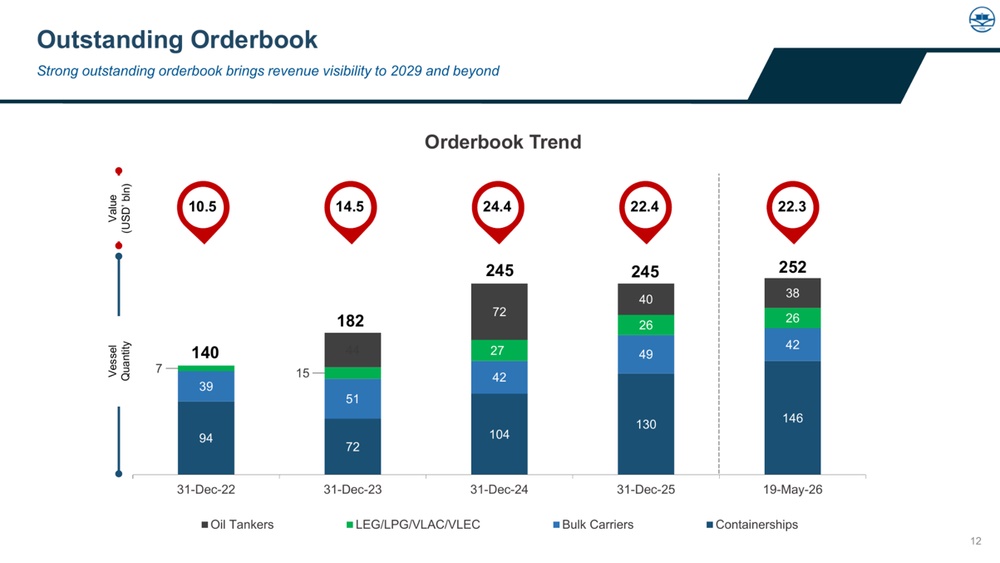
As of 19 May 2026, Yangzijiang Shipbuilding had an outstanding order book of US$22.3 billion comprising 252 vessels, providing revenue visibility to 2029 and beyond.
This provides visibility over future revenue, although the eventual profit will depend on factors such as contract pricing, steel costs and the execution of vessel deliveries.
The group is also expanding its production capacity through Project Hongyuan.
Preliminary shipbuilding activities started in the first quarter of 2026, and the project is expected to be completed by the end of the year. Management has set an order-win target of US$4.5 billion for FY2026.
Beyond its core shipyard business, Yangzijiang Shipbuilding has also been expanding into ship ownership and chartering.
The group completed the acquisition of a 10% equity interest in Poseidon, the owner of Seaspan Corporation, making Poseidon an associated company of Yangzijiang Shipbuilding.
Seaspan is a major containership owner and operator, which gives Yangzijiang Shipbuilding exposure to recurring containership leasing income.
The stake was acquired for US$825.7 million in cash from affiliates of Canada’s Fairfax Financial and the Washington Family.
The acquisition was funded using Yangzijiang Shipbuilding’s internal resources.
Strategically, the deal moves the group one step beyond its traditional shipbuilding business and gives it exposure to the ship leasing value chain.
However, it also uses up part of the net cash position that has supported Yangzijiang Shipbuilding’s balance-sheet strength.
Yangzijiang Shipbuilding proposed a final dividend of S$0.20 per share for FY2025, representing a payout ratio of 50%.
At its share price of S$3.92 on 31 July, this would represent a trailing dividend yield of about 5.1%.
The group had RMB20.1 billion of cash and cash equivalents at the end of 2025, compared with total borrowings of RMB5.5 billion.
This translates to a net cash position of approximately RMB14.6 billion, excluding restricted cash.
Based on its FY2025 net profit and average shareholders’ equity, its return on equity was approximately 29.6%.
This is well above our preferred baseline, although part of the high return reflects the favourable stage of the shipbuilding cycle.
Yangzijiang Shipbuilding therefore passes all three initial Opportunity Pot checks.
Its large order book and higher-priced contracts may support earnings over the next few years.
However, shipbuilding remains cyclical. A decline in new vessel orders, weaker ship prices, higher steel costs or delays in completing vessels could affect future margins.
The group also receives much of its revenue in US dollars while reporting in renminbi, making its earnings sensitive to currency movements.
Yangzijiang Shipbuilding is expected to report its first-half results on 6 August. I would watch its shipbuilding margin, pace of new order wins, progress at Project Hongyuan and whether vessel deliveries remain on schedule.
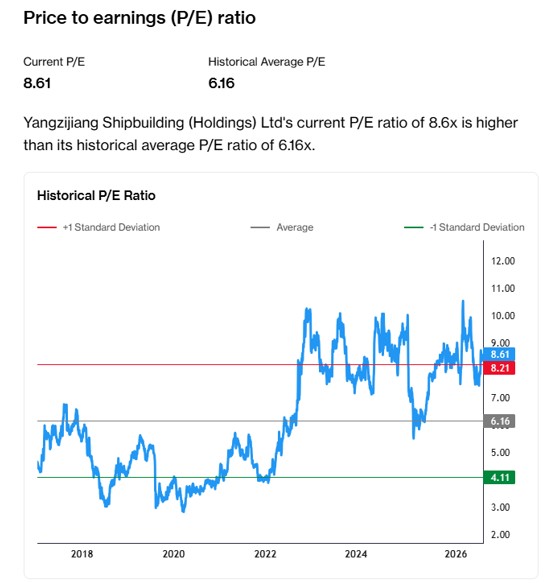
As of 3 August 2026, Yangzijiang Shipbuilding was trading at a price-to-earnings ratio of about 8.61 times, above its historical average of 6.16 times.
Estimate a potential entry or exit price for Yangzijiang Shipbuilding based on its historical price-to-earnings ratio using the P/E price target estimator below.
Related Links:
- Yangzijiang Shipbuilding (Holdings) Ltd latest valuation, share price and analysis
- Yangzijiang Shipbuilding (Holdings) Ltd dividend history and dividend forecast
#3 – Hongkong Land (SGX: H78)
Hongkong Land is an Asian property investment and development group.
Its portfolio is anchored by premium office and retail properties in Hong Kong’s Central district, together with commercial properties in Singapore and developments across other Asian markets.
Hongkong Land's share price gained 13.2% in Singapore dollar terms during July and closed at US$8.12 on 31 July. As its shares trade in US dollars, the Singapore dollar return also reflects currency movements.
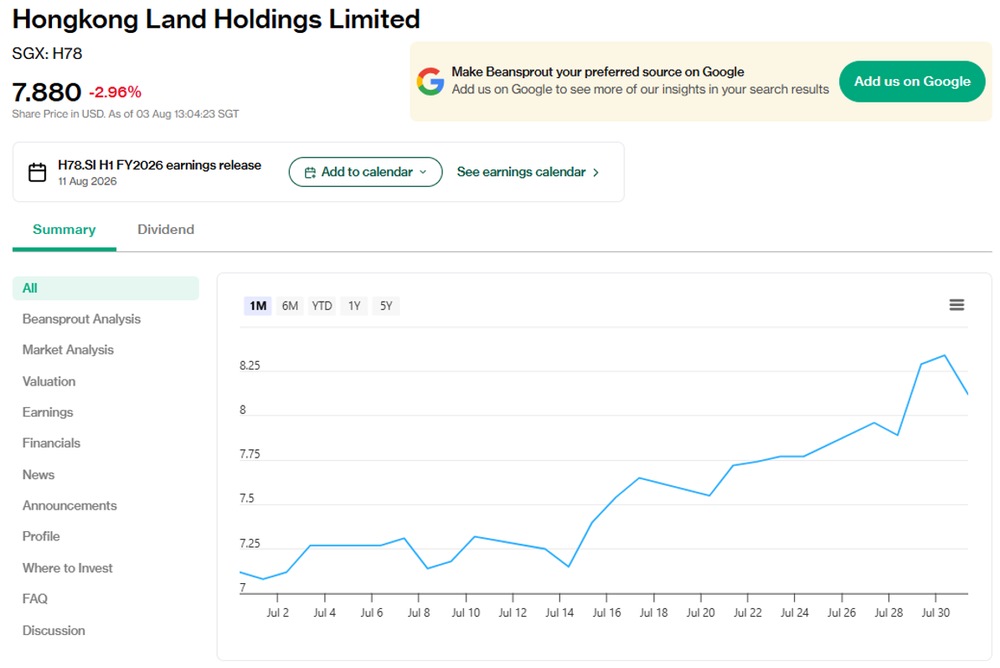
The gains were supported by improving sentiment towards Hong Kong’s prime office market, continued asset recycling and Hongkong Land’s ongoing share repurchases.
Hongkong Land reported an underlying profit of US$259 million for the first half of 2026, up 11% year on year.
Underlying earnings per share grew 14% to US$0.1207.
Including non-cash property valuation movements, profit attributable to shareholders rose to US$1.26 billion from US$221 million in the previous year.
The value of its investment-property portfolio increased by 3% from the end of 2025, mainly due to higher market rents and lower capitalisation rates for its prime Hong Kong properties.
Net asset value increased to US$14.71 per share from US$14.30 at the end of 2025.
At its 31 July share price of US$8.12, Hongkong Land was trading at a discount of about 45% to its latest net asset value.
This discount may appear attractive, but closing it will depend on whether management can improve the returns generated by the group’s large asset base.
Hong Kong’s prime Central office market continued to recover during the first half of 2026.
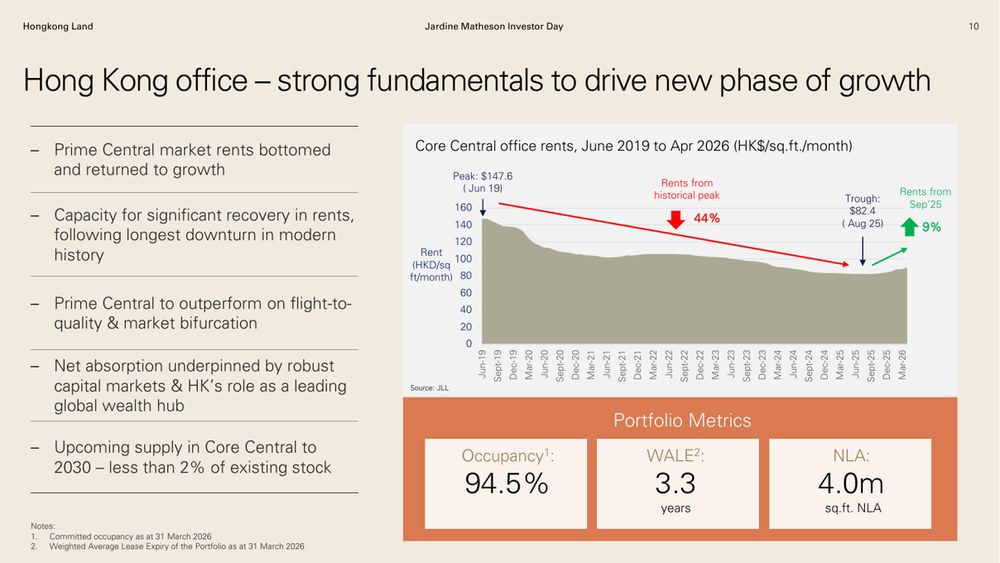
Market rents had risen 11% from their third-quarter 2025 low by the end of June, while market vacancy declined to 9.2% from 11.0% at the end of 2025.
Hongkong Land’s Central office portfolio achieved committed occupancy of 94.2%.
Tenant sales at its LANDMARK retail properties grew 11%, supported by demand for luxury watches and jewellery.
In Singapore, committed office occupancy stood at 96.3%, with positive rental reversions and average rents of S$11.90 per square foot.
However, the broader Singapore office market remains mixed.
URA data for 2Q2026 showed island-wide office rents rising 0.8% quarter-on-quarter, reversing the 0.2% decline in the previous quarter.
Office prices also rose 0.4%.
At the same time, the island-wide office vacancy rate edged up to 11.0%, from 10.8% previously.
This suggests that rental recovery is still uneven.
While prime and well-located assets such as Hongkong Land’s Singapore offices remain well occupied, the gradual increase in broader market vacancy is worth watching.
Hongkong Land has realised US$3.7 billion of net proceeds from asset recycling since launching its new strategy in late 2024.
This represents 93% of its target to recycle at least US$4 billion by the end of 2027.
Net debt declined to US$3.4 billion at the end of June 2026, from US$4.9 billion a year earlier, while net gearing fell to 11%.
The stronger balance sheet gives Hongkong Land more flexibility to invest in its existing portfolio, return capital to shareholders and expand its third-party fund-management business.
The group returned more than US$560 million to shareholders through dividends and share repurchases during the first half of 2026.
Hongkong Land’s fund-management push has already produced its first deal.
Its newly established private real estate vehicle, the Singapore Central Private Real Estate Fund, has agreed to acquire Wheelock Place in Singapore for about S$1.1 billion from Wharf Real Estate Investment.
This is the fund’s maiden transaction since it was launched in February.
The acquisition covers Wheelock Place’s 21-storey commercial tower and retail podium, with about 43,280 square metres of gross floor area.
The deal is expected to complete by the end of August.
Once completed, the fund’s assets under management will rise to S$9.4 billion, from S$8.2 billion at inception.
The acquisition is also expected to be accretive to Hongkong Land’s underlying earnings.
Hongkong Land will inject additional equity to maintain its existing majority stake in the fund alongside other investors.
It will also earn additional management fees as AUM grows.
This is a tangible step in building recurring, capital-light fund-management income, which management has identified as a lever to improve group returns over time.
Hongkong Land passes two of the three initial Opportunity Pot checks.
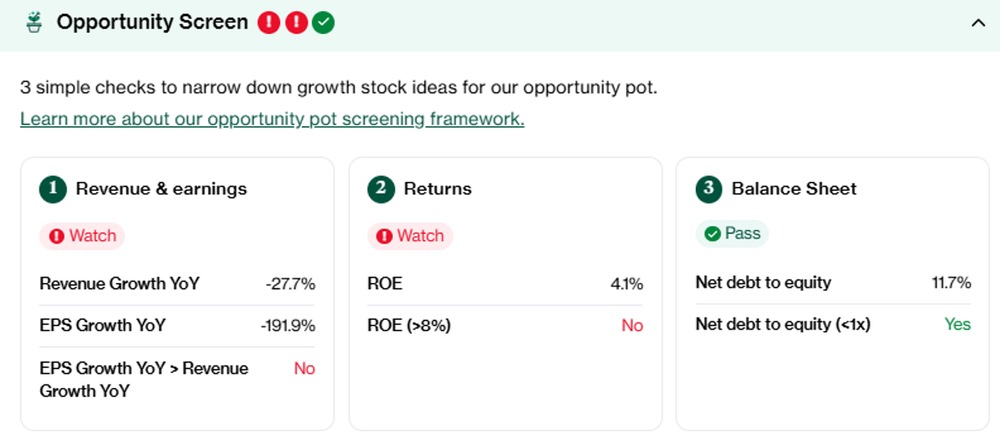
Based on its first-half underlying profit and average shareholders’ equity, its annualised underlying return on equity was only about 1.7%.
Even if non-cash property revaluation gains are included, its annualised reported return on equity would remain below the 10% threshold.
This highlights the main challenge facing Hongkong Land.
It owns valuable properties and trades at a significant discount to their reported net asset value, but the recurring returns generated on its equity base remain modest.
Management will need to demonstrate that asset sales, share repurchases, new funds and improvements in occupancy can produce meaningfully higher returns over time.
As of 3 August 2026, Hongkong Land Holdings was trading at a price-to-earnings ratio of about 29.76 times, above its historical average of 25.8 times.
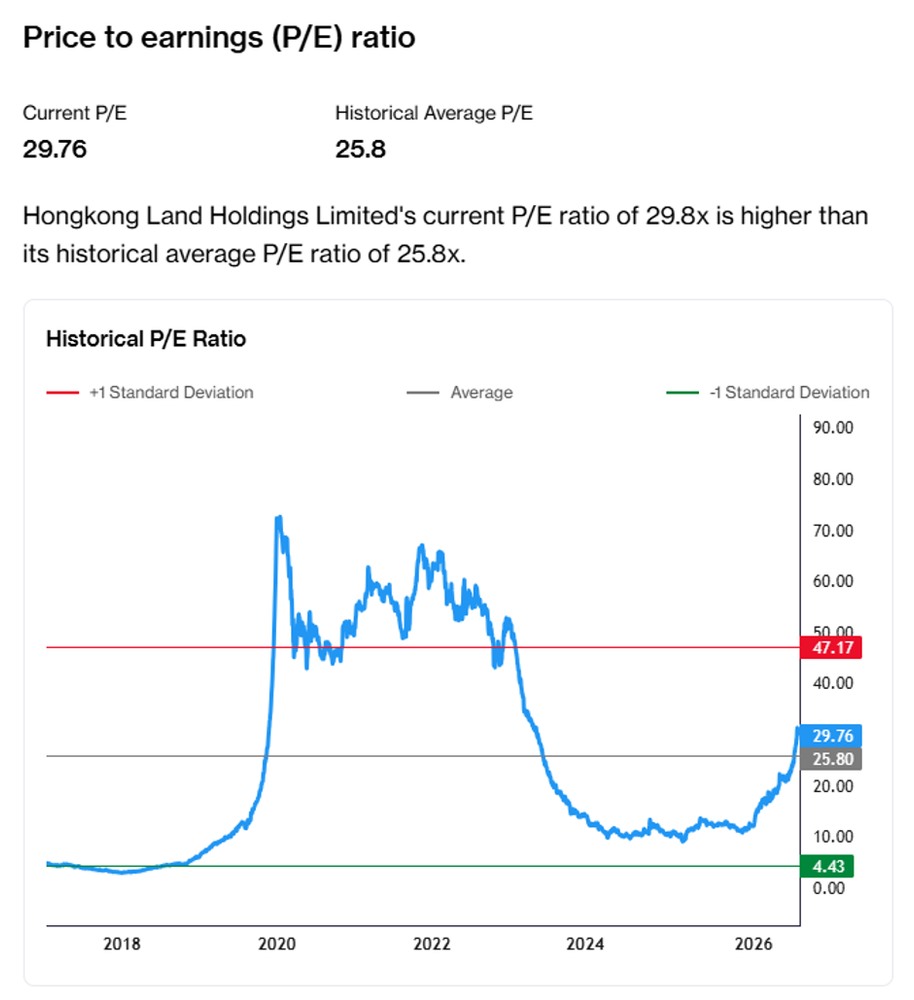
Estimate a potential entry or exit price for Hongkong Land based on its historical price-to-earnings ratio using the P/E price target estimator below.
Related Links:
- Hongkong Land Holdings Limited latest valuation, share price and analysis
- Hongkong Land Holdings Limited dividend history and dividend forecast
What would Beansprout do?
OCBC, Yangzijiang Shipbuilding and Hongkong Land have each delivered strong share-price gains in July 2026.
However, I would not consider a stock for my Opportunity Pot as part of Beansprout’s four pots of wealth based on a strong one-month share-price gain alone.
I would start by looking at their earnings momentum, balance sheets and return on equity.
| Stock | Opportunity Pot result | What stands out | Key risks |
| OCBC | 2/3 checks | Diversified earnings, growing wealth income and strong capital position | EPS momentum, lower net interest margins, credit costs and valuation after the rally |
| Yangzijiang Shipbuilding | 3/3 checks | Strong earnings growth, high ROE, net cash and a record order book | Shipbuilding cycle, new orders, steel costs, currencies and execution |
| Hongkong Land | 2/3 checks | Improving operating conditions, lower debt and a wide discount to NAV | Low underlying ROE, property-market volatility and strategy execution |
Based on the screen, Yangzijiang Shipbuilding is the only stock that passes all three checks.
It has the strongest earnings momentum and return on equity, while its net cash position and large order book provide some visibility over the next few years. However, I would still assess its valuation and watch whether margins and order wins remain resilient as the shipbuilding cycle matures. Learn more about Yangzijiang Shipbuilding's latest valuation and dividend analysis here.
OCBC passes the returns and balance-sheet checks but remains on my watchlist for revenue and earnings growth. Its diversified income streams are encouraging, but I would want to see EPS momentum improve and assess whether the recent rally has already priced in much of the positive outlook. Learn more about OCBC's latest valuation and dividend analysis here.
Hongkong Land passes only the balance-sheet check. Its latest underlying results and operating indicators are improving, but I would like clearer evidence that asset recycling and the recovery in its prime properties can lift recurring earnings and ROE before carrying out a deeper review. Learn more about Hongkong Land's latest valuation and dividend analysis here.
Overall, Yangzijiang Shipbuilding appears strongest based on the Opportunity Pot screen.
OCBC remains a high-quality business to watch, while Hongkong Land is still a recovery story with more to prove.
If their latest results point to improvements and meaningful upside, I would assess whether these blue-chip stocks merit further research as higher conviction individual stock ideas within my portfolio. You can learn how we screen for growth stocks using three simple checks here.
To find out which blue chip stocks we would hold in our model portfolio, check out how we would invest $100,000 in Singapore today.
If you are looking for greater clarity on the markets and the investment decisions that matter, explore Beansprout Pro for our latest views, portfolio thinking and the reasoning behind each opportunity.
Investors who prefer broad exposure to Singapore blue chips without selecting individual companies may consider gaining exposure to the Straits Times Index through an STI ETF.
Beyond these three companies, we still believe that Singapore stocks are still worth looking at in 2026.
There are many other avenues to capture structural growth in the Singapore market, including companies linked to infrastructure, data centres, energy and food security as well as Singapore's rise as a wealth hub. Find out more about the 4 growth themes we are watching in Singapore stocks here.
Which of these three blue-chip stocks are you watching after their strong performance in July? Share your thoughts in the comments below or in the Beansprout Telegram community.
Planning to invest in Singapore blue chip stocks? Check out Beansprout's guide to the best stock trading platforms in Singapore with the latest promotions to invest in the Singapore market and see the latest promotions and sign-up rewards available.
Enjoyed this insight? Follow Beansprout on Telegram, Youtube, Facebook and Instagram, and add Beansprout as your preferred source on Google so you never miss an update.
Read also
Gain financial insights in minutes
Subscribe to our free weekly newsletter for more insights to grow your wealth
Most Popular

Comments
0 comments