
SGX board lot size reduction: What it means for buying DBS, UOB, OCBC and other blue chip stocks from October 2026
Stocks
By Gerald Wong, CFA • 03 Sep 2026
Why trust Beansprout? We’ve been awarded Best Investment Website at the SIAS Investors’ Choice Awards 2025
'%3e%3cpath%20fill-rule='evenodd'%20clip-rule='evenodd'%20d='M17.64%209.20455C17.64%208.56637%2017.5827%207.95273%2017.4764%207.36364H9V10.845H13.8436C13.635%2011.97%2013.0009%2012.9232%2012.0477%2013.5614V15.8195H14.9564C16.6582%2014.2527%2017.64%2011.9455%2017.64%209.20455V9.20455Z'%20fill='%234285F4'/%3e%3cpath%20fill-rule='evenodd'%20clip-rule='evenodd'%20d='M9%2018C11.43%2018%2013.4673%2017.1941%2014.9564%2015.8195L12.0477%2013.5614C11.2418%2014.1014%2010.2109%2014.4205%209%2014.4205C6.65591%2014.4205%204.67182%2012.8373%203.96409%2010.71H0.957275V13.0418C2.43818%2015.9832%205.48182%2018%209%2018V18Z'%20fill='%2334A853'/%3e%3cpath%20fill-rule='evenodd'%20clip-rule='evenodd'%20d='M3.96409%2010.71C3.78409%2010.17%203.68182%209.59318%203.68182%209C3.68182%208.40682%203.78409%207.83%203.96409%207.29V4.95818H0.957273C0.347727%206.17318%200%207.54773%200%209C0%2010.4523%200.347727%2011.8268%200.957273%2013.0418L3.96409%2010.71V10.71Z'%20fill='%23FBBC05'/%3e%3cpath%20fill-rule='evenodd'%20clip-rule='evenodd'%20d='M9%203.57955C10.3214%203.57955%2011.5077%204.03364%2012.4405%204.92545L15.0218%202.34409C13.4632%200.891818%2011.4259%200%209%200C5.48182%200%202.43818%202.01682%200.957275%204.95818L3.96409%207.29C4.67182%205.16273%206.65591%203.57955%209%203.57955V3.57955Z'%20fill='%23EA4335'/%3e%3c/g%3e%3cdefs%3e%3cclipPath%20id='clip0_0_2849'%3e%3crect%20width='18'%20height='18'%20fill='white'/%3e%3c/clipPath%3e%3c/defs%3e%3c/svg%3e)
Make Beansprout your preferred source on Google
Add us on Google to see more of our insights in your search results
SGX will reduce board lot sizes for DBS, UOB, OCBC and eight other blue chip stocks from 5 October 2026. Here’s how the change could affect how you invest and your portfolio.

What happened?
Buying DBS, UOB and OCBC will soon require a lot less cash.
This could be helpful after DBS, OCBC and UOB continued to rally this year, pushing up the amount needed to buy a standard board lot of these blue chip stocks.
OCBC, for example, has been among the best-performing Singapore blue-chip stocks for two months in a row.
At a share price of S$31.85 as of 2 September 2026, buying one current board lot of 100 OCBC shares would require S$3,185 before transaction fees.
However, from 5 October 2026, the standard board lot for 11 higher-priced stocks on the Singapore Exchange (SGX), including DBS, OCBC and UOB, will fall from 100 shares to 10 shares.
That means, investors will be able to buy 10 shares as one standard lot instead. For OCBC, this would reduce the amount needed for one standard lot to about S$318.50 at the same share price.
For me, the more interesting question is what this means for how I build my portfolio.
If I have S$10,000 to invest in Singapore stocks, I will soon have much more flexibility to decide how much I want to put into DBS, UOB, OCBC and other Singapore stocks, rather than letting the size of one board lot determine my allocation.
So rather than just looking at how much cheaper it becomes to buy one board lot, I think the bigger question is whether smaller board lots will change how we diversify, build positions and allocate money across Singapore stocks.
What is an SGX board lot and how will board lot sizes change?
A board lot is the standard number of shares we buy or sell on SGX’s ready market.
For most Singapore stocks today, one board lot contains 100 shares.
This means that if a stock trades at S$20, buying one board lot would require an investment of about S$2,000, before transaction fees.
From 5 October 2026, SGX will reduce the standard board lot for higher priced securities.
| Price of security | Current board lot | New board lot |
|---|---|---|
| S$10 and below | 100 units | 100 units |
| Above S$10 and up to S$100 | 100 units | 10 units |
| Above S$100 | 100 units | 1 unit |
The change can apply to stocks as well as certain REITs, business trusts, stapled securities, company warrants, depository receipts and depository shares listed on SGX.
One point worth clearing up is that this is not a stock split.
If DBS is trading at S$77.60, one DBS share will still be worth S$77.60 after the board lot changes.
The company’s market value does not change either.
What changes is simply the number of shares that make up one standard lot.
Instead of having to buy 100 DBS shares as one board lot, investors will be able to buy 10 shares.
Which Singapore stocks will have smaller board lots from October 2026?
The initial board lot reduction will apply to 11 stocks:
- DBS Group (SGX: D05)
- Great Eastern Holdings (SGX: G07)
- Haw Par Corporation (SGX: H02)
- Jardine Cycle & Carriage (SGX: C07)
- Jardine Matheson Holdings (SGX: J36)
- Keppel (SGX: BN4)
- OCBC (SGX: O39)
- Prudential (SGX: K6S)
- Singapore Exchange (SGX: S68)
- UOB (SGX: U11)
- Venture Corporation (SGX: V03)
The three Singapore banks are therefore among the most prominent beneficiaries of the change.
All 11 currently fall within the range where the standard board lot will be reduced from 100 shares to 10 shares.
How much will it cost to buy DBS, UOB and OCBC after the board lot cut?
The amount needed to buy one standard lot of DBS, UOB and OCBC will fall significantly from 5 October.
Based on share prices as of 2 September 2026, the amount needed to buy one standard lot of DBS would fall from S$7,760 to S$776.
For UOB, it would fall from S$4,177 to S$417.70.
For OCBC, it would fall from S$3,185 to S$318.50.
Here is what the change could mean across the 11 stocks.
| Stock | Share price | Current 100 share lot | New 10 share lot |
|---|---|---|---|
| DBS | S$77.60 | S$7,760 | S$776 |
| UOB | S$41.77 | S$4,177 | S$417.70 |
| OCBC | S$31.85 | S$3,185 | S$318.50 |
| Jardine Cycle & Carriage | S$27.04 | S$2,704 | S$270.40 |
| SGX | S$24.95 | S$2,495 | S$249.50 |
| Great Eastern | S$20.78 | S$2,078 | S$207.80 |
| Venture Corporation | S$16.67 | S$1,667 | S$166.70 |
| Haw Par | S$14.19 | S$1,419 | S$141.90 |
| Keppel | S$11.53 | S$1,153 | S$115.30 |
| Jardine Matheson | US$59.18 | US$5,918 | US$591.80 |
| Prudential | US$14.20 | US$1,420 | US$142 |
| *Share prices as of 2 September 2026. Jardine Matheson and Prudential trade in US dollars on SGX. Figures exclude brokerage and other transaction fees. | |||
The difference is especially large if we are looking at the three local banks together.
Buying one current board lot each of DBS, UOB and OCBC would require about S$15,100 based on their share prices as of 2 September 2026.
From 5 October, one new board lot of each would require about S$1,510.
For those considering the three banks, we recently compared their latest earnings, dividends and valuations in our DBS vs OCBC vs UOB comparison.
How could smaller SGX board lots change how I invest?
For me, the main benefit is that smaller board lots give me more flexibility over how I allocate my portfolio.
This could make it easier to diversify, build a position gradually and rebalance over time.
1. Higher priced stocks become more accessible
DBS is perhaps the clearest example.
With its share price above S$70, a 100 share board lot requires more than S$7,000.
That can be a significant commitment, especially for someone who is just starting to invest or has a smaller portfolio.
Reducing the standard lot to 10 shares brings the minimum outlay down to hundreds of dollars instead.
The same applies to stocks such as UOB, OCBC and SGX.
2. It becomes easier to diversify
Suppose I have S$10,000 to invest in Singapore stocks.
Today, buying one board lot of DBS at S$7,760 would use up more than three-quarters of my portfolio.
That leaves relatively little room to diversify into other stocks.
With the smaller board lot, I could instead invest S$776 in 10 DBS shares, about S$418 in 10 UOB shares and about S$319 in 10 OCBC shares.
I would then have much more flexibility to decide how much exposure I want to each company, as well as how much to allocate elsewhere.
This can be particularly useful for investors with smaller portfolios, where one large board lot can otherwise become a disproportionately large position.
3. It becomes easier to build a position gradually
Smaller lot sizes could also make it easier to invest over time.
Instead of waiting until I have several thousand dollars before buying another 100 DBS shares, I could add 10 shares at a time.
This could be useful if I invest a prefer to build a position gradually rather than investing a large amount at once.
It also means I do not have to make the investment decision all at once.
If the share price falls or the company's outlook changes, I still have flexibility over whether I want to add further.
4. It becomes easier to rebalance a portfolio
The change also gives investors more control when adjusting an existing portfolio.
Suppose one stock has grown to become a much larger part of my portfolio than I intended.
Rather than adding another several thousand dollars to a different stock just to buy one board lot, I can deploy smaller amounts into other holdings.
Likewise, if I want a particular stock to represent 3% or 5% of my portfolio, smaller board lots make it easier to get closer to that intended allocation.
Individual Singapore stocks or STI ETF: What is the difference?
The choice depends on whether I want broad exposure to the Singapore market or more control over the individual companies I own.
Within Beansprout’s Four Pots of Wealth framework, individual stocks and an STI ETF can serve different purposes in my overall portfolio, depending on what I am trying to achieve.
Picking individual stocks such as DBS, UOB or OCBC would typically fall within my Opportunity Pot as it would allow me to decide which companies to invest in and how much to allocate to each one.
Here, I may take more concentrated positions in companies where I have a stronger view on their fundamentals, valuation and potential returns.
If I am picking individual stocks myself, I would generally keep these higher-conviction positions within my Opportunity Pot and set clear limits on position sizes, so that any single stock does not take up too much of my overall portfolio.
By comparison, an STI ETF can form part of my Growth Pot, where the objective is to build wealth over the long term through a diversified portfolio.
If my objective is simply to gain broad exposure to Singapore’s largest companies, I may not need to pick DBS, UOB or OCBC individually in the first place.
An STI ETF tracks the Straits Times Index, which consists of 30 of the largest and most liquid companies listed in Singapore.
Instead of buying DBS, UOB, OCBC and other stocks individually, an STI ETF allows investors to gain exposure to the entire index through a single investment.
More importantly for investors starting with a small amount, the SGX listed STI ETFs have a board lot size of just one unit.
This includes the SPDR Straits Times Index ETF (ES3), as well as the Amova Singapore STI ETF distributing class (G3B) and Amova Singapore STI ETF accumulating class (GAB).
This means the minimum amount needed to start investing can be just a few dollars, based on the prevailing ETF price, before brokerage and other transaction costs.
By comparison, even after the board lot reduction, buying 10 DBS shares at S$77.60 would require around S$776.
Buying 10 shares each of DBS, UOB and OCBC would require around S$1,510 based on the prices used earlier.
There is a trade-off.
An STI ETF gives me exposure to a broader basket of Singapore stocks, but I cannot choose exactly which companies I own or how much to allocate to each one.
The STI is also relatively concentrated in the three Singapore banks, so I would still consider how a Singapore-focused ETF fits alongside other markets and asset classes in my broader Growth Pot.
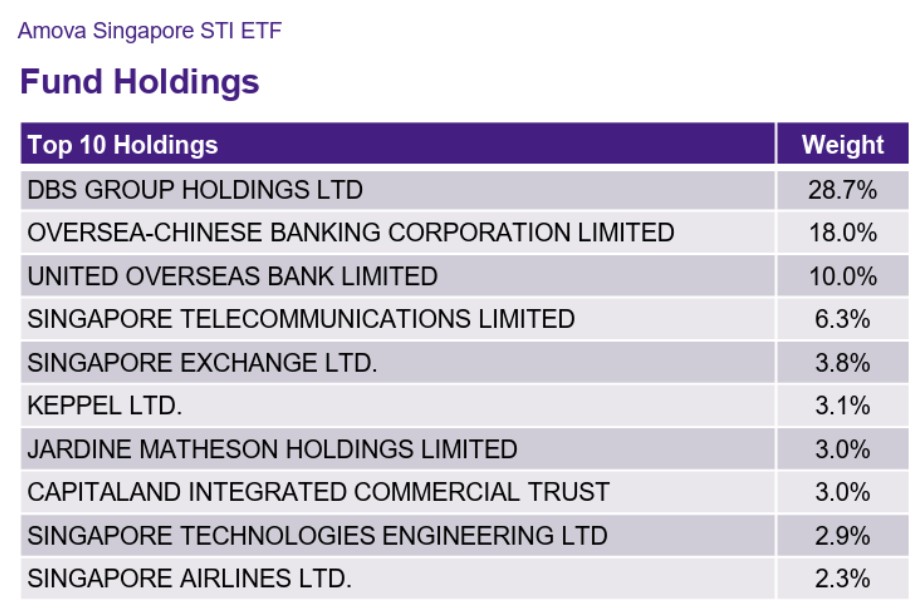
For investors who simply want broad exposure to Singapore’s largest listed companies, an STI ETF can therefore be one of the simpler and more accessible ways to invest.
For investors who have a stronger view on individual companies, the smaller board lot sizes make it much easier to build an Opportunity Pot of selected Singapore stocks without needing several thousand dollars for each position.
The board lot reduction therefore does not make one approach better than the other.
It simply gives me more flexibility to choose between building broad market exposure through my Growth Pot and taking more targeted positions through my Opportunity Pot, depending on what I am trying to achieve.
You can learn how to choose the best STI ETF for your growth pot and portfolio here.
Does the smaller board lot make DBS, UOB or OCBC cheaper?
The board lot reduction makes these stocks more accessible. It does not make them cheaper investments.
This is probably the most important point I would keep in mind.
If DBS trades at S$77.60 before the change, one share still costs S$77.60 afterwards.
Its earnings, dividend yield and valuation do not change just because investors can buy fewer shares at a time.
The same applies to UOB, OCBC, Keppel and the other stocks affected.
So I would not buy a company simply because the amount needed to get started has fallen.
I would still look at the business first: how earnings are doing, what could drive them from here, how strong the balance sheet is and what valuation I am paying.
The board lot determines how easily I can size the position.
It does not tell me whether the stock is worth owning.
Will more Singapore stocks above S$10 get smaller board lots?
More Singapore stocks could move to smaller board lots over time, as the first 11 stocks are only the initial batch.
SGX will review the market every calendar quarter to determine whether more securities qualify.
ST Engineering (SGX:S63) is one example of a stock investors may be watching.
Its share price has been trading above S$10, but it is not among the first 11 stocks moving to smaller board lots in October.
That does not mean its board lot will remain at 100 shares indefinitely.
SGX will review the market every calendar quarter to determine whether more securities qualify.
The first review after the October rollout will take place in January 2027 and will consider daily closing prices from July to December 2026.
Any subsequent board lot changes will be announced within the first five trading days after the end of the quarter and implemented within the first five trading days of the second month after that quarter.
Another useful feature is that once a board lot has been reduced, SGX says it will stay at the smaller size even if the share price later falls below S$10 or S$100.
So over time, we could see more Singapore stocks move to smaller board lots.
How do brokerage fees affect smaller stock trades?
Smaller board lots allow us to invest smaller amounts at a time, but transaction costs can become more significant when each trade is smaller.
This is especially relevant if your broker charges a minimum commission, platform fee or other fixed trading charge.
For example, a S$5 cost on a S$100 investment is already 5% of the amount invested. The same S$5 on a S$1,000 trade is 0.5%.
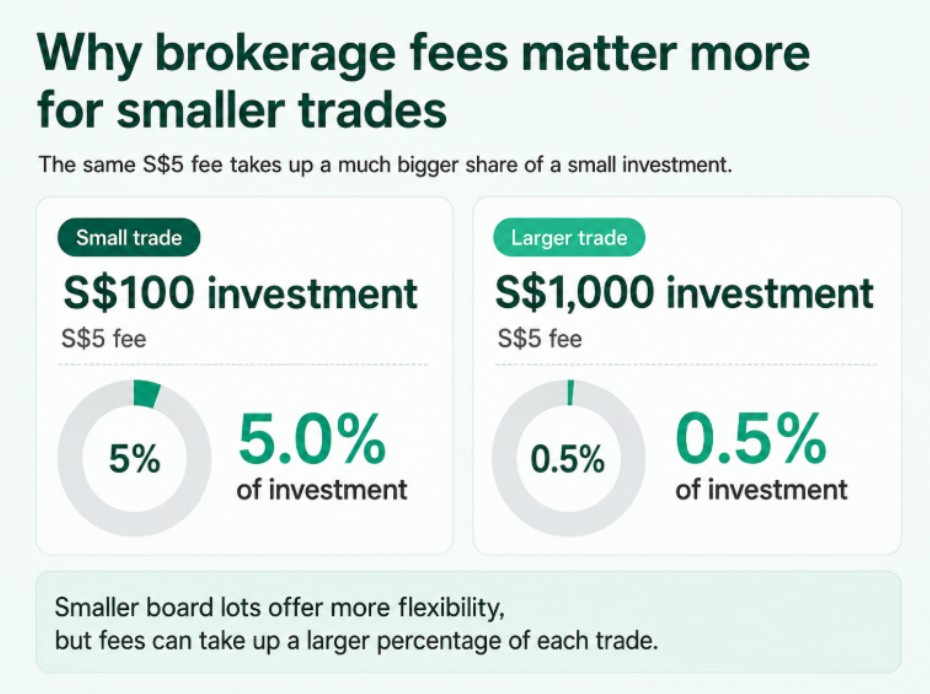
So while the smaller board lot gives me more flexibility over how much I invest, buying the minimum 10 shares every time may not necessarily make sense.
I would therefore check the fees on my brokerage account before deciding how small each trade should be.
You can compare the fees and account structures across platforms in our latest online brokerage comparison in Singapore.
The smaller board lot gives us more flexibility. However, we do not necessarily have to use the smallest trade size available.
Will the smaller board lot boost the Singapore stock market?
Smaller board lots could encourage more retail investors to participate in the Singapore stock market, but I would not assume that this will automatically push share prices higher.
SGX expects the board lot revision to lower barriers to participation and improve affordability for retail investors.
The initial 11 stocks alone accounted for about 35% of trading activity in the first six months of 2026, so the changes apply to a meaningful part of the Singapore market.
Making these stocks easier to access could encourage more retail participation and potentially support trading activity.
I think the change may be particularly relevant to younger investors.
An investor with a few hundred dollars can already buy fractional shares of many US stocks through some online brokers.
In comparison, having to commit several thousand dollars to buy one standard lot of a Singapore blue chip can be a significant hurdle.
Reducing the board lot narrows that gap.
However, I would be careful about assuming this will automatically lead to higher share prices.
More accessibility may bring in more investors, but ultimately a company’s value will still depend on factors such as its earnings, cash flows and outlook.
What would Beansprout do?
Our house view on Singapore equities remains constructive, although I would be more selective after the market's strong rally.
The SGX board lot reduction does not change my view of whether a particular company is attractive.
What it changes is how easily I can put my investment view into practice.
This is particularly useful for the Opportunity Pot within Beansprout's four pots of wealth, where I may want to size individual Singapore stock positions more closely according to my conviction, valuation and risk.
Instead of having to invest more than S$7,000 to buy one current board lot of 100 shares of DBS, for example, I could start with 10 shares instead and add gradually if the investment case remains attractive.
The same flexibility applies to stocks such as OCBC, UOB, Keppel and Singapore Exchange.
What the change does not alter is the investment case for any company.
If we did not think a stock was attractive at its current valuation before 5 October, being able to buy 10 shares instead of 100 would not change our view. We would still look at the company’s fundamentals, outlook, valuation and role in the portfolio before deciding whether to invest.
If you’d like to see how we put this approach into practice, our latest Beansprout Pro model portfolio update shows how we are allocating S$100,000 across different investments, including how we think about individual stock selection and position sizing.
For those who prefer not to pick individual stocks, an STI ETF can play a different role in the portfolio within the Growth Pot, which is meant for long-term compounding growth.
An STI ETF remains a simpler way to gain broad exposure to Singapore’s largest listed companies. With a board lot of just one unit, an STI ETF has an even lower minimum investment and gives us exposure to 30 Singapore stocks through a single investment. Our guide to STI ETFs in Singapore compares the available options.
Ultimately, I think the biggest benefit of the board lot reduction is that my desired allocation within the Opportunity Pot can increasingly determine how many shares I buy, rather than the other way around.
Which Singapore stocks would you be more interested in buying once the smaller board lots take effect? Share your thoughts in the comments below or join the discussion in our Telegram group!
Planning to invest in Singapore stocks? Compare the best Singapore brokers to find the right trading platform, and see the latest promotions and sign-up rewards available.
Follow Beansprout on YouTube, Facebook and Instagram, and add Beansprout as your preferred source on Google so you never miss an update.
Read also
Gain financial insights in minutes
Subscribe to our free weekly newsletter for more insights to grow your wealth
Most Popular

Comments
0 comments