
3 best-performing Singapore blue chips in August. Here’s what the earnings say
Stocks
By Ng Hui Min • 02 Sep 2026
Why trust Beansprout? We’ve been awarded Best Investment Website at the SIAS Investors’ Choice Awards 2025
'%3e%3cpath%20fill-rule='evenodd'%20clip-rule='evenodd'%20d='M17.64%209.20455C17.64%208.56637%2017.5827%207.95273%2017.4764%207.36364H9V10.845H13.8436C13.635%2011.97%2013.0009%2012.9232%2012.0477%2013.5614V15.8195H14.9564C16.6582%2014.2527%2017.64%2011.9455%2017.64%209.20455V9.20455Z'%20fill='%234285F4'/%3e%3cpath%20fill-rule='evenodd'%20clip-rule='evenodd'%20d='M9%2018C11.43%2018%2013.4673%2017.1941%2014.9564%2015.8195L12.0477%2013.5614C11.2418%2014.1014%2010.2109%2014.4205%209%2014.4205C6.65591%2014.4205%204.67182%2012.8373%203.96409%2010.71H0.957275V13.0418C2.43818%2015.9832%205.48182%2018%209%2018V18Z'%20fill='%2334A853'/%3e%3cpath%20fill-rule='evenodd'%20clip-rule='evenodd'%20d='M3.96409%2010.71C3.78409%2010.17%203.68182%209.59318%203.68182%209C3.68182%208.40682%203.78409%207.83%203.96409%207.29V4.95818H0.957273C0.347727%206.17318%200%207.54773%200%209C0%2010.4523%200.347727%2011.8268%200.957273%2013.0418L3.96409%2010.71V10.71Z'%20fill='%23FBBC05'/%3e%3cpath%20fill-rule='evenodd'%20clip-rule='evenodd'%20d='M9%203.57955C10.3214%203.57955%2011.5077%204.03364%2012.4405%204.92545L15.0218%202.34409C13.4632%200.891818%2011.4259%200%209%200C5.48182%200%202.43818%202.01682%200.957275%204.95818L3.96409%207.29C4.67182%205.16273%206.65591%203.57955%209%203.57955V3.57955Z'%20fill='%23EA4335'/%3e%3c/g%3e%3cdefs%3e%3cclipPath%20id='clip0_0_2849'%3e%3crect%20width='18'%20height='18'%20fill='white'/%3e%3c/clipPath%3e%3c/defs%3e%3c/svg%3e)
Make Beansprout your preferred source on Google
Add us on Google to see more of our insights in your search results
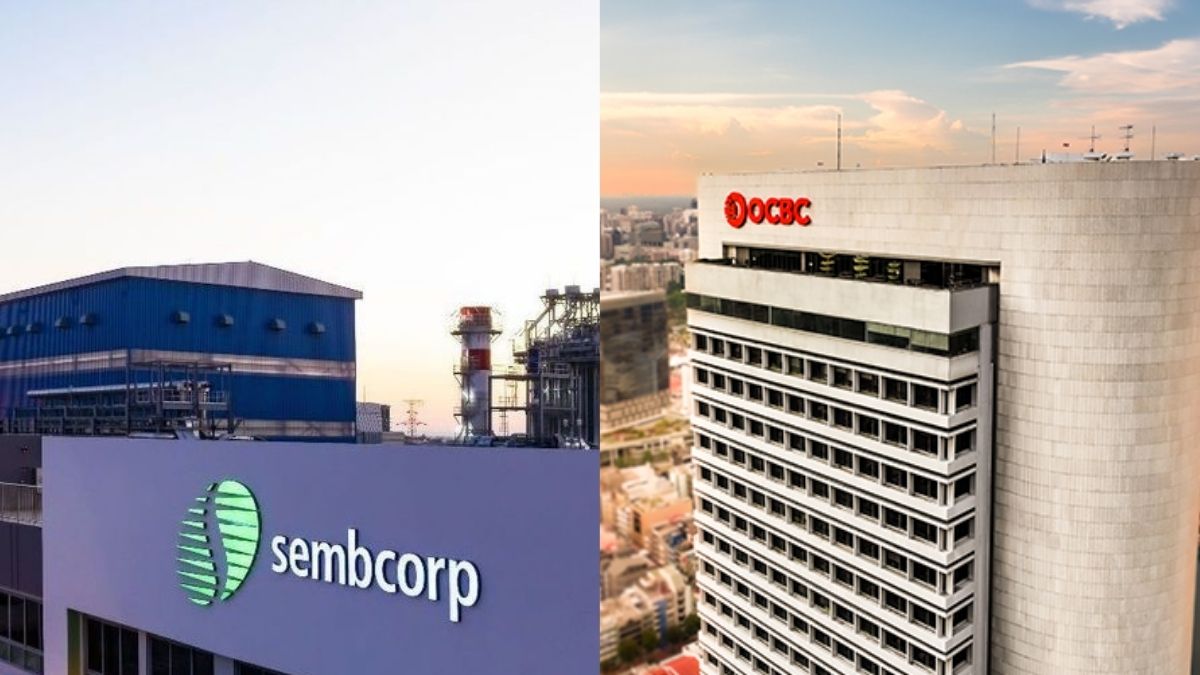
We look at the Singapore blue chips that led August’s gains, what drove their rallies and whether their latest earnings and valuations still stack up.
What happened?
Singapore stocks stayed resilient in August, even after the strong rally we saw in July.
The banks continued to attract attention, with DBS and OCBC reaching record highs after their latest results. At the same time, we highlighted that valuations, particularly for the banks, had moved well above their historical averages.
That made me more selective about where I would add rather than simply chasing stocks that had already rallied.
August’s strongest performers were not all driven by the same story.
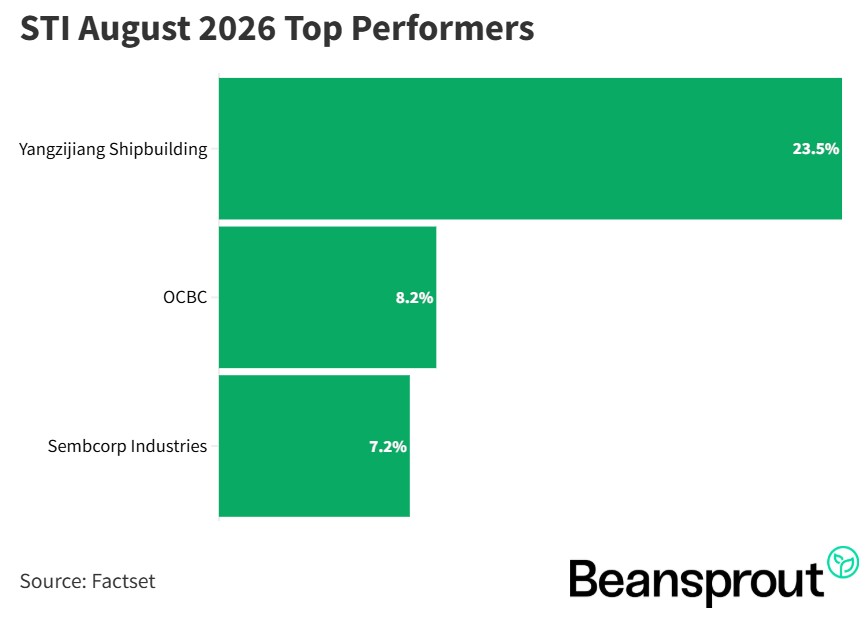
Yangzijiang Shipbuilding surged after reporting record first-half earnings, OCBC continued to climb as wealth-management income supported record profit, while Sembcorp Industries rallied even though its underlying first-half earnings declined.
Interestingly, Yangzijiang Shipbuilding and OCBC were already among the best-performing blue-chip stocks in July, and both made the list again in August.
With some of these stocks continuing to outperform, members of the Beansprout Community wondered whether there is still room for further gains, or whether much of the good news has already been priced in.
In this article, I look at what drove August’s three best-performing blue chips, what their latest earnings tell us, and how they stack up against Beansprout’s Opportunity Pot checks and historical valuations.
3 best-performing Singapore blue-chip stocks in August 2026
#1 – Yangzijiang Shipbuilding (SGX: BS6)
Yangzijiang Shipbuilding is one of China’s largest privately owned shipbuilders.
The group constructs commercial vessels including containerships, bulk carriers, oil tankers and gas carriers at its shipyards in Jiangsu, China.
Yangzijiang Shipbuilding was the standout performer among STI stocks in August.
Its share price gained 23.5% during the month, after already rising 14.6% in July.
The latest rally came alongside another strong set of earnings.
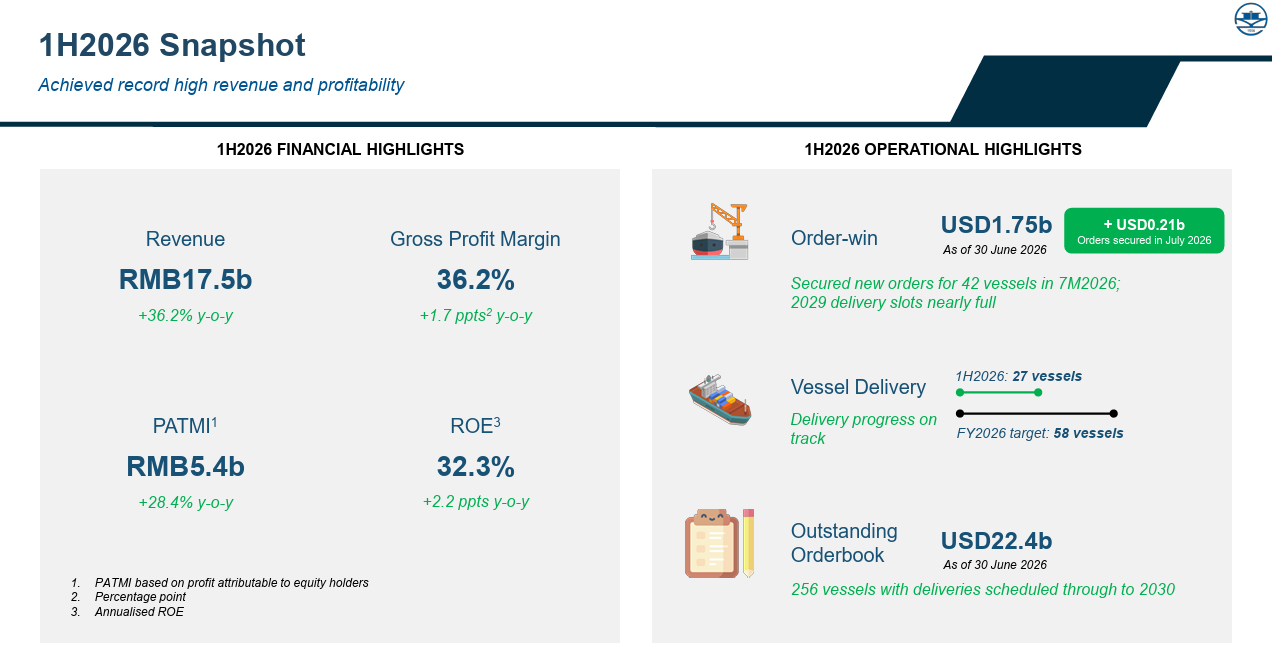
Yangzijiang Shipbuilding reported record revenue of RMB17.5 billion for 1H2026, up 36.2% year on year.
Profit attributable to shareholders rose 28.4% to RMB5.4 billion, while its gross profit margin expanded to 36.2%. Annualised return on equity reached 32.3%.
The stronger performance was driven mainly by its shipbuilding business.
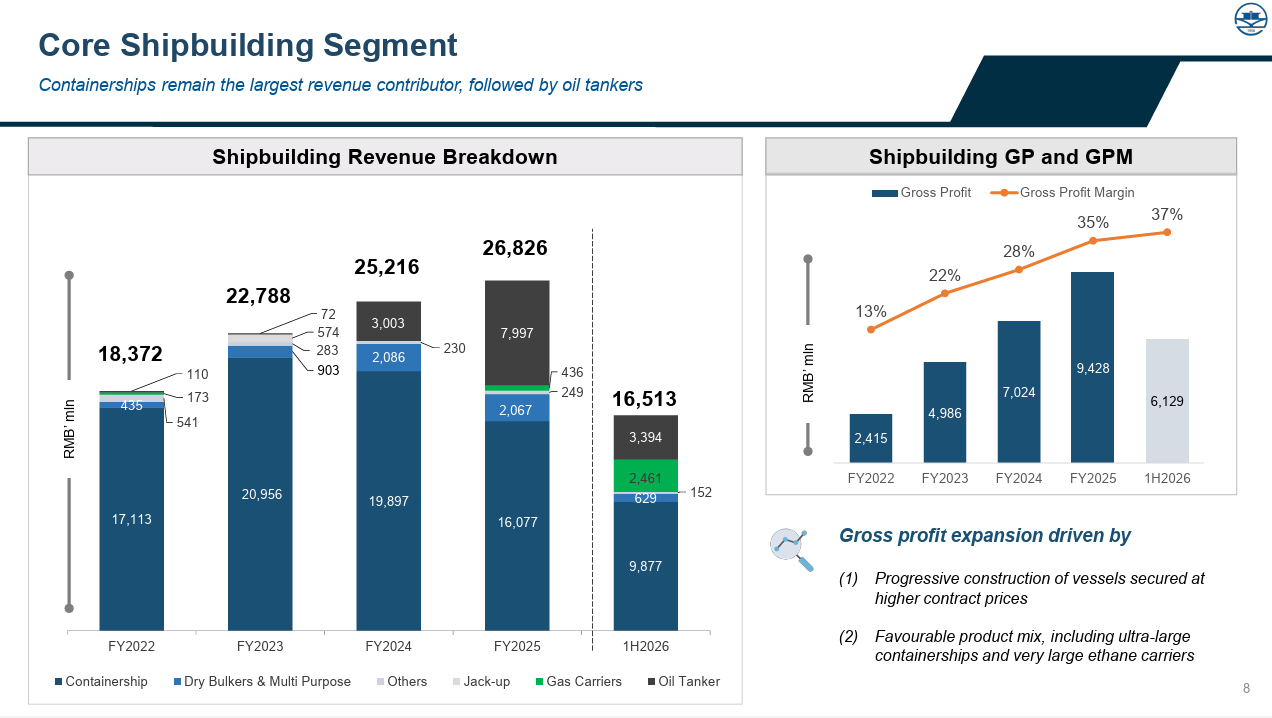
Yangzijiang continued to recognise revenue from vessels secured at higher contract prices, while a favourable mix of vessels, including ultra-large containerships and very large ethane carriers, supported margins.
Shipbuilding gross profit margin rose to 37% in 1H2026 from 35% in FY2025.
Its large order book also continues to provide visibility over future revenue.
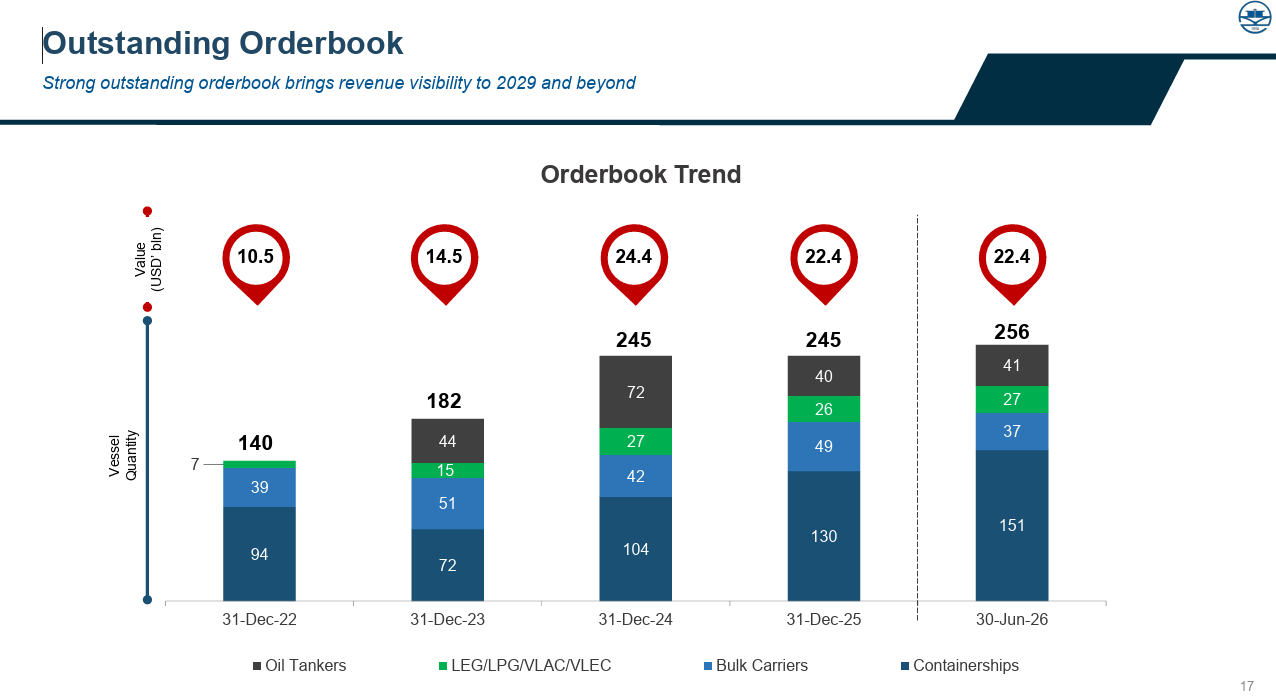
As at 30 June 2026, Yangzijiang Shipbuilding had an outstanding order book of US$22.4 billion comprising 256 vessels, with deliveries scheduled through to 2030.
The company secured US$1.75 billion of new orders in the first half, followed by another US$210 million in July. Its 2029 delivery slots were already close to full.
Vessel deliveries also remain on track.
Yangzijiang delivered 27 vessels in the first half compared with its full-year target of 58 vessels, which means a larger portion of deliveries is expected in the second half.
Its balance sheet remains another strength.
Yangzijiang Shipbuilding had a net cash position of about RMB12.5 billion as at the end of June.
Based on Beansprout’s current Opportunity Screen, Yangzijiang Shipbuilding passes all three checks.
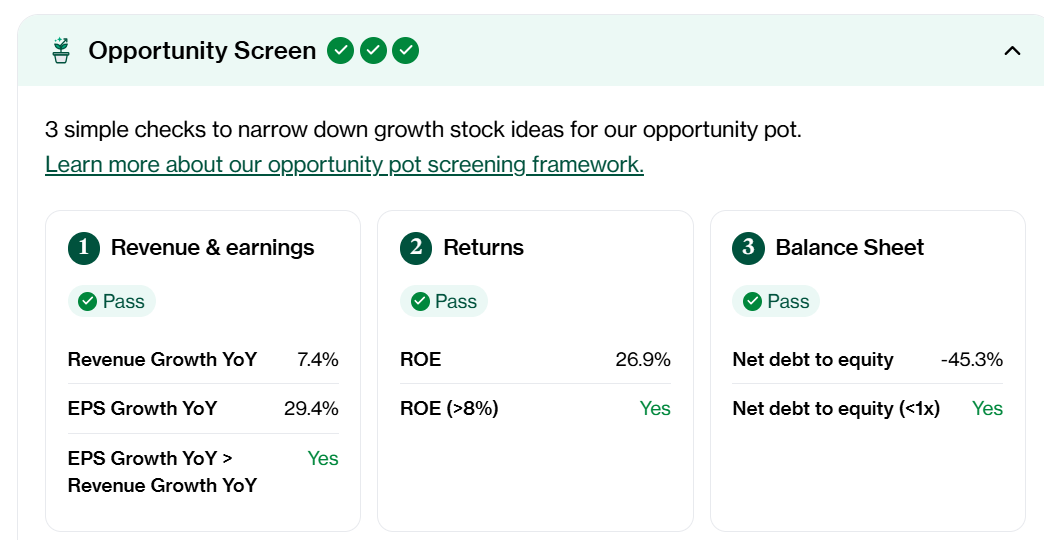
Revenue grew 7.4%, while EPS increased at a much faster pace of 29.4%, allowing it to pass the revenue and earnings check.
It also passes the returns check with an ROE of 26.9%, as well as the balance-sheet check with net debt to equity of negative 45.3%.
The latest 1H2026 results have since shown even stronger revenue growth. However, profit growth of 28.4% was slower than revenue growth of 36.2%, so I would continue to watch whether earnings can keep pace with revenue growth.
After a 23.5% gain in August alone, I would also pay attention to whether Yangzijiang Shipbuilding can continue replenishing its order book at attractive prices.
Shipbuilding remains a cyclical business, and future earnings could be affected by weaker new orders, lower vessel prices, steel costs, currency movements and execution.
For me, the key indicators to watch are new order wins, shipbuilding margins, vessel deliveries and the ramp-up of additional production capacity.
As of 1 September 2026, Yangzijiang Shipbuilding was trading at a price-to-earnings ratio of about 9.1 times, above its historical average of 6.17 times.
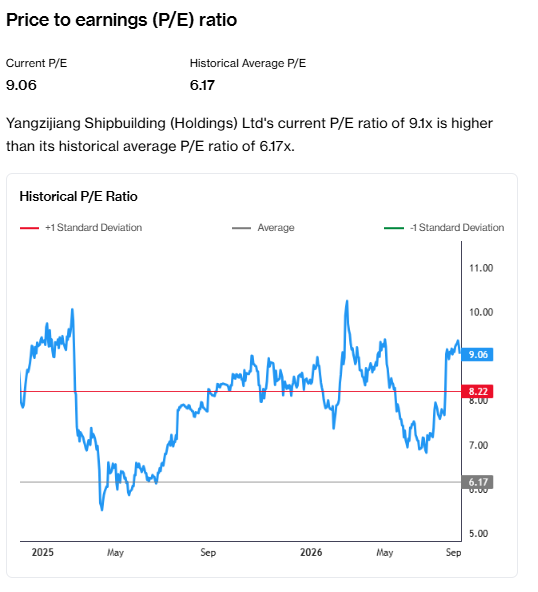
Estimate a potential entry or exit price for Yangzijiang Shipbuilding based on its historical price-to-earnings ratio using the P/E price target estimator below.
Related links:
- Yangzijiang Shipbuilding latest valuation, share price and analysis
- Yangzijiang Shipbuilding dividend history and dividend forecast
#2 – OCBC (SGX: O39)
OCBC is Singapore’s second-largest bank by assets and has banking operations across Singapore, Malaysia, Indonesia and Greater China.
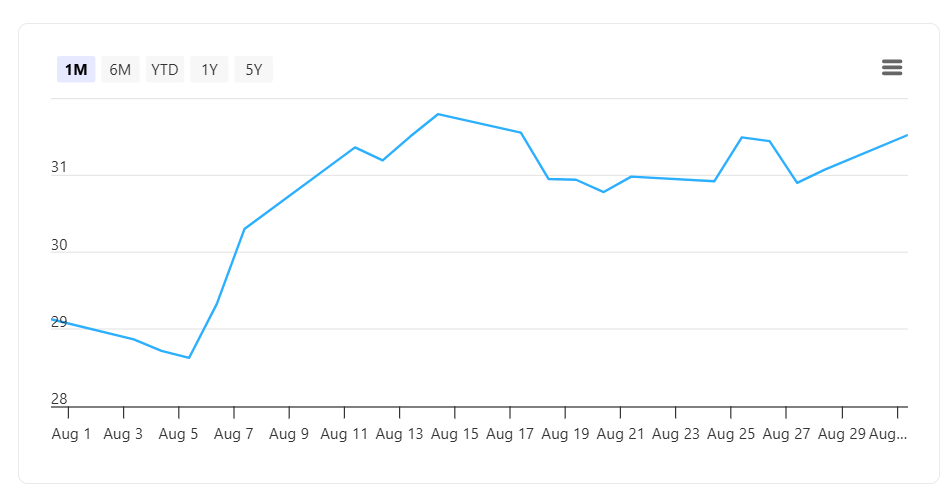
OCBC was the second-best-performing STI stock in August, with its share price rising another 8.2%.
This came after a 17.5% gain in July, making OCBC one of the strongest-performing Singapore blue chips over the past two months.
Its latest results also gave investors more reasons to remain optimistic.
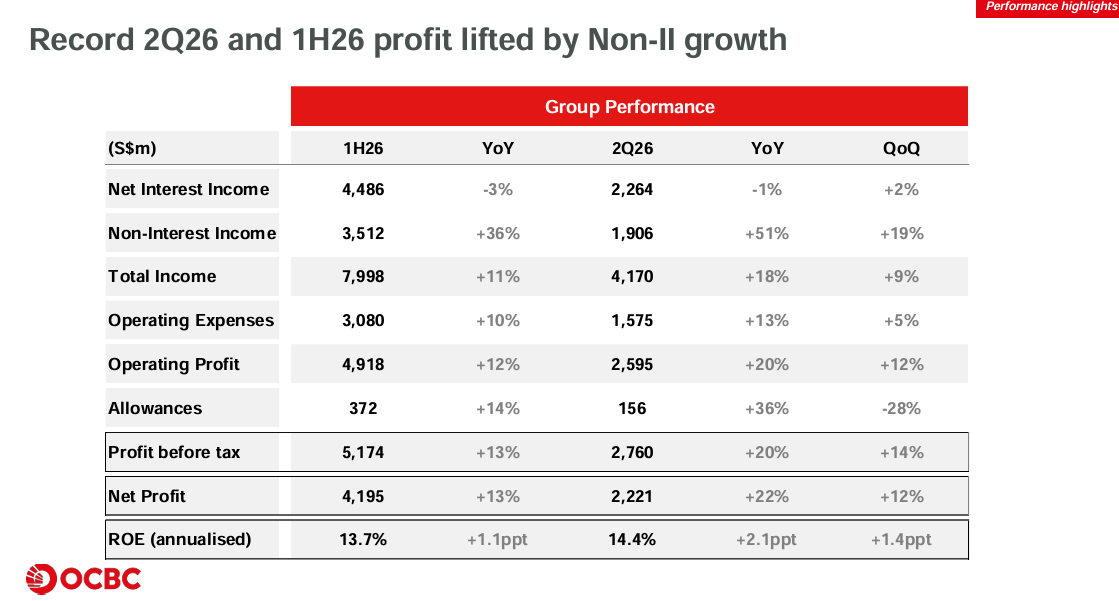
OCBC reported a record quarterly net profit of S$2.22 billion in 2Q2026, up 22% year on year and 12% from the previous quarter.
This lifted its first-half net profit to a record S$4.19 billion, 13% higher than a year earlier.
We shared our take on OCBC’s record 2Q2026 profit and higher interim dividend here.
Total income grew 11% in 1H2026 to S$8.00 billion.
A key driver was OCBC’s growing contribution from businesses outside traditional lending.
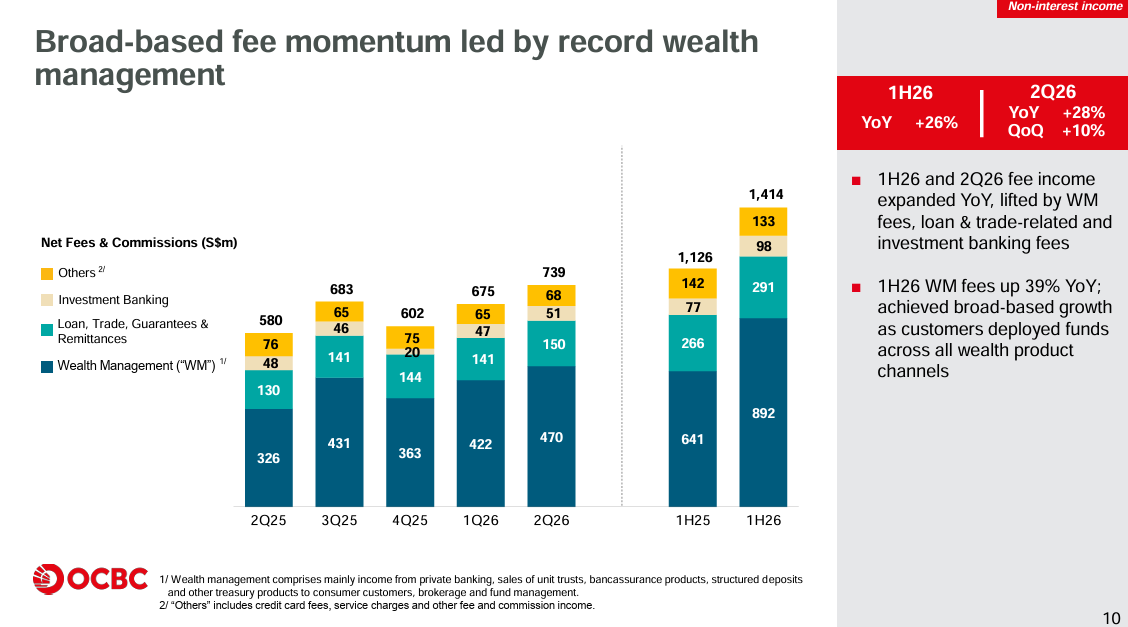
Non-interest income rose 36% to a record S$3.51 billion and accounted for close to 44% of total income, helping to offset weaker net interest income as interest rates declined.
Wealth management was another bright spot.
OCBC’s wealth-management income grew 27% to a record S$3.29 billion, while banking wealth-management assets under management reached S$350 billion.
However, lower interest rates remain a headwind.
Net interest income declined 3% in the first half, while net interest margin fell by 25 basis points year on year to 1.73%.
The pressure on margins was partly offset by growth in average asset volumes.
OCBC’s asset quality remained healthy.
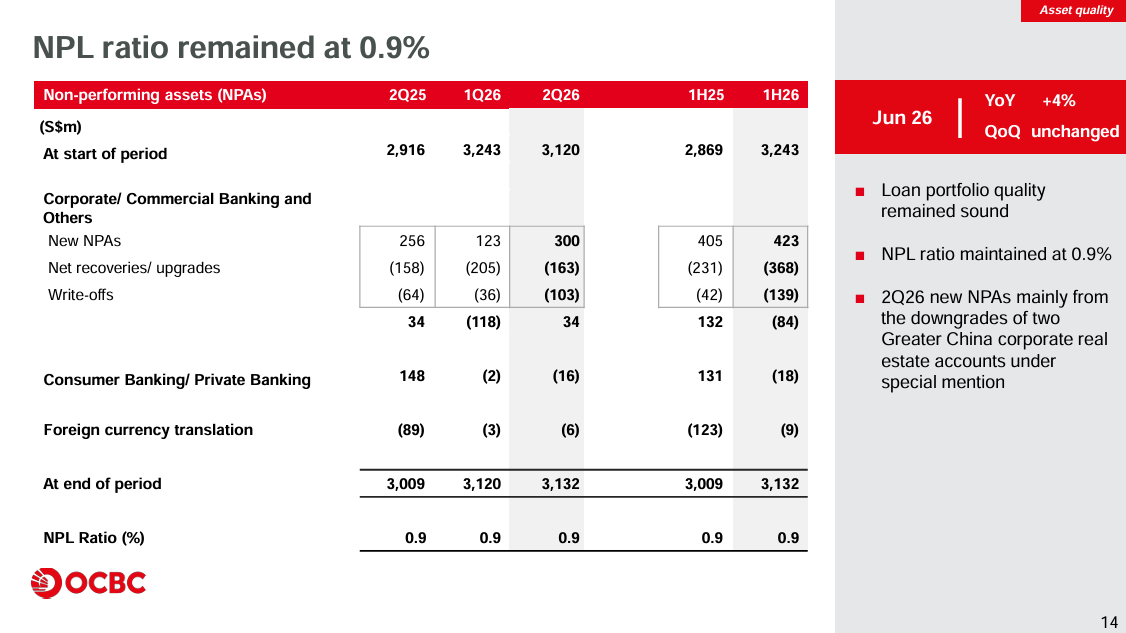
Its non-performing loan ratio was unchanged at 0.9%, while allowance coverage for non-performing assets stood at 163%.
Its CET1 capital adequacy ratio was 15.7%, or 14.0% on a fully phased-in basis.
Annualised ROE improved to 13.7% for 1H2026, compared with 12.6% a year earlier.
Shareholders also received a higher payout.
OCBC raised its interim ordinary dividend by 15% to S$0.47 per share from S$0.41 a year earlier.
The dividend represented a payout ratio of 50% of first-half net profit.
Based on Beansprout’s current Opportunity Screen, OCBC passes all three checks.
For banks, our updated Opportunity Pot three-check framework looks at CET1 capital adequacy and non-performing loan ratios to assess financial strength, since net debt to equity is less meaningful for a bank.
OCBC reported first-half total income which grew 11%, net profit rose 13% and annualised earnings per share increased from the previous year.
OCBC passed the ROE check with a reported 1H2026 ROE of 13.7%.
Its reported CET1 ratio is 15.7% while its NPL ratio is lowest among the three banks at 0.9%.
For me, the question now is whether this momentum can continue.
Wealth management, fees, trading and insurance have done much of the heavy lifting as net interest margins declined.
If these businesses remain strong, OCBC may be better placed to absorb further pressure from lower interest rates.
However, after the sharp rise in its share price, valuation becomes increasingly important too.
I would watch net interest margins, wealth-management inflows, loan growth, asset quality and whether non-interest income can continue growing at a healthy pace.
As of 1 September 2026, OCBC was trading at a price-to-earnings ratio of about 17.46 times, above its historical average of 10.85 times.
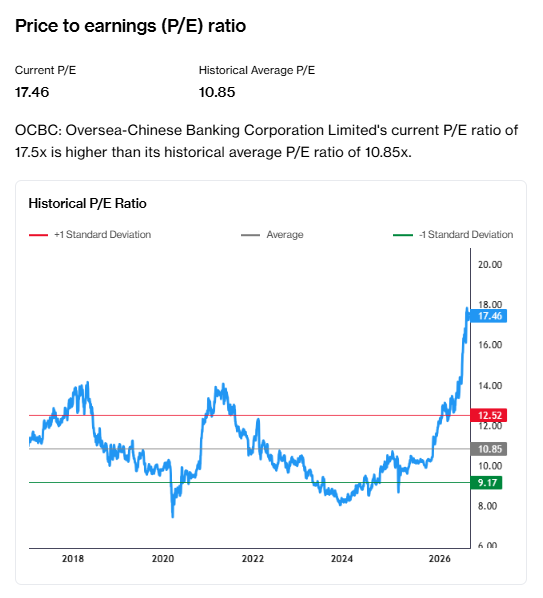
Estimate a potential entry or exit price for OCBC based on its historical price-to-earnings ratio using the P/E price target estimator below.
Related links:
#3 – Sembcorp Industries (SGX: U96)
Sembcorp Industries was the third-best-performing STI stock in August, gaining 7.2% during the month.
Its share-price performance is interesting because its first-half earnings were more mixed than those of Yangzijiang Shipbuilding and OCBC.
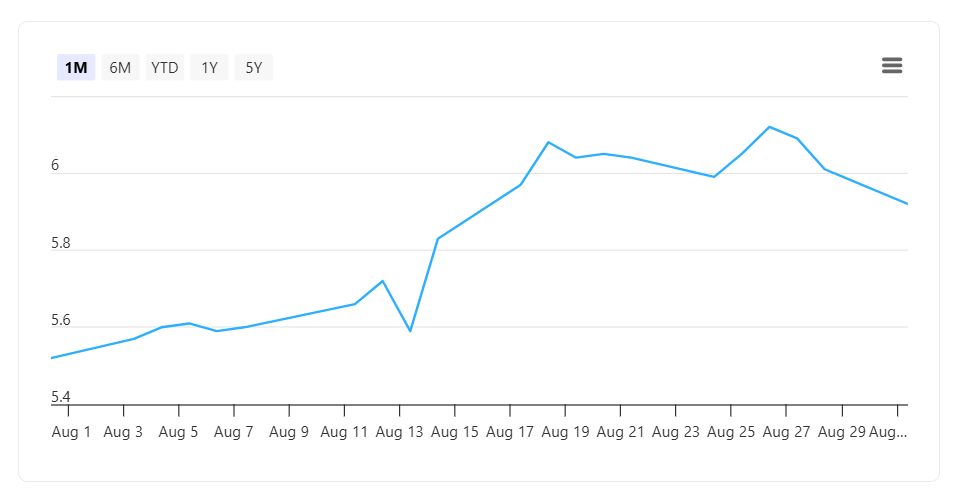
Sembcorp’s turnover rose 28% year on year to S$3.77 billion in 1H2026.
However, underlying net profit fell 25% to S$369 million from S$491 million a year earlier.
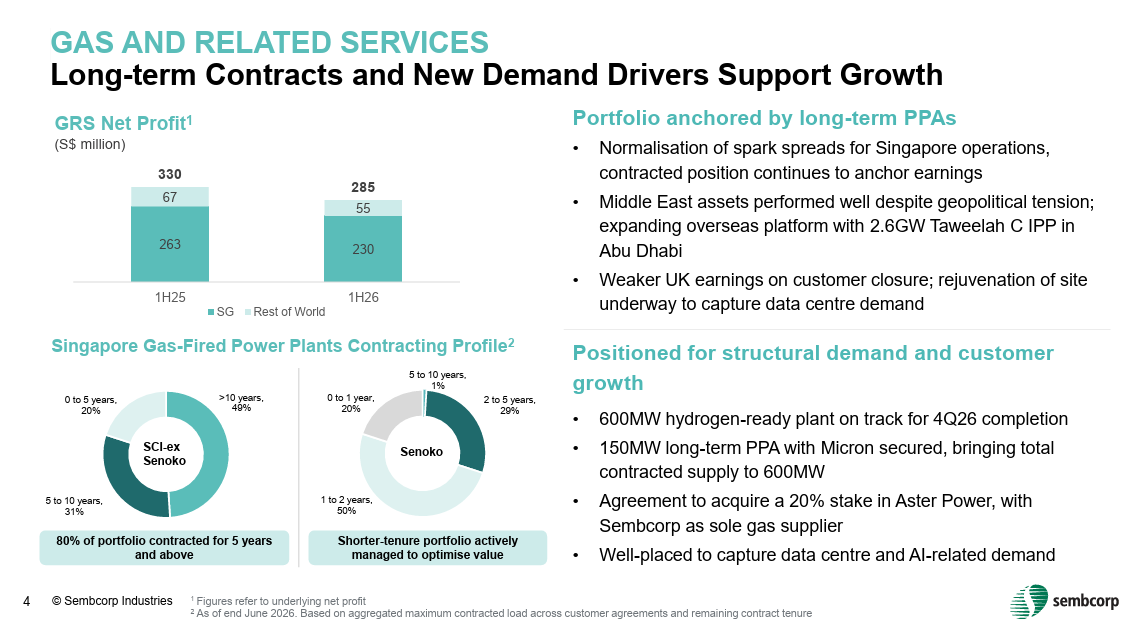
Reported net profit declined more sharply to S$150 million, mainly due to one-off transaction costs related to the acquisition of Alinta Energy.
Its underlying businesses also faced several headwinds.
Underlying net profit from Gas and Related Services declined to S$285 million from S$330 million, affected by lower generation spreads in Singapore and weaker earnings in the UK.
Renewables' underlying net profit fell to S$69 million from S$132 million as curtailment, lower tariffs and weaker wind and solar resources weighed on its China operations.
Integrated Urban Solutions underlying net profit also declined to S$62 million from S$74 million.
So why did Sembcorp still rank among August’s best-performing blue chips?
One factor may be that investors are looking towards its earnings outlook rather than just the weaker first-half numbers.
Sembcorp completed its acquisition of Australian energy company Alinta in June, meaning Alinta contributed only one month of earnings to its reported first-half results.
On a pro-forma basis, assuming Alinta had been part of Sembcorp since the start of 2026, underlying first-half net profit would have been S$558 million.
Management also expects a stronger performance in 2H2026.
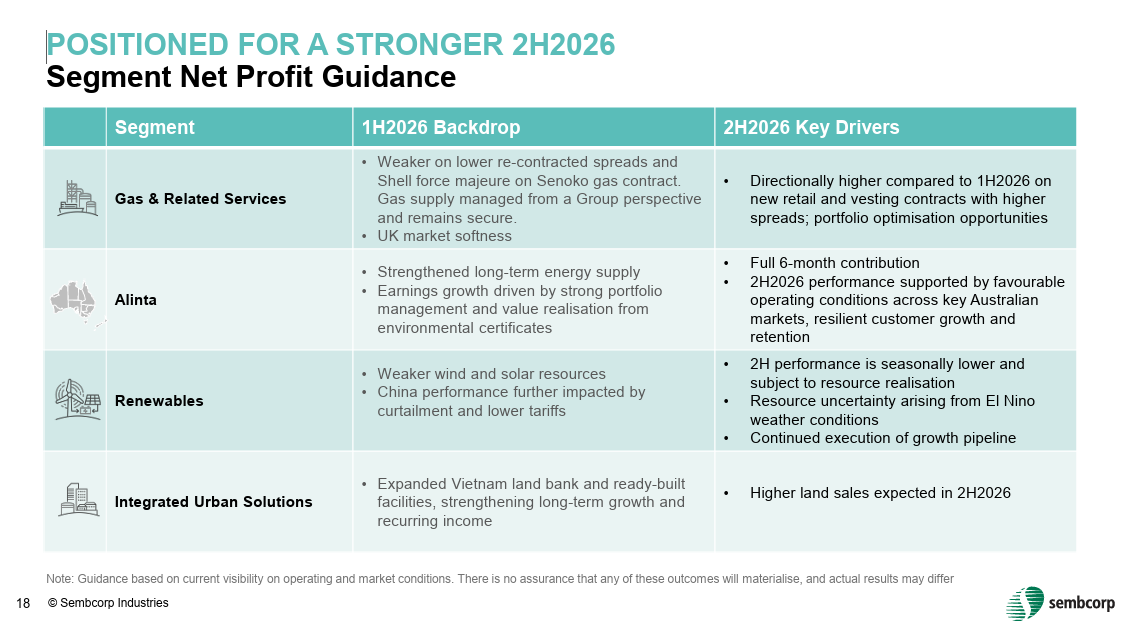
The improvement is expected to be supported by contributions from Alinta, improved earnings from its Gas and Related Services business and higher land sales from Integrated Urban Solutions.
The renewables segment is expected to continue facing seasonal and tariff-related headwinds, although new capacity may partly offset these pressures.
Sembcorp has also highlighted structural demand from data centres and AI-related infrastructure as potential longer-term growth drivers.
Despite the weaker first-half earnings, Sembcorp raised its interim dividend from 9 cents to 11 cents per share, an increase of 22%.
The area I would watch most closely is its balance sheet following the Alinta acquisition.
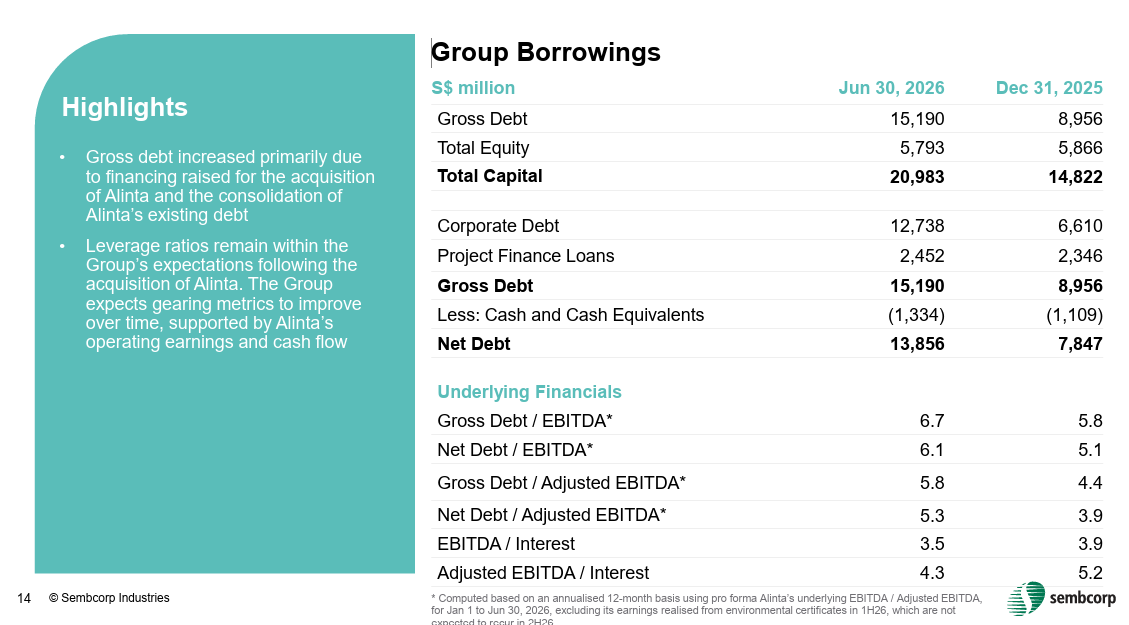
Gross debt rose to S$15.2 billion as at the end of June from S$9.0 billion at the end of 2025, largely due to financing raised for the acquisition and the consolidation of Alinta’s existing debt.
Net debt increased to S$13.9 billion from S$7.8 billion, while net debt to adjusted EBITDA rose to 5.3 times from 3.9 times.
Management expects gearing metrics to improve over time as Alinta contributes operating earnings and cash flow.
Sembcorp still has a healthy liquidity position, with S$9.1 billion of unutilised borrowing facilities at the end of June.
Based on Beansprout’s current Opportunity Screen, Sembcorp Industries passes two of the three checks.
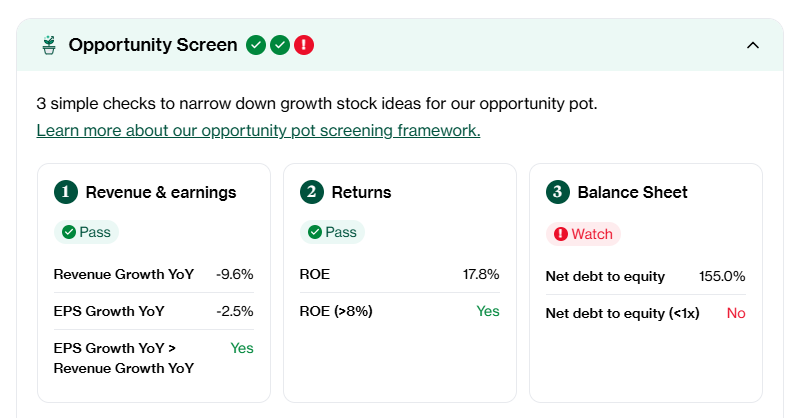
Revenue declined 9.6%, while EPS fell by a smaller 2.5%. As earnings held up better than revenue, Sembcorp passes the revenue and earnings check under the current screening framework.
Its ROE of 17.8% also allows it to pass the returns check.
However, its balance sheet remains on watch, with net debt to equity of 155%, above our preferred level.
The latest results reinforce why leverage is something I would keep an eye on.
Sembcorp’s annualised underlying ROE stood at 13.0% in 1H2026, while the Alinta acquisition materially increased its borrowings.
For me, Sembcorp therefore presents more of an earnings recovery story.
I would want to see the stronger second-half performance that management expects translate into higher earnings and cash flow, while helping the group gradually reduce leverage.
I would also watch conditions in the Singapore power market, the recovery of China renewables and how well Alinta is integrated into the group.
As of 1 September 2026, Sembcorp Industries was trading at a price-to-earnings ratio of about 11.3 times, above its historical average of 9.84 times.
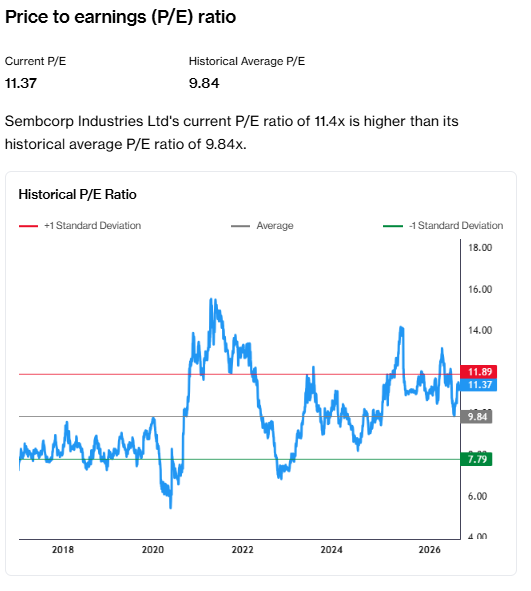
Estimate a potential entry or exit price for Sembcorp Industries based on its historical price-to-earnings ratio using the P/E price target estimator below.
Related links:
- Sembcorp Industries latest valuation, share price and analysis
- Sembcorp Industries dividend history and dividend forecast
What would Beansprout do?
Yangzijiang Shipbuilding, OCBC and Sembcorp Industries all delivered strong share-price gains in August.
However, I would not consider a stock for my Opportunity Pot as part of Beansprout’s four pots of wealth based on a strong one-month share-price gain alone.
I would start by looking at their earnings momentum, returns and balance-sheet strength.
| Stock | Opportunity Pot result | What stands out | Key risks |
| Yangzijiang Shipbuilding | 3/3 checks | Strong earnings growth, high ROE, net cash and large order book | Shipbuilding cycle, pace of new orders, steel costs, currencies and execution |
| OCBC | 3/3 checks | Record 1H26 profit, growing wealth income and strong capital position | NIM pressure, sustainability of non-interest income growth and valuation after the rally |
| Sembcorp Industries | 2/3 checks | Healthy ROE, Alinta contribution and stronger 2H26 outlook | Higher leverage, weaker underlying 1H26 earnings and integration execution |
Based on Beansprout’s current Opportunity Stock Screen, Yangzijiang Shipbuilding and OCBC pass all three checks.
Firstly, on Yangzijiang, Its strong profitability, net cash position and large order book stand out. However, after a 23.5% gain in August, I would not assume that the recent pace of share-price gains can continue. I would want to see new orders remain healthy and margins stay resilient as the shipbuilding cycle evolves. Learn more about Yangzijiang Shipbuilding's latest valuation and dividend analysis here.
OCBC passes three checks based on its latest first-half results.
Its growing wealth-management, insurance and fee businesses are increasingly important as net interest margins come under pressure. For me, the key question is whether these businesses can continue growing quickly enough to offset lower net interest margins after the stock’s strong rally. Learn more about OCBC's latest valuation and dividend analysis here.
Sembcorp also passes two checks, with the balance sheet being the main area I would monitor.
The Alinta acquisition could strengthen its earnings base, and management expects a stronger second half. However, I would want to see those additional earnings translate into cash flow and lower leverage over time before becoming more confident. Learn more about Sembcorp Industries' latest valuation and dividend analysis here.
Overall, Yangzijiang Shipbuilding currently has the strongest earnings and balance-sheet momentum, OCBC offers the most established earnings quality, while Sembcorp has the clearest potential earnings recovery story for 2H2026.
For me, the Opportunity Screen is a starting point rather than the final investment decision. You can learn how we screen for growth stocks using three simple checks here.
After identifying stocks that pass the initial checks, I would still look deeper into valuation, business quality, risks and the catalysts that could drive earnings from here.
To find out which Singapore blue-chip stocks we would hold in a portfolio, you can also see how we would invest S$100,000 in Singapore stocks today.
If you are looking for greater clarity on the markets and the investment decisions that matter, explore Beansprout Pro for our latest views, portfolio thinking and the reasoning behind each opportunity.
Investors who prefer broad exposure to Singapore blue chips without selecting individual companies may consider gaining exposure to the Straits Times Index through an STI ETF.
Beyond these three companies, we still believe that Singapore stocks are still worth looking at in 2026.
There are many other avenues to capture structural growth in the Singapore market, including companies linked to infrastructure, data centres, energy and food security as well as Singapore's rise as a wealth hub. Find out more about the 4 growth themes we are watching in Singapore stocks here.
Which of these three blue-chip stocks are you watching after their strong performance in August? Share your thoughts in the comments below or in the Beansprout Telegram community.
Planning to invest in Singapore blue chip stocks? Check out Beansprout's guide to the best stock trading platforms in Singapore with the latest promotions to invest in the Singapore market and see the latest promotions and sign-up rewards available.
Enjoyed this insight? Follow Beansprout on Telegram, Youtube, Facebook and Instagram, and add Beansprout as your preferred source on Google so you never miss an update.
Read also
Gain financial insights in minutes
Subscribe to our free weekly newsletter for more insights to grow your wealth
Most Popular

Comments
0 comments