
Guide to Straits Times Index ETF: How to choose the best STI ETF for your portfolio
ETFs
By Gerald Wong, CFA • 13 Jul 2026
Why trust Beansprout? We’ve been awarded Best Investment Website at the SIAS Investors’ Choice Awards 2025
'%3e%3cpath%20fill-rule='evenodd'%20clip-rule='evenodd'%20d='M17.64%209.20455C17.64%208.56637%2017.5827%207.95273%2017.4764%207.36364H9V10.845H13.8436C13.635%2011.97%2013.0009%2012.9232%2012.0477%2013.5614V15.8195H14.9564C16.6582%2014.2527%2017.64%2011.9455%2017.64%209.20455V9.20455Z'%20fill='%234285F4'/%3e%3cpath%20fill-rule='evenodd'%20clip-rule='evenodd'%20d='M9%2018C11.43%2018%2013.4673%2017.1941%2014.9564%2015.8195L12.0477%2013.5614C11.2418%2014.1014%2010.2109%2014.4205%209%2014.4205C6.65591%2014.4205%204.67182%2012.8373%203.96409%2010.71H0.957275V13.0418C2.43818%2015.9832%205.48182%2018%209%2018V18Z'%20fill='%2334A853'/%3e%3cpath%20fill-rule='evenodd'%20clip-rule='evenodd'%20d='M3.96409%2010.71C3.78409%2010.17%203.68182%209.59318%203.68182%209C3.68182%208.40682%203.78409%207.83%203.96409%207.29V4.95818H0.957273C0.347727%206.17318%200%207.54773%200%209C0%2010.4523%200.347727%2011.8268%200.957273%2013.0418L3.96409%2010.71V10.71Z'%20fill='%23FBBC05'/%3e%3cpath%20fill-rule='evenodd'%20clip-rule='evenodd'%20d='M9%203.57955C10.3214%203.57955%2011.5077%204.03364%2012.4405%204.92545L15.0218%202.34409C13.4632%200.891818%2011.4259%200%209%200C5.48182%200%202.43818%202.01682%200.957275%204.95818L3.96409%207.29C4.67182%205.16273%206.65591%203.57955%209%203.57955V3.57955Z'%20fill='%23EA4335'/%3e%3c/g%3e%3cdefs%3e%3cclipPath%20id='clip0_0_2849'%3e%3crect%20width='18'%20height='18'%20fill='white'/%3e%3c/clipPath%3e%3c/defs%3e%3c/svg%3e)
Make Beansprout your preferred source on Google
Add us on Google to see more of our insights in your search results
The Straits Times Index (STI) ETF offers you exposure to the Singapore market. Use our guide to find out the differences between the various STI ETFs and pick the best for your portfolio.

What happened?
The Straits Times Index (STI) continued to reach new all-time highs in 2026.
This has led me to relook at home-ground opportunities for capital growth and passive income that Singapore’s blue-chip companies offer through dividends.
One of the simplest ways to gain exposure to the STI is through exchange-traded funds (ETFs), which allow investors to invest in a basket of stocks without having to pick individual companies.
There are three ETFs listed on the Singapore Exchange (SGX) that track the STI:
- SPDR STI ETF (ES3)
- Amova Singapore STI ETF distributing class (G3B)
- Amova Singapore STI ETF accumulating class (GAB).
They could be convenient options for long-term investors and those who prefer a hands-off approach to invest in the Singapore market.
However, they are not exactly the same, with differences in expense ratios, dividend payout schedules, liquidity and how returns are distributed or reinvested.
In this guide, I’ll break down how each ETF works and the key factors to consider when choosing between them.
What is the Straits Times Index (STI)?
Many new investors often wonder what is a good Singapore ETF to buy.
You can start by understanding what the Straits Times Index (STI) is.
An index tracks the performance of a group of selected stocks that represent a market or sector.
Just like how the S&P 500 index is used as a benchmark for the US stock market, the STI is widely used as a benchmark for the Singapore stock market.
The STI comprises the 30 largest and most actively traded companies listed on the Singapore Exchange (SGX).
These companies are selected and reviewed by FTSE Russell, a global index provider.
The index is constructed using a market capitalisation-weighted method.
This means companies are chosen based on both market cap and liquidity, ensuring the STI reflects the performance of the most significant stocks in Singapore.
To stay aligned with market changes, the STI is reviewed and rebalanced quarterly in March, June, September and December.
What are the constituents of the STI?
The top 30 companies listed on the SGX are from a wide range of industries.
The financial sector makes up a sizeable portion of the index, , followed by real estate, industrial goods and services, and telecommunications.
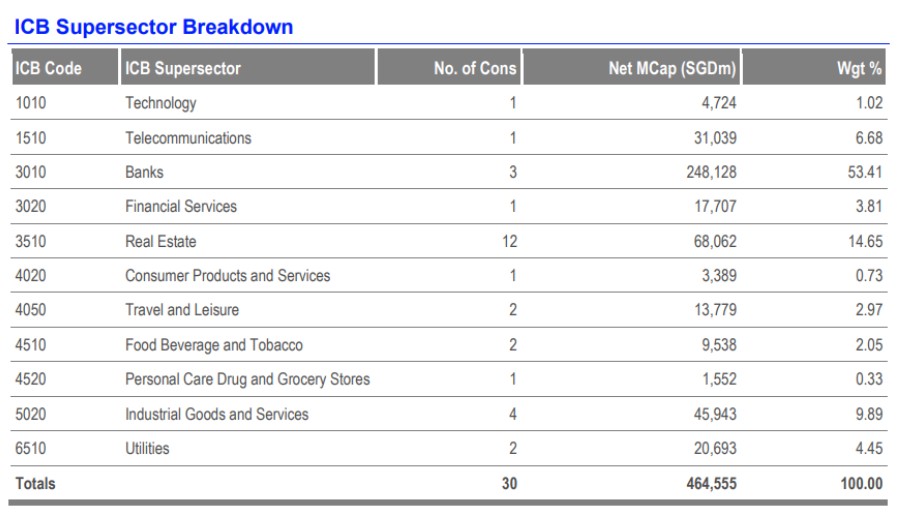
This is because the big three banks in Singapore (DBS, UOB, and OCBC) constitute the highest weightage in the STI, comprising close to 50% of the index.
Their strong performance and large market capitalisation give them a heavy influence on the movement of the index.
The constituents of the STI are:
Learn more about the Straits Times Index (STI) here.
How can I invest in the STI?
You can’t buy the STI directly because it’s not a stock or tradable asset.
To replicate the STI on your own, you’d need to buy shares in all 30 constituent companies, in proportion to their weight in the index.
This takes a lot of money, time, and effort. Plus, you’ll face extra costs like brokerage fees, which can add up.
For most people, this is not practical. That’s where ETFs come in.
ETFs are funds that own a basket of assets tracking an underlying index or benchmark and are listed and traded on the stock exchange, just like a stock.
So if you want exposure to the STI, the simplest way is through index-related products like STI ETFs.
What is the STI ETF?
STI ETFs track the underlying performance of the Straits Times Index (STI).
When you buy an STI ETF, you’re essentially investing in a fund that invests in all the constituents of the STI.
With a single trade, you can own a basket of the 30 largest and most liquid companies listed in Singapore, from DBS Group Holdings to Singapore Airlines (SIA).
You also get instant diversification across sectors, spreading your risk while keeping costs low compared to buying individual stocks.
There are currently three STI ETFs available: SPDR STI ETF (ES3), and Amova Singapore STI ETF distributing class (G3B), and Amova Singapore STI ETF accumulating class (GAB).
Which STI ETF should I buy?
All three STI ETFs provide ways to invest in the top 30 companies on the SGX.
Although all three of the ETFs serve to track the performance of the STI, there are a few differences between them and considerations to look at.
#1 - Performance
In terms of performance, the ETFs generated similar returns over the comparable time periods however the Amova Singapore STI ETFs consistently had slightly higher returns.
| ETF | 6-Month Return | 1-Year Return | 3-Year Return (Annualized) |
| SPDR STI ETF (ES3) | +13.37% | +34.01% | +21.86% |
| Amova Singapore STI ETF Distributing Class (G3B) | +13.65% | +34.74% | +22.30% |
| Amova Singapore STI ETF Accumulating Class (GAB) | +13.65% | N/A | N/A |
| STI^ | +13.86% | +35.26% | +22.76% |
Source: Respective ETF websites as of 31 May 2026 Returns are calculated on a NAV-NAV basis and assuming all dividends and distributions are reinvested, if any. Returns for periods in excess of 1 year are annualised. Past performance is not indicative of future performance. ^Benchmark returns are calculated on a total return basis. | |||
However, the performance of all the STI ETFs are slightly below the STI itself because of expenses incurred in running the funds. This difference is known as tracking error.
Year-to-date, the Amova Singapore STI ETFs has continued to outperform the SPDR STI ETF.
#2 - Total expense ratio (TER)
Amova Singapore STI ETF Distributing Class (G3B) and Amova Singapore STI ETF Accumulating Class (GAB) have a total expense ratio (TER) of 0.24% p.a., which is lower than SPDR STI ETF (ES3) with a TER of 0.28% p.a..
The TER measures the total costs associated with the overall management and operating expenses of the ETF.
This may include management fees, administrative costs, as well as distribution fees.
A lower TER means more of our money stays invested instead of paying fees.
#3 - Tracking error
Tracking error refers to the difference between the price performance of an ETF compared to its benchmark index.
A lower tracking error means the fund mimics its benchmark better.
On this front, the Amova Singapore STI ETF Distributing Class (G3B) has a slightly lower tracking error.
According to their latest fact sheets, Amova Singapore STI ETF Distributing Class (G3B) has a 3-year annualised tracking error of 0.13% while SPDR STI ETF (ES3) has a rolling 1-year tracking error of 0.17%.
Meanwhile, since Amova Singapore STI ETF Accumulating Class (GAB) is newly launched, it does not have its tracking error reported yet.
#4 - Track record
All three ETFs are run by established fund managers.
The SPDR STI ETF (ES3) is managed by State Street Global Advisors with more than US$5.66 trillion worth of assets.
Both the Amova Singapore STI ETF is managed by Amova Asset Management, which manages more than US$271.5 billion worth of assets.
SPDR STI ETF (ES3) is the oldest local ETF in Singapore having been listed since April 2002.
Amova Singapore STI ETF Distributing Class (G3B) was listed on the SGX in February 2009 while Amova Singapore STI ETF Accumulating Class (GAB) was just listed in September 2025.
#5 - Dividend yield
Both the SPDR STI ETF (ES3) and the Amova Singapore STI ETF (G3B) are distributing ETFs. Distributing ETFs are funds that pay out earnings like dividends to investors in cash, instead of reinvesting them.
Investors are then free to do whatever they want with the dividends, whether to reinvest them or use them elsewhere.
Meanwhile, Amova Singapore STI ETF Accumulating Class (GAB) is an accumulating ETF. Accumulating ETFs automatically reinvests the dividends back into the fund, which makes the reinvesting process seamless.
The SPDR STI ETF (ES3) generally pays out dividends twice a year, typically in February and August, while the Amova Singapore STI ETF (G3B) usually distributes its dividends in January and July.
However, these payouts are not guaranteed and are entirely at the fund manager’s discretion.
Currently, the SPDR STI ETF (ES3) offers a dividend yield of about 3.29%, while the Amova Singapore STI ETF (G3B) yields around 3.53% over the 12-month period.
Depending on your broker, you can typically choose to receive dividends in cash or automatically reinvest them into additional units of the ETF.
How the Amova AM STI ETF and SPDR STI ETF compares
Here is a table showing quick facts and comparison of the three STI ETFs:
| Amova Singapore STI ETF Distributing Class | Amova Singapore STI ETF Accumulating Class | SPDR STI ETF | |
| Trading Code | G3B | GAB | ES3 |
| Total Expense Ratio | 0.24% | 0.24% | 0.28% |
| Fund Size (AUM) | S$1,519.12M | S$24.41M | S$3,537.41M |
| Inception Date | 24 February 2009 | 17 September 2025 | 11 April 2002 |
| Exchange | SGX | SGX | SGX |
| Fund Domicile | Singapore | Singapore | Singapore |
| Dividend Distribution | Semi-Annually (January & July) | No dividends are distributed | Semi-Annually (February & August) |
| Dividend Type | Distributing | Accumulating | Distributing |
| Dividend Yield* | 3.53% | 0% | 3.29% |
| Tracking Error | 0.13% | N/A | 0.17% |
| Source: Fund Websites as of 30 June 2026. *Historical Dividend Yield over the trailing 12-month period | |||
Risks factors to consider
While STI ETFs offer many benefits, it’s important to be aware of certain risks before investing:
#1 – Market risk and volatility
Since STI ETFs track the Singapore stock market, their value fluctuates with overall stock market conditions. This means your investment can go up or down depending on market movements.
#2 – Tracking error
ETF returns may differ slightly from the actual index due portfolio management and trading costs.
#3 – Expense ratio impact
Although generally lower than actively managed funds, ETFs charge management fees (expense ratios) that can slightly impact your overall returns over time.
#4 – No guarantee of dividends
ES3 and G3B have historically declared dividends semi-annually. However, dividend declaration is ultimately up to the fund manager’s discretion.
The dividend policies may be altered and there’s no guarantee that dividends will always be paid out.
How to buy the STI ETFs?
Here are 3 common and convenient methods to get started:
#1 – Buy STI ETFs via a brokerage
ES3, G3B, and GAB are listed on the Singapore Exchange (SGX), so you can purchase them easily through any stock brokerage, just like buying regular stocks.
You can buy STI ETFs through a regulated broker that offers access in the Singapore stock market, such as Moomoo, Longbridge, Webull Singapore, Tiger Brokers and IG Markets.
Check out our guide to the best online brokerage and stock trading platform in Singapore.
#2 – Use a Regular Savings (RSS) Plan
A Regular Savings Plan (RSP) or Regular Shares Savings (RSS) lets you invest in STI ETFs gradually with as little as S$100 per month.
You can automate your investments and practice dollar-cost averaging (DCA) for steady growth over time with RSS Plans.
They are offered by providers like FSMOne, OCBC, Phillip Securities, Webull Singapore, Moomoo Singapore and DBS/POSB.
#3 – Invest through the CPF Investment Scheme (CPFIS)
Another alternative is to use your CPF Ordinary Account (OA) savings to invest in STI ETFs under the CPFIS.
After opening a CPFIS account with a local bank, such as DBS/POSB and UOB, you can link it to your brokerage account and buy STI ETFs using your CPF funds.
Learn more about the CPF Investment Scheme (CPFIS) here.
What would Beansprout do?
For investors who want broad exposure to the Singapore stock market without having to pick individual stocks, the STI ETFs can be a simple place to start.
It offers exposure to the top 30 companies on the SGX and helps reduce single-company risk, while still providing a mix of dividend income and long-term growth potential.
Within Beansprout’s four pots of wealth framework, I would see broad-based index investing through the STI ETF as part of the Growth Pot, especially for investors building a long-term balanced portfolio.
You can learn more about how the SPDR STI ETF, Amova Singapore STI ETF Distributing Class and the Amova Singapore STI ETF Accumulating Class provide ways to invest in the top 30 companies on the SGX.
If you want to learn more about ETF Investing, you can read our beginner’s guide about on how to choose your first ETF.
However, if you are keen to select your own stocks to purchase in the Singapore market, you can start by referring to our guide on Singapore blue chip stocks.
If you are looking to add more Singapore ETFs into your portfolio apart from the STI ETF, check out our guide on Singapore REIT ETFs, Singapore bond ETFs and Singapore Gold ETFs.
If you prefer to invest in the US market, find out more about the ETFs that track the S&P 500 index.
If you prefer to invest in a portfolio of global stocks, find out more about the ETFs that offer you exposure to both developed and emerging markets.
Learn more about Beansprout's four pots of wealth framework to grow your wealth with clarity here.
Which of the STI ETFs would you prefer for long-term investing? Leave a comment below or share with us in the Beansprout telegram group.
Planning to invest in the Singapore STI ETF? Compare the best Singapore brokers to find the right trading platform, and see the latest promotions and sign-up rewards available.
Follow Beansprout on Youtube, Facebook and Instagram, and add Beansprout as your preferred source on Google so you never miss an update.
Read also
Gain financial insights in minutes
Subscribe to our free weekly newsletter for more insights to grow your wealth
Most Popular

Comments
1 comments
- Ng Soon Hian • 12 Jun 2025 12:15 PM