
5 SGX ETFs to build a simple Singapore-dollar portfolio
ETFs
Powered by

By Gerald Wong, CFA • 09 Jun 2026
Why trust Beansprout? We’ve been awarded Best Investment Website at the SIAS Investors’ Choice Awards 2025
'%3e%3cpath%20fill-rule='evenodd'%20clip-rule='evenodd'%20d='M17.64%209.20455C17.64%208.56637%2017.5827%207.95273%2017.4764%207.36364H9V10.845H13.8436C13.635%2011.97%2013.0009%2012.9232%2012.0477%2013.5614V15.8195H14.9564C16.6582%2014.2527%2017.64%2011.9455%2017.64%209.20455V9.20455Z'%20fill='%234285F4'/%3e%3cpath%20fill-rule='evenodd'%20clip-rule='evenodd'%20d='M9%2018C11.43%2018%2013.4673%2017.1941%2014.9564%2015.8195L12.0477%2013.5614C11.2418%2014.1014%2010.2109%2014.4205%209%2014.4205C6.65591%2014.4205%204.67182%2012.8373%203.96409%2010.71H0.957275V13.0418C2.43818%2015.9832%205.48182%2018%209%2018V18Z'%20fill='%2334A853'/%3e%3cpath%20fill-rule='evenodd'%20clip-rule='evenodd'%20d='M3.96409%2010.71C3.78409%2010.17%203.68182%209.59318%203.68182%209C3.68182%208.40682%203.78409%207.83%203.96409%207.29V4.95818H0.957273C0.347727%206.17318%200%207.54773%200%209C0%2010.4523%200.347727%2011.8268%200.957273%2013.0418L3.96409%2010.71V10.71Z'%20fill='%23FBBC05'/%3e%3cpath%20fill-rule='evenodd'%20clip-rule='evenodd'%20d='M9%203.57955C10.3214%203.57955%2011.5077%204.03364%2012.4405%204.92545L15.0218%202.34409C13.4632%200.891818%2011.4259%200%209%200C5.48182%200%202.43818%202.01682%200.957275%204.95818L3.96409%207.29C4.67182%205.16273%206.65591%203.57955%209%203.57955V3.57955Z'%20fill='%23EA4335'/%3e%3c/g%3e%3cdefs%3e%3cclipPath%20id='clip0_0_2849'%3e%3crect%20width='18'%20height='18'%20fill='white'/%3e%3c/clipPath%3e%3c/defs%3e%3c/svg%3e)
Make Beansprout your preferred source on Google
Add us on Google to see more of our insights in your search results
These 5 SGX ETFs offer exposure to Singapore stocks, short-duration bonds and gold, helping investors build a simple Singapore-dollar portfolio.
This post was created in partnership with SGX. All views and opinions expressed in this article are Beansprout's objective and professional opinions.
What happened?
Singapore stocks are back in focus.
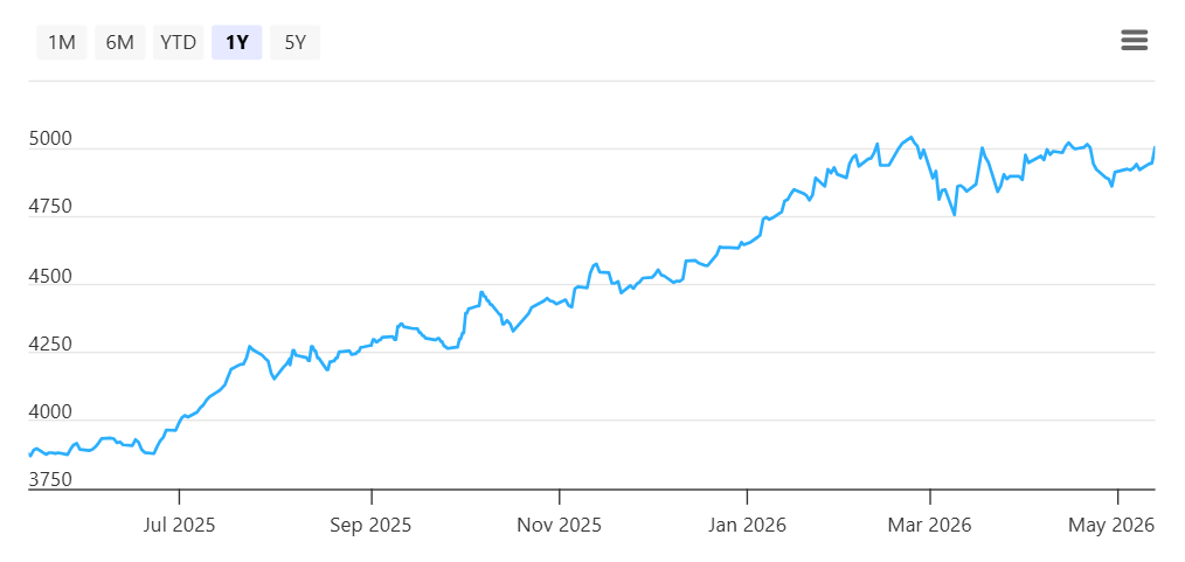
The Straits Times Index (STI) delivered a 5.6% total return in the first quarter of 2026, supported by both price gains and dividends.
At the same time, the Singapore dollar has also remained resilient.
We have previously looked at SGX ETFs that offer exposure to Asia ex-China, China A-shares, and Asia growth opportunities.
Investing overseas can help with diversification, but it may also expose us to foreign currency movements and global market risks.
For investors who earn, save and spend mainly in Singapore dollars, these 5 SGX-listed ETFs may offer a simple way to build a simple Singapore dollar portfolio that's diversified across asset classes.
Why Singapore stocks, short-duration bonds and gold may be worth considering in an ETF portfolio
Overseas markets can offer broader opportunities, but they also come with currency movements and global market risks.
That is why it may still make sense to keep part of the portfolio closer to home, especially for investors who earn, save and spend mainly in Singapore dollars.
The key is not to choose Singapore over global markets, but to understand how Singapore stocks, short-duration bonds and gold can complement the rest of the portfolio.
#1 - Singapore stocks for growth and dividends, supported by policy and macro tailwinds
Singapore blue chip stocks have drawn renewed interest in 2026, helped by the STI’s recent performance and continued dividend appeal.
Beyond market performance, there are also several reasons why the local market may still have support.
The MAS Equity Market Development Programme and MAS-SGX Value Unlock Programme could help improve liquidity, investor engagement and capital allocation among Singapore-listed companies.
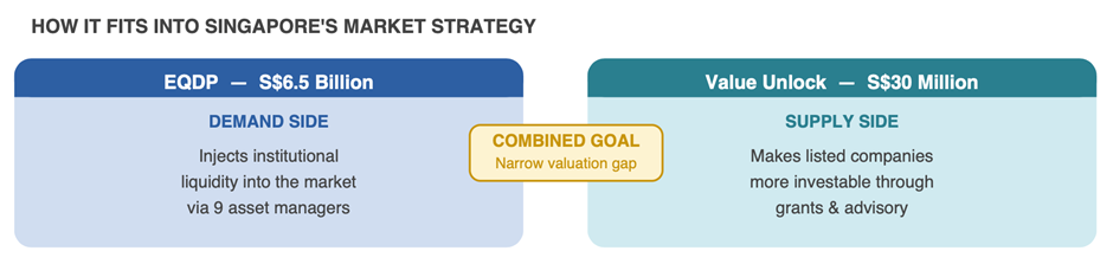
Singapore’s role as a stable financial hub may also continue to attract capital amid geopolitical uncertainty, while the resilient Singapore dollar can help reduce the impact of sharp currency swings for local investors.
At the same time, structural themes such as AI and data centres, energy security, and government infrastructure spending may support parts of the Singapore market, including banks, REITs, utilities, construction and logistics.
Singapore stocks may not offer the same growth profile as US technology stocks, but they can still provide exposure to familiar companies, dividends and Singapore’s long-term economic development.
#2 - Short-duration bonds for income and stability
Bonds can play a different role from equities.
Instead of seeking high growth, they are often used to provide income and reduce overall portfolio volatility.
Short-duration bonds may be especially relevant when the interest rate outlook remains uncertain.
When rates rose sharply in 2022, short-duration SGD bonds fell about half as much as longer SGS and recovered faster. Short-duration cushions the bumps when the rate path is uncertain.
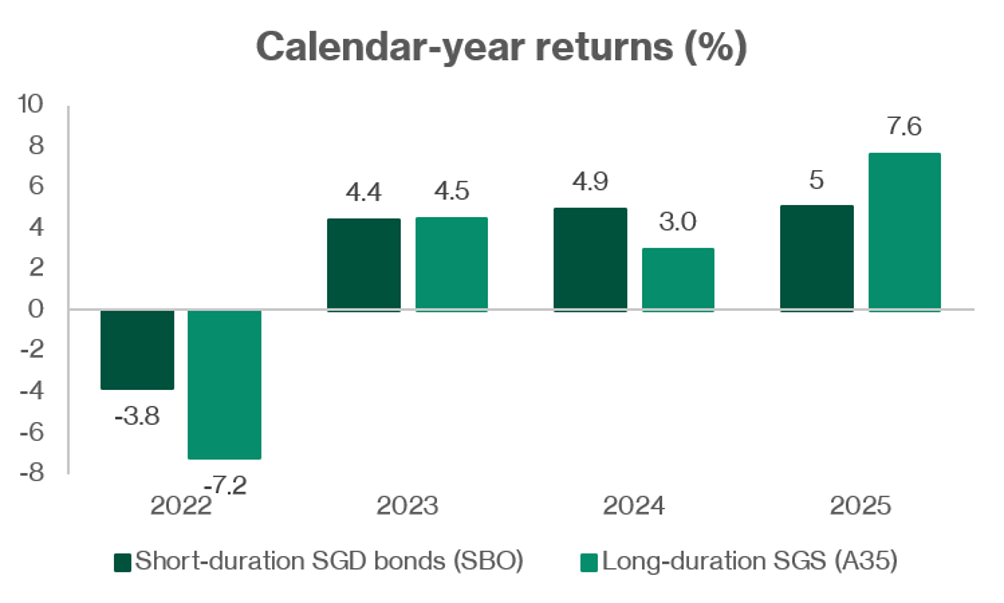
Sources: Lion Global Investors, Endowus, Yahoo Finance.
Because they have shorter maturities, they are generally less sensitive to changes in interest rates compared to longer-duration bonds.
This does not remove interest rate or credit risk, but it can make short-duration bond exposure a useful stabiliser in a portfolio.
For investors who earn and spend mainly in Singapore dollars, bond exposure through an SGD class may also help reduce currency mismatch.
However, investors should still check the underlying holdings to understand whether the bonds are Singapore or international securities.
#3 - Gold for diversification
Gold plays a different role from both stocks and bonds.
It does not generate dividends or interest, but it has often been viewed as a diversifier during periods of market volatility, inflation concerns or geopolitical uncertainty.
This can make gold useful for investors who want an asset that may behave differently from equities and bonds.
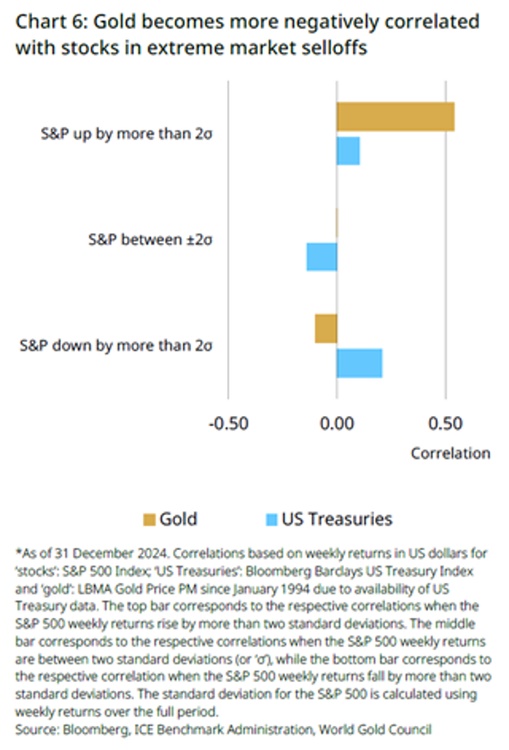
How Gold has Performed Relative to Other Asset Classes over the Years
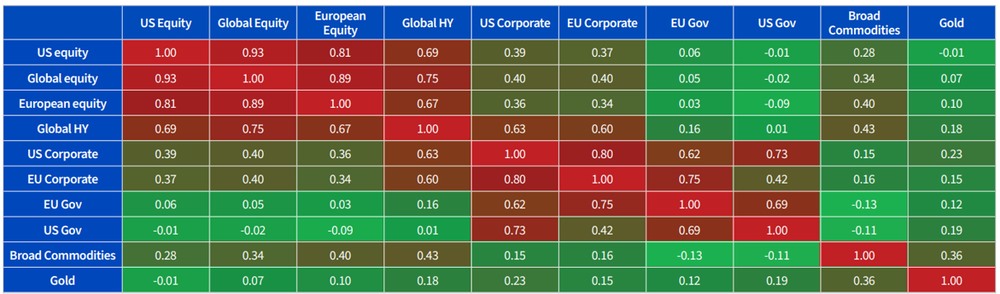
That said, gold should not be seen as a replacement for income-generating assets.
Its returns depend mainly on movements in the gold price, which can be volatile over shorter periods.
5 SGX ETFs to invest in Singapore stocks, short-duration bonds and gold
#1 - Amova Singapore STI ETF (SGX: G3B/GAB)
The Amova Singapore STI ETF offers exposure to Singapore blue-chip stocks through the Straits Times Index.
The STI represents the top 30 companies listed on the SGX by market capitalisation, and is widely followed as a benchmark for the Singapore stock market.
This means investors can gain broad exposure to Singapore banks, REITs, telcos and other large listed companies through one ETF, instead of picking individual stocks.
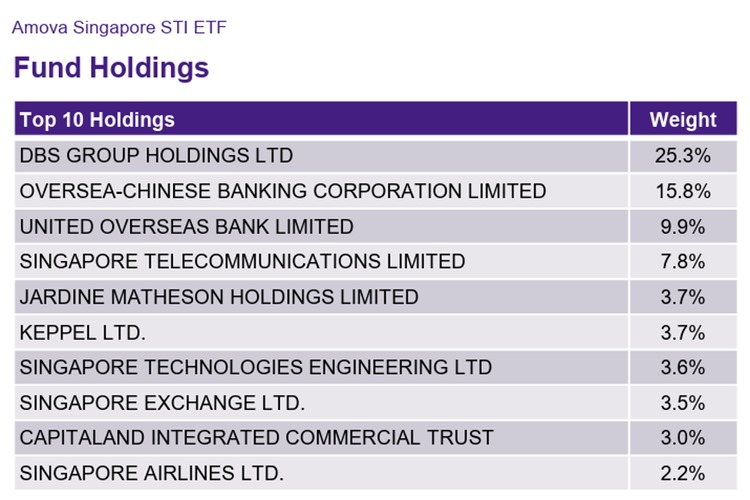
The Amova Singapore STI ETF had a fund size of about S$1.35 billion as of 30 March 2026. With a total expense ratio is 0.24% p.a..
The Amova Singapore STI ETF may be useful for investors who want broad Singapore equity exposure and dividend income potential, with G3B making semi-annual cash distributions at the manager’s discretion.
For investors who prefer distributions to be reinvested, Amova also offers an SGD accumulation class under the ticker GAB.
#2 - SPDR STI ETF (SGX: ES3)
The SPDR STI ETF also tracks the Straits Times Index, giving investors exposure to the top 30 eligible companies listed on SGX.
This means it gives investors exposure to broadly the same Singapore stock market benchmark as the Amova Singapore STI ETF.
The ETF was listed on SGX in April 2002, making it one of the more established Singapore equity ETFs with a fund size of S$2.9 billion as of 30 March 2026.
Its expense ratio is slightly higher at 0.28% p.a.

Since both G3B and ES3 track the same index, the choice between them may come down to factors such as expense ratio, fund size (AUM), trading liquidity, bid-ask spread and distribution history.
Unlike the Amova Singapore STI ETF, which has an SGD accumulation class under the ticker GAB, the SPDR STI ETF only has the distributing class listed on SGX under ES3. The ETF makes semi-annual distributions at the manager’s discretion.
For long-term investors who simply want broad exposure to Singapore blue chips, both ETFs can serve a similar role.
Read here to see how to choose between the SPDR STI ETF and Amova AM STI ETF.
#3 - Lion-OCBC Securities Singapore Low Carbon ETF (SGX: ESG/ESU)
The Lion-OCBC Securities Singapore Low Carbon ETF provides exposure to Singapore stocks, but with a sustainability tilt.
Instead of tracking the STI, the ETF aims to replicate the iEdge-OCBC Singapore Low Carbon Select 40 Capped Index.
This index tracks 40 companies domiciled or incorporated in Singapore, with a focus on reducing carbon intensity and excluding companies involved in fossil fuels.
This may appeal to investors who want Singapore equity exposure but prefer a portfolio with a low-carbon approach.
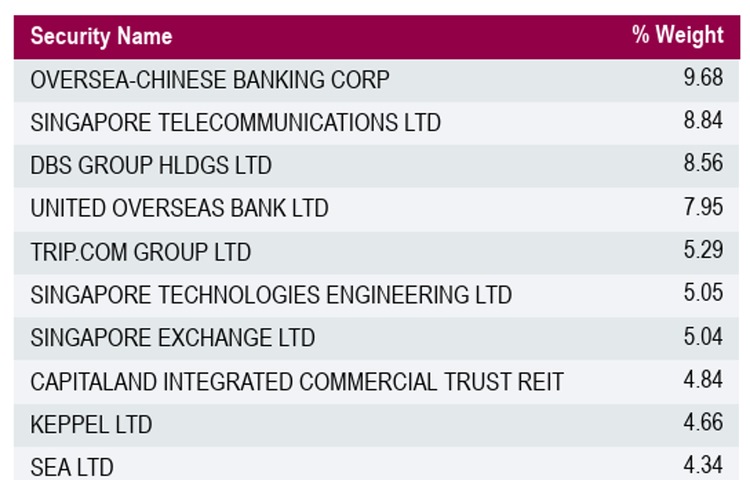
Its expense ratio is at 0.45% p.a., and the SGD class has semi-annual distributions at the fund manager’s discretion.
However, investors should note that this is not the same as buying the STI.
The sector and stock exposures may differ, so returns may also differ from a broad Singapore market ETF.
Learn more about the Lion-OCBC Securities Singapore Low Carbon ETF here.
#4 - LionGlobal Short Duration Bond Fund Active ETF SGD Class (Dist) (SGX: SBO/SBV)
The LionGlobal Short Duration Bond Fund Active ETF SGD Class provides exposure to short-duration bonds.
This can help investors add a more defensive component to the portfolio, especially if they do not want to rely only on equities.
Unlike index-tracking bond ETFs, this is an actively managed bond ETF. The ETF focuses on short-duration bonds, which may reduce sensitivity to interest rate movements compared to longer-duration bond funds.
It also provides exposure to Singapore and global bonds, with an active strategy aimed at generating total return from capital growth and income.
Based on SGX ETF Market Highlights 1Q2026, the ETF had a yield-to-maturity of 3.37%, higher than selected SGD fixed income instruments shown in SGX’s comparison. However, this is not guaranteed and should not be viewed as the same as distribution yield or actual return.
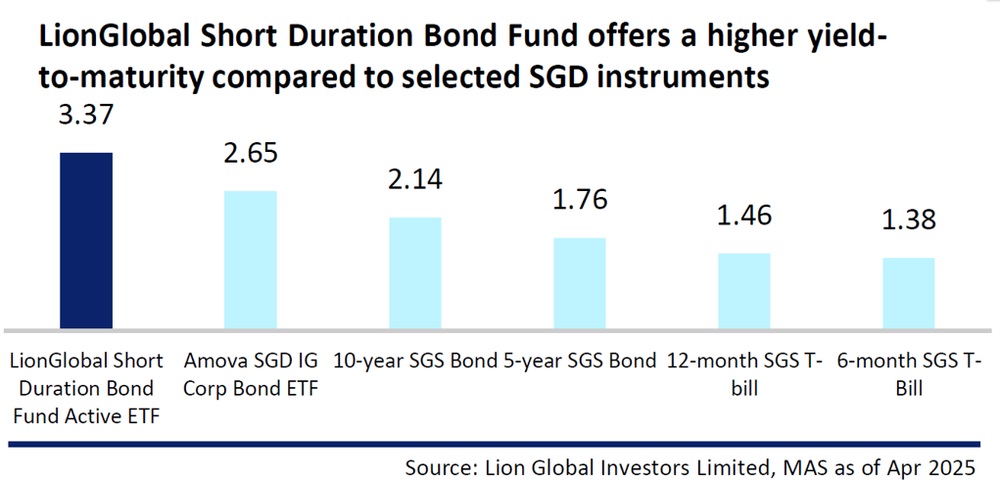
The management fee is currently 0.25% p.a. The ETF intends to distribute quarterly, though distributions are not guaranteed and may fluctuate.
This can make them useful for investors who want bond exposure but are concerned about volatility from changes in interest rates.
For Singapore investors, this ETF may be useful as part of the income or stability portion of the portfolio.
Learn more on how to earn a regular income with the LionGlobal Short Duration Bond Fund here.
#5 - LionGlobal Singapore Physical Gold ETF (SGX: GLS/GLU)
The LionGlobal Singapore Physical Gold ETF provides exposure to physical gold through an SGX-listed ETF.
This ETF is backed by investment-grade physical gold bars, with the allocated gold vaulted in Singapore and insured while in custody and transit.
It was recently listed on SGX on 26 March 2026. The ETF’s SGD counter trades under the ticker GLS, while its USD counter trades under GLU.
The LionGlobal Singapore Physical Gold ETF tracks the LBMA Gold Price AM and has a management fee of 0.39% p.a.
However, investors should note that the fund’s base currency is USD, even though the ETF can be traded in SGD.
This means the SGD counter may make buying and selling more convenient, but it does not remove all currency considerations.
How do these 5 SGX ETFs compare?
Here is a summary of the 5 SGX ETFs, based on their exposure, role in a portfolio, distribution frequency and fees.
| ETF | Main exposure | Role in portfolio | Distribution | Fee / expense ratio |
| Amova Singapore STI ETF (G3B) | Singapore blue-chip stocks via STI | Broad Singapore equity exposure | Semi-annual | 0.24% p.a. TER |
| SPDR STI ETF (ES3) | Singapore blue-chip stocks via STI | Broad Singapore equity exposure | Semi-annual | 0.28% p.a. TER |
| Lion-OCBC Securities Singapore Low Carbon ETF (ESG/ESU) | Singapore low-carbon equities | Singapore equity exposure with sustainability tilt | Semi-annual | 0.45% p.a. TER |
| LionGlobal Short Duration Bond Fund Active ETF SGD Class (SBO/SBV) | Short-duration bonds | Income and stability | Intended quarterly distribution | 0.25% p.a. management fee |
| LionGlobal Singapore Physical Gold ETF (GLS/GLU) | Physical gold | Diversification | n/a | 0.39% p.a. management fee |
| Source: SGX ETF Market Highlights Q1 2026, respective fund factsheets and fund manager websites. Figures are based on the latest available factsheets and product pages as at May 2026. | ||||
What to consider when building a Singapore-dollar portfolio with these 5 SGX ETFs
While these 5 SGX ETFs can be useful building blocks, they should not be viewed as a complete portfolio on their own.
The two STI ETFs, Amova Singapore STI ETF (SGX: G3B) and SPDR STI ETF (SGX: ES3), both track the Straits Times Index, so their underlying exposure is likely to be similar and concentrated in sectors such as banks, real estate and telecommunications.
The Lion-OCBC Securities Singapore Low Carbon ETF (SGX: ESG) offers investors exposure to Singapore companies with a sustainability tilt and overseas listings, including Sea Ltd. and Grab Holdings.
Investors should also note that Singapore-dollar exposure does not remove currency risk completely. Some Singapore-listed companies earn revenue overseas, while gold is globally priced even if the LionGlobal Singapore Physical Gold ETF (SGX: GLS) trades on SGX in Singapore dollars.
For the LionGlobal Short Duration Bond Fund Active ETF (SGX: SBO), returns may still be affected by interest rate movements, credit risk and the quality of the underlying bonds.
What would Beansprout do?
We continue to see Singapore stocks as a core part of a globally diversified portfolio.
Apart from being defensive, the market also offers dividend income, relatively resilient companies, and exposure to long-term growth areas such as data centres, infrastructure and wealth management.
For investors who earn, save and spend mainly in Singapore dollars, I would still keep part of my portfolio anchored in Singapore-dollar investments.
If I wanted broad Singapore blue chip stock exposure, I would compare the Amova Singapore STI ETF (SGX: G3B) and SPDR STI ETF (SGX: ES3), rather than assume I need to own both.
If I wanted a sustainability tilt, the Lion-OCBC Securities Singapore Low Carbon ETF (SGX: ESG) could offer a different way to gain exposure to Singapore-listed companies.
To balance the equity exposure, the LionGlobal Short Duration Bond Fund Active ETF (SGX: SBO) may help add income and stability, although I would note that it provides short-duration bond exposure rather than pure SGD bond exposure.
For diversification, the LionGlobal Singapore Physical Gold ETF (SGX: GLS) could also play a small role, especially during periods of market uncertainty, though gold does not generate dividends or interest.
Overall, I would use these 5 SGX ETFs selectively as building blocks for a simple Singapore-dollar portfolio, while still maintaining exposure to global markets for broader diversification.
Which SGX ETF are you most interested in? Share with us in the comments below or in our Telegram group!
You can find out more about these and other SGX-listed ETFs on the SGX ETF screener page. If you are considering where to buy them, you may also want to check out our review of the best stock trading platforms in Singapore and the latest broker promotions below.
Are there any ongoing broker promotions when I invest in SGX ETFs?
Several brokers and platforms offer promotions to incentivize ETF investments:
| Broker | Promotion Description |
| iFast FSMOne |
|
| Phillip Securities |
|
| *Terms and conditions of participating brokers apply. Please refer to their website for more details. | |
Enjoyed this insight? Follow Beansprout on Telegram, Youtube, Facebook and Instagram, and add Beansprout as your preferred source on Google so you never miss an update.
Disclaimer
This advertisement has not been reviewed by the Monetary Authority of Singapore.
Any information provided in this article is meant purely for informational and investor education purposes and should not be relied upon as financial or investment advice, or advice on corporate finance.
This article is not and does not constitute or form part of any offer, recommendation, invitation or solicitation to purchase any financial product or subscribe or enter any transaction. This article also does not take into account your personal circumstances, e.g. investment objectives, financial situation or particular needs and shall not constitute financial advice. You should consult your own independent financial, accounting, tax, legal or other competent professional advisors.
The information provided in this article are on an “as is” and “as available” basis without warranty of any kind, whether express or implied. Beansprout does not recommend any particular course of action in relation to any investment product or class of investment products. No information is presented with the intention to induce any person to buy, sell, or hold a particular investment product or class of investment products.
Read also
Gain financial insights in minutes
Subscribe to our free weekly newsletter for more insights to grow your wealth
Most Popular

Comments
0 comments